Tag Archives: Fortune-telling

Three Enemies of Good Divination (and One Ally)

Remember those listicles that were much in demand about ten years ago, before people grew tired of the rage-bait? Yea, they still do them, but they have somewhat fallen out of favor, especially since they are so basic even AI can do them better than the poorly paid saps who wrote them back then. Anyway, here’s a short one, hopefully more interesting than the average listicle, on what generally hinders good divination, plus a bonus entry for what helps.

Mechanic Behavior

Divination eschews mechanic repetition. Asking the same question one or two times is fine because there is still enough emotion behind it to put the system into motion. In fact, it is fine to ask the same question many times as long as the querent is truly invested in it, but the more the querent asks the same question with the same emotional drive as the first time, the more you know the querent is cuckoo and is best avoided. In general, it is best to wait a little between divinations.

This point is one that skeptics seem unable to wrap their heads around, because it seems to run against the principle that experiments can be repeated ad libitum, but it is really quite simple: divination is not an experiment, and the more you mechanically ask the same question, the more the real question changes to whatever it was at the beginning to “does divination really work?” and this question cannot be answered by divination itself.

All in all, a balanced relationship to divination as a means of intelligence gathering, together with the understanding that we are attempting something more exceptional than cleaning the cat’s litterbox, is in order.

Shallow Understanding of the System You Work With

If you asked your doctor how he knows his diagnosis is right and he told you it was just his intuition, you’d feel justified in seeking a second opinion. Yet among ‘spiritual seekers’ anything that reeks of effort and study is frowned upon and people go to extraordinary lengths in order to avoid the simple fact that both knowledge and experience are needed to perform satisfactorily in any sector of life. So they come up with anything from intuitive advice (which essentially means “don’t ask me how I know”) to the great angel HRU to fairies to ‘kickass schools of non-duality.’

The reality is that divination is a method for the acquisition of knowledge. If we don’t make the effort of studying the method we don’t get much knowledge. I believe the current distrust of study comes in part from the distrust of intellectual knowledge (see the bonus entry in this list) and in part from the fact that many people who become interested in divination do it to create a little bubble of mystery and mysticism away from the golden cage that is modernity.

Either way, it is a misguided attitude. Divination requires study. Lots of it. In fact, the study will never end. The good news is that we can start practicing much sooner. As for intuition, it does have a place in divination, and I’ll talk about it in the future, but unbridled intuition is just a badly behaved kid.

Bias and Preconceptions

I’ve already talked at length about this, and I will probably still talk about it in the future. It bears repeating: the more we think we know, the less we’re open to discovery.

Aside from ideological forms of bias, which are always bad regardless of the ideology, there are also other forms. One of the most deadly forms of bias is, for instance, the belief that the querent knows what they are talking about. A querent doesn’t need to be malicious in order to confuse us: they can just be confused themselves, or they can have built a whole scenario inside their heads before sitting in front of us.

On the other hand, talking over our querent and treating them like a special needs child won’t do either. There needs to be a balance between our ability to see the truth of the matter in a dispassionate way (thanks to the divination system we are employing) and open-heartedness toward the querent. As a matter of fact, an open heart can go a long way.

Querents can also be biased against us, but we can do nothing about it. People sometimes ask me what happens when someone asks false questions maliciously. What happens is that if I’m lucky, I’ll understand it from the cards, while if I’m not lucky I’ll make a fool of myself. Either way, the person won’t change their mind about divination or about me, so why bother getting worked up about it? Stuff happens.

Your Brain, Your Best Friend

Ever since Madame Blavatsky disgracefully started peddling poorly understood principles of oriental philosophy, the Western esoteric world has become convinced that the “mind is the enemy”. People generally think so (isn’t it ironic? The mind thinking that the mind is the enemy) because they are incapable of using it but want to sound deep in their incompetence.

In reality, if there is such a thing as overthinking, there is also such a thing as underthinking. The idea that everything must come immediately and instinctively to us in a space of pure knowing and that everything resembling logic is the work of the devil is patently wrong.

Aside from the fact that this is philosophically delusional, most people who think only the mind lies never stop to consider how many times their instincts or their heart actually let them down on a day-to-day basis. The reality is that our mind, our body and our heart are ways for us to acquaint ourselves with the world, and all three can lead us astray depending on the context, just as much as they can guide us to profound insight.

Therefore, if it is not correct to let the other two dry up, it is also not correct to become mindless pseudomystics, sacrificing our understanding on the altar of an ill-digested and rather offensive orientalism (“Counterfeit Asian philosophy 101 says the mind is poo poo, therefore it’s true. See how smart I am? I misquote exotic people!”)

The funny thing is that most Eastern forms of divination are not at all intuitive, and in fact verge on the overly technical (see Da Liu Ren, Qi Men Dun Jia, Wen Wang Gua, Vedic Astrology, Purple Emperor Astrology, etc.) They are also incredibly accurate exactly because of how majestically brainy they are, though they may not have the glamour of the latest useless set of empowering witchy cards. Traditional Western divination systems, of course, can be just as accurate, but people usually have the expectation that they need to unplug their brains on the way in. Let’s not do this. Our mind can sometimes lead us astray. It can also help a great deal.

MQS
Tarot Encyclopedia – The Page of Cups

The Page of Cups in the Builders of the Adytum (BOTA) tarot deck

Paul Foster Case (and Ann Davies)

In divination this Key suggests the warmth, radiance and the generous productivity of summer. Thus the Page of Cups indicates a radiant, generous, youthful personality of either sex. The time period is from the first decanate of Cancer, June 21, through the last decanate of Virgo, September 22 – the entire summer season.
Well Dignified: the character is sweet, poetical, gentle and kind; fond of home and all that it stands for; imaginative, dreamy, yet with a good deal of latent courage; friendly to the Querent and will further Querent’s hopes and wishes.
lll Dignified: may still show or profess friendship, or even wish to be of help, but the character is unstable, too indolent to be of real service and probably prone to promise far more than he can perform.
(From the Oracle of Tarot course)

A. E. Waite

A fair, pleasing, somewhat effeminate page, of studious and intent aspect, contemplates a fish rising from a cup to look at him. It is the pictures of the mind taking form. Divinatory Meanings: Fair young man, one impelled to render service and with whom the Querent will be connected; a studious youth; news, message; application, reflection, meditation; also these things directed to business. Reversed: Taste, inclination, attachment, seduction, deception, artifice.
(From The Pictorial Key to the Tarot)

Aleister Crowley

The Princess of Cups represents the earthy part of Water; in particular, the faculty of crystallization. She represents the power of Water to give substance to idea, to support life, and to form the basis of chemical combination. She is represented as a dancing figure, robed in a flowing garment on whose edges crystals are seen to form.

For her crest she wears a swan with open wings. The symbolism of this swan reminds one of the swan in oriental philosophy which is the word AUM or AUMGN, which is the symbol of the entire process of creation. [See, for a full analysis and explanation of this Word, Magick, pp. 45.]

She bears a covered cup from which issues a tortoise. This is again the tortoise which in Hindu philosophy supports the elephant on whose back is the Universe. She is dancing upon a foaming sea in which disports himself a dolphin, the royal fish, which symbolizes the power of Creation.

The character of the Princess is infinitely gracious. All sweetness, all voluptuousness, gentleness, kindness and tenderness are in her character. She lives in the world of Romance, in the perpetual dream of rapture. On a superficial examination she might be thought selfish and indolent, but this is a quite false impression; silently and effortlessly she goes about her work.

In the Yi King, the earthy part of Water is represented by the 41st Hexagram, Sun. This means diminution, the dissolution of all solidity. People described by this card are very dependent on others, but at the same time helpful to them. Rarely, at the best, are they of individual importance. As helpmeets, they are unsurpassed.
(From the Book of Thoth)

A cutesy AI generated illustration for the Page of Cups

Golden Dawn’s Book T

A BEAUTIFUL Amazon-like figure, softer in nature than the Princess of Wands. Her attire is similar. She stands on a sea with foaming spray. Away to her right a Dolphin. She wears as a crest a swan with opening wings. She bears in one hand a lotus, and in the other an open cup from which a turtle issues. Her mantle is lined with swans-down, and is of thin floating material.
Sweetness, poetry, gentleness and kindness. Imaginative, dreamy, at times indolent, yet courageous if roused.
When ill dignified she is selfish and luxurious.
She rules a quadrant of the heavens around Kether.
Earth of Water

Etteilla

Blond boy
Upright. This card, as far as the medicine of the spirit is concerned, means, in its natural position: Blond Boy, Scholar. – Study, Application, Work, Reflection, Observation, Consideration, Meditation, Contemplation, Occupation. – Craft, Profession, Employment.
Reversed. Tendency, Inclination, Inclination, Attraction, Taste, Sympathy, Passion, Affection, Attachment, Friendship. – Heart, Want, Desire, Attraction, Promise, Seduction, Invitation, Attraction. – Flattery, Moine, Ruffianry, Flattery, Praise, Praise. – In decline, threatening ruin, tending to the end.

MQS

When Will the Horror End? (Horary Astrology Reading)

I occasionally help my husband when he needs to work from home and I’m free. Yesterday was one such occasion. He’s a stenographer and was sent several audio bits from a famous company so that he would make a protocol out of them. I don’t think I need to stress how tedious this is. I do it mostly to improve my German, aside from being helpful to my husband. At around 18:04, he was told that the meeting was running late and that there was the possibility of us receiving audios well into the night. Horrified, I asked “when will it be over?”

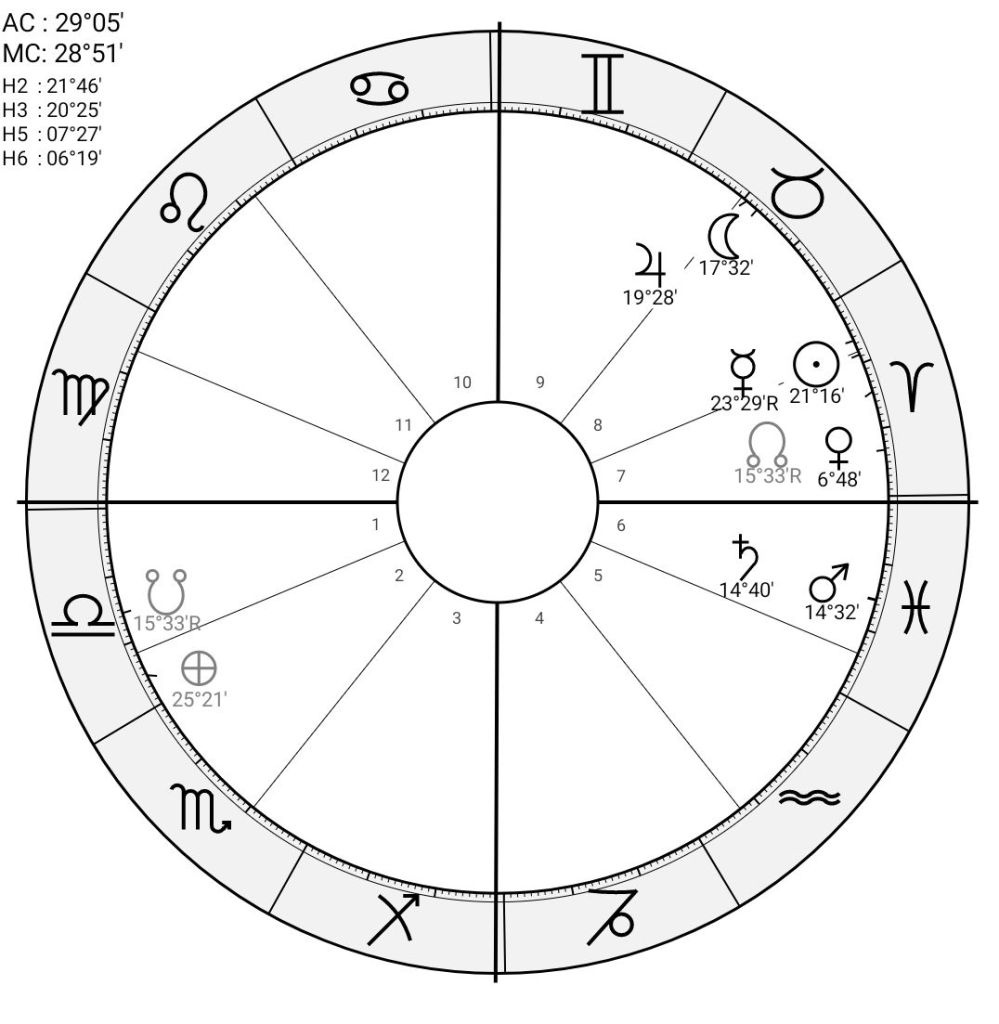
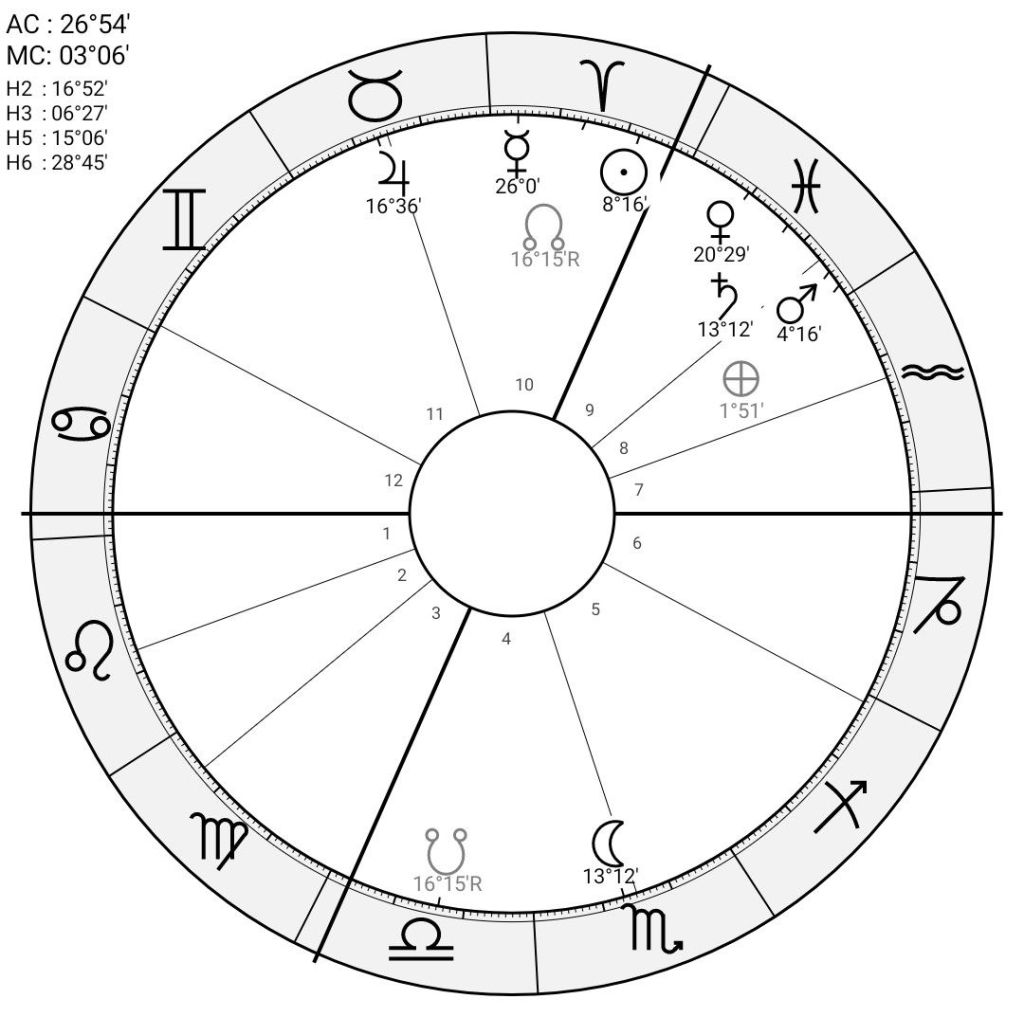
The Heavens answered with this chart.

When will it be over?

I am represented by Mercury, Lord of the Ascendant. Mercury is retrograde, stuck in the evil Eight House of “fear and anguish of Minde”, as William Lilly wrote, and speeding into Combustion of the Sun. In a word, my poor Mercury is a mess. At this point I am unsure if only I am signified by Mercury and my husband by Jupiter, Lord of the Seventh House, or if we are both signified by Mercury. The fact that a Bi-Corporeal sign is rising (Virgo) seems to indicate we are both Mercury. Our stress is well captured by Mercury’s affliction.

However, one thing that gives me hope is the VERY late ascendant (29.05 Virgo), which seems to indicate it won’t take that much. Let’s look at the Moon. She is in her exaltation in Taurus, separating from a sextile of the two Malefics and about to bump into Jupiter, the Great Benefic. Help may be at hand! Initially, as I said, I half-thought that Jupiter was my husband. However, reflecting on my question “when will it end?” I realized that Jupiter rules the Fourth House, which can indicate the end of the matter. In this case, it is quite appropriate that the end of the matter be signified by a benefic.

If that’s the case, then the Moon approaching Conjunction with Jupiter must indicate that things are about to end. When though? The Moon perfects the aspect in around two degrees, so we are left with “two somethings”, i.e., two seconds, two minutes, two hours (days wasn’t an option). The Moon is in a fixed sign, but also very quick in motion and strongly dignified, so my sense was that it would be over in less than two hours. Looking at the ascendant, which had less than one degree of Virgo left on it, I had the feeling that it could possibly be around an hour.

The question was asked at around 18:04, and at 19:02 we were told it was over.

MQS

Love Fool (Horary Astrology and Playing Cards Reading)

This is the first time I use my new interest, Horary Astrology, in conjunction with playing cards. Let’s see what they have to say. The question was asked by a friend of mine who just broke up with her girlfriend. He wants to know if there is a future. This reading was made a couple of days ago.

Relationship reading, is there a future?
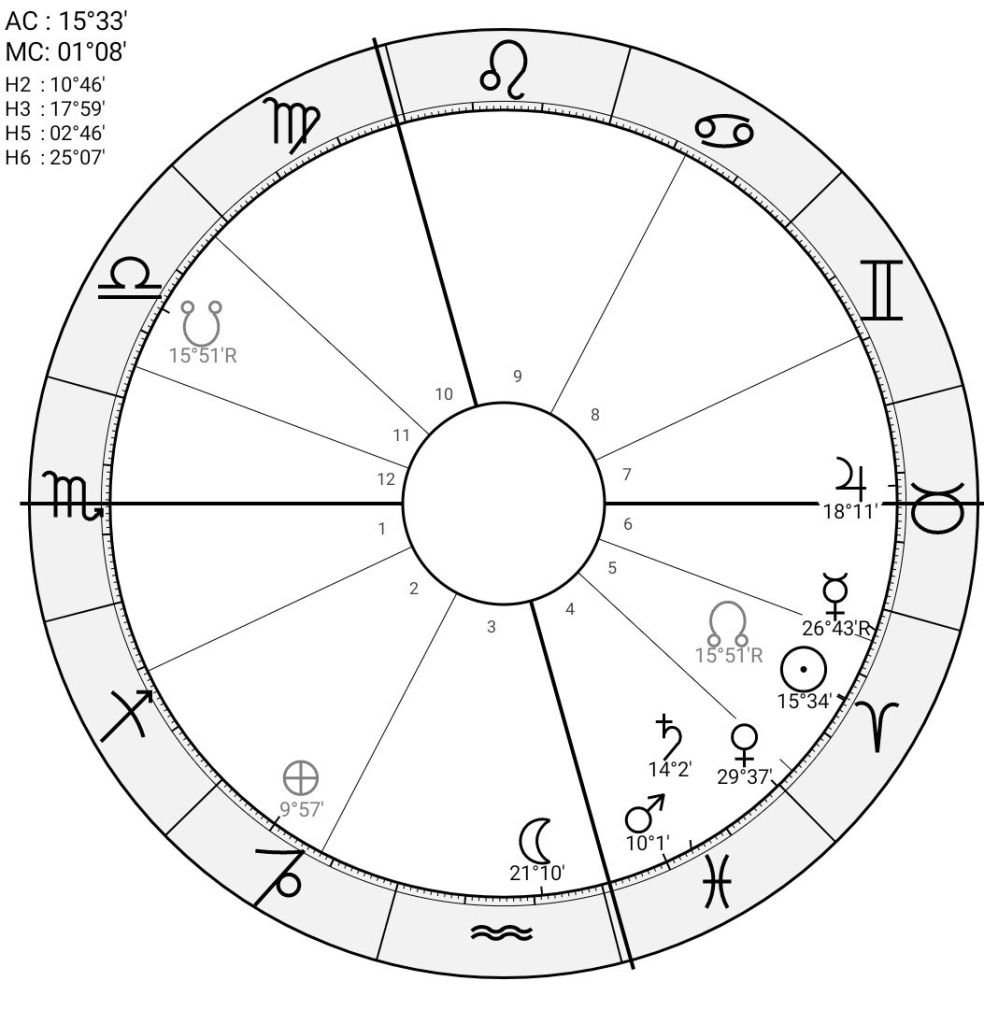
Answered with horary astrology

The querent is Mars, lord of the Ascendant, while the quesited, i.e., the girlfriend, is Venus lord of the Seventh. The Moon indicates the flow of the action.

In a night chart, Mars is dignified by triplicity in Pisces, and is angular, while Venus is exalted, also in Pisces, and also angular. The first thing that strikes me is that Venus is moving away from Mars. Furthermore, the Moon is separating from a difficult square with Jupiter in the Seventh. I asked my friend if he had broken up with her or she had broken up with him, since from the chart it seems it was her initiative. He didn’t like to admit it, but said she had left him.

Note that Mars is in triplicity, so a decent Mars, but also conjunct Saturn. Saturn is peregrine. Also note that Venus, the girlfriend, is exalted, and exaltation is sometimes an indication of haughtiness. Clearly she thought she could do better than Saturn-like Mars as she moved away from him. My friend then told me she told him she didn’t like the fact she is to attached to her.

Well, CAN she do better? Venus is about to change sign, from Pisces to Aries, whereupon she will not only lose all her dignity, but she will also enter her detriment. Let us look at the Moon now. The Moon separates from the square with Jupiter and moves toward a sextile with Mercury Retrograde. Sextiles are positive aspects. If we put together the indications, we have: 1) Venus moving away but regretting her decision 2) A future positive contact 3) the contact is about things that go back (retrograde)

This seemed to me a sign of reconciliation. Just to be on the safe side, I had the querent pull three cards from the playing card deck. These were:

5♠ – Q♣ – 3♥

The cards are quite clear. The Five of Spades is a card of imprisonment, but it also indicates regret (which is what you are supposed to feel in prison). Then we have her significator, followed by the Three of Hearts. I would have preferred to see a Six of Hearts to show reconciliation, but the Three of Hearts will do. In this case, the added shade of meaning seems to be that the cards don’t even consider the breakup effective, because the Three of Hearts show things that flow positively without interruption.

I will update this post when I know the outcome.

MQS

Playing Card Multiples

I believe that in the development of divination techniques, the creation of meanings for multiples of cards of the same number must have probably come pretty early. When I was taught to read playing cards, the person who gave me the meanings passed also the signification of card multiples to me, with the caveat that she’d never found them to be very reliable, contrary to the rest of the method. I must confess that I almost never use them, except when the meaning can be derived from the meanings of the cards, which is why I never talked about them before. However, since someone asked me, I’ll retrieved them from my notes so that you can experiment with them.

Note that it does not matter which cards we are talking about as long as they have the appropriate number of pips. However, the presence of Spades in the combination is supposed to worsen the meaning, especially if the Spade card comes last.

Aces
2 = Surprise
3 = Positive Chance
4 = when together, death or great danger, when apart, glory or success

Twos
2 = Exchange
3 = Agreement
4 = Slowness, Boredom

Threes
2 = Tricks
3 = Increase or Progress
4 = Quick Communications

Fours
2 = Worry, Insomnia
3 = Situations speeding up, Unblocking
4 = Travel

Fives
2 = Small losses, Small torments
3 = Resolution
4 = Law

Sixes
2 = Nervousness
3 = Anger
4 = Violence

Sevens
2 = Development
3 = Sickness
4 = Dissatisfaction

Eights
2 = New acquaintances or learning something new
3 = Wedding bells
4 = Infamy

Nines
2 = Help from friends
3 = Triumph
4 = Glory

Tens
2 = Change of place
3 = Change of life
4 = Birth or rebirth

Jacks
2 = Fighting
3 = Litigation
4 = Danger

Queens
2 = Talks
3 = Gossip
4 = Slander

Kings
2 = Help
3 = Commerce
4 = Great Honor

MQS

Is She Alright? Horary Astrology Reading

Horary astrology is a centuries old form of divination. The word ‘horary’ means ‘of the hour’, because unlike natal astrology, which predicts from someone’s natal chart, Horary looks at a chart for the time and place a meaningful question is asked.

The fascinating thing about Horary is the way it works: it doesn’t require you to shuffle a deck or cast dice. There’s nothing for you to manipulate. Once someone asks a (relatively) serious question to someone else who can cast a chart, the answer is there. In a way, it presupposes a view of the universe as an unraveling system of self-answering questions or self-solving problems.

As I strive to create a coherent philosophy of divination, Horary is definitely one of my most important sources of inspiration. I will probably start offering cheap email horary readings in the near future in exchange for feedback, in order to gain experience. In the meantime, here’s an example from yesterday.

Is she alright? Horary question answered with the App Aquarius2Go

Background: A woman my husband is involved with for some projects had disappeared for a couple weeks after the death of her father. She didn’t answer any message my husband or the other people involved sent her, so naturally they were all worried that she might have fallen into depression and done something silly. So the question he asked me, knowing I’ve started dabbling in Horary, was “Is she alright?”

My husband is signified by the Moon, lady of the Ascendant. The woman is not really his friend (Eleventh house) but rather his colleague, so she is signified by the Seventh house and its ruler, Saturn. This is appropriate, as Saturn rules solitude.

Since the question is about this person’s wellbeing, we are looking at potential afflictions that Saturn may be suffering from. It’s peregrine, that is, it is in no dignity. Peregrination is a minor affliction. It also describes her very well: “peregrine” means “wanderer”, and she has disappeared. Saturn is also in a cadent house, the ninth, which however is not especially malefic. On the other hand, Saturn is Sextiled by Jupiter. This is a positive aspect, and Jupiter is a protective planet. My idea was that she wasn’t especially fine, but she wasn’t in any great danger either.

My husband (and probably the other people involved) is the Moon. The Moon is in her fall and inside the Via Combusta, i.e., the stretch of Zodiac that goes from 15 Libra to 15 Scorpio, which is bad for the Moon, as it is said to indicate turmoil. This is a good description of their apprehension. Mercury is slow in motion and squaring the Ascendant: communication is a problem.

The Moon is in exact Trine (to the minute) with Saturn. Trines are aspects of amity, so obviously they want to know that Saturn (aka the woman) is fine, and are worried (Fall, Via Combusta) about her.

Since Saturn doesn’t seem to be in any grave peril, it stands to reason that the woman will be back in contact (we would need strong testimonies to show the contrary). The fact that the Trine aspect is exact doesn’t allow us to say whether it is still applying or separating, but considering all the chart, it seems to be an indication that she will soon resurface. This is also shown by the fact that the Moon is near the end of the Via Combusta, so I judged that she would write my husband soon. Another possible indication is that the First House Cusp is nearing the end of Cancer, so the situation is in its late phase and is about to change. But I’m on the fence about this testimony.

Result: yesterday (day of the question) after weeks of not hearing from her, my husband got a message from her three or four hours after this chart was cast. The woman was of course not in top shape, but she was relatively fine.

MQS

Exploring Curses with Playing Cards

Most systems of divination can also be used to explore esoteric topics. For instance, I have answered the question “have I been hexed?” way more than I would like. The answer is no 95% of the times. Only two times in my life have I sent someone straight to see a priest because something supernatural was objectively at play. Most of the times, people use dark magic as a scapegoat to rationalize natural periods of bad luck.

Of the the two times I did detect a curse I can only find records of one (my notes tend to be rather messy). The girl in question asked me if she’d received the evil eye (malocchio). This was the spread:

10♠ – 5♠ – 5♥ – J♠ – Q♠

I added two cards to the queen, and I got the Q♦ and the 2♥. The reading is quite obvious: a woman cursed her (the Queen of Spades with the Jack) on behalf of a relative (the Queen of Diamonds and Two of Hearts) though probably not a blood relative. The Ten and Five of Spades, when read together with the other spades, indicate the use of negative occult powers, probably at night.

The Five of Hearts in the center of the spread probably showed the sector of the querent’s life that was impacted by the curse: the ‘abundance’ sector. The young woman had lost a ton of weight in a short timeframe, she looked wasted, had started losing her hair and her beauty, had started developing money problems (in that she couldn’t retain any money she made). Her significator is absent, meaning she was completely passive to the hex.

It seems her mother-in-law had gone to see a country witch to try to harm her. This is far more troublesome than the evil eye, which sometimes can even be cast inadvertently without a ritual. The hex was broken by a priest, or rather, thanks to a priest who put her in contact with a monk specializing in this kind of stuff.

I’m bringing up the topic because I was recently asked the same question by a friend of mine who is going through a rough patch (lost her job, broke up with her boyfriend, argued with her sister, etc), which she believed was due to some ‘bad vibes’ or the malocchio. The spread was:

3♠ – 6♣ – Q♣ – 7♠ – 5♦

This time we have the querent in the middle of the spread. This, coupled with the fact that there are no combinations of curse, is encouraging: the querent has not been displaced from the center stage of her life.

The cards are negative, but they don’t reference supernatural phenomena: the Three of Spades could indicate curses or evil eye in combinations, but here there is no such combo, so it just indicates problems, things that don’t go smoothly. The querent is surrounded by the Six of Clubs and the Seven of Spades, the latter showing unfortunate events, the former reiterating the idea of difficulties. The Seven of Spades connects to the Five of Diamonds to indicate a period of misfortune, that is, of natural bad luck, which will pass (there will be change, it won’t stay that way forever).

MQS

Astrological Aspects in Geomancy

In Medieval and early modern times, Astrology was everything. Being a natural consequence of the philosophical worldview tolerated by the church (that is, Aristoteleanism), Astrology was not seen, strictly speaking, as a Bible-prohibited practice, but merely as an extension of the science of the day. Though it always had its detractors, it was generally accepted. Therefore it was normal to try to astrologize everything.

We’ve already discussed geomantic perfection. This takes place thanks to something resembling aspects. But some old books go a step further and seek to introduce the actual astrological aspects of the time into geomantic practice.

In Astrology, an aspect happens when two planets occupy the same degree in different signs: a sextile happens to planets that are 60 degrees apart (e.g., Venus at 10 Aries and Jupiter at 10 Gemini); a square is between planets that are 90 degrees apart (e.g. Venus at 10 Aries and Jupiter at 10 Cancer); a trine is between planets that are 120 degrees apart (e.g., Venus at 10 Aries and Jupiter at 10 Leo); an opposition is between planets that are 180 degrees apart (e.g., Venus at 10 Aries and Jupiter at 10 Libra)

Aspects are key to astrological perfection. They show the things signified by the planets coming together, with sextile and trine indicating good contact on one hand and square and opposition showing bad or difficult contact. For instance, if in a love question my significator aspects my love interest’s significator, it shows us coming together. If by trine, we get along, if by square we argue.

In geomancy, astrological aspects have been adapted to the chart as follows:

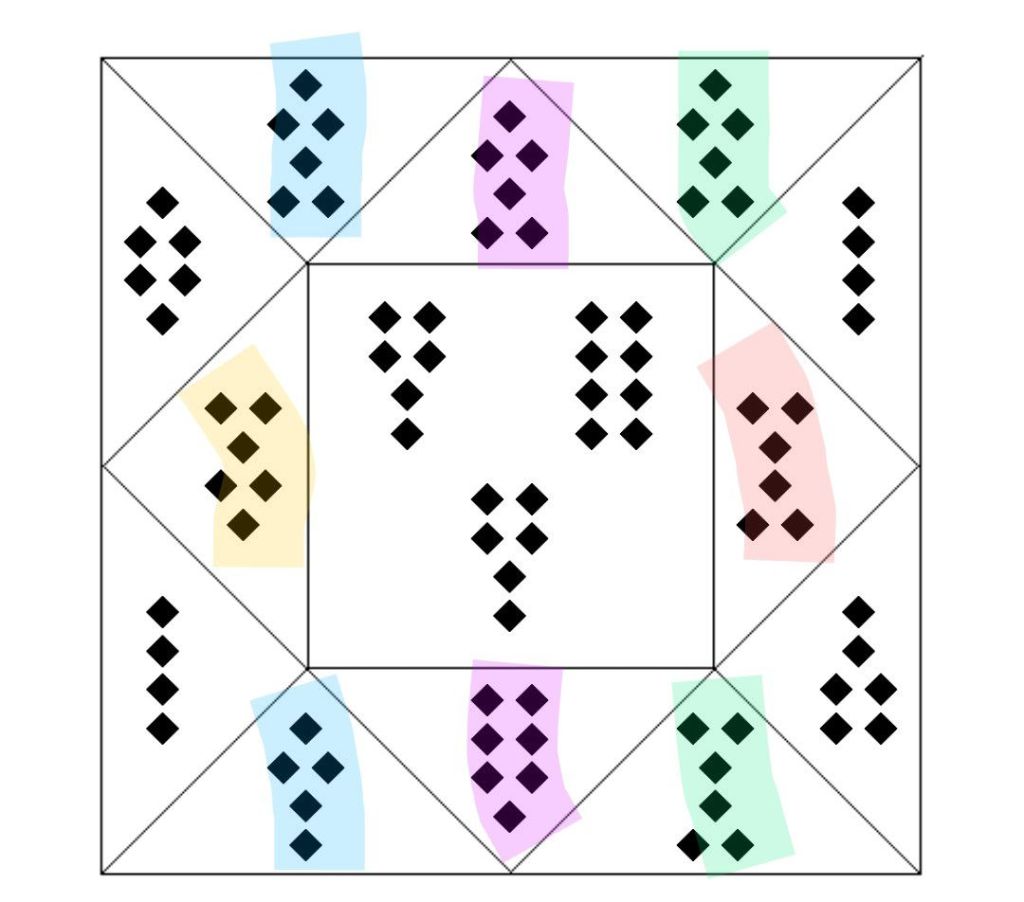
Astrological aspects in Geomancy (App used: Simple Geomancy)

If we take the figure in the first house (marked in yellow) as a reference point, then the figures in blue sextile it, because they are separated from it by a single sign; the figures in purple square it, because they are separated from it by two houses; the figures in green trine it because they are separated from it by three houses, and the figure in red opposes it, since it occupies the houses directly opposite.

This is supposed to shed some light on the relationship between the figures: two figures that fall into a square pattern have a difficult relationship, two figures in a trine a good one, etc.

The problem with using astrological aspects in Geomancy is that aspects work in a fundamentally different way: in Astrology, an aspect requires a planet to move in order to apply to another planet. After perfection, then, the aspect separates and its effect wanes.

Geomancy, though, is a static system with no real movement. Sure, we can say a figure moves from one house to another, but in reality that figure is already present in both houses. The only way to conceptualize movement in a geomantic chart is when we take a significator’s house to be the original position of the figure in it, and every other instance of that figure as a successive movement (e.g., in a career reading, if Laetitia is in the tenth house and in the seventh, we take it to move from the tenth to the seventh and not vice versa).

I am honestly not convinced that astrological aspects can find a meaningful place in geomancy. They certainly cannot bring matters to perfection, otherwise everyone would always be separating from their partner since the figure in the seventh house always opposes the figure in the first. Similarly, everyone would always get along with their siblings since the third house always sextiles the first.

One possibility which has been suggested is that of applying aspects only to figures that move. In a love reading, for instance, if the seventh figure moves to the tenth, it moves to square the querent, since the tenth house squares the first.

I personally find this application also problematic, because the tenth house represents the job, among other things, so that would mean that everytime the querent’s job is involved in their love life it causes trouble, which is a false assumption.

At most, I would take an aspect into consideration only if BOTH significators move. In the hypothetical love reading, for instance, if the first figure (querent) moves to the fourth house and the seventh (significant other) moves to the tenth, then they are in opposition to one another. Maybe they will argue. Or, if the first moves to the fourth and the seventh to the second, they sextile each other, which is good.

Even in a situation like this I am generally cautious about applying this theory. There are certain aspects of Astrology (pun intended) that simply don’t translate well to other systems of divination. You are of course welcome to try this theory on for size, but personally I believe Geomancy already has its particular version of aspects, and throwing other stuff into the mix feels more like an attempt at complicating this “brief and simple science” to find something more to tell the querent.

MQS

Reading Old Sources (for Geomancy, Astrology, Occultism)

I’m currently studying horary astrology under Chris Warnock’s supervision. He puts a great deal of emphasis on studying old sources, which is perfect for a guy like me who breaks out in hives when occultism is boiled down to “just wear a deep knowing expression, drink herbal tea and let the ascended masters guide your intuition.”

Geomancy is similar to horary astrology in that it allows you to answer questions, though it is less dependent on the time the question is asked. It is also similar in that you need to go back to really old books in order to study it seriously.

When reading premodern sources we always run a couple of risks:

  1. Unless they’ve been edited and discussed by a modern, they are probably written in a language that is not our own, or, even if it is, it’s an old version of it. This makes room for misunderstanding.
  2. More subtly, the world in which the author lived and wrote is not our world: it has different cultural, political and spiritual reference points.
  3. The source is written by someone who is just as fallible as we moderns (or rather postmoderns) are.

If one thing that grinds my gears is when people just turn occultism into their little escape from reality (“I wanna believe the world is magical but I’m too special for Christianity”), the other thing that equally grinds my gears is when people desperately seek a doctrine to follow blindly just because it happens to run against the Zeitgeist.

An occultist (and divination is a branch of occultism, though we often forget it) must be capable of being equally distant from intellectual lassitude and fanaticism, from scientism and religion. It takes a particular temperament that most people don’t possess, and I say this in a neutral sense: most people simply don’t have the temperament for most things, which is why only few people in any generation do any one thing.

Point three on the list is what I’m referring to here. The few on the occult path who have what it takes to move beyond the sanitized, advertiser-friendly version of occultism that gets tarot readers invited to corporate meetings often run the contrary risk: that of believing “if something says the opposite of what we hear everyday in our decadent world, it must be true and I must worship at its altar.”

When reading old sources (and I’m talking about geomancy, but it could refer to any other branch) this can turn us into fanatics if we don’t constantly remind ourselves that a book, even in the old days, could be written for a variety of reasons:

  1. to pass on important knowledge (but still from the author’s limited perspective)
  2. to record your experience
  3. to help others
  4. as a publicity stunt
  5. to impress others
  6. to confuse others
  7. a mix of all the above

Furthermore, old authors are just as capable as modern ones of believing crap. As such, while it is vital to question our own worldview, it is also just as vital to question all others. The moment you are asked (or you feel like you ought) to stop questioning is exactly the point where prejudice has crystallized, be it yours or someone else’s. It is also the point where you can break new ground if you proceed cautiously and with intelligence.

All this is to say, old books are treasure troves of information that we can study, learn from, adapt sensibly to our current needs, and much more. But if you are looking for a new Bible, you’re better off sticking to the old one.

MQS

Divination and Intellectual Honesty

When I was a teen, I remember stumbling upon Aristotle’s definition of the “educated mind” as being able to hold a thought without accepting it, and I remember thinking how silly and basic the definition was. The older I get, the more I find myself agreeing with him, as I see fewer and fewer people capable of doing it (the fact that Aristotle never actually wrote the sentence is a whole ‘nother can of worms)

A lot of people don’t have an educated mind per the definition above. One would like to think that tarot readers, astrologers and the like would not be like a lot of people, seeing how much the word “wisdom” gets thrown around in their circles. But one would be wrong. Leave it to the “spiritual community” to be among the most ideological and stiff. And, consequently, not among the brightest. If there is a group of people I don’t trust to be capable of holding any thought except the ones they agree with, that’s these people.

I believe I already talked a little about this, but one of the most memorable examples I can think of is the 2016 US election, when every tarot reader on youtube and their mom were busy predicting Trump would lose the election disgracefully, poop his pants, writhe on the floor, throw a tantrum and retreat into the hell that spawned him while Hillary Clinton swung her throbbing, veiny, 25 inch hard-on at the glass ceiling. While I am slightly exaggerating, this was pretty much the tone. (interestingly, those same readers routinely claim that the tarot is not for fortune-telling)

One such reader went as far as channeling Trump’s character. I do not remember the exact spread, nor most of the cards, but two things stuck with me: first, no egregiously bad card showed up, and second, the King of Cups featured prominently in the spread. She interpreted the card as Trump being a violent man prey to his base emotions and instincts. I took a quick look at some of that reader’s other videos, only to discover that she never, ever interpreted the King of Cups this way. In fact, she always interpreted it as the significator of a good man who takes care of the querent.

This is a good time to point out that I am fiercely apolitical, so this is not about politics. All ideologies are, as far as I am concerned, clouds over the mind’s clarity. I’m not saying everyone needs to think like me. Everyone has their delusion of choice, and everyone (including me) has their way of slanting reality in one direction or the other, whether politically, spiritually or philosophically (or even scientifically, for that matter). In fact, slanting reality is probably needed in order to filter information that might be useful to us.

Yet divination should be something else. What that reader did was merely using the cards as a mirror of her own (perfectly legitimate) bias. This is fine, and can even be useful at times–if you are aware that you are doing it. Even that would not be actual divination, but at least it wouldn’t be a waste of time.

I already discussed that divination is really a process of deification, that is, the process of allowing the dispassionate, bird-eye view clarity of the divine into one’s limited, subjective world by letting new information in. In other words, true divination is the opposite of retreating into one’s bubble: it’s the bursting of the bubble.

This, in turn, requires a certain readiness to accept the information we get (which is why it is always best to get someone you don’t know to read your cards.) Divination without intellectual honesty is just a crutch for one’s ego, and that’s how it is currently being used by the vast majority of diviners.

Unfortunately, intellectual honesty won’t make you many friends. Back in 2016 I had arguments with more tarot readers than I care to remember and was routinely labeled a dangerous extremist just because I called into question the usefulness of this type of reading (back then I still tried to entertain fruitful conversations with people). But occultism, in all its branches, is a narrow path.

Two lessons from all this: 1) if you are reading for yourself and the cards (or chart, or dice, or whatever) seem to confirm what you already think or wish, apply a bucketful of salt to the reading; 2) invest some money into a simple handbook of logic, or at least expand your knowledge of logical fallacies. This will repay you many times over, regardless of what branch of sorcery you practice.

MQS