Tag Archives: Fortune-telling

Astrological Aspects in Geomancy

In Medieval and early modern times, Astrology was everything. Being a natural consequence of the philosophical worldview tolerated by the church (that is, Aristoteleanism), Astrology was not seen, strictly speaking, as a Bible-prohibited practice, but merely as an extension of the science of the day. Though it always had its detractors, it was generally accepted. Therefore it was normal to try to astrologize everything.

We’ve already discussed geomantic perfection. This takes place thanks to something resembling aspects. But some old books go a step further and seek to introduce the actual astrological aspects of the time into geomantic practice.

In Astrology, an aspect happens when two planets occupy the same degree in different signs: a sextile happens to planets that are 60 degrees apart (e.g., Venus at 10 Aries and Jupiter at 10 Gemini); a square is between planets that are 90 degrees apart (e.g. Venus at 10 Aries and Jupiter at 10 Cancer); a trine is between planets that are 120 degrees apart (e.g., Venus at 10 Aries and Jupiter at 10 Leo); an opposition is between planets that are 180 degrees apart (e.g., Venus at 10 Aries and Jupiter at 10 Libra)

Aspects are key to astrological perfection. They show the things signified by the planets coming together, with sextile and trine indicating good contact on one hand and square and opposition showing bad or difficult contact. For instance, if in a love question my significator aspects my love interest’s significator, it shows us coming together. If by trine, we get along, if by square we argue.

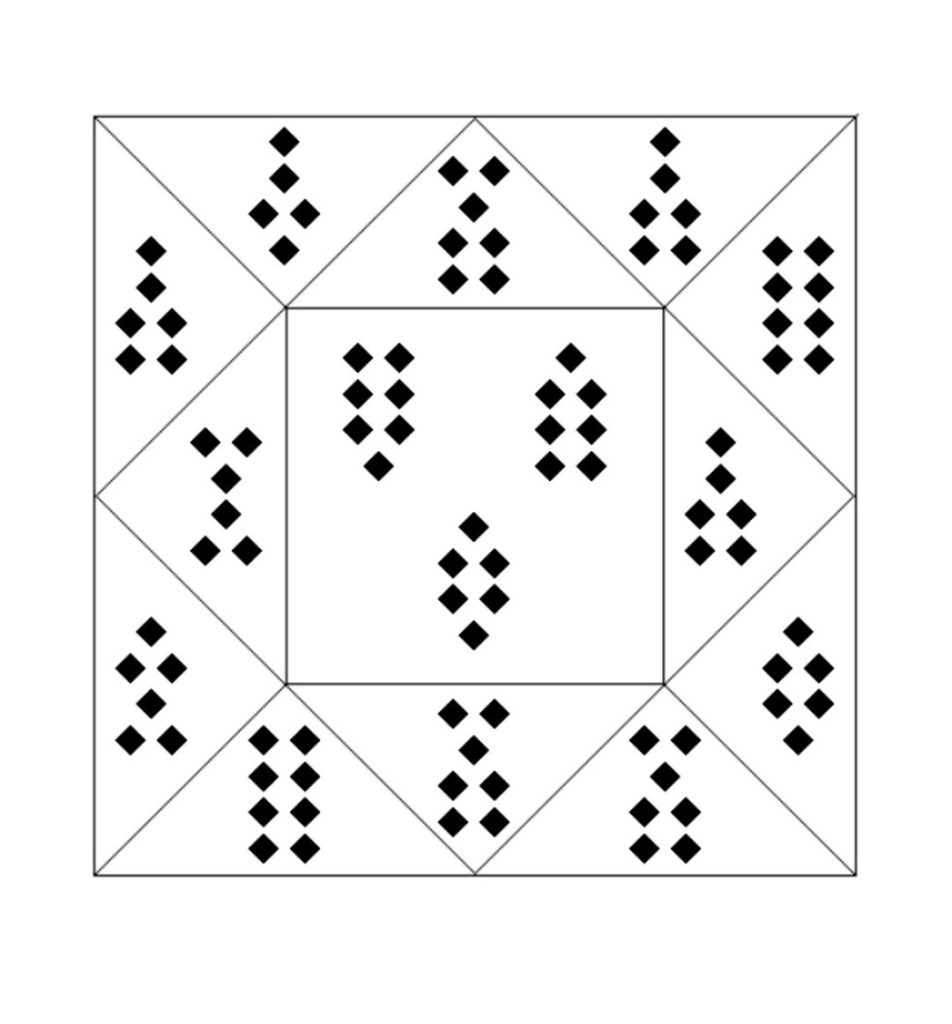
In geomancy, astrological aspects have been adapted to the chart as follows:
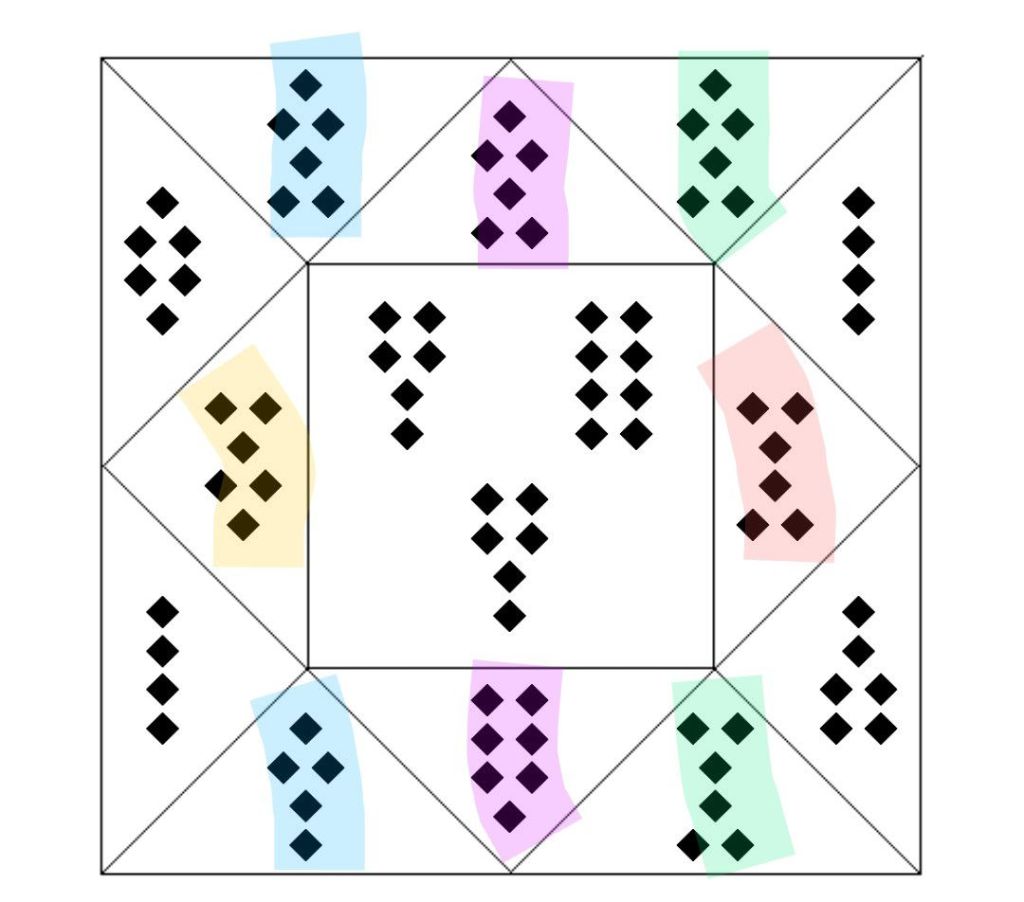
Astrological aspects in Geomancy (App used: Simple Geomancy)

If we take the figure in the first house (marked in yellow) as a reference point, then the figures in blue sextile it, because they are separated from it by a single sign; the figures in purple square it, because they are separated from it by two houses; the figures in green trine it because they are separated from it by three houses, and the figure in red opposes it, since it occupies the houses directly opposite.

This is supposed to shed some light on the relationship between the figures: two figures that fall into a square pattern have a difficult relationship, two figures in a trine a good one, etc.

The problem with using astrological aspects in Geomancy is that aspects work in a fundamentally different way: in Astrology, an aspect requires a planet to move in order to apply to another planet. After perfection, then, the aspect separates and its effect wanes.

Geomancy, though, is a static system with no real movement. Sure, we can say a figure moves from one house to another, but in reality that figure is already present in both houses. The only way to conceptualize movement in a geomantic chart is when we take a significator’s house to be the original position of the figure in it, and every other instance of that figure as a successive movement (e.g., in a career reading, if Laetitia is in the tenth house and in the seventh, we take it to move from the tenth to the seventh and not vice versa).

I am honestly not convinced that astrological aspects can find a meaningful place in geomancy. They certainly cannot bring matters to perfection, otherwise everyone would always be separating from their partner since the figure in the seventh house always opposes the figure in the first. Similarly, everyone would always get along with their siblings since the third house always sextiles the first.

One possibility which has been suggested is that of applying aspects only to figures that move. In a love reading, for instance, if the seventh figure moves to the tenth, it moves to square the querent, since the tenth house squares the first.

I personally find this application also problematic, because the tenth house represents the job, among other things, so that would mean that everytime the querent’s job is involved in their love life it causes trouble, which is a false assumption.

At most, I would take an aspect into consideration only if BOTH significators move. In the hypothetical love reading, for instance, if the first figure (querent) moves to the fourth house and the seventh (significant other) moves to the tenth, then they are in opposition to one another. Maybe they will argue. Or, if the first moves to the fourth and the seventh to the second, they sextile each other, which is good.

Even in a situation like this I am generally cautious about applying this theory. There are certain aspects of Astrology (pun intended) that simply don’t translate well to other systems of divination. You are of course welcome to try this theory on for size, but personally I believe Geomancy already has its particular version of aspects, and throwing other stuff into the mix feels more like an attempt at complicating this “brief and simple science” to find something more to tell the querent.

MQS
Reading Old Sources (for Geomancy, Astrology, Occultism)

I’m currently studying horary astrology under Chris Warnock’s supervision. He puts a great deal of emphasis on studying old sources, which is perfect for a guy like me who breaks out in hives when occultism is boiled down to “just wear a deep knowing expression, drink herbal tea and let the ascended masters guide your intuition.”

Geomancy is similar to horary astrology in that it allows you to answer questions, though it is less dependent on the time the question is asked. It is also similar in that you need to go back to really old books in order to study it seriously.

When reading premodern sources we always run a couple of risks:

  1. Unless they’ve been edited and discussed by a modern, they are probably written in a language that is not our own, or, even if it is, it’s an old version of it. This makes room for misunderstanding.
  2. More subtly, the world in which the author lived and wrote is not our world: it has different cultural, political and spiritual reference points.
  3. The source is written by someone who is just as fallible as we moderns (or rather postmoderns) are.

If one thing that grinds my gears is when people just turn occultism into their little escape from reality (“I wanna believe the world is magical but I’m too special for Christianity”), the other thing that equally grinds my gears is when people desperately seek a doctrine to follow blindly just because it happens to run against the Zeitgeist.

An occultist (and divination is a branch of occultism, though we often forget it) must be capable of being equally distant from intellectual lassitude and fanaticism, from scientism and religion. It takes a particular temperament that most people don’t possess, and I say this in a neutral sense: most people simply don’t have the temperament for most things, which is why only few people in any generation do any one thing.

Point three on the list is what I’m referring to here. The few on the occult path who have what it takes to move beyond the sanitized, advertiser-friendly version of occultism that gets tarot readers invited to corporate meetings often run the contrary risk: that of believing “if something says the opposite of what we hear everyday in our decadent world, it must be true and I must worship at its altar.”

When reading old sources (and I’m talking about geomancy, but it could refer to any other branch) this can turn us into fanatics if we don’t constantly remind ourselves that a book, even in the old days, could be written for a variety of reasons:

  1. to pass on important knowledge (but still from the author’s limited perspective)
  2. to record your experience
  3. to help others
  4. as a publicity stunt
  5. to impress others
  6. to confuse others
  7. a mix of all the above

Furthermore, old authors are just as capable as modern ones of believing crap. As such, while it is vital to question our own worldview, it is also just as vital to question all others. The moment you are asked (or you feel like you ought) to stop questioning is exactly the point where prejudice has crystallized, be it yours or someone else’s. It is also the point where you can break new ground if you proceed cautiously and with intelligence.

All this is to say, old books are treasure troves of information that we can study, learn from, adapt sensibly to our current needs, and much more. But if you are looking for a new Bible, you’re better off sticking to the old one.

MQS

Divination and Intellectual Honesty

When I was a teen, I remember stumbling upon Aristotle’s definition of the “educated mind” as being able to hold a thought without accepting it, and I remember thinking how silly and basic the definition was. The older I get, the more I find myself agreeing with him, as I see fewer and fewer people capable of doing it (the fact that Aristotle never actually wrote the sentence is a whole ‘nother can of worms)

A lot of people don’t have an educated mind per the definition above. One would like to think that tarot readers, astrologers and the like would not be like a lot of people, seeing how much the word “wisdom” gets thrown around in their circles. But one would be wrong. Leave it to the “spiritual community” to be among the most ideological and stiff. And, consequently, not among the brightest. If there is a group of people I don’t trust to be capable of holding any thought except the ones they agree with, that’s these people.

I believe I already talked a little about this, but one of the most memorable examples I can think of is the 2016 US election, when every tarot reader on youtube and their mom were busy predicting Trump would lose the election disgracefully, poop his pants, writhe on the floor, throw a tantrum and retreat into the hell that spawned him while Hillary Clinton swung her throbbing, veiny, 25 inch hard-on at the glass ceiling. While I am slightly exaggerating, this was pretty much the tone. (interestingly, those same readers routinely claim that the tarot is not for fortune-telling)

One such reader went as far as channeling Trump’s character. I do not remember the exact spread, nor most of the cards, but two things stuck with me: first, no egregiously bad card showed up, and second, the King of Cups featured prominently in the spread. She interpreted the card as Trump being a violent man prey to his base emotions and instincts. I took a quick look at some of that reader’s other videos, only to discover that she never, ever interpreted the King of Cups this way. In fact, she always interpreted it as the significator of a good man who takes care of the querent.

This is a good time to point out that I am fiercely apolitical, so this is not about politics. All ideologies are, as far as I am concerned, clouds over the mind’s clarity. I’m not saying everyone needs to think like me. Everyone has their delusion of choice, and everyone (including me) has their way of slanting reality in one direction or the other, whether politically, spiritually or philosophically (or even scientifically, for that matter). In fact, slanting reality is probably needed in order to filter information that might be useful to us.

Yet divination should be something else. What that reader did was merely using the cards as a mirror of her own (perfectly legitimate) bias. This is fine, and can even be useful at times–if you are aware that you are doing it. Even that would not be actual divination, but at least it wouldn’t be a waste of time.

I already discussed that divination is really a process of deification, that is, the process of allowing the dispassionate, bird-eye view clarity of the divine into one’s limited, subjective world by letting new information in. In other words, true divination is the opposite of retreating into one’s bubble: it’s the bursting of the bubble.

This, in turn, requires a certain readiness to accept the information we get (which is why it is always best to get someone you don’t know to read your cards.) Divination without intellectual honesty is just a crutch for one’s ego, and that’s how it is currently being used by the vast majority of diviners.

Unfortunately, intellectual honesty won’t make you many friends. Back in 2016 I had arguments with more tarot readers than I care to remember and was routinely labeled a dangerous extremist just because I called into question the usefulness of this type of reading (back then I still tried to entertain fruitful conversations with people). But occultism, in all its branches, is a narrow path.

Two lessons from all this: 1) if you are reading for yourself and the cards (or chart, or dice, or whatever) seem to confirm what you already think or wish, apply a bucketful of salt to the reading; 2) invest some money into a simple handbook of logic, or at least expand your knowledge of logical fallacies. This will repay you many times over, regardless of what branch of sorcery you practice.

MQS

A Money Spread – With a Mistake

Not even the best card readers are 100% correct, and I’m far from being the best card reader. This is an example from some time ago. The querent was a woman she asked me, generally, about her finances.

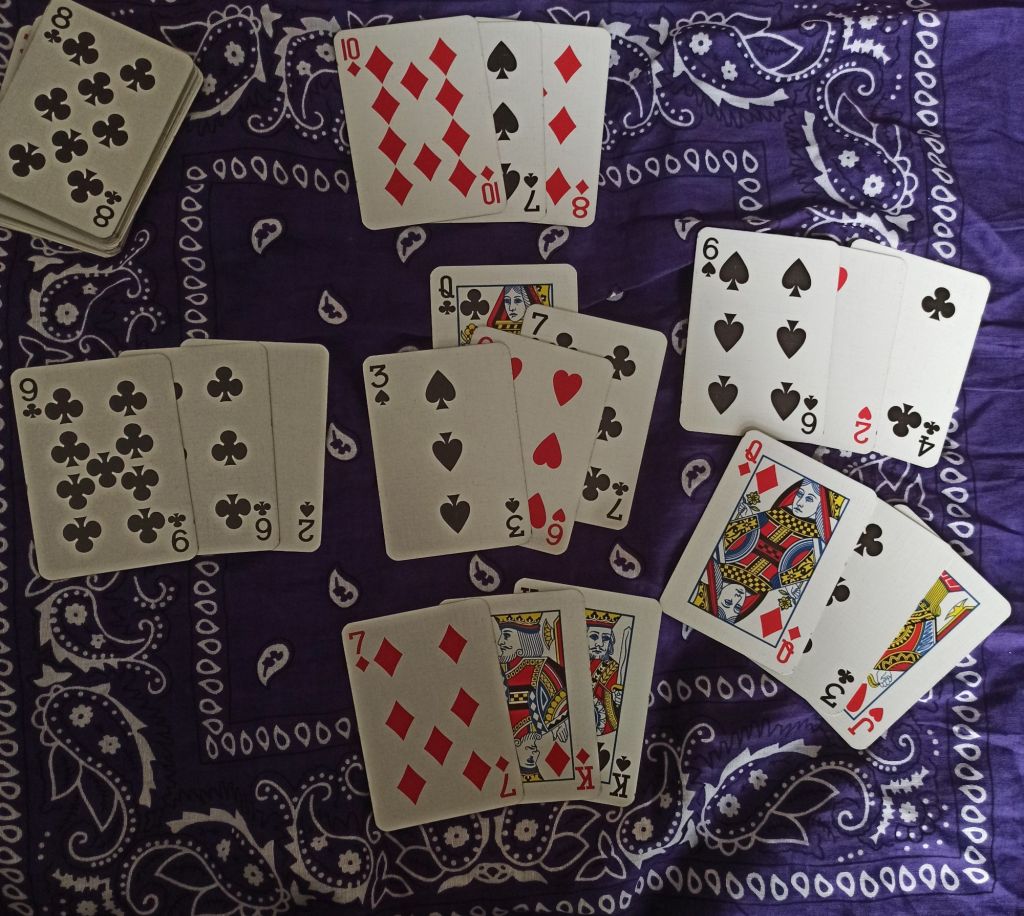
Cartomancy with playing cards – a cross spread about money

Looking at the spread as a whole, it is clear that  it’s about money. In the upper position there are money issues highlighted, particularly a sudden (Seven of Spades) expense. The position below, which often needs to be connected to the one above, indicates issues connected with authority, possibly a bank or other financial institution (the King of Spades and King of Diamonds). In the past position we have a situation of slowness and difficulties for a long time, while in the heart position there are difficulties, possibly either obtaining something or getting it back (the Six of Hearts can mean that) or just simply difficulties finding one’s footing.

I ask the querent and she tells me that she’s a small business owner and business has been slow, and she’s been having trouble applying for financial help in the form of loans to renovate her business (note the Six of Hearts) and make it more appealing.

Encouraged by how responsive the spread seems to be, a look at the future positions. This is where I got everything wrong. I tell her that, although there is trouble (Six of Spades) she will get a positive answer (the last fan with the Three of Clubs and the Jack of Hearts). Looking back it is quite obvious the cards were saying something else.

She didn’t get the loan. The fan with the Six of Spades is not positive at all, even though I had decided to interpret it positively: it merely shows she will be quickly (Two of Hearts) refused the loan, possibly because she is not deemed to have her finances in order.

However, she later did end up partnering (Three of Clubs) with another woman (Queen of Diamonds) to start something new (Jack of Hearts).

Whodunnit? Playing Card Reading on Theft and How to Identify People

It’s not just about love. Playing cards (and any other oracle) can be used to identify people, find lost objects and animals and many other things. Unfortunately, this type of reading is extremely complex, and I have a less than stellar track record in this regard (as opposed to the lady who taught me, who was sort of known for finding lost rings and describing thieves)

The reason for the difficulty is that the world’s complexity is almost endless, and we only have a limited number of cards at our disposal, so that there is always a need for combining card meanings in new and clever ways to signify everything. One of the subjects I want to touch on in a next article on the philosophy of divination is exactly the fact that the limits of our imaginations can also be the limits of our ability to make predictions.

Furthermore, the language of the cards is otherworldly, at least as far as making predictions is concerned, so that the oracle will not necessarily answer the question in a linear form that is readily understood. This is why my error rate by people descriptions and by finding lost items tends to be higher than in other readings. Sometimes I can’t so much as make sense of one of the cards, let alone the whole composition.

There is, however, a reading I want to share because of how clear the cards were, which makes this a good case study. A woman had lost her bracelet and, after looking for it everywhere, was beginning to suspect her niece of stealing it, possibly as a game. Here’s the spread:

Playing Card Divination, A Reading about Theft

There is one woman in the spread. She is next to the Ace of Clubs. This is extremely important. The Ace of Clubs represents initiative, and if you ask whether someone will or won’t do something, if their significator comes up next to the Ace of Clubs (or the Five of Clubs, representing action, or, sometimes, even the Two of Clubs, which means taking steps) it shows the person will do it.

In this case, though, we are talking about theft. So this woman took the initiative, i.e., she stole the bracelet. She is next to the Eight of Clubs, which represents work. So this is not the querent’s niece, but a coworker or superior.

Note, though, that she comes up as the Queen of Diamonds, not as the Queen of Spades, so there is no inherent ‘evil’ about her. Furthermore, we have the Three of Diamonds next to the Eight of Clubs. The Three of Diamonds represents all activities that are done part-time. Metaphorically, therefore, the woman is not a ‘full-time’ thief, i.e., she doesn’t have the habit of stealing. She probably just seized the moment to have something that caught her fancy. The Ten of Hearts closing the spread shows the possibility of a happy ending.

To be more sure, I asked the querent to pick another card for the Queen of Diamonds, and she chose the Four of Clubs. So this is a woman the querent speaks to habitually. Furthermore, even though the Queen is a Diamonds, and should technically be very fair, she is surrounded by Clubs, which represent a dark complexion and/or hair (but not as dark as Spades)

Well, some days after the reading the querent’s coworker, a woman of dark complexion and hair, came forward to her, wracked with guilt, and gave her back the bracelet, which the querent had left on her desktop unattended. The woman said she didn’t know what had possessed her to steal the item.

MQS

Toward the Geomancy Shield – The Four Mothers

Geomancy has changed a bit since Medieval times, but one thing that remains constant is how a Geomantic figure or Geomantic Shield is formed. This is done in order to answer a question.

As I said in the previous article, we don’t draw the whole figure in the same way. We can divide the process in two parts: the creation of the four Mothers on one side; and the deriving of the rest of the figure from the four Mothers on the other side. The first is the “divinely inspired” part, i.e., the part where you allow chance into your life, while the second part is automatic and fixed and will follow with mathematical rigor from the first.

So, how do we get a set of four Mothers? In reality, Geomancy is a rather flexible oracle, as any method is technically valid. Once you are well versed in the main operations required to draw a Geomantic figure, you can pretty much use any method that suits you in order to obtain the four mothers.

Still, some methods are more traditional than others. It seems that the Arab Magi used a stick to poke points in the sands of the desert, a method that is still perfectly valid and has even been accepted and adapted by the Golden Dawn. By the time Geomancy reached Europe in the Middle Ages, it was customary to use a stylus or pen and a tablet or piece of paper or parchment. Dice were also used, and one could, and can use dried beans or pebbles or playing cards. Anything that can give you odd and even numbers will do.

Needless to say, some have devised software that calculate everything automatically. I don’t particularly trust this method, and yes, partly it’s because technology is still so new that my mind doesn’t accept it as a valid substitute for things that are more dependent on my direct manipulation–it may very well be that in five hundred years occultists will use geomantic software without thinking twice about it, but we’ll cross that bridge when we get to it.

The Pen and Paper Method

My personal favorite method remains pen and paper. I almost always use it, and I find it has an odd beauty, even power to it. It also reminds me of a playful oracle that we used to use as kids in middle school and high school in Italy to answer yes or no questions. Usually, some love-stricken teen would ask the fateful question, “does he love me?” and would start drawing random numbers of points on a piece of paper. Then she would pair up the points until either one point was left (yes) or none at all (no). I have no idea how this oracle originated, but I remember it being very much in vogue when I was a kid.

A set of geomantic Mothers is obtained in a similar, albeit more complex, manner. First off, it pays to write down the question. This has the incredible advantage that it forces you to think about it seriously, and it also makes it more real and objective.

Then, after concentrating on the question, you should ask for divine help. I’m not saying this to be preachy. Consult any Medieval handbook of Geomancy and you will find the same instruction: it’s the “Unmoved Mover” that sends his “vertue” down from the skies to answer your question. At the very least, you should take a moment to relax.

Once you feel ready, start drawing sixteen consecutive rows of points. Try to be orderly, but don’t worry too much: as long as the rows don’t cross or merge you are fine. Also, I have found that it is better to draw I’s instead of points, for the simple reason that it makes it easier to recognize the marks instead of leaving you wondering “is it a point or a random inkblot?”

Do not count the points or I’s you are making, and do not bother counting the rows as you make them. Do not engage in any kind of mathematical or rational thinking. In fact, I have found it pays to write down numbers from 1 to 16 before starting the operation, so as to be free from the worry of drawing too many or too few rows of points. Still, in the traditional instruction, you are normally told not to bother if you end up with an extra row of two–just go overboard and then discount the extra ones. Either way you will end up with something like this:

  • 1) IIIIIIIIII
  • 2) IIIIIIIIIIIII
  • 3) IIIII
  • 4) IIIIIIIIIIIIIIIIIIII
  • 5) IIIIIIII
  • 6) IIIIIIIIIIIIIIIIII
  • 7) IIII
  • 8) IIIIIIIIIIIII
  • 9) IIIIIIIIIIIII
  • 10) IIIIIIIIIIIIIII
  • 11) IIIIIIIIIIII
  • 13) IIIIIII
  • 14) IIIIIIIIIIIIIIIIIIIII
  • 15) IIIIIIIII
  • 16) IIIIIIIIIIIIIII

Once this operation is over, you have your four Mothers, but only in a raw form. Each Mother figure is made up of four rows (4×4 = 16). Now you need to pair up the I’s in each row until either one is left over or two. Let’s make the example of the first Mother, which is made up of rows 1 through 4:

  • 1) I-I I-I I-I I-I I I = O O
  • 2) I-I I-I I-I I-I I-I I-I I = O
  • 3) I-I I-I I = O
  • 4) I-I I-I I-I I-I I-I I-I I-I I-I I-I I I = O O

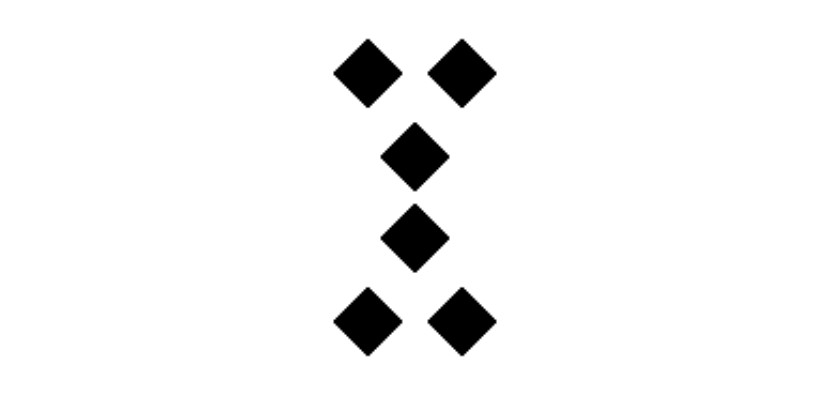
The figure we have received as first Mother is comprised by a sequence of two points on top, then one point, then one point, then two points. The same process of pairing up must be done for all sixteen rows to obtain the four Mothers (the second Mother being made up of rows 5 through 8, etc.) The first Mother we have obtained is called Conjunctio.

The Geomantic figure Conjunctio. From the App ‘Simple Geomancy’

Once this operation is over, you will be left with four figures, each made up of four rows of either one or two points. From these figures you will need to derive the rest of the chart, which I will go over in the next post.

Geomancy | Master Post

Here I gather all my articles on (mostly European) Geomancy.

Geomancy has been an ongoing interest of mine. It is an ancient divination system that is being rediscovered after a couple of centuries spent in obscurity. It exists in various flavors, the most commonly recognized in the West being the one practiced by Medieval and early Modern magi. It derives in its main lines from Arabic Geomancy, and is only distantly related to African practices that use similar figures.

Of course, at the time when Geomancy was introduced to the West, Astrology was all the rage, which means that European Geomancy has a marked astrological bent. In most of its variations, Geomancers obtain a response by generating a random number of points which are then organized according to a fixed series of rules. Note that geomancy has nothing to do with Feng Shui and related practices (Flying Stars, Qi Men Dun Jia, Ba Gua Sectors, etc.)

Translations of Old Books
Peter of Abano’s Geomancy Handbook
Robert Fludd’s Geomancy Handbook (from the Fasciculus Geomanticus)

General
A step by step Deconstruction of a Geomantic Reading
Obtaining the Four Mothers
From the Four Mothers to the Geomantic Shield
Anatomy of a Geomantic Figure
Meanings of the Houses
Which House is Next to Which?

The Figures
Via
Populus
Fortuna Major
Fortuna Minor
Puer
Albus
Puella
Rubeus
Acquisitio
Amissio
Laetitia
Tristitia
Conjunctio
Carcer
Caput Draconis
Cauda Draconis

Interpretation
Geomantic Perfection: how things come to pass
Interpreting the Judge and Witnesses
Reconciling the Judge with the Chart
The Via Puncti or Way of the Points
The Company of Houses
Astrological Aspects in Geomancy

Readings
A question about Study
Friend or Acquaintance?

My Articles on Geomancy

Something went wrong. Please refresh the page and/or try again.

Geomancy Reading – Study-related question

I’m currently translating an old manuscript on Geomancy from Italian into English and I wanted to seize the opportunity to give someone a reading. My husband proved to be the guinea pig I needed. He was about to enroll in a course at the local VHS (Volkshochschule, a network of continuing education institutes in Germany) and wanted to know if he would be happy with the course.

Will I be happy with the course I’m about to start?

The lord of the first is Conjunctio, which indicates mental flexibility and the ability to learn. The quesited is the lord of the ninth house, Fortuna Minor, which is outside help. It often indicates good opportunities that need to be seized.

Fortuna Minor moves to the twelfth house, perfecting the chart. This is a very good indication, as it shows contact between querent and quesited, in this case the transfering of knowledge/skill. The perfection happens by the ninth figure moving, showing that the course organizer(s) will do their best.

However, F. Minor also moves to the seventh house, from which it opposes the querent. Furthermore, Minor plus Conjunctio gives Amissio, Loss, which shows either waste of money or the inability/impossibility to learn everything.

Carcer is the Judge, which indicates that overall it’s a wash, especially since the Right Witness is Laetitia but the Left Witness is Tristitia, indicating a downward or negative trend. The Judge of the Judge (Judge + Lord of the First) is Via, which in general can be seen as something of little consequence, something that is there and then is gone.

The Way of the Points leads back to Amissio in the second house, it’s an investment that is not wholly justified.

Outcome: my husband was somewhat happy with the course, but his interest waned with every class, especially because he found that he disagreed with some of what the teacher was saying (that opposition) although the teacher was generally enthusiastic and helpful. He didn’t get buyer’s remorse. He was still happy he had done it, but he had hoped for way more, especially considering the price.

MQS