Living at the intersection of occultism, fiction and philosophy, I travel the planes at a moderately quick pace. I read, I do magic, I cook for hubby. Confused by the number of things I talk about? Good, confusion is a nice thing ;)
Sometimes a spread doesn’t give us enough information and we need to dig deeper. I know that there is a number of way to do it. The way that has been taught to me is called ‘opening the spread‘ and it simply means adding one to three cards in one point to obtain further information. At this point I should say that I try to use this technique only when I find it is strictly necessary. The cards are fickle friends, so they are best kept on a short leash, lest they start confuse us. Here is an example. A querent asked me about his career. This is what came out:
Career reading
He didn’t ask a specific question, but the first two cards, the Six of Diamonds and the Five of Diamonds, represent worry about change. The center of the spread is occupied by the Jack of Diamonds, which indicates messages. Note, also, that the spread is ovverrun with Diamonds.
At this point, I asked him to draw two cards to add to the Jack of Diamonds, and we got the Four of Clubs and the Eight of Diamonds, clearly an interview. Then I asked him to open the spread again on the Eight of Clubs, the job card, and the Ace of Clubs and Seven of Clubs came up, indicating the overcoming of obstacles.
The question I asked him was if he was waiting for a message about some change, possibly to do with a raise or another positive change, where he would need to solve new problems, and he said he had applied for a promotion with came with new tasks, and he was waiting for an answer. I told him he’d get it (Ten of Diamonds and Eight of Clubs). Yesterday he confirmed he got the promotion.
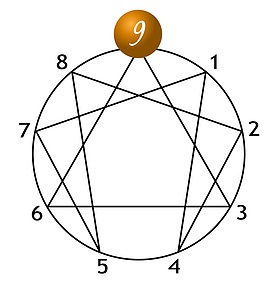
Enneagram Type Nine, sometimes called the Mediator, belongs to the Body triad. People of this Enneatype tend to be nurturing, accepting, agreeable and flexible. They are usually very good at holding space for other people, and they often manage to find common grounds with others. They are generally driven by a desire to avoid conflict, because they fear that conflict will make others fail to see them as independent individuals. They much prefer to work together with others, sometimes giving up on their own agenda to avoid rocking the boat, but also exerting a kind of silent passive resistance against things they don’t want to do or accept.
Enneagram Type Nine
Enneatype Nine Grows: Move to Three
Nines have a tendency to ‘disappear’, but not necessarily because they are shy or because they retreat from others in a traditional sense (like a Five avoiding draining contact or a Four witholding themselves to lick their wounds). Instead, average Nines fail to emerge as individuals in the eyes of others (and even in their own eyes): they often find it hard to articulate their preferences, projects and views out of fear of clashing with the people around them.
So while Nines are usually the most sociable of the three withdrawing types (Nine, Four, Five) they still withdraw from others by not opposing them or putting their foot down. This way of remaining merged with other people’s preferences and ideas and going with their flow can cause pain to the Nine as they may feel that they are being stepped on, even though they never drew a line to begin with, which makes it hard even for well-meaning friends to respect their boundaries.
However, as they develop and relax their mechanism, Nines learn to assert themselves more clearly. They learn that there is nothing wrong with having their own agenda, aims and views, and that in fact life cannot be meaningfully lived without choosing one’s path rather than remaining stuck in an all-encompassing mystical haze. Nines thus take on some of the qualities of healthy Threes.
Threes are very assertive people, with a strong desire to emerge and embody exceptional qualities. As one of the most driven Enneatypes, Threes’ way of getting the social acceptance they seek is not to blend in, but to stand out. As they take on some of these qualities, healthy Nines learn to take action by themselves, even if it means risking conflict with others by defending their own identity, their boundaries and their vision.
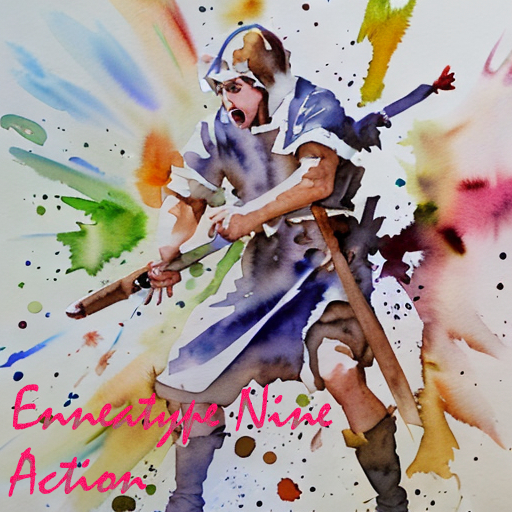
Action, the virtue of Enneagram Type Nine
Enneatype Nine Under Stress: Move to Six
Average Nines generally have a rather diffuse sense of self. Their ideal of a good day is one spent in peace, though not necessarily in inaction, as Nines can be very active people. What gives them peace is the idea that everything has its neat little place, everyone is a good neighbor, pleasantries are exchanged and no one causes any trouble. As long as everything goes like this, Nines don’t feel pressured into taking uncomfortable stances and they can simply occupy themselves with comforting thoughts.
Obviously, since life rarely takes place in Hobbitville, the Nines’ ideal rarely comes true, especially because many people don’t share Nines’ worldview. Nines usually go with other people’s flow as long as it doesn’t cause them any trouble and the even surface of their life is not ruffled. When someone threatens to bring serious change into their placid routine, Nines often engage in passive sabotage until the ‘agitator’ gives up in the face of the futility of their effort.
When this typical strategy fails though, Nines can become seriously stressed out as it becomes impossible for them to sweep every problem and irregularity under the rug. This is when they reach their stress point at Six. Enneatype Six is usually the opposite of Nine’s serene peace. High-strung and catastrophizing, they seek to poke a hole into every possibility and theory in order to find the one that will give them the certainty they are looking for.
In embodying some of Six’s negative traits, unhealthy Nines often become cynical toward those trying to bring change in their life. They will often conjure up endless amounts of excuses for why whatever has been proposed is silly or doesn’t work. In extreme cases, others may even be treated as threats to the Nine’s way of life and dealt with accordingly.
When you pull three cards to describe a person (as I just did) and you get:
9♦ – J♠ – 3♠
This is a meddler, someone who interferes in others’ lives (J♠, 3♠), not out of self-interest or to get something, but due to a bloated belief in themselves (the Nine of Diamonds following the negative Court card). If the court card were positive, it would still be meddling, but out of love (Hearts, for instance)
I’m looking for a solution to have the blog available in a couple of languages. If you occasionally see that the blog content seems to disappear, don’t worry, I’m just experimenting
Enneagram Type Eight, sometimes called the Boss or the Challenger, belongs to the Body triad. Those of this Enneatype tend to be powerful, assertive and present in their body. They have seemingly endless endurance and stamina. They highly value their own independence and hate submitting to people, especially if they consider them unworthy. Their best defense is often offense, in the form of being imposing and challenging, but they also have a sense of duty toward their friends and associates, especially if they feel they need to defend them.
Enneagram Type Eight
Enneatype Eight Grows: Move to Two
Average Eights are known for their power-exuding, in-control behavior. In a way, they go through life as if they were a fortress constantly redying for war (and occasionally attacking a neighboring country to be on the safe side). They generally seem to believe that the best way of maintaining their autonomy is to behave in an assertive, hands-on way.
In general, Enneagram Type Eight is deeply aware of a weakness or softness within them that they feel they need to defend from exploitation and aggression. This is what leads them to being defensive (or aggressive, depending on the circumstances) and to wanting to establish themselves above other people, because once they know that they are the reference point for everyone else in the room, they know how to deal with them directly and head-on, which is Eight’s favorite kind of confrontation, as it leaves little space for subtlety and underhandedness.
As they grow and learn to relax their mechanism, Eights become capable of taking care of their soft side in a more nurturing way. They learn to see that not everyone is out to get them and that, in fact, other people have a tender, weak spot too that is deserving of love and protection. As they recognize this, maturing Eights take on some of the healthy traits of Enneagram Type Two.
At their best, Twos are caring, interpersonal, giving, motherly and see the needs of others as theirs to take care of. In growing toward Two, Eights become capable of putting their warrior qualities to a higher use in honoring others’ need and defending them. They become extremely giving (in a more neutral, less manipulative way than unhealthy Twos) and their energy is expressed in a way that is innocent because it places itself beyond the rigid distinction between friend and foe.
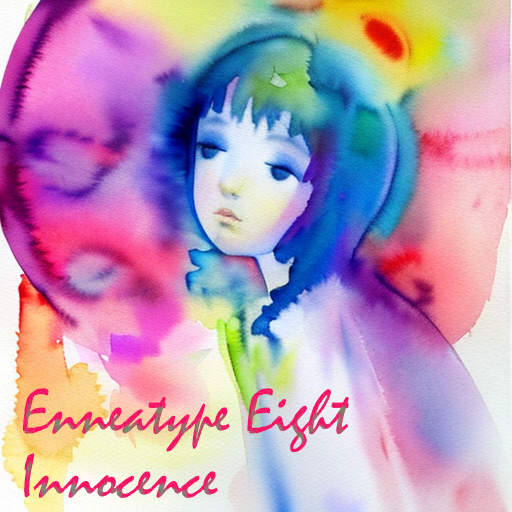
Innocence, the Virtue of Enneagram Type Eight
Enneatype Eight Under Stress: Move to Five
All Eights tend to act assertively in order to protect a part of them that they consider vulnerable and tender. In a way, it is as if they were padding the space around that vulnerable point with their boldness and in-your-face behavior, so that others can’t take advantage of it.
Unfortunately, it is not always possible for them to succeed in this effort. Sometimes their vulnerability comes to light, especially in the form of not feeling adequate or smart enough or strong enough to meet the challenges of life. While average to healthy Eights can enjoy meeting the resistance of the world and can appreciate worthy sparring partners, unhealthy Eights can feel that big challenges threaten their independence as individuals. In these circumstances, receiving a reaction that is equal to or stronger than the action they exert can cause Eights to lose their balance.
When this happens, Eights move to their stress point, where they develop some of the less healthy traits of Enneagram Type Five. Seeing an Eight move to Five is like seeing a bloated baloon letting out the air all at once. Suddenly all the assertive energy of Type Eight implodes toward the center of their being and they become insecure, silent and almost invisible.
Eights, like average to unhealthy Fives, now tend to feel exposed and in need of putting distance between them and the threat, and it is not uncommon for stressed out Eights to physically remove themselves from others’ presence. In doing so, Eights hope to regain some power and energy and to strategize a way out of the impasse.
English Version (scroll down for the Italian version)
It is an exciting time to be practicing divination. Among the occult arts it is probably the most popular for its immediate practical usefulness. The tarot is enjoying a divinatory revival after being brought to its knees by decades of pseudodeep elucubrations, and even lesser known systems of fortune-telling are being slowly fished out the obscure underbelly of folk tradition.
And occult folk tradition is especially rich in Italy, a country which, in part due to its chaotic and conflicted history, can boast a huge diversity of divinatory systems, especially (but not exclusively) of the card-based kind. It is especially reassuring to see that, unlike in the past, people of considerable education are taking these folk systems seriously.
It’s the case with Ernesto Fazioli’s latest book: Carte Piacentine. Divinare con le Briscole (Piacentine Cards. Divining with Briscola* Cards), a book dedicated to one of the many dozens of cartomancy systems based on the many types of Italian playing cards — in this case, Piacentine Cards–
Carte piacentine, one of the most popular playing card decks in Italy
Fazioli’s book is part of the same series as Germana Tartari’s Book on the Bolognese Tarot and it shares some of its traits: it is short (84 pages) and goes straight to the point; it is prefaced by a very quick but well-documented historical introduction; finally, it is aimed at shining a light on a small part of the Italian folk tradition while giving the reader the tools to work with it in today’s world.
I could quibble on a couple of points that made me wrinkle my nose, such as the association of the four suits with the four elements following the Golden Dawn pattern (which is not rooted in folk tradition, Italian or otherwise) but in reality all this is of very little account, as it can be very easily overlooked. The bulk of the book is solid and it teaches a traditional and little-known method of fortune-telling using a reduced pack of 30 Piacentine cards.
Each of the 30 cards is dedicated a small paragraph, which is enough, considering that, in traditional fortune-telling, one doesn’t spend a great deal of time musing on the quaint design of this or that card based on the latest fashion. For what little I know about this deck, the meanings retrieved by Fazioli feel genuine and even show a degree of overlap with the meanings of the Bolognese tarot.
This should not be a surprise, as fortune-telling and divination were born as methods of “gathering intelligence” about the world, meaning that, whatever system one uses, one must be given access do an adequate vocabulary–that is, a vocabulary that is adequate to describing the real world.
The spreads that Fazioli present also come from the folk tradition, and vary from the easier ones (the five card spread) to the very complex (a tableau of all 30 cards).
All in all, I am very pleased with my purchase, and will probably be posting a spread or two following the system. I am especially surprised by the good amount of information that Mr. Fazioli could pack into such a short booklet, and am endlessly fascinated, once again, by how folk divination emerges in its quality of spontaneous and creative remedy to life’s uncertainty.
* Briscola refers to one of the most popular game cards in Italy, usually played with Piacentine cards or a similar 40 card regional deck. For this reason, regional playing cards are often known as “carte da briscola” (briscola cards) in common parlance.
Versione Italiana
È un momento storico molto entusiasmante per chi pratica la divinazione. Tra le arti occulte è probabilmente la più popolare per la sua immediata utilità pratica. I tarocchi stanno vivendo un revival divinatorio dopo essere stati messi in ginocchio da decenni di elucubrazioni pseudointelletuali, e anche sistemi di cartomanzia meno conosciuti vengono lentamente ripescati dal ventre oscuro e creativo della tradizione popolare.
E la tradizione popolare occulta è particolarmente ricca in Italia, un Paese che, anche a causa della sua storia caotica e frammentata, può vantare un’enorme varietà di sistemi divinatori, soprattutto (ma non esclusivamente) del tipo basato sulle carte. È particolarmente rassicurante vedere che, a differenza del passato, persone di notevole cultura prendono sul serio questi sistemi popolari.
È il caso dell’ultimo libro di Ernesto Fazioli: Carte Piacentine. Divinare con le Briscole, un libro dedicato a una delle molte decine di sistemi di cartomanzia basati sui numerosi tipi di carte da gioco italiane – in questo caso le carte piacentine -.
Il libro di Fazioli fa parte della stessa collana del Libro sui Tarocchi Bolognesi di Germana Tartari e ne condivide alcuni tratti: è breve (84 pagine) e va dritto al punto; è preceduto da un’introduzione storica molto rapida ma ben documentata; infine, si propone di far luce su una piccola parte della tradizione popolare italiana dando al lettore gli strumenti per metterla a frutto nel contesto odierno.
Potrei cavillare su uno o due punti che mi hanno fatto storcere il naso, come l’associazione dei quattro semi con i quattro elementi secondo lo schema della Golden Dawn (che non ha radici nella tradizione popolare, italiana o meno), ma in realtà tutto ciò è di ben poco conto, perché può essere facilmente trascurato da chi non è interessato. Il libro ha solidi contenuti e insegna un metodo di cartomanzia tradizionale e poco conosciuto, utilizzando un mazzo ridotto di 30 carte piacentine.
A ciascuna delle 30 carte è dedicato un piccolo paragrafo, il che è sufficiente, considerando che, nella cartomanzia tradizionale, non si passa molto tempo a riflettere sul design pittoresco di questa o quella carta in base all’ultima moda. Per quel poco che so di questo mazzo, i significati recuperati da Fazioli nella sua attenta indagine sembrano genuini e mostrano persino un certo grado di similitudine con i significati dei tarocchi bolognesi.
Ciò non deve sorprendere, poiché la cartomanzia e la divinazione sono nate come metodi di “raccolta di informazioni” sul mondo, il che significa che, qualunque sia il sistema utilizzato, ci deve dare accesso a un vocabolario adeguato, cioè un vocabolario che sia adeguato a descrivere il mondo reale.
Anche le stese che Fazioli presenta provengono per lo più dalla tradizione popolare e variano da quelli più semplici (la stesa delle cinque carte) a quelli molto complessi (una stesa di tutte le 30 carte).
Nel complesso, sono molto soddisfatto del mio acquisto e probabilmente pubblicherò una o due stese seguendo il sistema. Sono particolarmente sorpreso dalla buona quantità di informazioni che Fazioli è riuscito a racchiudere in un libricino così breve e sono infinitamente affascinato, ancora una volta, da come la divinazione popolare emerga nella sua qualità di rimedio spontaneo e creativo all’incertezza della vita.
This spread is proof that we always need to have good communication with the querent, because sometimes readings are deceptive.
Sometimes spreads don’t answer the question at hand. This happens in two cases: when something more important is going on (or about to happen) in the querent’s life or when the cards want to give us details about the question that we haven’t asked for. This latter case requires great care, especially if the question is of a delicate nature.
A woman asked me if she will get pregnant. This is the spread (this is a rather old reading):
A pregnancy question answered with playing card divination
You’d probably think (and you’d be right) that my first instinct was to say “no” due to the horrible mesh of Spades following the Jack of Hearts, which is the child card.
However, something didn’t sit right with me about this spread. I wasn’t at all convinced the spread was answering the question directly. The reason is that the cards Ace of Spades, Nine of Spades and Ten of Spades can show bereavement, and bereavement can only happen if there *is* a child.
The King of Spades could be a doctor performing an abortion, but this isn’t confirmed by any other card (e.g. the Six of Spades). In this case, the King of Spades seems to be more like a priest celebrating a funeral.
I asked the querent if she already had a child, and she said that she unfortunately had a miscarriage in the recent past when the pregnancy was already relatively advanced.
So the cards were not saying that she wouldn’t have a child: they were merely reflecting a recent trauma. With that in mind, I interrupted the reading, telling her the cards were telling her to take time for herself. This was an excuse, of course: I could have done another reading, but I didn’t want to risk having to predict another miscarriage.
Fortunately, today the woman is the happy mother of two twins.
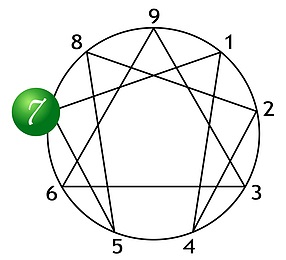
Enneagram Type Seven, sometimes called the Epicurean or the Enthusiast, belongs to the Head triad. Those of this Enneatype are usually positive, upbeat, energetic and fun-loving. They are mainly driven by the desire to avoid negative sensations and to maximize their options of experiencing the world and its potentials without being held back or restricted. They often make lots of plans and are engaged in many projects, activities, side activities, etc, some of which are bound to be left incomplete. They are usually possessed of quick wits and have an aptitude toward picking up new skills and interests. They rarely focus on the negative side of life, and even when they do, they tend to snap out of it quickly (or more quickly than other people.)
Enneagram Type Seven
Enneatype Seven Grows: Move to Five
One of the common themes in most Sevens’ lives is their fear of being confined to just one option, which will lead them (in their perception) to not experiecing life to the fullest or to not having back-up plans if one option fails. This tendency can cause Sevens to remain perpetually stuck on the surface of life, to the point that some unhealthy Sevens believe the surface is all there is. Sometimes this belief can cause Sevens to make rash decisions out of fear of being chained down in one place or situation.
As they grow and learn to relax their mechanism, though, Sevens start to develop a keener appreciation for the depth and complexity of life and a greater focus in pursuing certain options as more obviously right for them as opposed to others. In this, they start to take on some of the better qualities of Enneagram Type Five. Fives are the intellectuals of the Enneagram. They rarely make rash decisions and are often laser-focused, as though their mind were a blade that they use to cut through the surface of things to reach their core. They also don’t shy away from the negative side of life.
In general, even healthy Fives tend to lead a more sober life than their Seven friends, with a preference for a few well-chosen activities (or a few well-chosen possessions, friends, etc.) as opposed to the epicurean sludgeflow that usually clutters the lives of unhealthy Sevens. This is not to say that Sevens must become minimalistic, but as they grow they do become more stably anchored to their own core.
As they do so, Sevens realize that they are not necessarily foregoing anything essential if they choose to pursue one option to the exclusion of another, and instead they learn to cultivate what they do choose with care and persistence, while bringing their sense of humor, childlike wonder and almost endless adaptability with them.
Sobriety, the Virtue of Enneagram Type Seven
Enneatype Seven Under Stress: Move to One
Perceptive Sevens can sometimes feel that they are being led on a leash by their fear of restriction and pain. While healthy Sevens face their demons directly (like all healthy types) less healthy individuals can become absorbed in an endless whirlwind of meaningless novelty-chasing and hype traps, whereby they drop their toy as soon as the next shiny trinket catches their attention.
Because Sevens are very sharp-witted, they usually notice this trend, but they also feel that they must keep going, because stopping for a second (they feel) would cause more obscure feelings and fears to catch up with them. Unhealthy Sevens generally know that they are caught in a loop, but they feel that it’s too late to stop (Sevens in general have a tendency to excuse away their lack of restraint).
In moving toward their direction of stress, Sevens can pick up some of the less healthy qualities of Enneatype One. Like unhealthy Ones, they become critical and rigid, usually toward those around them who refuse to jump on the next hype train with them. Furthermore, perceiving the futility of their behavior, Sevens may also try to organize themselves to bring more structure to their life and activities (especially if it is spiralling out of control due to poor decision-making), but they tend to organize them to death, until all the wonderful Seven-ish spontaneity is sucked out of them and all that is left is the unhealthy One’s grayish sense of bureaucratic doom.
(Note: this is a collection of the meanings attributed to the cards by some occultists in the past centuries. It does not reflect my own study or opinion of the cards. It is only meant as a quick comparative reference as I develop my own take.)
The Queen of Cups from the Builders of the Adytum (BOTA) tarot deck
Paul Foster Case (and Ann Davies)
The time period is the beginning of the last decanate of Libra to the end of the second decanate of Scorpio, October 13 to November 11, combining the rulerships of Mercury, Mars, Jupiter and Neptune. Well Dignified: through the influence of Mercury in Libra the Queen of Cups personifies a woman, mentally alert, yet somewhat superficial, who probably has a touch of the poetic in her nature. She is kindhearted though not likely to go to too much trouble for anyone. The Scorpio influence added gives her strong desires and makes her emotionally responsive and attractive to the opposite sex; very psychic, and if her hig he r nature is developed she depicts a very powerful spiritual force akin to the influence of the purified desire nature and the influence of Neshamah. Ill Dignified: a woman who is subtle, decidedly coquettish and may even be a deliberate heart-breaker. Usually gold-brown hair with blue eyes. (From the Oracle of Tarot course)
A. E. Waite
Beautiful, fair, dreamy–as one who sees visions in a cup. This is, however, only one of her aspects; she sees, but she also acts, and her activity feeds her dream. Divinatory Meanings: Good, fair woman; honest, devoted woman, who will do service to the Querent; loving intelligence, and hence the gift of vision; success, happiness, pleasure; also wisdom, virtue; a perfect spouse and a good mother. Reversed: The accounts vary; good woman; otherwise, distinguished woman but one not to be trusted; perverse woman; vice, dishonour, depravity. (From The Pictorial Key to the Tarot)
Aleister Crowley
The Queen of Cups represents the watery part of Water, its power of reception and reflection. In the Zodiac it rules from the 21St degree of Gemini to the 20th degree of Cancer Her image is of extreme purity and beauty, with infinite subtlety; to see the Truth of her is hardly possible, for she reflects the nature of the observer in great perfection.
She is represented as enthroned upon still water. In her hand she bears a shell-like cup, from which issues a crayfish, and she bears also the Lotus of Isis, of the Great Mother. She is robed in, and veiled by, endless curves of light, and the sea upon which she is enthroned conveys the almost unbroken images of the image which she represents.
The characteristics associated with this card are principally dreaminess, illusion and tranquillity. She is the perfect agent and patient, able to receive and transmit everything without herself being affected thereby. If ill-dignified, all these qualities are degraded. Everything that passes through her is refracted and distorted. But, speaking generally, her characteristics depend mostly upon the influences which affect her.
In the Yi King, the watery part of Water is represented by the 8th hexagram, Tui. The commentary is as colourless as the card; it consists of mild exhortations on the subject of pleasure. It may really be said that, normally, people of this type have no character at all of their own, unless it can be called a characteristic to be at the disposition of every impact or impression.
There is, however, a hint (line 6) that the chief pleasure of people of this type is to lead and attract others. Such are accordingly (often enough) exceedingly popular. (From The Book of Thoth)
AI-Generated illustration for the Queen of Cups
Golden Dawn’s Book T
A VERY beautiful fair woman like a crowned Queen, seated upon a throne, beneath which is flowing water wherein Lotuses are seen. Her general dress is similar to that of the Queen of Wands, but upon her crown, cuirass and buskins is seen an Ibis with opened wings, and beside her is the same bird, whereon her hand rests. She holds a cup, wherefrom a crayfish issues. Her face is dreamy. She holds a lotus in the hand upon the Ibis. She is imaginative, poetic, kind, yet not willing to take much trouble for another. Coquettish, good-natured and underneath a dreamy appearance. Imagination stronger than feeling. Very much affected by other influences, and therefore more dependent upon dignity than most symbols. She rules from 20 Degree Gemini to 20 Degree Cancer.
Etteilla
Blonde Woman Upright: As far as the medicine of the spirit is concerned, this card, when upright, means: Blonde Woman, Honest Woman, Virtue, Wisdom, Honesty Reversed: Distinguished woman, Vice, Dishonesty, Debauchery, Corruption, Scandal