All posts by MQS

Living at the intersection of occultism, fiction and philosophy, I travel the planes at a moderately quick pace. I read, I do magic, I cook for hubby. Confused by the number of things I talk about? Good, confusion is a nice thing ;)

Enneagram Type Six – Growth and Stress

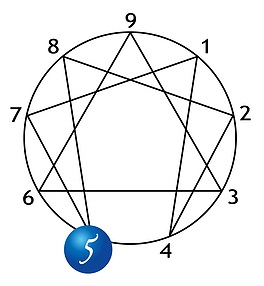
Enneagram Type Six, sometimes called the Loyalist or the Skeptic, belongs to the Head triad. Those of this Enneatype tend to feel the need for an external source of security, whether it be in the form of social connections, love, a political ideology or religion, etc. They are often friendly and want to show themselves as dependable and trustworthy to avoid danger and controversy, but they also have a skeptical streak that undermines their ability to find the security they need. They are often given to catastrophizing, questioning and poking holes into everything in hopes of finding the one thing that they can trust, but once they feel they have found it, they rarely question it.
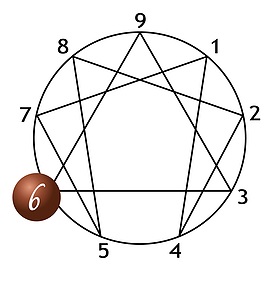
Enneagram Type Six

Enneatype Six Grows: Move to Nine

The beginning of a Six’s fear lies in their inability to give themselves the security and stable ground that they need. Because they lack a sense of inner guidance, they usually look outside of themselves, finding it in people, institutions, systems of all type, etc. Ultimately, Sixes want their anchor to be beyond doubt (that is, in a way, perfect).

This is obviously a problem, since an honest look at anything and anyone will reveal their flaws. Although some Sixes manage to convince themselves to stick to something even if imperfect, the nagging sense of uncertainty remains.

When a Six learns to trust themselves, their decisions, their own processes and learn to see the difference between a healthy dose of skepticism and an excessive one, they can also relax and, in doing so, they pick up certain qualities of healthy Nines. Enneagram Type Nine is often trusting of others and allows space for honest interaction without the drama that average Sixes often stir up when they haven’t yet sorted a person in trustworthy or dangerous.

Usually, Nines tend to see beyond division and can capture the unitary essence of all processes, including interpersonal ones. In integrating aspects of Enneatype Nine, Sixes, usually become much calmer and more capable of seeing the simple essence of a situation without getting lost in a myriad contradictions and doubts. More importantly, healthy Sixes develop the kind of self-assurance that they usually lack.

Courage, the Virtue of Enneagram Type Six

Enneatype Six Under Stress: Move to Three

Enneatype Six tends to create secure and stable social connections, which they reinforce by being trustworthy and friendly. Largely they do it to reduce the uncertainty of life (it wouldn’t be a stretch to say that the Six’s socially cohesive instinct is what brought humanity together and created the basis for society)

Unfortunately, this strategy is not always effective. Depending on their particular situation, Sixes may feel that their life is too unpredictable and dangerous. They may feel like they are swimming in a sea of ungraspable alternatives whose consequences they can’t pin down and anticipate. When this happen, a Six may still try to create certainty, but if the strategy fails, they will go to their stress point, where they embody the less healthy qualities of Ennneagram Type Three.

Threes are the workaholics of the Enneagram, constantly trying to emerge and establish themselves as worthy of respect. At their worst, Threes are unreasonably competitive and tend to see everyone as an opponent to outdo, outfox, outperform at any cost and using any trick possible. Stressed Six embody this more antisocial aspect of Type Three, as they feel they can no longer trust others and must therefore learn to compete with them.

Highly cynical and with a generally negative outlook, unhealthy Six can try to constantly undermine others, as though doing this was necessary to deactivate the potential threat associated with other untrustworthy human beings. This behavior is often seen together with panicked responses to every minor setback and a tendency toward authoritarianism as a coping mechanism.

MQS
Enneagram Type Five – Growth and Stress

Enneagram Type Five, sometimes called the Observer, belongs to the Head triad. Those of this Enneatype are often recognizable for their tendency to withdraw from social contact and interaction with the world in order to observe it and accumulate knowledge and understanding. Fives tend to have a sense of energetic dearth, as though their inner resources weren’t enough for them to meaningfully impact the world, or even just to be in the world. Highly intellectual, they value objectivity and facts, which they often recombine in new and creative way, and are generally unsentimental and unbothered by social conventions.

Enneagram Type Five

Enneatype Five Grows: Move to Eight

Many Fives report that at some point they realized they were going through life as though they were constantly getting prepared for it, with the result that when they felt ready, life was already over. This is an understandably heartbreaking situation to be in, so it’s vital that Fives come to terms with it as soon as possible in order to live life before it’s gone.

A large chunk of a Five’s growth path comes from understanding that it is ok to get started without knowing everything, and that their marvelous mental abilities will inevitably go to waste if they don’t cultivate them in a practical setting and in the midst of real life action. Ultimately, Fives’ tendency to withdraw from others, withhold their presence and accumulate knowledge is a defense mechanism against fear, but as long as they withdraw they reinforce the implicit notion that the world is so fear-inducing that it must be seen from a distance.

The only way to break the cycle is for Fives to gradually let go of their tendency to let go of the world (it’s a letting go of the letting go) and to dive into it and take full charge of their body and their instincts, taking up space and showing up. In doing this, they start to embody the better qualities of Enneagram Type Eight, the most physically expansive and assertive of the nine type. Interestingly, Eights, like Fives, deal a lot with the idea of truth, but Eights have an instinctive awareness of it, whereas Fives have an analytical understanding of it.

In allowing their insights to take physical form, Fives reduce their tendency to detach from reality and become capable of bringing their objectivity and knowledge to fruition. Their ability to let go of things is used not to renounce the world, but to experience it all equally in all its transient permutations. Detachment thus becomes non-attachment.

Non-Attachment, the virtue of Enneagram Type Five

Enneatype Five under Stress: Move to Seven

Fives generally hate having to jump into things without preparation. They tend to plan ahead as if they possessed half the energy, time and resources they actually have and often don’t communicate their thoughts unless they have had the time to polish, proof and justify them. This is why going to war with a Five in a field they know a lot about is often a lost cause: they are always five or six steps ahead in the argument.

But, as much as they would like to be omniscient, Fives aren’t. The world is too complex to hold it all inside one’s mind before one ventures into it (which is how Fives get started on their journey of observation.) Variables are bound to intrude into one’s views. More importantly, Fives may not always have the chance to step back from quickly unfolding situations to take a breath and organize their mental response.

When this happens, Fives may initially still try to withdraw, but if their usual strategy becomes impossible, it is not uncommon to see them make fools of themselves, like unhealthy Sevens. This is not because Fives (or Sevens, for that matter) are actually fools, but because they panic at the prospect of not being able to employ their typical strategy.

Often, Fives that move to Seven under stress become volatile, scattered, given to missing the mark with odd jokes or comments. Because they haven’t had the time to establish clear boundaries within which they feel secure, they become erratic and aimless, thus lending credence to their own worst fear of being incompetent and needing to withdraw even further.

MQS

Tarot Encyclopedia – The King of Swords

(Note: this is a collection of the meanings attributed to the cards by some occultists in the past centuries. It does not reflect my own study or opinion of the cards. It is only meant as a quick comparative reference as I develop my own take.)

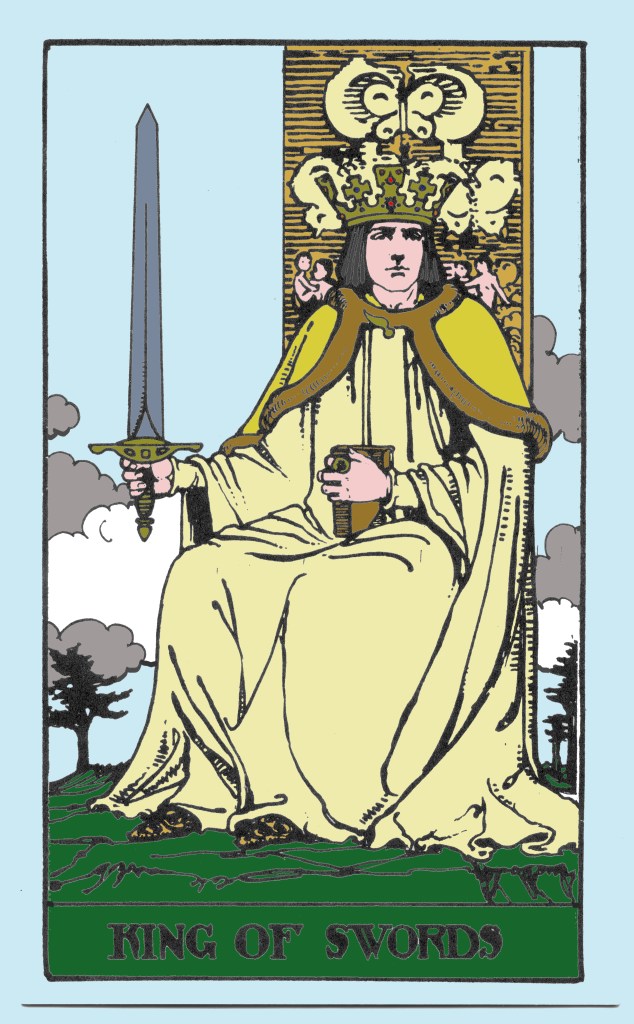
A collection of interpretations for the King of Swords
The King of Swords from the Builders of the Adytum (BOTA) tarot deck

Paul Foster Case (and Ann Davies)

The time period is from the beginning of the last decanate of Virgo to the end of the second decanate of Libra, September 13 to October 12, under the combined rulerships of Venus in Taurus, Venus in Libra, and Saturn-Uranus in Aquarius. Meanings: a man of strong and powerful imagination; hard worker and having authority; keen in understanding law and capable of excellent cooperation; somewhat distrustful and suspicious and therefor e hard to convince. He sometimes surprises his friends by sudden changes of attitude, although he is usually overcautious and analytical. In a divinatory lay-out:
Well Dignified: he is friendly to the Querent and will cooperate with him. lll Dignified: he is inimical, harsh, malicious and plotting, obstinate and wholly unreliable.
Dark hair and dark eyes.
(From the Oracle of Tarot course)

A. E. Waite

He sits in judgment, holding the unsheathed sign of his suit. He recalls, of course, the conventional Symbol of justice in the Trumps Major, and he may represent this virtue, but he is rather the power of life and death, in virtue of his office. 
Divinatory Meanings: Whatsoever arises out of the idea of judgment and all its connexions-power, command, authority, militant intelligence, law, offices of the crown, and so forth. 
Reversed: Cruelty, perversity, barbarity, perfidy, evil intention.
(From The Pictorial Key to the Tarot)

Aleister Crowley

(Note: Crowley and the Golden Dawn swapped around King and Knight. This is in part true of Waite as well.)

The Knight of Swords represents the fiery part of Air; he is the wind, the storm. He represents the violent power of motion applied to an apparently manageable element. He rules from the 21st degree of Taurus to the 20th degree of Gemini. He is a warrior helmed, and for his crest he bears a revolving wing. Mounted upon a maddened steed, he drives down the Heavens, the Spirit of the Tempest. In one hand is a sword, in the other a poniard. He represents the idea of attack.

The moral qualities of a person thus indicated are activity and skill, subtlety and cleverness. He is fierce, delicate and courageous, but altogether the prey of his idea, which comes to him as an inspiration without reflection.

If ill-dignified, the vigour in all these qualities being absent, he is incapable of decision or purpose. Any action that he takes is easily brushed aside by opposition. Inadequate violence spells futility. “Chimaera bombinans in vacuo”.

In the Yi King, the fiery part of Air is represented by the 32nd hexagram, Hang. This is the first occasion on which it has been simple to demonstrate the close technical parallelism which identifies Chinese thought and experience with that of the West. For the meaning is long continuance: “perseverance in well-doing, or continuously acting out the law of one’s being”, as Legge puts it in his note on the hexagram; and this seems incongruous with the Qabalistic idea of violent energy applied to the least stable of the elements. But the trigram of Air also indicates wood; and the hexagram may have Suggested the irresistible flow of the sap, and its effect in strengthening the tree. This conjecture is supported by the warning in line 6: “The topmost line, divided, shows its subject exciting himself to long continuance. There will be evil.”

Allowing this, the image of “the extended flame of mind”, as Zoroaster calls it, may well be subjoined to the former description. It is the True Will exploding the mind spontaneously. The influence of Taurus makes for steadiness, and that of the first decanate of Gemini for inspiration. So let us picture him, “integer vitae scelerisque purus”, a light-shaft of the Ideal absorbing the entire life in concentrated aspiration, passing from earthy Taurus to exalted Gemini. Here, too, is shewn (as in the Yi) the danger to the subject of this symbol; for the first decan is the card called “Interference”; or, in the old pack, “Shortened Force”.
(From the Book of Thoth)

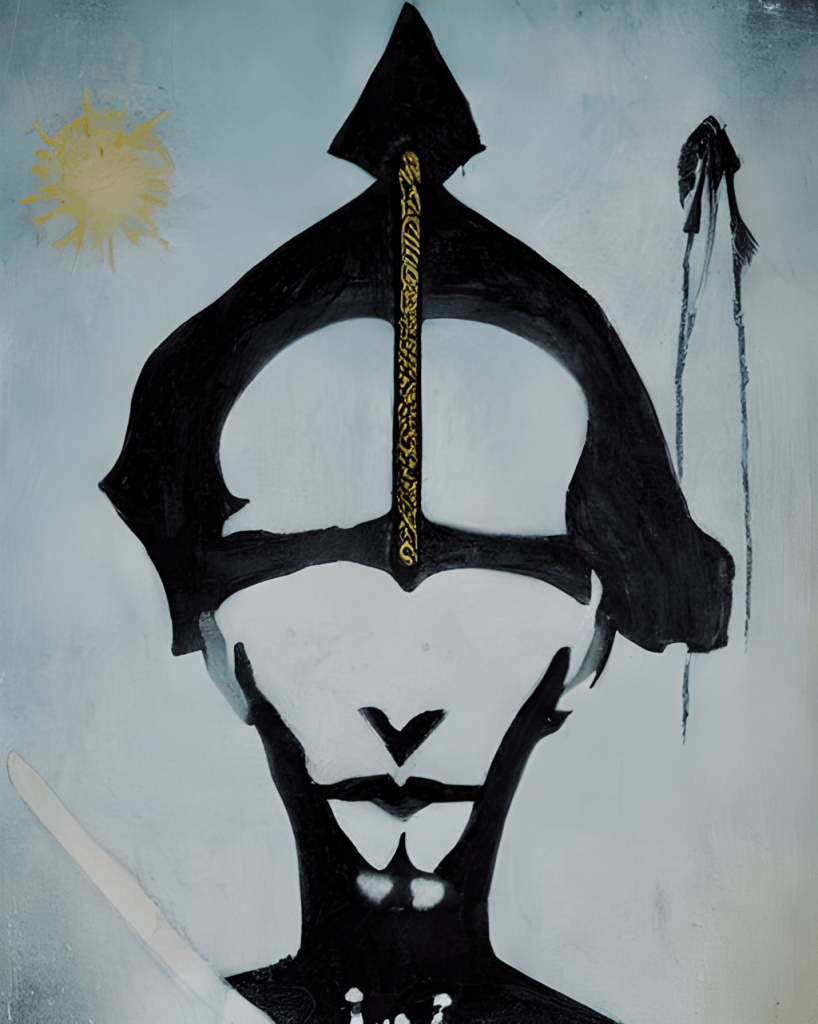
Oddly Bismarckian AI-generated Illustration for the King of Swords

Golden Dawn’s Book T

A WINGED Warrior with crowned Winged Helmet, mounted upon a brown steed. His general equipment is as that of the Knight of Wands, but he wears as a crest a winged six-pointed star, similar to those represented on the heads of Castor and Pollux the Dioscuri, the twins Gemini (a part of which constellation is included in his rule). He holds a drawn sword with the sigil of his scale upon its pommel. Beneath his horse’s feet are dark-driving stratus clouds. He is active, clever, subtle, fierce, delicate, courageous, skilful, but inclined to domineer. Also to overvalue small things, unless well dignified. If ill dignified, deceitful, tyrannical and crafty.
Rules from 20 Degree Taurus to 20 Degree Gemini.

Etteilla

Man in Uniform
Upright: This card, as far as the medicine of the spirit is concerned, means, in its natural position: Man in Uniform, Man of the Law, Judge, Councilor, Assessor, Senator, Business Man, Medical Practitioner, Lawyer, Prosecutor, Doctor, Physician. – Jurist, Law-making. – Litigant [= Party to litigation], Jurisconsult.
Reversed: Malicious, Maliciousness, Perversity, Perfidy, Crime, Cruelty, Atrocity, Inhumanity.

MQS

The Via Puncti (Way of the Point) in Geomancy

I already said that I am not a big fan of complications in divination. Nor do I believe that the tendency to overcomplicate things is just modern: if we look in older Horary Astrology handbooks, for instance, they are filled to the brim with (often mutually contradictory) techniques that may be thrown at the chart in an attempt to smoke a positive judgement out of it.

Still, one technique that is relatively consistent in the tradition is that of the Via Puncti, or Way of the Point. Not all traditional sources talk about it, but I have found it to be occasionally helpful. As usual, techniques are not to be used blindly, but intelligently, like tools in the hand of a surgeon.

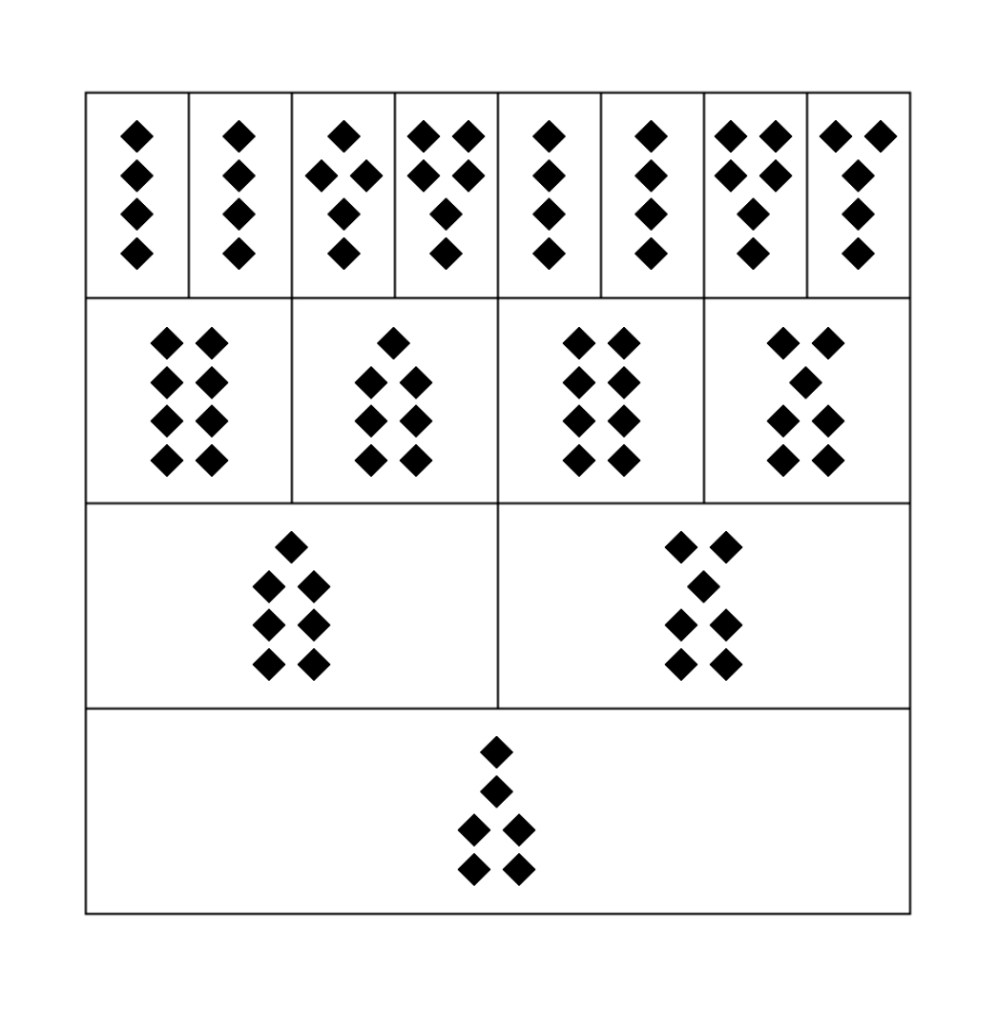
The long and short of this technique is as follows: some Judges have one point in their Fire line (the upmost one), while others have two. In fact, out of all eight possible Judges, four have one single Fire point (Carcer, Fortuna Minor, Via, Amissio), while the other four have two (Conjunctio, Fortuna Major, Populus, Acquisitio). Due to how Geomancy’s model works, whenever the Judge has one Fire line, it is possible to trace it back unequivocally to one of the four Mothers or Daughters (that is, to one of the eight figures at the top of the shield).

Geomantic Shield Reading, drawn with the Simple Geomancy app

In the above example, Fortuna Minor is the Judge. It has one point in its Fire line. This one point is found again in the Left Witness, Laetitia, and again in the third Niece, which is again Laetitia, and finally in the second Daughter Puella. No other path is possible. This is always so (if it isn’t so and you’ve calculated the chart by hand, you’ve made a mistake.)

Usually, the Via Puncti or Way of the Point can be looked at as a root cause for at least some aspects of the final answer. In the example above, for instance, a woman may be the cause (Puella). Or, if we take the House in consideration, since Puella is in the Sixth house, it may indicate that a sickness is the cause, or a servant/subordinate, or a pet, depending on the question.

I repeat: depending on the question. I make no effort to squeeze a consideration of the Via Puncti into my readings. If it is helpful, and if the question lends itself, I will consider it.

Geomantic Shield Reading, drawn with the Simple Geomancy app

In this second example, Acquisitio is the Judge. Immediately the Via Puncti branches off, as both Witnesses have two points in their Fire line. John Michael Greer says that this shows more complex causes, but he fails to mention that, in the old books, this is not considered a valid Via Puncti. I don’t know if I am unaware of some of the old material or if Greer gave in to his tendency to mix innovation (which is fine) with pretense that it is rooted in tradition. You can of course choose to experiment with Greer’s version of the Via Puncti. Personally, I don’t even always regard it when it is there (as in the first example) let alone when it is not there.

One thing that the existence of the technique shows, though, is that the Golden Dawn’s way of reading the astrological chart by placing the mothers in the angles is completely baseless, and is a typical example of the “let’s make up a secret” tendency of the occult community.

MQS

The TikTok Psychic Who Screwed Herself Up

One of my favorite things in life is when idiots in the online spiritual community are outed for the entitled, narcissistic, exploitative asses that they are.

I don’t know if you are aware of this story, but a TikTok psychic literally accused an innocent person of being the mastermind behind a series of murders, and she had other leg to stand on except that she’d done a reading.

I have honestly no idea if this psychic was just doing it to drive traffic to her profile or if she is seriously that deluded. The fact that, whenever a celebrity dies, swathes of psychics get their 15 minutes by “channeling their spirit” on youtube would argue in favor of the woman being just another tacky, phony con artist. However, the fact that she apparently chose to represent herself in court does lend the possibility of her being delusional some credibility.

Either way, she’s royally screwed herself up, though the damage she’s done both to the innocent person she’s accused and to the families of the murder victims can hardly be repaid.

I feel one day a study should be made on the incredible mix of ignorance, entitlement and sheer delusion that pervades the community, especially the online one. (I am aware of studies done on the new age community, but I believe the modern, online community should be studied critically)

(To be clear, I also do readings on current events as case studies for myself. I never publish nor talk about them for the obvious reason that exploiting personal tragedies is not my idea of a good time. )

MQS

A Tarot Reading is like a Movie (Example)

The astounding thing about all oracular forms is that they reflect the real world in the same way a recording of a scene does. This reading is from five or six months back, and it was partially confirmed a couple of weeks later, but the final feedback came only very recently.

I friend of ours was dating a new man. She’d been out of the dating scene for a while due to focusing on other things in her life. But she noticed that the guy was acting weird, as if he was looking for any excuse to cause a fight that would end the (still budding) relationship. We asked the cards and this is what happened:

Relationship reading with the tarot (Tarocchi di Layla, by Elisa Scerrato)

The cards of the cut are the Fool and Justice. Justice usually represents a solid union, not one that has just started and where the partners don’t even live together. The instability caused by the fool was already an alarm bell.

Then we have a full scene playing out: the Tower breaks up the relationship between her (Empress) and him (Emperor), but there is an obscure (Moon) influence next to him. Another woman (Popess / High Priestess). This is not even a new girl he met. The Popess has the World card next to her, showing a solid family, and the Hanged Men indicates being bound to someone, a serious commitment. I told our friends that I didn’t think the relationship had much of a future, and that she should be careful that there wasn’t any other woman around the dude.

A couple of weeks later he left her abruptly via text message. A couple of days ago, we met with our friend and she confirmed the guy was married all along, although he has an on again, off again relationship with his wife and, due to his cultural background, he doesn’t see it as strange to date multiple women, even without them knowing.

Notice how the readings flows from one card to the next in true cinematic fanshion. This ability of divination to act as a mirror is partly why I don’t believe in asking the cards for advice. This would be like asking a map for advice on where to go. The map gives you a larger picture, but the advice doesn’t come from the map: it comes from checking your plans against the available options.

MQS

The Virtue Signal

Previous / Back to Index / Next

From the Microcosmicon, 17:

If God Exists He’s a Hippie.

Science Confirms: Universe Wants Us to Make Love, Not War.

Harmony of the Spheres Makes Aggressive Lab Rats Love Each Other.

‘Virtue Signal Key to World Peace,’ Says Scientist Who Harnessed Mysterious Space Frequency to Tame Lions.

First Experiment on Humans Confirms: Virtue Signal Effective in Conflict-Solving.

Legislators Looking Into Uses of Virtue Signal. ‘Only in Extreme Cases.’

Virtue Signal Used on Difficult Schoolchildren. Why It’s a Good Thing.

Crime Rate Drops Thanks to Virtue Signal. World Peace Next.

Unidentified Objects Sighted Over DC.

‘Negotiations with Invaders Successful,’ Says President After World Population Decimated.

The Virtue Signal

MQS

Playing Cards – The Ace of Spades VS the Five of Diamonds

I was asked in a private message about the difference between the Ace of Spades and the Five of Diamonds in my way of reading playing cards, since both seem to signify change. This is a nice question, so I thought I’d write an article about it. Maybe I’ll write other comparative articles if I feel inspired to.

First off, let’s start with two obvious facts. The Ace of Spades belongs to the Suit of Spades, which is the most negative in the deck. Spades have very few redeeming qualities. They represent the dark side of existence, pain, grief and sorrow. The Suit of Diamonds, on the other hand, is neutral, with some positive undertones. It is a symbol of energy, change, progress. It is connected to technology and science, to money, wealth, intelligence. Broadly, it shows impulses and new impulses. This fact alone indicates that the Ace of Spades must have more negative connotations than the Five of Diamonds.

Furthermore, the Ace of Spades is, well, an ace. Aces have a powerful impact on any reading, as they can show the manifestation of new currents of destiny, new life phases, etc. They indicate the beginning of something. Even when they don’t, they are still very dominant cards, and we must always pay close attention to them. Fives, on the other hand, are roughly in the middle of the sequence, so the change they indicate is more akin to a transition within the same sequence or current of events.

This is, of course, somewhat vague and needs to be understood within the context of each reading. However, when we combine the suit with the number, we do have a general picture of the Ace of Spades as a very drastic card, whereas the Five of Diamonds, unless supported by drastic cards, tends to show a smoother transition, which is also less all-encompassing.

There is something else to take into account. Calling the Ace of Spades the card of change is somewhat reductive, as if we were trying to neutralize it. The Ace of Spades is, for the most part, a negative card. One of the ways my teacher called it, in addition to ‘the Death card’ was also ‘a thorn in the heart‘ though I don’t remember if I talked about this in the post. Perhaps I, too, have been guilty of playing it down.

A thorn in the heart is something that makes us suffer beyond words. It symbolizes grief, bereavement, sometimes even trauma. Even when followed by positive cards, the Ace of Spades represents painful changes that take a toll on our psyche, changes we are likely to perceive as some kind of great loss. The somewhat sterile concept of ‘change’ pales in comparison to this description.

The Five of Diamonds has, by itself, none of these connotations. It shows transition in the most neutral sense possible. For instance, when found next to the Ace of Hearts, i.e., the house, the Five of Diamonds can show renovations or changing the place of some piece of furniture, depending on the accompanying cards. The Ace of Spades next to the House can show grief in the family or coming from the family, and if it does indicate change, it is more likely to indicate an eviction or an unwanted change of residence.

Again, this is rather vague: we need to understand the cards within the context of a concrete reading, but by and large that’s my experience.

MQS

Fatalism and the Moment of Divination (Notes on Divination)

This post is part of my Notes on Divination series. This gets somewhat philosophical and is rough and not organized, so bear with me.

In the previous post in this series, I started discussing some general ideas on why fatalism is an inherently flawed view, while in the one before I had shown why pure free will makes just as little sense. To summarize, pure free will simply doesn’t take into account the fact that we don’t live and move within a blank space that we can change at whim.

On the other hand, pure fatalism cannot even be articulated as a view without contradicting itself: if fatalism is real, then my fatalism is not due to me assessing reality and forming a fatalistic worldview that corresponds to how reality factually is, but it’s due to destiny forcing me to be a fatalist. This implies that when I say I am a fatalist, I don’t really mean it. I *cannot* really mean it – It is conceptually impossible. In order to be a fatalist, I must have the freedom to develop a fatalistic worldview. This is a contradiction.

My view of the universe is consequently inherently libertarian, though it is a reasonable and limited libertarianism.* No matter how small our personal freedom is, it exists and is the place we our soul inhabits. Freedom is the consequence of consciousness. When I become aware of something, I posit it as the object of my awareness, outside of myself, and therefore incapable of completely determining my whole being.

Now let us ask: what happens during a (serious) divination session? What does divination do, at heart? At the very least, divination must either make us aware of unknown facts about the past, present or future, or it must shed new light on known facts, thus revealing them from a different, previously unknown point of view. A divination session that does not do this is not a divination session. It may or may not be helpful in other regards, but it is not divination.

The Moment of Divination

It is clear, therefore, that divination is inherently connected to consciousness and to increasing our conscious awareness of (our) reality. This is another reason why a (mildly) libertarian view of divination makes more sense. Suppose you cross the fortune-teller’s palm with silver and then you get told you will win over your crush: is the fortune-teller right because she actually sees this in the crystal ball or is she doomed to say this to you? If she is doomed to say it, then the fact that she is saying it has nothing to do with the statement being true and everything to do with destiny forcing her to say it.

Furthermore, in revealing your future to you, the fortune-teller cannot help but modify it. This has nothing to do with some odd theories I’ve read on the internet, about the fact that if you predict something you make it happen. If that were true, I could predict myself into a billionaire. Besides, even if the fortune-teller saw your future and didn’t tell you, she would still be modifying your future.

Reality is much more subtle. Suppose that X is going to happen to you. If the fortune-teller tells you, then you are aware of X happening. X happening with your awareness is different from X happening without your awareness. The fabric of the fact itself changes with your awareness of it, for the simple fact that something that happens with your knowledge is not something that happens without your knowledge.

The moment of divination, therefore, has a very important place in our life, because it is part of our life, but it is also a part of our life wherein our awareness of reality increases, thereby changing our reality. This does not automatically mean that divination can make us realize every whim that crosses our mind, nor that it can always save our butt. Sometimes the only choice possible is between accepting a fact and not accepting it.

I like to liken an oracle to a friend on top of a high building, who has a wider view of our surroundings than us as we move in a busy intersection of streets, and who texts us hints that increase our understanding of our reality and can help us make better choices, though sometimes the choices we can make are so severely limited as to border on predestination.

MQS

* I mean ‘libertarian’ from a metaphysical standpoint.