All posts by MQS

Living at the intersection of occultism, fiction and philosophy, I travel the planes at a moderately quick pace. I read, I do magic, I cook for hubby. Confused by the number of things I talk about? Good, confusion is a nice thing ;)

Enneagram Comparisons | Type One and Type Five

Enneagram Type One and Enneagram Type Five can occasionally resemble each other in that both are rational, unsentimental, emotionally controlled, but they are also very different. Ones are a Body type, and they are concerned with acting rightly as an autonomous being in the world. Fives are a Head type, and they are focused on security, which they get by detaching from the world and identifying with their rational power, which is often considerable.

Both Ones and Fives have a difficult relationship with emotions. Both tend to set their own subjective reaction to reality aside: Ones to make truth and righteousness prevail; Fives to quickly get to the logical core of a given situation and analyze it from that objective standpoint. Fives, however, do not consider emotions such as anger as something that needs to be justified, as Ones do, but rather know emotions to be logically meaningless and therefore unimportant to their survival strategy. Ones on the other hand are nagged by emotions (especially anger) that they would love to express but fail to.

Both Ones and Fives can care little about social approval, but while Ones can stand up to the crowd for what they believe to be the right ideal, that is, the one everyone should obey, Fives are more clearly anarchic and chaotic, and laugh in the face of consensus not because they have the ultimate solution to push, but because they know this consensus to be relative, arbitrary, meaningless. In the end, Fives are inherently outsiders, while Ones are only outsiders if they deem the insiders wrong.
Truth

Ones use their mind as a tool to strategize the best, most moral and most correct way to embody their ideal. However, they rarely question this ideal from a rational standpoint, although they are keen on finding positive proofs that it is, indeed, the right ideal. In a way, they resemble those Medieval theologians who made up proofs of the existence of a God they already believed in anyway. Ones are rarely concerned with ideas for the sake of ideas. They are action-oriented and want to improve themselves and the world. In this, they have a very somber, serious, practical demeanor.

Fives, on the other hand, would perceive this behavior as an arbitrary limitation of their analytical faculties. They are far more playful and far more unrestrained, almost Dionysian, in their rationality. They entertain thoughts and create new concepts, worlds, stories just for the joy of doing so, or just for the joy derived from destroying them, like a child on a beach gleefully destroying a sand castle it just spent an hour building. Fives rarely care about right and wrong, moral and immoral, or rather, they usually don’t let these concepts color their objectivity. Their rational abilities are like a highly corrosive substance that burns its way out of every container: no concept, ideal, belief can stop it and keep it sealed forver. Of course, Fives are also terribly impractical and usually care as little to lead others as they care to follow them.

MQS

Public Safety

Previous / Back to Index / Next

From the Microcosmicon, 18:

They show up at your door, armed.
“Have I done anything wrong?” you ask.
“Sir, the city’s population has dropped below critical level. You are required to supply the Municipal Authority with your semen.”
“Why me?”
“Your profile has been selected based on our genetic database.”

So you sigh, you follow them, you comply.
You realize now there’s a small being growing in an artificial womb, somewhere, who is like you.

One day, they show up again.
“Sir, the child is defective. Your genetic map contained some errors. You must follow us. I’m sorry, but it’s for public safety reasons.”

In the Public Interest

MQS

Enneagram Comparisons | Type One and Type Four

Enneagram Type One and Enneagram Type Four are almost nothing alike, so much so that they represent the arrow each of the other (Four grows at One, One stresses at Four). Ones are a Body type and are concerned with acting rightly in order to justify their existence as autonomous beings, while Fours are a Heart type and focus on what they are missing that would allow them to be happy.

Both Ones and Fours usually have a somewhat negative view of the world. However, Ones see the world as something to redeem, while Fours see the world as something they long to be redeemed from. For a One, most things are imperfect and require their guidance and action in order to be straightened out; for a Four, the world is a place of exile, and the best they can do is either to tolerate the pain or to wait for someone to rescue them.

Both Ones and Fours can focus on what they are missing or lacking, but in different ways: Ones feel that they are falling short of an objective ideal, and this spurs them into action, while Fours feel they are missing something more existential, and this lack (which they may not even be able to put a word to) singles them out as tragic victims.

Longing

Ones are usually objective, rational and somewhat impersonal, and as such there is a sobriety in them that is missing in Fours. They deal in terms of facts, albeit facts colored by their value judgements, and tend to be practical. They are extremely organized, dependable, tidy and usually try to take themselves out of the equation when judging a situation.

None of this is true of Fours. Fours relate everything to themselves, put great value on their subjective reactions and feelings and whatever schedule they try to submit themselves to is almost sure to be disrupted by their need to withdraw from objective reality to take an aromatic bath in some mix of dark emotions they’ve saved for a special occasion. Furthermore, Fours may feel that rules are unimportant or beneath them, because they fail to capture the essence of their life. Indeed, one of the reasons Four grows at One is that they learn to be more principled and consistent.

On the other hand, there is an interpersonal component in Fours that is almost completely absent from Ones. Fours feel rejected by the world and envy others, but they also long to be rescued from this state by the right people who will relate to them in a special way. Ones, of course, long for relationships like most other human beings, but their primary focus is on changing themselves and the world so that everything is as it should be.

MQS

Sibilla Reading – Real Estate

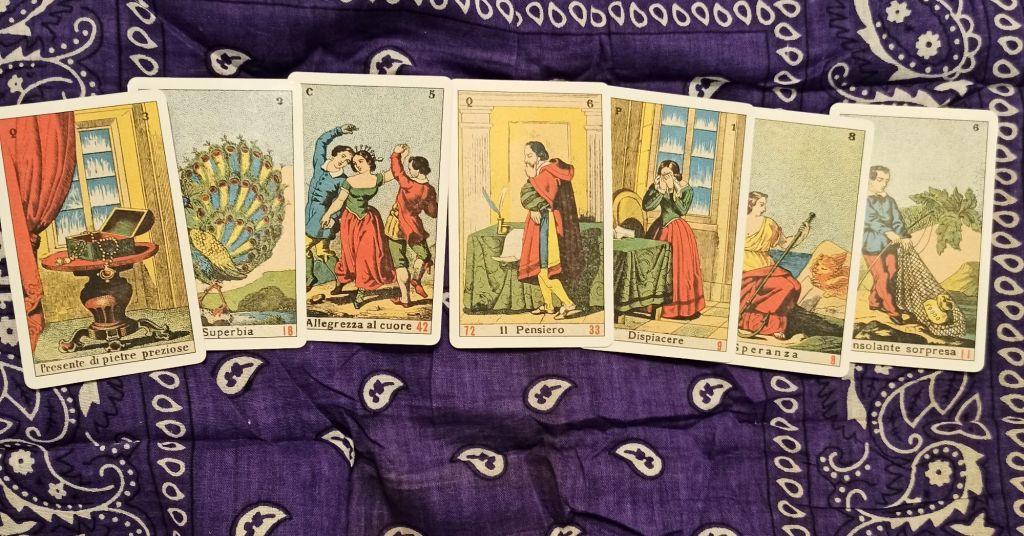
I said some time ago that my husband and I are looking for a home (I have a tarot reading ready for that). I also wholeheartedly believe that once you are interested in something, everyone else who has the same interest tends to show up in your life, and real estate questions have been common lately. Here’s the spread for a woman who asked if she would manage to buy a house she was interested in (it started out as a five card spread, but I asked her to draw two more cards, for reasons that will become obvious shortly, and then a third I forgot to take a picture of)

Real estate question with the Vera Sibilla Italiana

The first cards that caught my attention in the original five cards are the Five of Hearts and the Eight of Diamonds. Traditionally this means an engagement ring, but in this context it shows the proposal of a down payment (which is basically your engagement ring with the house you want to buy). According to the Peacock card between the two, this is a very high down payment, so I asked the querent, and she said they are (understandably) trying to pay off as much as possible in advance, almost half the total price.

The Thought card gives us some insight into the querent’s psyche: since it is followed by the Ace of Spades, she is worried, preoccupied or pessimistic. But the spread clearly isn’t complete, so I asked her to draw two more cards, and these were the Eight of Hearts, Hope, and the Six of Clubs, the Surprise. Clearly things will end up well, because these two cards together indicate the receipt of the hoped for money or the receipt of awaited money – for instance, money you’ve loaned or invested.

So I asked the querent if she’s waiting for money to invest into the home and she confirmed that she has some money tied down in an investment and she’s waiting for her bank to agree to free that money ahead of time. I was 99% sure this was possible, but to be on the safe side I asked her to draw a further card: this was the Seven of Clubs, the Realization (gran consolazione). Everything will be fine.

MQS

MQS

Tarot Encyclopedia – The Queen of Wands

(Note: this is a collection of the meanings attributed to the cards by some occultists in the past centuries. It does not reflect my own study or opinion of the cards. It is only meant as a quick comparative reference as I develop my own take.)

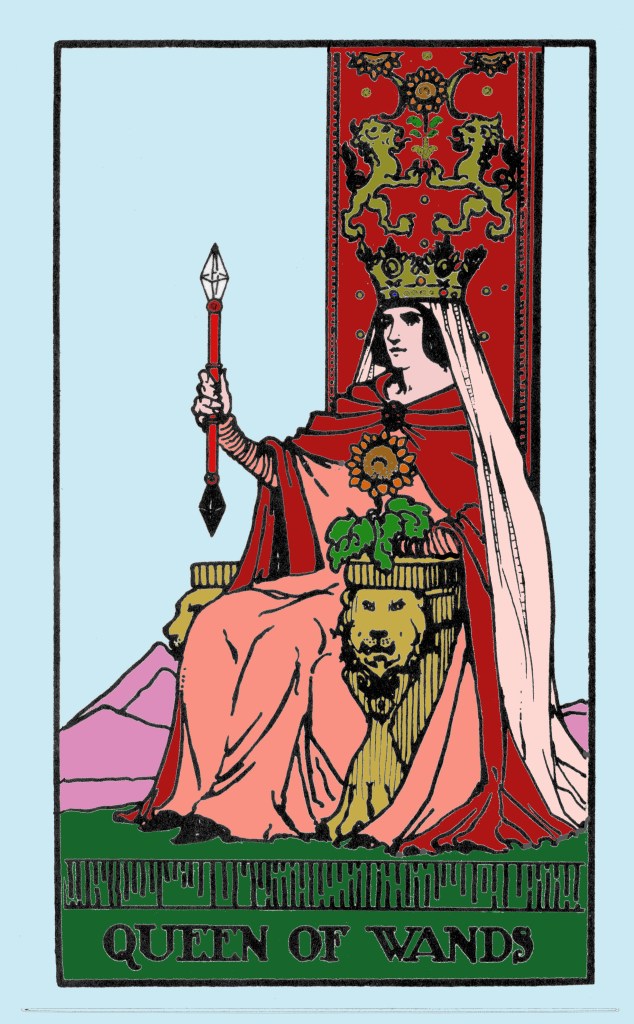
The Queen of Wands from the Builders of the Adytum (BOTA) tarot deck

Paul Foster Case (and Ann Davies)

The time period related to the Queen of Wands is from July 13 to August 12, symbolizing the influence of Jupiter and Neptune in Cancer and of the Sun and Jupiter in Leo. The basic power suggested by this Key is that of command.
Well Dignified: in a divination the Queen of Wands symbolizes a kind, generous woman, resolute in the face of opposition, strongly psychic and intuitive but practical in applying her spiritual gifts; intense; magnetic ; friendly to the querent and a favorable influence for the success or business of the querent.
Ill Dignified: Inimical to the querent; obstinate, dangerous woman, unfavorable to querent’s affairs; revengeful and tyrannical.
(From the Oracle of Tarot course)

A. E. Waite

The Wands throughout this suit are always in leaf, as it is a suit of life and animation. Emotionally and otherwise, the Queen’s personality corresponds to that of the King, but is more magnetic. Divinatory Meanings: A dark woman, countrywoman, friendly, chaste, loving, honourable. If the card beside her signifies a man, she is well disposed towards him; if a woman, she is interested in the Querent. Also, love of money, or a certain success in business. Reversed: Good, economical, obliging, serviceable. Signifies also–but in certain positions and in the neighbourhood of other cards tending in such directions–opposition, jealousy, even deceit and infidelity.
(From The Pictorial Key to the Tarot)

Aleister Crowley

The Queen of Wands represents the watery part of Fire, its fluidity and colour. Also, she rules in the Zodiac from the 21st degree of Pisces to the 20th degree of Aries. Her crown is topped with the winged globe and rayed with flame. Her long red golden hair flows down upon her armour of scaled mail. She is seated upon a throne of flame, ordered into geometrical light by her material power. Beneath the throne the surging flames are steady. She bears a wand in her left hand; but it is topped with a cone suggestive of the mysteries of Bacchus. She is attended by a couchant leopard upon whose head she lays her hand. Her face expresses the ecstasy of one whose mind is well in-drawn to the mystery borne beneath her bosom.

The characteristics of the Queen are adaptability, persistent energy, calm authority which she knows how to use to enhance her attractiveness. She is kindly and generous, but impatient of opposition. She has immense capacity for friendship and for love, but always on her own initiative.

There is as much pride in this card as in the Knight, but it lacks the spontaneous nobility which excuses that error. It is not true pride, but self-complacent vanity and even snobbery.

The other side of her character is that she may have a tendency to brood, come to a wrong decision thereon, and react with great savagery. She may be easily deceived; then she is likely to shew herself stupid, obstinate, tyrannical. She may be quick to take offence, and harbour revenge without good cause. She might turn and snap at her best friends without intelligible excuse. Also, when she misses her bite, she breaks her jaw!

In the YI King, the watery part of Fire is represented by the 17th hexagram, Sui. It indicates reflection upon impulse, and the consequently even flow of action. There is great capacity for lucid conception and steady prosecution of work; but this is only at the bidding, and under the guidance, of some creative mind. There is a tendency to be fickle, even disloyal; the ideas which she obeys make no deep or permanent impression. She will “cleave to the little boy and let go the man of age and experience” or the reverse (lines 2 and 3) without realizing what she is doing. There is liability of fits of melancholy, which she seeks to cure by bouts of intoxication, or by panic-stricken outbursts of ill-considered fury.
(From The Book of Thoth)

Strangely Crowley-esque AI-generated illustration for the Queen of Wands

Golden Dawn’s Book T

A CROWNED queen with long red-golden hair, seated upon a Throne, with steady flames beneath. She wears a corslet and buskins of scale-mail, which latter her robe discloses. Her arms are almost bare. On cuirass and buskins are leopard’s heads winged, and the same symbol surmounteth her crown. At her side is a couchant leopard on which her hands rest. She bears a long wand with a very heavy conical head. The face is beautiful and resolute.
Adaptability, steady force applied to an object, steady rule, great attractive power, power of command, yet liked notwithstanding. Kind and generous when not opposed.
If ill dignified, obstinate, revengeful, domineering, tyrannical, and apt to turn against another without a cause.
She rules the heavens from above the last Decan of Pisces to above the 20 Degree of Aries: including thus a part of Andromeda.

Etteilla

Country Woman
Upright: This card, as far as the medicine of the spirit is concerned, means, when upright: Country woman, housewife, economy, honesty, civility – Sweetness, virtue – Honor, chastity
Reversed: Good woman, goodness, excellence – Respectful, caring, obliging – Service, favor, benefit

MQS

Enneagram Comparisons | Type One and Type Three

Enneagram Type One and Enneagram Type Three belong to different centers: Ones are a Body type and Threes a Heart type. Therefore, there are broad differences between them, although they may have some similarities on the surface, depending on their particular life circumstances. Ones’ main aim is autonomous action, which they believe themselves entitled to only in so far as it is the right action. Threes, though, are not especially concerned with right or wrong, but rather with recognition and admiration.

From this fact alone it is clear that Ones and Threes live in vastly different worlds. Of course, Threes who have been socialized in an environment where morality and righteousness are, for better or worse, the standard to meet may occasionally behave like Ones. However, even in this case, Threes will generally do so as long as recognition is forthcoming.

Achieving

Furthermore, both Threes and Ones tend to be unsentimental and action-oriented, but again, in different ways. Ones feel the need to suppress their particular feelings, preferences and desires in order to abide by an ideal they believe to be more or less absolute. Threes, on the other hand, file their feelings away for later consideration in order to achieve a goal not necessarily because it is good, but because they believe it will bring them prestige.

In a word, if a One is the crusader converting the infidels of distant lands, the Three is the Roman emperor conquering a new province to be remembered forever. If Threes are the competitors, Ones are the referees.

Shame can be a powerful experience for both Ones and Threes. Ones constantly feel they need to work on themselves in order to improve their adherence to their ideal, and may feel shame in front of themselves if they feel they have failed to do so. Threes feel shame in a more mundane sense, as internalized social pressure to achieve a certain goal and improve their performance.

While both types can be perfectionistic, Threes are motivated by the joy and sense of challenge of making others see how praiseworthy they are, while Ones are prepared to go through the desert alone, or even for martyrdom if necessary.

Ultimately, like all Heart types, Threes are not necessarily principled individuals, which doesn’t mean they are immoral, but that the core structure of their personality does not revolve around principles as it does around interpersonal dynamics, and the opposite is true for Ones.

MQS

To Understand Divination You Need to Understand Its Place in the World

While in Italy for the holidays, I retrieved my first notes from when I had started learning cartomancy from the person who taught me to read playing cards and the Sibilla. It’s just a couple of loose sheets on the basic meanings of the playing cards, the main combinations and two spreads (the row of cards, hardly a spread at all, and the cross).

This brought back so many memories of that period, but most of all it reminded me of how eminently practical divination used to be before its current glamorization. Of course, over time I learned a lot more from that lady than what is on that couple of now yellowed sheets, but the core of the system is there, and I believe she must have passed it on to me in no more than two sittings, if not just in one.

People who spend their time musing on the arcane meaning of the splotch of color on this or that card in the latest glossy and overly ornate oracle deck may laugh at how bare-bones that system is, but they would forget what significance divination had for the regular folks that used it to solve everyday matters.

Folk systems of fortune-telling, especially by cards, were designed to be quickly memorizable in their main lines, because they formed part of every housewife/househusband’s toolkit of remedies to the difficulties and uncertainties of life.

When an elderly person passed their meanings on to you, they did so not to introduce you to a different world detached from the real one, where you could dilly-dally with pleasant platitudes, but to send you into this life with another string to your bow. In principle, they revealed their system to you for the same reason that they taught you how to make preserves and liquors and how to best cultivate your garden.

Folk fortune-telling, in a word, was just another traditional remedy to the complexities of life. It did not involve stepping into a different plane of existence, because the everyday one was already enough, and it was looked on with the same pragmatic, solution-oriented gaze that was cast on all other problems people faced back in the day. “Don’t forget to add a small pinch of sugar to your tomato sauce. The Ace of Spades is a thorn in the heart.”

This is an attitude toward life that is hard to recapture nowadays. The idea of divination being useful has been so utterly eradicated from our mind that, when we approach it again, we do it as if it were an exotic, quaint, arcane world separate from our own. Our immediate reaction is therefore to keep it separate from our life, divorcing it from veriafiable prediction.

This stance is fatal, because it implies that our world is not inherently meaningful as it is; that meaning is found elsewhere and cannot be reconciled with our real life; that in order to find it, one must learn to look at one’s everyday struggles as illusions or as silly preoccupations not worthy of the attention of those in the know about the cosmic mechanism. All this ends up debasing both life and divination, because once life is debased, divination, which is the language of life’s drama, becomes a meaningless mirror only reflecting vague vapors.

MQS

Enneagram Comparisons | Type One and Type Two

Enneagram Type One and Enneagram Type Two are quite different, although they can share some traits. Ones are a Body type, meaning they are chiefly concerned with autonomy, while Twos are Heart type, whose main preoccupation is recognition by others. Ones defend their autonomy by abiding by rules and trying to enforce them so as to justify their actions. Twos seek recognition in the eyes of others by being ‘helpful’ to them, that is, they try to carve themselves a place in another person’s life.

These different motivations can lead both Ones and Twos to similar activities and superficial behavior, such as being altruistic and of service to others, taking care of things the right way and just generally being a goody-two-shoes.

However, the two types are vastly different in most respects. Ones are dry, unemotional and often suppress their subjective preferences in the name of their ideal, while Twos are very wet in their behavior, being emotional and subjective, and they are less interested in how things are supposed to be than in doing what it takes to receive the love and appreciation they need.

Enneagram Type Two and Enneagram Type One
Service

Ones are famous for telling people off (“this is against the rules”) and are somewhat pessimistic, while Twos usually limit themselves in this regard, at most advising you in a motherly way (“that’s not good for you”) and tend to be upbeat and positive. Furthermore, Ones are more formal and rigid, while Twos tend to be informal and almost flirty with others, seeking close contact with them. Ones rarely unclench and are highly methodical, while Twos love to be in a flow in all their activities. Also, ultimately, Twos tend to be self-serving, even though an average Two would never admit it, even to themselves, while Ones usually deny themselves for the ideal they serve.

Interestingly, both types tend to have a problem with anger, but for different reasons: Ones can’t let the choler flow unhindered through them, so they put it in the service of a law (“it’s only ok to be angry if I get angry at things not being right”) which leads them to passive-aggressive behavior; Twos usually shy away from anger altogether because they feel it would endanger their relationship with the object of their desire, and only when they move to Eight under stress can they explode into a fit of rage if they feel scorned, unseen or when they see that their attempts at creating complicity (or codependence) with others are failing. But this rarely lasts.

Both Ones and Twos, though, tend to feel shame after a bout of anger: Twos almost always, because they fear their behavior has made them unlovable and unworthy of appreciation; Ones when they feel the anger wasn’t perfectly justified.

MQS

A Career Reading and How to Open the Spread

Sometimes a spread doesn’t give us enough information and we need to dig deeper. I know that there is a number of way to do it. The way that has been taught to me is called ‘opening the spread‘ and it simply means adding one to three cards in one point to obtain further information. At this point I should say that I try to use this technique only when I find it is strictly necessary. The cards are fickle friends, so they are best kept on a short leash, lest they start confuse us. Here is an example. A querent asked me about his career. This is what came out:

Career reading

He didn’t ask a specific question, but the first two cards, the Six of Diamonds and the Five of Diamonds, represent worry about change. The center of the spread is occupied by the Jack of Diamonds, which indicates messages. Note, also, that the spread is ovverrun with Diamonds.

At this point, I asked him to draw two cards to add to the Jack of Diamonds, and we got the Four of Clubs and the Eight of Diamonds, clearly an interview. Then I asked him to open the spread again on the Eight of Clubs, the job card, and the Ace of Clubs and Seven of Clubs came up, indicating the overcoming of obstacles.

The question I asked him was if he was waiting for a message about some change, possibly to do with a raise or another positive change, where he would need to solve new problems, and he said he had applied for a promotion with came with new tasks, and he was waiting for an answer. I told him he’d get it (Ten of Diamonds and Eight of Clubs). Yesterday he confirmed he got the promotion.

MQS

Enneagram Type Nine – Growth and Stress

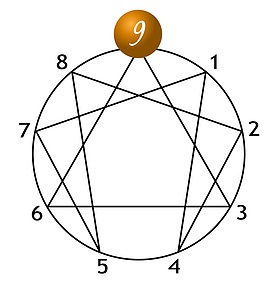
Enneagram Type Nine, sometimes called the Mediator, belongs to the Body triad. People of this Enneatype tend to be nurturing, accepting, agreeable and flexible. They are usually very good at holding space for other people, and they often manage to find common grounds with others. They are generally driven by a desire to avoid conflict, because they fear that conflict will make others fail to see them as independent individuals. They much prefer to work together with others, sometimes giving up on their own agenda to avoid rocking the boat, but also exerting a kind of silent passive resistance against things they don’t want to do or accept.

Enneagram Type Nine

Enneatype Nine Grows: Move to Three

Nines have a tendency to ‘disappear’, but not necessarily because they are shy or because they retreat from others in a traditional sense (like a Five avoiding draining contact or a Four witholding themselves to lick their wounds). Instead, average Nines fail to emerge as individuals in the eyes of others (and even in their own eyes): they often find it hard to articulate their preferences, projects and views out of fear of clashing with the people around them.

So while Nines are usually the most sociable of the three withdrawing types (Nine, Four, Five) they still withdraw from others by not opposing them or putting their foot down. This way of remaining merged with other people’s preferences and ideas and going with their flow can cause pain to the Nine as they may feel that they are being stepped on, even though they never drew a line to begin with, which makes it hard even for well-meaning friends to respect their boundaries.

However, as they develop and relax their mechanism, Nines learn to assert themselves more clearly. They learn that there is nothing wrong with having their own agenda, aims and views, and that in fact life cannot be meaningfully lived without choosing one’s path rather than remaining stuck in an all-encompassing mystical haze. Nines thus take on some of the qualities of healthy Threes.

Threes are very assertive people, with a strong desire to emerge and embody exceptional qualities. As one of the most driven Enneatypes, Threes’ way of getting the social acceptance they seek is not to blend in, but to stand out. As they take on some of these qualities, healthy Nines learn to take action by themselves, even if it means risking conflict with others by defending their own identity, their boundaries and their vision.

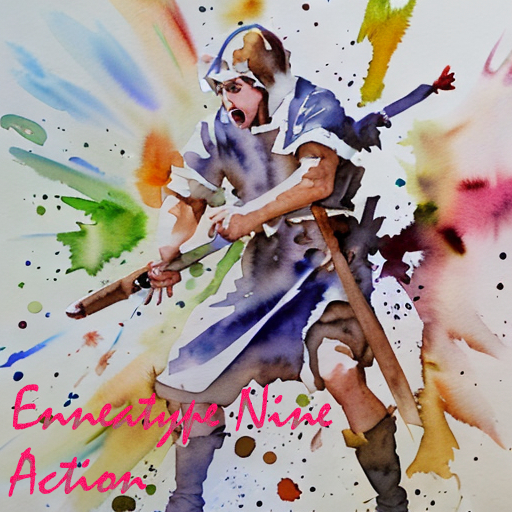
Action, the virtue of Enneagram Type Nine

Enneatype Nine Under Stress: Move to Six

Average Nines generally have a rather diffuse sense of self. Their ideal of a good day is one spent in peace, though not necessarily in inaction, as Nines can be very active people. What gives them peace is the idea that everything has its neat little place, everyone is a good neighbor, pleasantries are exchanged and no one causes any trouble. As long as everything goes like this, Nines don’t feel pressured into taking uncomfortable stances and they can simply occupy themselves with comforting thoughts.

Obviously, since life rarely takes place in Hobbitville, the Nines’ ideal rarely comes true, especially because many people don’t share Nines’ worldview. Nines usually go with other people’s flow as long as it doesn’t cause them any trouble and the even surface of their life is not ruffled. When someone threatens to bring serious change into their placid routine, Nines often engage in passive sabotage until the ‘agitator’ gives up in the face of the futility of their effort.

When this typical strategy fails though, Nines can become seriously stressed out as it becomes impossible for them to sweep every problem and irregularity under the rug. This is when they reach their stress point at Six. Enneatype Six is usually the opposite of Nine’s serene peace. High-strung and catastrophizing, they seek to poke a hole into every possibility and theory in order to find the one that will give them the certainty they are looking for.

In embodying some of Six’s negative traits, unhealthy Nines often become cynical toward those trying to bring change in their life. They will often conjure up endless amounts of excuses for why whatever has been proposed is silly or doesn’t work. In extreme cases, others may even be treated as threats to the Nine’s way of life and dealt with accordingly.