I thought this was a rather interesting reading, in part because of what it revealed and in part because it shows that divination requires rules and flexibility. I’ll probably talk about it again in an article.
MQS

I thought this was a rather interesting reading, in part because of what it revealed and in part because it shows that divination requires rules and flexibility. I’ll probably talk about it again in an article.
MQS
(Note: this is a collection of the meanings attributed to the cards by some occultists in the past centuries. It does not reflect my own study or opinion of the cards. It is only meant as a quick comparative reference as I develop my own take.)
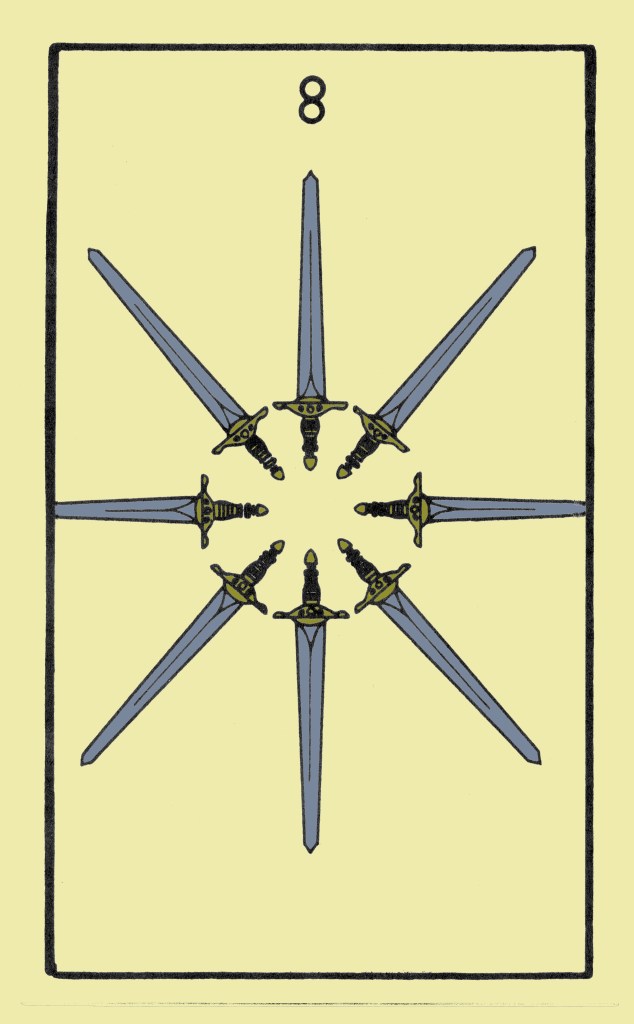
The time period is the first decanate of Gemini, May 21 to May 31, under the rulership of Mercury.
Well-Dignified: even well-dignified, the excessive Mercurial influence expressing in the Yetziratic field of unstable forces and changing forms, symbolized by the Eight of Swords, gives a marked tendency toward ill-directed or wasted action. Meanings in divination: force wasted in petty affairs; too much talk; too much illdirected action; the state of being terribly busy without accomplishing much; over-careful about details; could possibly intimate a crisis in affairs, and probably much talk, correspondence and moving about.
Ill-Dignified: malice; ill-natured gossip; pettiness; too much concern with personalities; disagreements with brothers and sisters. This Key divinatorily expresses unbalanced or excessive Gemini qualities in third house affairs. The se negative Gemini qualities portend the need for balancing the quick-mindedness and penchant for action of this astrological type with the d e pth of feeling and emotional warmth corresponding to Netzach and Venus.
Keyword: Mediocrity
(From the Oracle of Tarot course)
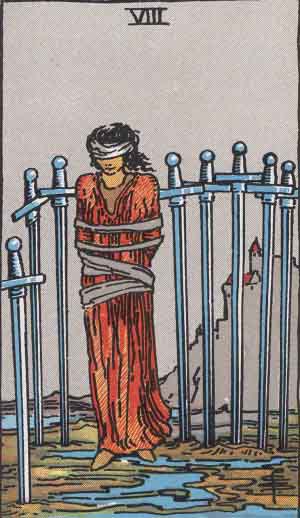
A woman, bound and hoodwinked, with the swords of the card about her. Yet it is rather a card of temporary durance than of irretrievable bondage. Divinatory Meanings: Bad news, violent chagrin, crisis, censure, power in trammels, conflict, calumny; also sickness. Reversed: Disquiet, difficulty, opposition, accident, treachery; what is unforeseen; fatality.
(From The Pictorial Key to the Tarot)
The Eight of Swords is called Interference. At first sight, it would seem easy to confuse it with the Eight of Cups; but the idea is, in reality, quite different. The card is attributed to Jupiter and Gemini; accordingly, there is no weighing down of the will by internal or external stress. It is simply the error of being good-natured when good-nature is disastrous. Gemini is an airy sign, an intellectual sign; Jupiter is geniality and optimism. This will not do in the world of Swords; if one must hit at all, a knock-out blow is best.
But there is another element in this card; that of unexpected (the Eights, being at heart Mercurial, are always that) interference, sheer unforeseen bad luck. Trivial incidents have often altered the destiny of empires, brought to naught “the best laid plans of mice and men”.
[…]
The number Eight, Hod, here signifies lack of persistence in matters of the intellect and of contest. Good fortune, however, attends even these weakened efforts, thanks to the influence of Jupiter in Gemini, ruling the Decan. Yet the Will is constantly thwarted by accidental interference.
The centre of the card is occupied by two long Swords pointed downward. These are crossed by six small swords, three on each side. They remind one of weapons peculiar to their countries or their cults; we see here the Kriss, the Kukri, the Scramasax, the Dagger, the Machete and the Yataghan.
(From The Book of Thoth)

FOUR White Radiant Angelic Hands issuing from clouds, each holding two swords, points upwards; all the points touch near the top of the card. Hands issue, two at each bottom angle of the card. The pose of the other sword symbols is reestablished in the centre. Above and below are the Decan symbols Jupiter and Gemini.
Too much force applied to small things: too much attention to detail at the expense of the principal and more important points. When ill dignified, these qualities produce malice, pettiness, and domineering characteristics. Patience in detail of study; great care in some things, counterbalanced by equal disorder in others. Impulsive; equally fond of giving or receiving money or presents;
generous, clever, acute, selfish and without strong feeling of affection. Admires wisdom, yet applies it to small and unworthy objects.
Hod of HB:V (Narrow, restricted, petty, a prison).
Therein rule the Angels HB:VMBAL and HB:YHHAL.
Criticism
Upright. This card, as far as the medicine of the spirit is concerned, means, in its natural position: Criticism, Unfortunate position, Critical moment, Critical time, Decisive instant, Unfortunate situation, Delicate circumstance, Crisis. – Examination, Discussion, Research, Blame, Censure, Critical comment, Critical epilogue, Control, Disapproval, Condemnation, Cassation, Judgment, Contempt.
Reversed. Accident, Difficulty, Particular circumstance, Conjunction, Occurrence, Accessory, Unconscious, Obstacle, Delay, Hindrance. – Abjection. – Contestation, Contradiction, Opposition, Resistance, Divergence. – Unplanned, Unforeseen, Chance, Adventure, Occurrence, Destiny, Fatality, Accident, Misfortune, Symptom
MQS
The great thing about occultism being my life but not my job is that I get to do whatever I please. Well, right now it pleases me to talk about this deck, somehow.
MQS
I Tarocchi Parlano (The Tarot Speaks) by Maria Luigia Ingallati is perhaps the most well-known book about the Tarocchino Bolognese in Italy, and the one that, thanks to its success, launched the rediscovery of this deck outside of its native region. Since the publication of Ingallati’s book, the Bolognese tarot has enjoyed a small but growing cult following. This, we shall see, is probably the book’s greatest merit, though not the only one.
Ingallati herself is not from Bologna. She relocated there many years prior to the publication of her first book (‘Il Tarocchino Bolognese’, which I will review separately). There, she started seeing the local card readers, getting her fortunes told and learning a great deal from them, until she began practicing the art herself and synthesizing a personal method from the Bolognese tradition and her own experience as a card reader.
The book does a good job of presenting Ingallati’s journey, and it is undeniable that her personality shines through the pages of the richly illustrated volume. Ingallati is a good story-teller, enjoys reading and talking about poetry, philosophy and psychology, all of which she uses to shed light on the Bolognese tarot.
Ingallati uses a personal variation of the 50-card method, comprised of the following cards: the 18 surviving Major Arcana; the 3 Strangers or Moors; 7 Cup cards (Ace, Nine, Ten and the Court); 6 Wand cards (Ace, Six and the Court); 8 Coin cards (Ace, Six, Nine, Ten and the Court); 7 Sword cards (Ace, Six, Seven and the Court); and the red Joker.
Of Ingallati’s selection, the choice to include the Joker is the one that has always stuck out like a sore thumb to me. The traditional deck includes no Jokers, since they are not needed for playing card games, and to this day only one producer has recently randomly decided to add them. That being said, Ingallati is very careful in acknowledging what she took from the tradition and what she introduced as her own innovation.
The book starts off with a chapter on the history of the Tarocchino. It is not the best and most accurate historical account, but it covers most of the basics and it is the one most people will skip anyway. Then, Ingallati presents the spreads she uses. This is a peculiar trait of her method, which she also teaches in her private classes: she uses a huge variety of spreads one after the other to move from an account of the querent’s past to the future.
No time is wasted on the technical details of how to lay out the cards, in what order, etc.: the reader is left to his or her own initiative of how to apply the traditional spreads. This may overwhelm us at the beginning, but it is clear that she thinks everyone should find their own way of laying out the traditional spreads, which is fair. This is possibly the most interesting part of the book: Ingallati’s method is a synthesis of many strands of traditional lore about the spreads which can be mined by reading the section carefully and comparing it to other sources.
Only after the section on the spreads does Ingallati start her discussion of the card meanings. Here, the writer spends, in my opinion, way too much time overanalyzing the various details of color and symbol. We learn, thus, that the shape of the lace on this or that character’s tunic has this or that meaning; that the number of triangular shapes on the Queen of Coin’s scepter suggests certain symbolic interpretations; that the colors of the Fool’s feathers is very important.
Of course, none of this has any historical relevance nor any bearing on the interpretation of the cards, nor with the traditional, succint meanings that Ingallati scatters around in the descriptions, sometimes almost as an afterthought. This leaves one wondering if the overzealous interpretation of the various bits of design was just the happy meeting point between the publisher needing a longer book and the writer being happy to provide it with a clear poetic gusto for the mysterious and the metaphorical. Almost every card is accompanied by snippets of poetry and aphorisms, anecdotes as well as by illustrations of some combinations.
The final part of the book is dedicated to Jungian character analysis based on the Bolognese tarot, something that the author clearly has a great deal of interest in, and for which she provides some curious combinations that might be worth trying.
Ingallati’s book is hard to review objectively. It has the incredible historical merit of having brought the Bolognese tarot to a wider public, and it is undeniable that her poetic and evocative style and her attempt at ennobling it as a ‘legitimate’ tool for divination is part of why she succeeded.
The esoteric landscape has a growing public of people I like to call educated suckers, those who think themselves too smart and learned for folk superstitions but can easily be sold on the idea of reinterpreting them as deeper mysteries of personal development and esoterically flavored self-help. This is the reason why so many ‘real and only’ Tarot of Marseilles’ get sold every year, together with ridiculously expensive courses on ‘this is not divination’ and books of metaphysical platitudes that sound deep if you don’t think too much about them.
Ingallati struck gold when she managed to appeal to this kind of public with her literary style while also preserving the teachings she received and developed from the card readers she met in Bologna. In doing so she succeeded where the small handful of other books published before and since failed: creating a niche for the Bolognese tarot. Despite my sarcasm in the previous paragraph, this is no small accomplishment. Pragmatically speaking, it is a serious merit.
The book also excels at being a treasure trove of meanings, spreads, combinations and suggestions that can be studied, reflected on and compared with other sources. It is certainly a book I recommend, in this regard.
Where to buy: Amazon
MQS
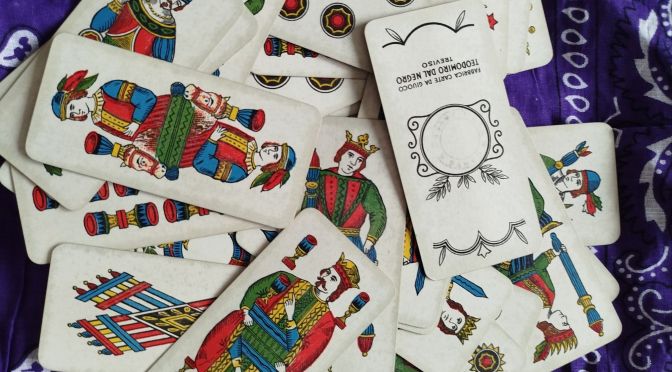
Ok, I swear this is the last deck I’m buying for a while, but it was only a couple of € on Ebay, and it was vintage, so yeah.

It is actually a Schafkopf deck (literally, sheep head), and it is comprised of 36 cards. As far as I can tell, not all Schafkopf reading traditions use all 36 cards, as some discard the sixes.
MQS
In the latest reading I presented, an interesting phenomenon occurred. At some point during the reading, two cards came up that seemed very negative, but which actually had nothing to do with the reading in itself. Instead, they simply acted as some form of punctuation. This happens especially with simple methods like the one I used, called ‘alla zdoura’ (literally, ‘method of the housewife’, or ‘like the housewives do it’ in dialect), where we start with a very limited number of cards, usually one, two or three, and then we keep adding them without following a specific layout.
In this type of reading, if the cards need to signal that we are changing topics and moving on to a new one, they may use cards or combinations that show an ending (sometimes even just the Death card). Of course, I had a huge deal of luck in this reading, because it came up clear. It isn’t always like that. Often, these combinations look really bad, but if we look around we see that they feel out of place.
In playing cards, the same can happen when the Four of Spades and Five of Spades, or the Ace of Spades, or the Five of Diamonds come up. Usually, in these situations, it pays to zoom out of the reading and catch the general flow of it: it will become apparent, generally, whether these cards are part of the reading or if they act as punctuation.
I am also experiencing a similar phenomenon while experimenting with the Bolognese tarot. For instance, in the first few lines of a thirteen- card spread, it may happen that the Angel and Death cards come up together, and then the cards seem to discuss other topics. In this case, the cards seem to be answering the question positively and quickly, only to introduce new discussions. At other times, the Queen of Coins comes up to say “and that’s the truth about it, period.” or the Justice card, to say “and that ok the way it is.” Of course, I need to experiment a little more, especially to see if apparently negative combinations can act in the same way.
MQS
MQS
(Note: this is a collection of the meanings attributed to the cards by some occultists in the past centuries. It does not reflect my own study or opinion of the cards. It is only meant as a quick comparative reference as I develop my own take.)
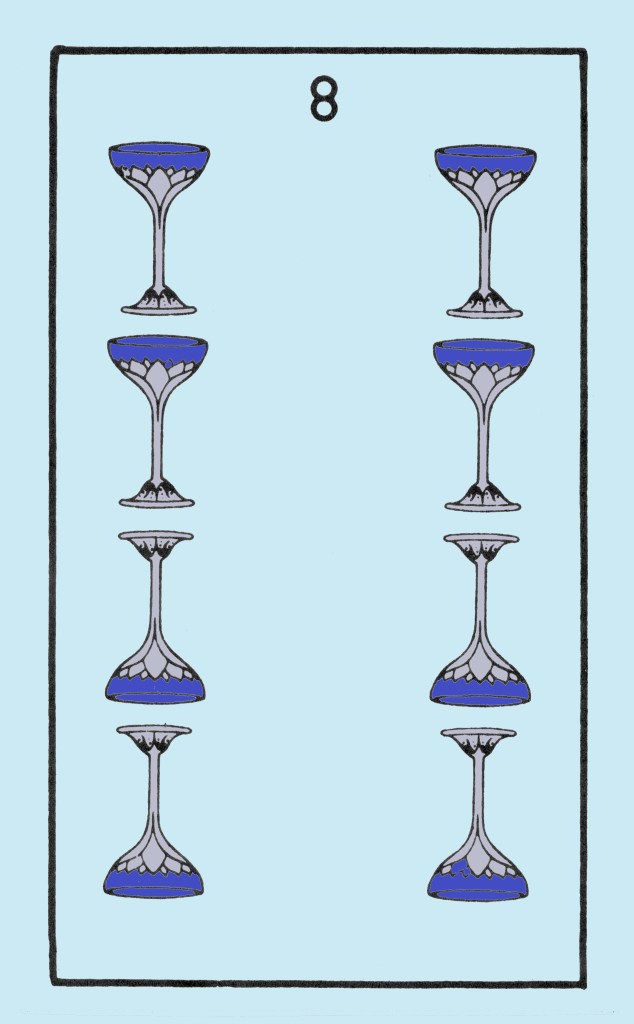
The time period is the first decanate of Pisces, February 19 to February 28, ruled by Jupiter and Neptune.
Well-Dignified: renunciation of material success for something higher; interest in psychic and spiritual things; strong emotions; charity and helpfulness; love of travel and of scientific investigation.
Ill-Dignified: momentary success, but nothing lasting; the person to whom the card applies is overimpressionable, erratic and unsteady in his emotions; meaningless change of mood; purposeless journeying; querulous disposition.
Keyword: Instability
(From the Oracle of Tarot course)
A man of dejected aspect is deserting the cups of his felicity, enterprise, undertaking or previous concern. Divinatory Meanings: The card speaks for itself on the surface, but other readings are entirely antithetical–giving joy, mildness, timidity, honour, modesty. In practice, it is usually found that the card shews the decline of a matter, or that a matter which has been thought to be important is really of slight consequence–either for good or evil. Reversed: Great joy, happiness, feasting.
(From The Pictorial Key to the Tarot)

The Eight of Cups is called Indolence. This card is the very apex of unpleasantness. It is ruled by the planet Saturn; time, sorrow, have descended upon pleasure, and there is no strength in the element of water which can react against it. This card is not exactly “the morning after the night before”; but it is very nearly that. The difference is that the “night before” has not happened! This card represents a party for which all preparations have been made; but the host has forgotten to invite the guests; or, the caterers have not delivered the good cheer. There is this difference, though, that it is in some way or other the host’s own fault. The party that he planned was just a little bit above his capacity; perhaps he lost heart at the last moment.
[…]
The Eight, Hod, in the suit of Water, governs this card. It shows the influence of Mercury, but this is overpowered by the reference of the card to Saturn in Pisces. Pisces is calm but stagnant water; and Saturn deadens it completely. Water appears no longer as the Sea but as pools; and there is no florescence in this card as there was in the last. The Lotuses droop for lack of sun and rain, and the soil is poison to them; only two of the stems show blossoms at all. The cups are shallow, old and broken. They are arranged in three rows; of these the upper row of three is quite empty. Water trickles from the two flowers into the two central cups, and they drip into the two lowest without filling them. The background of the card shows pools, or lagoons, in very extensive country, incapable of cultivation; only disease and miasmatic poison can flourish in those vast Bad Lands.
The water is dark and muddy. On the horizon is a pallid, yellowish light, weighed down by leaden clouds of indigo. Compare with the last card; it represents the opposite and complementary error. The one is the Garden of Kundry, the other the Palace of Klingsor. In the psychopathology of The Path, this card is the German Measles of Christian Mysticism.
(From The Book of Thoth)

A WHITE Radiating Angelic Hand, holding a group of stems of lotuses or waterlilies. There are only two flowers shown, which bend over the two central cups, pouring into them a white water which fills them and runs over into the three lowest, which later are not yet filled. The three uppermost are quite empty.
U U U
U U
U U U
At the top and bottom of the card are symbols Saturn and Pisces.
Temporary success, but without further results. Thing thrown aside as soon as gained. Not lasting, even in the matter in hand. Indolence in success. Journeying from place to place. Misery and repining without cause. Seeking after riches. Instability.
Hod of HB:H (Success abandoned; decline of interest).
The Angels ruling are HB:VVLYH and HB:YLHYH.
Blonde girl
Upright. This card, as far as the medicine of the spirit is concerned, means, in its natural position: Blonde Girl, Honest Girl, Practical Girl, Honor, Modesty, Restraint, Timidity, Fear, Apprehension, Sweetness, Attraction.
Reversed. Satisfaction, Happiness, Contentment, Gaiety, Joy, Cheerfulness, Enjoyment, Fun, Celebration. – Apology, Reparation, Discompense. – Public Joy, Spectacle, Arrangement, Recollection, Preparations, Arrangements.
MQS
A couple of years ago I published a series of three articles on the Skat deck. This is not a system I use, merely one that has been kindly passed down to me, together with the premission to translate it. I came into contact with another reader, who also kindly accepted to share her system, which she learned from a friend some years back. This is another German system, which is recognizable in that Spades tend to be neutral and Clubs negative. There are also many similarities with the previous system I published, which is not surprising since the various systems tend to be regional, and both readers come from the same region ( the Südpfalz). Still, there are some interesting differences. What follows is my translation of the meanings, combinations and reading method. Thanks to Anke for this method.
Ace – The Home
King – The Man (Herzensmann, the man of my heart)
Queen – The Woman (Herzensfrau, the woman of my heart)
Jack – Thoughts, Projects, Hopes, Positive Feelings/Thoughts (gute Gesinnung)
Ten – Great Joy, Wish Fulfillment, Wedding Bells (Hochzeitsglocken)
Nine – Joy, Love, Sympathy, Affection / Inclination (Zuneigung)
Eight – A Relationship, Harmony, Accord / Deal, Reconciliation
Seven – Fun, Entertainment (Fröhlichkeit, Spaß)
Ace – Office (Amt), understood as official things, Bureaucracy, Documents, Laws, Lawsuits, etc.
King – A friend or relative, Can be an office worker
Queen – A friend, relative or office worker (Büroangestellte)
Jack – Message, Contacts
Ten – Journey, A long period of time, The Long Road (auf dem langen Weg), An important change (Umbruch)
Nine – Uncertainty, Uncertain timeframe, Jealousy, Unwarranted turmoil, at the end of a sequence it improves the situation (the worry is unwarranted)
Eight – A short timeframe, Also the card of society (Gesellschaftskarte)
Seven – Very short timeframe, Discussions and Talks, The Short Road (auf dem kurzen Weg)
Ace – Letter, Invitation or Gift
King – A Man of position, Respected (angesehener Mann), Someone who counts
Queen – A woman of position, Respected, Who counts
Jack – The Jack of Good Luck (Glücksbube)
Ten – Big Money
Nine – Success, Ambition, Idealism
Eight – Work, Also buying and selling, Business (Geschäftskarte)
Seven – Small Money, A child
Ace – Shock (Schreck), Fear, Fright, Suffering or Loss
King – A lonely man, Older or inimical, Father-in-law
Queen – A lonely woman, Older or inimical, Mother-in-law
Jack – The Jack of Bad Luck (Pechbube), Bad/evil ideas / feelings / disposition (böse Gesinnung)
Ten – Great sorrow, Illness
Nine – Falseness, Antipathy (Abneigung), Dislike
Eight – Arguments, Fights, The need to fight, Obstacles
Seven – Tears
Ace of Hearts – Ace of Spades – Ten of Hearts = Wedding
Ace of Spades – Ten of Clubs – King of Clubs = Hospital stay
Any Queen – Seven of Diamonds – Ten of Clubs = Pregnancy (apparently pregnancy is seen as a sickness)
Ace of Clubs – Ace of Spades – Evil card (especially the Jack of Clubs) = death
Ace of Spades – Eight of Clubs – King of Clubs = Court case
Ten of Spades – Person card = Someone who comes from afar (but can also be someone who is away)
There are two phases to a general reading. The first is a cross spread not unlike the one I use. Lay out the querent’s card (King or Queen of Hearts), but with some slight variations. Let’s say you are reading for a woman:
| 4 | 9 | 14 | ||||||
| 2 | 7 | 12 | QH | 3 | 8 | 13 | ||
| 1 | 6 | 11 | ||||||
| 5 | 10 | 15 |
The positions’ meanings are quite similar, although the order of laying out the cards differs: above are the thoughts, underneath the problems or what she has command over, behind is the past, in front is the next future. The second stage is as follows:
| 3 | 8 | 13 | 4 | 9 | 14 | |||
| QH | ||||||||
| 1 | 6 | 11 | ||||||
| 2 | 7 | 12 | 5 | 10 | 15 |
This second spread is called the Rundum Blick, literally the comprehensive view or all-around view. The cards covering the Queen are supposed to be the most important ones, while the others all cover the future, with those to the left being a bit closer than the ones to the right, unless the Ten of Spades (the long time card) is present, in which case it can change the timeframe.
I didn’t receive any instructions on how to read the cards for answering specific questions, which is not surprising, since many folk methods of divination were simply meant to talk generally about what was ahead. Still, I am quite sure you can devise your own strategy.
MQS
The Bolognese Tarot tradition has several spreads for the couple. One that has been taught to me, and which I have also found is practiced by other Bolognese tarot readers, is the following:
| 1 | 2 | 3 | 4 | 5 | 6 | |
| He | She | |||||
| 7 | 8 | 9 | 10 | 11 | 12 | |
| 13 | 14 | 15 |
He and She are, of course, the King and Queen of Wands. However, we can explore the relationship between any two individuals. The cards above the two significators show what’s on their mind (1-2-3 his mind, 4-5-6 her mind, in this case).
The cards covering them (7-8-9 for him, 10-11-12 for her) are ambiguous. The way the method has been passed down to me, these cards show what’s going on with him and what’s going on with her, but I have found other readers (such as Rossella Giliberti) who say that these cards show what’s in his heart and what’s in her heart. Choose the variant you prefer, and remember that these are local methods, so there’s bound to be variations between one town and the other. The final three cards (13-14-15) show what’s happening to them as a couple in the near future, or if there is potential, or what connects them.
Another spread, which is found in Maria Luigia Ingallati’s book on the Bolognese Tarot (which I will review in the near future together with the few others that have been published). The layout is as follows:
| He | She | |||||||||
| 1 | 2 | 3 | 15 | 16 | 17 | 8 | 9 | 10 | ||
| 4 | 5 | 6 | 18 | 19 | 20 | 11 | 12 | 13 | ||
| 7 | 21 | 14 |
Here we have cards 1 through 7 talking about what’s going on with him, cards 8 through 14 telling us what’s going on with her, and finally the group in the center (15 through 21) talking about them as a couple. Another reader I know (Monica Barbieri) uses thirteen cards for each group instead of seven.
Another variant is found in Lia Celi’s out-of-print book on the 45-card method. This is the layout:
| He and She | ||||
| 1 | 2 | 3 | 4 | 5 |
| 6 | 7 – 8 | 9 | ||
| 10 | 11 | 12 | ||
| 13 – 14 | ||||
| 15 |
As can be seen, this is a pyramid spread. Here, cards 1, 2, 6, 7, 10 and 13 talk about him, cards 4, 5, 8, 9, 12 and 14 talk about her, and cards 3, 11 and 15 talk about them.
These methods are specific for analyzing two people’s interaction, but nothing prevents you from using a simpler spread, like the thirteen card spread. To be honest, that’s what I do. Still, this is an interesting bit of traditional lore about the Bolognese tarot.
MQS