Tag Archives: Fortune-telling

The Geomancy of Peter of Abano – Book III Pt. 9

Previous / Back to Index / Next

Here Abano talks about the meanings of Caput Draconis and Cauda Draconis in the various houses.

Caput Draconis (The Dragon’s Head or North Moon Node)

Caput Draconis in the first house means good luck, noble people, wise people, leaders, captains, honor, dignity, a prelate.1
In the second it means good success, gaining wealth or dignity or money.
In the third it means noble brothers and sisters, lucky siblings, good through them, isolated gardens2, pleasures.

In the fourth it means good for the parents, inheritance, buildings, cities, citizens, noble people, good end to an issue.
In the fifth it means science, good children, gain and help through them.
In the sixth it means good servants, faithful servants, good officials, grave infirmity, melancholic infirmity,3 long fevers.

In the seventh it means honorable women, good marriage, good company, gain from noble people or from women and thanks to them.
In the eighth it means inheritance, goods gain from the dead, usefulness through women and noble people, gain through war and by violence against life, being beheaded.4
In the ninth it means honoring God, ecclesiastical dignity, religious people, noble people, good journeys, delay in coming back but with good results, a messenger with bad news, messenger bearing news of legal issues, ingeniousness in a noble science.

In the tenth it means the king, the emperor, the lord, a magistrate, dignity, honor, good regents and orators, noble people.
In the eleventh it means noble soldiers, captains, dignity, sublimation5, succeeding one’s lord, faithfulness, valor, good luck.
In the twelfth it means noble inheritance through the mother, honorable things for [or through] women, few enemies, weak enemies, certainty, fame.

In the thirteenth it means journeys, messengers, a king, lords, usefulness, gain, honor, dignity, friendship and good recoglientia.6
In the fourteenth it means coming back from a journey with dignity and mirth and gain, letters, positive answer, honors, dignity, usefulness.
In the fifteenth it means a good end to the question and strong hope.7

Cauda Draconis (The Dragon’s Tail or South Moon Node)

Cauda draconis in the first house means evil disposition of the querent or of the quesited, fear of death, being murdered.8
In the second it means wealth gain through illicit means, theft, violence.
In the third it means iniquity against siblings and relatives, remains, retaliations, killings on the streets.

In the fourth it means loss of inheritance, evil lands, evil people, betrayals, false rumors, destruction of a city or fortress.
In the fifth it means evil children or women, loss of children, danger during childbirth, loss of blood.
In the sixth it means evil servants, runaways, grave illness, bodily fluids, killing, desperation, damage.

In the seventh it means a harlot, vile marriage, evil company, unfaithfulness, betrayal, violence, enmity.
In the eighth it means fear of death for [or through] women, rumors, freedom from prison and from illness, loss through women, being killed, loss of blood and flobotomia.9
In the ninth it means being forced on a journey, loss, danger of death, toil, changing one’s religion, evil or false religious people, evil Christians,10 evil messengers, death during a journey.

In the tenth it means an evil lord, traitors of one’s country, iniquitous judges or orators, overthrowing tyrants, loss of dignity, destruction of one’s kingdom.
In the eleventh it means wrongful succession, betrayal, violence, rebellion, death of one’s lord.
In the twelfth it means hidden enemies of the kingdom, machinations, treason against one’s lord, assassinations both public and private, violence.

In the thirteenth it means betrayals during a journey, hate from noble people, the absent party doesn’t come back.
In the fourteenth it means toiling for gain and honor, bad luck, hatred from underlings and very evil enemies, overcoming one’s enemies,.
In the fifteenth it is the worst of all, eccept for doing evil things.11

MQS
Footnotes
  1. Possibly due to the Moon’s North Node connection with beginnings and with increase, as well as the connection of the term ‘head’ with leadership. ↩︎
  2. The text seems to say “giardini solati”, and I am not sure if it means isolated gardens or gardens in the sun or something else that escapes me. The connection with gardens is clear, as the Third House rules neighborhoods and therefore what’s around the house. ↩︎
  3. Illnessess were traditionally categorized based on the prevailing humor. ↩︎
  4. This is another excellent example of how to read the meaning of the figure into the meaning of the house. Caput Draconis is the head, and the Eighth House rules death, thus giving beheading (death by losing one’s head). Of course much depends on the question and the rest of the Shield. ↩︎
  5. This is not clear. ↩︎
  6. An archaic Italian word of whose meaning I am unaware. ↩︎
  7. Caput cannot be the Judge. ↩︎
  8. It is usually said that Cauda being in the First House is enough to break the figure. However, here Abano gives us coherent interpretations. Most of them are very dramatic, but it’s the principle that counts and needs to be assimilated. ↩︎
  9. A term belonging to the vocabulary of Medieval medicine. I do not know what it means. ↩︎
  10. Probably to be interpreted as evil believers in general, nowadays. ↩︎
  11. Cauda cannot be the Judge. ↩︎

Is He Coming Back? Example Reading

This is a super-quick reading I did for a friend of a friend. She doesn’t believe in the cards, which is fine, but decided to try them by asking a silly question. She asked if her ex would come back to her. Here are the cards:

K♣️ 3♣️ 10♥️

On the surface of it, the cards seem positive: they show the man she’s asking about, they show a union (the Three of Clubs) and they show happiness (the Ten of Hearts).

Unfortunately, what the cards seem to be saying is that he has a marriage going on, and he is happy in it. When I told the querent, she confirmed that they haven’t spoken in years and he is married and has children.

This is not the first time someone asks me a fake question, either purposefully or out of self-delusion, and it is not rare for people to ask about old sweethearts who have moved on.

It goes without saying that we, as diviners, must always come to terms with our finitude and fallibility, but the more the querent is deluded or insincere, the harder it becomes to interpret the cards. This time I was doubtlessly lucky that the cards came up very clear.

NOTE: if the querent had told me that the man she was asking about is not married, then I would have asked if they had just broken up. In this case, the spread would have probably meant that their relationship was still going on strong, and that the break-up was something so fleeting the cards didn’t feel the need to describe it.

MQS

The Many Ways of Reading the I Ching

The I Ching (usually translated as Classic of Changes) is primarily known to the West as an oracular book in which people look up answers to their questions after casting a Hexagram. In reality, the I Ching (or Yi Jing, following the newer transliteration) permeates traditional Chinese culture much more thoroughly and its symbols are found in many methods of divination. Here are the most common ones (the list is not meant to be exclusive and it is limited by my ignorance, no doubt).

Zhou Yi (Reading Commentaries)

Zhou Yi means ‘the changes of the Zhou [dynasty]’ and refers to the oracular text we and Legge, Wilhelm, Jung, Philip K. Dick, Aleister Crowley, Ursula Le Guin etc. knew. This is what we usually mean when we cast an I Ching reading in the West (and also in much of the Eastern world).

We flip coins or manipulate yarrow stalks or pick up small handfuls of rice, depending on the method, in order to obtain a symbol made up of six lines that may change or remain stable (solid). The changing lines are then flipped to their opposite (yin to yang and yang to yin) and a new Hexagram is derived, so that we can interpret the initial Hexagram as the beginning of a matter and the final Hexagram as the likely conclusion or result.

We then look up the Hexagram(s) we got, as well as the text pertaining to any changing line, and we patch together an interpretation. This method of consulting the I Ching, which is traditionally called Zhou Yi, is very old and seems to have been the preferred method of interpretation of the Confucian or Neoconfucian school, the semi-official school of the intellectual bureaucracy of Imperial China.

And this school is exactly the one that the Western missionaries came into contact with first and foremost when they arrived in China and started studying Chinese culture. Although compared to other methods of Hexagram interpretation it may seem the most straightforward, it is complicated by the arcane and hermetic nature of the text, which is notoriously difficult even in Chinese, let alone to translate.

Yet I must say that, in my experimentations with the I Ching, the text method has revealed a subtle, beautiful simplicity. Often the answer is very clear and elegant, just clouded by one’s preconceptions.

Mei Hua Yi Shu (Plum Blossom Numerology Method)

Far wackier, but also far more interesting than the text and commentaries method, Plum Blossom Divination seems to have been devised by a Medieval scholar, Shao Yung. This method does not consist in looking up interpretations in an old book (and this probably accounts for the fact that it has fallen out of favor among most Neoconfucians). Instead, it applies certain rules of interpretation to the Trigrams.

The Eight Trigrams are the building blocks of the sixty-four Hexagrams of the I Ching text. They are also found in Feng Shui, traditional medicine and other forms of divination (e.g., Qi Men Dun Jia or Da Liu Ren) as well as in Chinese alchemy, philosophy and magic. They are, in a word, among the most important symbols in traditional Chinese culture. Everything can be categorized under one of the Trigrams.

Plum Blossom Numerology is essentially a form of Trigram divination that interprets the meanings of the eight Trigrams rather than considering the Hexagrams as a whole with their own commentaries. In Plum Blossom, we usually get a Hexagram made up of two Trigrams and we look at how the Trigrams interact based on certain fixed rules such as the five phases theory. In this method of divination we usually accept only Hexagrams with one mandatory changing line (and no more than that), so that the Trigram without the changing line represents the subject, and the one that does change is the object.

What is most interesting about Mei Hua Yi Shu is how we derive the Trigrams. This is done by way of augury. For instance, if you hear a short metallic sound and want to know if this has a particular meaning or announces a particular event, you search your mind for the Trigram that symbolizes short metallic sounds (this would be Qian). To derive the second Trigram, as well as the changing line, you generally take the time of day into account, similarly to horary astrology.

In essence, Plum Blossom allows one to interpret the world around them based on the signals the world sends them in that moment. It is both a very simple method and a very complicated one, because it requires a certain disposition and flexibility of mind that most people only achieve through much training.

Wen Wang Gua

This is, as far as I know, the most complex way of interpreting Hexagrams. To cover it would require much more than a short section in a short article. Wen Wang Gua (usually translated as King Wen’s Oracle) is a form of Chinese horary astrology that applies many of the rules of Chinese metaphysics (Chinese astrology, the Five phases, the Six Animals, etc.) to the interpretations of a Hexagram (usually cast using coins).

It is a favorite among fortune-tellers, and if we were to apply the (faulty) distinction between divination and fortune-telling that is en vogue in the West, we would say that the Zhou Yi, i.e., the commentaries, are divination, while Wen Wang Gua is fortune-telling. This because Wen Wang Gua can often predict situations very specifically, even down to the day or month something will happen.

In reality, the more I delve into Wen Wang Gua, the more I realize that it is as philosophically deep as it is captivating and accurate from a divinatory standpoint. The Hexagram one casts symbolizes the spatial, earth-related aspect of a matter, while the application of astrological rules to said Hexagram allows one to see the connection of the earthly element to the celestial element.

This is the form of I Ching divination I am devoting most of my study, and I will in time present my (very faulty and very partial) understanding of it, not because I consider myself the most qualified, but because I hope to awaken some interest for it in more people who may be more gifted than me and can comprehend its mysteries.

MQS

Tarot Encyclopedia – The Three of Cups

(Note: this is a collection of the meanings attributed to the cards by some occultists in the past centuries. It does not reflect my own study or opinion of the cards. It is only meant as a quick comparative reference as I develop my own take.)

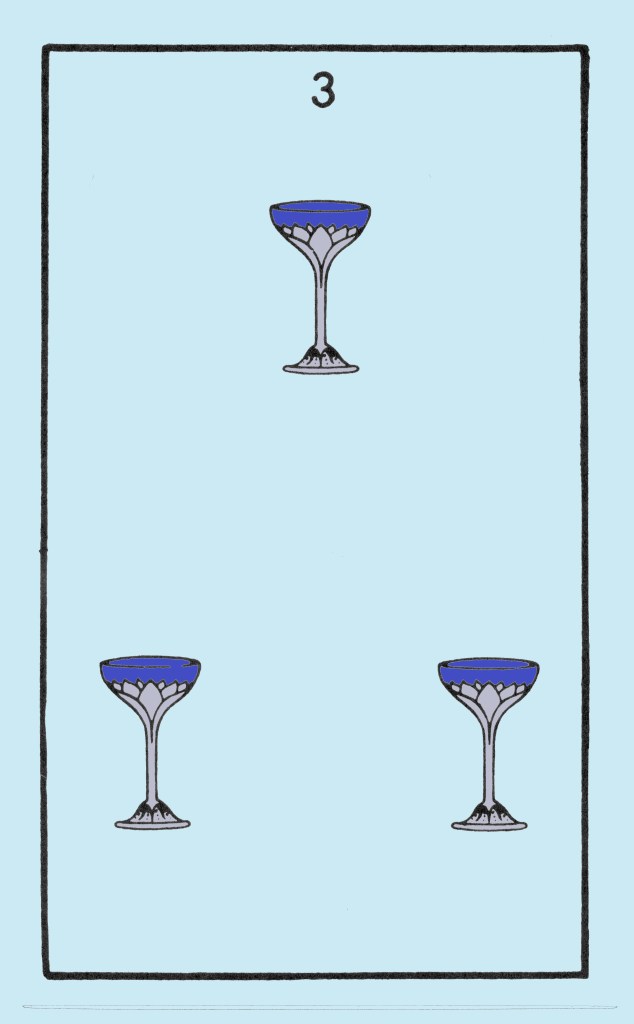
The Three of Cups from the Builders of the Adytum (BOTA) tarot deck

Paul Foster Case (and Ann Davies)

The Three of Cups is astrologically related to the second decanate of Cancer ruled by the Scorpio aspect of Mars, time period July 2 to July 12. The distinct meanings in divination combine the pleasure and emotion associated with the suit of Cups and the sex magnetism of the Scorpio aspect of Mars, together with Cancerian practicality and penchant for attachments.
Well-Dignified: activity, determination, practicality; fondness for pleasure and comfort; attachments and attractions to the opposite sex; pleasure, merriment, eating and drinking, plenty of new clothes, etc.
Ill-Dignified: danger of the ‘triangle’ situation; trouble through attachments to the opposite sex; midunderstandings; prodigality; sensuality.
Keyword: Enjoyment
(From the Oracle of Tarot course)

A. E. Waite

Maidens in a garden-ground with cups uplifted, as if pledging one another. Divinatory Meanings: The conclusion of any matter in plenty, perfection and merriment; happy issue, victory, fulfilment, solace, healing, Reversed: Expedition, dispatch, achievement, end. It signifies also the side of excess in physical enjoyment, and the pleasures of the senses.
(From The Pictorial Key to the Tarot)

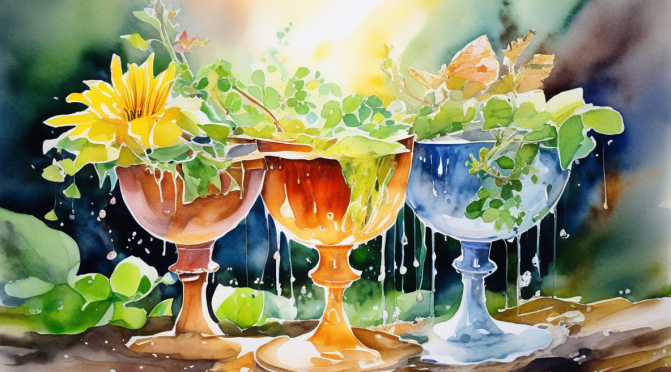
A marvellous AI-generated illustration for the Three of Cups

Aleister Crowley

The Three of Cups is called the Lord of Abundance. The idea of love has come to fruition; but this is now sufficiently far down the Tree to introduce a very definite differentiation between the suits, which was not previously possible.

[…]

This card refers to Binah in the suit of Water. This is the card of Demeter or Persephone. The Cups are pomegranates: they are filled bountifully to overflowing from a single lotus, arising from the dark calm sea characteristic of Binah. There is here the fulifilment of the Will of Love in abounding joy. It is the spiritual basis of fertility.

The card is referred to the influence of Mercury in Cancer; this carries further the above thesis. Mercury is the Will or Word of the All-Father; here its influence descends upon the most receptive of the Signs.

At the same time, the combination of these forms of energy brings in the possibility of somewhat mysterious ideas. Binah, the Great Sea, is the Moon in one aspect, but Saturn in another; and Mercury, besides being the Word or Will of the All-One, is the guide of the souls of the Dead. This card requires great subtlety of interpretation. The pomegranate was the fruit which Persephone ate in the realms of Pluto, thereby enabling him to hold her in the lower world, even after the most powerful influence had been brought to bear. The lesson seems to be that the good things of life, although enjoyed, should be distrusted.
(From The Book of Thoth)

Golden Dawn’s Book T

A WHITE Radiating Hand, as before, holds a group of lotuses or water-lilies, from which two flowers rise on either side of, and overhanging the top cup; pouring into it the white water. Flowers in the same way pour white water into the lower cups. All the cups overflow; the topmost into the two others, and these upon the lower part of the card. Cups are arranged in an erect equilateral triangle. Mercury and Cancer above and below.
Abundance, plenty, success, pleasure, sensuality, passive success, good luck and fortune; love, gladness, kindness, liberality.
Binah of HB:H (Plenty, hospitality, eating and drinking, pleasure, dancing, new clothes, merriment).

Etteilla

Success
Upright. This card, as far as the medicine of the spirit is concerned, means, in its natural position: Success, Science, Happy outcome, Happy solution, Victory. – Healing, Cure, Relief. – Accomplishment. – Perfection.
Reversed. Dispatch, Sending, Execution, Completion, End, Conclusion, Termination, Fulfillment.

MQS

The Geomancy of Peter of Abano – Book III Pt. 8

Previous / Back to Index / Next

Abano talks about some of the meanings of Carcer and Conjunctio in the various houses.

Carcer

Carcer in the first means difficulties, preoccupations, melancholy, prison, deep thoughts, secret thoughts.
In the second it means delay in gain and increase, success through toil, but with difficulty.
In the third it means evil siblings, dishonest pleasures, dishonest and disgraceful neighbors, licentiousness with siblings.

In the fourth it means fortresses, cities, stable buildings, inheritance, abudance, hidden treasures, hidden things.
In the fifth it means miscarriage, dead children,1 danger through childbirth, evil children, lame children, or deranged or possessed, womanly pains.
In the sixth it means good, trustworthy servants, gain from animals, long sickness, danger and pain, crying.

In the seventh it means chaste women, stable marriage, good company,2 faithful people, stable peace, people who can keep secrets.
In the eighth it means death, interment, hiding treasures and goods from the dead, funeral or congregation of people caused by a death.
In the ninth it means religion, serving God, hidden things coming to light, long travel or pilgrimage, good monks, just people, faithful Christians.

In the tenth it means a stable kingdom, lordship, palaces, just judges and orators.
In the eleventh it means succession in a kingdom, oppressing enemies, gain with difficulty, hidden machinations, frauds, rumors.
In the twelfth it means dangerous hidden enemies, long imprisonment, death of the inmate.

In the thirteenth it means danger from childbirth, miscarriage, dangers for the mother, long illness, bad in everything.
In the fourteenth it means freedom from dangers and other issues, but after much trouble, leaving all problems behind.
In the fifteenth it means inner strength, delay in getting one’s wish.

Conjunctio

Conjunctio in the first house means an evil disposition, machinations, fraud, cheating, unstable life, a variety of colors.3
In the second it means merchandise, gain through one’s ingenuity, being active, promptness.
In the third it means ingenious brothers and sisters, good short journey and a speedy return, a messenger, false letters, having fun in company.

In the fourth it means good for the father, good inheritance, a beautiful building, ingenious actions, divisions among citizens, killings, rumors, betrayals among them [the citizens]4
In the fifth it means mirth through one’s children, giving birth, false women, a fun evening.5
In the sixth it means good but petty servants, fugitives, various illnesses but not grave, thieves in one’s family.

in the seventh it means iniquitous women, petty women, harlots, false company, thieves, scuffles and brawls, war, a sad marriage, various colors.
In the eighth it means a prisoner being hanged, for the ill man it means death, and likewise for the absent party, desperation, danger of death for women [or through women].
In the ninth it means intelligence, various interests, various journeys, various fatherlands, traveling to acquire knowledge or virtue.

In the tenth it means official documents, judges, litigations, kings, lords, various offices, dignity.
In the eleventh it means promises or oaths, dispatching soldiers or courtesans, instability, wrongful succession, wrong faith.
In the twelfth it means hidden enemies, betrayal, damage through evil animals, infamy, detractions, dishonor, but it is good to buy animals.

In the thirteenth it means good luck in the quesited thing, in marriage and in doing good.
In the fourteenth it means well for litigations and scriptures or writings, for promises and for lordships and congregations.
In the fifteenth it means happy ending and good luck depending on the question.6

MQS

Footnotes
  1. Elsewhere Carcer is given as positive for pregnancies. ↩︎
  2. Usually Carcer signifies solitude. Perhaps, though, if the question is about someone else’s goodness it may indicate a serious character. Needless to say, much depends on the configuration as a whole. ↩︎
  3. Conjunctio’s description is perhaps where Abano is at his most contradictory, possibly highlighting the inherently contradictory nature of this mercurial figure. Keep in mind that Mercury was seen not just as messenger but as patron of thieves. ↩︎
  4. Possibly here Mercury suggests the idea of partisanship. ↩︎
  5. The latin word ‘conjunctio’ can literally means the act of being joined to another in intercourse. ↩︎
  6. Often Conjunctio is taken to means a middling result. ↩︎

The Geomancy of Peter of Abano – Book III Pt. 7

Previous / Back to Index / Next

Abano discusses some of the meanings of Populus and Via in the houses of the chart.

Populus

Populus in the first house means change,1 a mutable life, but a long one, and water, rivers, company, ships, mills, prairies, rain.
In the second it means gain of a lot of wealth, good merchandise, gain of money.
In the third it means gaiety with siblings, union with one’s neighbors, dangerous travel, gardens, watery places.

In the fourth it means the city, castles, buildings, union, congregation of people, inheritance, usefulness, abundance throughout the year.
In the fifth it means many children, succession, inheritance of a pregnant woman, unstable children.
In the sixth good family, many animals, usefulness through servants, deadly illness.

In the seventh it means good marriage, good partnership or company, usefulness, love of unstable women.
In the eighth it means tears, funerals,2 inheritance, usefulness from dead people, gain through women, fear of death.
In the ninth it means long travel with gain, rain, storm while at sea, shipwreck but ending well, peregrination with company.


In the tenth it means congregation of lords, exaltation of common people over the lords,3 rebellion, schism, diversion, suffocation of common people, grave person.
In the eleventh it means dignity, gifts from lords, usefulness from the mother.4
In the twelfth it means many occult enemies, damage from their coconspirators, unjust machinations, freedom from illness and by sea.

In the thirteenth it means good company, security, safety in travel, gain from friends, goodwill, gain from travel, good return of the absent party.
In the fourteenth it means gain from the mother5 and from relatives, inheritance, good fame.
In the fifteenth it means good things, but with delay.

Via

Via in the First House means a positive journey, whether long or short, poverty, a short life.
In the second it means little wealth, toil, loss of money and possessions.
In the third it means a short journey, gardens, pleasure, gain from the dead,6 few siblings.

In the fourth it means a small inheritance, little gain, desert places, lots of water, a year of dearth, being without a father or mother.
In the fifth it means few children, good relatives, succession for the mother.7
In the sixth it means servants fleeing, small animals, little gain from them, short but dangerous illness, bad servants.

In the seventh it means an unstable woman, corrupt, sad, unstable marriage, company of few but good people.
In the eighth it means liberation from infirmity and from prison, fleeing danger, return [of someone].
In the ninth it means a long journey soon, goods from the church, messengers, unstable and unfaithful religious people, a bad life.

In the tenth it means instability for the kingdom, lordship, dignity, unjust judges, infamy.
In the eleventh it means little hope, vain hope, unfaithful soldiers and curials.
In the twelfth it means few enemies, unfortunate journey, falling from a high place,8 danger of death, loss of inheritance due to the mother, freedom from prison.

In the thirteenth it means gain from travel, a secure street, little rain, good for selling.
In the fourteenth it means damaged goods, short journey, dispatching goods, the absent party is coming back soon.
In the fifteenth it means good change, a quick resolution.

MQS

Footnotes
  1. Usually, Populus is taken as a rather stable figure, while Via should indicate change. Here Abano considers them both rather changeable, possibly due to the association with the Moon. ↩︎
  2. A congregation due to death. ↩︎
  3. Because Populus means the common folk, and finding it in the Tenth House it can show that the common folk take over the place of honor. Once again, this shows very well how we ought to interpret the chart. ↩︎
  4. The mother is the Tenth House, her Second House shows gain from her. ↩︎
  5. Because the Fourteenth derives from the Eleventh and Twelfth and the Eleventh is, as discussed, gain from the mother. ↩︎
  6. I don’t understand why in this house Via should indicate gain from the dead. ↩︎
  7. This is unclear to me. ↩︎
  8. Possibly because the Twelfth House is cadent from the Tenth House, the highest place in the chart, and Via shows physical movement, thus “a movement that falls from a high place”. ↩︎

Translation of Light in Astrology (with Example)

Traditional astrology is full of interesting techniques. One of these, which is especially useful in Horary Astrology, is translation of light.

The most generally accepted definition of translation of light is when a planet that has conjuncted or aspected one significator goes on to conjunct or aspect the other significator, thus perfecting the matter. In other words, since Horary heavily depends on the contact between significators, which shows interaction, translation of light shows this interaction happening usually thanks to third parties.

The most common culprit when it comes to translating light is the Moon, because she is the quickest of the traditional planets, as well as having the metaphysical role of spreader of influences, whereas Saturn can never translate light under normal circumstances, being the slowest of the seven planets (Saturn cannot apply to an aspect to another planet, and it can only be applied to by others).

In general, in order for translation to be effective, it must happen by a positive aspect (trine or sextile) or at least with reception. Some old authorities even consider reception to be a requisite. This is probably on the theory that the translator must “receive” the significator’s light that it then translates to the other significator. As the example below shows, this is being way too precious.

When Will The Package Arrive?

I had bought a book from the US and wanted to know if and when it would arrive. I’ve always had little luck with stuff from America, as it often ended up stuck at customs and I always had to pay extra.

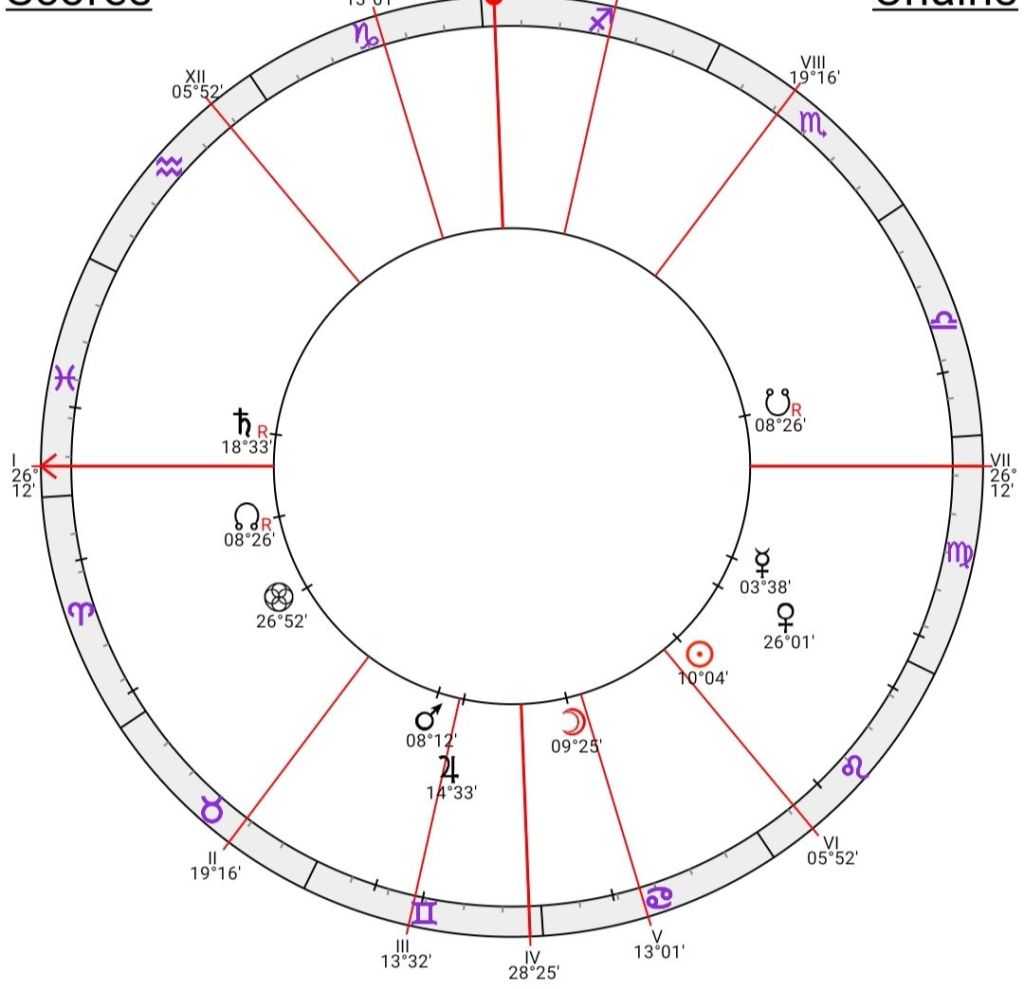
When will the parcel arrive? Horary astrology example. App used: Astro Charts

I am signified by Jupiter, ruler of the Ascendant sign Pisces. The seller is the Seventh house ruler Mercury, but I am not interested in the seller, but rather in his stuff, which is represented by the second house from the Seventh, i.e., the radical Eighth house. Therefore, the book is signified by Mars, ruler of Scorpio.

Jupiter is in detriment and in a cadent house, but that is no big deal: it merely shows I can do very little to change the situation (I can’t just teleport to America, take the book and teleport back to Germany.)

Mars is also in Gemini, and will conjunct Jupiter eventually. However, before that, Jupiter is sextiled by the Sun. What is the Sun? The Sun is the ruler of the Sixth house, which it also occupies. The Sixth house is the house of servants, including couriers, since they perform work for us.

The Sun’s previous aspect is to Mars, the book, and its next aspect is to Jupiter, me. This is a very good example of translation: the courier getting the book and taking it to me. This seems like a plausible cosmic representation of the situation.

Timing

The Sun perfects its sextile with Jupiter in around five degrees, corresponding to five units of time. The prediction was made on August 1. With the Amazon order page saying the package would arrive on August 11, the more likely unit of measure is five days. This meant the book would arrive around August 6 or 7. It arrived yesterday, on August 6.

A note on reception

Note that there is no major reception at play here, so clearly the positive aspect suffices. The Sun is received by Jupiter by face and triplicity, which undoubtedly helps things, but this only shows my receiving the package. Mars has no reception with the Sun, yet the Sun still collected Mars’ light to take it to my significator.

MQS

Fantasy in Divination: A Double-Edged Sword

I’m currently still doing readings in exchange for recommendations for when I  decide to start offering readings from this site. After a short reading with a querent we began chatting about the process of divination, and he asked me if fantasy is required to interpret the cards. I thought this was a really great question. I’m taking fantasy as a synonym with imagination, that is, the ability to conjure up images in one’s mind.

First off, we need to distinguish fantasy/imagination from (true) intuition. True intuition is relatively rare and it does not originate from the limited structure of the personality. It is, for all intents and purposes, otherworldly. Before being appropriated by boss babes on TikTok, intuition was rightfully considered a gift of the gods. It is hard to obtain and even harder to train, although the practice of divination, as it leads to the divine, does allow for the development of intuition.

Fantasy or imagination is mostly the product of neurons bouncing together, and it is at least in good part under our control (though whether imagination is also merely a personal power is up for debate. Many occultists think it isn’t, and I agree.)

Imagination plays a large role in modern magic, and, it could be argued, in the magic of all times (though with different implications and within different frameworks), but I’ll leave this discussion for another time. The point is that imagination is one among the many legitimate sources of understanding that we have at our disposal, including in the occult world.

Ordinarily, if someone asked me what’s the one thing that is required in order to become a diviner, I would answer that they need to understand the vocabulary, grammar and syntax of what is essentially a divine language.

Yet, in philosophy of language, and even more in philosophy of science, there is a concept called underdetermination. In its most frequent use, the principle of underdetermination states that, given a number of facts, there exist more than one theory that can explain those facts and account for them. How we then choose the most appropriate theory has sparked a debate that largely goes on to this day between scientists, philosophers, psychologists and anthropologists.

Something similar happens with divination: given a spread of cards, or a chart, it is often the case that more than one explanation might appear plausible at first. True, the more cards we string together, the fewer the possible interpretations are, just as a single word out of context might mean many things, but the more words there are, the more we understand the sentence.

But take a sentence like “we saw her duck“. Was she avoiding a bullet or does she live on a farm? This is a form of underdetermination, because the possible mental images evoked by the sentence cannot be reduced to the sentence itself.

Probably if we had a perfect understanding of the language of divination we would get unambiguous results, but we don’t. We must therefore use logic and context to weed out the less likely predictions, yet even so we might be left with more than one possible image of the future in mind. The word image here is key.

Can we predict a future we cannot imagine? That is, can we predict a future (or reveal a past) that we cannot put in the form of a picture or series of pictures? If one asks me: would you be able to understand a sentence you’ve never heard before? The answer is: if I know the language, yes. We hear sentences we’ve never heard before everyday and we rarely have problems. But going back to “we saw her duck”, if I didn’t know that duck can also be a verb, I would interpret the sentence univocally, as I wouldn’t be able to create a mental image corresponding to the interpretation of “duck” as verb instead of noun.

In real world languages the ambiguity is often removed by clear context. But in divination context is not always clear, meaning it is harder to exclude possible interpretations, and we need to be capable of creating mental images of all the most likely interpretations of an oracle before choosing which one is the most likely.

We need to be able to extrapolate the many possible meanings a spread can have before submitting them to inquiry. The ability to construct mental images or scenes from the divination tool we are using is consequently incredibly important. In other words, yes, imagination is key in divination.

But the imagination I am talking about is not the unbridled imagination that so many mistake for intuition, and which usually leads either to error or to unverifiable predictions. Imagination is the ability to create possible images derived from our (limited) understanding of the medium we are using, so that we can then see which one is more likely to be accurate by finding testimonies in the spread or by asking the querent.

Like all other occult arts, divination therefore requires the cooperation of both sides of the brain (to which we may add the importance of bodily grounding, but that’s a matter for another post).

MQS

The Geomancy of Peter of Abano – Book III Pt. 3

Previous / Back to Index / Next

Abano gives some examples of the possible meanings of Fortuna Major and Fortuna Minor in the various houses.

Fortuna Major

Fortuna Major in the first house means good luck for the querent, science, honor, fame, noble people, health, long life, good in all.
In the second it means gain, good luck, science, victory, money, and good through women1 and animals.
In the third it means good luck, happiness with brothers, relatives, friends, usefulness in travel and through women, obtaining what you wish.

In the fourht it means usefulness in stable things, inheritance, good things from one’s parents and older relatives.
In the fifth it means good fame, friendship, good grace, happiness through children, good news, favors from women, obtaining your wish.
In the sixth it means health, except for women, and gain through animals and servants.

In the seventh it means marriage, increase of wealth, good partnership with gain, overcoming your enemies, good and tranquil life.
In the eighth it means gaining wealth through other people’s death, freedom from danger and from death, gain, increase of wealth.
In the ninth it means travel with honor, gain through it, and through science in foreign countries and with foreign people, good change of place, quietude, divine spirit, true judgment.2

In the tenth it means honor, dignity, riches through one’s ingeniousness and speeches, and thanks to one’s mother, and in things related to God, good fame, gain through great and noble people, and through one’s job, and from prelates.3
In the eleventh it means good luck, gain, increase through friends, servants, kids, and from the King or from lords and prelates and noblemen.
In the twelfth it means health, freedom from danger and fear, gain through animals and servants, but the sick person won’t heal and the prisoner won’t be released, or with difficulty.

In the thirteenth it means gain through travel or from the king or a lord, parties, banquets, and toils and difficulties to have health.
In the fourteenth it means good luck in all you wish, and in animals, agriculture, buildings, long life.4
In the fifteenth it means good success, good outcome, succession, good friendship.

Fortuna Minor

Fortuna Minor in the first means King, Queen, lord, nobleperson, dignity, honor, fortitude, noblewoman, noble things, animals, good journey.5
In the second it means gain, gain through merchandise, and in selling and in buying, and from family or servants.
In the third it means a sister or (female) relative or (female) neighbor, good luck, good science.

In the fourth it means bringing secret things to light, fixed term employment or office, inheritance, unmovable goods, buildings.
In the fifth it means honor, dignity, spouses, happiness among the common folk, happiness through journey and children.
In the sixth it means sickness of a servant, problems through them, female servants, gain through toil.

In the seventh it means marriage, congregation of people, but with problems, partnership, gain throguh movable things.
In the eighth it means quick long travel bringing gain, but with danger of death, good fame followed by death, being killed.
In the ninth it means change of place, honorable journey, peregrination, good sceince, occult things.

In the tenth it means empress, king, lord, dignity, magistrate, mother, judge, excellent master/teacher, law, institutions.
In the eleventh it means happiness, chanting, dancing, various sounds, noble friends, fortitude, travel, obtaining your wish.
In the twelfth it means honor and dignity, fear of enemies and subjects and servants and sick people, freedom from prison, good for animals.

In the thirteenth it means travel with honor, sacraments, faith, gain, quick positive results.
In the fourteenth it means good luck and fortune in all you wish to gain.
In the fifteenth it means good succession, fame, honor among people, obtaining or accumulating wealth.

MQS

Footnotes
  1. It is not clear why women should be connected with the Second House or with Fortuna Major. ↩︎
  2. It is not clear what the word ‘judgment’ refers to here. In some old astrology books the Ninth house represents the court in a court case, though usually, for instance in Horary, we take the Tenth house as the judge. Furthermore, the Ninth House represents the wise people whose judgment was held in great esteem in the community. ↩︎
  3. Although some of these subjects are usually Ninth House matter, gain through them is the second from the Ninth, so the radical Tenth House. ↩︎
  4. The associations of the two Witnesses are taken mostly, as I’ve already discussed, from the two houses they derive from on the Shield. ↩︎
  5. Journeys are not normally associated with the First House, but Fortuna Minor is a mobile figure and the First House can represent the querent’s location and the means of transport they use to move (buggy, ship, etc.) ↩︎

A Reading Gone Wrong

Getting things wrong hurts, but is part of the human condition. In fact, I would argue that if a reader says they are infallible, that’s a good time to put as much distance between you and them as possible. An infallible reader is either so delusional that they block out all negative feedback from their reality or so dishonest that they’ll constantly be looking for the right bridge to sell you. Either way, they are best kept at a distance.

Still, there’s no denying that getting a reading wrong is disheartening because, as much as we should keep the ego out of the equation, the ego always seeps into it. I think it’s fair to share our failures as well as our triumphs. Here is a reading I got wrong relatively recently.

The querent was asking about her recent pregnancy.

Q♣️ – 7♣️ – J♥️ – 3♠️ – 2♥️

Accepting the question was my first mistake, as such issues are way too delicate. There is no situation where “you will miscarry” is an acceptable thing to say, and if we can’t be honest there is no point in giving a reading. Even if I had interpreted the cards correctly I would never have told the querent.

Thing is, though, that I wanted to give her good news, albeit subconsciously, and so I ended up interpreting a clearly negative spread positively. The querent falls first in the spread, and there is a card of obstacles between her and the child (the Jack of Hearts). The Three of Spades in questions of pregnancy often leads to loss, but I interpreted the Two of Hearts as the solution of the problems, while in fact it was merely saying that the loss would happen soon (it was knocking at the door). In hindsight, I probably should have added some cards.

I told the querent the pregnancy would go fine, though with minor problems which would be solved, but that she should always listen to the doctor. In reality, the cards point to a situation that not even doctors would be able to salvage (the doctors don’t show up in the spread).

Two things can be learned: first, never accept questions you are not really comfortable answering; second, always keep your desire to give a skewed answer in check. It is human nature to want other people to be happy (or sad, if we don’t like them) but this gets in the way of our objectivity.

MQS