Tag Archives: Fortune-telling

What Makes Readings Go South

A recent comment by a visitor of this website has inspired me to write an article about what makes divination go south, whether it’s card reading or something else. I have already shared one or two readings I got wrong, but in the future I would like to share more of my hardships as well as my successes, for two reasons: 1. it gives a fairer representation of how divination works and 2. it doesn’t discourage those who are studying the material I provide (I often get messages from people despairing they will ever be good diviners)

The reality is that divination is a human activity, and like all human activities it can go wrong. In a world where lawyers, scientists and doctors can be wrong (and not seldom), it’s unclear why we would expect fortune-tellers to be infallible.

There can be a variety of factors that make a reading go south. Here’s a bunch, in no particular order.

The querent is too emotionally volatile

Usually, the querent’s attitude doesn’t matter that much. However, it has been my experience that when a querent is in a state of utter and extreme desperation or emotional volatility, they will skew the reading in one direction or the other. This is rare, but it does happen on occasion. Once a friend who was looking for a job and was absolutely desperate asked for a reading and he pulled ALL spades. He still got a job around a month later. The cards were just reflecting his emotional turmoil.

Emotional involvement is also usually not good when reading the cards for ourselves. My personal experience is that if I read for myself about a topic I don’t care too much about, the reading will be largely accurate, while if I read about something I care very much about, the cards will show me either what I hope or what I fear.

Note though that there are divination tools that work better when the querent is very emotionally involved. This is the case, for instance, for Horary Astrology, where there are no counters to manipulate and therefore a relatively strong emotional push is required for question and answer to align.

The reader isn’t grounded enough

This is more common. Divination is not an assembly line type of occupation. We are dealing with a world that is, in a very real sense, divine and that eschews the mechanic and repetitive.

The diviner needs to be relatively at peace with themselves before performing a divination. I say ‘relatively’ because we don’t need to always be at our best (otherwise we’d never be able to divine). Certainly we need to be capable of detaching at least momentarily from our deepest worries and hopes. Fits of ecstasy and cheap mysticism are also to be avoided, as the best attitude is one of sober helpfulness toward the other.

There are some partial exceptions for ‘inspired divination’, such as mediumistic spiritism, but I don’t cover these topics on this website as I avoid these practices like the plague (I had a distant relative who was an excellent natural psychic and ruined her life in her attempt at constantly staying in the required state of passive receptivity).

The reader simply doesn’t always interpret the medium right

This is obvious, and I’ve talked about it at length, but it bears repeating. Divination is a language with no native speakers. We must learn it as if it were a foreign language. or, if you are romantic about the universe and think divination is our original language, then we must relearn it, but the end result doesn’t change. Like with all secondary languages, we are bound to make mistakes.

The best we can do about it is strive to correct our mistakes and be upfront with our querents that we are not offering miracles but just help in widening their view of their own life, of where it’s coming and where it’s directed.

Drawing wrong conclusions from right premises

This is another important pitfall, and it is a particular variety of ‘not reading the medium right’. As diviners we must understand that certain things can be changed and certain things can’t. Most divination tools are very upfront about it. If they say the thing you want cannot be achieved, then it cannot be achieved (unless we are interpreting the medium wrong, see above). If it says the thing you want will fall in your lap, then it will fall in your lap. Period. But if the medium says what you want is hard, it doesn’t mean it’s impossible, just as when it says it’s easy it doesn’t mean you’ll achieve it.

As diviners, sometimes, we feel we must give our querents more certainty than we are entitled to give them based on our divination tools. If the querent wants to become a writer and the cards show that writing comes easy to them, it doesn’t mean they will become a writer if they don’t put in the effort. Usually, in such cases, the lack of effort does come up in the cards as a warning, so that the prediction will sound like: you are very talented, but unless you actually spend time honing your craft, you won’t amount to much. This, too, is a valid prediciton.

All in all, we must be careful to distinguish what the medium says from what we want to tell the querent.

MQS
Example Spread: Guess Who’s Coming To Dinner?

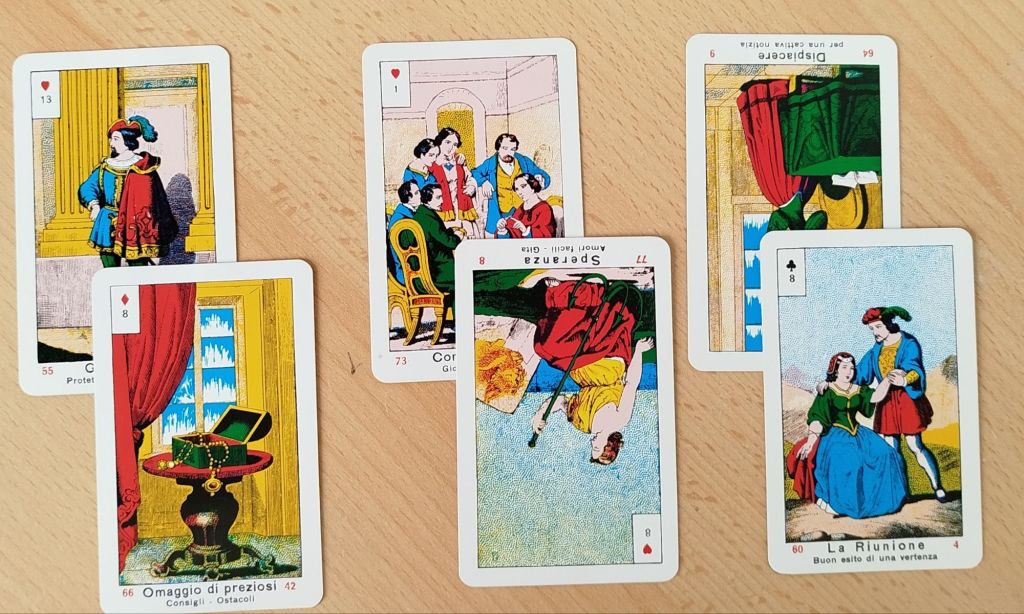
I’ve been having some fun with the answer spread with my playing cards but so far I had never used it with the Sibilla. This is an example of a spread I did two days ago, when hubby invited a colleague over for dinner. My question was simply how the dinner would go. It is a mundane question, useful for trying out a new spread.

Regina Russell’s answer spread, adapted for the Vera Sibilla

The Sibilla is, thankfully, very clear here. The first column, the one that supposedly gives us the background of the question, shows hubby (the King of Hearts) extending an invitation (the Gift, a proposal).

The central column generally gives us the answer to the question. Usually, the Hope card, when reversed, makes things go up in smoke. Together with a card such as the Conversation, which talks about gatherings, clearly the appointment does up in smoke or is at least dalayed.

The final column usually gives us additional information. The reversed Ace of Spades is generally less dangerous or less disappointing than when it is upright, but another meaning it has is that of a repeated occurrance. What repeated occurange? The Reunion, i.e., another gathering card.

What ended up happening was that the colleague had to cancel on us to take care of her ailing mother, but we rescheduled for next week.

An interesting Experiment

According to Regina Russell’s instructions, we only read the cards in the answer spread in columns. However, let us try to read them in the order in which they were pulled, which is:

Gentleman, Conversation, Sorrow rev., Gift, Hope rev., Reunion

In this case, the situation doesn’t change that much. The Gentleman, i.e., my husband, repeatedly gifts an invitation which, with some delay (Hope rev.) ends up happening (Reunion). Though, to be fair, in this case I would have probably pulled an additional card to make sure.

MQS

The Geomancy of Peter of Abano – Book IV Pt. 2

Previous / Back to Index / Next

Abano discusses the various meanings of Via, Populus, Caput and Cauda when deriving from various figures.

Via

From Via and Populus, its meaning is weakened, but quickened.1
From Acquisitio and Amissio its efficacy is mediocre in every question.
From Major and Minor it means good luck, but it is still mediocre.
From Laetitia and Caput, it means good luck and success.

From Tristitia and Cauda it means misfortune in the question at hand, and it is very strong in its malice.
From Albus and Puer it is mediocre good luck.
From Rubeus and Puella it shows a mix of good and bad, but it brings about the thing quesited.
From Conjunctio and Carcer it means good luck, stability and firmness in all one asks about.

Populus

From Populus and Populus it means stability, getting one’s wish, copious amounts.
From Acquisitio and Acquisitio it means great good luck, great acquisition of what one wishes, usefulness.
From Amissio and Amissio it shows good luck, and being venereal and lascivious.
From Major and Major it means fortune, stability, great gain, honor.
From Minor and Minor it means mediocre good fortune.
From Via and Via it means weakness in the thing enquired about.
From Caput and Caput it means good luck, usefulness.
From Cauda and Cauda, it means great misfortune.

From Albus and Albus it means good effect, good outcome especially in watery things and womanly or white things.
From Rubeus and Ruveus it means excessive evil, war, loss of blood.
From Laetitia and Laetitia it means good luck, happiness, honor, easily getting what one wants.
From Tristitia and Tristitia it means great misfortune, long lengths of time, difficulties and problems, enmities.
From Conjunctio and Conjunctio it means good luck, getting one’s wish, good for marriage and partnerships.
From Carcer and Carcer it means great good luck in everything, melancholy and difficulties, anger, discord, infirmity, prison.
From Puella and Puella it means good luck and fortune, firmness, usefulness, getting one’s wish.
From Puer and Puer it means war, fighting, discord, good for merchandise, mediocre gain, good for marriage.2

Caput

From Populus and Caput it means great firmness, good outcome.
From Acquisitio and Albus it means great good luck, getting one’s wish.
From Amissio and Puer it means misfortune, loss, difficulties.
From Major and Rubeus great good luck, mediocre gain or honor, good fortune.
From Tristitia and Conjunctio it means good luck and gain, but with delay and difficulties.
From Cauda and Carcer it means misfortune and tragedy.

Cauda

From Populus and Cauda it means misfortune, long illness, difficulties, weakness in getting one’s wish.
From Acquisitio and Puella it means good fortune, firmness, usefulness in mobile things.3
From Amissio and Rubeus it means misfortune and grave danger.
From Major and Puer, it means misfortune under the guise of gain.

From Via and Tristitia it means misfortune in getting what one wishes, and long-lasting difficulties.
From Caput and Carcer it means mediocrity, good for virtue and honorable things, otherwise loss.
From Laetitia and Conjunctio it means mediocre fortune, but gain from merchandise.
From Albus and Minor, it means good luck and freedom from difficulties, but mediocre gain.4

MQS

Footnotes
  1. One of the reasons this Book IV is interesting is that it affords us a look into how old geomancers derived meanings from the interaction of figures. Unfortunately Abano’s process is not always clear. Furthermore, it is not clear whether Abano means what I have written (namely, Via’s meaning is weakened but quickened) or if he is saying that Via’s meaning is weakened more than any other figure. I have chosen my interpretation based on this logical argument: that Populus tends to accentuate the meaning of the figure it interacts with, and Via is weak and quick, so in interacting with Populus it would become weaker and quicker. ↩︎
  2. Generally speaking, it seems the effect of Populus is that of accentuating the meaning of the figures it comes from (‘lots of…’). However, some interpretations are not clear, for instance Carcer and Carcer meaning great good luck. Note also that Populus is the only figure that Abano explains in full, giving all possible combinations. ↩︎
  3. It seems here that the two positive figures rub off on the otherwise foreboding Cauda. ↩︎
  4. Again, the two positive figures it comes from seem to bring out the best in Cauda, according to Abano. ↩︎

Tarot Encyclopedia – The Three of Pentacles or Coins

(Note: this is a collection of the meanings attributed to the cards by some occultists in the past centuries. It does not reflect my own study or opinion of the cards. It is only meant as a quick comparative reference as I develop my own take.)

The Three of Pentacles from the Builders of the Adytum (BOTA) deck

Paul Foster Case (and Ann Davies)

The time period is the second decanate of Capricorn, under the rulership of Venus, from January 1 to January 9.
Well-Dignified: construction; increase, growth; financial gain; the building up of favorable conditions; gain in commercial transactions; rank or prestige in vocation or business; beginning of matters to be perfected later.
Ill-Dignified: selfishness; cleverness in business, but lack of scruples;
narrowness and prejudice; too much ambition.
Keyword: Constructiveness.
(From the Oracle of Tarot course)

A. E. Waite

A sculptor at his work in a monastery. Compare the design which illustrates the Eight of Pentacles. The apprentice or amateur therein has received his reward and is now at work in earnest. Divinatory MeaningsMétier, trade, skilled labour; usually, however, regarded as a card of nobility, aristocracy, renown, glory. Reversed: Mediocrity, in work and otherwise, puerility, pettiness, weakness.
(From The Pictorial Key to the Tarot)

Aleister Crowley

The Three of Pentacles, in a similar manner, exhibits the result of the idea of Earth, of the crystallization of forces; and so the Three of Pentacles is called the Lord of Work. Something has definitely been done.

[…]

The influence of Binah in the sphere of Earth shows the material establishment of the idea of the Universe, the determination of its basic form. It is ruled by Mars in Capricornus; he is exalted in that Sign, and therefore at his best. His energy is constructive, like that of the builder or engineer. The card represents a pyramid viewed from above the apex. The base is formed by three wheels-Mercury, Sulphur, and Salt; Sattvas, Rajas, and Tamas in the Hindu system; Aleph, Shin, and Mem-Air, Fire, and Water-the three Mother letters of the Hebrew alphabet.

This pyramid is situated in the great Sea of Binah in the Night of Time, but the sea is solidified; hence the colours of the back-ground are mottled, a cold thin dark grey with a pattern of indigo and green. The sides of the pyramid have a strong reddish tint, showing the influence of Mars.
(From The Book of Thoth)

AI-generated illustration for the Three of Pentacles or Coins

Golden Dawn’s Book T

A WHITE-WINGED Angelic Hand, as before, holding a branch of a rose tree, of which two white rosebuds touch and surmount the topmost Pentacle. The Pentacles are arranged in an equilateral triangle. Above and below the symbols Mars and Capricorn.
Working and constructive force, building up, creation, erection; realization and increase of material things; gain in commercial transactions, rank; increase of substance, influence, cleverness in business, selfishness. Commencement of matters to be established later. Narrow and prejudiced. Keen in matters of gain; sometimes given to seeking after impossibilities.
Binah of HB:H (Business, paid employment, commercial transaction).
Herein are HB:YChVYH and HB:LHChYH Angelic Rulers.

Etteilla

Important
Upright. This card, as far as the medicine of the spirit is concerned, means, in its natural position: Noble, Considerable, Famous, Important, Great, Major, Extended, Vast, Sublime, Renowned, Famous, Powerful, Elevated, Illustrious. – Excellence, Consideration, Greatness of mind, Nobility of conduct, Generous deeds, Magnificently, Splendidly.
Reversed. Puerility, Childhood, Infantilism, Frivolity. – Weakening, Lowering, Diminishing, Education, Modicity, Mediocrity, Minuity, Inezia, Frivolity, Lowness, Vileness, Poltrony, Rampant, Small, Puerile, Petty, Low, Servile, Vile, Abject, Humble. – Abjection, Humility, Humiliation.

MQS

A World of Odd Coincidences

Yesterday I was cleaning in my office. I took my playing card deck (the one I use for divination) and was about to put it on the windowsill to dust my desktop, when it fell to the floor and the cards went flying in all directions.

So I gathered the cards without thinking anything of it and went on with my day. Later on I realized that one of the cards was the wrong way around: the Six of Spades, the sickness card.

Around an hour later my husband was on the phone with my mother-in-law, when she suddenly started slurring her words and being unable to move one side of her face. Fearing a stroke, we immediately called an ambulance and they were there a few minutes later.

We are still not sure what it was, but it was thankfully gone. She seems to be doing fine now, but the paramedics told her to remain in contact in case the situation presents itself again.

It is a good thing that we were on the phone with her when it happened, and I find the way the cards forewarned me endlessly fascinating, though I didn’t put two and two together until after the fact.

MQS

Regina Russell’s Answer Spread (with Example Reading)

The Answer Spread was popularized by Regina Russell in her Card Reader’s Handbook.1 Here, Russell details a system of fortune-telling by playing cards that is different from mine, but still quite interesting as a reference. She also gives examples of some spread layouts, including a small one to answer specific question.

I have rarely used this spread, but I added it to my repertoire just for variety, and I have found it to be quite reliable. You’ll need to shuffle or have the querent shuffle the deck after formulating a clear question. Then, have the querent take out six cards from the fanned out deck (or pull them yourself, if you’re doing a phone reading). Lay the cards out in this order

123
456
Layout for Regina Russell’s Answer Spread

Russell explains that the cards are read exclusively in columns (1-4, 2-5, 3-6). Each column has a different meaning: the first (1-4) indicates the background of the question or the current situation; the second (2-5) answers the question; the third (3-6) adds information about the answer. The sixth card can on occasion be of special importance and may contain the answer or some information on which everything hinges, but I have generally found this not to be the case.

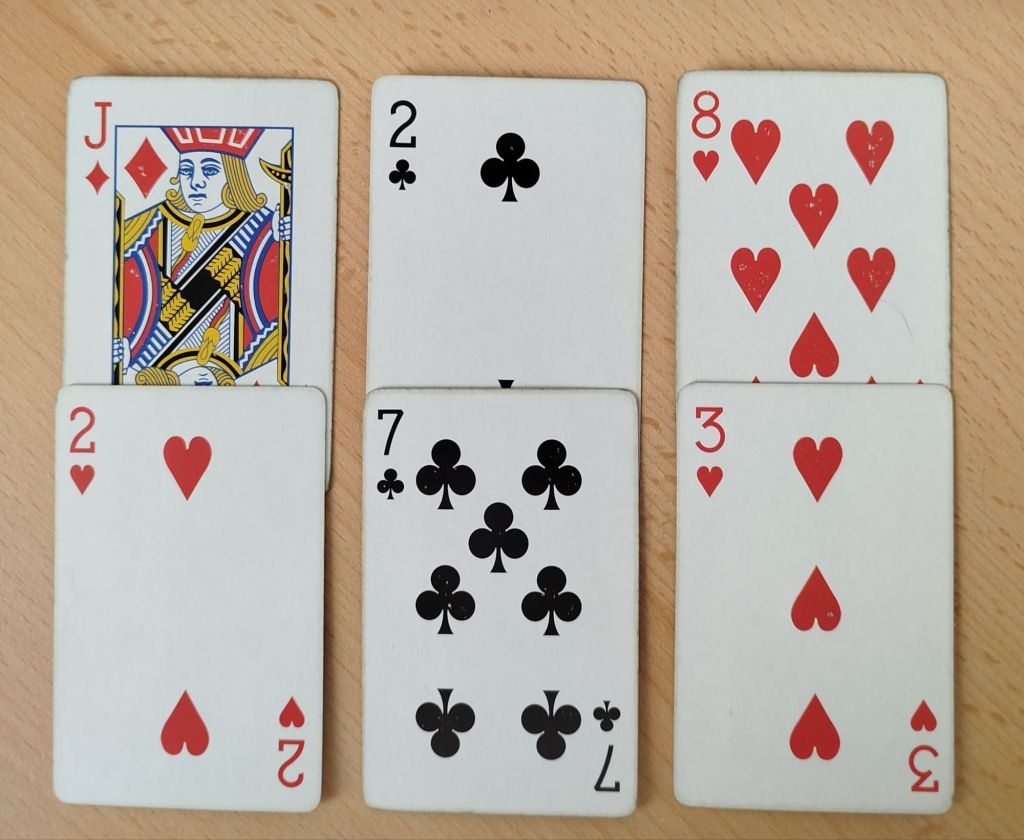
As you may have guessed, this is a very short spread to receive information quickly. Here is an example from the recent past with my husband as a guinea pig: his birthday was approaching and he wanted to know relatives would drop by unannounced to celebrate. These were the cards (note that I am not using Russell’s meanings, but those I am familiar with):

Will there be a surprise visit? Regina Russell’s Answer Spread

Since the question is so specific, you have the right to wonder why he thought they would throw him a surprise party. If we look at the column on the left, the one that talks about background information, we have the Jack of Diamonds and the Two of Hearts, an exciting message or a message from relatives. I didn’t know this at the time of hubby pulling the cards, but in talking to his family on his family chatgroup there had been odd remarks that had made him suspect something was being prepared. So this is the background information we need to understand the spread.

The answer, however, is somewhat disappointing. There are steps (Two of Clubs) being taken, so something is indeed being organized, but the Seven of Clubs causes trouble.

If we look at the right column, where additional information is found, we see a party (Eight of Hearts) and a gift (Three of Hearts). If these two cards had been in the center column, the answer would have been positive. As it stands though, these cards merely explains what steps had were being taken. So the answer is no, they won’t come on the day of his birthday.

It turned out that they did not come, though his brother would have liked to and was making plans for, because his mother was still recovering from a minor operation she’d had: this is the problem (Seven of Clubs). However, looking at this spread, I wouldn’t be surprised if a little celebration did take place next time we get together.

MQS

  1. Which you may buy here if interested. I’m not affiliated with them, I just think the book is a good reference to have. ↩︎

The Geomancy of Peter of Abano – Book IV Pt. 1

Previous / Back to Index / Next

Here Abano begins a discussion of how the genesis of each of the figures from other two figures can modify their meaning.

Since one is not only supposed to consider the springing of the figures from one place to the other, but also their origin and generation one from the other,1 an esposition of of the meanings of each of the figure depending on the figures it is born from is in order, without forgetting the inherent meaning of the figure, as well as that of the querent’s and quesited’s, and those figures in the angles, and those conjoined to them.

Acquisitio

From Populus and Acquisitio: recovering one’s losses or recovery from damage; gain, profitable journey.
From Amissio and Via: dishonorable journey, but useful, recovering something lost.
From Fortuna Major and Conjunctio: good luck, mediocre gain, and [it is positive for] the thing asked.
From Fortuna Minor and Carcer: love between husband and wife,2 and [it is good for] the thing asked.
From Puella and Cauda Draconis: gain, usefulness in things of merchandise, and gain from difficulties.

From Puer and Laetitia: gain from minerals, gain from merchandise.
From Tristitia and Rubeus: fortitude, stability in everything, good outcome, victory, loss of merchandise.
From Conjunctio and Fortuna Major: good luck, mediocre gain.
From Carcer and Fortuna Minor: usefulness; kings and lords, noble people.
From Albus and Caput Draconis: good luck in material things, loss of objects.

Amissio

From Populus and Amissio: loss, trouble, good luck for the ill and the imprisoned, good for traveling.
From Acquisitio and Via: damage, trouble, loss, the lost or stolen thing is not found, vain friends or servants.
From Carcer and Fortuna Major: trouble, problems, little gain.
From Caput Draconis and Puer: good luck in things connected with women; in other questions, gaining what one wants results in damage.
From Rubeus and Cauda Draconis: misfortune [or accident], injury, fear, fighting, trouble, damage, illness.

From Conjunctio and Fortuna Minor: loss of animals, lots of trouble, desperation for the thing lost.
From Albus and Laetitia: freedom from illness or prison, the absent party will come back, white clothes, mobile things, quick ending.
From Puella and Tristitia: poverty, vile things, trouble due to secrets, desperation, mirth, luck in debauched things.
From Fortuna Major and Carcer: recovering the lost or stolen thing.3

Fortuna Maior

From Populus and Fortuna Maior: luck in everything, getting what one wishes to get, but with delay.
From Carcer and Amissio: being very lucky and obtaining what one wants, but with difficulties.
From Albus and Tristitia: it means good news, messenger, usefulness, dignity, good salary [remuneration].
From Caput Draconis and Rubeus: great accident or misfortune, hanging, health problems, violent death.

From Amissio and Carcer: accident, problems, prison, good ending but with difficulties.
From Fortuna Minor and Via: fighting, good news, quick dispatch, honorable journeys.
From Acquisitio and Conjunctio: good fortune, prosperity, getting one’s wish.
From Puer and Cauda: good fortune, tranquillity after much trouble, getting one’s wish with much delay.
From Puella and Laetitia: mediocrity in everything, good things.

Fortuna Minor

From Populus and Fortuna Minor: its meaning has more virtue in good as in bad depending on the question.
From Acquisitio and Carcer: stability, certainty, mediocre fortune.
From Amissio and Conjunctio: good but mediocre fortune, especially in mobile things, less in stable things.
From Fortuna Major and Via: great virtue, great good fortune.

From Caput and Puella: good luck, especially in friendship and marriage.
From Albus and Cauda Draconi: mediocre good luck, especially in feminine things.
From Laetitia and Rubeus: very noble things, luck in mobile, outgoing things.
From Puer and Tristitia: mediocrity, but more bad and mutable than otherwise.

MQS

Footnotes
  1. This seems to imply that we must consider how the figures are generated on the shield. Whether this applies only to the Judge is not clear, though Abano seems to hint at the need to consider all figures, since he also considers those that cannot be Judge. ↩︎
  2. Admittedly, some of these explanations are hard to follow. I do not know, for instance, why this combination should indicate positive things between husband and wife. ↩︎
  3. Abano does not present all possible combinations. It is not clear whether he forgot or he thought it was enough to give some examples. Note also that some explanation almost seem contrary to reason. ↩︎

Vera Sibilla Cards Connected With Work

In the Vera Sibilla there are a couple of cards that connect more or less directly to the topic of work. Here we review them quickly to show their similarities and differences. As usual, this isn’t meant to be exclusive.

Six of Hearts – Money

Not directly related to work per se, the Six of Hearts is the money card, and as such it shows where money comes from, where it goes, whether one has it or not, etc. However, in a consultation about work, it can also indicate whether the pay is good or not, whether the business one works for flourishes or not, etc.

Seven of Hearts – The Scholar

This card is always welcome when we want to know whether we’ll get a job, as it can show the signing of a contract. It is also related to talent in one’s field, as well as certain types of job (intellectual or desk jobs).

Ace of Clubs – Marriage

Again a card that can represent the signing of something. Marriage is anything that gives us rights and obligations with respect to someone else, and a job contract is exactly that. It is also an important card for business deals and partnerships

Six of Clubs – The Surprise

This is a small money card, but because it represents money being received, it can symbolize the wages and therefore being employed. For instance, together with the House card it can sometimes represent the place where you gain money, i.e. the workplace.

Seven of Clubs – Realization

The Seven of Clubs is the card of worldly ambition and it can therefore stand for the querent’s career (I’m always reminded that in German the word Beruf, work, comes from the word Ruf, fame, the name you make for yourself in the world).

Eight of Diamonds – The Handmaid

This is another card that is strongly connected with money and where it comes from and where goes toward, but it is also a card of employment (a handmaid works for someone else). When it signifies the querent’s work, it is essentially a synonym of the Merchant card.

King of Diamonds – The Merchant

This is THE work card, the one you usually want to see in a question about work, and four times out of five, when it pops up in a different kind of question it still indicates the influence of the querent’s job on question, though the card also has other less common meanings.

King of Spades – The Priest

Not directly related to the querent’s job, but this card can represent the institution or company the querent works for (especially if it is relatively big). Needless to say it can stand for many other things, such as works related with the law or religion (with specific cards) or even works where one wears a uniform (the Soldier also represents a uniform, but usually it shows less socially important types of employment, such as being a builder).

MQS

Tarot Encyclopedia – The Three of Swords

(Note: this is a collection of the meanings attributed to the cards by some occultists in the past centuries. It does not reflect my own study or opinion of the cards. It is only meant as a quick comparative reference as I develop my own take.)

The Three of Swords from the Builders of the Adytum (BOTA) tarot deck

Paul Foster Case (and Ann Davies)

The time period is the second decanate of Libra, under the combined rulership of Saturn and Uranus, October 3 to October 12. Because Libra is involved, remember that the qualities of the Seventh house are prominent.
Well-Dignified: this is nevertheless a Key depicting sorrow, disappointment and tears, but it can be the beginning of deep understanding as to the basis and cause of our problems; disruption of friendship; interruption of cherished projects; quarrels; occasionally the position in the layout may indicate platonic friendships; in money matters this card is almost always a symbol of loss, but indicates that whatever money matters are under consideration have been fair and honest, so that no blame attaches to anyone for the loss.
Ill-Dignified: slander; selfishness and dissipation; deceit with respect to promises; loss in legal affairs.
Keyword: Sorrow
(From the Oracle of Tarot course)

A. E. Waite

Three swords piercing a heart; cloud and rain behind. Divinatory Meanings: Removal, absence, delay, division, rupture, dispersion, and all that the design signifies naturally, being too simple and obvious to call for specific enumeration. Reversed: Mental alienation, error, loss, distraction, disorder, confusion.
(From The Pictorial Key to the Tarot)

Aleister Crowley

The idea of division, of mutability, the idea of the airy quality of things, manifests itself in the Three of Swords, the Lord of Sorrow. Here one is reminded of the darkness of Binah, of the mourning of Isis; but this is not any vulgar sorrow dependent upon any individual disappointment or discontent. It is Weltschmerz, the universal sorrow; it is the quality of melancholy.

[…]

Binah, the Great Mother, here rules the realm of Air. This fact involves an extremely difficult doctrine which must be studied at length in The Vision and the Voice: Aethyr 14.
Binah is here not the beneficent Mother completing the Trinity with Kether and Chokmah. She represents the darkness of the Great Sea.
This is accentuated by the Celestial Lordship of Saturn in Libra.
This card is dark and heavy; it is, so to speak, the womb of Chaos. There is an intense lurking passion to create, but its children are monsters. This may mean the supreme transcendence of the natural order. Secrecy is here, and Perversion.
The symbol represents the great Sword of the Magician, point uppermost; it cuts the junction of two short curved swords. The impact has destroyed the rose. In the background, storm broods under implacable night.
(From The Book of Thoth)

A gruesome AI-generated illustration for the Three of Swords

Golden Dawn’s Book T

THREE White Radiating Angelic Hands, issuing from clouds, and holding three swords upright (as though the central sword had struck apart the two others, which were crossed in the preceding symbol): the central sword cuts asunder the rose of five petals, which in the previous symbol grew at the junction of the swords; its petals are falling, and no white rays issue from it. Above and below the central sword are the symbols of Saturn and Libra.

Disruption, interruption, separation, quarrelling; sowing of discord and strife, mischief-making, sorrow and tears; yet mirth in Platonic pleasures; singing, faithfulness in promises, honesty in money transactions, selfish and dissipated, yet sometimes generous: deceitful in words and repetitions; the whole according to dignity.
Binah of HB:V (Unhappiness, sorrow, and tears).
Herein rule the Great Angels HB:HRYAL and HB:HQMYH as Lords of the Decan.

Etteilla

Removal
Upright. This card, as far as the medicine of the spirit is concerned, means, in its natural position: estrangement, Departure, Absence, Discarding, Dispersion, Remoteness, Delay. – Contempt, Repugnance, Aversion, Hatred, Disgust, Horror. – Incompatibility, Contrariness, Opposition, Unsociability, Misanthropy, Incivility. – Separation, Division, Breaking, Antipathy, Section, Cutting off.
Reversed. Misdirection, Dementia, Vanity, Alienation of spirit, Distraction, Insane conduct. – Error, Miscalculation, Loss, Deviation, Discard, Dispersion.

MQS

Answering Airy-Fairy Questions… Meaningfully (Example Reading)

As someone who advocates a grounded approach to divination, you’d expect me to scoff at questions that deal with more philosophical or spiritual themes. But this is not so. Airy-fairy is in the eye of the beholder, or rather, of the reader. Just like many airy-fairy readers can drown concrete topics in a deluge of commonplace spiritual-but-not-religious buzzwords, so can a grounded reader approach complex, ‘soulful’ topics from a grounded standpoint, while always following what the oracle says.

Someone asked me what was the goal of her current incarnation. Right off the bat we are confronted with a dilemma: firstly, the question presupposes that there is such a thing as reincarnation, which I don’t believe (at least, not in a sense that is compatible with what most people think of as reincarnation);1 secondly, it presupposes that this happens with a goal.

The first problem (reincarnation) we may circumvent by simply asking what’s the goal of the querent’s life. The second question (the goal) is trickier, but as I show in the example, it is not unanswerable.

What is my life’s goal? Playing card divination

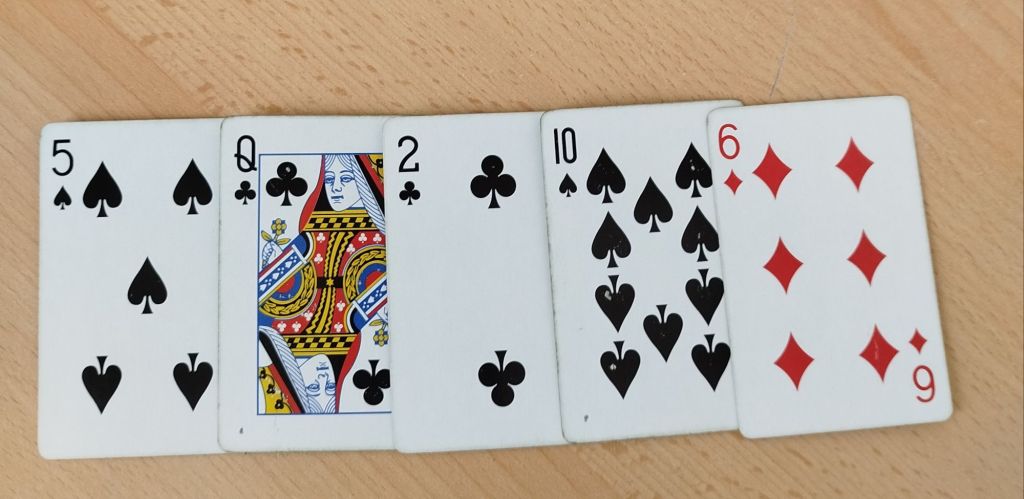
Since we have absolutely nothing to go off on, we can start by noting that the querent’s significator shows up (the Queen of Clubs), though not in a very good spot. She comes after the Five of Spades which is the card of sacrifice, imprisonment and the inability to move. So we can already sort of guess that the querent is feeling trapped in some form or another.

The spread ends with the Six of Diamonds, which represents worry, insecurity and the like. Often it shows financial problems, but not necessarily: it can be a card of general nervousness and uncertainty. The spread is now starting to reek of psychological hang-ups.

Usually, the Two of Clubs after a person card indicates the person taking steps. Toward what? Toward the Ten of Spades. This is the card of secrets, of the night and of unknown situations.

At this point I asked the querent if she’s someone who never leaps into unclear, unknown situations. She said that that was one of the things keeping her from enjoying life, since she always prefers to avoid risk or put off taking it until she feels prepared, which is never.

Bingo. This is the answer: she must learn to step into the dark, take risks and be ok with not having everything figured out. She must learn to swim by swimming rather than by reading up on how to swim. If she doesn’t do it, she will spend her whole life by the poolside waiting for every condition to be perfect.

So, have the cards talked about the purpose of the querent’s whole life? You may disagree with me, but I don’t think so. I do not think that this is the purpose of her whole life (I think there is much, much more to anyone’s life), nor do I think that this is the reason she was born or has reincarnated (if you believe in reincarnation at all). And I told the querent as much, in the spirit of transparency.

What I do mean is that, at least at this juncture in her life, this is a recurring pattern that weighs her down and that needs addressing because it influences her general quality of life. That’s already enough to be worth being mentioned by the cards.

Ultimately, almost every airy-fairy woo woo question is the voluntary or involuntary corruption and modernization of some kind of longing that is deeply seated in the human soul. Questions about the purpose of one’s life may be often answered with the usual mix of mind body spirit platitudes, but the human desire for purpose is not to be lightly dismissed, whether the purpose is really there or not. And divination can address this desire in some form or another.

I believe that divination should be able to run the whole gamut of the human experience, from the most concrete questions to the most abstract, because this is the extension of the human soul. The problem arises only when we try to reduce one order of problems (Will I the chicken cross the street?) to another order of problems (What kind of psychospiritual drama do you think caused the chicken to want to cross the street?)

MQS

  1. I will probably discuss it more at length in another section, but my belief is that there is only one, universal soul that is constantly incarnating and reincarnating through everything. ↩︎