Tag Archives: Fortune-telling

Tarot Encyclopedia – The Four of Swords

(Note: this is a collection of the meanings attributed to the cards by some occultists in the past centuries. It does not reflect my own study or opinion of the cards. It is only meant as a quick comparative reference as I develop my own take.)
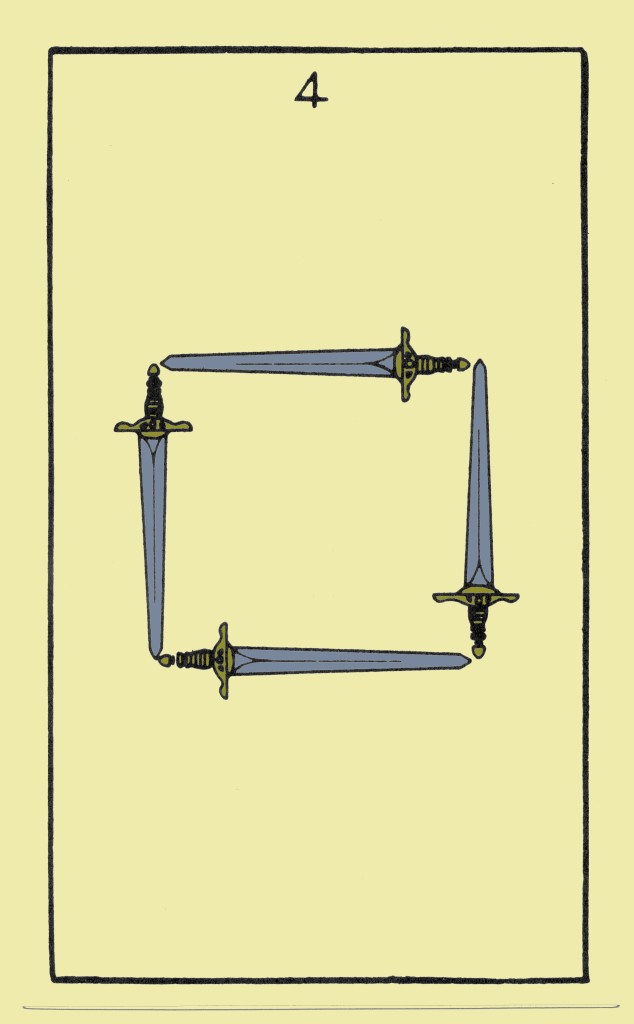
The Four of Swords from the Builders of the Adytum (BOTA) tarot deck

Paul Foster Case (and Ann Davies)

The time period is the last decanate of Libra, October 13 to October 23, under the rulership of Mercury.
Well-Dignified: rest from sorrow, yet after and through it; relief from anxiety; rest after illness; quietness; change for the better; success in legal affairs; association with others in Mercurial pursuits; strong mental attraction to a person of the opposite sex; activity in writing or short journeys.
Ill-Dignified: inharmony with partners; unsettled conditions in legal
affairs; disorder and loss through ill-considered writings or needless
short journeys; vexations through petty strife and sarcastic speech.
Keyword: Rest.
(From the Oracle of Tarot Course)

A. E. Waite

The effigy of a knight in the attitude of prayer, at full length upon his tomb. Divinatory Meanings: Vigilance, retreat, solitude, hermit’s repose, exile, tomb and coffin. It is these last that have suggested the design. Reversed: Wise administration, circumspection, economy, avarice, precaution, testament.
(From The Pictorial Key to the Tarot)

Aleister Crowley

The Four of Swords is called Truce. This seems rather on the lines of “the strong man armed, keeping his house in peace”. The masculine nature of air makes it dominant. The card is almost a picture of the formation of the military clan system of society.

[…]

The number Four, Chesed, is here manifested in the realm of the Intellect. Chesed refers to Jupiter who rules in Libra in this decanate. The sum of these symbols is therefore without opposition; hence the card proclaims the idea of authority in the intellectual world. It is the establishment of dogma, and law concerning it. It represents a refuge from mental chaos, chosen in an arbitrary manner. It argues for convention.

The hilts of the four Swords are at the corner of a St. Andrew’s cross. Their shape suggests fixation and rigidity. Their points are sheathed—in a rather large rose of forty-nine petals representing social harmony. Here, too, is compromise.

Minds too indolent or too cowardly to think out their own problems hail joyfully this policy of appeasement. As always, the Four is the term; as in this case there is no true justification for repose, its disturbance by the Five holds no promise of advance; its static shams go pell-mell into the melting-pot; the issue is mere mess, usually signalized by foetid stench. But it has to be done!
(From The Book of Thoth)
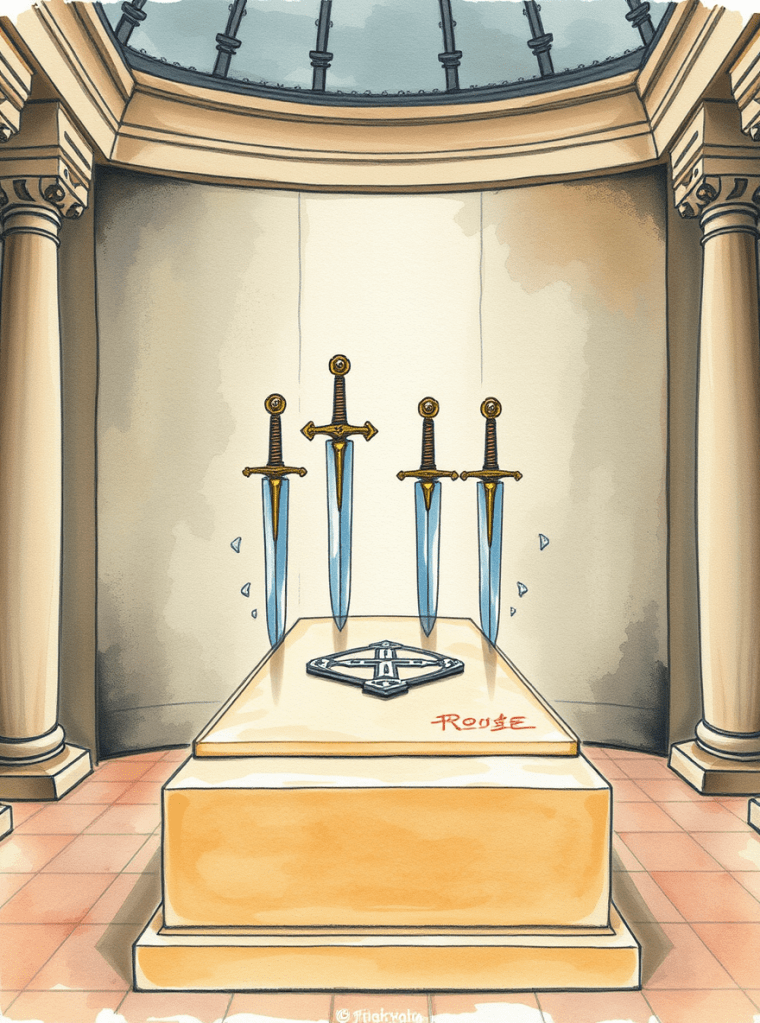
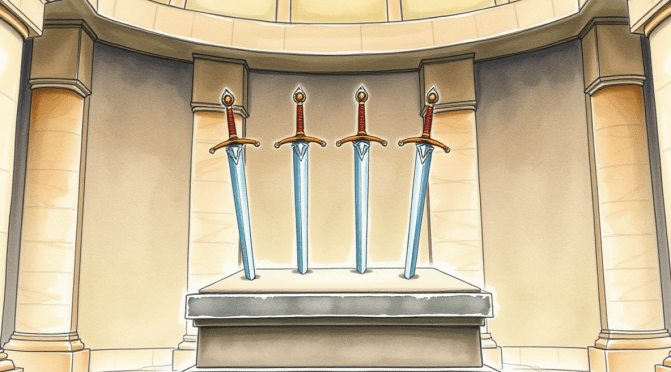
AI-generated illustration for the Four of Swords

Golden Dawn’s Book T

TWO White Radiating Angelic Hands, each holding two swords; which four cross in the centre. The rose of five petals with white radiations is reinstated on the point of their intersection. Above and below, on the points of two small daggers, are Jupiter and Libra, representing the Decanate.

Rest from sorrow; yet after and through it. Peace from and after war. Relaxation of anxiety. Quietness, rest, ease and plenty, yet after struggle. Goods of this life; abundance; modified by dignity as is usual.
Chesed of HB:V (Convalescence, recovery from sickness; change for the better).
Herein do HB:LAVYH and HB:KLYAL bear rule.

Etteilla

Solitude
Upright. This card means, as far as the medicine of the spirit is concerned and in its natural position: Solitude, Desert, Retired place, Hermitage. – Exile, Banishment, Proscription. – Uninhabited, Isolated, Abandoned, Neglected. – Tomb, Burial Ground, Coffin.
Reversed. Economy, Wise Conduct, Wise Administration. – Welfare, Management, Household management, Savings, Avarice. – Order, Arrangement, Relationship, Convenience, Concordance, Agreement, Harmony, Music, Disposition. – Will. – Reservation, Restriction, Exception. – Circumspection, Circumscription, Retention, Wisdom, Sympathy, Regard, Precaution.

MQS
Bolognese Tarot – Introduction to an Old Fortune-Telling Tradition (Part I)

As I’ve mentioned on this blog, I’ve been studying the divination tradition of the Bolognese Tarot (Tarocchino Bolognese, literally the Small Tarot of Bologna) for some months now. I’ve been doing it under the direction of a traditional practitioner of this art, whom I’ve befriended and with whom a wonderful exchange of ideas has started.

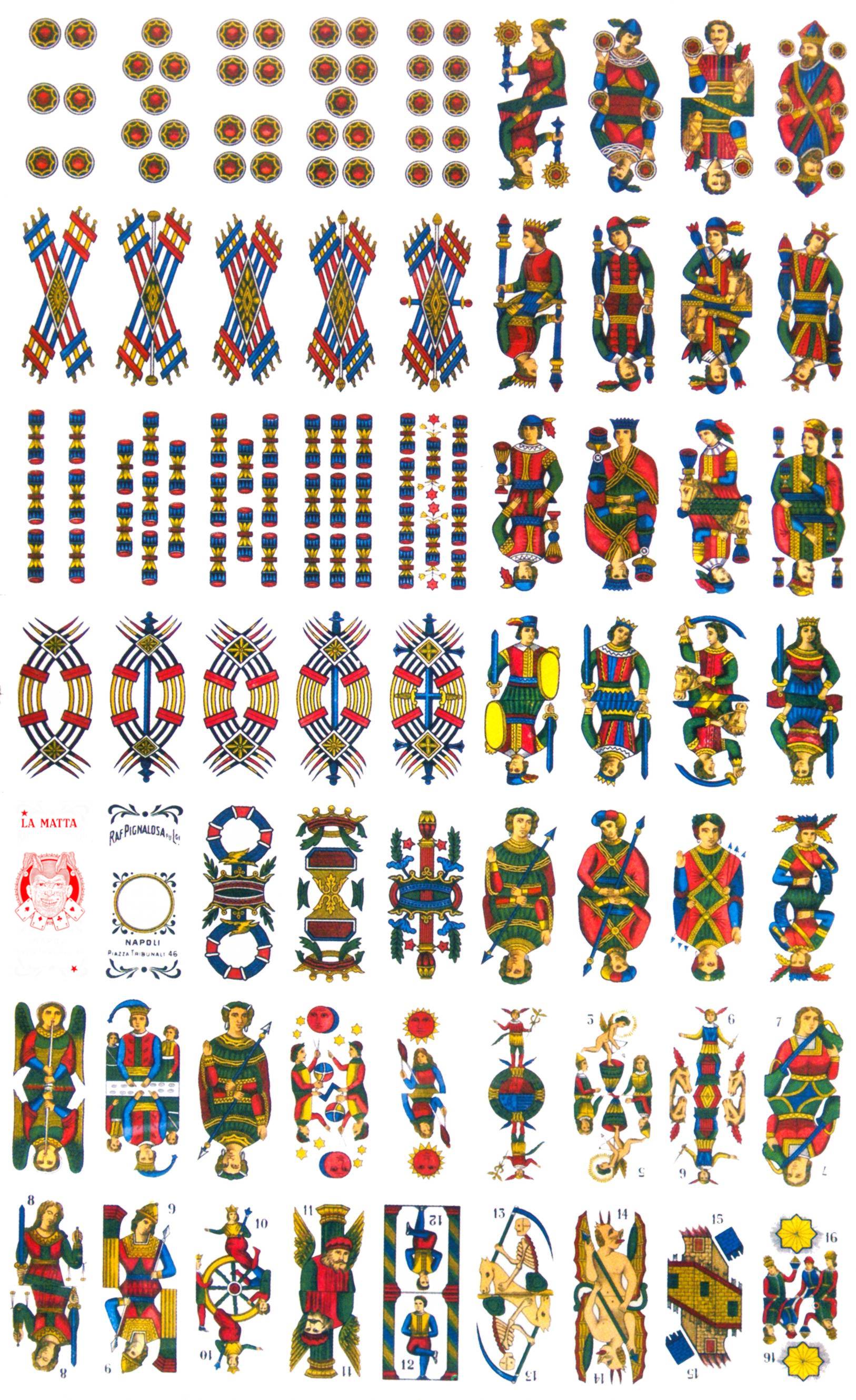
The full deck. Image from the website Labirinto Ermetico

I plan on introducing this form of divination in its main lines for a couple of reasons: 1) it is little known outside of Italy and it deserves some love 2) Its reading techniques are markedly different from the current approach and allow for a very concrete, down-to-earth approach 3) I want to discuss some spreads done with it in the future, and I can’t do it without introducing it first 4) it is the oldest tarot-related divination tradition that we know of, and it is therefore cool from a historical standpoint.1

The Ugly Duckling and Its Quirks

Like the almost totality of very old decks, with a couple of exceptions (the Visconti deck is one) the Bolognese tarot is distinctively unappealing from an esthetic standpoint, largely because, like other popular pre-RWS decks, it was meant to be used by poor people as a playing deck at the local inn.

A selection of cards from the Bolognese Tarot. As may be noted, they are symmetrical, like playing cards, though the earliest packs had full images.

The reason it is called ‘tarocchino’ (small tarot) has to do with its reduced size, probably to enhance its handlability. However, it is not just the size of the cards that is reduced, but also the number of the cards that comprise the deck: all pip cards from Two to Five are removed, leaving only the Ace of each suit plus the cards from Six to Ten and the court cards.

Furthermore, the Pope (Hierophant), Popess (High Priestess) Empress and Emperor are absent from the deck for political reasons, as Bologna was directly under the control of the Church. Instead, the deck includes four ‘Moors‘ (the Moors were Muslim colonizers that had conquered parts of Italy.)

Three of the ‘Moors’. The Fourth one is a copy of the third on the right.

Finally, the Bolognese Tarot has another peculiarity, in that the Major Trumps are out of order compared to our regular system. This may sound surprising to some, but our current ordering of the trumps is a relatively recent development and has nothing mystical about it (the oldest preserved document with the order of the trumps gives a rather different sequence).

An Old Tradition

The Bolognese Tarot tradition was almost entirely confined to the city of Bologna and the surrounding areas, and was at risk of dying out, until both the card game and the divination tradition were transmitted to a larger public thanks to the power of the Internet.

Interestingly, to this tradition is connected the most ancient set of meanings handed down by old sources. The following list dates back to the pre-Napoleonic period and gives the meanings of a reduced pack of thirty five cards. I’m copying it here for its historical interest, but it does not correspond to the system I have been taught:

  1. The Juggler (Magician): Married Man
  2. The Lovers: Love
  3. The Chariot: Journey
  4. Temperance: Time
  5. Strength: Violence
  6. The Hermit: Old (Person)
  7. The Hanged Man: Treason
  8. Death (called ‘Thirteen’): Death
  9. The Devil: Wrath
  10. The Star: A Gift
  11. The Moon: Night
  12. The Sun: Day
  13. The Angel (Judgement): Marriage or Agreement
  14. The World: Long travel
  15. The Fool: Madness
  16. King of Wands: A Bachelor
  17. Queen of Wands: A Prostitute
  18. Knight of Wands: Something Knocking at the Door
  19. Page of Wands: Thoughts of the Female Querent
  20. Ace of Wands: Sexual Escapades
  21. King of Cups: An Old Man
  22. Queen of Cups: Married Woman
  23. Knight of Cups: Reconciliation
  24. Page of Cups: The Female Querent
  25. Ten of Cups: The Roof of the House
  26. Ace of Cups: The House
  27. King of Swords: An Evil Tongue
  28. Ten of Swords: Tears
  29. Ace of Swords: A Letter
  30. King of Coins: The Male Querent
  31. Queen of Coins: The Truth
  32. Knight of Coins: Thoughts of the Male Querent
  33. Page of Coins: Unmarried Woman
  34. Ten of Coins: Money
  35. Ace of Coins: The Table

As I said, this is not the system that I’ve been taught, and it is very likely that even back then more than one system existed (usually, significant differences are found from quarter to quarter in Bologna and from small village to small village in the surrounding areas). Since this cartomantic tradition predates Etteilla’s by at least a quarter of a century, and probably more, and since Etteilla says he learned to read the tarot from an Italian card reader (though he pretends it was Alexis of Piedmont to add to the mystery), it is not to be excluded that the Bolognese tarot had some influence on him.

But this is speculation. What is clear is that tarot divination, whenever it was born, was brought into the world as a way of addressing concrete issues. This series of articles is dedicated to bringing the tarot back to these roots.

MQS

  1. If you want to read more, you can start with the Wikipedia page. More Information is contained on the webside of the Associazione Le Tarot ↩︎

A Long Long Time (Reading Example)

Sometimes in readings it’s not immediately clear whether the cards start by describing the past, present or future. There are times when they jump immediately into the future, while at other times they only talk about past and present situations and we need to keep adding cards to find out what happens next. More often, though, the cards start with the past/present and then move on to the prediction, or at least this is my experience.

In this case I was asked by a querent if she would find a job. Note that I started with five cards and then added more to get more details, but I here want to concentrate on the first five:

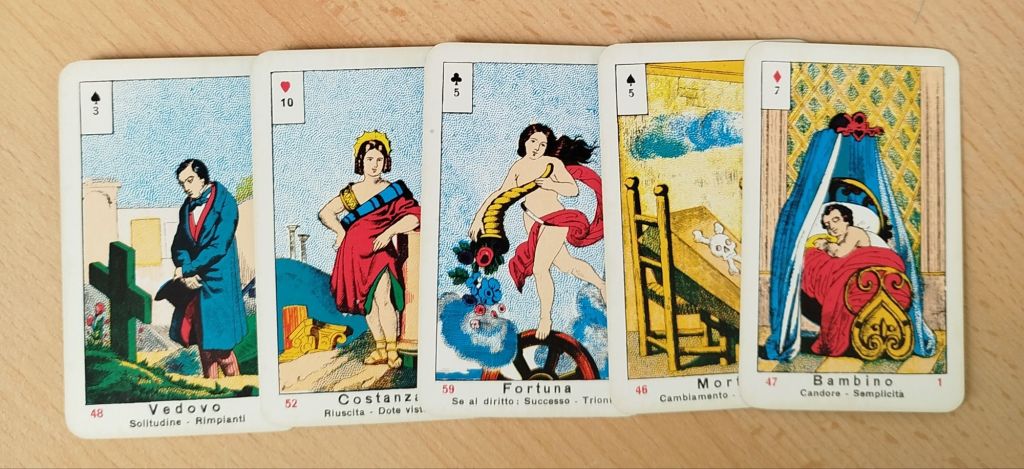
Job Prospects. A Vera Sibilla Reading

The first four cards (Widower, Perseverance, Fortune and Death) deserve special attention. The Widower is the card of “being without”. It also has some affinity with the past, especially when it falls toward the beginning of the spread. The Perseverance card can sometimes indicate that something goes on for a long time (it perseveres). Usually this happens when the cards surrounding it have the same polarity or talk about the same thing.

In this case, the Fortune card is not the same polarity as the Widower, since the former is positive and the latter negative. However, Fortune is followed by Death, showing misfortune or lost chances. In this case, it’s as if Fortune + Death formed a single (negative) card, which is of the same polarity as the Widower.

Therefore the Perseverance card highlights the fact that the querent is without (work) and has been for quite a while, and has repeatedly lost chances or opportunities, or has had repeated misfortunes connected to her career. She confirmed to me that she hadn’t found a job since giving birth to her daughter a few years ago. Actually, she hadn’t looked that much for a job, but whenever she had she had been passed over in favor of someone else.

The Child card is a card of beginning, and in a way it shows the start of a new phase. This fact is highlighted by the Death card being at the end of a negative sequence, so that while it is a negative card in itself (because it follows the Fortune card) it also ends the negative period thanks to being followed by the Child.

The cards following the first five simply described the work environment and the various ups and downs she will face, but they are less interesting.

MQS

Robert Fludd’s Geomancy – Introduction Pt. 2

Previous / Back to Index / Next

Fludd describes the importance of purification, meditation and other practices in preparation to geomancy.

3. How a Geomancer Should Prepare Himself, So That the Intentions of His Mind May Be Clearly Emitted, and May Be United With the Senses by Means of Reason

It is thanks to our senses that we can see the geomantic points. Then, we compare these same points to the celestial [bodies] and the elements with our imagination.1 Finally, the hidden virtue, both of these points and of the figures arising from them proceeds from the correctness of the intellect, both active and passive,2 and consequently from the mind.

From all this follows that the human body must be regulated and governed in such a way that its more intellectual part may not be drowned by too much intercourse with the flesh, or become dulled, and that the imaginative or fantastic spirit may not be rendered dull and impure.3

Therefore, before this work is approached, let our fantastic spirit be clean, pure, unmoved and untroubled by cares, so that it may be made worthy of being trusted by the mind and intellect. Thus, such a spirit, most suitable for divination, will receive the light of the rays of the mind without any hindrance, and will depict the objects of truth in a mystical manner, as if in a mirror, and will cause the sensation and movement of the body to proceed exactly and to the degree to which the effect of the mind itself tends.4

When, therefore, we are safe and healthy in body, and not disturbed in mind, not weighed down by food or drink, not suffering from want or poverty, and not ruled by any vices of lust or anger, let us enter into this area of ​​prophecy. Let him also who wishes to use this art keep his spirit pure, both by quiet and religious meditation, and by moderate and temperate diet according to nature.5

This preparation is necessary for him who desires to foretell the truth of future things, either by the geomantic art, or by any other method, since without it no one can access true divination, for he who is languishing in a fantastical spirit6 will not attain the desired end, but will judge confusedly and indiscernibly.

Similarly, when we are filled with wine, our imaginative spirit, as if submerged in noxious vapors, hides and distorts the glory and truth of the rays of the mind, no differently than a thick cloud, or the earth raised in the middle of the air region, shields the glory of the sun from the eyes of the beholder, and produces a refraction of its rays. In this manner falsities will appear instead of truths, and in the very portion of the cloud the objects of the sun will be seen changed into an iridescent or multi-colored substance, and many phantasms will appear in the air, which are not such as they appear.7

Hence they say that the vassals of Amphariaus,8 as Philostratus testifies, ordered one who wished to divine future things, and to receive the oracles of God or of the mind, to abstain from food and wine for a whole day, or even for three days, if this could be conveniently done.

Thus we read that Ezra and Daniel, and even Moses himself, before they came to God, abstained from their wives for three days and washed their clothes: and so they did all this, at the command of God himself, of which we read Exod. 19 and Ezech. 44.9

And so also must he who desires to devote himself faithfully to this form of divination, be delighted not with carnal intercourse, but with spiritual union, not with wine, but with the light of the mind’s milk, not to be lavished with worldly riches, but with the infinite affluence of the divine intellect, not with junk, but to be filled with spiritual food.10

In an old French manuscript on occult Geomancy I found a confirmation of the above in these following words: “Before you get to the projection of the Geomantic points, I would like you to understand that they are not counted. Indeed, if you do this, nothing good or profitable will result from it, since this is knowledge based on the soul, and therefore the number of points is to be found in the will of the soul, and in no way be established according to the appetite of your senses.

It behooves him, therefore, who undertakes this work, to begin nothing, unless his heart is at peace, and his conscience is whole and healthy, and his spirit and soul are not troubled by any disturbances, so much so that he would not even wish worse for another than for himself.11

Finally, having been prepared in this way, let him trust in God, the teacher of knowledge, and beseech him with prayers, that by the power of that knowledge he may reveal to him the truth; having therefore carefully completed these things, it will be necessary to proceed immediately to the projection and arrangement of the points, etc.”

This author in no way disagrees with our opinion, but rather, on the contrary, seems to agree exactly with it.

4. It Is Not Sufficient for Divination That the Body and Flesh Should be Well Ordered. It is Also Necessary That the Rays of the Internal Soul Be Gathered Together

As concentrating a force generally increases its strength, so also it begets great weakness when it is dispersed.12 Thus we see that the rays of a candle in a confined room illuminate a place in a wonderful manner, since the narrowness of the place compresses and contracts the rays emitted by the flame to each other, so that they have a greater power in illumination. However, if that candle is placed in a larger room, its light is greatly weakened and darkened, because of the dispersion of its rays in a wide area.

In the same way, then, the soul (whose candlestick is the human body) spreads its rays in this or that business, nay, in infinite external things, for example, in lawsuits and legal affairs, in the art of medicine, in the care of family matters, in pain and sadness over a lost cause or the death of a friend, in anger or some unexpected adversity, in some art or knowledge and others of the like, or if he is also affected by the intercourse of concupiscence, the vice of drunkenness, the indulgence of gluttony, or other temptations of the flesh, he will be very weak and have little power to illuminate the body.

But truly, if all these soul-rays are reduced from external affairs to the internal economy of the Microcosm, and are drawn back to their center from the multitude, the force of the soul will be united, and that body, which was formerly dark and gloomy because of the rays, will be illuminated in a wonderful way, and thus the prophetic power in man will be far more effective than it was before.13

However, this reduction of the expanded rays of the soul into one cannot take place without the purification of the body, which is done in the manner mentioned above. As a result it is necessary above all things for him who wishes to claim the name of truth in Geomancy, that his soul should once again turn and reflect its scattered rays upon itself; since the chief virtue of this science consists in the illumination of the soul, in so far as true things are seen in its divine light, as in a mirror of truth, and are explained by the external observation of points in a mystical way through the guidance of the soul that turns its attention to this.

MQS

Footnotes
  1. By using the correspondences of the figures. ↩︎
  2. The concept of the ‘intellectus agens’ or Active Intellect is key to Neoplatonist spirituality both in Europe and in the Arab world, and has many similarities with some kabbalistic concepts. Generally, the Active Intellect was a universal form of intelligence that is not confined to one’s individual nature. Whether Fludd is referring to this or simply to the more active faculties of the human soul is unclear to me. The gist of his argument, however, is that the occult sciences, including Geomancy, rest on the highest principles, which makes them hard to access when one is not pure. ↩︎
  3. Imagination is depicted here as a valid aid to understanding, as long as it is in its pure form and not just mere fancy. ↩︎
  4. To put it simply, the body and the lower faculties of our nature must be ruled in such a way that they move in unison with the higher. Once this is accomplished, divination may take place successfully. ↩︎
  5. Old medicine was of the idea that an appropriate diet could only be prescribed based on one’s nature. There was no one-size-fit-all. As for meditation, Fludd is unlikely to refer to those forms of meditation that entered into the Western consciousness thanks to theosophy’s Eastern dabblings, and that have become commonplace today. The West used to have its forms of meditation. ↩︎
  6. possibly meaning someone who gives in to their fantasy without ruling it appropriately ↩︎
  7. It is impossible to read this passage without being reminded of Plato’s myths, especially that of the cave. ↩︎
  8. Possibly Amphiaraus, the mythological seer. ↩︎
  9. Here Fludd interprets passages from the Bible as episodes describing some higher form of divination. In a way, this is very true. ↩︎
  10. Here Fludd proposes a series of alternatives to ‘lower’ forms of pleasure that may seem rethorical at first, but on closer inspection aren’t. Such ‘substitutions’ are typical of many occult training curricula. ↩︎
  11. Ill-wishing is part of the things that weigh the soul down. ↩︎
  12. The same pressure applied on a wider surface disperses it. ↩︎
  13. This process of ‘unification’ is the same that has been typical of Neoplatonism since (at least) Plotinus, and which has been described, within a Christian context, by the German mystics (Meister Eckhart and his disciples) who described the Seelengrund (ground of the soul) as the point of contact of the individual soul with the universal presence of the divine. Fludd, living at the end of the Renaissance and its exaltation of humanity, gives us a slightly less mystical version of this idea, one geared toward increasing one’s knowledge through occult practices. ↩︎

Unanswerable Questions

Not every question is fit for divination, and as diviners who get approached by people, discernment and, if necessary, gate-keeping is among our rights and duties. I say this not because I want to feel part of a superior caste of priests, but because our practice should be informed by two great principles: the well-being of our querents and the honor of our art.

It is perfectly fine to ask questions out of mere curiosity or for fun, but the ultimate decision on whether a question shall be put to the cards rests with us. I, for one, have dodged more questions about controversial politicians in the last couple of weeks than in the last couple of years altogether, largely because the question, when boiled down to its essential meaning, was “Is it true this politician I hate is a spawn of Satan?”

Such questions are unanswerable not merely because they are idle, but because they are ultimately unverifiable: unless you are that politician’s cleaning lady you have few ways of verifying my answer. Furthermore, consider this: if my answer is anything except “yes, you’re absolutely justified in your hatred,” the person is going to be inclined to dismiss my answer as superstitious nonsense. Why, then, whould a positive answer be of any value?

But unanswerable questions are not just those that belong to the “is it true that my particular preferences are absolutely valid and I don’t ever need to question them?” category. Some are more tragic. Recently I got asked something heart-breaking: “Is my life still worth living?”

No matter how we slice it, THIS is an unanswerable question, which doesn’t make it a meaningless string of sounds. On the contrary, it is a clearly formulated cry for help. As someone who has been struggling with depression since my teen years and has gone dangerously close to the edge on more than one occasion, I resonate strongly with it. But the fact remains that divination is not the tool to solve this issue.

I refused to open the cards on this question, obviously, but suppose I had, and suppose that, predictably, the cards had shown me the absolute mess that is this person’s life: does this make their life less worth living?

There is no answer. In this case, not because we cannot verify the details (I could easily point at the cards and say “your career is in shambles and your family life is a museum of red flags”) but because the reality of the situation has no bearing on the answer. Worth is subjective. The exact same set of circumstances that might drive someone to walk into a lake with stones in their pockets would be taken by someone else as life throwing a little challenge their way.

Therefore, in this case the question would translate as “What is your personal opinion on what makes life worth living and do you think I still meet those criteria?” I don’t think anyone would be foolish enough to even consider taking such a responsibility for themselves.1 It is much wiser to talk to the person, encourage them to open up and direct them to an appropriate source of (medical) help.

Again, though, the fact that the question cannot be answered does not imply that there isn’t a deep, real, visceral experience behind it. It is just that divination is not the way to go. It is like asking a pair of scales to measure whether you are pretty.

MQS

  1. Furthermore, people in a seriously distressed state are especially prone to esoteric influences, and would to better to avoid them, even if it’s just a simple card reading ↩︎

Tarot Encyclopedia – The Four of Cups

(Note: this is a collection of the meanings attributed to the cards by some occultists in the past centuries. It does not reflect my own study or opinion of the cards. It is only meant as a quick comparative reference as I develop my own take.)

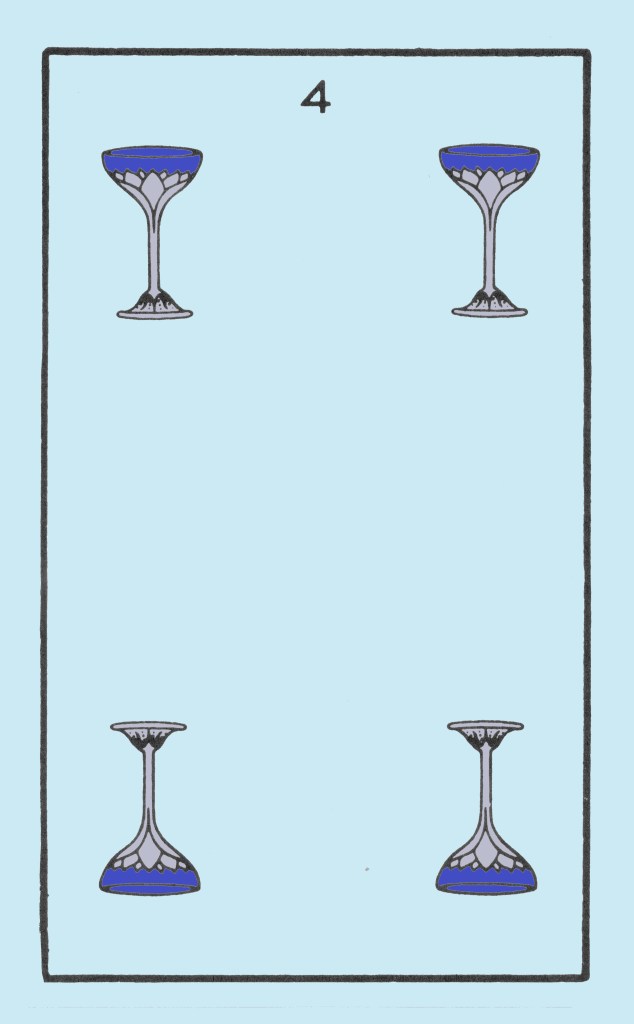
The Four of Cups from the Builders of the Adytum (BOTA) tarot deck

Paul Foster Case (and Ann Davies)

The specific divinatory meanings are thus based on the attributions of Chesed, the planetary forces of Jupiter and Neptune, the zodiacal influences of Cancer ruled by the Moon, and the astrological fourth house. Jupiter’s sphere of influence is Chesed. It co-rules the third decanate of Cancer besides being exalted in this zodiacal sign. Therefore the Four of Cups has a very strong Jupiterian influence of wealth and expansiveness. The Four of Cups corresponding to the third decanate of Cancer is the time period July 13 to July 22, ruled by Jupiter and Neptune.
In specific Tarot Divination its key meanings are:
Well Dignified: success in material things, but desire for something higher; a period of comparative comfort, yet a little confining, thus suggesting a measure of satiety; it is a symbol of contemplation and of the turning away from pleasure in quest of higher things; it intimates strong psychic influences in the life or environment of the Querent.
lll-Dignified: material gain, but through injustice; sorrows resulting from satisfaction of desire; getting what one has wanted but finding no joy in it.
Keyword: Surfeit
(From the Oracle of Tarot Course)

A. E. Waite

A young man is seated under a tree and contemplates three cups set on the grass before him; an arm issuing from a cloud offers him another cup. His expression notwithstanding is one of discontent with his environment. Divinatory Meanings: Weariness, disgust, aversion, imaginary vexations, as if the wine of this world had caused satiety only; another wine, as if a fairy gift, is now offered the wastrel, but he sees no consolation therein. This is also a card of blended pleasure. Reversed: Novelty, presage, new instruction, new relations.
(From The Pictorial Key to the Tarot)

Aleister Crowley

The Four of Cups is called Luxury.

The masculine nature of fire permits the Four of Wands to appear as a very positive and clear-cut conception. The weakness in the element of water threatens its purity; it is not quite strong enough to control itself properly; so the Lord of Pleasure is a little unstable. Purity has somehow been lost in the process of satisfaction.

[…]

This card refers to Chesed in the sphere of Water. Here, below the Abyss, the energy of this element, although ordered, balanced and (for the moment) stabilized, has lost the original purity of the conception.

The card refers to the Moon in Cancer, which is her own house; but Cancer itself is so placed that this implies a certain weakness, an abandonment to desire. This tends to introduce the seeds of decay into the fruit of pleasure.

The sea is still shown, but its surface is ruffled, and the four Cups which stand upon it are no longer so stable. The Lotus from which the water Springs has a multiple stem, as if to show that the influence of the Dyad has gathered strength. For although the number Four is the manifestation and consolidation of the dyad, it is also secretly preparing catastrophe by emphasizing individuality.

There is a certain parallelism between this card and the Geomantic figures Via and Populus, which are attributed to the Moon in her decrease and increase respectively. The link is primarily the “Change=Stability” equation, already familiar to readers of this essay. Four is an “awkward” number; alone among the natural numbers, it is impossible to construct a “Magic Square” of four cells. Even in the Naples Arrangement, Four is a dead stop, a blind alley. An idea of a totally different Order is necessary to carry on the series. Note also the refolding-in-upon-itself suggested by the “Magic Number” of Four 1 + 2 + 3 + 4 which is Ten. Four is the number of the Curse of Limitation, of Restriction. It is the blind and barren Cross of equal arms, Tetragrammaton in his fatal aspect of finality, as the Qabalists knew him before the discovery of the Revolving Formula whereby the Daughter, seated upon the Throne of the Mother, “awakens the Eld of the All-Father”.

For the meanings of Via and Populus, refer to the “Handbook of Geomancy” (Equinox Vol. I, No.2).

(From The Book of Thoth)

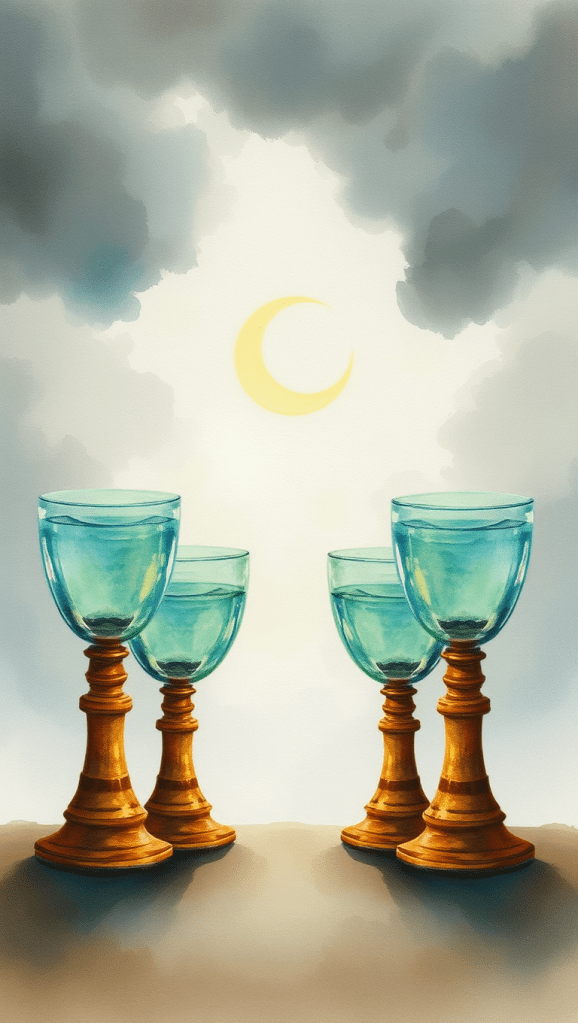
An AI-generated illustration for the Four of Cups

Golden Dawn’s Book T

FOUR cups: the two upper overflowing into the two lower, which do not
overflow. An Angelic Hand grasps a branch of lotus, from which ascends a stem bearing one flower at the top of the card, from which the white water flows into the two upper cups. From the centre two leaves pass right and left, making, as it were, a cross between the four cups. Above and below are the symbols Moon and Cancer for the Decan.

Success or pleasure approaching their end. A stationary period in happiness, which may, or may not, continue. It does not mean love and marriage so much as the previous symbol. It is too passive a symbol to represent perfectly complete happiness. Swiftness, hunting and pursuing. Acquisition by contention: injustice sometimes; some drawbacks to pleasure implied.
Chesed of HB:H (Receiving pleasure or kindness from others, but some
discomfort therewith).
Therein rule the great Angels HB:HYYAL and HB:MVMYH.

Etteilla

Boredom
Upright. This card, as far as the medicine of the spirit is concerned, means, in its natural position: Boredom, Displeasure, Discontent, Disgust, Aversion, Enmity, Hatred, Horror, Restlessness, Pain of spirit, Slight sadness, Affliction, Painful, Annoying, Unpleasant. – Saddening, Distressing.
Reversed. New Directive, New Light. – Index, Indication, Conjecture. – Augury, Foreboding. – Presentment, Foreboding, Predilection, Novelty.

MQS

Self-Fulfilling Prophecies And How to Avoid Them

A couple of weeks ago I received a message about the question of whether we, as readers, risk causing self-fulfilling prophecies with our predictions. For instance, if I tell a querent that the relationship she is in is going to end, I may end up causing the break-up. What follows is a slight elaboration on my response.

First off, we need to recognize that some things we can change or at least improve, others we can’t and they will happen regardless of what we do and what a reader tells us. Most people who go about their life with their brain switched on can recognize this. It is only when we get into delulu territory and body-mind-spirit-section pseudomysticism that we encounter people who deny the existence of unavoidable happenings.

On the other hand, sheer fatalism is also a gross misunderstanding. Consider simply this fact: if two people X and Y are exactly the same and go exactly through the same life experience, except that X also uses divination or consults a diviner, this is enough to tell them apart.

The fact that X knows about what is going to happen in advance is enough to make him a different individual, which in turn is enough to change the nature of his fate, because our ability to change a situation is contingent on our knowledge of what the situation truly is. Even if X cannot change a certain fact in any meaningful way, but knows about it enough in advance that he can make his peace with it, the same event Z won’t be the same if X’s attitude toward it changes, because X is part of the event that takes place in his life, and so if X change, the event changes. Even if X cannot bring himself to accept Z, his knowledge of Z is enough to change Z, because X with knowledge of Z is not equal to X without knowledge of Z.

Fate patterns are a difficult topic to tackle without a previous sound philosophical and occult discussion, and I plan on starting that discussion at some point, once I’ve organized my notes. For now, it suffices to say that we, as readers, can play a rather important role in the querent’s life if we are consulted at the right moment.

Yet, this doesn’t mean that we are capable of empowering querents to always turn their life around, and I don’t even think empowering is our mission: our mission is to provide information. On a number of occasions, especially when I was less experienced, I gave querents the wrong prediction on purpose because I didn’t want to disappoint them, even though the cards were clearly negative: Yes, you’ll get the job, yes the relationship is going to last and be wonderful. But it didn’t happen. 

On some of those occasions you may even think that because I didn’t bring up the negative aspects, the querent wasn’t prepared to tackle them, so my not bringing them up may have been just as bad as another diviner handing out negative predictions willy-nilly. That’s because I wasn’t able to give accurate information.

It is nice that some things can be changed even if some things can’t, but unfortunately we don’t always know which is which. Therefore, we must also recognize that we have a degree of power over our querent just by virtue of using odd, mysterious counters to give our predictions, and we must not abuse this power. 

Whenever possible, we should either frame our predictions as potentials and/or accompany them with positive suggestions. These suggestions, though, must ALWAYS be based on what the oracle describes, never on vague self-help platitudes. Sometimes (many times) it is best to highlight critical points so that the querent can become conscious of them (e.g., “you know, this relationship is headed down a pumpy road. You should address x, y and z if you want to try to make it work”) while avoiding drastic predictions unless necessary.

Furthermore, we must never frame our predictions in such way as to take away all hope. It is not our right to do so. Deluding and disillusioning are the two capital sins that we must avoid, even though striking the right balance is sometimes hard. There is plenty of space between being a pushover to our querent’s wishes and being an insufferable sassy tough-love prick.

If there are positive aspects to a situation, we should emphasize those and try to put them at the center of the querent’s life so that they can address the negative points more positively.

Finally, we ought to always remind our querent that diviners are people and are therefore fallible. In a world where doctors, lawyers, judges, scientists and bakers can get things wrong it would be absurd to expect diviners to always be right. Always encourage the querent to take your predictions as an additional input. 

MQS

The Job Interview (Example Reading)

Since I began reviewing my geomancy reading method I started nagging some friends for an opportunity to read for them. I am especially interested in seeing whether we can consider the houses in the shield to be adjacent across the shield (like, for instance, the First with the Ninth), as Peter of Abano seems to suggest in his handbook. This would open up the Geomantic Shield to a whole host of interactions.

A friend of mine was applying for a job, so he asked me if he would get it. This is the Shield I got:1

“Will I get the job?” Geomancy reading. App used: Simple Geomancy

The Querent is represented by the First House and the first figure, Tristitia. The Job is represented by the Tenth House and the tenth figure, Caput Draconis. Tristitia is not a great figure, indicating trouble and difficulties. The querent has been having trouble holding down a job or having contracts renewed, so it is fitting that he should be troubled by the situation. Caput is an encouraging figure, showing things beginning, but without contact between the two houses I wouldn’t predict him being hired.

Fortunately, contact is provided by Tristitia, which springs to the Eleventh House. The fact that Tristitia moves, and not Caput, indicates that the querent will need to put quite a bit of effort into the hiring process. Tristitia also springs to the Third House, and, according to Abano, this seems to count as being in contact with the Tenth House. I cannot make any definitive judgment on this issue. I will merely file it away for future consideration.

The Judge is Fortuna Maior, which is a very encouraging indication of success through effort. Possibly, I thought, the hiring process will stretch out and take longer than the querent thinks. The fact that Maior emerges from a very difficult set of Witnesses adds to the obstacles and the delay.

The outcome, thankfully, was positive. He got hired, but the pay was not as satisfying as he thought it would be (note Amissio as Left Witness) and the hiring process definitely lasted way longer than he thought it would.

MQS

  1. Someone asked me if I do my geomancy readings with the app I use to show the chart. I don’t. I always do my readings with pen and paper. The App is only for presentation. ↩︎

An Overview of the Opening of the Key Spread

A recent exchange in the comment section made me go back to some notes I’ve been sitting on for a while about how different card spreads used to be in the past, compared to how they tend to be nowadays. A good example for this is the famous spread used by the Golden Dawn, which has become known as the Opening of the Key.

The Opening of the Key is a complex, multi-stage spread that was (and still is) used within the Golden Dawn system and has been adopted by Paul Foster Case’s and Crowley’s followers as well.

From a magical standpoint, the allure of this spread is that it mirrors within its layouts the whole GD system, being therefore a tool for learning it. Since I do not particularly advocate the Golden Dawn system, I’ll leave this aspect to your consideration, should you be so inclined.

From a purely divinatory standpoint, though, the interesting aspect of the Opening of the Key is that it affords us a glance at how card spreads used to work in traditional cartomancy.

Nowadays we are used to what many call “positional spreads“, that is, spreads where each single card is read more or less independently from the others based on the meaning of the position. The most famous positional spread is certainly the Celtic Cross, also taken from the GD system and popularized by Waite. Over time, though, more and more ridiculous spreads have emerged, with positional meanings as abstracted from actual reality as possible.

If we take a look at many books on divinations published before the 60s, when the Rider Waite deck truly took off, and with it the Celtic Cross spread, we find very different spreads.

Many traditional spreads, used both for tarot and for playing cards, share the following characteristics:

  1. They tend to be large and unwieldy. Many of them take up a whole table. In part, this reflects the old idea that you wouldn’t be potentially in contact with your go-to fortune-teller 24/7 via social media, and so the diviner ought to be able to cover as much of your life as possible in one go. There was also a certain old-fashioned mistique to these spreads, it being the idea that your life unfolds like a book that can be read page to page. Furthermore, the way of reading the cards was different: you didn’t waste too much time on each single card, but simply used it as a building block to be added to the others. Therefore, you needed many building blocks.
  2. Very few positional meanings. Many old spreads used to be either sequential or tableau-like, or a mix of the two. If certain chunks of spread did have a particular positional meaning attached to them, such positions were always covered by more than one card (usually three or more). The cross spread I was taught to use with playing cards is one such example.
  3. Strange techniques. In the English-speaking world, the idea that there are special reading techniques has largely gone lost for over half a century, as tarot became a tool for psychological masturbation that eschews all technicality in favor what one’s heart palpitations. This was until some people, tired of how ineffectual and watered-down the new-age version of the tarot had become, discovered Lenormand cards. In reality, reading techniques have been part of many cartomancers’ toolkit for centuries. Two of the most common techniques (though not the only one) used in old tarot and playing card divination were card counting (starting from a card and counting a certain number of cards to land on the next card to be read) and card pairing (pairing the cards on the opposite sides of a row two by two.)
  4. More than one stage. It was not uncommon for many spreads to have more than one stage to them. Back then, divination was not seen as something to run to for every minor inconvenience, but rather as something affording a general overview of one’s main issues and prospects. Cartomancy was, at least in part, a parlor game, though a serious one, with serious implications.

One of the characteristics of the early Golden Dawn, before it became a battle of egos, was its (relatively intelligent) syncretism, as well as its attempt to act as a reservoir of everything the occult Western tradition had created over the centuries. Many of the founding members of the Golden Dawn were very well acquainted with, and even contributed to the then-growing literature on fortune-telling.

It comes therefore as little surprise that THE Golden Dawn spread, the Opening of the Key, is just as much an occult compendium as it is a compendium of quaint fortune-telling techniques. Let’s read the original instructions together (From Book T):

A Method of Divination by the Tarot

  1. THE Significator.
    Choose a card to represent the Querent, using your knowledge or
    judgment of his character rather than dwelling on his physical
    characteristics.
  2. Take the cards in your left hand. In the right hand hold the wand over
    them, and say: I invoke thee, I A O, that thou wilt send H R U, the great
    Angel that is set over the operations of this Secret Wisdom, to lay his hand invisibly upon these consecrated cards of art, that thereby we may obtain true knowledge of hidden things, to the glory of thine ineffable Name. Amen.
  3. Hand the cards to Querent, and bid him think of the question attentively, and cut.
  4. Take the cards as cut, and hold as for dealing.

“First Operation”
This shows the situation of the Querent at the time when he consults you.

  1. The pack being in front of you, cut, and place the top half to the left.
  2. Cut each pack again to the left.
  3. These four stack represent I H V H, from right to left.
  4. Find the Significator. It be in the HB:Y pack, the question refers to work,
    business, etc.; if in the HB:H pack, to love, marriage, or pleasure; if in the
    HB:H pack, to money, goods, and such purely material matters.
  5. Tell the Querent what he has come for: if wrong, abandon the divination.
  6. If right, spread out the pack containing the Significator, face upwards.
    Count the cards from him, in the direction in which he faces.
    The counting should include the card from which you count.
    For Knights, Queens and Princes, count 4.
    For Princesses, count 7.
    For Aces, count 11.
    For small cards, count according to the number.
    For trumps, count 3 for the elemental trumps; 9 for the planetary trumps;
    12 for the Zodiacal trumps.
    Make a “story” of these cards. This story is that of the beginning of the affair.
  7. Pair the cards on either side of the Significator, then those outside them, and so on. Make another “story,” which should fill in the details omitted in the first.
  8. If this story is not quite accurate, do not be discouraged. Perhaps the
    Querent himself does not know everything. But the main lines ought to be
    laid down firmly, with correctness, or the divination should be abandoned

“Second Operation”
Development of the Question

  1. Shuffle, invoke suitably, and let Querent cut as before.
  2. Deal cards into twelve stacks, for the twelve astrological houses of
    heaven.
  3. Make up your mind in which stack you ought to find the Significator,
    “e.g.” in the seventh house if the question concerns marriage, and so on.
  4. Examine this chosen stack. If the Significator is not there, try some
    cognate house. On a second failure, abandon the divination.
  5. Read the stack counting and pairing as before.
    “Third Operation”
    Further Development of the Question
  6. Shuffle, etc., as before.
  7. Deal cards into twelve stacks for the twelve signs of the Zodiac.
  8. Divine the proper stack and proceed as before.

“Fourth Operation”
Penultimate Aspects of the Question

  1. Shuffle, etc., as before.
  2. Find the Significator: set him upon the table; let the thirty-six cards
    following form a ring round him.
  3. Count and pair as before.

Fifth Operation
Final Result

  1. Shuffle, etc., as before.
  2. Deal into ten packs in the form of the Tree of Life.
  3. Make up your mind where the Significator should be, as before; but failure
    does not here necessarily imply that the divination has gone astray.
  4. Count and pair as before.

There are many characteristics to the Opening of the Key that mirror the checklist I’ve created above:

  1. The spread is large. Especially in its fourth operation, it requires a big table to perform.
  2. Few positional meanings. No individual card signifies anything in particular. What counts is the diviner’s ability to string the meanings together into coherent sentences that apply to the querent’s concrete life. The stacks themselves do have general meanings (business, pleasure, etc.) but these are broad, and you will never find yourself applying them to just one card.
  3. Techniques. These are, more specifically, card counting and card pairing, which are plucked straight out of the fortune-telling tradition.
  4. More than one stage. This is quite evident. Although many GD initiates ended up simplifying the method (more on this in a later article), the complete operation, which could take up upwards of two hours, consisted of five stages which offered a glimpse into the various facets of a situation.

Quite clearly, there is more to the Opening of the Key than what I’ve listed, aside from the heavy occult overlays. For one, the GD added a method for discerning whether the divination is valid: one needs to find the significator in the appropriate stack. This is in part due to the desire to import the notion of ‘radicality’ used by many horary astrologers, according to which certain charts cannot be judged if certain configurations are present or absent; and in part it is a system of magical checks and balances to avoid idle curiosity (again, more on this in a later post).

MQS

Vera Sibilla Cards That Indicate Negative Feelings

I already made a post about positive feelings. This is a follow-up on the other side of the coin. As usual, this isn’t meant to be exhaustive. Note that many cards indicating difficult feelings are just reversed cards whose upright meaning is positive.

Three of Hearts Reversed – The Balcony

When upright, the Three of Hearts relates to the sense of sight, both literally and figuratively. Reversed, it can represent someone who is blinded by emotion, especially such emotions as rage or lust (the “red” emotions). It can indicate the inability to control oneself as a result of such emotions.

Four of Hearts Reversed – Love

Aside from being an indication of depravity, the reversed Love card can, and in fact is more commonly found to relate to unrequited feelings, emotional dryness and deep emotional scars from disappointment, usually in love.

Seven of Hearts Reversed – The Scholar

Upright, the Scholar card represents the mind in its best aspects of intelligence, creativity and having a solid grip on reality and on one’s problems. When it is reversed, it represents either someone who is cold and calculating (the lower octave of the mind) or someone who feels impotent and easily overwhelmed by problems.

Eight of Hearts Reversed – Hope

When reversed, the Eight of Hearts is a harbinger of sorrow, disappointment and unfulfilled hopes and wishes. Being a card that is strongly connected with one’s inner optimism, the reversed Hope card becomes one of pessimism or even of mild depression (by itself).

Nine of Hearts Reversed – Faithfulness

Upright, the Dog card of the Sibilla indicates friendship and loyalty, as well as deep and strong attachment to someone, something or an idea. Reversed, it is an indicator of rebellion, unreliability and biting the hand that feeds you, from thankless teens to political activists depending on the context.

Ten of Hearts Reversed – Perseverance

Upright, the Ten of Hearts can indicate solid, reliable people, lasting feelings and certainty. When it falls reversed in a reading, the Ten of Hearts become an indication of turmoil and of not being able to control oneself, one’s instinct and one’s rage.

Two of Clubs Reversed – The Peacock

When it comes up reversed, the Peacock card embodies the negative side of the symbolism of the animal, namely pride, haughtiness, an inflated ego that is easily slighted and self-centeredness. Depending on the surrounding cards this can go from a mild drama-queen complex to serious pathological deviancy.

Seven of Clubs Reversed – Realization

The Upright Seven of Clubs represents our realization in the world, our ambitions and our sense of accomplishment. When it comes up reversed, it shows insecurity, dissatisfaction with one’s existence, and fear, especially understood as feeling under attack in one’s life projects.

Eight of Clubs Reversed – The Reunion

Reversed, the Reunion card has many difficult meanings relating to groups and one’s social contacts. However, it is also a card of disillusion, sadness and depression. It represents someone who has lost momentum and is prey to inner turmoil, self-doubt and similar feelings.

Nine of Clubs Reversed – Merriment

Coming up reversed in a reading, the Nine of Clubs reverses the hakuna matata feeling of its upright counterpart. It becomes a card of joylessness, and it can also represent feeling isolated from others, sometimes even as a consequence of other people taking shots at us.

Four of Diamonds – Falsehood

The Falsehood of this card must be understood broadly as a feeling of “wrongness” and negativity. In this sense it is the opposite of the Dog card. It represents being ill-disposed or displeased with something, and negative feelings brewing right below the surface.

Five of Diamonds – Melancholy

The title speaks for itself. Upright, the card can be an indicator of disappointment, sadness, pining, melancholy and dissatisfaction. By itself it is not a tragic card, but it does slow you down. Reversed, the card becomes much more impactful and its effects long-lasting.

Seven of Diamonds Reversed – The Child

When it falls reversed, the Child card embodies the negative side of children: childishness, in the main, but also a general sense of inexperience and that the world is too complex for us to understand and tackle.

Nine of Diamonds – The Fools

The Fools indicate feelings of unwarranted exaltation and self-confidence, mistaken conceptions, as well as easily aroused feelings of aggression. They depict a volatile atmosphere where things can go seriously south.

Ten of Diamonds – The Thief

The Thief is a card of betrayal, whether literal or metaphorical. It represents ill-will toward someone or something, and the desire to do wrong things. This needn’t be tragic, as there are many situations where the sneakiness of the Thief borders on amorality rather than immorality. Still, this card is always a warning.

Ace of Spades – Sorrow

The Sorrow card is the card of tears, of the broken heart and of the sense of being cut off from one’s source of happiness. In itself it is a very difficult card to go through, but when not piled on by other problematic cards it can show just a sense of discouragement that the person can muscle through with some mental discipline.

Three of Spades – The Widower

Another difficult card, the Widower represents isolation, loneliness and serious interpersonal issues. Being the card that signifies “oneness” and the single individual, sometimes it can show things done alone, with no negative connotation, but more often than not it foretells difficulties in one’s loneliness. When reversed, it becomes a rather tragic card.

Four of Spades – Sickness

Although this is the card that indicates literal sickness, it can also be interpreted metaphorically on occasion. It often signifies feeling sick, disturbed or down, but it can also be the card of sick and morbid feelings which cannot find a healthy expression.

Six of Spades – Sighs

Among the less difficult Spades in the deck, the Six of Spades represents everything we desperately long for and await, hoping it will come to us. It is a less serene version of the Eight of Hearts, as it contrasts its composure with a sense of uncertainty and fear of losing what one wishes to get.

Seven of Spades – Tragedy

Another card of “red” feelings, this one indicates anger and wrath. It shows explosive energy disrupting one’s life, which, from an emotional standpoint, usually signifies that we are feeling slighted or wronged or somehow unable to restrain our ire.

Eight of Spades – Desperation and Jealousy

In the main, the Eight of Spades is a card of literal jealousy and envy, but it can represent all those situations where we look at others with toxic feelings in our heart. It can also signify desperation and tears, and a sense of being trapped in a corner with no way out.

MQS