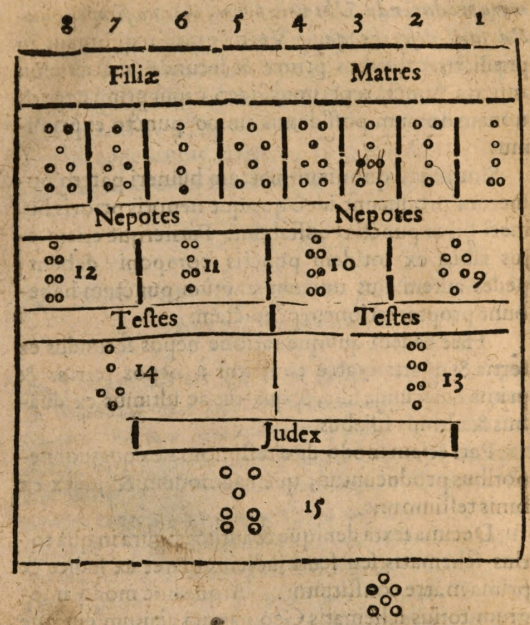
Fludd explains how a full geomantic shield is derived from the initial four mothers.
Of the Production of the Other Figures in the Geomantic Shield
It must be noted that from the said mothers,1 who constitute the first four figures of the geomantic shield, four daughters, constituting the fifth, sixth, seventh and eighth figures, arise, taking separately the parts of all the mothers. In the previous example we take from the first figure / . / from the second / . . / from the third / . / from the fourth / . . / And thus these four parts, joined together, generate the first daughter occupying the fifth house, namely, the figure called Amissio. From the mothers’ shoulders the second daughter is born occupying the sixth house, from the legs the third, from the feet the fourth.
But first the niece is derived from the two first mothers, for her head is fused from their two heads, etc. And this is a general rule: that where two heads, shoulders, legs, or feet joined together produce an odd number, namely three, they produce a single; but when they are even, they produce two points. For example: since we find only three points in the aforesaid heads of the first and second mothers, we therefore express the head of the first niece who occupies the ninth house with a single point.
In the same way, since the mothers’ shoulders produce an equal number, therefore also the shoulders of the first niece will consist of two points. Equally, her legs must also be composed of the same number of points, and her feet will have only one point for the above reason. For this reason also, the second niece is fused from the third and fourth mother; the third niece from the first and second daughter, and the fourth and last from the two and last daughters.
In the same way, two Witnesses are produced from four nieces, just as a Judge is produced from two Witnesses. Finally, the sixteenth, the last figure in which the whole shield is summarized, is made up of the Judge and the first mother. And in this manner the whole geomantic shield and its houses must be filled, from which the judgment in this art is to be taken.
A geomantic shield, from Robert Fludd’s Geomancy handbook
Footnotes
Referring to Book I, Part 3. This section requires no commentary, as it describes the usual technique of deriving the full shield from the initial four figures. ↩︎
One pro of using more than one system of divination is that sometimes they clarify each other: sometimes one reading is somewhat obscure in one system but clear in the other, and we can use the clear one to navigate the one that has us scratching our heads. Granted, obscurity is in the eye of the beholder, being always a consequence of our own limitations, but it is still an occasion to learn.
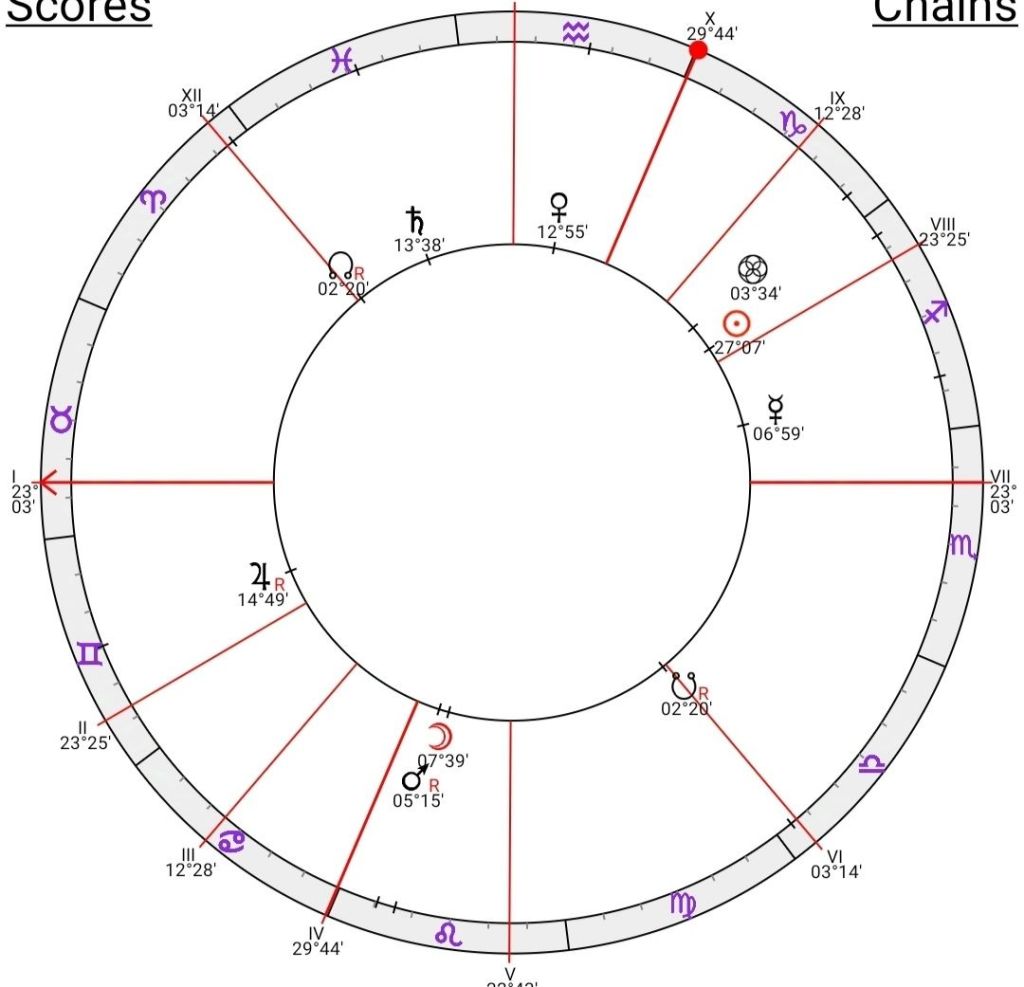
I was at the airport yesterday, trying to catch a flight to get back home. Suddenly, and to my horror, I noticed that plenty of flights were being cancelled due to the heavy mist, including one flight on the same route I needed. My first instinct was to cast a Horary chart, asking if I’d be able to get back home.
Will my flight go as planned or will it be cancelled? Horary Astrology
This was my first interpretation. I am represented by Venus, ruler of the ascendant. The place I want to get is my home, which is ruled by the Fourth House and therefore by the Moon (Cancer is on the cusp). The Moon is approaching an opposition of Venus. Bam! The flight will be cancelled.
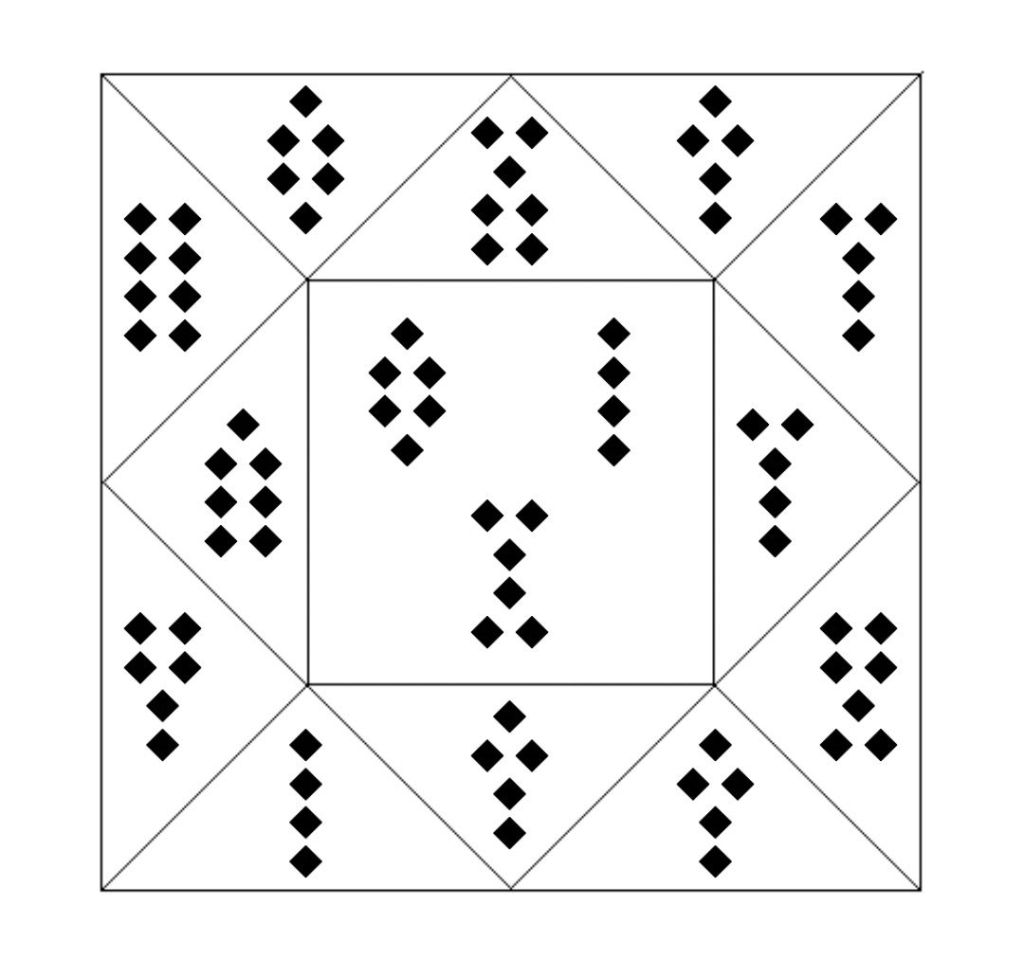
After a while, as I was waiting for information, I did a Geomancy reading on the same question. Here is the chart:
Will the flight go as planned or will it be cancelled? App used: Simple Geomancy
The first thing the struck me is the generally positive Judge, Conjunctio, which arises from Carcer and Via. It argues mobility more than stasis, and obstacles that are removed. The second important point is the figure that represents me: Laetitia in the first. Laetitia represents upward motion. It is an exiting figure, meaning movement. What a wonderful symbol for a plane taking off!
Even if we want to involve the Fourth house, we see that it is occupied by Puella, a mildly benefic figure, which is also connected to the ninth house of journeys (it occupies it). So the journey (Ninth) connects with the home (Fourth).
Obviously,two systems of divination cannot give contradictory answers if correctly interpreted, and the Geomancy seemed rather obviously positive. So I went back to the Horary Chart (again below)
Will my flight go as planned or will it be cancelled? Horary Astrology
I meditated on this chart quite a while (I had plenty of time, after all). Then it hit me. I am represented by Venus. Venus is in the Midheaven (up in the sky) in Aquarius, an *air* sign. Not only, but Aquarius is fixed: it doesn’t change. My being in the sky is fixed. So there will be a flight: I will be up in the sky as planned.
But what about that opposition by the Moon? Well, there was significant delay, so the Moon could show the flow of events causing trouble to my being up in the air.
Ultimately, the Fourth House didn’t need to get involved. The point of the question was not whether I would get home (I would have gotten home anyway at some point) but what would happen to me/my flight.
(Note: this is a collection of the meanings attributed to the cards by some occultists in the past centuries. It does not reflect my own study or opinion of the cards. It is only meant as a quick comparative reference as I develop my own take.)
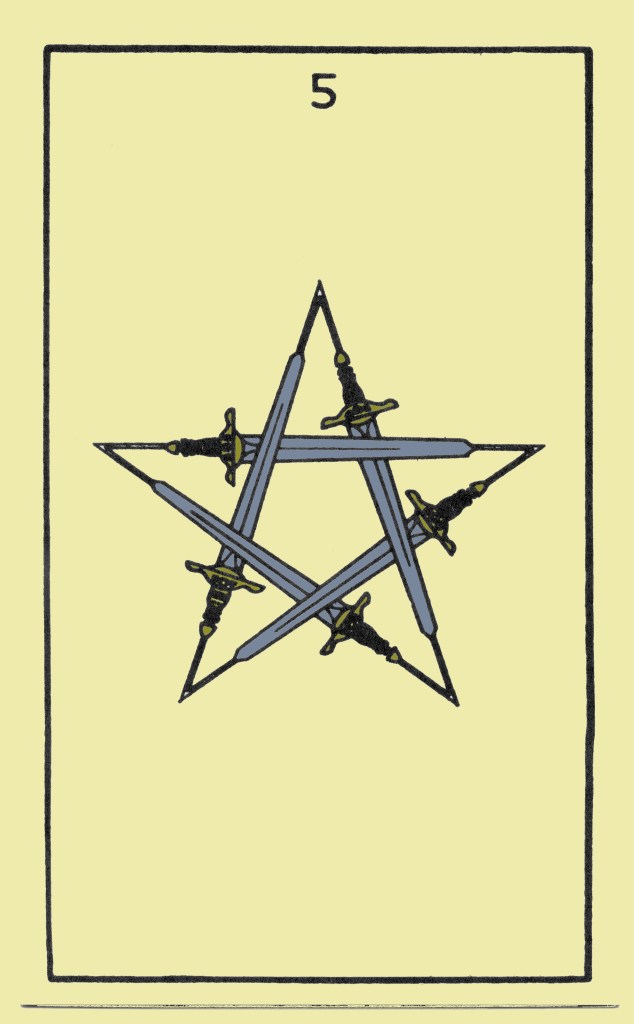
The Five of Swords from the Builders of the Adytum (BOTA) tarot deck
Paul Foster Case (and Ann Davies)
The time period is the first decanate of Aquarius, from January 20 to 29, under the rulers hip of Saturn and Uranus. Well-Dignified: the decision is adve rse to the Querent in any matter of a material nature. In spiritual affairs this card portends apparent troubles which work out ultimately to good result. Thus this Key is one of trouble and anxiety, but rightly comprehended can be the turning point for positive good . Ill-Dignified: the troubles are intensified and are probably due to the Querent’s own lack of understanding of the true nature of the situation. If the question is one of speculation, the Querent is likely to be disappointed due to his own desire to get something for nothing, to over-reach somebody else, or to get rich quick. Keyword: Defeat. (From the Oracle of Tarot Course)
A. E. Waite
A disdainful man looks after two retreating and dejected figures. Their swords lie upon the ground. He carries two others on his left shoulder, and a third sword is in his right hand, point to earth. He is the master in possession of the field. Divinatory Meanings: Degradation, destruction, revocation, infamy, dishonour, loss, with the variants and analogues of these. Reversed: The same; burial and obsequies. (From The Pictorial Key to the Tarot)
Aleister Crowley
The Five of Swords is similarly [to the other fives] troublesome; the card is called Defeat. There has been insufficient power to maintain the armed peace of the Four. The quarrel has actually broken out. This must mean defeat, for the original idea of the Sword was a manifestation of the result of the love between the Wand and the Cup. It is because the birth had to express itself in the duality of the Sword and the Disk that the nature of each appears so imperfect.
[…]
Geburah, as always, produces disruption; but as Venus here rules Aquarius, weakness rather than excess of strength seems the cause of disaster. The intellect has been enfeebled by sentiment. The defeat is due to pacifism. Treachery also may be implied.
The hilts of the swords form the inverted pentagram, always a symbol of somewhat sinister tendency. Here matters are even worse; none of the hilts resembles any of the others, and their blades are crooked or broken. They give the impression of drooping; only the lowest of the swords points upwards, and this is the least effective of the weapons. The rose of the previous card has been altogether disintegrated.
The historian is happy to observe two perfect illustrations of the mode of this card and the last in the birth of the Aeon of (1) Osiris, (2) Horus. He will note the decay of such Virtue as characterized Sparta and Rome, ending in the establishment of the Pax Romana. As Virtue declined, corruption disintegrated the Empire from within. Epicene cults, such as those of Dionysus (in its degraded form), of Attis, of Adonis, of Cybele, the false Demeter and the prostituted Isis, replaced the sterner rites of the true Solar-Phallic gods; until finally (the masters having lost the respect, and so the control, of the plebs, native and alien) the lowest of all the slave-cults, dressed up in the fables of the vilest of the parasitic races, swept over the known world, and drenched it in foul darkness for five hundred years. He will delight to draw close parallels with the cognate phenomena displayed before the present generation. (From The Book of Thoth)
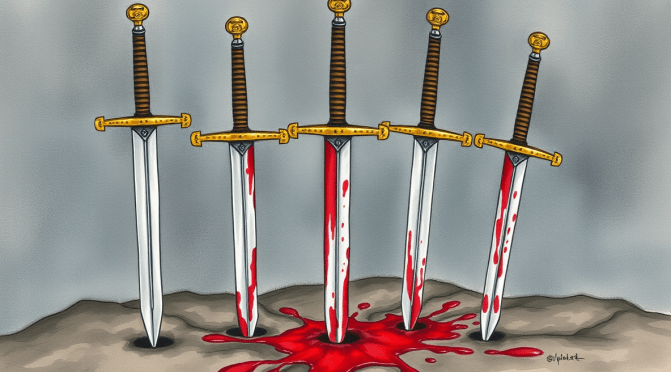
AI-generated illustration for the Five of Swords
Golden Dawn’s Book T
TWO Rayed Angelic Hands each holding two swords nearly upright, but falling apart of each other, right and left of the card. A third hand holds a sword upright in the centre as though it had disunited them. The petals of the rose, which in the four had been reinstated in the centre, are torn asunder and falling. Above and below are Venus and Aquarius for Decan.
Contest finished and decided against the person; failure, defeat, anxiety, trouble, poverty, avarice, grieving after gain, laborious, unresting; loss and vileness of nature; malicious, slanderous, lying, spiteful and tale-bearing. A busybody and separator of friends, hating to see peace and love between others. Cruel, yet cowardly, thankless and unreliable. Clever and quick in thought and speech. Feelings of pity easily roused, but unenduring.
Geburah of HB:V (Defeat, loss, malice, spite, slander, evil-speaking). Herein the Angels HB:ANYAL and HB:Cha’aMYH bear rule.
Etteilla
Loss Upright. This card, as far as the medicine of the spirit is concerned, means, in its natural position: Loss, Alteration, Discredit, Degradation, Perdition, Decay, Destruction, Deterioration, Deterioration, Diminution, Depression, Diminution, Damage, Failure, Prejudice, Blemish, Torts, Avarice, Decline of business, Failure, Disadvantage, Devastation, Dilapidation, Dissipation, Injury, Disgrace, Reversal, Reversal of fortune, Ruin. – Defeat – Debauchery, Disgrace, Dishonor, Infamy, Ignominy, Affront, Ugliness, Difformity, Humiliation. – Theft, Thievery, Rape, Plagiarism, Abduction, Filthy, Horrible. – Infamy, Corruption, Profligacy, Seduction, Libertinism. Reversed. Mourning, Abasement, Affliction, Sadness, Grief, Pain of spirit, Funeral pump, Burial, Funeral, Inhumation, Burial.
No matter what kind of divination we practice: if it’s worth its salt and is not just some feelgood angel therapy oracle, it has the potential to deliver bad news. How we handle bad news is a mark of how helpful we are capable of being as diviners.
People can come to us for a variety of reason. They may need reassurance, hope, advice or just a quick look ahead. They may even come to us for fun or curiosity, and as long as they are not disrespectful, there is nothing wrong in indulging them.
The principle of respect for our querent stems from seeing them as a whole person rather than a sack of meat endowed with more than its fair share of doubts. We, as diviners and as handlers of odd devices (decks, charts, counters of various kinds) hold a degree of power over them. It is symbolic power, for sure, but reality itself is symbolic (that’s how magic works), therefore symbolic power is real power, and must not be misused.
Finding the right balance between informing the querent and respecting them can be difficult. It’s all well and good as long as the cards talk about pleasant trips and job interviews. But occasionally we recognize messages that we know are going to deeply upset our querent.
Causing unnecessary anguish is a no-no, and there are things that cannot be said without causing unnecessary anguish (“You’ll die soon”, “You’ll lose the baby). Even less serious topics (at least, less serious than death), such as marital infidelity must be treated with caution. We cannot just destroy whole families willy-nilly simply because our cards seem to hint at untoward dealings.
We must also distinguish whether a querent directly asks for something or something unpleasant simply shows up in the cards. Usually, if the querent asks for something, we can be more forthcoming, if we can speak with tact. If they ask “Will I get the job?”, they need to be able to accept “I’m not infallible, but it seems they appear more inclined to go with someone else.”
If they ask “Is my spouse faithful?” and the cards show clear signs of interference, an answer like “Remember that I could be wrong, but there does seem to be someone who’s trying whisk them away from you. Maybe it’s time to have an honest talk and try to solve the issue.”
Incredibly enough, even some taboo topics may occasionally be addressed in this guise. For instance, there are plenty of non-morbid reasons querents might want to know about death: “Do you think my elderly father going to survive long? I want to be able to visit him one last time but the situation at home is just crazy.”
While we must not delude the querent, we have no right to rob them of all hope. Aside from the mantra “Remember I’m a fallible human being”, and even aside from potential advice we might sometime give the querent to soften the blows of bad luck, there are occasionally ways of preparing the querent for a difficult situation without hurting them.
“Is the pregnancy going to go alright?” This is a question I am become more and more skeptical of answering as time goes by, because there is no way of saying anything other than “yes” and still be able to look at myself in the mirror. If we do find ourselves somehow coerced into answering it and the cards are less than positive, the only thing we may say is something to the effect of “Yes, but remember to take it easy, and the cards are saying you should pay extra attention to the doctor’s orders.”
Where all else fails, human empathy is our last line of defense. Helping the querent even for just some minutes by sharing their burden is part of what we may have to sign up for when we choose the path of divination.
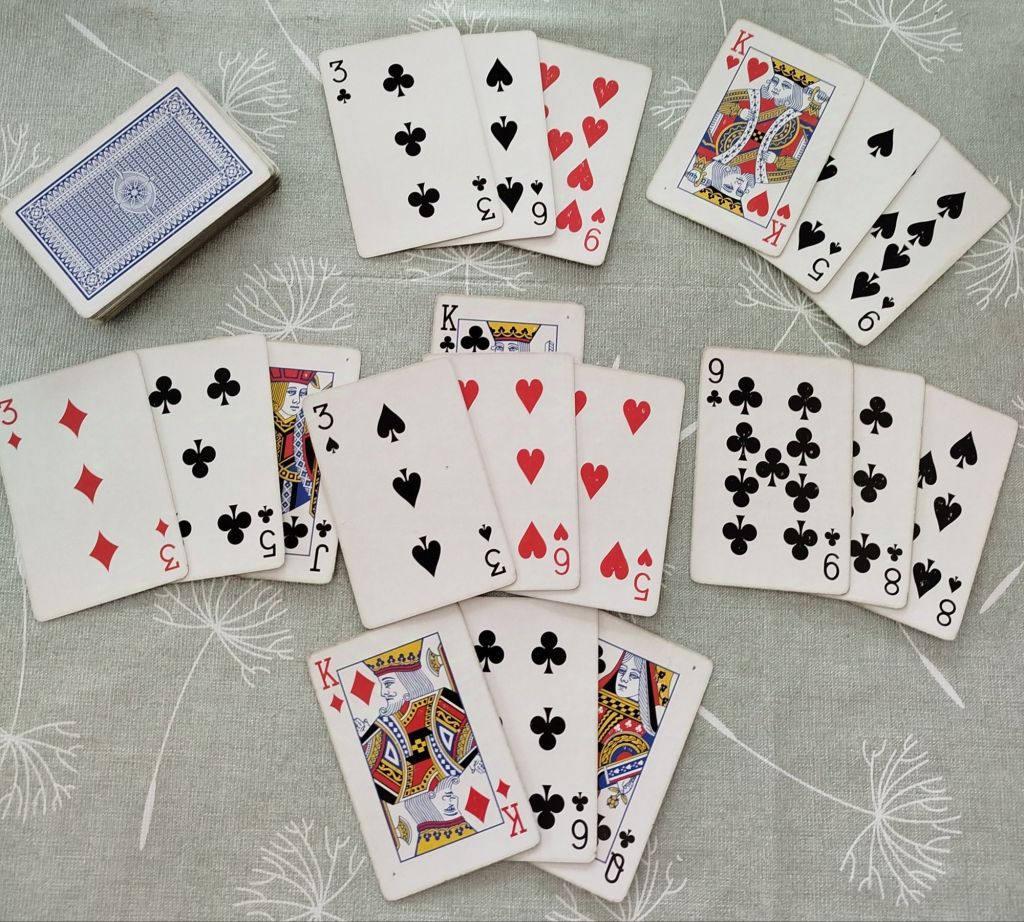
When I was taught to read playing cards, the cross spread was presented to me as a general spread. However, over time I discovered that it can also be used to answer specific questions of a general nature, or simply to explore certain compartments of the querent’s life. Here is a recent spread on a male querent asking about his career:
A career cross spread. Divination with playing cards
To summarise the main meanings of the various fans:
Left: past-present
Center: in the heart, sometimes present
Right: present-future
Above: thoughts, would like
Below: dislikes, problem
To the side: future/answer
The cool thing about larger spreads is that sometimes we can just identify a single spot that answers the question clearly, and everything else gives details that may or may not interest the querent. Here, the clear answer occurs in the right spot: 9♣️ 8♣️ 8♠️, which translates as “for a long time the job will give the querent tears”.
Now that we have identified a clear sentence, let’s fill out the details. Since the sentence is quite negative, let’s look at other negative spots. In his heart, the querent has the 3♠️ which brings difficulties, complications etc. But it is followed by cards that bring hopes of a solution (the two Hearts). Clearly there has been something that caused the querent to start hoping.
Now look at the fan above: he would like a contract (3♣️) that gives him happiness (10♥️). Between these two cards we find the sickness card (6♠️). This could indicate that it is a vain hope or a sick hope, one that is not grounded in reality. On the left we see that he has a small income (3♦️) but works hard (5♣️ J♣️) so it’s not that he doesn’t deserve job security. Below we see a difficult situation with a man that might be his boss or a superior. Clearly he is not the teacher’s pet (the Q♣️ simply shows that the querent’s troubles reflect badly on his love life).
The final fan unfortunately robs the querent of all hope, although it argues that there will be help from a man. To dig deeper I should have done another spread. As it stands, the detail is quite vague.
They are the bane of many a reader: Court Cards are seen as difficult to read, in part because they clearly represent people, and so refuse to be banished into the realm of woolly platitudes inhabited by way too many readers, in part because locating them within the querent’s life can be objectively difficult.
In cartomancy with playing cards, however, the inherent signification of the cards can help us: The Queen and King of Clubs are almost always the main protagonists (the querent and his/her significant other), though there may be exceptions. I know of cartomancy systems where the querents are represented by the Heart suit, but this is just semantics.
Then we have the Heart court cards, of which the Jack is a child, a pet or something fresh and immature and small and the Queen and King represent people close to the querent’s heart. This is actually a modern interpretation: traditionally, they would be people sharing the querent’s bloodline, but modern times require modern solutions. I have found that the Heart courts can simply indicate very dear friends. For gay people, usually the significant other is a Heart card of the same sex, although occasionally the cards simply use the Club cards. We need to stay open. The Jack of Clubs can indicate friendship, help, cooperation.
The Diamond suit represents people usually unrelated to the querent, though they can indicate relatives by marriage. More usually, they show colleagues, acquaintances, bosses, rich people or people who have a more neutral or even cold perspective of the querent compared to the Hearts. The Jack of Diamonds usually represents a message.
Finally, Spades show people who are downright inimical to the querent, or who wield power over the querent’s well-being and enforce an objective set of rules, such as the police, doctors, judges, etc. This is especially the case for the King. The Jack can represent enmity, scheming, etc.
All Jacks can indicate children or very young people, though in practice this is more likely with the Jack of Hearts.
Usually, one court card within a reading is already more than we can tolerate, but sometimes we find that there are ONLY court cards. This is an example of a reading a did yesterday for a man who asked about his relationship:
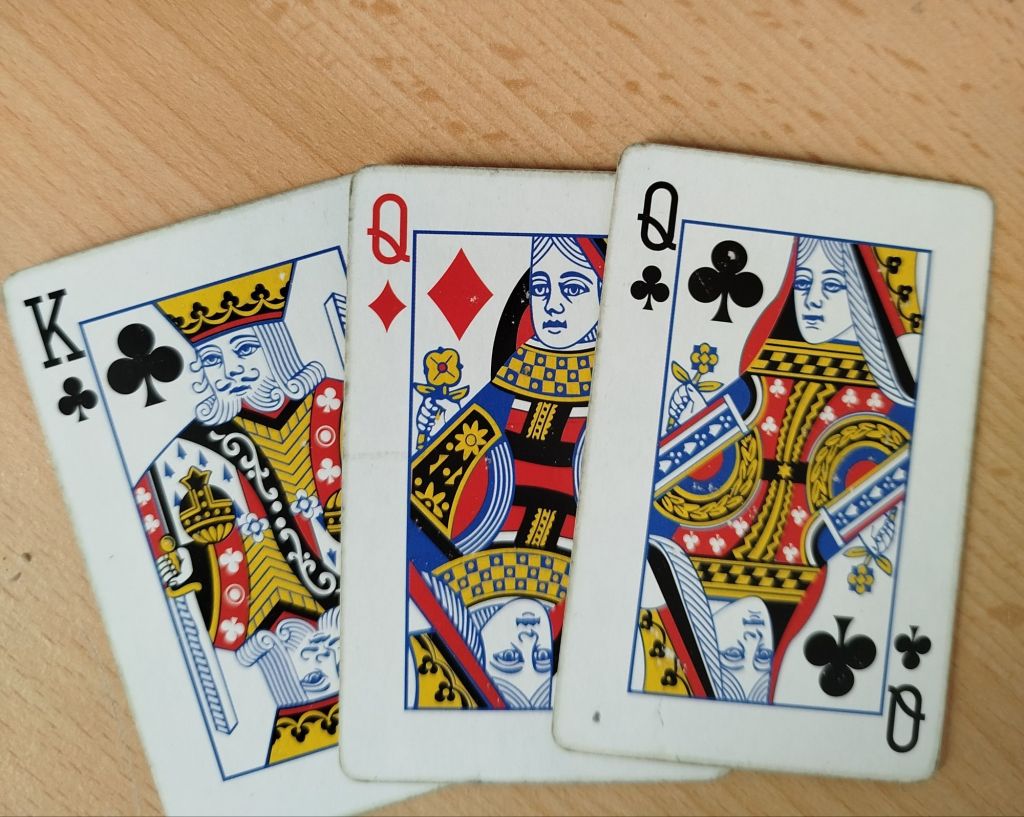
A marriage-related three-card spread
When more than one court card shows up, it is important to look at the cards between them, as they show the nature of their relationship, or what’s between them.
It is easy to jump to conclusions here: there’s a woman between you two! You have a lover! This could very well be the case, actually, but it is always important to keep in mind that, with so few cards on the table, more than one interpretation is possible. Here are some possibilities:
There could actually be a woman between them. He may have a lover (or, more rarely, she may have a female lover)
It might be a threesome
There could be a woman who interferes but who is not a lover: it could be her mother, her friend, any other person.
There might be a person mediating between them in a positive way
He might know her from work or from a business context, since sometimes, two queens or two kings together can represent a single person, merging the qualities of two suits.
So, how do we know which interpretation applies? Well, first off, we ought never to play Nostradamus: in doubt, we ask. This may sound unimpressive, but our aim is not to impress, but to give accurate information. Still, with experience, we may rule out a couple of possibilities as being less likely:
This is a simple three-card spread. If the querent were in some kind of odd polyamorous arrangement, the cards would not lead off with three court cards, but by telling us the querent is weird. This may sound politically incorrect, but the cards are keyed to a rather traditional view of the world. This doesn’t mean they are a compass of morality: it’s just their language. They highlight the strange and untypical in rather clear ways. Three court cards together aren’t strange enough.
This is a simple three-card reading. If the querent had a hidden lover they would tell us the relationship is in danger, or at least they would highlight the lover by assigning her to the Queen of Spades rather than Diamonds (The Queen of Diamonds can be a lover, but it requires more hints from the surrounding cards). Even the Queen of Spades wouldn’t necessarily be a lover, but at least we’d know she’s trouble.
This is a simple three-card spread. If there were a positive influence mediating between them, the cards would have given her to the suit of Hearts, or they would have omitted the information altogether and told us the querent and his significant other are in a positive phase (the mediator isn’t that important, and a three-card spread only has space for what’s important).
With that in mind, I asked the querent if he knew his girlfriend from work or from a business context, and he denied this. I asked him then if there was a woman causing some issues between them. He smirked and said: “A friend of hers doesn’t like me, she’s trying to break us up.”
Obviously, this spread doesn’t tell us how it’s going to end. It just describes the situation rather than how it will evolve, and more cards should be drawn.
(Note: this is a collection of the meanings attributed to the cards by some occultists in the past centuries. It does not reflect my own study or opinion of the cards. It is only meant as a quick comparative reference as I develop my own take.)
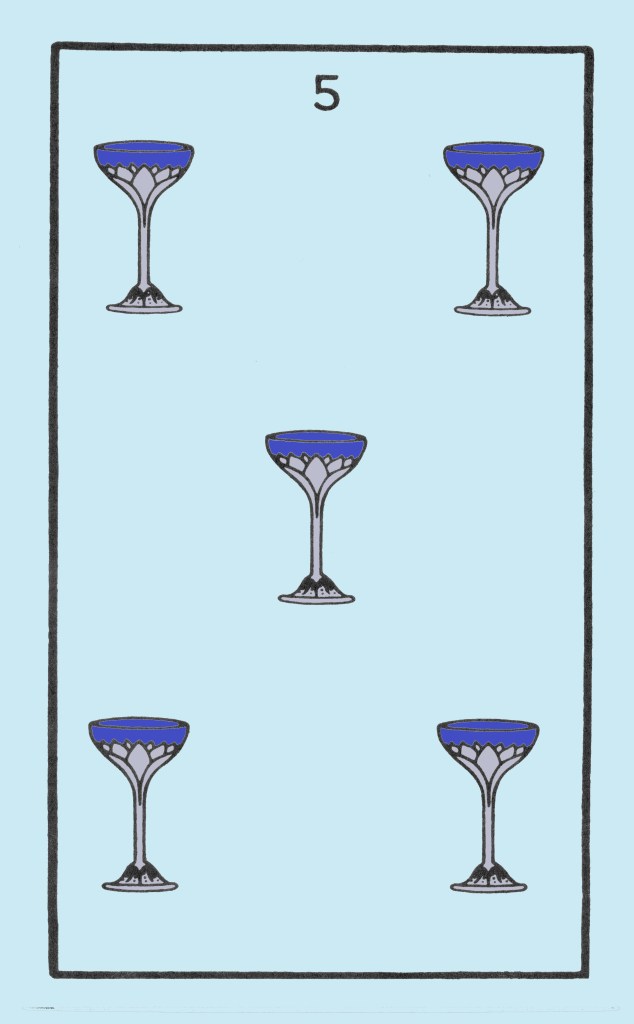
The Five of Cups from the Builders of the Adytum (BOTA) tarot deck
Paul Foster Case (and Ann Davies)
The Five of Cups is the first decanate of Scorpio, ruled by Mars, time period October 22 to October 31. Well-Dignified: strength, power to do; ability to introduce needed changes and let go of relationships, prejudices and false ideas that are hindering spiritual progress. lll-Dignified: loss in pleasure, vain regret, disappointment, sorrow and loss of those things which have been much desired; treachery, deceit; unexpected troubles and anxieties; disappointments in love, broken engagements, broken friendships. (Note: These sorrows and disappointments, as indicated by the Five of Cups, lll Dignified, are often the necessary destruction before the beginning of a new and greater expansion and growth in the life of the Querent, depending on his basic understanding and evolutionary level.) Keyword: Defeated desire. (From the Oracle of Tarot course)
A. E. Waite
A dark, cloaked figure, looking sideways at three prone cups two others stand upright behind him; a bridge is in the background, leading to a small keep or holding. Divanatory Meanings: It is a card of loss, but something remains over; three have been taken, but two are left; it is a card of inheritance, patrimony, transmission, but not corresponding to expectations; with some interpreters it is a card of marriage, but not without bitterness or frustration. Reversed: News, alliances, affinity, consanguinity, ancestry, return, false projects. (From The Pictorial Key to the Tarot)
Aleister Crowley
[…] the Five of Cups is called Disappointment, as is only natural, because Fire delights in superabundant energy, whereas the water of Pleasure is naturally placid, and any disturbance of ease can only be regarded as misfortune.
This card is ruled by Geburah in the suit of Water. Geburah being fiery, there is a natural antipathy. Hence arises the idea of disturbance, just when least expected, in a time of ease.
The attribution is also to Mars in Scorpio, which is his own house; and Mars is the manifestation on the lowest plane of Geburah, while Scorpio, in its worst aspect, suggests the putrefying power of Water. Yet the powerful male influences do not show actual decay, only the beginning of destruction; hence, the anticipated pleasure is frustrated. The Lotuses have their petals torn by fiery winds; the sea is arid and stagnant, a dead sea, like a “chott” in North Africa. No water flows into the cups.
Moreover, these cups are arranged in the form of an inverted pentagram, symbolizing the triumph of matter over spirit.
Mars in Scorpio, moreover, is the attribution of the Geomantic figure Rubeus. This is of such evil omen that certain schools of Geomancy destroy the Map, and postpone the question for two hours or more, when Rubeus appears in the Ascendant. Its meaning is to be studied in the “Handbook of Geomancy” (Equinox Vol. I, No.2). (From The Book of Thoth)
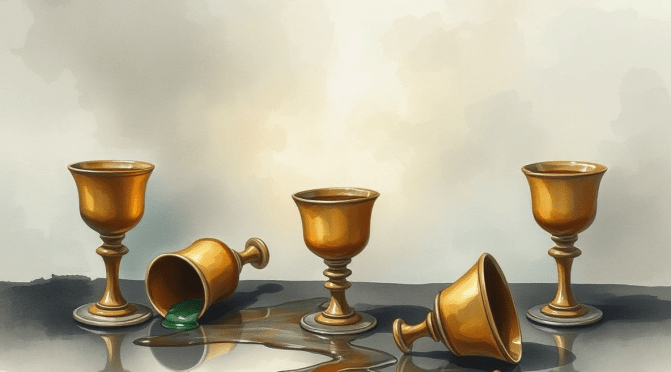
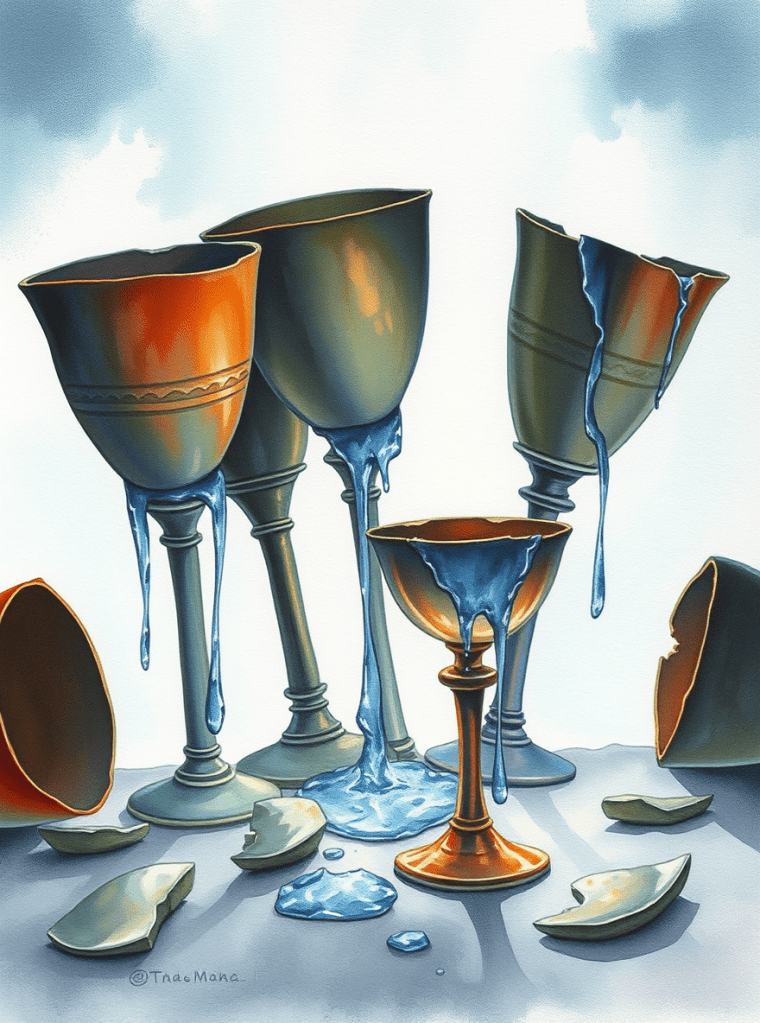
AI-generated illustration for the Five of Cups
Golden Dawn’s Book T
A WHITE Radiating Angelic Hand, holding lotuses or water-lilies, of which the flowers are falling right and left. Leaves only, and no buds, surmount them. These lotus stems ascend between the cups in the manner of a fountain, but no water flows therefrom; neither is there water in any of the cups, which are somewhat of the shape of the magical instrument of the Zelator Adeptus Minor. Above and below are the symbols of Mars and Scorpio for the Decan.
Death, or end of pleasure: disappointment, sorrow and loss in those things from which pleasure is expected. Sadness, treachery, deceit; ill-will, detraction; charity and kindness ill requited; all kinds of anxieties and troubles from unsuspected and unexpected sources. Geburah of HB:H (Disappointment in love, marriage broken off, unkindness of a friend; loss of friendship). Herein rule HB:LVVYH and HB:PHLYH.
Etteilla
Legacy Upright. This card, in its natural position, means, as far as the medicine of the spirit is concerned: Inheritance, Succession, Bequest, Gift, Donation, Endowment, Estate, Transmission, Will. – Tradition, Resolution [=Decision]. – Kabbalah. Reversed. Consanguinity, Blood, Family, Avi, Ancestors, Father, Mother, Brother, Sister, Uncle, Aunt, Cousin, Cousin. – Filiation, Extraction, Race, Lineage, Alliance. – Affinity, Attachment, Relationship, Ties.
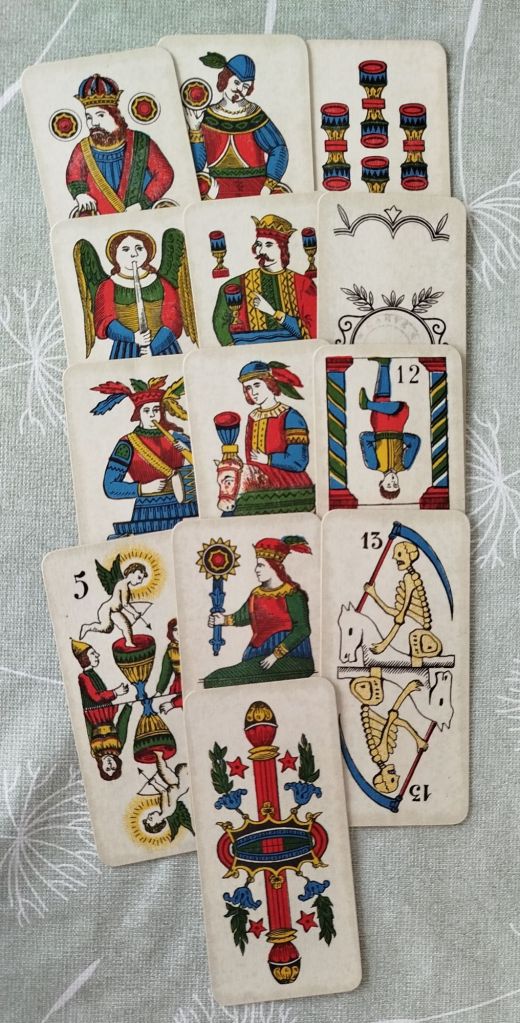
As I mentioned here, I got a new parrot from a local breeder and I had an interesting reading concerning it. The reading was done using the Bologna Tarot in its 45-card variant. We had already gotten some pictures of some of the available birds, and we had settled on a gray cockatiel, because it looked like the one I had as a kid. As the day approached, I asked the cards if everything would go alright. This is the spread I got:
Is the bird handover going to go smoothly?
Although I’ve already talked about the 13 card spread, when used with the Bolognese tarot there are some peculiar aspects to it (it is, after all, one of the “official” traditional spreads to be used with this deck). Traditionally, when a yes-or-no question is asked, the following rules apply:
If the Death card shows up in the spread, it’s a yes (as sure as we all die)
If the Angel (Judgement) card shows up, it’s a good chance
If both show up, it’s a sure thing
If the Angel and the Devil show up, it represents great satisfaction within the context (the Devil is in itself a negative card, but it is redeemed by the presence of the Angel)
Well, in my (still limited) experience with this tarot deck, I have found that it’s best not to rely too much on mechanical rules: the cards must always be interpreted, and exceptions allowed for. Still, it is encouraging to see both the Angel and the Death card as answer. Let’s interpret the cards row by row, as they came up very clear and orderly (it is not always like this, unfortunately):
King of Coins – Page of Coins – Seven of Cups: there have been talks (Page) with a man concerning business (King). The Seven of Cups is generically positive here. Angel – King of Cups – Ace of Coins: There is help (Angel) from a man of the house (King) concerning money (Ace). My husband paid in part for the parrot and the cage and food. Fool – Knight of Cups – Hanged Man: This is the most interesting row in the spread. It shows something that brings chaos or confusion (Fool) and that betrays or upends (Hanged Man) the agreement (Knight of Cups) Love – Queen of Coins – Death: True (Queen of Coins) Love (Love) is confirmed (Death) Ace of Wands: Success, positive ending
So in general what we can say from the spread is that the breeder is trustworthy, my husband helps me and I will be very satisfied, but still the deal will somehow be changed in an unexpected/confused way.
What ended up happening: we got there and the breeder introduced us to the various chicks that were ready for adoption, including the one we had settled on. But as we were playing with them, a white cockatiel chick quickly flew onto my shirt looking for cuddles. Obviously, it was love at first sight (see the true love in the spread), and we got that one instead.
I believe this change of plans is shown in the spread by combination of Knight of Cups (agreement, conciliation) followed by the Hanged Man (betrayal, upending). Our initial agreement was upended (or “betrayed” in a metaphorical sense), but still everything ended on a positive note.
NOTE: look how “dry” this reading is. Traditionally, tarot was not interpreted by musing on how the pictures looked, but by applying clear and specific meanings.
I’ve already written a couple of articles on unanswerable questions. Some of them are unanswerable for logical reasons, others because they ask about something on which no objective standard of measurement exists. Some are also unanswerable for ethical reasons (“Tell me when is the best time to rob the bank.”)
But occasionally someone comes along who asks a question that we instinctively feel is unanswerable, yet we can’t put our finger on why. It’s happened a couple of times to me that someone would ask me something to the effect of “Will I ever be happy?“
Obviously no one whose life is coming up roses would seek out a diviner of all people to ask such a question. These queries are put to the cards or the skies in a moment of weakness. My experience in these situations is that the cards behave in one of three ways. They:
Show the cause of the person’s unhappiness rather objectively, and whether the problem is likely to be overcome over the next few months (usually not)
Are generically very negative, without a specific sense to them
Are generically very positive, without a specific sense to them
In the first instance, the cards usually show the problem not getting resolved, not necessarily because it never will be, but because the person is still knee-deep in it. The fact that they chose to frame their question in such tragic terms tells us that, whatever the nature of their problem, it goes beyond its specific objective nature and it has wounded the person in their soul.
Extreme care is advised in dealing with people in such a state of difficulty. They come to us broken and they should, at the very least, not leave even more broken. Furthermore, it is not unlikely that they have started consulting many diviners, obsessively asking the same question in hopes of getting a magical solution to their issue dropped in their lap. It would be good to advise them to stay away from divination for a while, unless we are capable of pointing out a solution they haven’t thought about, which unfortunately is rare.
When the cards are generically positive or generically negative, they are merely reflecting the person’s state of confusion: the bleakness of their outlook or the irrational hope for unexpected redemption. I don’t think there is much that we can do in such situations, except telling them that their upset shows in the cards and that, life being a succession of phases, even this one will pass. Sometimes, in such situations, talking to them in our quality of human beings is better than talking to them in our quality of diviners. In extreme cases, having a hotline number handy may be helpful.
Really there isn’t much sense in asking this question except to torture ourselves. We as diviners should know this when asking our own questions, but many people don’t, so it’s best to be prepared.
Here’s a quick one I thought was interesting. A querent wanted to know if her boyfriend would propose to him. This is the reading:
K♣️ – 3♦️ – J♥️ – Q♣️ – 2♣️
Notice that the two querent cards both come up in the reading. They are separated by the Three of Diamonds and the Jack of Hearts. I didn’t think the Jack could represent a literal child, but to be on the safe side I asked the querent and she said they have no children. If they did, it could have shown a relatively loose relationship but with children.
The Three of Diamonds represents small projects within the couple. It is not negative, but falling next to the querent’s boyfriend it made me think that he was still a bit immature (especially with the Jack) or at least that he didn’t have big projects in mind. However, we find the Queen followed by the Two of Clubs which represents some steps taken. To me it looked as though she would be the one to take action, either proposing herself or pressuring him to commit further.
What ended up happening is that the querent fell pregnant and told the boyfriend she wanted to at least move together. They are apparently making arrangements to find a place, and an engagement may be on the horizion in the next few years.
Could I have foreseen the pregnancy? Maybe, with the Jack of Hearts so central to the spread. Still, it didn’t feel like a pregnancy spread (and after all it wasn’t even the question).
What I find interesting about the spread is how it describes the nature of the querent’s relationship and who wants to take it to the next level