I thought this was a rather interesting reading, in part because of what it revealed and in part because it shows that divination requires rules and flexibility. I’ll probably talk about it again in an article.
MQS
I thought this was a rather interesting reading, in part because of what it revealed and in part because it shows that divination requires rules and flexibility. I’ll probably talk about it again in an article.
MQS
(Note: this is a collection of the meanings attributed to the cards by some occultists in the past centuries. It does not reflect my own study or opinion of the cards. It is only meant as a quick comparative reference as I develop my own take.)
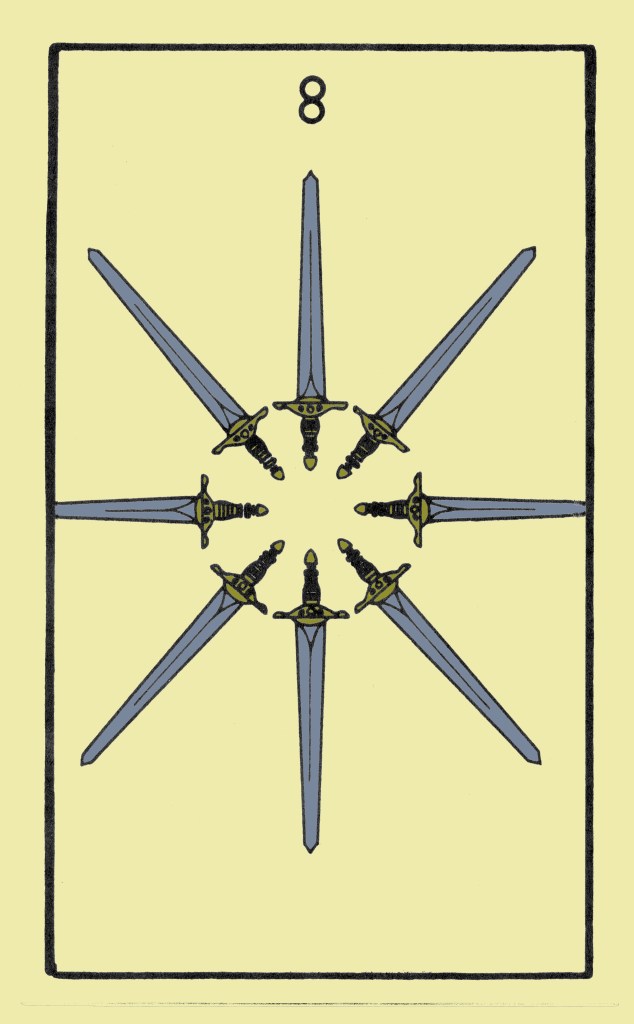
The time period is the first decanate of Gemini, May 21 to May 31, under the rulership of Mercury.
Well-Dignified: even well-dignified, the excessive Mercurial influence expressing in the Yetziratic field of unstable forces and changing forms, symbolized by the Eight of Swords, gives a marked tendency toward ill-directed or wasted action. Meanings in divination: force wasted in petty affairs; too much talk; too much illdirected action; the state of being terribly busy without accomplishing much; over-careful about details; could possibly intimate a crisis in affairs, and probably much talk, correspondence and moving about.
Ill-Dignified: malice; ill-natured gossip; pettiness; too much concern with personalities; disagreements with brothers and sisters. This Key divinatorily expresses unbalanced or excessive Gemini qualities in third house affairs. The se negative Gemini qualities portend the need for balancing the quick-mindedness and penchant for action of this astrological type with the d e pth of feeling and emotional warmth corresponding to Netzach and Venus.
Keyword: Mediocrity
(From the Oracle of Tarot course)
A woman, bound and hoodwinked, with the swords of the card about her. Yet it is rather a card of temporary durance than of irretrievable bondage. Divinatory Meanings: Bad news, violent chagrin, crisis, censure, power in trammels, conflict, calumny; also sickness. Reversed: Disquiet, difficulty, opposition, accident, treachery; what is unforeseen; fatality.
(From The Pictorial Key to the Tarot)
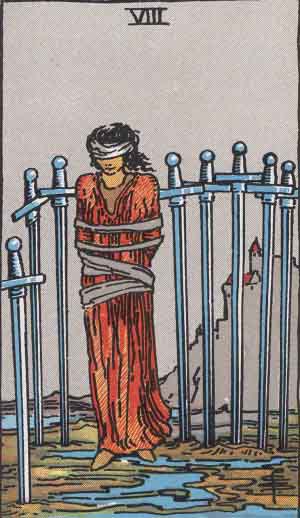
The Eight of Swords is called Interference. At first sight, it would seem easy to confuse it with the Eight of Cups; but the idea is, in reality, quite different. The card is attributed to Jupiter and Gemini; accordingly, there is no weighing down of the will by internal or external stress. It is simply the error of being good-natured when good-nature is disastrous. Gemini is an airy sign, an intellectual sign; Jupiter is geniality and optimism. This will not do in the world of Swords; if one must hit at all, a knock-out blow is best.
But there is another element in this card; that of unexpected (the Eights, being at heart Mercurial, are always that) interference, sheer unforeseen bad luck. Trivial incidents have often altered the destiny of empires, brought to naught “the best laid plans of mice and men”.
[…]
The number Eight, Hod, here signifies lack of persistence in matters of the intellect and of contest. Good fortune, however, attends even these weakened efforts, thanks to the influence of Jupiter in Gemini, ruling the Decan. Yet the Will is constantly thwarted by accidental interference.
The centre of the card is occupied by two long Swords pointed downward. These are crossed by six small swords, three on each side. They remind one of weapons peculiar to their countries or their cults; we see here the Kriss, the Kukri, the Scramasax, the Dagger, the Machete and the Yataghan.
(From The Book of Thoth)

FOUR White Radiant Angelic Hands issuing from clouds, each holding two swords, points upwards; all the points touch near the top of the card. Hands issue, two at each bottom angle of the card. The pose of the other sword symbols is reestablished in the centre. Above and below are the Decan symbols Jupiter and Gemini.
Too much force applied to small things: too much attention to detail at the expense of the principal and more important points. When ill dignified, these qualities produce malice, pettiness, and domineering characteristics. Patience in detail of study; great care in some things, counterbalanced by equal disorder in others. Impulsive; equally fond of giving or receiving money or presents;
generous, clever, acute, selfish and without strong feeling of affection. Admires wisdom, yet applies it to small and unworthy objects.
Hod of HB:V (Narrow, restricted, petty, a prison).
Therein rule the Angels HB:VMBAL and HB:YHHAL.
Criticism
Upright. This card, as far as the medicine of the spirit is concerned, means, in its natural position: Criticism, Unfortunate position, Critical moment, Critical time, Decisive instant, Unfortunate situation, Delicate circumstance, Crisis. – Examination, Discussion, Research, Blame, Censure, Critical comment, Critical epilogue, Control, Disapproval, Condemnation, Cassation, Judgment, Contempt.
Reversed. Accident, Difficulty, Particular circumstance, Conjunction, Occurrence, Accessory, Unconscious, Obstacle, Delay, Hindrance. – Abjection. – Contestation, Contradiction, Opposition, Resistance, Divergence. – Unplanned, Unforeseen, Chance, Adventure, Occurrence, Destiny, Fatality, Accident, Misfortune, Symptom
MQS
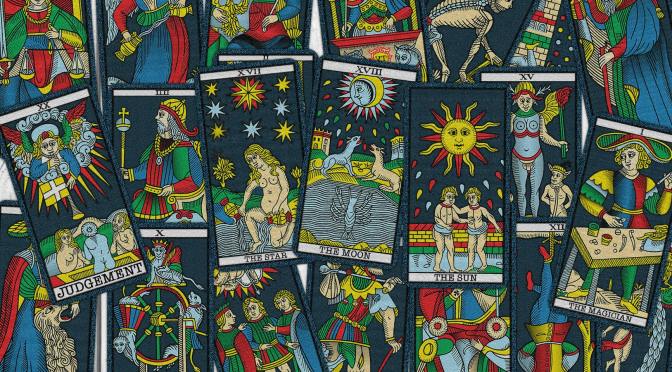
In the movie Kraven the Hunter there is a small tarot scene, where the girl starts playing around with the grandma’s deck and the grandma has her choose three cards from a Tarot of Marseilles-esque deck. We were discussing this scene in a Bolognese tarot group I’m part of.
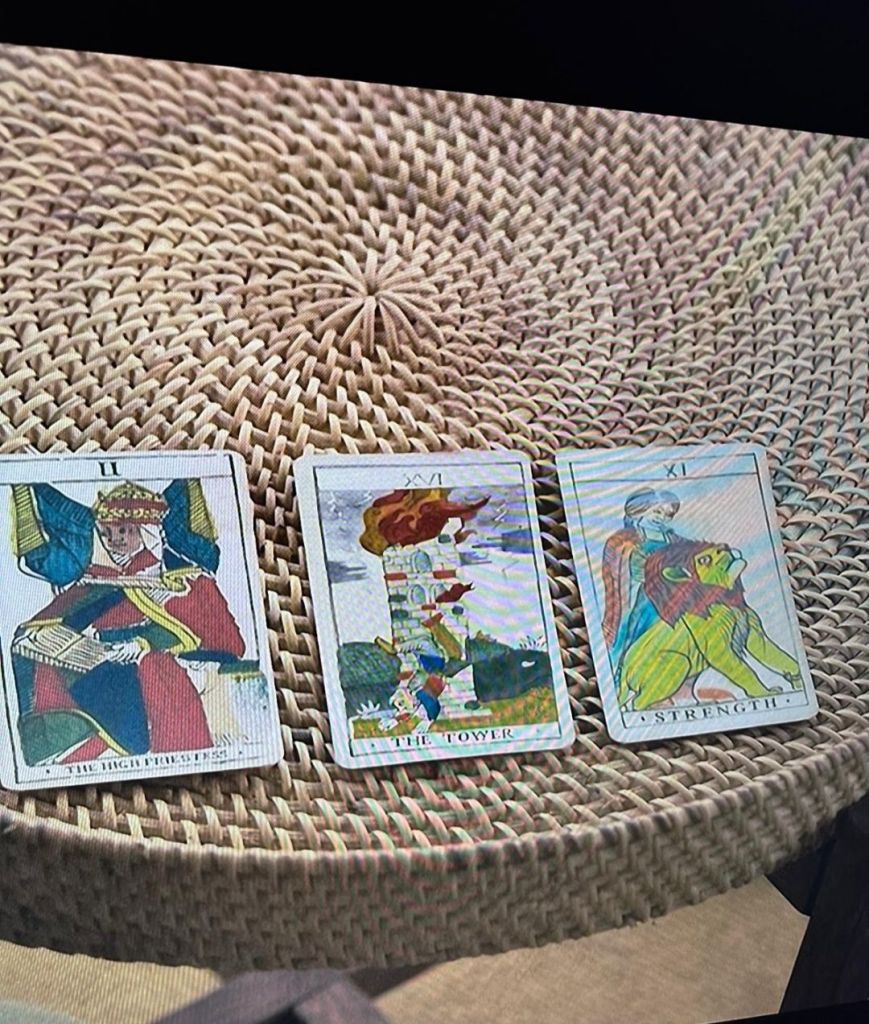
It’s probable that the deck was commissioned for the movie. What I find interesting is that while the Popess is quite faithful to most Marseille renditions and the Tower sort of resembles the old decks (though the flames have probably been remade), the Strength card is completely new. My wild guess here is that, unless there is an old tarot I am unaware of that really depicts the lion like this, the lion in the Marseille deck would barely be recognized as a lion by casual vewers: it looks like confused smoke billowing out of the maiden’s privates.
Note that the details which have been changed the most (the flames of the Tower and the lion) are the ones that used to be stylized differently in the early modern period compared with today. This is what led people like Jodorowsky to pull the “it’s actually a bird’s tail flying out of the tower” theory out of their ass, even though a cursory look at medieval art would have shown that that was how flames and lightnings were depicted.
MQS
The great thing about occultism being my life but not my job is that I get to do whatever I please. Well, right now it pleases me to talk about this deck, somehow.
MQS
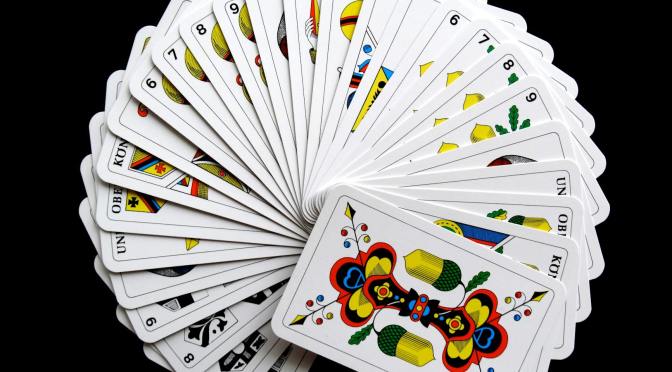
Well, Skat cards and I keep crossing paths. Ebay showed me this:
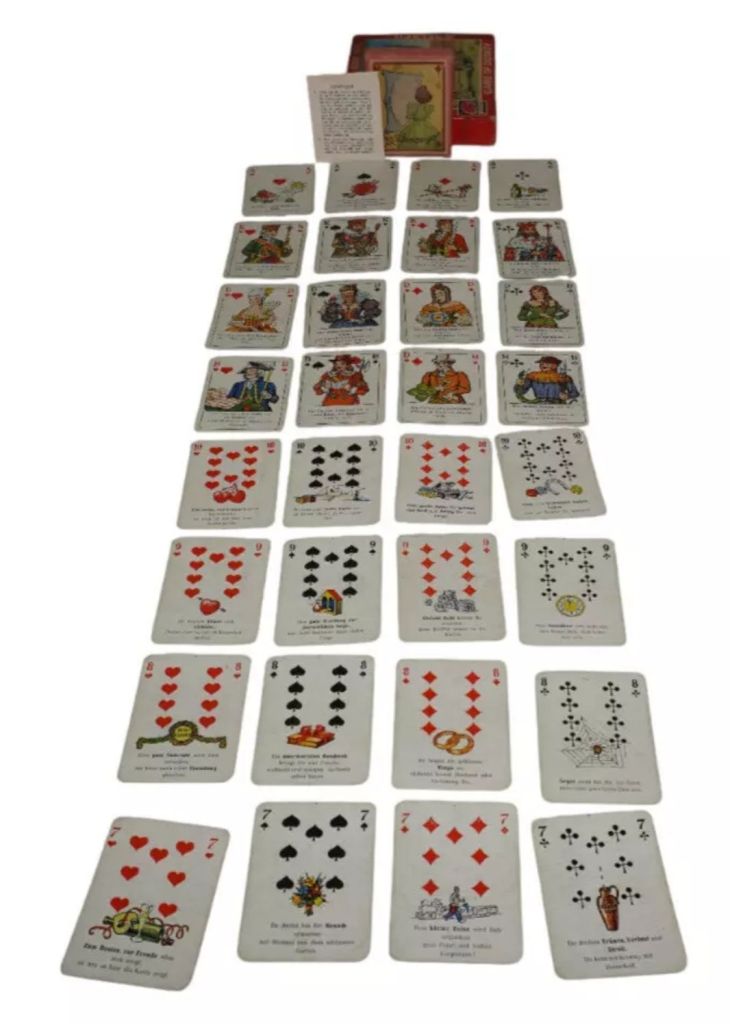
I won’t buy it, because there’s really no point in me owning it, but I’m going to post a personal translation of the meanings found on the cards, just as a comparison to the other systems I posted. Note: in German the descriptions rhyme (sort of). Since poetry is not among my many, many gifts, I’m not even going to try it in English. We’ll wait for the next Lord Byron to stumble upon this blog and give it a go. However, I will leave in bold type the words that are in bold in German, where possible.
The fact that some of the meanings coincide with the ones I posted, which I know to be traditional because I trust the sources, tells me that this Oracle of the Silver Mirror isn’t something someone just pulled out of his heinie, but they probably at least did some reaserch or had access to someone who could read skat cards. Still, I don’t want to exaggerate the importance of this deck: it is just a little bit of Skat trivia, in the long tradition of card fortune-telling as a parlor game.
The Silberspiegel Orakel is a fortune-telling deck about which very little is known. A source online says it’s from the 50s. Considering the old-fashioned language and the pre-reform orthography it might as well be true.
A♥️ Soon an event will involve the house. It appears as though it is something good!
K♥️ The King of Hearts is your reflection in the mirror, or “He” who envelops you in his love
Q♥️ The Queen of Hearts is your reflection in the mirror, or “She” who envelops you in her love.
J♥️ The Jack of Hearts can be your son or your daughter, or just a child, broadly speaking.
10♥️ You can expect much love, much joy. The world becomes your enchanted garden.
9♥️ Kisses and love-making await you. Don’t lose your head, whether in December or in May. (This sounds much cuter in the original)
8♥️ A bit of good news is headed your way. It could also be an invitation.
7♥️ Everything turns out for the best and is cause for joy, as shown here in this card.
A♠️ Taxes, the courthouse or the government await you. Don’t pull a long face!
K♠️ There is a wealthy man (around you). He could be your father, who loves you very much
Q♠️ A well-meaning woman coddles you. She could be your mother, who protects you and takes care of you.
J♠️ The postilion brings you a letter or message with much excitement. He’s almost here!
10♠️ You are planning a long journey, toward new horizons (shores) and harbors.
9♠️ A positive change in your personal situation. That’s a certain thing.
8♠️ An unexpected gift will bring you much joy, perhaps tomorrow, maybe even today.
7♠️ You can expect a visit, with flowers from the most beautiful garden.
A♦️ An important letter or a merry celebration, perhaps a marriage or something from the stork’s nest.
K♦️ A blond man will propose to you. He may also be a relative (!!!)
Q♦️ You will go out with a blonde woman. If she’s a relative, forget about her (!!!)
J♦️ This is the big, big luck. Cut yourself a nice slice of it.
10♦️ You manage to accomplish something great, everything brings you success and lots of money.
9♦️ You may expect a bit of money. This is what the cards clearly show.
8♦️ You’ll have golden rings to wear. Maybe you’ll celebrate an engagement or a marriage.
7♦️ A small journey will restore you. Have a good journey and some fun!
A♣️ Affliction and a doctor are in your home, but a cheerful disposition can drive the devil out.
K♣️ An older man is around you. Maybe a father-in-law, maybe a public official.
Q♣️ An older woman is by your side. If she’s your mother-in-law, do as she says.
J♣️ A false person wants to charm you. Be careful, and you will charm the snake!
10♣️ Luck, affluence and a long life are gifted to you as treasures.
9♣️ Something will soon become certain. Now ask yourself what it may be.
8♣️ Aggravations are coming to your house. Someone may exploit your good will.
7♣️ Tears, loss and fights threaten you. You will overcome them with a merry disposition.
In the LWB, two spreads are described. One is the classic große Tafel, the grand tableau of 8×4, where one reads the lines that intersect the querent’s card.
The other is a cross spread (once again), where the person’s significator is taken out, the cards fanned out and fifteen cards chosen: covering him (“Was dich deckt!”, i.e., “what covers you”), to his right (“Was dich schreckt!” i.e., “What scares you/shocks you”), below him (“Was du mit Füßen trittst”, i.e., “What you tread on with your feet”), to his left (“Was dir gewiß ist”, i.e., “what you hold for certain”) and above (“Was du im Kopfe trägst”, i.e, “What you have in your head”). The “what shocks you” position on the right is probably the opposite of the “what you hold for certain” position on the left. It probably indicates something the person doesn’t expect.
Clearly this is yet another variant of the cross spread that is so widespread across Europe, of which I was taught another variation.
The general tone of the LWB is very cautious and markedly negative toward divination, which reinforces the hypothesis that the deck originates from before the late 60s or early 70s. The reader is constantly encouraged to practice it only as a game with family members and not to practice professionally.
MQS
Following my deep dive into the Door Knockers, which seems to be an exclusive symbol (or almost) of Italian cartomancy, let’s talk about a much more universal presence in many traditions: the Road. Still, even though the symbol is widespread, the interpretations may vary.
I was introduced to the symbol of the road when being taught to read playing cards. In the system I was introduced to, the Two of Clubs is the card of the steps. Actually, the word for it was “cammino”, which means a way, road or path, but it also implies the idea of people taking steps on it. That is, a ‘cammino’ is a road that exists because people walk on it, rather than being a road that has been created so that people may or may not use it. An example would be a path through a forest or a road created by pilgrims as they progress on their pilgrimage.
The Two of Clubs therefore implies forward motion toward a goal of some kind, and the taking of steps, whether literal or figurative. In this, it is similar to the Two of Wands in some Piacentine cards systems, which interpret the card as a road, largely due to its design showing two parallel staves, no doubt (although in some other Piacentine systems the road is the Knight of Wands).
The Vera Sibilla doesn’t have a road card per se, although it does have various cards connected with movement, journeying or taking steps/fighting for something. For instance, the Journey card is connected to traveling, while the Soldier may imply fighting to attain a goal (although, being a Spade card, the struggle is more accentuated).
Etteilla famously attributed the meaning of road to the Six of Swords, and his pupils developed a whole vocabulary of synonyms that extend the meaning into other areas. An example of this is the meaning of conduct, which is, figuratively speaking, the path of the person’s actions through life. Etteilla’s attribution of the meaning of road to the Six of Swords remained attached to tarot through the Golden Dawn, who preserved it in part as a possible meaning in their Book T, and then through Waite, who had Smith design the Six of Swords as a card of journey. Even in the Crowley tradition this attribution has in part been rediscovered in Eshlemann’s Liber Theta.
In the Bolognese tarot, the meaning of road is attributed usually to the Six or Eight of Wands. Some strands of the tradition also distinguish between an open road (Six/Eight of Wands) and a closed road (Nine of Wands or Ten of Swords). The road is in itself a card of forward motion, like the Two of Clubs, it can indicate short trips and it is a card of openness.
The road or path is also present in the Lenormand and Kipper traditions. I am unclear on the Lenormand meaning, as the interpretation seems to have evolved considerably through time. Most contemporary English-speaking sources seem to see it as a card of choice (with two paths, although I am unsure if this duality was intended in the original design). Most German sources interpret it differently. Since I am not a Lenormand reader, I will leave it at that.
As for the Kipper cards, they have a card called Ein langer Weg, a long road. In most of the sources I have consulted, the card is more static than in the other traditions, highlighting the element of time (some call it the Two Years card). Interestingly, in many German Skat systems of divination, the suit of Spades / Leaves is connected with movement, and the low-numbered cards, mostly the Seven and Eight, can show a short trip or something happening quickly, while the Ten is also called the long road, and it can indicate an actual journey or the need to wait a long time.
BONUS: The Road is obviously present in Geomancy as well. The Geomantic figure Via, attributed to the Moon, is a symbol of journey and change. It is the symbol with the least amount of points, only one in every position, so some sources also attribute it to the concept of ‘little’ and to the waning of something.
MQS
I Tarocchi Parlano (The Tarot Speaks) by Maria Luigia Ingallati is perhaps the most well-known book about the Tarocchino Bolognese in Italy, and the one that, thanks to its success, launched the rediscovery of this deck outside of its native region. Since the publication of Ingallati’s book, the Bolognese tarot has enjoyed a small but growing cult following. This, we shall see, is probably the book’s greatest merit, though not the only one.
Ingallati herself is not from Bologna. She relocated there many years prior to the publication of her first book (‘Il Tarocchino Bolognese’, which I will review separately). There, she started seeing the local card readers, getting her fortunes told and learning a great deal from them, until she began practicing the art herself and synthesizing a personal method from the Bolognese tradition and her own experience as a card reader.
The book does a good job of presenting Ingallati’s journey, and it is undeniable that her personality shines through the pages of the richly illustrated volume. Ingallati is a good story-teller, enjoys reading and talking about poetry, philosophy and psychology, all of which she uses to shed light on the Bolognese tarot.
Ingallati uses a personal variation of the 50-card method, comprised of the following cards: the 18 surviving Major Arcana; the 3 Strangers or Moors; 7 Cup cards (Ace, Nine, Ten and the Court); 6 Wand cards (Ace, Six and the Court); 8 Coin cards (Ace, Six, Nine, Ten and the Court); 7 Sword cards (Ace, Six, Seven and the Court); and the red Joker.
Of Ingallati’s selection, the choice to include the Joker is the one that has always stuck out like a sore thumb to me. The traditional deck includes no Jokers, since they are not needed for playing card games, and to this day only one producer has recently randomly decided to add them. That being said, Ingallati is very careful in acknowledging what she took from the tradition and what she introduced as her own innovation.
The book starts off with a chapter on the history of the Tarocchino. It is not the best and most accurate historical account, but it covers most of the basics and it is the one most people will skip anyway. Then, Ingallati presents the spreads she uses. This is a peculiar trait of her method, which she also teaches in her private classes: she uses a huge variety of spreads one after the other to move from an account of the querent’s past to the future.
No time is wasted on the technical details of how to lay out the cards, in what order, etc.: the reader is left to his or her own initiative of how to apply the traditional spreads. This may overwhelm us at the beginning, but it is clear that she thinks everyone should find their own way of laying out the traditional spreads, which is fair. This is possibly the most interesting part of the book: Ingallati’s method is a synthesis of many strands of traditional lore about the spreads which can be mined by reading the section carefully and comparing it to other sources.
Only after the section on the spreads does Ingallati start her discussion of the card meanings. Here, the writer spends, in my opinion, way too much time overanalyzing the various details of color and symbol. We learn, thus, that the shape of the lace on this or that character’s tunic has this or that meaning; that the number of triangular shapes on the Queen of Coin’s scepter suggests certain symbolic interpretations; that the colors of the Fool’s feathers is very important.
Of course, none of this has any historical relevance nor any bearing on the interpretation of the cards, nor with the traditional, succint meanings that Ingallati scatters around in the descriptions, sometimes almost as an afterthought. This leaves one wondering if the overzealous interpretation of the various bits of design was just the happy meeting point between the publisher needing a longer book and the writer being happy to provide it with a clear poetic gusto for the mysterious and the metaphorical. Almost every card is accompanied by snippets of poetry and aphorisms, anecdotes as well as by illustrations of some combinations.
The final part of the book is dedicated to Jungian character analysis based on the Bolognese tarot, something that the author clearly has a great deal of interest in, and for which she provides some curious combinations that might be worth trying.
Ingallati’s book is hard to review objectively. It has the incredible historical merit of having brought the Bolognese tarot to a wider public, and it is undeniable that her poetic and evocative style and her attempt at ennobling it as a ‘legitimate’ tool for divination is part of why she succeeded.
The esoteric landscape has a growing public of people I like to call educated suckers, those who think themselves too smart and learned for folk superstitions but can easily be sold on the idea of reinterpreting them as deeper mysteries of personal development and esoterically flavored self-help. This is the reason why so many ‘real and only’ Tarot of Marseilles’ get sold every year, together with ridiculously expensive courses on ‘this is not divination’ and books of metaphysical platitudes that sound deep if you don’t think too much about them.
Ingallati struck gold when she managed to appeal to this kind of public with her literary style while also preserving the teachings she received and developed from the card readers she met in Bologna. In doing so she succeeded where the small handful of other books published before and since failed: creating a niche for the Bolognese tarot. Despite my sarcasm in the previous paragraph, this is no small accomplishment. Pragmatically speaking, it is a serious merit.
The book also excels at being a treasure trove of meanings, spreads, combinations and suggestions that can be studied, reflected on and compared with other sources. It is certainly a book I recommend, in this regard.
Where to buy: Amazon
MQS
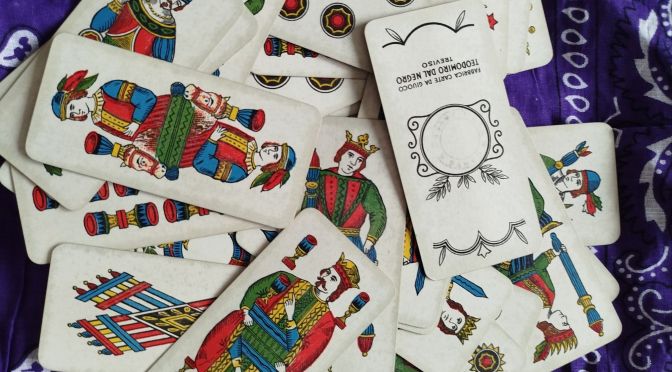
Ok, I swear this is the last deck I’m buying for a while, but it was only a couple of € on Ebay, and it was vintage, so yeah.

It is actually a Schafkopf deck (literally, sheep head), and it is comprised of 36 cards. As far as I can tell, not all Schafkopf reading traditions use all 36 cards, as some discard the sixes.
MQS
In the latest reading I presented, an interesting phenomenon occurred. At some point during the reading, two cards came up that seemed very negative, but which actually had nothing to do with the reading in itself. Instead, they simply acted as some form of punctuation. This happens especially with simple methods like the one I used, called ‘alla zdoura’ (literally, ‘method of the housewife’, or ‘like the housewives do it’ in dialect), where we start with a very limited number of cards, usually one, two or three, and then we keep adding them without following a specific layout.
In this type of reading, if the cards need to signal that we are changing topics and moving on to a new one, they may use cards or combinations that show an ending (sometimes even just the Death card). Of course, I had a huge deal of luck in this reading, because it came up clear. It isn’t always like that. Often, these combinations look really bad, but if we look around we see that they feel out of place.
In playing cards, the same can happen when the Four of Spades and Five of Spades, or the Ace of Spades, or the Five of Diamonds come up. Usually, in these situations, it pays to zoom out of the reading and catch the general flow of it: it will become apparent, generally, whether these cards are part of the reading or if they act as punctuation.
I am also experiencing a similar phenomenon while experimenting with the Bolognese tarot. For instance, in the first few lines of a thirteen- card spread, it may happen that the Angel and Death cards come up together, and then the cards seem to discuss other topics. In this case, the cards seem to be answering the question positively and quickly, only to introduce new discussions. At other times, the Queen of Coins comes up to say “and that’s the truth about it, period.” or the Justice card, to say “and that ok the way it is.” Of course, I need to experiment a little more, especially to see if apparently negative combinations can act in the same way.
MQS