All posts by MQS

Living at the intersection of occultism, fiction and philosophy, I travel the planes at a moderately quick pace. I read, I do magic, I cook for hubby. Confused by the number of things I talk about? Good, confusion is a nice thing ;)

Sibilla Quick Meanings – Suit of Hearts

Ace – Conversation (Conversazione) | A♡
Upright: Words, Conversations, Information exchange, News, Communication | Meetings, Dates, Appointments | People who live together or spend a lot of time under the same roof | How you communicate, How you open yourself up to other people or to new things | Ability to interact with other people, with the public, etc.
Reversed: Revolution, Change, Metamorphosis | Lack of communication, Communication problems, Arguments | Problems with clients or with the public

Two – House (Casa) | 2♡
Upright: Warmth, Harmony, Intimacy, Solidity, Stability, Stabilization, Solidification | The querent’s home or family | A House, Real estate | An outside building in general | This is the significator card for a couple’s inner dynamics 
Reversed: Problems at home or in the family, The querent’s home environment feels stifling or wrong, A troubled household | Trouble in the couple, A couple that is no longer solid | Problems with real estate, Problems with a building, A house you shouldn’t buy | Any building or outside place where the querent would rather not go (Hospital, Graveyard, Prison, A court of law, etc.)

Three – Balcony (Belvedere) | 3♡
Upright: Arrival of news, people, situations, etc. within a short period | New developments soon to be expected, The situation is taking shape | Looking, Watching, Seeing, Searching | Seeing in a metaphorical sense, Insight | This card is connected with long distances
Reversed: News, people, situations, developments that won’t arrive, or will be delayed, or the querent would be better off without | An animalesque character, Bestial behavior | Lack of insight, Not seeing | A situation that will not have developments

Four – Love (Amore) | 4♡
Upright: Love, Feelings | Emotionally important situation, Emotionally supportive environment, Context that is good or emotionally fulfilling | Traditionally, a “blind force” that cannot be dominated by human rationality
Reversed: Traditionally, homosexuality | More often, Distorted feelings, Promiscuity, Off-limits sexual behaviors | Aridity, Lack of love or support or fulfillment

Five – Happiness (Allegrazza al Cuore) | 5♡
Upright: Step toward stability, Step in the right direction, Transition toward happiness | Quick, fulfilling developments, Joy, Celebration, Dance | A commitment, Any type of commitment and promise that will be honored at a later date or that will lead to a next step later (An engagement, A reservation, A down payment, A probationary period, Making out with someone, etc.) | This card can be a significator for the querent’s engagement and what happens to it | The querent’s extended family, The querent’s relatives
Reversed: Unstable relationships in any field | Cheating, Betrayal in any field | A commitment that won’t be honored | Frustrations, Setbacks, Unreached aims | Problems with the querent’s relatives

Six – The Safe (Denaro) | 6♡
Upright: Everything that is accumulated, All situations that are present now in the querent’s life as a result of having been there from the past, Transmition, Hereditariness in all senses, from the genetic sense to the metaphorical sense | The past | Money, Liquid assets, Opulence, Wealth
Reversed: The future, New things | Suddenness | Money trouble | Avarice, Possessiveness, Unwillingness to let go | Situations, good or bad, that will persist for a long time

Seven – Scholar (Letterato) | 7♡
Upright: The mind, The brain, Intelligence, Talent | Education, Scholarly endeavors | Creativity, Artistry, Projects | Ability to make projects, To commit, Being serious about a relationship, Reconciliation | A notary public, A lawyer, An expert, A professional | A contract, A legally binding agreement | A man from the querent’s family, Or the querent, Or the querent’s (male) partner
Reversed: Ulterior motives, A calculating individual | Lack of education, intelligence, talent, Not being cut for something | Impotence in all senses, from sexual impotence to lack of power/ability to cope with a situation

Eight – Hope (Speranza) | 8♡
Upright: Realization, Situations clearing up, A sense of balance and confidence, The end of turmoil and difficulties | Optimism, Hope, Expectation, Faith, Belief |Emotional investment, Investments in general | Flirts, Easy love stories | A meeting, A trip, especially near the water | All watery places (beaches, rivers, islands, etc.) | Overseas
Reversed: Situations that go up in smoke, Hopes falling through | Depression, Sadness, Doubt, Lack of confidence | Atheism, Loss of faith, Dark religious beliefs | Danger by water (rare)

Nine – Faithfulness (Fedeltà) | 9♡
Upright: Success in Love | Faithfulness, Loyalty, Honesty, Dependability, Transparency | Things that seem as they are and are as they seem | A strong bond, Attachment to someone, something, an idea, a country, a tradition, a religion | Rarely, a friend or friendship | This card is connected with distant relatives
Reversed: Lack of success in love | Disloyalty, Dishonesty, Cheating, Betrayal, Unfaithfulness, Disrespect | Things that don’t seem as they are or are not as they seem, Having an axe to grind | Biting the hand that feeds you, A nasty character, Lack of sweetness | Anarchy, Revolt, Rebellion, Secession, The will to be independent, The will to oust or overthrow, Disrespect of tradition

Ten – Perseverance (Costanza) | 10♡
Upright: Willpower, Earned success, Earned victory, Victory after toil and sacrifice | Dependability, Reliability | Steadfastness, Perseverance, Constancy, Fixity of purpose | Fixity in general, Duration (for good or bad), For a long time | The querent’s city or homeland (depending on the scope of the question)
Reversed: Inconsistency, Lack of perseverance | Anger, Arguments, Violence (with other cards) | Willpower in a negative sense (lack or eccess of it, or wrong pursuits, or pursuits against the querent/query) | Loss in transactions | Storms, Bad weather for travelling, Danger at sea

Jack – Boyfriend (Amante) | J♡
Upright: An unmarried man, usually older than 30, but not necessarily | The boyfriend, The lover, The one the querent’s heart skips a beat for | VERY rarely this card has a sense of longing for something, or even courting it, either in a literal or a metaphorical sense
Reversed: Same as the upright, but the man is either negative/against the querent or in trouble (depending on the context of the question or of the surrounding cards) | In questions like “Does he love me?” it’s a resounding no | As a reversed court card of the Suit of Hearts, it can stand for a cheater | This card is sometimes connected with seeking unbridled sexual pleasure, a male prostitute or a sexually hyperactive man

Queen – Girlfriend (Amatrice) | Q♡
Upright: She is the female counterpart to the Jack of Hearts | VERY rarely, this card has a sense of emotional fulfillment attached to it
Reversed: A woman who is either negative/against the querent or in trouble | Like all reversed court cards of the Suit of Hearts, it can stand for a cheater | “Does she love me?” Answer: no | An older meaning is that of a career-oriented woman, but I find it very rarely the case (this meaning probably comes from XIX century prejudices depicting career women as prostitutes, as the Reversed Queen of Hearts can, in the appropriate context, represent a prostitute or a sexually hyperactive woman)

King – Gentleman (Gran Signore) | K♡
Upright: A mature (or older in the context of the question) man, A married man or Family man, A father or uncle | A protector, A teacher, A trustworthy partner all around, A (good) boss | Protection in general
Reversed: A negative man or a man in trouble | This card is connected with addictions and “sinfulness”, i.e. leading a life of excess | All the negative connotations of the Reversed Heart Court cards apply here (unfaithful/not in love/promiscuous, etc.) | Someone whose help should not be accepted

An Exercise To Do With New and Pre-Owned Decks

One fun little exercise I like to do whenever I get a new deck (any deck, of any tradition) is to ask them some questions to see if they are in tune with me. Some readers treat decks as if they were God-given artifacts. If that works for you, wonderful, no judgement, but I treat them as simple pieces of cardboard that are inserted into a universal mechanism of synchronicity. They are tools, and, like all tools, they need to be treated with some respect, but not to be revered as idols.

My own very personal experience with new decks is that the first few readings they give are often way off, until they enter into synchronicity with a particular reader and that reader alone. The only way for me to get past this phase of initial unreliability on their part is simply to use them a lot, until they get tuned to my subconscious language.

I will probably cover this in another article, but I staunchly believe that divinatory tools are like languages, and, like languages, their structure is perfectly objective, meaning that just as I cannot reinvent the English language as if it were a random convention, I cannot reinvent the meaning assigned to cards in a particular system (although there can be different systems, just as there can be different languages, and sometimes different systems use the same deck, just as sometimes different languages use the same alphabet or even similar words).

That being said, even though English is out there regardless of me, I will have my own take on the English language as I learn it, and you yours. Ever tried reading a Modernist author? Finnegan’s Wake is written in English, yet it is an English very few people who are not called James Joyce will understand. All this is to say that my own take on the issue is that card systems are objective, but you need to develop your own take on them in order for them to make sense in your particular universe (and you are your own universe).

The process of “developing your own take” cannot be decided rationally by convention, as in “From now on X will mean Y”. That’s part of the reason why Esperanto will never be a real thing aside from a laudable minority of dedicated learners. No, this process of development is largely a subconscious process of reciprocal adaptation between language and speaker, or between reader and reading system. It does take a little bit of time and patience, but then again, all things that are worth time take time.

As far as I am concerned, new decks need to be inserted into my mechanism of synchronicity. What about used deck? I have found that if a deck has been consistently used by someone else, it will take a bit more time for it to respond to me. Either way, the first question I will ask my new deck to answer is “Who is your master?” or, if you are not into kinky stuff, “Who do you respond to?” and I pull three cards. Usually, as soon as the cards start responding, I get a very clear description of myself as I am at the moment. Interestingly, if a deck belonged to someone else, I first get complete nonsense, then, as the cards start to respond to me, but not well enough, I almost always get the older owner’s description.

If you give this exercise a try, remember that the description you get of yourself needs to be beyond doubt. It’s like an “a-ha” moment. No vagueness. So, what happens if you don’t get the answer you are looking for? That is up to you and, in part, to your creativity. If you want to consecrate or cleanse your deck, go ahead. My own practice is to give the same question another couple of tries, and if the deck refuses to acknowledge me, or to let go of its previous owner, I leave it there for a couple of days, maybe spending some time shuffling it in the meantime, before giving it another try.

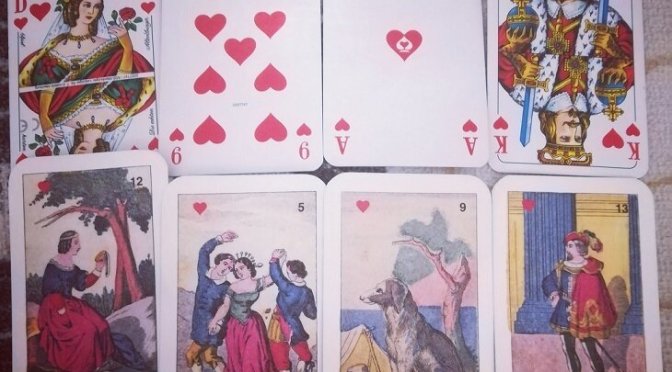
Here is what I did with my new Sibilla della Zingara deck. I asked “Who do you answer to?” and it answered perfectly on my first try, something that had never happened to me, except with my very first deck. I guess part of the reason is that it didn’t have a previous owner, as pre-owned decks tend to be a bit more stubborn, I have found. (Even then, don’t worry: my main deck was second hand, and it works perfectly now).

“Who do you answer to?” “To you, oh lord of all that’s sad, master of inner drought”

One thing you have to know about me is that I have a relatively strong depressive streak to me. I’ve always had it, and depending on the period it resurfaces. These days I was battling through a relatively strong depressive episode, and it definitely shows in the cards.

The King of Hearts is me. Usually I show up as the Jack of Clubs (unmarried man under thirty), but in the past I have come up as the Gentleman, mostly in relationship readings and in job readings, as I’m a teacher (protector/helper figure) and therefore the Jack of Clubs can represent the students. In this case I’m not sure why I showed up as Gentleman. It might be a very contingent reason, as upon searching the deck for the Jack of Clubs and the Jack of Hearts, I found them reversed. Apparently, the deck simply pushed the most serviceable significator into service.

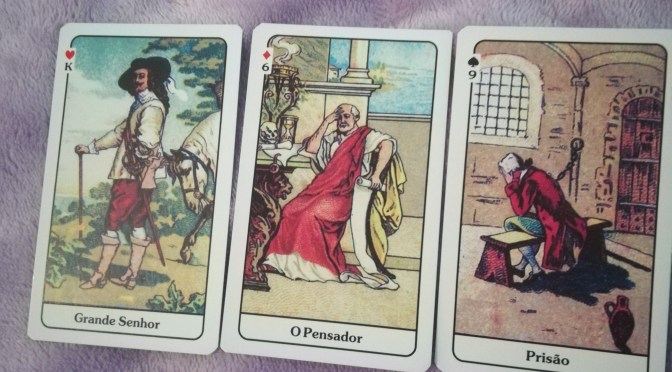
The following combination is Six of Diamonds (Thought) + Nine of Spades (Prison). This is one of those combinations that can signal feeling down, or depressed, or oppressed. It can also signify psychological submission, but there would need to be other cards as well.

What’s interesting about this reading is that these past couple of days I had battled through the depressing feelings without even noticing them, but as soon as they came up in the reading I got my “a-ah” moment, “yep, that’s me”.

Other questions you might ask the cards are What’s going to happen in the next 24 hours?”, “What did I do yesterday?” or any other question whose answer can be easily verified within a very short timeframe. I personally would avoid questions like “What will you teach me?” or “What have you entered my life for?” as it’s all too easy to concoct a convenient answer out of any card combination, but I leave it for you to decide for yourself.

The point is: don’t feel bad if sometimes a new deck doesn’t seem to make any sense, it just takes some time to get in tune with it. At other times, however,, as in the example above, the synchronicity is perfect from the start.

Reading – Will the University Go Bust?

Here’s a reading from some time ago, which I recreated using my new Sibilla Originale 1850. The querent’s problem was: Will the university I work for go bust?

A pyramid spread on the question “Will the University I work for go bust?”

The first line is pretty interesting, as we get a chance to see the power of the Peacock card in action. The Two of Clubs is the best card in the deck, capable of lessening the blow of any negative card. And boy do we need it, as right before it we have the worst card in the deck, the Seven of Spades Reversed. Aside from being the card of tyranny and overbearing power, the reverse Seven of Spades talks about ruination and utter and final capitulation.

Why is the university going toward ruination? We have the Ace of Clubs, Marriage, and the Ten of Clubs, Levity. The Ten of Clubs is the card of “just a little”, while the Marriage card is about contracts and legal agreements. So, the university is at risk of going bust because there’s not enough students signing up, but the worst will be avoided thanks to the Two of Clubs, which can be visualized as a sort of divine hand grabbing the debris falling from a collapsing building and putting them back in place before they manage to fall on someone’s head.

The second line tells us something a bit more specific about what is going to save the university from the worst. The Seven of Diamonds, the Child, is about new things, and the Jack of Clubs, the Servant, is, among other things, the card of students, an interpretation which is confirmed by the Two of Diamonds, the Letter, which is one of the cards of studying and books, and when near the Servant it can identify a student. Here we are not talking about a specific student, but about students in general. There will be new (Child) students. At least enough to keep the whole thing going.

In this instance, we may also see the Child as falling between the Ace of Clubs, Marriage, and the Two of Hearts, House. Ace of Clubs + Two of Hearts is the card combo that, in job-related issues, represents a firm or a business. Here we are talking about a university, but the meaning still applies: universities don’t pay their employees in wisdom. They, too, need to make money, just like a business.

The presence of the Child inside this combination of business tells us that the university is preparing something new, perhaps new courses or maybe some new marketing ploy. The querent confirmed that they are looking to concoct some new study course that will make the university he works for more alluring.

The final three cards tell us that, although the university will manage to stay alive, it probably won’t be thriving, at least not in the next period. We need to understand “the next period” in the context of the question: we all know how public institutions tend to suck as much money as they can for as many years as they can without profit before actually being left to their fate, so in the context of a public institution, which this university is, the next period means the next few years, or at least that’s what I think.

The Two of Hearts, the House, shows the place itself, while the Nine of Diamonds, The Fools, and the reversed Three of Hearts, the Balcony, tell us something that seems to contradict the presence of the Peacock in the first line. It would be easy to interpret this combination as one pertaining to violent groups, but this wouldn’t mean anything in the context.

Aside from its usual connotations, the Nine of Diamonds talks about things proceeding irregularly, or without really looking where they are going, while the Three of Hearts is connected with sight, whether literal or figurative. Reversed, it becomes a lack of insight, so whatever it is that the university is coming up with is not going to be that good of a product for potential students to buy into.

Finally, let us look at the angles of the pyramid: Marriage, Peacock and Balcony Reversed. The business (Marriage) will stay open for the foreseeable future (Peacock), but this will not necessarily be a good thing, as the Balcony Reversed is also the card that points to a lack of positive developments.

Vera Sibilla Master Post

Vera Sibilla FAQ

Vera Sibilla and Numerology Series

Quick Meanings for the Vera Sibilla

Vera Sibilla Numeral Cards Descriptions

Vera Sibilla Court Cards Descriptions

Cards by Concept

Combinations

Interpretation and Spreads

Reviews

My Articles on the Vera Sibilla cards

Something went wrong. Please refresh the page and/or try again.

Vera Sibilla and Numerology – The Sixes

In the Vera Sibilla, the Sixes represent the natural evolution of the number Five. Whereas Fives dealt with transition, the Sixes represent the flow of time, with all its philosophical annexes: the idea of duration (or lack thereof), the notions of past, present and future, etc.

The four Sixes in the Vera Sibilla: The Six of Hearts (Money), The Six of Clubs (Surprise), The Six of Diamonds (Thought), The Six of Spades (Sighs)

The Six of Hearts is called Money. A better name for it would perhaps be The Safe or The Archive, because while it is true that it does represent money, liquid assets and wealth, this meaning is derived from the idea of accumulation which is a consequence of the traditional meaning of the Six of Hearts in cartomancy in Italy: the past.

And, indeed, the past is one of the main meanings of the Money card, strange as this may sound. Often, when together with a court card, it shows someone whom we already know, or an ex. In general, this card shows that we inherit something from the past, whether it be a situation, a person, an illness (which maybe we haven’t treated properly, or simply one that runs in the family, i.e. a hereditary disease), etc.

Money, the other main meaning of this card, is simply a logical consequence of the notion of time (number six) understood in a positive sense (suit of Hearts), i.e. as a resource and therefore as convertible in resources to be accumulated. Note that, reversed, the Six of Hearts talks about the future, as in future occurrences, unknown places, situations and people. It also heralds money trouble, but it is especially a card of avarice, i.e. unwillingness to let go of what we already have (or of the past).

At the opposite end of the spectrum, the Six of Spades, Sighs, is the card of anxiety and tormented hope. This card, too, can represent something that already happened, but this time it doesn’t show it in a neutral way, but as a source of anguish. More in general, however, rather than to the past, this card is connected with the passage of time as a neutral-to-negative element that comes between us and our desire: the need to wait.

When reversed, one of the meanings of the Six of Spades is that it can represent the idea of letting go of our tormented desires or of our anxiety concerning the past. This is one of the cards that can show, when reversed, opening up to new possibilities rather than clinging to what causes us nothing but grief.

It’s the ability to step outside of ourselves or of our issue and listen to reason, whether it’s in the form of new inspiration or some professional advice. When surrounded by more neutral or negative cards, however, it remains a card of instability, material or psychological even when reversed.

In between Hearts and Spades we find the Six of Clubs, the Surprise, and the Six of Diamonds, Thought. The Six of Clubs is the card of the present time. It represents things happening now, or at least in the very near future. With it are connected the ideas of suddenness and immediacy, and therefore marvel and surprise, of coming across something that was unexpected. Since the suit of Clubs is positive, this unexpected surprise is usually positive.

Taking this idea of “chancing upon” further, we get to the meanings of receiving, getting, acquiring that this card also shows. But this is also the card of things that start flourishing. Note how, in the image, the guy is fishing a bag of money out of a river or lake, which means that, while the result was beyond his expectations, he did have to cast his net. As such, this is the card of minimum effort for great results: small past efforts paying off in the present and possibly heralding a positive future.

Finally, the Six of Diamonds, Thought, also represents the present, but it’s more the a-temporal present that exists in the mind, rather than the physical present of the Six of Clubs. As the card of consciousness, the Six of Diamonds is the point where past, present and future converge and are organized, made sense of and shaped into alternative ideas of reality that we then seek to act out.

As such, this card also shows plans, ideas, etc. Not necessarily true ideas, not necessarily good plans, and not necessarily plans that we are going to be able to act out: this is the card of pure consciousness, the timeless present which fluctuates above the flow of real time.

Vera Sibilla and Numerology – The Eights

The Eights in the Vera Sibilla are a natural continuation of the sevens. They represent the concept of balance and evolution toward balance. If you look at the number 8, you’ll see that it’s made up of two loops, which represent the inside or inner world and the outside or outer world. One of the two loops is represented by the “intention” set forth by the number seven, while the other loop represents whether or not that intention finds actual expression in reality.

The Eights in the Vera Sibilla: The Eight of Hearts (Hope), The Eight of Clubs (Reunion), The Eight of Diamonds (Handmaid) and the Eight of Spades (Jealousy)

The Eight of Hearts, Hope, is connected with the realization of one’s expectations and dreams. At its best, this card shows things going as hoped, at its worst, when it ends a negative sequence, the Eight of Hearts promises us that all will be well anyway and things will evolve in a positive direction.

The two “loops” that make up the number eight are, in this case, in perfect balance: inner and outer are as one. As such, aside from showing the realization of hopes, this is the card that represents clairvoyant abilities, dreams and faith as a whole, as these are manifestations of the concrete reality of our inner world.

The Eight of Spades, Consumed with Jealousy, is by far the most interesting card in the deck. In the Italian title, the word “Disperato” actually means “desperate”, not consumed. Desperation is the opposite of Hope. And, indeed, the two images convey opposite ideas.

Let’s look at the two cards. On one hand, a young woman is gazing confidently in the distance. She is poised and dignified, and there is a sense of peace, of perspective, of having a future in front of us that is clear and peaceful. Her titties out to the wind don’t exactly scream insecurity, if I may add. The connection of this card with the element of water can also be interpreted as things flowing smoothly and calmly, which is itself an extension of the eight-ish idea of balance, understood as our inner wishes flowing out and permeating reality.

On the other hand we have one of the most disturbing images in the history of cartomancy: a guy who has lost all sense of perspective and all hope for the future, whose life has stopped flowing smoothly and who finds himself at a desperate turning point, and he’s about to possibly end his own life. Not someone you’d ask to look after the kids while you are out shopping.

This is the card of crisis, of the world closing in on you, of oppression and lack of positive ways out of this impasse (at least, unless other cards show otherwise). This card behaves as a landmine that our hopes and desires step onto while on the way toward realization. Here, the two loops of the number eight are imbalanced with one another. This imbalance can also be understood not just as unfulfilled hope or crisis, but also as negative hope, hence the card’s connection with envy, slander etc.

In between Spades and Hearts we have the Eight of Clubs, the Reunion and the Eight of Diamonds, the Handmaid, which represent evolution toward balance in two opposite senses. The Eight of Clubs is the card of the positive evolution toward a good conclusion, but it implies either a previous upset or a previous distance.

This is the card that can show winning a court case, which implies the upset of having gone through a trial, it’s the card of the date or meeting, which implies being apart (otherwise we wouldn’t be able to meet), it’s the card of reconciliation, which implies break-up, it’s the card of healing, which implies illness, it’s the card of getting back the money you’ve lent, which implies a previous parting with your money. In general, this card represents an evolution leading us back to a previous balance that has been interrupted, and a positive offsetting of the situation as a whole.

The Eight of Diamonds, The Handmaid, is also a card of evolution, but one that doesn’t necessarily lead us back: it’s an evolution that leads us forward toward a new equilibrium (or lack thereof). It is said that this card, when it falls in the spread without any specific reason, heralds new phases in life, and we must always look where the young woman is going.

The staircase she’s climbing is a symbol for improvement, expansion, growth. As such, this is one of the cards representing nobility, refinement, good manners and climbing up the social ladder. The evolution here is therefore not intended as a re-establishment of a former positive situation as the Reunion (Re-union) often implies, but rather as a building on what is already there to reach a new equilibrium. Note that the handmaid is also the card of offers and money, things and situations being given to us: the new equilibrium or balance may be coming toward us from the outside.

Sibilla Originale 1850 by Il Meneghello – A Review

I was pleasantly surprised to discover the legendary Il Meneghello had come out with a new edition of their lovely Vera Sibilla deck. The Vera Sibilla is a traditional Italian divination deck. In its land of origin, the Sibilla is second in popularity only to Tarot cards, so much so that it is cheaply available at any of the numerous tobacco shops scattered in every town and city. It also seems to be slowly making its way to the rest of the world.

Sibilla cards are also affectionately called “chiacchierine”, which means something along the lines of “little chatty (cards)”. The word conjures up the image of a couple of saggy old grannies sitting outside late in the afternoon in a picturesque cobblestone alley, away from the noise of the main street, shelling beans while exchanging the latest news about the neighbor’s affair with the school teacher’s dog trainer, and what the florist’s daughter thinks about all this, being the prude that she is.

They are, in a word, nosy little f*ckers, these cards. Their astounding love for details is only equaled by their complete inability to keep their mouth shut. It is often wise to keep them on a short leash to avoid being overwhelmed. In my personal experience, a short-ish spread done with the Sibilla often gives the same amount of detail as a Kipperkarten or Lenormand Grand Tableau. This doesn’t mean that other decks are more limited. It is purely a question of “character”, and each deck has its own character. The Sibilla simply happens to be the hyperactive cousin with no grasp of boundaries, political correctness and social acceptability.    

Il Meneghello is renowned for its hand-made limited editions of historical decks. Master Menegazzi, the heart and soul behind IM, has been producing and reproducing decks for years now, and has become some kind of a legend amongst collectors and card readers. The products they publish are always guaranteed to be of high quality. This reproduction of the 1850s Vera Sibilla is no exception.

What’s inside

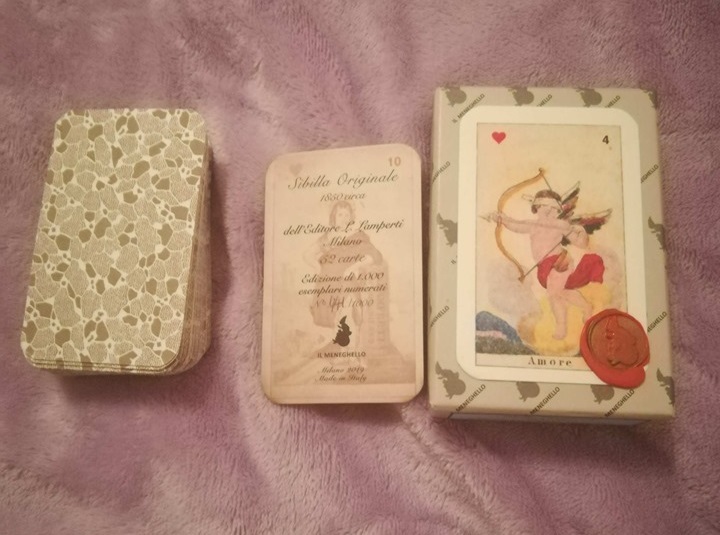
As usual for Il Meneghello, the deck comes packaged in a lovely reinforced cardboard box (see picture). I keep my other Sibilla decks in their original box, as I’m a practical dude and I can’t be bothered with finding a more “appropriate” accommodation for what is, at the end of the day, just a deck of cards. In this case, however, I wouldn’t be able to think of a better solution even if I wanted to. Not only is the box beautifully decorated (with a reproduction of the iconic Love card glued on the front), but it is also made to last.

The Deck, The Extra Card and the Box

Inside the box you’ll find the deck itself, an extra card, a Little White Book and a note. The note simply warns you that, since the product is hand-made, some imperfections are to be expected. Cool. The Little White Book is, like all Little White Books, pretty useless. You won’t find the meanings of the cards in it, although a simple five card positional spread is suggested.

Frankly, the Sibilla works at its best when read in rows or other geometrically inspired shapes (e.g. box, square, pyramid, tableau etc.) which are made up of multiple rows. This allows the cards to come together and form combinations and clusters. Using positions, and even worse, using one card per position is extremely limiting. Other than that, the LWB keeps its promise of being “little”, and it only adds some historical remarks in Italian and English. The extra card, which you can see in the picture, is a reproduction of the Ten of Hearts with some information about the edition.

All that’s left to talk about are the cards themselves. If you don’t know how a Vera Sibilla deck is structured, it is basically like a playing card deck, with four suits (Hearts, Clubs, Diamonds and Spades), but each card is assigned an image. According to Sibilla expert Etienne Valancourt, the Vera Sibilla deck has been created by taking the Italian system of reading playing cards and adapting it to the images of the famous Gypsy Cards which were popular in Germany and Austria back then.

Indeed, many images and names are very similar. However, since the Gypsy cards are 36, while the Sibilla has 52 cards, some images had to be split among various cards (for instance, the card of the Visit, where you can see a handmaid visiting an old lady, became the two cards of the Old Lady and of the Handmaid), while other images were added to the mix to fit the Italian system. Let’s look at the cards in this particular edition.

Pros

The cards themselves are a treat for the eye and, if I may, for the hand as well. Il Meneghello has chosen to sell this new edition of their Sibilla deck with the corners already rounded off. I believe this is a winning move: the cards come across as much gentler and “approachable” to the eye. They are just pretty, I wanna merry them. According to Kapherus of Art of Cartomancy, who owns a copy of the previous IM Sibilla reproduction, the square corners of that edition tended to peel off a bit too easily. I have been mistreating (really!) this deck for a couple of weeks now and it seems to be in perfect shape. If in doubt, choose this newer edition.

The backs of the cards in this edition (left) compared to the standard Masenghini edition (right). As you can see, they are not exactly reversible, but they are more reversible than the Masenghini ones.

There’s something extremely authentic and genuine in the experience of holding this deck in my hands. Although the size is the same as the popular Masenghini edition (see image), the deck as a whole takes up more space, simply because it is made of relatively irregular pieces of actual cardboard rather than of 52 identical pieces of plastic. Whenever I shuffle the deck, I feel immediately transported to a tearoom of old, where a funny-looking lady shuffles her self-made deck for her numerous clients.

Speaking of hand-made stuff, this deck is completely matte. I don’t have the previous Il Meneghello edition of the 1890 Sibilla, but I have been told by a Facebook friend that that edition is at least lightly coated. Not so with this 1850 edition. This certainly contributes to the feeling of authenticity of the deck.

Another important pro, in my opinion, is that this deck, like the previous edition (and like the original edition), has no annoying keywords on it as the Masenghini edition does. Bear in mind that the Masenghini edition came out only in the late 1970s and it was probably some rich old manager who’d never used the cards for divination and simply wanted to make them more appealing to bored teenagers that slapped the keywords on the cards.

Granted, I have learnt to disregard them, especially since they are very reductive, and many of them are extremely misleading, telling you the Jack of Clubs is an evil dude, even though he is actually traditionally the prototype of the good friend, son, student, coworker, and only becomes negative when reversed. Still, it feels liberating, and the font used for the title is also much prettier.

Some of the names of the cards, being the original ones, are slightly different from the Masenghini edition (e.g. Present of Precious Stones instead of Present of Jewels, Consumed with Jealousy instead of just Jealousy, etc.). Also, the Present and the Handmaid are swapped back to their original place. Finally, you can see that the colors in this edition are a bit more muted compared to the newer ones. I find them lovely, less fake. Note: this is not meant as a bashing of the Masenghini edition, which I adore and use. It’s just a comparison.

A comparison of the images on the cards of this 1850 edition (top) with those on the Masenghini edition (bottom). Notice how some names have been changed and the Eight and Three of Diamonds have been swapped back to their original placement.

Cons

Is this a wonderful deck to have if you are a Sibilla Reader? Absolutely! I don’t know how you could miss out on it.
Is this a great deck to have if you like traditional oracle decks in general? Yep, go ahead, buy it!
Is this a good addition to your collection if you are a collector? Hurry up, it’s limited!
Should this be the only Sibilla deck you own? Probably not.

Granted, it does seem sturdy enough to last me a lifetime. This doesn’t change the fact that it’s not meant to be as resistant as a mass-produced, heavily coated plastic deck, especially considering it’s a limited edition and it’s not necessarily cheap. If I ever chose to go pro, this wouldn’t be the deck I use with my clients, although I could probably keep it for my personal readings.

Since these are actual pieces of uncoated cardboard, you need to be careful around liquids, as I guess they will stain quite easily. Also, you need to get used to shuffling this deck, which wasn’t easy for me at the beginning. It’s not impossible, and with a little practice it is actually extremely pleasant, but don’t expect it to be the same as with the newer, plastic-y editions.

Final Thought: absolutely recommended!

Pros:
+ The Vera Sibilla Oracle at its best. If I had to choose my favorite edition, this would be it
+ Pleasantly matte pieces of cardboard in your hands
+ Rounded corners!
+ Seems very resistant
+ No keywords on the cards
+ It’s like gazing into images from a dream

Cons:
– You might need to be careful around liquids
– Initially difficult to shuffle, but you just need to get used to it
– It’s lovingly hand-made in a limited edition, so I don’t know if it would be suitable as a “power horse deck”. Perhaps if you are careful

Price: When I bought it, it cost 40€ plus shipping.

How to order it: It is not currently available on the website. However, you can order it by emailing Il Meneghello. Their customer service is quick and efficient.

Vera Sibilla and Numerology – The Threes

The threes in the Vera Sibilla are all connected with the concept of movement. Card Reader and Youtuber Etienne Valancourt, who inspired me to study numerological hints in the Vera Sibilla, noted in one of his videos that threes seem to refer to spacial or metaphorcial movement. If the Ace was the single dot and the Two was the extension of the dot into a line, the Three brings in the idea of moving up and down, left and right, since movement implies at least two directions (where you start from and where you finish) that are connected by the movement itself.

The Threes in the Vera Sibilla Oracle: The Three of Hearts (Balcony), The Three of Clubs (Journey), The Three of Diamonds (Gift of Precious Stones), The Three of Spades (Widower)

The Three of Hearts, The Balcony, and the Three of Spades, The Widower, show, as usual, two opposite interpretations of the concept. The Three of Hearts, as the illustration points at, is a card of arrival. The lady is waiting for something or someone that are on their way to her (or, at least, that are supposed to). It’s a positive card, although, like all red cards, relatively easily influenced by the black cards around it.

The Balcony is also connected with sight, the eyes and looking (either literally or figuratively), which are a natural extension of its primary meaning: when something is coming our way, it becomes easier to spot than if it is parting from us. In general, the arrival, i.e. the notion of “getting closer”, may be interpreted as a general remark that new developments are on the way, that the issue under consideration has not reached its conclusion yet, and that the matter is not yet settled. For all its connection to the concept of “getting closer”, this card is also associated with great distances, especially when with cards that reinforce this meaning.

The Three of Hearts is a generally favorable card. The Three of Spades, on the other hand, is extremely negative. In the Widower we find the idea of separation, of getting away. When it’s not a character card depicting an older man, the Widower is always connected with feeling unwell, not necessarily in a health-related sense. He’s not the type of guy you’d want over for a cup of tea, he’s really gonna bring the mood down.

The main ideas connected with it are those of abandonment, loss (things getting away from us), bereavement, deprivation, and something being generally taken from us. If the Balcony points to new things and people coming our way, the Widower is a card of loneliness and isolation, of no news and no people arriving (it can function as a kind of “minus” sign, showing us what we don’t have). This card is pervaded by a general sense of finality, of matters being ready for burial. How fun, right?

In between, we have the Three of Clubs, The Journey, and the Three of Diamonds, The Gift of Precious Stones. The Journey card speaks for itself: it represents journey and movement in general. It can, however, also show change in general. This card is connected with things not remaining the same, of things going through some kind of change. This can be positive or negative, external or internal (e.g. changing point of view). It’s not a difficult card, aside from the fact that it’s one of those in the Vera Sibilla where directional cues need to be taken into account.

The Three of Diamonds is, in most editions of the Sibilla, assigned to the Gift card, but some newer and easily accessible editions have popularized its connection with the card of the Handmaid, The Eight of Diamonds. While I chose to stick with the traditional numerology, I am going to discuss this issue in a separate blog article to show how both attributions make sense. After all, the Gift and the Handmaid have some astounding similarities in their meanings.

In general, The Gift is a card of gifts (duh!) and proposals, of situations moving in our direction to allow us to jump on board. It represents the movement of objects, i.e. packages being sent or received, and, as an extended meaning, this is the card of objects in general, i.e. moveable goods. Another important connection of this card is with opulence and wealth, and therefore with upward mobility and a higher social status. The Handmaid card can also be appropriate as Three, considering that it, too, represents evolution, things that are given to us and a higher position in society. It also has other traits, however, that make her a good Eight as well.

Vera Sibilla and Numerology – The Sevens

The sevens in the Vera Sibilla are mainly connected with the ideas of intentions, mindset, projects and planning. They speak, in other words, of our ability to conjure up visions of reality and of ourselves that may then be planted into the outside world and grown. While the sixes spoke of the passage of time and the flow of events, the sevens represent our ability to see an alternative that may be tapped into to alter that flow. Differently put, they show us how the Self reacts to that flow.

The Sevens in the Vera Sibilla Oracle – The Seven of Hearts (Scholar or Artist), The Seven of Clubs (Gratification), The Seven of Diamonds (Child) and The Seven of Spades (Disaster)

As it should by now be clear, Hearts and Spades are direct opposites of one another. The Seven of Hearts, the Scholar or Artist, represents the power of reason. Notice the difference between the Seven of Hearts and the Six of Diamonds, the Thought card. The latter is about our inner reality, which may or may not be reasonable. A passing look at the amount of psychic crap that comes pouring out whenever we hit a shrink’s couch shows us that the Thought card, i.e. what goes on on the inside, may bear little to no resemblance to reality in its absolute, objective sense.

The Six of Diamonds may show projects, but only in so far as they are inside and not yet outside. The Seven of Hearts, on the other hand, represents the ability to plan. It represents rationality, brain power, the ability to measure and count (when reversed, the idea of measuring and counting becomes the negative notion of ulterior motives, of doing something because you are calculating individual).

It is also the card connected with the skill of coherently putting together a vision of reality that may be used to then mold reality itself. Hence its connection with creativity and art, which are not the opposite of reason, but its extension into the world. As unfashionable as thinking straight is among us new-agey folks, this card is very important. The most important practical meaning of the Scholar, i.e. contracts, comes from the fact that the juridical side of life is founded on the concept of “meeting of minds”, which is what generates contracts: it’s when my mind meets yours midways to create a stable, reasonable intersubjective agreement.

Let’s turn to the Seven of Spades, Disaster, which is notoriously similar to the Tower card in the tarot. This card is, in more than one sense, the direct opposite of the Scholar. In its most general sense, this is the card of immeasurability. It shows all those things that, no matter how “scholarly” we might be, hit us from the outside, without forewarning and without any discernible cause that we might prepare for in advance. It shows shit happening because shit just happens, and that’s kind of it.

As an extended, neutral meaning, this card also represents things happening all of a sudden, and usually very quickly, though not necessarily in a bad sense. A third important meaning of this card is that of negative projects. While the Scholar is the good architect of reality, the Disaster card can show ill-will, the desire to hurt or harm another. It is connected with anger and choler, all forces that blur the line between what’s reasonable and what isn’t.

In between we have the Seven of Clubs, Gratification, and the Seven of Diamonds, the Child. These, too, are starkly different cards in many ways, although with a common tread. The Seven of Diamonds is the card of all things new and novel. It represents new projects, new plans, new things in general coming into our lives. More subtly, this is also the card of new visions, of opening up to new points of view, new stimuli, new perspectives and new ways of understanding ourselves and others.

Its archetype extends to cover ideas such as purity of soul, candor, innocence, but also naivety. The Suit of Diamonds is the suit of seeds, of all those little impulses, positive or negative, that are planted into our lives. Among the other Diamonds cards, the Child is the one that most of all represents a seed: small, ready to grow and full of promise and potential.

The Seven of Clubs, Gratification, is anything except small. It is deeply connected with our sense of self, with what makes us secure in our identity and what supports our narrative of who we are and of how who we are finds its deepest fulfillment in real life. If the Child is the seed, Gratification is the tree ripe with succulent, plump fruits.

This is not a “theoretical” card, but a very material one. In the most general sense, it is connected with our sense of stability in the world: it may have to do with fame, recognition, our good or bad name (depending on the cards around and on whether this one is upright or reversed). Furthermore, the Seven of Clubs has strong ties with the concept of concreteness and concretization: it shows the next logical step in making a situation more stable, concrete and fulfilling, whether it’s marriage (the ring in the picture) a promotion at work (the bag of money) or a positive reception by our fellow humans (the wreath).

As Alessandra Venturi says in her book, this card can be the light at the end of the tunnel, in that after a slew of negative cards it can allow us to regain a sense of balance and a more positive outlook. Whatever the field, this card doesn’t speak of emotions, but it does speak of personal fulfillment in the situation.

Vera Sibilla and Numerology – The Fours

The fours of the vera sibilla. Like and subscribe to support my work

The four Fours in the Vera Sibilla appear to be connected with the notions of environment, context or situation. The famous squareness that almost every system of cartomancy ascribes to the number four is still present, but rather than talking about stability or lack of change, it is focused on describing of the type of 3D world that exists around the querent, depending on the suit. The Ace was like a spark, the Two extended it into a line, the Three provided movement, now we have a full-blown situation.

The four Fours in the Vera Sibilla: The Four of Hearts (Love), The Four of Clubs (Friend), The Four of Diamonds (Falsehood) and the Four of Spades (Sickness)

The Four of Hearts, Love, is perhaps the most famous card in the deck. Every traditional source describes it as a card that represents a live, blind force shaping the situation. This idea movement, aliveness and blindness are a consequence of the irrational nature of love, which is impossible to put in chains or define in a limiting way. I like what I like, I am attracted to what I am attracted to. Period.

Hence, the idea here is one of a context that the querent likes: it may be a house, a partner, a job, whatever. With this card, we are in a context we like. The Love card represents a situation that is alive, that has enough of that vital impetus to keep it going, and the vital impetus is, of course, attraction. The whole of the universe is love, and all that good shit.

Conversely, the Four of Spades, the Sickness card, shows a situation or context that is not hot, but cold, not lively and moving, but rotting, ill and decaying, not free, but stuck, not beneficial but noxious. This card represents sickness and illness in the most general sense, whether it’s an ill body, an ill career, a sick way of living a relationship, etc. Whereas the Four of Hearts is the card of a situation that we love, that we are compatible with, the Four of Spades is a card of wrong paths, situations that developed in the wrong way or that have grown stagnant.

In between, the Four of Clubs, the Friend, is a card of positive, helpful contexts. It may represent partnerships and co-operation, pacts etc., but in general it represents a supportive context or people who support the querent. Some of the undertones of this card are similar to those of the Nine of Hearts, Faithfulness, in that in both cases we have someone (or a general situation) that is loyal, caring and helpful, and will do what’s best for the querent.

Jobs and career in the field of service are often represented by the Friend, as well as all supportive roles (e.g. nurses). All this being said, this card sometimes represents a person, in which case it’s going to be neutral.

The Four of Diamonds, Falsehood or the Cat, is one of the most iconic in the deck. In the most general sense, it is the opposite of the Nine of Hearts and, in a way, of the Four of Clubs. While the Friend represents a positive, supportive context, the Four of Diamonds represents negative contexts in general. Under this card fall all those situations and contexts that are wrong, false or bad for the querent.

While the Dog card shows things being as they seem and seeming as they are, Falsehood is about reality being hidden behind a layer of something else which may be anything, but is not real. In this sense, it also covers illusion and self-deception, in addition to cheating and lies. Interestingly, this is also the card of bad weather, likely because bad weather is a passing illusion covering the eternal blue of the sky.