All posts by MQS

Living at the intersection of occultism, fiction and philosophy, I travel the planes at a moderately quick pace. I read, I do magic, I cook for hubby. Confused by the number of things I talk about? Good, confusion is a nice thing ;)

How ‘Topic’ Cards Behave

In every deck there are what we might call topic cards, that is, cards that represent a specific field of life: family, work, money, health, love, the law, etc.

All or most of these cards also have general meanings that apply to various contexts. For instance, the Ace of Cups in the Bolognese Tarot is the home card (just like the Ace of Hearts in playing cards or the Two of Hearts in the Vera Sibilla), so it is the topic card for everything relating to family and house questions. But it can also indicate that someone belongs to the family, e.g., when it comes up next to a court card. It can also indicate the inner side of one’s experience of life, one’s inmost, intimate world, etc. So it can also show that something is close to us and touches us.

We need to distinguish between a card acting as a stand-in for a specific topic and the same card acting out a particular meaning. To keep with the Ace of Cups example, when it comes up in a question about work, it might show that the querent’s work life interferes with their family life or vice versa, or that they work from home, or that their work environment is family-like. In all these cases, the house card qualifies the other cards by adding details of its own.

But when the House card is simply a stand-in for the topic ‘home and family life’, the card says nothing about the topic itself. It doesn’t qualify the reading. It simply tells us, “this is the topic.” It is then the role of the other cards to describe the situation, qualifying it in a positive or negative way.

When we are doing a general reading with no question, or with all the cards down on the table, this is all well and good: we see if the person’s significator is next to any of the topic cards, showing that that topic is important, and then we read the cards surrounding the topic card relating them to the topic.

When the question has been specified, though, extra care must be taken trying to figure out if the topic cards that appear are qualifying the topic of the question or if they are coming up to ignore the question and talk about something else. This is not always easy.

Let’s say you asked about work, but the house card comes up. Why? Is it because the home is involved? Or is it because the cards have decided to bypass your question and discuss something else? Or is it both? (It CAN be both). One way to solve this issue is to see if there are topic cards relating to the question, or if at least the cards seem to be predominantly of a nature that seems more akin to the question asked (e.g., lots of Diamonds and Clubs in a work-related question).

The other way is to see if the cards next to the rogue topic card coalesce with it to form a coherent statement that has nothing to do with work, or if instead the topic card allows itself to be absorbed into the querent’s question.

The third way is simply to work with the querent. This is always a good idea. After all, our aim is to interpret the oracle correctly, not to impress people.

Cards that have the potential to be topic cards are always quite strong in a reading, so it is always good to observe them first. Often they form focal points in the interpretation of the spread. Sometimes some cards in some readings can even be ignored, but topic cards always seem to have something to say. We ignore them at our peril.

MQS

Get Out And Read!

When it comes to divination, theory can only get you so far. The best way to improve your reading skills is to learn the basics of a *valid* system and then start reading.

For most of us, we are our own first querents, and that is a problem. I don’t have a 100% accuracy record when reading for others, but I barely reach 60% when reading for myself, especially if I’m invested in the topic. It is not just a matter of wrong interpretation, which can and does happen. I am more and more convinced that sometimes, when we read for ourselves and we are not perfectly at peace, we tend to get readings that reflect what we think rather than what is happening or will happen.

Furthermore, the tendency that many people have to start obsessively putting questions to the cards just to see if they say something vaguely understandable (which doesn’t mean true) is dangerous, and can get us in a warped frame of mind.

I know that for many, especially coming from certain societal backgrounds, reading for others can be a big step into the unknown, but I would advise anyone to start reading for some sympathetic friends or relatives (and when I say for them I mean in front of them, not asking questions about them) and then to graduate as soon as possible to readings for people we don’t know or know little about.

I don’t have too many friends, but they do a good job of talking about me to their friends and to their friends’ friends, which is how I get my supply of test anim-ehm, querents. If you start reading for your friends and ask them to spread the word the same will happen to you.

The cool thing about reading for people we don’t know is that it is so much easier than you might think. Divination DOES work! And divining for someone when there is no chance of you knowing the information in advance is very impressive for them and very satisfying for us as diviners. It will build your confidence much more quickly than torturing the cards about your own mental dramas. Plus, the oracles always seem to be much clearer and much more crisp when I divine for strangers.

One thing I would advise is to be as scientific as possible: record the question, the reading, your interpretation and the results. Don’t think you cannot build your vocabulary because the only right answer is the one offered to you by your intuition. 99% of intuitive readers are terrible, and what they call intuition is not actual intuition: it’s their stupidity echoing in the empty chambers of their mind. Be systematic and slowly you will gain experience.

MQS

A Note On The Ten Of Cups

I always maintain that the Golden Dawn were not great astrologers, largely because the XIX century astrology they had access to was not very good. Still, for the purposes of deriving symbolism for magical operations, their take was acceptable.

One thing that has always fascinated me about the Golden Dawn’s take on astrology was how they tried to synthesize it into their tarot system. Aside from the attributions of Zodiac signs and planets to the Hebrew letters and of the Hebrew letters to the major trumps, they also assigned the thirty-six decans to the thirty-six minor cards two through ten and, in different ways, to the aces and court cards as well.

This way of allocating the symbolism was not unique to them, but (as someone who doesn’t like to mix cartomancy and astrology) I must say that it probably produced the most coherent system.

Crowley generally doesn’t stray too far from the GD interpretation of the minors, but there are a couple of exceptions, the most obvious of which is the Ten of Cups.

For the GD, the Ten of Cups is an excellent card (which is what inspired Waite’s take on it). Crowley, however, disagrees on account of the decan assigned to the card, which is the third decan of Pisces, ruled by Mars. This leads Crowley to argue that this is a card ruled by two disarmonious symbols (Pisces and Mars) and so it produces bad results.

The problem with Crowley’s take is that he constantly, throughout the book, mistakes decan rulership with the influence of a planet in a sign. This is wrong. Rulerships represent affinities of a planet with a sign or subdivision of the sign.

For instance, Aries is ruled by Mars, which means there is an affinity and so when Mars is in Aries it is said to be well-dignified, at least according to the astrological practice that developed in the middle ages. The Sun is also exalted in Aries, which means there is also an affinity. Then we have the three decans: the first ten degrees ruled my Mars, the second ten by the Sun and the last ten by Venus.

Now, Venus is in detriment in Aries, which means there is disharmony between Venus and Aries, so Venus is ill-dignified in it. She is like a dainty ballerina stranded in a war-torn country. It’s not her place. However, in the last ten degrees of Aries, Venus has subrulership by decanate. This means that, even though she is the anti-venusian environment of Aries, she has a small room where she is a bit more comfortable, though not by much: it’s as if our dainty ballerina had been hired to entertain the troops in the barracks. She’s still in the wrong place, but in a less uncomfortable subplace.

Therefore, when Crowley says that Mars is not compatible with Pisces he is saying something that is irrelevant: by definition, the fact that Mars rules the third decan of Pisces means that Mars is at least a bit comfortable in the last ten degrees of the sign. This is because the last decan of Pisces has some kind of Mars-like quality to it: it is the part of Pisces that expresses through Mars.

This is not to say that his system is more right or wrong than the GD (one can stretch symbolism in almost any direction by abusing it long enough), but his misunderstanding runs through the whole minor arcana section, and I thought it would be interesting to bring it up.

MQS

The Scrolling Mind

Back in my smoking days, I remember thinking that the biggest obstacle to quitting was not just the physical addiction to nicotine, but the fact that cigarettes had simply become a part of my day. Addictions slowly (or quickly) carve time for themselves in our life, so that even when we decide to stop engaging in the addictive behavior, there is a chasm left between the time before engaging in it and the time after engaging in it that needs to be filled. The hardest thing is beginning to reimagine our life as something whole even without the thing we stop doing.

I was talking to my husband’s little cousin the other day. She’s 16 and she is the typical fried-brained teenager who has been conditioned to expect that anything should be presented in small 15-second soundbites that you can scroll through if the gratification doesn’t hit within the first two seconds. By the way, I’m not saying this as a jab at the younger generations: my generation was fried-brained in a different sense, and besides, I know plenty of people older than me whose mind has been beaten to a pulp by the mechanisms of social media.

What I thought was funny, but also a bit worrying, was her fidgety demeanor whenever she had to spend more than a couple of minutes without fiddling with her phone. She was in principle no different than me after an hour of not smoking–except that the withdrawal symptoms kick in much more quickly. I asked her if she could fathom spending a day doing absolutely nothing that she didn’t have to do (e.g., going to school, help clean the house, etc.) and she looked at me as if I started speaking in tongues.

To be fair, asking this of most teenagers is asking too much, regardless of the generation, and she’s the ‘go go go’ type anyway. But yesterday I spent the day doing exactly that–nothing that I didn’t have to do. It was refreshingly hard to accomplish.

Coming to a point of stillness is difficult when we are constantly bombarded by stimuli. Plus, our conscience of other people’s awareness and attention has expanded in recent years from the couple of people around us to potentially the whole world.

The ringing silence I experienced was a reminder of how abstract this type of conscience actually is: I am not in front of an audience. I am alone, a point in the existence reflecting upon itself. It was one of the longest days I had in my recent memory, but not in a bad sense. I can start to see why so many ancient stoics said that each day can be treated as a lifetime in and of itself.

I feel this is a good exercise to do regularly, so I will incorporate it into my practice. It is not meant to be a flight from reality. It is a way of coming back to it so I don’t lose sight of its right proportions.

MQS

A Tale of Two Friends (Example Reading)

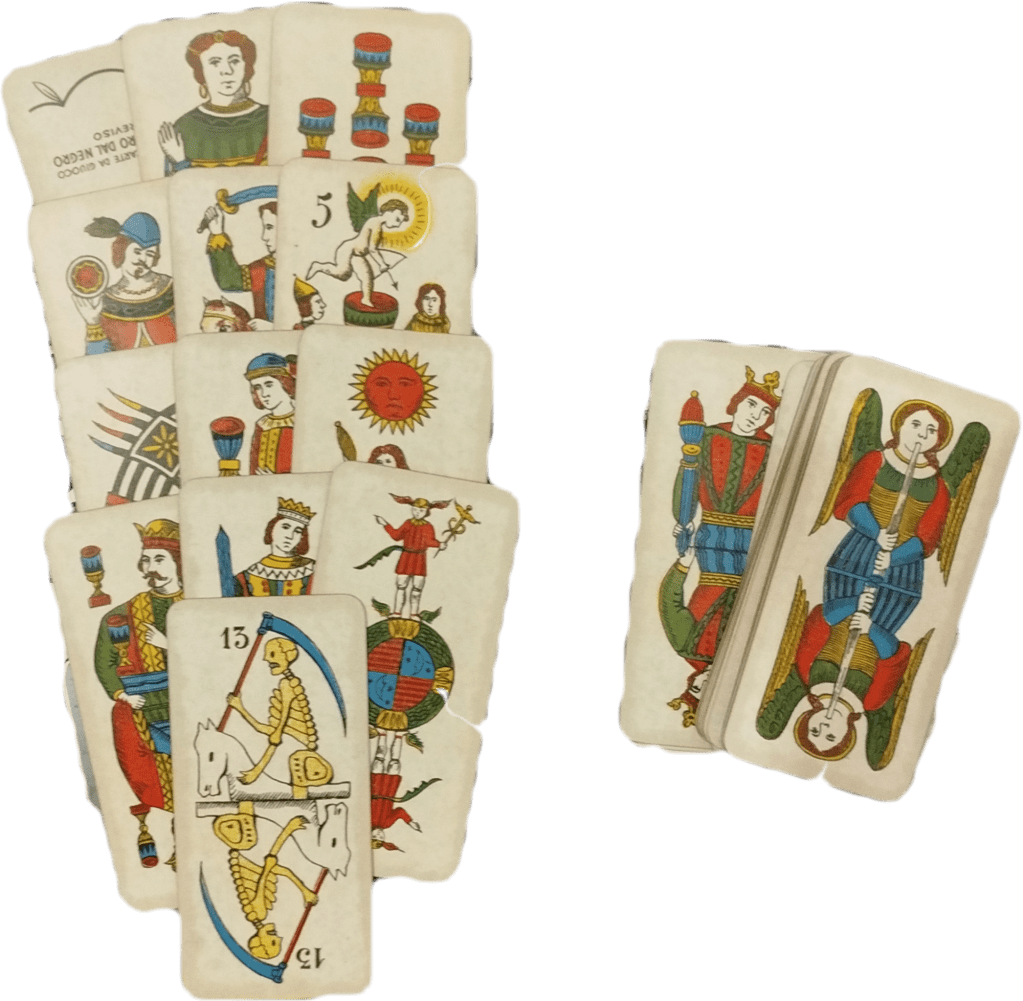
I think this reading is interesting because it showcases the odd behavior of the Death card in the Bolognese tarot of answering yes to a question. I have already written that I prefer to take this traditional rule with a grain of salt, but it does seem to apply in several cases.

Here the question the (male) querent asked is if there would be reconciliation with a friend he had had a fight with. The reason I included the cards of the cut (the King of Wands and the Angel) will become clear shortly.

Two Friends

Right off the bat, the death card comes up in the last position, and this, added to the Angel in the cut, should give us a sort of super yes. But we always need to interpret the reading.

The second thing that caught my attention was the Page of Coins (words) next to the Knight of Swords (cuts, problems, arguments, hurt) and the Love (affection). So there is affection between the two, even now (how could there not be, since they were friends?) but the Sword card creates problems.

In the next line we find the Eight of Swords, which is a card of suffering. If we see the Eight of Swords as coming after the Love card in the line before, then there is great emotional suffering surrounding this argument. However, all is not lost, as the Knight of Cups (agreement, conciliation) and the Sun (positivity, clarity) follow. So this, together with the Death card, seems to confirm there will be a great improvement after a period of uncertainty.

In the last line we have two kings. One is the friend probably the Sword. The other king, the Cup, can possibly identify him as like family, or, paired with the third king in the cut, it constitutes a triplet of success in the matter (three Kings are a success). Then the World card comes. Talking to the querent, I discovered the friend lives quite far away, but I believe the deeper meaning here is that their relationship’s path is still an open road, so it is not over.

I don’t have much to say about the first line. It isn’t clear to me. The Ace of Coins can be money, but the argument wasn’t about money, but it can also be the table, their conviviality (especially with the Seven of Cups, which is a relationship of closeness), which suffers a hiccup (the Stranger). That’s my best guess.

As for advice, the querent (the King of Wands) comes up in the cut together with the Angel, so clearly he has feelings of deep friendship. I told him to show them better, since this is what leads to the Sun card in the spread overtaking the Eight of Swords.

MQS

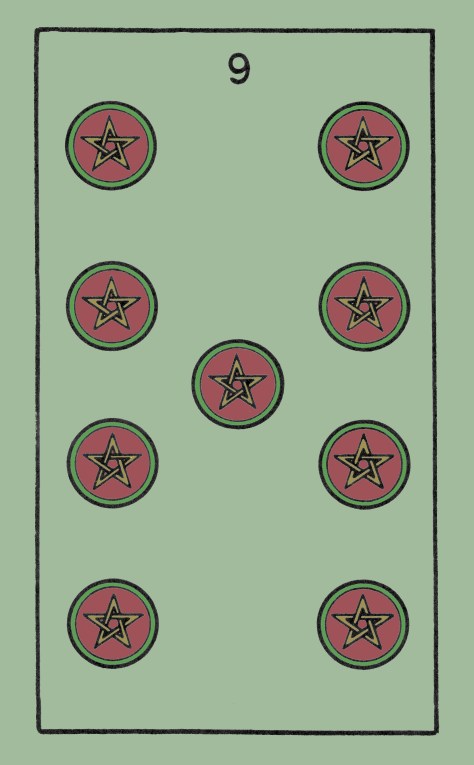
Tarot Encyclopedia – The Nine of Pentacles or Coins

(Note: this is a collection of the meanings attributed to the cards by some occultists in the past centuries. It does not reflect my own study or opinion of the cards. It is only meant as a quick comparative reference as I develop my own take.)

The Nine of Pentacles from the Builders of the Adytum (BOTA) tarot deck

Paul Foster Case (and Ann Davies)

The time period is the second decanate of Virgo, under the rulership of Saturn, September 3 to September 12. Meanings:
Well-Dignified: reserve, discretion, caution, frugality; some worries over money matters because of slow-maturing of plans; gain through careful investment. Occasionally when this card is especially welldignified, and other cards in the layout confirm it, this Key represents inheritance, material gain and much increase of goods, corresponding to the positive meanings of Saturn in Capricorn.
Ill-Dignified: discouragement; troubles through theft and knavery.
Keyword: Harvest.
(From the Oracle of Tarot course)

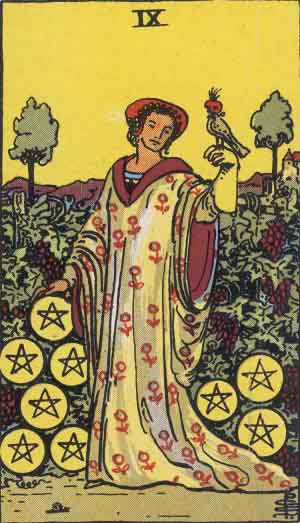
A. E. Waite

A woman, with a bird upon her wrist, stands amidst a great abundance of grapevines in the garden of a manorial house. It is a wide domain, suggesting plenty in all things. Possibly it is her own possession and testifies to material well-being. Divinatory Meanings: Prudence, safety, success, accomplishment, certitude, discernment. Reversed: Roguery, deception, voided project, bad faith.
(From The Pictorial Key to the Tarot)

The Nine of Pentacles from the Rider Waite Smith tarot

Aleister Crowley

The Nine of Disks is called Gain. The suit of Disks is much too dull to care; it reckons up its winnings; it does not worry its head about whether anything is won when all is won. This card is ruled by Venus. It purrs with satisfaction at having harvested what it sowed; it rubs its hands and sits at ease. As will be understood from the consideration of the Tens, there is no reaction against satisfaction as there is in the other three suits. One becomes more and more stolid, and feels that “everything is for the best in the best of all possible worlds”.

[…]

The number Nine, Yesod, inevitably brings back the balance of Force in fulfilment. The card is ruled by Venus in Virgo. It shows good luck attending material affairs, favour and popularity.

The disks are arranged as an equilateral triangle of three, apex upwards, close together; and, surrounded at some distance by a ring, six larger disks in the form of a hexagon. This signifies the multiplication of the original established Word-by the mingling of “good luck and good management”. The three central disks are of the magical pattern as in earlier cards; but the others, since the descent into matter implies the gradual exhaustion of the original whirling energy, now take on the form of coins. These may be marked with the magical images of the appropriate planets.

As a general remark, one may say that the multiplication of a symbol of Energy always tends to degrade its essential meaning, as well as to complicate it.
(From The Book of Thoth)

The Nine of Disks from the Thoth tarot deck

Golden Dawn’s Book T

A WHITE Radiating Angelic Hand, holding a rose branch with nine white roses, each of which touches a Pentacle. The Pentacles are arranged thus

* *
* *
*
* *
* *


and there are rosebuds on the branches as well as flowers. Venus and Virgo above and below.

Complete realization of material gain, good, riches; inheritance; covetous; treasuring of goods; and sometimes theft and knavery. The whole according to dignity.
Yesod of HB:H (Inheritance, much increase of goods).
Herein those mighty Angels HB:HZYAL and HB:ALDYH have rule and
dominion

Etteilla

Effect
Upright. In terms of the medicine of the spirit, this card, in its natural position, signifies: Effect, Realization, Positive, Accomplishment, Success.
Reversed. Deception, Fraud, Disappointment, Empty promises, Vain hopes, Failed projects.

MQS

To Plan Or Not To Plan

I have pretty much stopped making plans for this blog. I’ve realized that the reason I’m so glad working at it is that, while I have a broad vision of what I want it to become, I just follow my fixation of the day in order to get there. I don’t want it to feel like work (because it isn’t).

I know, for instance, that in the very near future I’ll go back to translate Fludd’s Geomancy handbook and other old works, but I don’t want to put a date on it (my husband, a perfect incarnation of the Prussian spirit, would shudder at the idea of not having a deadline).

I also know that I feel the need to explore the philosophical underpinnings of the stuff I’m into, but it is hard to get started as ideas accumulate in my head in no particular order. I know that I’m just waiting for everything to click into place, because I’ve been through the same process enough times to know how it works: you accumulate wood and sooner or later a lightning will strike it (or at least someone will drop a cigarette butt on it)

MQS

The Table – A Deep Dive Into Cartomancy

You’ve got to appreciate how folk cartomancy takes the objects of our everyday life and turns them into means for predicting the future. This is, after all, probably how cartomancy started: people needing to know what tomorrow would bring adapting the symbolism of the decks to which they had access (tarot, playing cards and later oracle cards) to the objects and situations that constituted their daily lives and their symbolic interpretation.

From a philosophical perspective this shows great acumen and observational ability on their part. They may not have had a piece of paper that qualified them to count angels dancing on pinheads, but they were possessed of great perception–which is only natural, considering that on their perception depended their survival.

From an occult standpoint, it further indicates that they were perfectly acquainted with the power of symbols to connect the inner and outer realms, which is the foundation of all forms of magic.

One of the recurring symbols of folk cartomancy is the table. In the system of cartomancy with playing cards that I was taught, this corresponds to the Four of Clubs, certainly due to the squarish (Four) and social (Clubs) nature of the card. The Four of Clubs is chiefly the card of words and talks, but it extends to all contacts we develop with others: we can sit at the table with them and talk, negotiate, have fun, etc.

In the Vera Sibilla, we must distinguish between the table in general and the festive table. The former is assigned to the Ace of Hearts, the Conversation. This is also the card of words and talks, but being the Ace of Hearts it is also representative of your family or the people you live with. Furthermore, the table here can also be seen as the table you eat at, due to the connection of the card with the hearth and with everything to do with your mouth and throat. The festive table is more a prerogative of the Nine of Clubs, which is connected with celebrations, fun and banquets.

The first written record of the cartomantic concept of the table is found in the earliest recorded system of reading the Bolognese tarot with 35 cards: here the table is given to the Ace of Coins. This is a meaning that still exists in all traditions I am aware of, although the card has also doubled down as the card of big money in the 45-card system I know, the card of official documents and letters for Germana Tartari and of work for Ingallati.

I am unclear as to why the Ace of Coins was chosen, but I guess the round shape of the heavily stylized coin could be seen as a round table or as a centerpiece. Broadly, the table in the Bolognese tradition is seen as the place of direct contact with others, of conviviality and of business transactions. The card also symbolizes ‘l’ora di tavola’, the time of day you sit at the table, usually lunch time and therefore, more generally, the day as opposed to the night.

The second earliest recording of the symbol of the table comes from Etteilla, whose source attributed it to the Ace of Cups. Here Etteilla and his students tried to extend the meaning of the table beyond the common experience of it by playing on the other meanings of the word ‘table’, so that for instance, the Ace of Hearts for him can also be the table of laws (as in, the one Moses received).

I am unaware of whether the Lenormand or Kipper traditions contemplate the symbolism of the table, though the symbol is not obviously represented in the cards. What I do know is that the symbol is also present in most Italian playing card system, so that I am aware of at least one where the Four of Coins indicates the table.

MQS

Forget Fame And Be Happy

One thing that never ceases to amuse me is how so many of the people who try to sell courses in ‘wisdom’ or other metaphysical services, who pretend to have had access to the ultimate secrets of the universe, all seem obsessed with increasing the weight their own name carries. There they are, engaged in cock fights with one another, vying for the attention and legitimation of a small number of clapping seals.

I’m not one to rain on other people’s parade, but if anyone reading this is on any sort of quest for ‘development’ (let’s use the shallow, non-descript term), you can safely forget fame. There is nothing wrong with wanting your merits recognized, but realize that you will be forgotten. Even the greatest of the greatest, the Shakespeare’s and the Einstein’s, will in the fullness of time be forgotten.

I understand the allure of an above-average level of recognition. I was raised by a mother who thought the only way for her to have a meaningful life was to birth and raise the next great genius of humanity. It took me years to distinguish my own aims from hers, to recognize that I am smart but not a genius, driven but not obsessed, and that my desire for recognition was actually hers. To this day I have to remind myself of that on a daily basis because the old education constantly rears its head within me.

I’m also not willing to reject humanity’s drive for recognition out of hand. I see that it has been the fuel behind some great accomplishments. But what I do find funny is that exactly the field that we might broadly speaking define as spirituality should be so full of egomaniacs of the shallowest, most recognizable sort.

As someone whose magical motto is ‘I shall neither lead nor follow’, I am not necessarily looking for a guru. But I know that there are people who look for a teacher, and in itself that is alright. But do be careful. Recognize them by their fruits. And some of their fruits include their actions. If they are screaming on socials at the top of their lungs, they might not be a great example to follow.

This is not to say they can’t have something to say or to teach. As a deeply flawed individual, I have learned a lot from deeply flawed individuals. But don’t put them on a pedestal. Don’t be a groupie. If you are on a path to wisdom, you cannot afford that.

MQS