Living at the intersection of occultism, fiction and philosophy, I travel the planes at a moderately quick pace. I read, I do magic, I cook for hubby. Confused by the number of things I talk about? Good, confusion is a nice thing ;)
(Note: this is a collection of the meanings attributed to the cards by some occultists in the past centuries. It does not reflect my own study or opinion of the cards. It is only meant as a quick comparative reference as I develop my own take.)
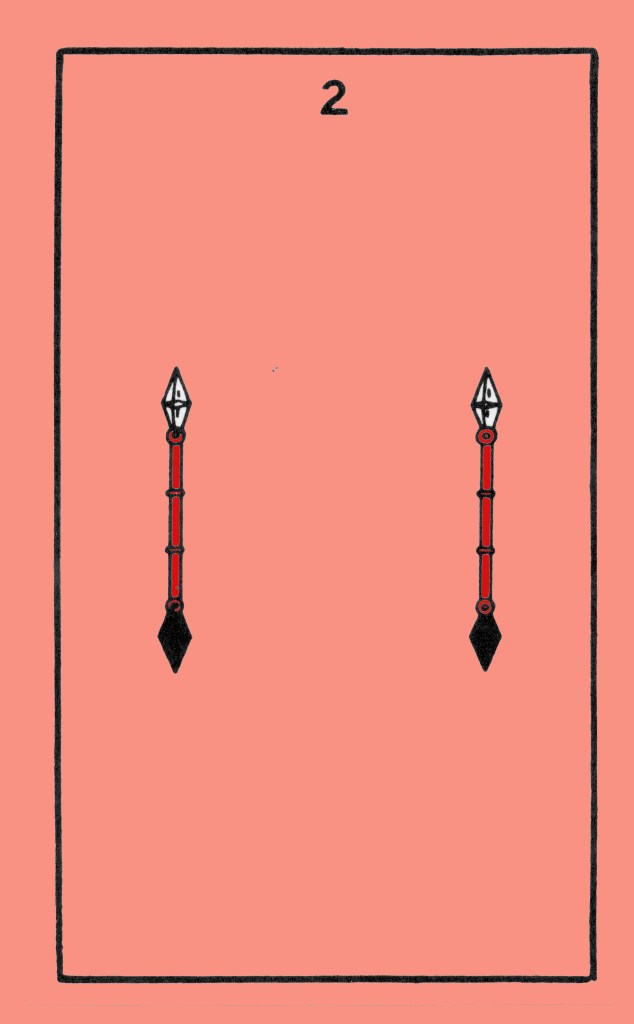
The Two of Wands from the Builders of the Adytum (BOTA) Tarot deck
Paul Foster Case (and Ann Davies)
In Tarot divination the Two of Wands has these key meanings: Well Dignified: it shows force, enterprise, boldness, resolution, some combativeness, much originality. lll Dignified: it signifies restlessness, fierceness, shamelessness, inordinate ambition, turbulence, obstinancy, revenge. A card of enthusiasm, but of strong self-interest. Keyword: Dominion (From the Oracle of Tarot course)
A. E. Waite
A tall man looks from a battlemented roof over sea and shore; he holds a globe in his right hand, while a staff in his left rests on the battlement; another is fixed in a ring. The Rose and Cross and Lily should be noticed on the left side. Divinatory Meanings: Between the alternative readings there is no marriage possible; on the one hand, riches, fortune, magnificence; on the other, physical suffering, disease, chagrin, sadness, mortification. The design gives one suggestion; here is a lord overlooking his dominion and alternately contemplating a globe; it looks like the malady, the mortification, the sadness of Alexander amidst the grandeur of this world’s wealth. Reversed: Surprise, wonder, enchantment, emotion, trouble, fear. (From The Pictorial Key to the Tarot)
Aleister Crowley
The Two of Wands is called the Lord of Dominion, and represents the energy of fire; fire in its best and highest form.
[…]
This card, pertaining to Chokmah in the suit of Fire, represents the Will in its most exalted form. It is an ideal Will, independent of any given object.
“For pure will, unassuaged of purpose, delivered from the lust of result, is every way perfect.” AL. 1. 44.
The background of this card shows the power of the planet Mars in his own sign Aries, the first of the Signs. It there represents Energy initiating a Current of Force.
The pictorial representation is two Dorjes crossed. The Dorje is the Tibetan symbol of the thunderbolt, the emblem of celestial Power, but more in its destructive than its creative form.
More, that is, in its earlier rather than its later form. For destruction may be regarded as the first step in the creative process. The virgin ovum must be broken in order to fertilize it. Fear and repulsion are therefore the primary reaction to the assault. Then, with understanding of the complete plan, willing surrender rejoices to co-operate. Six flames issue from the centre. This indicates the influence of the Sun, who is exalted in Aries. This is the creative Will.
Mars in Aries is the attribution of the Geomantic Figure Puer. The meaning of these figures is to be studied in the Handbook of that science: “The Equinox” Vol. I, No.2. Remember that the Geomantic Intelligences (see Liber 777 Cols. XLIX and CLXXVIII) are all primarily Gnomes. (From the Book of Thoth)
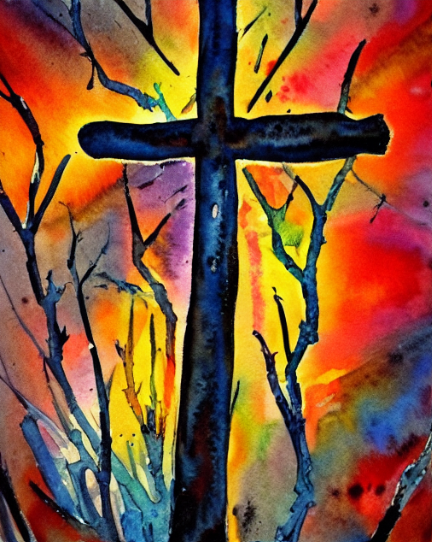
Weirdly religious AI-generated illustration of the Two of Wands
Golden Dawn’s Book T
A WHITE Radiating Angelic hand, issuing from clouds, and grasping two crossed wands. Flames issue from the point of junction. On two small wands above and below, with flames of five issuing therefrom, are the symbols of Mars and Aries for the Decan. Strength, domination, harmony of rule and of justice. Boldness, courage, fierceness, shamelessness, revenge, resolution, generous, proud, sensitive, ambitious, refined, restless, turbulent, sagacious withal, yet unforgiving and obstinate. Chokmah of HB:Y (Influence over others, authority, power, dominion). Therein the Angels HB:VHVAL and HB:DNYAL bear rule.
Etteilla
Sadness Upright. This card, as far as the medicine of the spirit is concerned, signifies, in its natural position: Sadness, Misery, Melancholy, Affliction, Sorrow, Desolation, Mortification, Mood, Discontent, Vapors, Gloomy Ideas. – Bitterness, Anger, Spite. Reversed. Surprise, Enchantment, Shock, Upset, Unexpected event, Unexpected fact, Excitement, Fear, Fright, Terror. – Consternation, Stunning, Domination, Abduction, Alarm. – Marvel, Phenomenon, Miracle.
In the Vera Sibilla, every card can indicate some type of feelings. I have singled out some of those that indicate positive feelings. As usual, the list is not meant to be exclusive.
Ace of Hearts (A♥️) – Conversation
This card is broadly connected with words and self-expression. However, when discussing someone’s feelings, they indicate someone who is capable of expressing their feelings to someone else and reaching some kind of communion with them. In general, it shows an attitude of openness toward others.
Two of Hearts (2♥️) – The House
Usually the Two is the card of the house and of places in general. However it is also connected with harmony between two people, and it shows a constructive attitude, especially, though not exclusively, in a love reading.
Four of Hearts (4♥️) – Love
The Love card is, wouldn’t you know, the card of love, but also of strong feelings of affection in all personal relationship. It is connected with the motions of our heart, and as such it shows emotions above and beyond reason. The caveat here is that this card is not stable, and it requires other more grounded cards to promise lasting happiness.
Five of Hearts (5♥️) – Happiness
The Happiness card indicates everything connected with joy and good intentions. Being the card of the bethrodal, it also shows a certain degree of commitment to someone, and is therefore also a symbol of fidelity.
Seven of Hearts (7♥️) – The Scholar
The Scholar is a rational card, one of planning and long term prospects. When not damaged by the presence of difficult cards it shows the desire to create something lasting, as well as a helpful attitude.
Eight of Hearts (8♥️) – Hope
Hope is the positive feeling par exccellence. It represents optimism, honesty, someone who takes the high road, is elevated, spiritual, reliable. The exception is when the Hope card is not supported by stronger cards, as in this case it tends to show flirts, due to its connection with ease and lack of trouble.
Nine of Hearts (9♥️) – Faithfulness
Contrary to popular belief, the Nine of Hearts (not the Four) is the best card when it comes to feelings. Not only does it show love, but unlike the Love card, it also represent a strong bond and commitment that goes beyond those feelings and is pursued systematically. It is the card of the diehard supporter, of the best friend, of the lifelong love commitment.
The Heart Court Cards
Court cards tend to be neutral. However, the Heart court cards, when upright, indicate a person who is in love or who has a positive attitude toward the question or the querent.
Four of Clubs (4♣️) – The Friend
Similar to the Nine of Hearts, the Friend can indicate friendship (when it doesn’t show a literal -female- friend). The difference is that the concept of friendship of the Four of Clubs is not as strong and it is often connected with practical matters. When reversed, the Friend card can indicate a helpful attitude that takes the form of tips, recommendations, etc.
Six of Clubs (6♣️) – The Surprise
The Surprise card is connected broadly with things that come to us easily. As such, it indicates people who are similar, have similar interests and find it easy to grow together and pursue similar activities. Relationships tend to flourish with this card.
Seven of Clubs (7♣️) – The Realization
In general, this card speaks of ambitions in a positive sense, so it can show people having common goals and projects.
Eight of Clubs(8♣️) – The Reunion
The reconciliation card of the deck, the Eight of Clubs is indicative of a willingness to compromise and to find common ground. Furthermore, it shows someone who is social and moves toward others with positive intents in mind.
Nine of Clubs (9♣️) – Merriment
In keeping with the energy of the suit, the Nine of Clubs indicate positive bonds, though not necessarily deep. It is a card of fun and of playing, drinking and having a good time together.
Ace of Diamonds (A♦️) – The Room
The Room has, among its meanings, that of intimacy. As such it represents someone who seeks closeness and contact. However it is not a card of love, as it is in the suit of Diamonds, not that of Hearts.
Seven of Diamonds (7♦️) – The Child
As the card of children, the Seven of Diamonds shows someone to be open, good-hearted and inoffensive, unless with cards that bring out the worst qualities of children (immaturity, etc.). It represents also someone who wants to start new things and is unprejudiced and innocent.
Eight of Diamonds (8♦️) – The Handmaid
This is the card of someone who is serviceable, dependable and hardworking. It is also a card of politeness and the desire of peace. It can show someone of a noble character who is helpful, friendly and improving himself to be better with others.
Two of Spades (2♠️) – The Old Lady
As pretty much the only card of this suit that is not outright negative, the Old Lady can indicate feelings of affection toward others, though these feelings tend to be tenuous and not very dynamic. It can also indicate someone who uses the wisdom and experience they gained in life to be of service to others in a detached, serene way
Enneagram Type Five and Enneagram Type Eight are apparently very different, so much so that they are each other’s arrow on the Enneagram symbol: Five is Eight’s stress point, Eight is Five’s growth point. Fives are a Head type, concerned with security, and tend to find it by removing themselves from the world and observing it from a distance. Eights are a Body type, whose drive for independence leads them to asserting themselves in most situations, even and especially when there is resistance against them.
Interestingly, both Fives and Eights assert the energy of their center: Fives assert the intellectual urge of the Head center, Eights the instinctual urge of the Body center. In this, they both tend to break down opposition on the plane on which they operate: Eights break down physical opposition, often by asserting themselves on others more or less fiercely; Fives assert their mind’s right to be the judge of the truth of this or that idea by breaking it down, rarely accepting it as a given. Both Eights and Fives can be confrontational when unhealthy: Eights physically, Fives intellectually.
Assertion
Both types are strongly concerned with truth. Fives seek to develop a true appraisal of reality beyond social or even academic conventions. Eights usually have a very instinctual conception of the truth (their famous bullshittometer). Fives’ danger is of getting lost in the hair-splitting byzantinisms of their mental process; Eights’ danger is of failing to realize that sometimes their instincts do fail them and not everything is as simple and black-and-white as their guts tell them. Eights usually tend to simplify, Fives to complexify. Both excesses are best curbed.
Socially, both Eights and Fives have an individualistic, maverick-like streak, and both can be socially awkward and be somewhat timid. Yes, this also applies to Eights: as soon as they feel they are out of their depth Eights tend to become withdrawn and insecure, like regular Fives, often out of fear of being called out for being stupid or incompetent (this is Five’s fear, which is Eight’s stress point). Usually, though, Eights, while not necessarily social, tend to be imposing and even demanding. Fives, on the other hand, are almost always distant and even remove themselves physically from contact with others. Fives who have consciously worked on their social skills may, however, develop some of Eight’s bodily confidence.
When we read for people and they only give us a broad question, I think it’s important to remain open to the twists of fate the cards are showing us, as well as to have an open dialogue with the querent Sometimes querents lie, but more often they are either confused or fail to focus on the ‘real’ question. In the following case, the querent’s question wasn’t wrong, but it hid more than it showed. The querent is a woman of around 25. She asked me about her career without specifying anything.
A career reading using the Vera Sibilla
The querent is anagraphically covered by the Queen of Clubs, the young maiden, so we can initially assign this card to her. She is reversed, showing trouble.
The first line of the pyramid indicates the influence of a (probably older) woman. She is surrounded by the House and Love, but on the same line we find the Seven of Spades reversed. This is one of the worst cards in the deck, so whenever we see it we must tread carefully.
I asked the querent if an older female relative, possibly her mother, is involved in the issue, and at this point the querent tells me she works with her parents in the family business.
The Seven of Spades reversed represents tyranny and oppression, so I ask her if her mother is somewhat authoritarian, and she confirms. Note though that the mother is surrounded by two positive cards, hence the ‘somewhat’ in the statement. Furtermore, look at the angles of the spread: Good feelings, oppression, but not too much (Butterfly). I am aware that smothering mothers are how some serial killers get started, but this mother, while not positive, could be worse. She smothers the querent out of (real) love. She is oppressive, but not a sociopath.
Be it as it may, the querent clearly suffers from this situation (she is reversed) and therefore hopes to move away (Hope + Journey), as the Hope card can indicate the hopes of the querent or of the person preceding it, which in this case is again the querent. Probably the querent wants to find her sense of self and freedom. This would be understandable even under normal circumstances, let alone in this case. I asked her if she wanted to leave and again she confirmed.
But, woe and alas, look how the spread ends! Money is tight (Money + Sickness) so whatever job she is looking for is going to probably make her start at the very bottom. Thus we end with the Ten of Clubs, the Butterfly. This card indicates all those things that are fleeting and not rooted in the querent’s destiny. Thus her hopes are just fleeting, at least in the foreseeable future, due to the rotten (Sickness) money situation.
In this chapter, Abano discusses what happens when a figure changes from one house to another, and also geomantic perfection.
It is very necessary that you know how figures change from one place to another, as shown above,1 for it is of great signification. We have three species of mutation: Mutation, Translation, Occupation and Conjunction. Mutation is when the first figure of the querent is found in other houses such as the third or ninth or other places, whether near to or far from the house that signifies the quesited.2 Similarly, Mutation is when the quesited does the same with the querent.
For instance, let there be a question about a sick person, who wants to know whether he shall heal. In this case the first is the querent and the sixth his being sick, and the eighth is death, and the tenth is the house of well-being and the twelfth the house of the graveyard. If the first goes to the third and also to the tenth or eleventh, this is a mutation of place; and similarly if the sixth goes to the ninth or eleventh house, this is also a mutation.
And Mutation has a double meaning, because depending on where it happens it changes its signification and virtue for good or ill depending on the house. If the said figures are in the tenth, which means well-being, or the eleventh which is next to the tenth, it means healing, especially if it is both in the tenth and the eleventh; but if the first or sixth goes to the eighth it means dying, or if to the twelfth also, because it means the graveyard, especially if the figures are earthy and unfortunate.
Another example. Let there be a question about whether one shall have the woman he desires. The first is the querent and the seventh the quesited. If the first, being fortunate, moves to the fourth and the seventh, similarly fortunate, moves to the third, he shall have her, because both figures are fortunate and they are next to each other: they have mutated place. However, this shows that he shall not have her at his place or even at hers, but it will happen in the house of a neighbor or relative of his, and this because both figures are found in the first four houses, which represent the querent. If it had been on her side of the chart, i.e., in the following four figures, it would have happened in the house of someone she knows. And if it were in the ninth, tenth and eleventh, in a distant place. But if the figures are unfortunate, it shows contrarieties, partly due to him and partly due to the persons signified by the houses involved. But if the figure is fortunate but it changes to the twelfth, it means he shall not have her due to hidden enemies.
Translation is when the first figure or the second, which is associated to it, moves to the house of the quesited or next to it, or vice versa. And if the figures are good and accompanied by good figures,3 it shows a happy end, but if it is a mixed bag, the greater part wins4. However, it is better when the translation is made by the first figure and not by the second.5 It is also a translation when the figure of the quesited is found in the house next to the querent, that is, the second. It is also a translation when the first or second are not only in the house before the the quesited, but also in the house afterward.
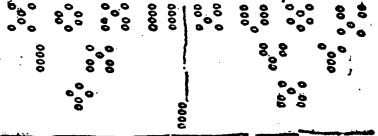
Example. If the question is about marriage, whether it will happen or not, and through what means, and the first figure is Acquisitio and the second Laetitia, which are both good (and the first is better), and the seventh is Albus and the eighth Laetitia, which is better than Albus, this all shows that the marriage will happen easily and will happen through one’s relatives, especially if the fourth and tenth are close to one another and to the second, which is airy, and to the querent and the first figure is found in the Witnesses. For instance:
Example of Geomantic Shield by Peter of Abano
Occupation can happen in two ways: the first is when the figure of the querent occupies the house of the quesited. For instance, if the question is about a (contested) inheritance and whether one shall have it or will need to get it from an enemy, and if the first figure is Albus and the same figure is found in the fourth house, which indicates houses, fields, possessions, inheritance and stable goods, this is called Occupation, because the first figure occupies the fourth house, i.e., that of the quesited. It indicates obtaining what you wish, especially because Albus is a good figure. No geomantic configuration is better than occupation, but only, again, if the figure is good.
Example of Geomantic Shield by Peter of Abano, 2
Even more does it indicate obtaining the quesited because Acquisitio is in the second house, which means gain, and the ninth and tenth are fortunate, being houses assigned to the querent. Another way of occupation is when the house of the quesited is found to hold the opposite figure of that of the querent. So, for instance, if with Albus in the first, one should find Rubeus in the fourth. This is also a form of occupation, but this is a worse kind, especially if the figure of the quesited thus obtained is unfortunate.6
Conjunction is also of two kinds. The first is when the first moves next to the house of the quesited, or vice versa when the quesited moves next to the house of the querent, that is, in the second house. The second type of conjunction is when not only one finds the two figures together as just said above, but one finds them together also far away, that is, in the ninth, tenth or eleventh.
Example. The question is if one shall get back a lost or stolen item or a fugitive servant. The first figure is Major, which moves to the fifth house next to the sixth of the lost thing or the runaway servant. Major is a good, entering figure. Furthermore the sixth figure is found in the second house next to the querent. The judgment is therefore that one shall get back the lost item. Furthermore, the figure of the quesited is conjunct to the first in the second, which shows the querent’s gain, and things are further facilitated by the fact that the sixth house has Populus in it, which means the waxing Moon. Finally, it is even more fortunate because Populus is found in the tenth and Major in the ninth and eleventh, and even more so because the first is found in the Witnesses, and the sixth as the Judge.
Example of Geomantic Shield by Peter of Abano, 3
All these configurations are called conjunction, whereby the ninth figure is said to be conjunct the first and the second because it is born from them,7 and the tenth is conjunct the third and fourth because it is born from them, and the eleventh is conjunct the fifth and the sixth because it is born from them, and the twelfth is cojunct the seventh and eighth, because it is born from them. And furthermore the Right Witness is conjunct to the ninth and tenth because it is born from them, and the Left Witness is conjunct to the eleventh and twelfth, because it is born from them.8
Let’s make the example of one asking about a lost item, and the first figure is Major, which however does not move to the house of the lost item, nor does it conjunct it, but moves to the third house, and similarly the sixth figure, which is Acquisitio, does not conjunct the first immediately, but moves to the tenth house, wherefore one shall judge that he shall soon get the lost item back, because the figure of the querent is found in the third house and Conjunctio is in the fourth, and the sixth figure is Acquisitio and is found in the tenth, which is born from Major in the third and Conjunctio in the fourth.9 Therefore, querent and quesited are said to be in Conjunction, especially when they are fixed and fortunate and entering, and the Witnesses are the Judge are exiting, and this means a change of place of the quesited to the place where the figure is found.
Example of Geomantic Shield by Peter of Abano, 4
The reason for all these methods of Mutation or Translation and Occupation and Conjunction is that every time a figure moves from its original house, it is always found in the place wherein it moves, and not in its original place, because no change happens without cause and without meaning something. Nevertheless, always it maintains the meaning of the person or thing inquired about in their original place, only changing its fortune or misfortune and its time-frame (past or future) in the way we have discussed above.
However it is not always the case that a good figure diminishes its good fortune or a bad figure its bad fortune; in fact, sometimes it increases them, depending that it is found in a better Mutation or Conjunction, so that if the first moves by Translation or Conjunction in another place, or if it occupies it, the figure still indicates the person of the querent, but it shows greater virtue of said figure in the question inquired about, and it means a more particular effect than if it were found only in the first house.
The same is to be observed if the second figure goes next to the house of the quesited or moves to its exact house, or next to the figure of said house, if they are good, and vice versa if they are bad the misfortune is greater [than if the figure hadn’t moved], always keeping in mind the limits of the question and of the figures it requires, and of the places and houses of the quesited. So that if the first goes to the seventh, which is a bad place, contrary to that which the querent seeks, being the house of the enemy, and it means fighting, anger, discord, then it means contrarieties surrounding the obtaining of what one wishes, unless if the question is about marriage, love, friendship, business, travel, lack of peace, and similar things, in which case finding the first in the seventh is excellent, if the figure is positive and fortunate.10
In other questions, if the first moves to the twelfth or sixth or seventh, if it is a good figure, it diminishes its goodness, but if it is a bad figure it augments its evil, except if the first figure is accompanied by a good figure in the second or ninth or eleventh.
And when the second, ninth and eleventh are fortunate and good and the questions are about an absent messenger, good news, money coming from afar and other similar things, and if you find in these houses the fifth or sixth figure or the seventh, twelfth, eleventh or thirteenth, it means good news, good messenger, a messenger coming from afar, money approaching. If the second or ninth and third or also the thirteenth move or translate to the seventh, eighth or twelfth it means good things from afar, especially if the Judge agrees.
If the seventh or eighth moves to the fourth they show good news and durable situations, if the figure is good, and the opposite if they are unfortunate. The best houses are the first, fifth, tenth and eleventh. The second, third, fourth and ninth houses follow. The worst are the sixth, seventh, eighth and twelfth.
Every good figure that you find in a good place increases its virtue due to being in a good place, but if you find it in a bad place it diminishes it. Every bad figure you find in a bad place increases its malice, but if you find it in a good place it diminishes it, except in the first house, where it always keeps its own properties and meaning. And every figure you find accompanied or conjunct by others diminishes or increases its goodness or malice depending on the figure it is accompanied by.
Therefore, if the first is good and fortunate and the second good, and the ninth also good,11 it does not increase the goodness of the first, but if it is bad it decreases the goodness of the first or second, keeping also in mind the question and the querent’s desire and the houses involved in it and the meaning of the house of the querent. The same is valid for the tenth house with respect to the third and fourth house, of the eleventh with respect to the fifth and sixth, of the twelfth with respect to the seventh and eighth, of the Right Witness with respect to the ninth and tenth, of the Left Witness with respect to the eleventh and twelfth, as said above.
In other words, mutation implies change of house, regardless of whether it brings the querent near the quesited, although in this case we have, of course, perfection. Note that usually we consider a Mutation to happen when two figures move to places that are next to each other, but Abano, as many other Medieval authorities, doesn’t seem to fixated on precise language. ↩︎
“Accomagnate cun bone”. It is unclear if this refers to the company of houses. ↩︎
That is, if the figures are mostly good, it is positive, and vice versa ↩︎
This seems to imply that translation happens even if the querent’s figure causes it. This is in contrast with modern practice. ↩︎
This technique has not survived in modern practice. However, it would be interesting to test it out. ↩︎
This assertion made by Abano is of incredible interest for those trying to make more of the Geomantic Shield. Apparently, we do not consider figures to be next to each other just in the order of the Astrological houses, but also when they are next to each other ‘genealogically’, so to speak, on the Geomantic Shield. ↩︎
As shown in other examples before, Abano seems to consider the Witnesses to be similar to the other houses, and therefore potentially in conjunction with them. ↩︎
In other words, the two figures are conjunct by moving to houses that Abano consider to be next to each other, i.e., the third and the ninth. ↩︎
Abano seems to be saying that when a house that is meaningful to the reading has its figure move to another house, it is always significant, but the good or bad import is decided by the kind of question. ↩︎
The Ninth House is considered by Abano therefore to be in company with the first, in a way, or at least to be close to it, so that a figure in it influences the querent. ↩︎
Danielle Johnson‘s posts on social media were like those of most popular astrology influencers: cheap mystical drivel devoid of any serious study and insight, constantly hyping up the next big astrological nothing-burger. I’ve known enough people like her in my life to know that this kind of fraudster is the worst exactly because they tend to buy the crap they peddle. Like many cult leaders, they become pleasantly accustomed to the smell of their own farts.
I am not going to examine her tragedy as a whole. You can look it up yourself if you want. Suffice to say that she ended her boyfriend’s and child’s lives, as well as her own. All because of an eclipse she thought was “the epitome of spiritual warfare” where people needed “to pick a side” in the upcoming apocalypse.
For sure there is enough going wrong in the world at present that new millenarian movements pop up from all religious and political directions. Furthermore, it is not unlikely that Johnson suffered from some kind of mental condition.
But there is more to this type of behavior. No one who seriously studies history can believe there was ever a golden age where nothing went wrong, nor there ever will be. These are the dangers of utopianism as opposed to pragmatism: in the name of something that was or will be, the utopian believer feels justified in trampling over others, either rationally (like the left-wing and right-wing dictators of yore) or psychotically.
But, again, there is more. There is a widespread malaise in the “spiritual” milieu at present, in spite of its ever growing popularity on social media. This malaise is the culmination of a historical process of decoupling of reason and spirituality. I have already touched upon this issue elsewhere.
Since official science embraced meterialism in the late XVIII century, those who believe there is more to life have found themselves without an intellectual foundation for their beliefs, and have therefore become prone to accepting any delusion as fact. This is relatively unprecedented in the history of humanity. Not that knowledge and spirituality have otherwise always enjoyed a frictionless relationship, but there had never been so stark and unanimous a rejection of the spiritual in the scientific community.
How the spiritual community tried to cope with this abandonment is paradigmatic. If you read many XVIII and early XIX century occultists, you will often find desperate attempts at fitting their ideas into the tight dress of the new scientific language. Spiritualism and vitalism, which is how occultism survived until around the 1960s are, in many ways, the evil twins of scientific materialism: they are groundless irrationalism masquerading as legitimate scientific concepts (electromagnetism, mesmerism, ‘energy’, etc.)
Yet, for all their attempts at sounding scientific, these authors have never managed to convince anyone who wasn’t already convinced. Furthermore, their attempts at proving, for instance, that this or that scientific discovery is foreshadowed in this or that spiritual doctrine made them look like asses when said discoveries were later disproved and replaced with better scientific theories–because, and this is something many occultists failed to understand, science in the modern sense ceased dealing with the eternally true in favor of ever-improving approximations of what’s likely to be the case. This is what makes modern science effective, but also what ‘spiritual seekers’ desperate for answers don’t want to hear.
Then along rolled the New Age, and the already washed-out spiritual movement started supplementing its diet with saccarine platitudes and politically correct, ill-digested mish-mashes of doctrines coming from all over the world washed down with copious drafts of unproved psychology. Any attempt at using reason became futile, or even frowned upon as a non-enlightened stance. And this is where we are now.
The medieval and Renaissance magus was as much an occultist and diviner as he was a doctor, a scientist, a philosopher, a political strategist, a war counsellor and many, many more things. In Ancient Greece, many great magi were also great philosophers and scientists (Empedocles and Pythagoras come to mind). Apparently, the contemporary spiritual guru just needs a couple of self-help concepts with a spirituar flair and he is qualitifed to tell people they need to “pick a side in the upcoming apocalypse”.
So, what is the solution? I do not know. I do not believe I have one, especially not at the collective level. All I know is that irrationalism is not the blood that sustains spirituality. it is merely the electric shock that makes its corpse convulse and appear to be alive. I also know that the future of occultism, magic and spirituality lies with few individuals who are capable of using their head rather than with desperate masses of unhinged spiritual seekers (“unhinged” because their life hinges on nothing) who let any “astrology influencer” peddle cheap illusions to them.
Readings about lost objects are hard. I am very much less than infallible in finding them. The reason is quite simple: most questions have a limited number of likely answers and an even more limited number of unlikely ones, so it is usually easier to make sense of the cards. “Yes he’ll marry you”, “No, he hates you”, “There doesn’t seem to be much tenderness left in the relationship, but with some effort you can keep it going a while.” There is, of course, some skill for finding nuances involved, and a good reader will add some details, but in general, the possible answers are relatively limited.
But a lost object can be anywhere, and we can either be very right or very wrong, with little space for “yes, but…” and “no, although…” Especially if we’ve never seen the place where the object was lost, it becomes hard to read the symbolism of the cards without reading our own fantasy into them. As far as I am concerned, much depends on how clear the cards decide to be with me. Since I have nothing to prove, I have no problem throwing my hands up and saying “Dunno” if that is my honest answer.
As we are moving all our stuff from the old house into the new one, plenty of things have gone momentarily missing, in the sense that I don’t know which of the dozens of boxes we’ve brought along they are in, and frankly I’m not too eager to start searching.
Except that I started itching to do some I Ching readings, and I couldn’t find my I Ching coins anymore. I did remember putting them somewhere where “I know I will find them”. The problem is that I have done the same with so many of my things in the last couple of months that the trick doesn’t work anymore. So I asked the cards for a pointer:
K♣ – 2♥ – 5♣
In general, what makes this reading relatively easy, compared to other lost item readings, is that it does not describe the place where the coins are, but rather their relationship to me. The King of Clubs is my significator. It is followed by a card, the Two of Hearts, which indicates ‘close to home’, but also ‘close’ in general. I know I cannot have left the coins in the neighborhood, which is naturally signified by the Two of Hearts, so I take it to mean ‘close’.
That Five of Clubs is interesting. In general it represents effort, but it is connected also with the body in general, understood as moving, acting ‘machine’, and also the hands. Close at hand, maybe? Or close to my body?
Either reading would have been correct. I found the coins in an internal pocket of my jacket where I usually don’t keep anything and don’t bother looking.
In this short paragraph, Abano introduces several technical terms.
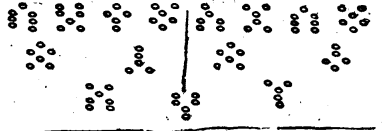
This is an example of a simple mutation, about the question whether one shall be with his girlfriend.1
Geomancy shield by Peter of Abano
The first figure is Conjunctio, the second Puer, the third Puella, the fourth Conjunctio. Look how the first moves to the fourth and the seventh is the same as the third, and thus it means being with her, especially since the first is in the fifth house of fun.2 Moreover, the first is found in both Witnesses.3 Also, this is an example of translation, because the first moves next to the house of the quesited,4 that is, in the eighth, which is associated to the seventh. Moreover it is an example of conjunction, because the first is conjunct to the ninth, and the eleventh with the fifth,5 and the thirteenth with the ninth, and the fourteenth with the eleventh.6
MQS
Footnotes
“Se uno havera la sua amica”, literally, “if one shall have his (female) friend”. This passage warrants its own chapter as it is relatively strange when confronted with the modern doctrine, and it seems to contain odd mistakes, at least prima facie. ↩︎
“Casa di gaudio della cosa quesita”, literally “the house of joy of the quesited”. It could be that Abano means the Fifth house is the joy of the question itself, because it signifies fun, and the question is about fun. ↩︎
It is not clear whether this is good because the figure is Conjunctio or because it is found in the houses of the Witnesses, or both. ↩︎
Abano seems to be using the word ‘translation’ in lieu of ‘conjunction’ here. There is a translation in the modern sense here, but this is effected by Puer, who is both in the Second and in the Sixth. ↩︎
The Eleventh does not seem connected in any way with the Fifth, unless we take the Fifth to be moving to the Fourteenth (the Left Witness) or we count the translation effectuated by Puer ↩︎
This is rather obscure, unless, again, we take the Thirteenth and Fourteenth as regular houses that can come into contact with the others. This would open up the Geomantic Shield to a whole different kind of interpretation. ↩︎
To Mrs. Pettigrew’s relief, the cat came back five days later.
Initially, everything seemed fine. Then Mrs. Pettigrew noticed something was off about the creature, though she could not put her finger on it. It kept meowing, but this in itself was not strange—Admiral was a talkative cat. It was the monotonous way it meowed.
Then, one night, as she was falling asleep trying to disregard the noise, it occurred to her—it was a looped recording.
She stood up and bolted into the living room. But Admiral was already taking off through the window with her biometric data.
Many people of the ‘spiritual but not religious’ milieu tend to believe they invented intuition, or that intuition came into existence when glossy oracle cards with gaudy images and inspirational quotes started being published–the kind that was especially en vogue before Doreen Virtue went from a fundamentalist with a deck of cards in her hands to a fundamentalist without a deck of cards in her hands.
But, believe it or not, intuition is a concept with a legitimate philosophical history. It is present, either implicitly or explicitly, in the epistemology (theory of how knowledge happens) of many great traditional Western and non Western philosophers.
If had to provide a generalization of what the tradition meant by intuition, I would say that it’s the immediate apprehension of universal principles and truths. It had nothing to do with the stream-of-consciousness-like association of ideas that many moderns mistake for psychic ability.
Old philosophers held that true intuition could only happen when someone had developed all their human faculties (including, and especially, reason) to their utmost degree, so that such faculties, having been tamed and trained, fell into place and were ready to receive truths otherwise reserved to the gods. In other words, intuition was the reward of the flourishing human.
Nowadays, “I’m intuitive” is usually synonymous with “I’m incapable of simple deduction but I am also deep up my ass and don’t take well to criticism.” Back in the day, intuition was regarded as the efflorescence of the rightly cultivated mind. Put simply, in the past intuition was considered suprarational. Now it is implicitly considered irrational.
So much so that intuition is today relegated to psychic exercise, whereas in days of yore prophecy through psychic means was regarded as a wholly separate matter: the famous prophetess of the Oracle of Delphi, for instance, entered a state of ‘enthusiasm’, that is, of literal divine possession, whereas intuition was, essentially, a gift of God to the philosopher who had educated himself to the point where his excelling human faculties grazed on the superior sphere of divine knowledge, allowing some of it to filter down to him.
This fact is especially clear when we consider the old conception of the cosmos as an onion-like set of emanated spheres, with humans in the middle, capable of either falling deeper or rising above. But the modern intuitive moves in a world that has no clear up or down and where over a century of psychologizing everything has planted in people’s minds the impression that everything is in their head and that, therefore, if it’s in their head it’s true. We could summarize this by saying that intuition in the older sense required people to get out of their ass and become bigger than they were, whereas by today’s standards it requires them to entangle themselves even further in their delusions.