All posts by MQS

Living at the intersection of occultism, fiction and philosophy, I travel the planes at a moderately quick pace. I read, I do magic, I cook for hubby. Confused by the number of things I talk about? Good, confusion is a nice thing ;)

Answering Airy-Fairy Questions… Meaningfully (Example Reading)

As someone who advocates a grounded approach to divination, you’d expect me to scoff at questions that deal with more philosophical or spiritual themes. But this is not so. Airy-fairy is in the eye of the beholder, or rather, of the reader. Just like many airy-fairy readers can drown concrete topics in a deluge of commonplace spiritual-but-not-religious buzzwords, so can a grounded reader approach complex, ‘soulful’ topics from a grounded standpoint, while always following what the oracle says.

Someone asked me what was the goal of her current incarnation. Right off the bat we are confronted with a dilemma: firstly, the question presupposes that there is such a thing as reincarnation, which I don’t believe (at least, not in a sense that is compatible with what most people think of as reincarnation);1 secondly, it presupposes that this happens with a goal.

The first problem (reincarnation) we may circumvent by simply asking what’s the goal of the querent’s life. The second question (the goal) is trickier, but as I show in the example, it is not unanswerable.
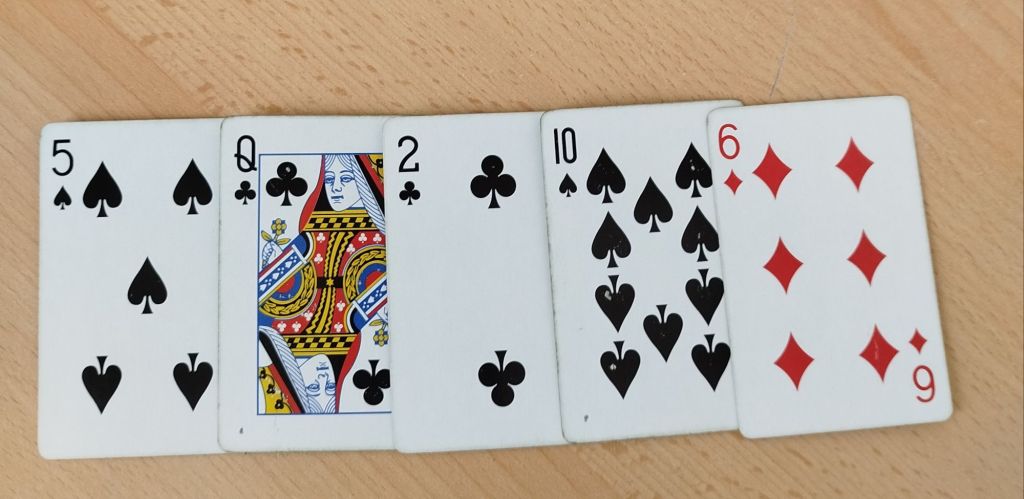
What is my life’s goal? Playing card divination

Since we have absolutely nothing to go off on, we can start by noting that the querent’s significator shows up (the Queen of Clubs), though not in a very good spot. She comes after the Five of Spades which is the card of sacrifice, imprisonment and the inability to move. So we can already sort of guess that the querent is feeling trapped in some form or another.

The spread ends with the Six of Diamonds, which represents worry, insecurity and the like. Often it shows financial problems, but not necessarily: it can be a card of general nervousness and uncertainty. The spread is now starting to reek of psychological hang-ups.

Usually, the Two of Clubs after a person card indicates the person taking steps. Toward what? Toward the Ten of Spades. This is the card of secrets, of the night and of unknown situations.

At this point I asked the querent if she’s someone who never leaps into unclear, unknown situations. She said that that was one of the things keeping her from enjoying life, since she always prefers to avoid risk or put off taking it until she feels prepared, which is never.

Bingo. This is the answer: she must learn to step into the dark, take risks and be ok with not having everything figured out. She must learn to swim by swimming rather than by reading up on how to swim. If she doesn’t do it, she will spend her whole life by the poolside waiting for every condition to be perfect.

So, have the cards talked about the purpose of the querent’s whole life? You may disagree with me, but I don’t think so. I do not think that this is the purpose of her whole life (I think there is much, much more to anyone’s life), nor do I think that this is the reason she was born or has reincarnated (if you believe in reincarnation at all). And I told the querent as much, in the spirit of transparency.

What I do mean is that, at least at this juncture in her life, this is a recurring pattern that weighs her down and that needs addressing because it influences her general quality of life. That’s already enough to be worth being mentioned by the cards.

Ultimately, almost every airy-fairy woo woo question is the voluntary or involuntary corruption and modernization of some kind of longing that is deeply seated in the human soul. Questions about the purpose of one’s life may be often answered with the usual mix of mind body spirit platitudes, but the human desire for purpose is not to be lightly dismissed, whether the purpose is really there or not. And divination can address this desire in some form or another.

I believe that divination should be able to run the whole gamut of the human experience, from the most concrete questions to the most abstract, because this is the extension of the human soul. The problem arises only when we try to reduce one order of problems (Will I the chicken cross the street?) to another order of problems (What kind of psychospiritual drama do you think caused the chicken to want to cross the street?)

MQS
  1. I will probably discuss it more at length in another section, but my belief is that there is only one, universal soul that is constantly incarnating and reincarnating through everything. ↩︎

The Little Old Chinese Learner

Every year I look for something new to learn. This year I had in mind to start learning Chinese, but my time was absorbed by the Bolognese Tarot (I am in contact with a traditional practitioner of this deck who is teaching me) as well as by the move. Finally, this August I decided to put my nose to the grindstone

My sorry attempt at a sentence

MQS

Enneagram Comparisons – Type Seven and Type Eight

Enneagram Type Seven and Enneagram Type Eight can be very similar and are often confused. Sevens are a Head type, who cope with their fear, pain and anxiety by getting lost in a world of pleasure-seeking and fun distractions. Eights are a Body type, and they seek to protect their independence by being assertive and bold and forcing others to deal with them and take them into account.

Both Sevens and Eights are very assertive and outgoing on the surface. Sevens find it easy to attract interesting people and adventures, since remaining confined in a routine can cause them to become restless or even to suffer. Eights are more guarded and do not trust people very much, but they do come out of their inner fortress to mark their territory against others and to let them know that they (the Eight) are not to be messed with. Thus they often end up either submitting others or guiding them.

Both types tend to have a somewhat materialistic view of reality and seek earthly pleasures. Generally speaking, Sevens seek variety and change in order to be constantly dazzled and stimulated and stay hyped about something positive, so that they can avoid being sucked into a cycle of fear. Eights on the other hand usually seek intensity in powerful experiences, as they enjoy the feeling of having something outside of them offer them resistance, and they enjoy conquering it in the end, to prove that they are the ones who are still standing (it is typical, for instance, for alcoholic Eights to want to prove that they can handle one more glass).

passion

Both types often come across as action-oriented. Eights attack problems from an instinctive standpoint, throwing brute force (either literal or metaphorical) against the obstacle until it is destroyed. Sevens are more intellectually versatile (not necessarily more intelligent) and they often quickly come up with plans to overcome obstacles in order to reap the rewards, the rewards usually being meterial comfort and/or the ability to pursue their many passions.

Socially, average Eights operate on a friend/enemy level: they quickly sort other people out in either one of the two camps. For them, life is a battle and they need to know whom they are going to defend and whom they are going to attack. Sevens are not naive, but they see the world more as their oyster, and while they know that there are difficult people in the world, they seek to look past them in anticipation of the fun time to be had after dealing with them.

Eights tend to be more unshakably dedicated to the small handful of people they call friends. Sevens are also very good friends, but they also often look to create different groups of friends based on their interests (the group they go dancing with, the group they watch movies with, etc.) although they too often have a small core of best friends.

MQS

The Geomancy of Peter of Abano – Book III Pt. 9

Previous / Back to Index / Next

Here Abano talks about the meanings of Caput Draconis and Cauda Draconis in the various houses.

Caput Draconis (The Dragon’s Head or North Moon Node)

Caput Draconis in the first house means good luck, noble people, wise people, leaders, captains, honor, dignity, a prelate.1
In the second it means good success, gaining wealth or dignity or money.
In the third it means noble brothers and sisters, lucky siblings, good through them, isolated gardens2, pleasures.

In the fourth it means good for the parents, inheritance, buildings, cities, citizens, noble people, good end to an issue.
In the fifth it means science, good children, gain and help through them.
In the sixth it means good servants, faithful servants, good officials, grave infirmity, melancholic infirmity,3 long fevers.

In the seventh it means honorable women, good marriage, good company, gain from noble people or from women and thanks to them.
In the eighth it means inheritance, goods gain from the dead, usefulness through women and noble people, gain through war and by violence against life, being beheaded.4
In the ninth it means honoring God, ecclesiastical dignity, religious people, noble people, good journeys, delay in coming back but with good results, a messenger with bad news, messenger bearing news of legal issues, ingeniousness in a noble science.

In the tenth it means the king, the emperor, the lord, a magistrate, dignity, honor, good regents and orators, noble people.
In the eleventh it means noble soldiers, captains, dignity, sublimation5, succeeding one’s lord, faithfulness, valor, good luck.
In the twelfth it means noble inheritance through the mother, honorable things for [or through] women, few enemies, weak enemies, certainty, fame.

In the thirteenth it means journeys, messengers, a king, lords, usefulness, gain, honor, dignity, friendship and good recoglientia.6
In the fourteenth it means coming back from a journey with dignity and mirth and gain, letters, positive answer, honors, dignity, usefulness.
In the fifteenth it means a good end to the question and strong hope.7

Cauda Draconis (The Dragon’s Tail or South Moon Node)

Cauda draconis in the first house means evil disposition of the querent or of the quesited, fear of death, being murdered.8
In the second it means wealth gain through illicit means, theft, violence.
In the third it means iniquity against siblings and relatives, remains, retaliations, killings on the streets.

In the fourth it means loss of inheritance, evil lands, evil people, betrayals, false rumors, destruction of a city or fortress.
In the fifth it means evil children or women, loss of children, danger during childbirth, loss of blood.
In the sixth it means evil servants, runaways, grave illness, bodily fluids, killing, desperation, damage.

In the seventh it means a harlot, vile marriage, evil company, unfaithfulness, betrayal, violence, enmity.
In the eighth it means fear of death for [or through] women, rumors, freedom from prison and from illness, loss through women, being killed, loss of blood and flobotomia.9
In the ninth it means being forced on a journey, loss, danger of death, toil, changing one’s religion, evil or false religious people, evil Christians,10 evil messengers, death during a journey.

In the tenth it means an evil lord, traitors of one’s country, iniquitous judges or orators, overthrowing tyrants, loss of dignity, destruction of one’s kingdom.
In the eleventh it means wrongful succession, betrayal, violence, rebellion, death of one’s lord.
In the twelfth it means hidden enemies of the kingdom, machinations, treason against one’s lord, assassinations both public and private, violence.

In the thirteenth it means betrayals during a journey, hate from noble people, the absent party doesn’t come back.
In the fourteenth it means toiling for gain and honor, bad luck, hatred from underlings and very evil enemies, overcoming one’s enemies,.
In the fifteenth it is the worst of all, eccept for doing evil things.11

MQS

Footnotes
  1. Possibly due to the Moon’s North Node connection with beginnings and with increase, as well as the connection of the term ‘head’ with leadership. ↩︎
  2. The text seems to say “giardini solati”, and I am not sure if it means isolated gardens or gardens in the sun or something else that escapes me. The connection with gardens is clear, as the Third House rules neighborhoods and therefore what’s around the house. ↩︎
  3. Illnessess were traditionally categorized based on the prevailing humor. ↩︎
  4. This is another excellent example of how to read the meaning of the figure into the meaning of the house. Caput Draconis is the head, and the Eighth House rules death, thus giving beheading (death by losing one’s head). Of course much depends on the question and the rest of the Shield. ↩︎
  5. This is not clear. ↩︎
  6. An archaic Italian word of whose meaning I am unaware. ↩︎
  7. Caput cannot be the Judge. ↩︎
  8. It is usually said that Cauda being in the First House is enough to break the figure. However, here Abano gives us coherent interpretations. Most of them are very dramatic, but it’s the principle that counts and needs to be assimilated. ↩︎
  9. A term belonging to the vocabulary of Medieval medicine. I do not know what it means. ↩︎
  10. Probably to be interpreted as evil believers in general, nowadays. ↩︎
  11. Cauda cannot be the Judge. ↩︎

What is the Heart of a Good Story?

One of my favorite writers is Jorge Luis Borges. One of his shortest stories is On Exactitude in Science, which goes as follows:

…In that Empire, the Art of Cartography attained such Perfection that the map of a single Province occupied the entirety of a City, and the map of the Empire, the entirety of a Province. In time, those Unconscionable Maps no longer satisfied, and the Cartographers Guilds struck a Map of the Empire whose size was that of the Empire, and which coincided point for point with it. The following Generations, who were not so fond of the Study of Cartography as their Forebears had been, saw that that vast Map was Useless, and not without some Pitilessness was it, that they delivered it up to the Inclemencies of Sun and Winters. In the Deserts of the West, still today, there are Tattered Ruins of that Map, inhabited by Animals and Beggars; in all the Land there is no other Relic of the Disciplines of Geography.
(translation by Andrew Hurley)

We can discuss for days about the meaning and philosophical implications of this story. You may like it or dislike it. But it is a *complete* story. It tells about something that has a beginning, a middle and an end, where the end is not clear from the beginning. It does so in a very short space, but it is complete. It has a plot, and nothing is missing from it. We are not left hanging. It has nothing to do with postmodern crap. This is traditional story-telling at its finest.

Though the story may have a deep significance and several layers of interpretation, from a structural standpoint nothing differentiates it from a penny dreadful or an early XX century pulp magazine story.

It is far from me to want to push all story-telling within the confines of a single structure, but the thing that makes Borges’ story a satisfying, well-written story worth telling is that it has some kind of twist to it. Someone is doing something, but then something else happens. X is Y-ing when Z.1

X, in this case, are the Empire’s cartographers. Y-ing is the attempt to perfect the science of cartography. Z is the fact that their success in perfecting said science renders it unserviceable.

So if we had to condense the essence of the story into a short sentence, we would say: The cartographers of an old empire manage to perfect the science of cartography, whereupon they discover that perfecting it makes it useless. X is Y-ing when Z (you can substitute ‘when’ with ‘whereupon’, ‘but’, ‘and then’, ‘but then’, etc.)

If the story had been:

In that Empire the cartographers made huge maps in an attempt to make them as accurate as possible. One day they managed to make a map that was as large as the Empire itself, and then they went home.

You’d be justified in thinking that this is no story at all. That’s because here we only have ‘X is Y-ing’, but only the Z makes the story worth telling. Pretty much every memorable, complete story has an ‘X is Y-ing when Z’ structure. In fact, even the single scenes of a story generally follow this structure (though, in Borges’ case, there is only one scene.)

When I say that this structure is near-universal I do not mean it in the same way as people rave about the Hero’s journey and other semi-academic tools of analysis. All these may have their place, but ultimately they are external models, while fiction is much freer than most people would like. Still, a story without an internal ‘Z’ factor is like a joke without a punchline, and in order for the ‘Z’ factor to make sense it must be nestled within a context in which X is Y-ing. Again, ‘X is Y-ing when Z’.

There *are* reasons to tell a joke without a punchline (to waste people’s time, maybe), just as there may be reasons to tell a story without a point. For instance, plenty of critically acclaimed writers write pointless stories for the sake of them being pointless, usually to show their intellectual peers that they, too, are possessed of the smarts or irony necessary to understand how meaningless life is.

But at this point we are just playing with semantics here: if the point of the story being pointless is that it is pointless, then it becomes its point. It’s just that the point is now external to the story, and found in the writer’s delusion of grandeur.

Of course there is much more that goes into crafting a good story than a simple formula. But, as far as I am concerned, this is not even a formula. It is the reason people have been telling stories since the beginning of times: to be enchanted by the witnessing of meaningful change. This is what makes story-telling so similar to magic: something changes before our eyes and we are left dazzled by it.

MQS

Footnotes
  1. Holly Lisle, one of the people whom I learned writing from, had a different formula, but still to the same effect. I recommend you check her out. I have link to her website in my recommended links. ↩︎

Is He Coming Back? Example Reading

This is a super-quick reading I did for a friend of a friend. She doesn’t believe in the cards, which is fine, but decided to try them by asking a silly question. She asked if her ex would come back to her. Here are the cards:

K♣️ 3♣️ 10♥️

On the surface of it, the cards seem positive: they show the man she’s asking about, they show a union (the Three of Clubs) and they show happiness (the Ten of Hearts).

Unfortunately, what the cards seem to be saying is that he has a marriage going on, and he is happy in it. When I told the querent, she confirmed that they haven’t spoken in years and he is married and has children.

This is not the first time someone asks me a fake question, either purposefully or out of self-delusion, and it is not rare for people to ask about old sweethearts who have moved on.

It goes without saying that we, as diviners, must always come to terms with our finitude and fallibility, but the more the querent is deluded or insincere, the harder it becomes to interpret the cards. This time I was doubtlessly lucky that the cards came up very clear.

NOTE: if the querent had told me that the man she was asking about is not married, then I would have asked if they had just broken up. In this case, the spread would have probably meant that their relationship was still going on strong, and that the break-up was something so fleeting the cards didn’t feel the need to describe it.

MQS

The Many Ways of Reading the I Ching

The I Ching (usually translated as Classic of Changes) is primarily known to the West as an oracular book in which people look up answers to their questions after casting a Hexagram. In reality, the I Ching (or Yi Jing, following the newer transliteration) permeates traditional Chinese culture much more thoroughly and its symbols are found in many methods of divination. Here are the most common ones (the list is not meant to be exclusive and it is limited by my ignorance, no doubt).

Zhou Yi (Reading Commentaries)

Zhou Yi means ‘the changes of the Zhou [dynasty]’ and refers to the oracular text we and Legge, Wilhelm, Jung, Philip K. Dick, Aleister Crowley, Ursula Le Guin etc. knew. This is what we usually mean when we cast an I Ching reading in the West (and also in much of the Eastern world).

We flip coins or manipulate yarrow stalks or pick up small handfuls of rice, depending on the method, in order to obtain a symbol made up of six lines that may change or remain stable (solid). The changing lines are then flipped to their opposite (yin to yang and yang to yin) and a new Hexagram is derived, so that we can interpret the initial Hexagram as the beginning of a matter and the final Hexagram as the likely conclusion or result.

We then look up the Hexagram(s) we got, as well as the text pertaining to any changing line, and we patch together an interpretation. This method of consulting the I Ching, which is traditionally called Zhou Yi, is very old and seems to have been the preferred method of interpretation of the Confucian or Neoconfucian school, the semi-official school of the intellectual bureaucracy of Imperial China.

And this school is exactly the one that the Western missionaries came into contact with first and foremost when they arrived in China and started studying Chinese culture. Although compared to other methods of Hexagram interpretation it may seem the most straightforward, it is complicated by the arcane and hermetic nature of the text, which is notoriously difficult even in Chinese, let alone to translate.

Yet I must say that, in my experimentations with the I Ching, the text method has revealed a subtle, beautiful simplicity. Often the answer is very clear and elegant, just clouded by one’s preconceptions.

Mei Hua Yi Shu (Plum Blossom Numerology Method)

Far wackier, but also far more interesting than the text and commentaries method, Plum Blossom Divination seems to have been devised by a Medieval scholar, Shao Yung. This method does not consist in looking up interpretations in an old book (and this probably accounts for the fact that it has fallen out of favor among most Neoconfucians). Instead, it applies certain rules of interpretation to the Trigrams.

The Eight Trigrams are the building blocks of the sixty-four Hexagrams of the I Ching text. They are also found in Feng Shui, traditional medicine and other forms of divination (e.g., Qi Men Dun Jia or Da Liu Ren) as well as in Chinese alchemy, philosophy and magic. They are, in a word, among the most important symbols in traditional Chinese culture. Everything can be categorized under one of the Trigrams.

Plum Blossom Numerology is essentially a form of Trigram divination that interprets the meanings of the eight Trigrams rather than considering the Hexagrams as a whole with their own commentaries. In Plum Blossom, we usually get a Hexagram made up of two Trigrams and we look at how the Trigrams interact based on certain fixed rules such as the five phases theory. In this method of divination we usually accept only Hexagrams with one mandatory changing line (and no more than that), so that the Trigram without the changing line represents the subject, and the one that does change is the object.

What is most interesting about Mei Hua Yi Shu is how we derive the Trigrams. This is done by way of augury. For instance, if you hear a short metallic sound and want to know if this has a particular meaning or announces a particular event, you search your mind for the Trigram that symbolizes short metallic sounds (this would be Qian). To derive the second Trigram, as well as the changing line, you generally take the time of day into account, similarly to horary astrology.

In essence, Plum Blossom allows one to interpret the world around them based on the signals the world sends them in that moment. It is both a very simple method and a very complicated one, because it requires a certain disposition and flexibility of mind that most people only achieve through much training.

Wen Wang Gua

This is, as far as I know, the most complex way of interpreting Hexagrams. To cover it would require much more than a short section in a short article. Wen Wang Gua (usually translated as King Wen’s Oracle) is a form of Chinese horary astrology that applies many of the rules of Chinese metaphysics (Chinese astrology, the Five phases, the Six Animals, etc.) to the interpretations of a Hexagram (usually cast using coins).

It is a favorite among fortune-tellers, and if we were to apply the (faulty) distinction between divination and fortune-telling that is en vogue in the West, we would say that the Zhou Yi, i.e., the commentaries, are divination, while Wen Wang Gua is fortune-telling. This because Wen Wang Gua can often predict situations very specifically, even down to the day or month something will happen.

In reality, the more I delve into Wen Wang Gua, the more I realize that it is as philosophically deep as it is captivating and accurate from a divinatory standpoint. The Hexagram one casts symbolizes the spatial, earth-related aspect of a matter, while the application of astrological rules to said Hexagram allows one to see the connection of the earthly element to the celestial element.

This is the form of I Ching divination I am devoting most of my study, and I will in time present my (very faulty and very partial) understanding of it, not because I consider myself the most qualified, but because I hope to awaken some interest for it in more people who may be more gifted than me and can comprehend its mysteries.

MQS

Tarot Encyclopedia – The Three of Cups

(Note: this is a collection of the meanings attributed to the cards by some occultists in the past centuries. It does not reflect my own study or opinion of the cards. It is only meant as a quick comparative reference as I develop my own take.)

The Three of Cups from the Builders of the Adytum (BOTA) tarot deck

Paul Foster Case (and Ann Davies)

The Three of Cups is astrologically related to the second decanate of Cancer ruled by the Scorpio aspect of Mars, time period July 2 to July 12. The distinct meanings in divination combine the pleasure and emotion associated with the suit of Cups and the sex magnetism of the Scorpio aspect of Mars, together with Cancerian practicality and penchant for attachments.
Well-Dignified: activity, determination, practicality; fondness for pleasure and comfort; attachments and attractions to the opposite sex; pleasure, merriment, eating and drinking, plenty of new clothes, etc.
Ill-Dignified: danger of the ‘triangle’ situation; trouble through attachments to the opposite sex; midunderstandings; prodigality; sensuality.
Keyword: Enjoyment
(From the Oracle of Tarot course)

A. E. Waite

Maidens in a garden-ground with cups uplifted, as if pledging one another. Divinatory Meanings: The conclusion of any matter in plenty, perfection and merriment; happy issue, victory, fulfilment, solace, healing, Reversed: Expedition, dispatch, achievement, end. It signifies also the side of excess in physical enjoyment, and the pleasures of the senses.
(From The Pictorial Key to the Tarot)

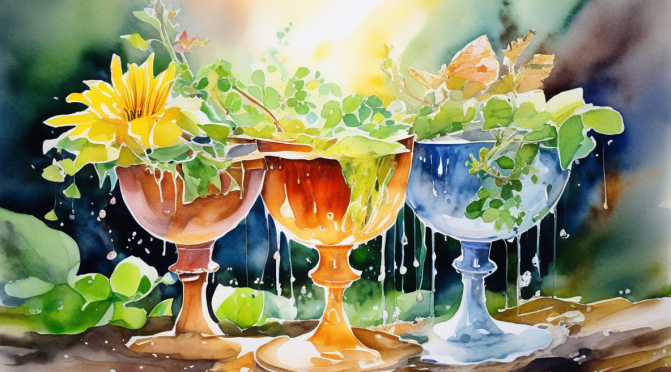
A marvellous AI-generated illustration for the Three of Cups

Aleister Crowley

The Three of Cups is called the Lord of Abundance. The idea of love has come to fruition; but this is now sufficiently far down the Tree to introduce a very definite differentiation between the suits, which was not previously possible.

[…]

This card refers to Binah in the suit of Water. This is the card of Demeter or Persephone. The Cups are pomegranates: they are filled bountifully to overflowing from a single lotus, arising from the dark calm sea characteristic of Binah. There is here the fulifilment of the Will of Love in abounding joy. It is the spiritual basis of fertility.

The card is referred to the influence of Mercury in Cancer; this carries further the above thesis. Mercury is the Will or Word of the All-Father; here its influence descends upon the most receptive of the Signs.

At the same time, the combination of these forms of energy brings in the possibility of somewhat mysterious ideas. Binah, the Great Sea, is the Moon in one aspect, but Saturn in another; and Mercury, besides being the Word or Will of the All-One, is the guide of the souls of the Dead. This card requires great subtlety of interpretation. The pomegranate was the fruit which Persephone ate in the realms of Pluto, thereby enabling him to hold her in the lower world, even after the most powerful influence had been brought to bear. The lesson seems to be that the good things of life, although enjoyed, should be distrusted.
(From The Book of Thoth)

Golden Dawn’s Book T

A WHITE Radiating Hand, as before, holds a group of lotuses or water-lilies, from which two flowers rise on either side of, and overhanging the top cup; pouring into it the white water. Flowers in the same way pour white water into the lower cups. All the cups overflow; the topmost into the two others, and these upon the lower part of the card. Cups are arranged in an erect equilateral triangle. Mercury and Cancer above and below.
Abundance, plenty, success, pleasure, sensuality, passive success, good luck and fortune; love, gladness, kindness, liberality.
Binah of HB:H (Plenty, hospitality, eating and drinking, pleasure, dancing, new clothes, merriment).

Etteilla

Success
Upright. This card, as far as the medicine of the spirit is concerned, means, in its natural position: Success, Science, Happy outcome, Happy solution, Victory. – Healing, Cure, Relief. – Accomplishment. – Perfection.
Reversed. Dispatch, Sending, Execution, Completion, End, Conclusion, Termination, Fulfillment.

MQS

The Geomancy of Peter of Abano – Book III Pt. 8

Previous / Back to Index / Next

Abano talks about some of the meanings of Carcer and Conjunctio in the various houses.

Carcer

Carcer in the first means difficulties, preoccupations, melancholy, prison, deep thoughts, secret thoughts.
In the second it means delay in gain and increase, success through toil, but with difficulty.
In the third it means evil siblings, dishonest pleasures, dishonest and disgraceful neighbors, licentiousness with siblings.

In the fourth it means fortresses, cities, stable buildings, inheritance, abudance, hidden treasures, hidden things.
In the fifth it means miscarriage, dead children,1 danger through childbirth, evil children, lame children, or deranged or possessed, womanly pains.
In the sixth it means good, trustworthy servants, gain from animals, long sickness, danger and pain, crying.

In the seventh it means chaste women, stable marriage, good company,2 faithful people, stable peace, people who can keep secrets.
In the eighth it means death, interment, hiding treasures and goods from the dead, funeral or congregation of people caused by a death.
In the ninth it means religion, serving God, hidden things coming to light, long travel or pilgrimage, good monks, just people, faithful Christians.

In the tenth it means a stable kingdom, lordship, palaces, just judges and orators.
In the eleventh it means succession in a kingdom, oppressing enemies, gain with difficulty, hidden machinations, frauds, rumors.
In the twelfth it means dangerous hidden enemies, long imprisonment, death of the inmate.

In the thirteenth it means danger from childbirth, miscarriage, dangers for the mother, long illness, bad in everything.
In the fourteenth it means freedom from dangers and other issues, but after much trouble, leaving all problems behind.
In the fifteenth it means inner strength, delay in getting one’s wish.

Conjunctio

Conjunctio in the first house means an evil disposition, machinations, fraud, cheating, unstable life, a variety of colors.3
In the second it means merchandise, gain through one’s ingenuity, being active, promptness.
In the third it means ingenious brothers and sisters, good short journey and a speedy return, a messenger, false letters, having fun in company.

In the fourth it means good for the father, good inheritance, a beautiful building, ingenious actions, divisions among citizens, killings, rumors, betrayals among them [the citizens]4
In the fifth it means mirth through one’s children, giving birth, false women, a fun evening.5
In the sixth it means good but petty servants, fugitives, various illnesses but not grave, thieves in one’s family.

in the seventh it means iniquitous women, petty women, harlots, false company, thieves, scuffles and brawls, war, a sad marriage, various colors.
In the eighth it means a prisoner being hanged, for the ill man it means death, and likewise for the absent party, desperation, danger of death for women [or through women].
In the ninth it means intelligence, various interests, various journeys, various fatherlands, traveling to acquire knowledge or virtue.

In the tenth it means official documents, judges, litigations, kings, lords, various offices, dignity.
In the eleventh it means promises or oaths, dispatching soldiers or courtesans, instability, wrongful succession, wrong faith.
In the twelfth it means hidden enemies, betrayal, damage through evil animals, infamy, detractions, dishonor, but it is good to buy animals.

In the thirteenth it means good luck in the quesited thing, in marriage and in doing good.
In the fourteenth it means well for litigations and scriptures or writings, for promises and for lordships and congregations.
In the fifteenth it means happy ending and good luck depending on the question.6

MQS

Footnotes
  1. Elsewhere Carcer is given as positive for pregnancies. ↩︎
  2. Usually Carcer signifies solitude. Perhaps, though, if the question is about someone else’s goodness it may indicate a serious character. Needless to say, much depends on the configuration as a whole. ↩︎
  3. Conjunctio’s description is perhaps where Abano is at his most contradictory, possibly highlighting the inherently contradictory nature of this mercurial figure. Keep in mind that Mercury was seen not just as messenger but as patron of thieves. ↩︎
  4. Possibly here Mercury suggests the idea of partisanship. ↩︎
  5. The latin word ‘conjunctio’ can literally means the act of being joined to another in intercourse. ↩︎
  6. Often Conjunctio is taken to means a middling result. ↩︎

Enneagram Comparisons – Type Six and Type Nine

Enneagram Type Six and Enneagram Type Nine are quite distinct from one another, so much so that they are each other’s arrow: Six relaxes at Nine, Nine stresses at Six. Sixes are a Head type, and their priority is to find security and certainty in an uncertain world. Nines are a Body type, whose main goal is to not have their inner sense of independence disrupted by disharmonious trends.

Both Six and Nine usually come across as friendly and likeable. Sixes want to prove to others that they are dependable and that they can be allies in facing common struggles. Nines are also broadly supportive of others, but more in the sense that they go with other people’s flow so as to not cause the kind of friction that might disrupt their inner sense of balance as independent individuals (“If I say yes to the invitation she won’t make a fuss”).

Sixes are often found evaluating the risk factors in every situation or assessing other people’s behavior to see if they can trust them, while Nines normally hold a non-descript optimistic view of people and life, and a sense that things will turn out well somehow, to the point where they may deny the existence of objective hurdles and problems. Sixes seek to predict all possible problems, while Nines often look the other way. On the other hand, average to unhealthy Sixes often end up compromising stable or positive situations in an attempt to smoke out hidden threats or enemies that exist only in their head.

Peace

A Six’s strategy for survival generally implies developing a conscience of themselves as a social being (they are the archetype of the ‘member’, whether of a party, a church, an organization, a class, a country, etc.) The Six’s idea of survival implies minimizing risk and uncertainty by handing over the final say on their life decisions to something external (a belief system, a person, a group, etc.) that is perceived as stable or trustworthy. However, once a Six has identified the idea or group they belong to, they can become rather confrontational with that idea’s or group’s enemies.

A Nine’s minimization of problems is more geared toward preserving an inner sense of peace. Swept under the rug of a general, bland “it’s all fine”-ness, external trouble can be denied the status of force that pushes against them. Similarly, in social situations Nines will tend to be agreeable and limber so as to not allow others to perceive resistance in their part that might turn into a power struggle. In other words, by denying a strong reaction, Nines seek to cause the external action to dissipate by itself.

MQS