Following my introductory article about the Bolognese Tarot, I want to introduce some quick meanings for the cards. No current method of reading the Bolognese Tarot employs all 62 cards. Instead, two main variants exist: the 45-card method and the 50-card method. I learned the 50-card method from my current teacher (whose book on the Bolognese tarot I reviewed some time ago). I have the 45-card method from another source, and I’ll talk about it separately.
My teacher’s hypothesis as to why traditional fortune-tellers seem to only use a reduced deck is that the cards were all employed in some older method, but the oral transmition of the tradition caused some meanings to go lost. I incline more toward the idea that the fortune-tellers of Bologna simply wanted a slimmer deck that could be used in large spreads (we will see in a future article that most spreads using this tarot deck employ many cards, some even the whole deck).
What follows is a quick summary of the main meanings. Note that: 1) the meanings are quick, concrete and to the point. Yet, in divination, it is possible to use the cards to write whole sentences 2) The major trumps are arranged according to our current system, but in reality the Bolognese tarot follows a different numbering tradition1
Major Trumps

The Fool. Foolishness, Originality, Confusion
The Juggler. A child, naive, uncertain, unreliable. A beginning
Love. Love, Good feelings, Joy
The Chariot. Moving toward something, but also the bed card (because in the picture the chariot seems to be static, with the horses resting)
Justice. Justice, Fairness, the law
The Hermit. Blockage, Obstacle, Small health issues

The Wheel. Upright (king with crown ascending): Good luck, positive development; Reversed (page without crown ascending): Instability, need for effort
Strength. Strength, Power, Energy, Effort, Health
The Hanged Man. Betrayal,2 Cheating, Feeling betrayed or cheated, Sudden reversal
Death. A sharp ending, The confirmation of something3
Temperance. Time, the passage of time, the need to wait, stability over time
The Devil. Wrath, Anger, Being bedeviled, Passion, Jealousy, Magic
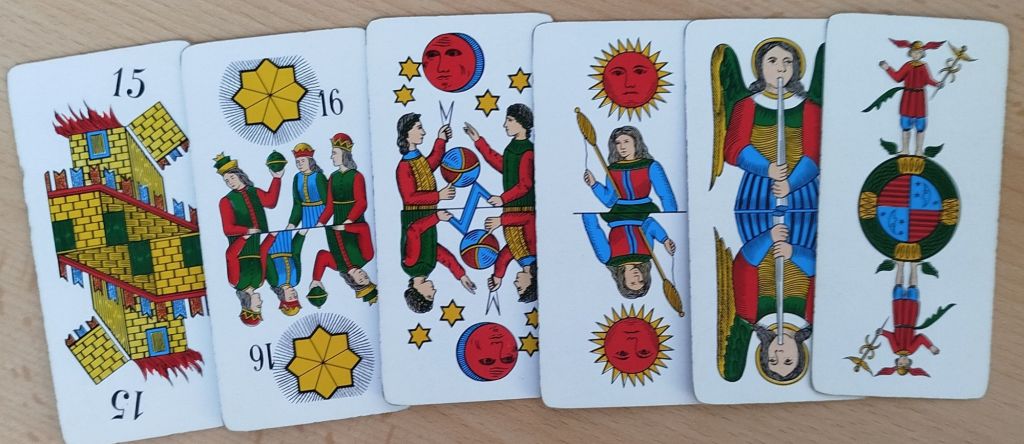
The Tower. A large building (usually, but not always, with a negative connotation), A prison, A hosipital. Obstruction, being imprisoned or limited (imagine being trapped in a burning building)
The Star. Objects, Gifts, Merchandise, Commerce, Work4, A positive card
The Moon. By night, Darkness, Sadness, Negativity, Secret
The Sun. By day, Light, Happiness, Positivity, Clarity
The Angel. Goodness, Friendship, Peace, Solution, Spirituality
The World. Around the world, From afar, Journey, Movement
The Moors

Moor with three Arrows. Intrigue, Danger, Something that is difficult and requires to be disentangled or clarified
Moor with a Turban. A doctor, someone wearing a uniform, sickness, melancholy. A priest
Moor with one Spear. Surprise, something unexpected for good or ill, Bump on the road
The Suit of Cups
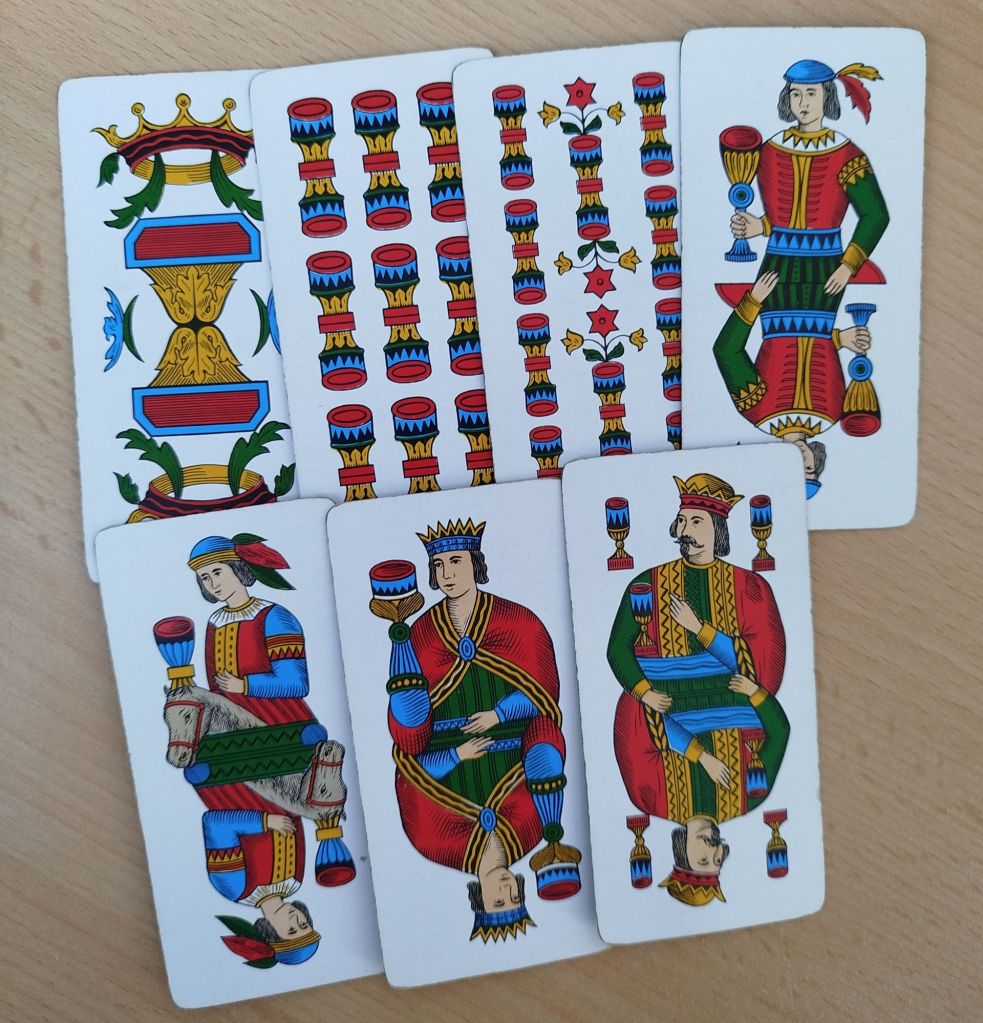
Ace. The Home, the Family
Nine. Close to home, Something on its way to us or something/someone close
Ten. Flourishing, Blooming, Feasting, Partying, Blood, Wine
Page. A young(er) woman, a small opportunity or consolation
Knight. Solution, Agreement, Reconciliation, Making peace or making your peace
Queen. A woman close to us or who loves us, archatypally a mother
King. A man close to us or who loves us, archetypally a father
The Suit of Wands
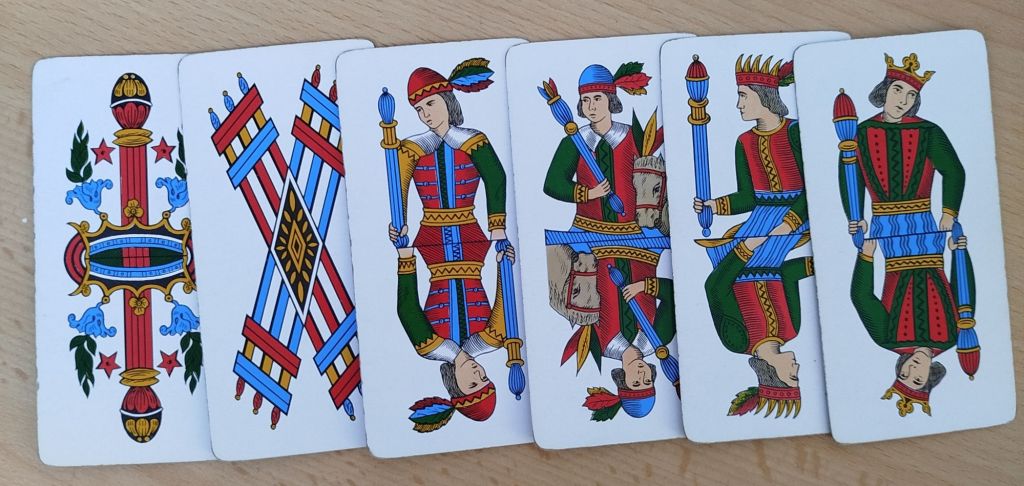
Ace. Sex, Pleasure, Triumph, Personal success
Six. A road, a path (literal or figurative), an opening
Page. The female querent’s thoughts
Knight. The male querent’s thoughts
Queen. The female querent
King. The male querent
The Suit of Coins

Ace. A document or letter, test results, contracts, etc. The table (sitting at the table, etc.)
Six. Tears, sadness
Nine. Money, assets
Ten. Well-being, lots of money
Page. Words, talks, communications
Knight. News (usually good)
Queen. The truth, wisdom, knowledge, trustworthy. Sometimes a woman embodying these traits
King. An important man, a gentleman, a lawyer or doctor, wise, with a degree
The Suit of Swords

Ace. The door knockers, something about to happen.5 Also something binding, a union, a prison sentence, a contract (notice they look like rings or handcuffs)
Six. Within a three (three hours, three days, three weeks, three months)
Nine. Destiny. It highlights the other cards.
Ten. A gate, end of the road, something closing down, Suffering
Page. A letter, a message, interpersonal relationships
Knights. Cuts, Stitches, Arguments, Attacks, Fractures (real or metaphorical)
Queen. A strict woman. Affliction.
King. A younger or strict man. Childishness
MQS

- In reality, our current order of the major trump also differs from all other ways of numbering them in the first centuries of the tarot’s existence. ↩︎
- In all ancient documents concerning the tarot, the Hanged Man was called “the traitor”, because being hanged by the feet was a the punishment for traitors (see Mussolini in Italy). In the old Medieval trumps, the Hanged Man represented the person who had betrayed God ↩︎
- “Sicuro come la morte”, i.e., “As sure as the fact that we all die”. it is the ‘yes’ card in the Thirteen card spread. ↩︎
- Usually the iconography of the card is interpreted as the three Magi bringing their gifts to Jesus, but some Bolognese fortune-tellers see three merchants striking a deal ↩︎
- Interestingly, in many system of fortune-telling by cards practiced in Italy, there is always a card called “the door knockers”. In the system of cartomancy by playing cards I was taught, this card is the Two of Hearts ↩︎
Discover more from Moderately Quick Silver
Subscribe to get the latest posts sent to your email.

„the 45-card method and the 50-card method. I learned the 50-card method from my current teacher (whose book on the Bolognese tarot I reviewed some time ago). I have the 45-card method from another source, and I’ll talk about it separately.“
It reminds me of a classic card reading method that is popular in my cultural zone. The one where you use only the King to 6s or King to 9s, omitting the „smaller“ cards. I’m not sure where exactly this comes from, maybe, as you say, it’s for a slimmer deck for larger spreads 🙂
LikeLiked by 1 person
I knew a girl from Bulgaria or Poland (can’t remember) in college who could read the playing deck with a reduced deck like the one you’re talking about.
LikeLiked by 1 person
Exactly – my cultural zone 😀
LikeLiked by 1 person
Now you’ve gone and done it. Someone was asking for information on this deck so I linked to your blog. And I took the time to really look over the Tarocco Bolognese meanings and combos. This thing is GOOD. I caved and ordered a deck. It’ll read like Lenormand but it will never be overrun with silliness. The Ugly Duckling isn’t a deck that appeals to those types. It seems tailor made to the way I read. Good stuff. Thank you!
LikeLike
Hey! And the blog flagged your comment as spam, no idea why. But anyway, I’m glad I can contribute to spreading this little gem. It is fun and accurate, and as you say, too ugly to be popular 😀 glad you like it!
LikeLike