The I Ching (usually translated as Classic of Changes) is primarily known to the West as an oracular book in which people look up answers to their questions after casting a Hexagram. In reality, the I Ching (or Yi Jing, following the newer transliteration) permeates traditional Chinese culture much more thoroughly and its symbols are found in many methods of divination. Here are the most common ones (the list is not meant to be exclusive and it is limited by my ignorance, no doubt).
Zhou Yi (Reading Commentaries)
Zhou Yi means ‘the changes of the Zhou [dynasty]’ and refers to the oracular text we and Legge, Wilhelm, Jung, Philip K. Dick, Aleister Crowley, Ursula Le Guin etc. knew. This is what we usually mean when we cast an I Ching reading in the West (and also in much of the Eastern world).
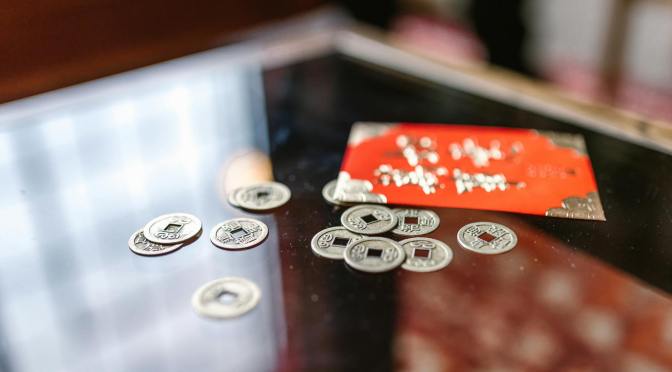
We flip coins or manipulate yarrow stalks or pick up small handfuls of rice, depending on the method, in order to obtain a symbol made up of six lines that may change or remain stable (solid). The changing lines are then flipped to their opposite (yin to yang and yang to yin) and a new Hexagram is derived, so that we can interpret the initial Hexagram as the beginning of a matter and the final Hexagram as the likely conclusion or result.
We then look up the Hexagram(s) we got, as well as the text pertaining to any changing line, and we patch together an interpretation. This method of consulting the I Ching, which is traditionally called Zhou Yi, is very old and seems to have been the preferred method of interpretation of the Confucian or Neoconfucian school, the semi-official school of the intellectual bureaucracy of Imperial China.
And this school is exactly the one that the Western missionaries came into contact with first and foremost when they arrived in China and started studying Chinese culture. Although compared to other methods of Hexagram interpretation it may seem the most straightforward, it is complicated by the arcane and hermetic nature of the text, which is notoriously difficult even in Chinese, let alone to translate.
Yet I must say that, in my experimentations with the I Ching, the text method has revealed a subtle, beautiful simplicity. Often the answer is very clear and elegant, just clouded by one’s preconceptions.
Mei Hua Yi Shu (Plum Blossom Numerology Method)
Far wackier, but also far more interesting than the text and commentaries method, Plum Blossom Divination seems to have been devised by a Medieval scholar, Shao Yung. This method does not consist in looking up interpretations in an old book (and this probably accounts for the fact that it has fallen out of favor among most Neoconfucians). Instead, it applies certain rules of interpretation to the Trigrams.
The Eight Trigrams are the building blocks of the sixty-four Hexagrams of the I Ching text. They are also found in Feng Shui, traditional medicine and other forms of divination (e.g., Qi Men Dun Jia or Da Liu Ren) as well as in Chinese alchemy, philosophy and magic. They are, in a word, among the most important symbols in traditional Chinese culture. Everything can be categorized under one of the Trigrams.
Plum Blossom Numerology is essentially a form of Trigram divination that interprets the meanings of the eight Trigrams rather than considering the Hexagrams as a whole with their own commentaries. In Plum Blossom, we usually get a Hexagram made up of two Trigrams and we look at how the Trigrams interact based on certain fixed rules such as the five phases theory. In this method of divination we usually accept only Hexagrams with one mandatory changing line (and no more than that), so that the Trigram without the changing line represents the subject, and the one that does change is the object.
What is most interesting about Mei Hua Yi Shu is how we derive the Trigrams. This is done by way of augury. For instance, if you hear a short metallic sound and want to know if this has a particular meaning or announces a particular event, you search your mind for the Trigram that symbolizes short metallic sounds (this would be Qian). To derive the second Trigram, as well as the changing line, you generally take the time of day into account, similarly to horary astrology.
In essence, Plum Blossom allows one to interpret the world around them based on the signals the world sends them in that moment. It is both a very simple method and a very complicated one, because it requires a certain disposition and flexibility of mind that most people only achieve through much training.
Wen Wang Gua
This is, as far as I know, the most complex way of interpreting Hexagrams. To cover it would require much more than a short section in a short article. Wen Wang Gua (usually translated as King Wen’s Oracle) is a form of Chinese horary astrology that applies many of the rules of Chinese metaphysics (Chinese astrology, the Five phases, the Six Animals, etc.) to the interpretations of a Hexagram (usually cast using coins).
It is a favorite among fortune-tellers, and if we were to apply the (faulty) distinction between divination and fortune-telling that is en vogue in the West, we would say that the Zhou Yi, i.e., the commentaries, are divination, while Wen Wang Gua is fortune-telling. This because Wen Wang Gua can often predict situations very specifically, even down to the day or month something will happen.
In reality, the more I delve into Wen Wang Gua, the more I realize that it is as philosophically deep as it is captivating and accurate from a divinatory standpoint. The Hexagram one casts symbolizes the spatial, earth-related aspect of a matter, while the application of astrological rules to said Hexagram allows one to see the connection of the earthly element to the celestial element.
This is the form of I Ching divination I am devoting most of my study, and I will in time present my (very faulty and very partial) understanding of it, not because I consider myself the most qualified, but because I hope to awaken some interest for it in more people who may be more gifted than me and can comprehend its mysteries.
MQS
Discover more from Moderately Quick Silver
Subscribe to get the latest posts sent to your email.

hey,
I can totally agree with you on wen wang gua. I’ve studied it for a few years, very accurate, but like most complex systems, it can be easily misinterpreted without being sure to follow all the rules, as well as checking every relationship with lines and the month and day pillar interactions.
mei hua yi shu I prefer to use as standard because its pretty much easy to grasp. And fairly accurate. Though it seems contingent of making sure you as a very clear question and understand what the various element responses represent in relation to the question.
but so looking forward to seeing your posts on these subjects. They are so fascinating.
LikeLiked by 1 person
Hi, glad to see there are other enthusiasts around! The main trouble with WWG, I think, is that there are many technicalities to take into account. Sometimes I feel that there is some kind of underlying simplicity underneath all the chaos of the various rules, but I am very far from being able to put it into words. It is definitely a journey
LikeLiked by 1 person
yes it’s very complex interactions between elements and sometimes it seems like there’s too much going on. But then I think the philosophy of it, Is that there are multiple variables to any circumstance and therefore these extra rules are in some way; a form of addressing those variables. Either way out of all the other forms of yi jing, this is perhaps the most comprehensive and accurate regarding the actions and consequences within the question and the factors surrounding the question.
infact it seems like there are many mechanisms in place, which gives the impression at least that the philosophy behind sees the universe as ordered, yet also chaotic in its outward appearance.
LikeLiked by 1 person
that’s a good way to put it. I think in order to make sense of the rules we need to see what these rules truly capture in terms of the interrelation of variables in the real world
LikeLiked by 1 person
yes kee takes alot of his studies from wild crane, and isn’t so keen on golden yarrows text. So yes there are different schools. Such as is the same in feng shui with san he and san yuan having a different emphasis on methods.
also there’s a difference of how certain terms are named and described. Chiu was for me a most confusing and again abstract way to describe everything down to the active line and the second hexagram.
I liked both Joseph yu for his simplicity and easily understandable way to grasp wen wang gua. But again Alfred kee does have alot of information yet I would say he places more emphasis on the day pillar as an indicator of the season. Which to me seems completely at odds with the bazi month pillar as well as other Chinese metaphysical methods which all rely on the month pillar for season indicators.
LikeLike
Yes, Kee seems to use a system of points that gives a great deal of emphasis to the day pillar. My preference so far is to go with Yu who uses the month for timeliness and the day branch as a sort of additional active force at play.
Although it does not relate directly to WWG I have found much of value in Gong Yu’s book on Da Liu Ren, which talks about various principles of Chinese metaphysics.
LikeLiked by 1 person
I agree with month pillar being prime indicator of element of season. And I have a copy of the da liu ren book by gong yu. There is an overlap woth most Chinese metaphysical systems. You can see this with da liu ren having some elements of what is found in qi men dun jia.
I’d say da liu ren though is extremely complex just from the first few chapters you find yourself having to read read the construction of the four passes.
I haven’t even begun to dig too far down that rabbit hole yet lol.
LikeLiked by 1 person
Both Da Liu Ren and Qi Men Dun Jia fascinate me, but considering they are even more complex than WWG it is wise for me to take one step at a time, plus there is almost nothing available on Da Liu Ren and the cost of most QMDJ courses is extortionate
LikeLiked by 1 person
it’s amazing that this system has managed to stay hidden from the mainstream for such a long time. Even plum blossom is rarely known in a public setting. Zhou yi is more for understanding one’s attitude and reaction to the question and circumstances as they stand and advice on how to tackle them. It rarely suggests the answer to the questions. It’s very abstract.
so so glad you’re going to bring light to these systems of yi jing. I think they have a broad range of applications many are missing out on.
LikeLiked by 1 person
I think in part it is due to how the West came into contact with the I Ching. Both Legge and Wilhelm studied with the intellectuals of the time, and when they brought the I Ching to the West our view of divination was more welcoming toward that type of system than to more rule-heavy, fortune-telling oriented systems.
Also in part it was due to how complex some of the rules are, especially for WWG. In fact, there is very little material on WWG in English, most of which is hidden behind hefty paywalls. I studied Joseph Yu’s course and got hold of a couple of books, but most courses in Chinese metaphysics tend to have the main aim of milking students with the “but wait, there’s more” tactic. The little material that IS available tends to be either poorly translated or poorly organized or both. WWG and Plum Blossom are probably never going to become mainstream, but they do deserve better.
LikeLiked by 1 person
I would agree with most of what you said there. There are others than Joseph yu, but I have seen his material and its similar to what I was taught. But there are certainly enough source materials to make sense of the basics. Even in some cases explaining the timing mechanisms can be hard to find information on. Though again with alot of digging there are a few basic methods out there.
LikeLike
also there seems to be more than one school of thought regarding certain topics (which is normal in most aspects of life, including divination, but it does require great care in study). For instance, Yu considers the resulting Hexagram’s element as based on that Hexagram’s palace, while other sources (Chiu, Kee) consider the second Hexagram in light of the first Hexagram’s palace. Again, it’s not a problem that there are more schools of thought, but we need to consider the underlying principles very carefully when choosing which one to follow
LikeLiked by 1 person