Tag Archives: writing

The Slop Must Flow On (and the Esoteric Anti-Initiation)

I don’t know about you, but at the ripe old age of 35 I’m an old fart who remembers the wild west days of the Internet, when people tried cool stuff just because they could. In the last few years I’ve noticed a shift, which probably started in the early 2010s when governments and corporations decided the internet wasn’t something to be vilified as they had done up until that point, but a space to be sanitized, homogenized and monetized.

I am not one to decry money as evil: money is simply an equivalent for one’s work that may be exchanged for the equivalent of another person’s work. In this sense, money has deep metaphysical properties and implications.

What I did notice, however, is that now, wherever I go, someone is trying to sell me something, even if it’s just a free, safe, “binge-worthy” series of videos designed to hook me in so that they may make money out of my attention.

And the more safe formulas get proofed and tested for grabbing people’s attention as quickly as possible, often with AI to provide the missing accelerationist flavor, the more the content that is peddled can be identified as slop. The existential ennui of someone who browses the internet in the year of our Lord 2025 with a smidgen of self-awareness is not to be undererstimated.

I’m bringing this up because I recently received an (automated) email on the account I use for my youtube channel where I was invited to take a course for blowing up my channel, which included such thoughtful advice as “make bad content” (their words, not mine). And honestly, that might very well work, if it wasn’t for the fact that I don’t give a rat’s tutu about drawing big numbers and am perfectly happy with my little corner.

Essentially, slop has been acknowledged as the fastest and most effective way to plug oneself into a premade template of ‘Internet success story’. This, in itself, is not a revolutionary discovery: crap has always existed and has always had success, and the reason why we often don’t know about the crap that existed in the past is that crap tends to be forgotten in the long run, unless it’s so bad it becomes an acquired taste.

What is new is the psychotic speed at which this is happening as attention spans get shorter, the number of people competing for them gets higher and the tools for achieving the result get more powerful.

From a metaphysical and esoteric standpoint, slop is simply the elevation of the lower aspects of the human consciousness to the status of aim to be pursued, with a result that might very well be seen as a form of anti-initiation.

The word initiation tends to conjure images of hooded figures bestowing grace on a supplicant. While the ritual aspect of it is not insignificant, the idea of initiation is far broader and it applies to many fields, not just esoteric, as a path that forces the person’s spirit to acquire, develop or balance certain qualities that allow it to adapt to the ideals of that path.

An anti-initiation, in this sense, is a process whereby the human spirit ossifies, rots and collapses in on itself, having lost any semblance of a guiding light and being only stirred into motion by the gravitational pull of its own ass.

I am not a prude and I am not a no-fun Fräulein Rottenmeier. I enjoy some of the products of our current age, and I accept the rest with some irony (what else is left?) I am merely observing an interesting trend. It is often repeated that initiation (any initiation) is for the few, but it seems to me that is becoming something for the fewer.

MQS
Musings on Magical Tools

One of the great myths about magical tools is that magic has always used four of them: the wand, the cup, the sword and the pentacle. This is actually a rather modern consolidation of the magician’s toolkit. Throughout history (and even more throughout geography) many different implements have been preferred. Especially pentacles, at least in the modern understanding of them, seem to be quite new.

There is nothing wrong with newness and innovation, but it is good to know that something is new. Some traditions of magic didn’t even contemplate the use of tools, and were wholly talismanic in nature, while there are strands of folk magic (like some traditions of Italian witchcraft) that use many everyday items as tools (chairs, dishes, needles, dolls, brooms, etc.)

One recent-ish idea about tools that has essentially crystallized into a dogma is that the implements are simply extensions of the practitioner. This is largely a consequence of our current egocentric view of magic and of the world, and its helpfulness escapes me. I ain’t crap. Why should an extension of the crap I ain’t be of any value?

I also started out with that idea, partly because it was the most readily available to me, partly because it was taught to me by some of my mentors. But the more I study, practice and move forward, the less I see the implements as tools and the more I see them as thresholds on otherness.

Otherness is the forgotten component of our magical worldview. The idea of tools as extensions of the magus shrinks otherness by inflating the role of the magus’ self through those extensions.

But quite on the contrary, tools as thresholds become meeting spaces between self and other, between the magus’ consciousness and the powers he works with. In this sense they are also filters through which those powers come to us in ways that are fruitful and measured.

The magus himself is a good magus in as much as he becomes a (discerning, filtering) threshold, and in this sense, one’s magical consciousness is one’s most important tool. This is not to say, as is often repeated today, that our consciousness changes the way the universe is.

But the way we approach the universe does change the results we get, simply because it changes the shape our filtering system, of our inner threshold. It is akin to an app or computer program: software programs allow us to use certain functionalities of the computer that would be inaccessible by using another software. If you keep trying to write an email on the pinball minigame you’re in for a world of problems.

MQS

What is the Heart of a Good Story?

One of my favorite writers is Jorge Luis Borges. One of his shortest stories is On Exactitude in Science, which goes as follows:

…In that Empire, the Art of Cartography attained such Perfection that the map of a single Province occupied the entirety of a City, and the map of the Empire, the entirety of a Province. In time, those Unconscionable Maps no longer satisfied, and the Cartographers Guilds struck a Map of the Empire whose size was that of the Empire, and which coincided point for point with it. The following Generations, who were not so fond of the Study of Cartography as their Forebears had been, saw that that vast Map was Useless, and not without some Pitilessness was it, that they delivered it up to the Inclemencies of Sun and Winters. In the Deserts of the West, still today, there are Tattered Ruins of that Map, inhabited by Animals and Beggars; in all the Land there is no other Relic of the Disciplines of Geography.
(translation by Andrew Hurley)

We can discuss for days about the meaning and philosophical implications of this story. You may like it or dislike it. But it is a *complete* story. It tells about something that has a beginning, a middle and an end, where the end is not clear from the beginning. It does so in a very short space, but it is complete. It has a plot, and nothing is missing from it. We are not left hanging. It has nothing to do with postmodern crap. This is traditional story-telling at its finest.

Though the story may have a deep significance and several layers of interpretation, from a structural standpoint nothing differentiates it from a penny dreadful or an early XX century pulp magazine story.

It is far from me to want to push all story-telling within the confines of a single structure, but the thing that makes Borges’ story a satisfying, well-written story worth telling is that it has some kind of twist to it. Someone is doing something, but then something else happens. X is Y-ing when Z.1

X, in this case, are the Empire’s cartographers. Y-ing is the attempt to perfect the science of cartography. Z is the fact that their success in perfecting said science renders it unserviceable.

So if we had to condense the essence of the story into a short sentence, we would say: The cartographers of an old empire manage to perfect the science of cartography, whereupon they discover that perfecting it makes it useless. X is Y-ing when Z (you can substitute ‘when’ with ‘whereupon’, ‘but’, ‘and then’, ‘but then’, etc.)

If the story had been:

In that Empire the cartographers made huge maps in an attempt to make them as accurate as possible. One day they managed to make a map that was as large as the Empire itself, and then they went home.

You’d be justified in thinking that this is no story at all. That’s because here we only have ‘X is Y-ing’, but only the Z makes the story worth telling. Pretty much every memorable, complete story has an ‘X is Y-ing when Z’ structure. In fact, even the single scenes of a story generally follow this structure (though, in Borges’ case, there is only one scene.)

When I say that this structure is near-universal I do not mean it in the same way as people rave about the Hero’s journey and other semi-academic tools of analysis. All these may have their place, but ultimately they are external models, while fiction is much freer than most people would like. Still, a story without an internal ‘Z’ factor is like a joke without a punchline, and in order for the ‘Z’ factor to make sense it must be nestled within a context in which X is Y-ing. Again, ‘X is Y-ing when Z’.

There *are* reasons to tell a joke without a punchline (to waste people’s time, maybe), just as there may be reasons to tell a story without a point. For instance, plenty of critically acclaimed writers write pointless stories for the sake of them being pointless, usually to show their intellectual peers that they, too, are possessed of the smarts or irony necessary to understand how meaningless life is.

But at this point we are just playing with semantics here: if the point of the story being pointless is that it is pointless, then it becomes its point. It’s just that the point is now external to the story, and found in the writer’s delusion of grandeur.

Of course there is much more that goes into crafting a good story than a simple formula. But, as far as I am concerned, this is not even a formula. It is the reason people have been telling stories since the beginning of times: to be enchanted by the witnessing of meaningful change. This is what makes story-telling so similar to magic: something changes before our eyes and we are left dazzled by it.

MQS

Footnotes
  1. Holly Lisle, one of the people whom I learned writing from, had a different formula, but still to the same effect. I recommend you check her out. I have link to her website in my recommended links. ↩︎

The Great Watcher

Previous / Back to Index / Next

From the Microcosmicon, 27:

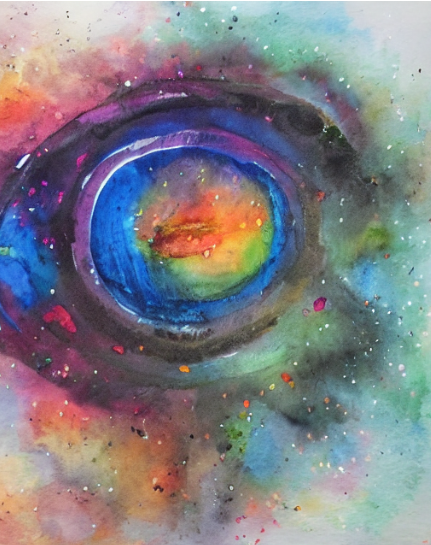
The psychonauts’ submarine plunged into the Inmost Ocean, the depths of the collective unconscious where the whirlpool roared. A wound throbbed at the bottom of it, through which meaning bled out of reality, leaving the world stunned under a pall of grayness.

“There’s something,” one of them shouted, as the sub spiraled down toward the abyss.
“Don’t be silly, there can’t be anything beyond reality,” another responded.

“Wake up!” Dr. Ferguson’s voice broke in, saving them just as they were approaching the point of no return.
Their vision disappeared from the screen as they awoke.

“What did you see?”
“An eye.”

MQS

The Great Watcher

Mrs. Pettigrew’s Cat

Previous / Back to Index / Next

From the Microcosmicon, 26:

To Mrs. Pettigrew’s relief, the cat came back five days later.

Initially, everything seemed fine. Then Mrs. Pettigrew noticed something was off about the creature, though she could not put her finger on it. It kept meowing, but this in itself was not strange—Admiral was a talkative cat. It was the monotonous way it meowed.

Then, one night, as she was falling asleep trying to disregard the noise, it occurred to her—it was a looped recording.

She stood up and bolted into the living room. But Admiral was already taking off through the window with her biometric data.

MQS

Mrs. Pettigrew’s Cat

Enneagram Comparisons – Type Five and Type Six

Enneagram Type Five and Enneagram Type Six belong both to the Head triad, yet they give off markedly different energies. Fives actively employ their Head energy, using it to make sense of the world from a distance. Sixes often suppress their Head energy, don’t trust their own judgment and seek someone or something that will explain reality to them.

Being both Head types, both Fives and Sixes deal at their core with fear of the world around them. Fives thus retreat from the world into the safe realm of their own intellect, from which they observe life without being touched by it. It is often held that Fives are taking time off from real life in order to look for something, an idea or strategy, with which they may join the others and be useful or have a fighting chance, but while some great Fives really do come up with revolutionary ideas that changed the world, most Fives become lost and almost hooked on their own thinking power.

Sixes deal with fear differently. They don’t trust their own mind, so they seek structures outside of them, whether social, political, religious or other kind. For them, life is a sea of difficult choices, risks and dangers, a place where nothing seems certain. They therefore become engaged in an endless quest for the person, idea, group or thing that will give them clear answers that they don’t need to question anymore. Once they have found (or if they find) something that stands up to their scrutiny, they espouse it with militant fervor.

Fives tend to be philosophical and rational (though not always reasonable). Their approach to ideas and concepts is seldom practical, and they tend build up mental constructs not to employ them but to sharpen their overactive mind’s claws on them. Their attitude toward ideas is often playful and nihilistic. Sixes on the other hand are more practically oriented because their sense of fear is less rarefied and is almost palpable, as if they needed to actually survive from moment to moment. Their attempt at tearing down ideas and concepts is not playful at all: they keep poking holes in everything in hopes of finding the one thing where holes cannot be poked.

From a social standpoint, the difference between Fives and Sixes is often marked. Fives are withdrawn, remote, aloof. Even at average levels they are often socially inept, nor do they care to work on this aspect of their life, as they consider it inessential. Sixes, on the other hand, while often questioning people’s motivations, put on a friendly and even cheerful facade, because they are aware of how important networking is in dealing with the uncertainties of the world.

In reality, both Fives and Sixes are mistrustful of people. However, as far as Fives are concerned, rather than mistrusting people’s motives, like Sixes do, they tend to mistrust other people’s ability to understand reality better than them. On the other hand, a Six’s skepticism is generally oriented at people’s loyalties and competence in providing answers the Six can rely on. For instance, in an educational context, a Six pupil may not believe the teacher is good and is, in a way, faking it, while a Five pupil will often think they are better.

MQS

Enneagram Comparisons | Type Four and Type Six

Enneagram Type Four and Enneagram Type Six share some similarities in spite of focusing on entirely different things. Fours are a Heart type, whose deep desire for authentic connection is only equaled by their feeling unable to find someone who will truly see them in their uniquely flawed nature. Sixes are a Head type, and their need to be reassured is equaled only by their inability to trust anything they or anyone else say.

Both types can have a generally negative view of the world. Fours believe themselves to be flawed and disadvantaged and feel that they don’t belong because they lack something other people have. Sixes are negative because they are used to questioning everything that is apparently good until they have managed to squeeze something that can be considered iffy or untrustworthy out of it, and see the world as a dangerous, or at least precarious place.

However, Fours are unapologetic in their pessimism, whereas Sixes may often try to tone it down or even suppress it in order to ingratiate themselves to others (they can even come off as upbeat) to build up friendships and alliances. In general, Sixes don’t like putting others off because they subconsciously don’t want to make enemies, whereas Fours generally don’t like behaving in a way that is not authentic to how they truly feel.

Indeed, the theme of authenticity is a leitmotif for both Fours and Sixes. Sixes want someone or something to explain reality to them in a way that leaves no place for doubt and fear, even if that means identifying threats or enemies (in fact, average Sixes love to be told who or what their enemy or threat is). One of their great fears is of being lied to, or of coming into contact with people who keep their real agenda secret to them. They also fear that people won’t tell them the truth to avoid hurting them, but because they have a very good nose, Sixes often can smell something is off.

Uncertainty

Average Fours do not so much fear lack of authenticity as they feel disdain for it, and are often unable to bring themselves to play socially accetaple roles if that means not being true to themselves.

Another similarity lies in the fact that both Fours and Sixes often feel a great deal of confusion within themselves. In spite of being a Head type, Sixes often come off as emotional and stormy. This is due to their lack of trust in their own judging ability, which sometimes leads them to drowning in a glass of water. Sixes would love to be told the clearcut truth, but as soon as they are presented with (one version of) it, they begin picking the black and white apart until a chaotic mess of shades of gray is left.

Fours also feel a great deal of confusion, but this is due more to their inability to pin their own personal identity down to a specific set of characteristics, because they always end up discovering a part of themselves that doesn’t fit any definition.

An important difference between the two types comes from the fact that Sixes tend to be sturdy, gregarious and friendly, whereas Fours are generally individualistic and delicate and experience great difficulties fitting in. Secretly, Fours may envy people who do fit in, but outwardly they often show contempt. On the other hand, Sixes may admire people who manage to stand out, but they generally deem it safer to fall back in line.

MQS

The Height of Science is to Know Nothing

or “Summa Scientiae Nihil Scire” in Latin. This motto is very useful in practical fortune-telling. One of the greatest risks we run is of assuming. “She’s 85, how is she gonna find love?” “He’s a 23-year-old jock, he’s probably not a priest.” “She looks so prim and proper, she’s unlikely to have seven lovers.”

All these preconceptions and more cloud our mind as we try to read the oracle’s answer, regardless of the oracle, whether it be the Tarot, playing cards, astrology, the I Ching, etc. All these preconceptions are poison to the art of divination. They are not of service to us, nor to our querent. Let’s delve into why.

Let us start from the fact that bias is a natural and necessary phenomenon, as politically incorrect as this may sound. Bias comes to us from our experience, but also from the experience of others, especially family members, friends, teachers and people we trust. Bias orients our life, and this cannot be otherwise. The attempt to forcibly eliminate bias from people’s minds only causes suffering, and is its own kind of irrational crusade.

You know who is NOT biased? God. You know what God does? Everything. But you can’t do everything. You can only do something. And in order to do something, you must be biased against something else. That’s life.

This is not to say that all bias is good. For instance, I may have accepted some preconceptions from my parents, who got them from their grandparents, who got them from the priest, who got them from a crazy lady next door, etc. This kind of bias is the worst because it can needlessly limit our options and create likewise needless suffering in those around us. The best kind of bias is the critically examined one that you accept based on your actual life experience and keep open to revision.

Yet even this kind of “good” bias is harmful to divination. When someone comes to us for a reading, or when we read for ourselves, what we are doing is trying to look at reality from the point of view of a symbolic system that reflects life from an objective, or at least less subjective standpoint.

Divination is a language with no native speakers, except maybe the guy upstairs, which means that our understanding of it is always going to be imperfect and faulty. But this is a technical kind of difficulty, and in its own way it’s excusable. What is less excusable is the additional confusion we create by reading our biases into the divination. This is not just about politics, philosophy, morality or religion. It’s everything.

“A 85-year-old is not going to find love again” is one sort of bias. “An attractive young guy is probably not a priest” is another. The aim of divination is to read the truth, not ourselves. That’s why the height of science is to know nothing. If we start with a clean slate we can receive much more information from the tool we are using, simply because we are not randomly blocking out information we consciously or subconsciously deem unlikely.

The unlikely happens everyday. Think about it. Almost everyday something unlikely happens in the world. That’s not to say we must feel the urge to make our predictions as unlikely as possible in order to impress the querent. Most of the time, what’s likely is what ends up happening. Still the unlikely is not the impossible.

I am big on comparing divination with language, as those reading this blog know. And as you know, I am not a native speaker. Around fifteen years ago, I was trying to improve my English by watching youtube videos. Yet this was very hard, because the language people use on youtube is very inconsistent, erratic at times, filled as it is with memes, asides, jokes, ancdotes, interruptions… I was trying to project the artificial English I had learned in school onto this truer, more lived English.

“Surely he can’t have said what he has just said. It doesn’t make any sense,” I constantly thought. It was when I stopped projecting my presuppositions and started just taking in what was objectively being said that my English truly improved. That’s the same with divination. The height of science is to know nothing. Only if we know nothing we can take in what is being said.

MQS

Enneagram Type Six – Growth and Stress

Enneagram Type Six, sometimes called the Loyalist or the Skeptic, belongs to the Head triad. Those of this Enneatype tend to feel the need for an external source of security, whether it be in the form of social connections, love, a political ideology or religion, etc. They are often friendly and want to show themselves as dependable and trustworthy to avoid danger and controversy, but they also have a skeptical streak that undermines their ability to find the security they need. They are often given to catastrophizing, questioning and poking holes into everything in hopes of finding the one thing that they can trust, but once they feel they have found it, they rarely question it.

Enneagram Type Six

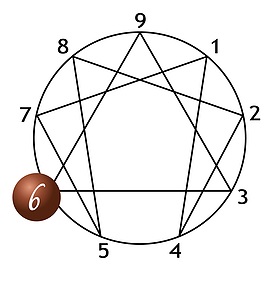
Enneatype Six Grows: Move to Nine

The beginning of a Six’s fear lies in their inability to give themselves the security and stable ground that they need. Because they lack a sense of inner guidance, they usually look outside of themselves, finding it in people, institutions, systems of all type, etc. Ultimately, Sixes want their anchor to be beyond doubt (that is, in a way, perfect).

This is obviously a problem, since an honest look at anything and anyone will reveal their flaws. Although some Sixes manage to convince themselves to stick to something even if imperfect, the nagging sense of uncertainty remains.

When a Six learns to trust themselves, their decisions, their own processes and learn to see the difference between a healthy dose of skepticism and an excessive one, they can also relax and, in doing so, they pick up certain qualities of healthy Nines. Enneagram Type Nine is often trusting of others and allows space for honest interaction without the drama that average Sixes often stir up when they haven’t yet sorted a person in trustworthy or dangerous.

Usually, Nines tend to see beyond division and can capture the unitary essence of all processes, including interpersonal ones. In integrating aspects of Enneatype Nine, Sixes, usually become much calmer and more capable of seeing the simple essence of a situation without getting lost in a myriad contradictions and doubts. More importantly, healthy Sixes develop the kind of self-assurance that they usually lack.

Courage, the Virtue of Enneagram Type Six

Enneatype Six Under Stress: Move to Three

Enneatype Six tends to create secure and stable social connections, which they reinforce by being trustworthy and friendly. Largely they do it to reduce the uncertainty of life (it wouldn’t be a stretch to say that the Six’s socially cohesive instinct is what brought humanity together and created the basis for society)

Unfortunately, this strategy is not always effective. Depending on their particular situation, Sixes may feel that their life is too unpredictable and dangerous. They may feel like they are swimming in a sea of ungraspable alternatives whose consequences they can’t pin down and anticipate. When this happen, a Six may still try to create certainty, but if the strategy fails, they will go to their stress point, where they embody the less healthy qualities of Ennneagram Type Three.

Threes are the workaholics of the Enneagram, constantly trying to emerge and establish themselves as worthy of respect. At their worst, Threes are unreasonably competitive and tend to see everyone as an opponent to outdo, outfox, outperform at any cost and using any trick possible. Stressed Six embody this more antisocial aspect of Type Three, as they feel they can no longer trust others and must therefore learn to compete with them.

Highly cynical and with a generally negative outlook, unhealthy Six can try to constantly undermine others, as though doing this was necessary to deactivate the potential threat associated with other untrustworthy human beings. This behavior is often seen together with panicked responses to every minor setback and a tendency toward authoritarianism as a coping mechanism.

MQS