I am an ecumenical troll: I will pour salt wherever I can regardless of political, religious, ethnic and gender affiliation, IF what I see is a sheer display of stupidity. This is one of those cases.
As most people will know by now, a certain oddly-colored politician has been reelected into office. Amongst the predictable TikTok meltdowns that were caused by the event, one peculiar trend caught my eye: that of witches sending him curses, either to make him croak or, and I quote, “having him willingly resign from the office so that Harris can take his place.”
Let us pretend for a second that this is how politics works (if it did, most politicians would dread winning an election more than losing it). What never ceases to amaze me is the complete detachment from reality that informs the witchcore scene.
Magic used to be the logical next step on the path to wisdom after mastering the worldly sciences. Now it’s a hobby for people with funny hair who need to unlearn anything resembling critical thinking in order to be able to tell themselves in front of a mirror that they are “witches”.
In large part this is due to the process of specialization and separation of knowledge that occurred after the scientific revolution, which virtually left no space for magic in the curriculum of the wise. This has led to two opposite tendencies developing: the “science confirms our eternal truths” tendency and the irrationalist tendency.
The “science confirms our eternal truths” strategy is typical of many XIX and XX century occultists. It makes no sense. Science is an open and ever-evolving body of theoretical and practical understanding which would survive even if it threw its most well-established theories overboard. If “scientific theory X is actually a reformulation of our eternal occult wisdom”, what does it say about that wisdom when, in 500 years, that theory is disproven and science moves on to the next one?
The scientific path is generally characterized by a flattening of magic onto (pseudo)scientific rationality. The irrationalist path, on the other hand, is characterized by the abandonment of all logic and understanding. It is typical of most milquetoast magical practitioners nowadays. This is the path that leads people to say with a straight face that you can manifest the result of an election and you can substitute sage with a piece of paper with “sage” written on it.1
This kind of irrationalist magic is the variety practiced by the TikTok witches sending curses to Trump. Rest assured that curses do exist. They mostly require some kind of contact with the victim, and even then almost no one can pull them off.
Even from the point of view of sending influences at a distance, Trump is as loved by those who voted for him as he is hated by those who didn’t: from a purely numerical standpoint, these influences cancel each other out, with something left over in his favor.
Finally, whether one likes it or not, the movement he leads has its own well-established etheric egregoric presence, which was created not just internally by those who support him, but also just as much externally by those who loathe him. A simple study of the life of Donald Trump, and even of the last months, shows that it would be very hard–not impossible, but hard–to hurt him, either physically or esoterically. Do you seriously think you lighting a candle and regurgitating formulas from a grimoir you bought on Etsy is going to change the course of humanity?
MQS
Substitutions CAN be operated in magic, but they are an art in an of itself, and require understanding ↩︎
Fludd discusses the mystical implications of using divination.
5. The Act of a True Geomancer Is Like a Movement of the Mind in Ecstasy, or Rather a Sort of Rapture, in Which There Is Prophecy
Rapture in general is called the abstraction, alienation, and illumination of the human mind, proceeding directly from God, through which prophecy is obtained.1
Thus also a certain kind of rapture and ecstasy is required for divination by Geomancy, which is not called the illumination of the mind directly emanating from God, but rather the act of gathering of the mind’s rays into a narrower place, that is to say, into the seat of the human body and its own home, so that through them the divining soul discerns the simple truth more clearly.2
As such, ecstasy is first of all required in this knowledge, that is, the abstraction of the rays of the mind from all external things or affairs, so that they are contracted within themselves: for in a great rapture of the mind and soul the rays are lifted up to the divine essence of God, or into the region of the mental world.3
Thus, even in this minor rapture of the human soul, the rays sent out from without, and scattered here and there, are recalled to their center, and are reflected in the mind, and thus man, who was formerly dark because of the diffusion of his own light, is now enlightened and glorious by the aggregation of the expanded rays.
In a similar manner, as we gather from the opinion of the learned men, on the third day of creation the rays created by the light scattered evenly throughout the sky, and all appeared in a dark manner, as if darkness were mixed equally with light, or night with day.4
But when, on the fourth day, all that light scattered everywhere was collected in the center of the solar body by a certain magnetic property, there was produced that glorious and worthy example of light, in which God himself is said to have had his tabernacle.5
We also see, for instance, that in a fortress equipped with a thousand soldiers, if the greater part of these soldiers, either for the purpose of preparing for defeat or for some other attempt, goes out and runs to and fro, then that fortification is rendered weak, and those who are left experience great fear.
But if those who had gone forth should return safe and sound, those who had been left in the stronghold recover their former confidence and their former hope, and putting aside all fear, they are in no way afraid of the invasions of the enemy, since that place is already well-furnished with warriors.
Here, therefore, things are in the same way with the bright rays of the human soul. For the human body is a stronghold or fortress, where the rays of the mind and the middle soul are likened to soldiers, of whom we may compare those who are sent out of the body to attend to foreign affairs, to soldiers running hither and thither outside the fortress, the absence of which renders the body less confident, and more insecure and timid, and weak in facilitating some noble and bright aim, such as divination, which is the best and highest thing.
We say, therefore, that the recollection of rays of this kind is the reduction of man’s internal nature from multitude to simplicity.6 As a result the soul, recalled from external meditations, and reflected and recollected within itself, renders a man, as it were, raptured and ecstatic, because he thinks of himself and within himself, he is only present to himself, oblivious of strangers, so that it appears to the ignorant that he is not aware of himself. when, in truth, he is now more than ever before.7
For he who neglects worldly things is sure to care for himself more, and he who withdraws himself from the multitude into himself seems to be most present to himself, since there will not be a great interval of distance between him and God.8
To such an attitude or disposition must he reduce himself, who endeavors to procure for himself the gift of future divination. For those thinking of externals divert the powers of the soul from the judgment of truth, so that the uncertainty of the geomancer is great in his judgment, or to be more precise, the truth in him will be as great as the variation of the soul from its unity.9 Indeed, in the multitude of things, tricks, vanities, and lies are concealed; in true unity and simplicity perfection, identity and unity [are found].
Let the soul therefore snatch from the Macrocosm that which is its own, given to it by the Creator in its creation, and internalize it into its own Microcosm, and let no one else enjoy what is its own.
By virtue, I say, of his own excellency, he is snatched from the world, and restored to himself and recollected, and clings to ecstasy, so that in his most refined mirror or spirit he may reflect not only worldly things, but also divine ones. For the more clarity he achieves, the more effective will be his visions and motions for prophesying the truth
6. About the Hidden Properties of Geomancy, and How the Soul or Mind Passes in Its Operation Through the Whole Nature of the Macrocosm
Nor is it right that those who are ignorant of geomancy should regard a series of points as mere lines, formed from the act of divination, since under these characters, the objects of the eye and the senses, many things, both spiritual and material, are concealed. Indeed, these series of lines comprise no less the idea of the universe than the human body itself.10
In fact, although in man his body can only be seen from the outside, yet with spiritual eyes we contemplate his spirit and soul and mind inwardly. Of course, in the body we see the elements invisibly mixed in composition;11 in the spirit and soul we observe the ethereal nature, in the intellect and mind we observe the empyrean nature.
the same can be observed also in Geomancy, since readings consist of four lines of points, and we perceive that the four elements are concealed in it, that is to say, the element of fire under the first line, of air under the second, of water under the third, and of earth under the fourth. 12
Furthermore, in the figures produced by those series of points, the seven planets and the twelve heavenly signs are included, which can only be perceived by the eyes of the spirit.
Thus the figure of Carcer is attributed to Saturn direct and Tristitia retrograde: the figure Laetitia signifies Jupiter direct, Acquisitio retrograde; Rubeus denotes Mars direct, and Puella retrograde; Major indicates the Sun in a certain direction, and the Minor in retrogradation; although the astrologers deny the retrogradation of the Sun, because of its epicycle; Puer is given to Venus direct, Amissio retrograde;13 Albus is attributed to Mercury direct, Conjunctio when retrograde; the direct Moon is symbolized by Populus, the retrograde by Via;14 Caput Draconis is represented by a figure bearing the same name, and Cauda Draconis is represented by a figure bearing the same name as well.
So also those figures contain in themselves the natures of the twelve signs. For Acquisitio is of Aries in an abstract manner; Laetitia and the Minor of Taurus, Rubeus and the Puer of Gemini; Albus and Populus of Cancer; Via of Leo; Caput and Conjunctio of Virgo; Puella of Libra; Tristitia and Amissio of Scorpio; Caput of Sagittarius; Cauda of Capricorn; Major of Aquarius; Carcer of Pisces.
Furthermore, Rubeus, Minor, Amissio and Cauda denote the element of Fire and the Southern part of the world; Laetitia, Acquisitio, Puella and Conjunctio denote Air and the Eastern part of the world; Populus, Via, Puer and Albus denote Water and the Northern corner of the world; Major, Caput, Carcer and Tristitia denote Earth and the Western part of the world.
Even deeper towards the center of the sky lies the empyrean spirit,15 which is the revealer of the future and the present, that is to say, the rational or intellectual collection of these figures and the worldly things contained in them.
From all this it is evident how purely and sincerely the intellectual spirit must be preserved from the inconveniences and harms of the flesh and filth, when from it the movement to produce the Geomantic points first arises, taking with it in a secret manner the natures of the heavenly signs, the planets, and the elements, and finally hiding all these under the number and in proportion to the points, like a certain treasure in a chest.16
If, therefore, we wish to open that chest, first to the elements, then to the planets and celestial signs, and finally to the boundary from which these movements originally flowed, we shall penetrate in the sanctuary of the mind, its will, in the mythotheque of the intellect, of the will, of the signs and planets; in the closet of the ether we shall find the act or execution of the mind; and in the storehouse of the elements, we shall find the effect of the mind’s will, reason, and act (all of which are contained and hidden under figures, as if in a chest).
From the aforesaid, therefore, it is evidently clear that, just as the prophecy of the inspired is the union of the divine mind with the human mind (whence it is the most complete and greatest, this species of prophecy), so also the prophecy of the uninspired sometimes happens, when the soul is united, with its rays drawn back to itself from the multitude toward its summit, that is, with the human mind, which, without doubt, if united with the soul and collected, can perform enormous things by itself, and can lead to the summit and a happy outcome.
MQS
Footnotes
The words ‘abstraction’ and ‘alienation’ must not be understood in their usually negative sense. In Neoplatonism (and mostly in Plato himself as well), the dialectical method allows the spiritual seeker to climb up the ladder of being through a process that leads from the particulars of the material world upward and inward to unity with the divine. Ecstasy, which is the goal of Neoplatonic spirituality, literally means “going out of oneself”. This is the process of abstraction and alienation. ↩︎
That is, prophecy stems from direct union with the divine and is harder to control, while divination (such as Geomancy) happens by focusing inward. ↩︎
See Note 1. Fludd describes the Neoplatonic method of retreating inward and upward. ↩︎
If the light is evenly distributed, no difference appears and everything is as equally dark as it is equally radiant. ↩︎
In the Hermetic interpretation of Astrology, the Sun is a symbol of divinity. ↩︎
Broadly speaking, the path of magic in all its branches (and divination is one of these branches) require an endless attempt at simplifying one’s life and one’s external nature. ↩︎
This is a common theme in mystical and occult literature, and one of the great truths of our art. As we reach what some have called ‘superconsciousness’ we appear to be less aware, while in fact we exceed regular awareness. ↩︎
The phrasing here is clearly very careful to avoid scandal. As for the words “caring for himself”, this is not to be understood as being egoistic. ↩︎
that is, we are capable of seing the truth in the measure that our soul is unified. This is probably part of the reason why divining for oneself is especially difficult, since divination implies doubt about an external topic. ↩︎
Here lies a great and central secret about all functional systems of divination: that their symbolic vocabulary is complete in itself, so as to be able to reflect within its permutations the truth of things to come. Here, Fludd compares the language of Geomancy to the human body, which is a symbol of the completeness of the universe. ↩︎
He means the four elements, which were thought to be mixed to form the material bodies. ↩︎
This is a reference to the fact that in Geomancy each figure is made up of four series of points, and each series is assigned to one of the elements. ↩︎
compared to the usual attributions, Fludd switches Puer and Puella ↩︎
The Moon cannot go into retrogradation. Usually, Populus is assigned to the waxing Moon and Via to the waning Moon. ↩︎
with reference to the Aristotelean and Ptolemaic view of the cosmos. ↩︎
This comparison is very much a consequence of Fludd’s Renaissance worldview, according to which Nature is replete with symbols. ↩︎
This post is inspired by a forum page I was reading where various people whose whole magical practice consists in casting the defensive spells were comparing notes. One thing that often amuses me is that many people who are looking to get into magic often start by practicing random rituals which are either plucked off the internet (trust me bro) or taken from old books (it’s old so it’s true).
Even supposing that these rituals are effective (no, your wanting it to be effective is not enough for it to be) practicing them outside of the cultural, philosophical and magical framework within which they were conceived can be extremely dangerous if it is not done with full knowledge of the facts pertaining to it and by supplementing your magical knowledge with your reasoning ability to work out its inner mechanism. This is why I advocate for magicians to study philosophy and logic, among other things.
The first thing these people will rush to is defensive magic, their reasoning being that defensive magic can do no harm. In fact, it’s good for you! How can it not be? There are some words that unfortunately evoke unwarranted feelings of safety. ‘Nature‘ is one of those words. People hear “It’s natural” and immediately assume it’s good. Know what is natural? Ebola. But people in industrialized countries have a romantic notion of nature due to how distant it is from them–they can afford such a romantic notion, since usually nature is allowed into their lives in small, sanitized drops of color.
The same goes with the word ‘defensive magic’. It must be good if it is just for defense! After all, defense is good: That’s why we take karate lessons and install cameras on the front door. This, people think, is the equivalent of defensive magic.
Yes, defense is good. So is hygiene. After all, while hygiene now falls mostly under the cosmetic industry, it was once a matter of defense: cities with running water and plumbing had healthier citizens who could defend themselves more effectively. And what is hygiene, at its core, if not defending the body against certain biological threats?
Still, most people would agree that taking antibiotica every day without a reason, or washing your hands every few minutes is not only silly but detrimental. Our body exists in a dynamic balance with the forces outside of it, and neutralizing those outside forces will inevitably lead to our body being incapable of resisting them. The same is true for our soul. Magical hygiene is a thing, and it does contain certain solutions to keeping a good equilibrium. So how do we know if something is good?
The one thing we need to ask ourselves when looking for protection is: protection from what? What am I doing that requires protection? To put this into perspective: a welder’s mask protects his face from flying sparks. Do you need such a mask? Are you in danger of being blinded by flying sparks? Unless you are a welder, probably not, and even if you are, you probably don’t need it the whole day.
Most people have a certain inborn resistance to low-level magical threats, often supplemented by whatever protection derives from the religion they practice, so long as it’s a traditional religion with established rituals and prayers. This basic package is usually enough for anyone who is not a practicing magician. There is no point in people going around casting Banishing Rituals for no reason.
One universal law, maybe of magic, maybe of life, is: if there is no problem, don’t try to implement a solution, lest you cause an imbalance that only the presence of the problem itself can solve, thus inviting the problem to present itself.
The more we advance in the magical path, the more we are going to be on the radar of the odd inner-world larvae, and perhaps worse, the more we are going to need to keep the defenses up, and this will usually involve an always unique combination of strategies that are always specific to the kind of work we are doing.
Abano discusses the various meanings of Tristitia, Laetitia, Puer and Puella as they derive from other figures.
Laetitia
When from Populus and Laetitia, it means luck, gain, especially in large [or great] things. When from Acquisitio and Puer it means gain, merriment, especially in changeable things. When from Amissio and Albus it means luck, but with mediocre gain. When from Major and Puella it means fixity, gain and good luck.
When from Minor and Rubeus it means mediocre gain or honor or good luck. When from Via and Caput it means gain, honor, positive change. When from Cauda and Conjunctio it means misfortune, evil, but incapable of doing all it wants.1 When from Tristitia and Carcer it means mifortune, difficulties and problems.
Tristitia
When from Populus and Tristitia it means misfortune, danger, evil. When from Acquisitio and Rubeus it means fixity and misfortune, except in in things lascivous or feminine. When from Major and Albus it means luck, gain and honor with firmness.2 When from Minor and Puer it means better3 luck in every question.
When from Caput and Conjunctio it means great fortune, gain and stability. When from Via and Cauda it means mediocre luck, difficulties, problems. When from Laetitia and Carcer it means a good deal of luck, but with more problems than positive things.4
Puella
When from Populus and Puella it means infirmity, lascivousness, luck, gain. When from Acquisitio and Cauda it means mobility, mediocre luck. When from Amissio and Tristitia it means good luck after much toiling and difficulties, gain in venereal5 things.
When from Via and Rubeus it means misfortune and anger, rumors, change, damage. When from Albus and Carcer it means gain, good luck, firmness. When from Conjunctio and Puer it means fortune in everything, luck.
Puer
When from Populus and Puer it means gain, good luck, change. When from Acquisitio and Laetitia it means gain, honor, mirth, goodness in everything. When from Amissio and Caput it means good luck, bood in easy things and in seeking pleasure.
When from Major and Cauda it means unfortunate change, damage. When from Via and Albus it means useful variety,6 fortune, good change. When from Carcer and Rubeus it means major misfortune in everything, loss. When from Minor and Tristitia it means fortune, some kind of gain, strife.
THE END
MQS
Footnotes
It is not clear wheter Abano means that the person won’t be able to do all he or she wants, or whether the evil signified by this combination is not all-pervasive. ↩︎
In this case, it seems that Tristitia’s role is to solidify the good fortune signified by the two figures it comes from. ↩︎
‘migliore’ means ‘better’, but it’s unclear better than what. ↩︎
These two meanings might be hard to harmonize, though maybe not impossible. ↩︎
One cool thing about moving to our new place is that we now live much closer to the countryside. Although there are a couple of major cities around us, our district is basically a cluster of small pictoresque old German villages close to the woods. This is a very good place for a magic practitioner to settle down.
I also discovered that there is a small lake or large pond (depending on who you ask) nearby. It’s been my experience that old water places, just like old caves, tend to be stably inhabited by spirits. In fact, in a subtle way, these spirits *are* the place they inhabit.
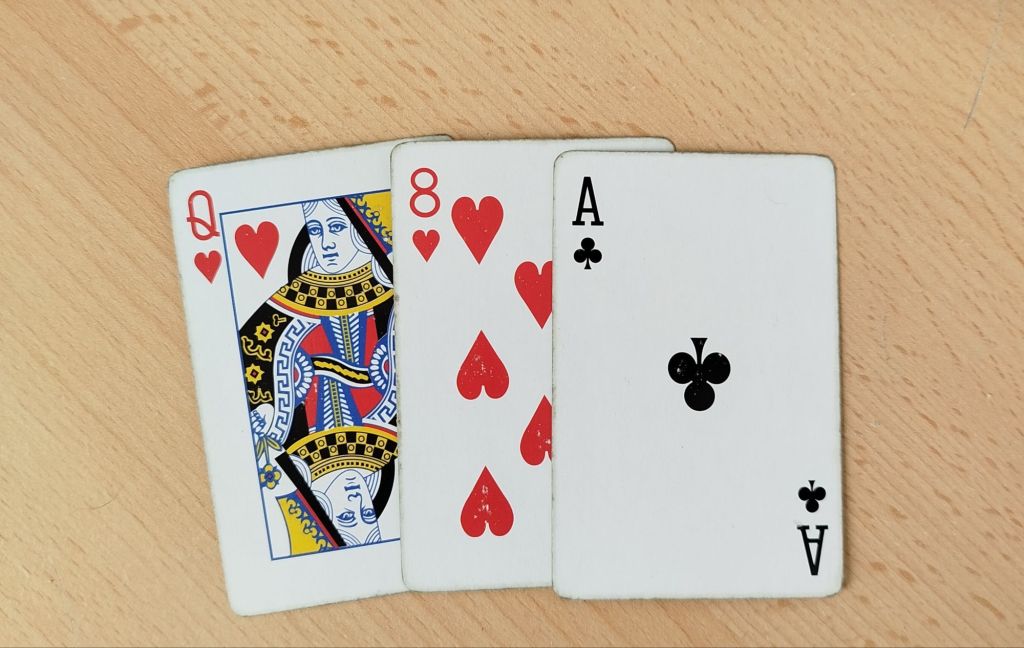
Before visiting the place I drew three cards to investigate, and these cards came up:
A water spirit – Cartomancy with playing cards
Obviously, the first thing to take note of is the presence of the Queen of Hearts, which is a motherly figure or a positive female entity. This is confirmed by the Eight of Hearts which can represent a water place, so in the context of an esoteric / magical reading it would represent a female entity of a broadly positive nature tied to water. The Ace of Clubs represents power, dominion, rulership. It indicates that the spirit has power over the place, so while she is positive, she is not the airy-fairy pushover type.
After doing the reading, I started researching local folklore. If you know of any such place near where you live, it may be wise to research local legends, as they often contain romanticized but accurate hints about the nature of the spirit.
What I discovered is that there is a medieval legend tied to the place, according to which a mother (!!!) once brought a local duke a basket of vegetables, in exchange for having a new irrigation system dug near where she lived. This irrigation system became the pond. There is no narrative reason why she should be characterized as a mother. Her being a mother serves no purpose in the legend, which makes it a very important hint in understanding the spirit: she is essentially motherly.
“But” you may be wondering “this is an artificial pond, how can it be magical?”
We must not draw strict boundaries between the world of humans and that of the great powers of nature. What we know from the legend is that a water spirit wanted to establish herself in this place and convinced the humans around her to cooperate by being motherly and nurturing toward them, and the humans were intelligent enough to accept her offer. There is nothing strange about this: in actuality, humans cooperate with nature all the time.
Note how the reading hints at a spirit that is positive (Queen of Hearts) but not submissive (Ace of Clubs). Had she been a difficult spirit she could have simply flooded the zone. There is altogether too much mischaracterization of water in the spiritual and magical community as something weak, vague and mystical. Water can be devastatingly powerful, so it is a good thing our local water spirit is a positive member of the community.
In one of my recent posts I discussed how playing cards can detect curses (of course, it’s not just playing cards that can do it). Today I wanted to add to this subject by discussing the esoteric use of Playing Cards to check if a spell (in this case, a talisman) is a good idea or has been successfully created and is working.
I should perhaps first explain that there is a modicum of belief in magic involved in all this. The modern worldview tends to react to the idea of magic in two ways: the skeptical way (“it’s not really true”) and the new age way (“it’s not really true, but I would really love for it to be true, so I’ll play make belief and tailor everything to my preconceptions”)
Either way, magic is reduced to the acceptable role of cathartic theater or psychological tool (unfortunately, even great minds within the occult scene, like William Gray, have partly fallen for this approach, or at least considered it viable). From here it has even found its way even into the corporate sphere (a friend of mine working for Google told me she was forced to attend a “magical” day with a psychic who talked to them about tarot and Wicca). You know something is crap when pandering megacorporations appropriate it.
At least since Aleister Crowley (but there are predecessors) magic has been understood as the way of the will. Granted, Crowley’s understanding of the word “Will” is not the same as how we understand it in our everyday life, which would rather be “whim“. His view resembles more closely Nietzsche’s view of the will, so it does have some nobility.
But this doesn’t detract from the fact that most people whose view of magic has been colored by Crowley’s (and that’s almost everyone today, whether they know it or not) don’t REALLY believe in magic. Instead, they tend to see it as, again, little more than a placebo. It’s true if you believe in it. It’s true if you want it to be true.
Still, it’s my experience that belief in magic is not really required for magic to work. In fact, one would be hard pressed to find any trace of the concept of the magician’s will in the traditional Western approach to magic (or in the Eastern approach, for that matter).
Because just believing in it was usually not considered a prerequisite for success, the use of divination to check the efficacy of magical workings has been advocated a long time. Besides, if belief is not enough, other, more objective factors must be checked. *
The Arab mages of old, for instance, invited people to do a horary reading to see if the use of planetary magic was warranted. Agrippa probably used geomancy for the same purpose. We don’t know about Abano, but it is not a stretch to think he would have consulted a geomantic shield to check how his spellwork was doing.
In general, all forms of divination take the reality of magic for granted within the worldview that informs their language. After all, why would divination work, but not magic? ** This is true for playing cards as well. Here is an example.
Last year while the Sun was in Leo I was working on a Sun talisman. I’m not going to disclose the aim of the talisman. It was nothing untoward, but I’d rather keep it to myself. After the creation of the talisman I set out to consecrate it. The number of days varies.
On the first day, after the first consecration, I got the following spread:
A♠ – 6♣ – 5♠
Definitely a bad start. And I wouldn’t have expected anything less. The majority is Spades, which is bad for anything but black magic.
6♣ – 8♣ – 10♣
Second day of consecration. A mash of clubs is not positive. It shows difficulties and toil without success. Still, Spades have abandoned the spread, which is a positive.
6♣ – A♦ – 3♠
This is the third day. Close but no banana. It is still a negative spread. It has the Six of Clubs in common with the previous spread, and it closes with an unpromising Three of Spades, which bring Spades and large obstacles back into the equation. Note that this is the third day in a row I get the Six of Clubs. But the Ace of Diamonds has appeared, which indicates success, talismans and even the Sun.
A♦ – 9♦ – 10♦
Fourth day. This is the sign I was waiting for. The Ace of Diamonds is back. This time it is well-placed. The Nine of Diamonds and Ten of Diamonds together just mean “it works”, whether we are talking about an object, a business plan or a spell.
MQS
* This is not to say that the old magi wanted you to do your homeworks half-heartedly. Marsilio Ficino talks about the importance putting your heart in your spellwork.
** this would lead us off into an interesting discussion of all those that practice divination without believing it to actually work (“it’s just a brainstorming method” being the most common rationalization)