Enneagram Type Five, sometimes called the Observer, belongs to the Head triad. Those of this Enneatype are often recognizable for their tendency to withdraw from social contact and interaction with the world in order to observe it and accumulate knowledge and understanding. Fives tend to have a sense of energetic dearth, as though their inner resources weren’t enough for them to meaningfully impact the world, or even just to be in the world. Highly intellectual, they value objectivity and facts, which they often recombine in new and creative way, and are generally unsentimental and unbothered by social conventions.
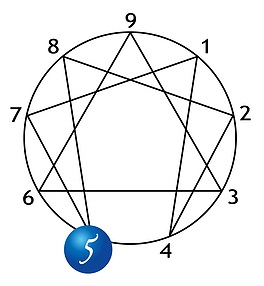
Enneatype Five Grows: Move to Eight
Many Fives report that at some point they realized they were going through life as though they were constantly getting prepared for it, with the result that when they felt ready, life was already over. This is an understandably heartbreaking situation to be in, so it’s vital that Fives come to terms with it as soon as possible in order to live life before it’s gone.
A large chunk of a Five’s growth path comes from understanding that it is ok to get started without knowing everything, and that their marvelous mental abilities will inevitably go to waste if they don’t cultivate them in a practical setting and in the midst of real life action. Ultimately, Fives’ tendency to withdraw from others, withhold their presence and accumulate knowledge is a defense mechanism against fear, but as long as they withdraw they reinforce the implicit notion that the world is so fear-inducing that it must be seen from a distance.
The only way to break the cycle is for Fives to gradually let go of their tendency to let go of the world (it’s a letting go of the letting go) and to dive into it and take full charge of their body and their instincts, taking up space and showing up. In doing this, they start to embody the better qualities of Enneagram Type Eight, the most physically expansive and assertive of the nine type. Interestingly, Eights, like Fives, deal a lot with the idea of truth, but Eights have an instinctive awareness of it, whereas Fives have an analytical understanding of it.
In allowing their insights to take physical form, Fives reduce their tendency to detach from reality and become capable of bringing their objectivity and knowledge to fruition. Their ability to let go of things is used not to renounce the world, but to experience it all equally in all its transient permutations. Detachment thus becomes non-attachment.

Enneatype Five under Stress: Move to Seven
Fives generally hate having to jump into things without preparation. They tend to plan ahead as if they possessed half the energy, time and resources they actually have and often don’t communicate their thoughts unless they have had the time to polish, proof and justify them. This is why going to war with a Five in a field they know a lot about is often a lost cause: they are always five or six steps ahead in the argument.
But, as much as they would like to be omniscient, Fives aren’t. The world is too complex to hold it all inside one’s mind before one ventures into it (which is how Fives get started on their journey of observation.) Variables are bound to intrude into one’s views. More importantly, Fives may not always have the chance to step back from quickly unfolding situations to take a breath and organize their mental response.
When this happens, Fives may initially still try to withdraw, but if their usual strategy becomes impossible, it is not uncommon to see them make fools of themselves, like unhealthy Sevens. This is not because Fives (or Sevens, for that matter) are actually fools, but because they panic at the prospect of not being able to employ their typical strategy.
Often, Fives that move to Seven under stress become volatile, scattered, given to missing the mark with odd jokes or comments. Because they haven’t had the time to establish clear boundaries within which they feel secure, they become erratic and aimless, thus lending credence to their own worst fear of being incompetent and needing to withdraw even further.
MQS