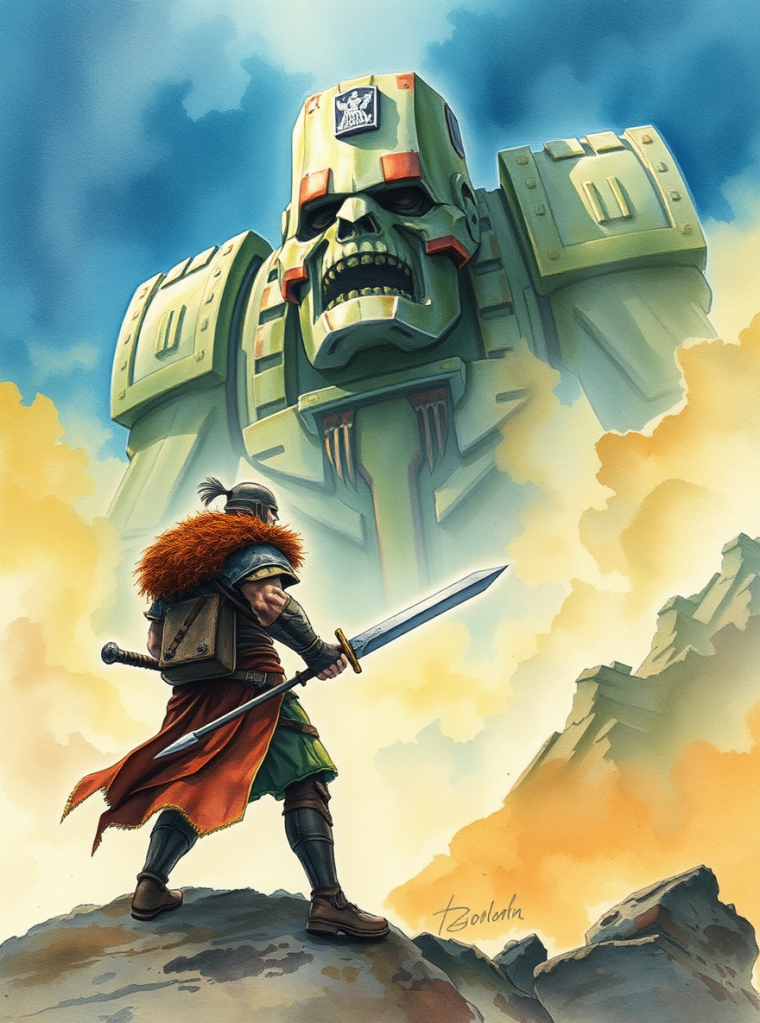
When the last titan was felled, my people rejoiced and called me their leader. Long had been the battle, and full of grief.
I still see it. The great shape folding in half under our bombs, then lying down on its shadow like an unruly mountain. I was raised to my late mother’s throne, to rule over a peaceful planet.
But soon the unused valor of our warriors turned inward. Children started hating their parents. Siblings called each other enemies.
And I understood that to rule in an age without titans is to rule in an age of small people.
Enneagram Type Seven and Enneagram Type Eight can be very similar and are often confused. Sevens are a Head type, who cope with their fear, pain and anxiety by getting lost in a world of pleasure-seeking and fun distractions. Eights are a Body type, and they seek to protect their independence by being assertive and bold and forcing others to deal with them and take them into account.
Both Sevens and Eights are very assertive and outgoing on the surface. Sevens find it easy to attract interesting people and adventures, since remaining confined in a routine can cause them to become restless or even to suffer. Eights are more guarded and do not trust people very much, but they do come out of their inner fortress to mark their territory against others and to let them know that they (the Eight) are not to be messed with. Thus they often end up either submitting others or guiding them.
Both types tend to have a somewhat materialistic view of reality and seek earthly pleasures. Generally speaking, Sevens seek variety and change in order to be constantly dazzled and stimulated and stay hyped about something positive, so that they can avoid being sucked into a cycle of fear. Eights on the other hand usually seek intensity in powerful experiences, as they enjoy the feeling of having something outside of them offer them resistance, and they enjoy conquering it in the end, to prove that they are the ones who are still standing (it is typical, for instance, for alcoholic Eights to want to prove that they can handle one more glass).
passion
Both types often come across as action-oriented. Eights attack problems from an instinctive standpoint, throwing brute force (either literal or metaphorical) against the obstacle until it is destroyed. Sevens are more intellectually versatile (not necessarily more intelligent) and they often quickly come up with plans to overcome obstacles in order to reap the rewards, the rewards usually being meterial comfort and/or the ability to pursue their many passions.
Socially, average Eights operate on a friend/enemy level: they quickly sort other people out in either one of the two camps. For them, life is a battle and they need to know whom they are going to defend and whom they are going to attack. Sevens are not naive, but they see the world more as their oyster, and while they know that there are difficult people in the world, they seek to look past them in anticipation of the fun time to be had after dealing with them.
Eights tend to be more unshakably dedicated to the small handful of people they call friends. Sevens are also very good friends, but they also often look to create different groups of friends based on their interests (the group they go dancing with, the group they watch movies with, etc.) although they too often have a small core of best friends.
Enneagram Type Six and Enneagram Type Eight can be similar, depending on certain factors, but overall they are very different. Sixes are a Head type and are concerned with security and certainty. Eights are a Body type and are concerned with independence and autonomy.
Sixes often tend to be sheepish, friendly, helpful and gregarious. They look for external points of reference that can give them the security they feel they lack (whether this point of reference be a leader, an idea, a group or something else). Eights are much more maverick-like, usually fight for themselves (and for those they wish to protect) and don’t usually need external frames of reference. In fact, they may despise them. If Eights are warriors, Sixes are worriers.
However, Sixes can also act in a radically different way when they enter their contraphobic stance, when they stop running away from fear and tackle it head-on. When this happens, Sixes can be very similar to Eights in that they act in an bold, fierce way that could even come across as arrogant or smug. The main difference between an Eight and a contraphobic Six is that the contraphobic Six still acts based on their deep fears. They are like herbivores charging against the predator.
courage
Socially, Sixes generally adopt a friendly stance. They hope to come across as those fun, dependable fellas you’d take inside and defend if the zombie apocalypse they fear should actually happen. They have a strong sense of the importance of safety nets, since they are forever catastrophizing and thinking about worst case scenarios and since they feel helpless in front of an uncertain world.
Eights rarely act like this. They are usually fierce and even overconfident. Their strategy is to force others to see them as either a threat they want to stay away from or a point of reference to gravitate around, submitting to their guidance. If Sixes try to poke holes in every certainty they have in order to see if if it is, in fact, certain, Eights can often jump the gun, confident they can bend the world to their will by sheer power.
Enneagram Type Five and Enneagram Type Eight are apparently very different, so much so that they are each other’s arrow on the Enneagram symbol: Five is Eight’s stress point, Eight is Five’s growth point. Fives are a Head type, concerned with security, and tend to find it by removing themselves from the world and observing it from a distance. Eights are a Body type, whose drive for independence leads them to asserting themselves in most situations, even and especially when there is resistance against them.
Interestingly, both Fives and Eights assert the energy of their center: Fives assert the intellectual urge of the Head center, Eights the instinctual urge of the Body center. In this, they both tend to break down opposition on the plane on which they operate: Eights break down physical opposition, often by asserting themselves on others more or less fiercely; Fives assert their mind’s right to be the judge of the truth of this or that idea by breaking it down, rarely accepting it as a given. Both Eights and Fives can be confrontational when unhealthy: Eights physically, Fives intellectually.
Assertion
Both types are strongly concerned with truth. Fives seek to develop a true appraisal of reality beyond social or even academic conventions. Eights usually have a very instinctual conception of the truth (their famous bullshittometer). Fives’ danger is of getting lost in the hair-splitting byzantinisms of their mental process; Eights’ danger is of failing to realize that sometimes their instincts do fail them and not everything is as simple and black-and-white as their guts tell them. Eights usually tend to simplify, Fives to complexify. Both excesses are best curbed.
Socially, both Eights and Fives have an individualistic, maverick-like streak, and both can be socially awkward and be somewhat timid. Yes, this also applies to Eights: as soon as they feel they are out of their depth Eights tend to become withdrawn and insecure, like regular Fives, often out of fear of being called out for being stupid or incompetent (this is Five’s fear, which is Eight’s stress point). Usually, though, Eights, while not necessarily social, tend to be imposing and even demanding. Fives, on the other hand, are almost always distant and even remove themselves physically from contact with others. Fives who have consciously worked on their social skills may, however, develop some of Eight’s bodily confidence.
Often Known As: Boss, Warrior, Challenger Sin/Passion: Lust Focus: on the power and strength needed to preserve their independence Fear: of weakness and being submitted Energy Center: Body (energy is asserted) Social Stance: Assertive Key Positive Traits (embodied at their best): Assertive, Strong, Powerful, Willful, Protective, Fatherly, No-nonsense, Decisive, Honest, Truthful, Magnanimous, Big-hearted, Inexhaustible, Fierce, Courageous, Heroic, Able to fight for what’s right, Has a good bullshittometer, Endlessly patient with friends and proteges Key Negative Traits (embodied at their worst): Cruel with enemies, Unforgiving, Aggressive, Overbearing, Vicious, Lustful, Unable to resist own urges, Uncompromising, Intimidating, Impulsive, Foolhardy, Hooked up on intense experiences, An elephant in a china shop, Obtuse, Unwilling to make subtle distinctions even when needed, Unable to unclench Directions of Growth and Stress: to Two and Five respectively
Enneagram chart with Type Eight highlighted
Introduction
An Enneagram Type Eight is usually hard to miss. Not seldom they are physically imposing–not necessarily because they are big or tall (the Enneagram has nothing to do with body type) but because of the kind of energy they emanate.
Eights enter a room and most people in there feel that they need to deal with them, one way or another. They exude power, they know they exude power, and they know you know they exude power. And they like it. Eights are not necessarily arrogant, but they are unwilling to let anyone trample over them, and will often take the opportunity to make it known at the merest slight they receive (sometimes even if no slight was intended).
Being on a Type Eight’s good side not only makes things easier, but it’s also a wonderful experience. They shower the people they like with all kinds of attention. It is like living between a cushion and a very, very soft place. Eights love pampering their friends, family and protégés just as much as they hate anyone that threatens them (either in reality or in the Eight’s imagination).
In fact, they have particularly developed protective instincts toward their loved ones, and average to healthy Eights often take the initiative whenever they feel anyone is being treated unfairly, especially if the Eight believes the person is too weak to defend themselves.
Fairness, truthfulness and honesty are the values that Eights usually cherish the most. They don’t have a cerebral definition of these qualities, but rather an instinctive understanding of it. Eights often feel that they had to toughen up early in life to avoid being treated unfairly or dishonestly, and their sense of justice will often come from their experience rather than from abstract principles.
In a way, they believe that they must still protect the tender side of their personality (figuratively, the small Eight child that still lives inside of them) and this they accomplish by making it known that they are a force to be reckoned with and that they are the one who are in control. This, of course, is where many problems start.
The powerful bear, a good symbol for Enneagram Type Eight
Core Mechanism
Eights belong to the Body triad, and they are the type that most directly and emphatically expresses their bodily energy. Out of all the nine types, Eights are the one with the most willpower, stamina and endurance.
In general, an Eight’s more or less subconscious drive is for independence, like all Body types. Eights achieve independence by either submitting others and being in control of the situation or by preventing others from submitting them. They have a strong sense of who is in charge of any situation, and they often look for ways to make those people know that they (the Eight) are not to be messed with.
An Eight’s greatest fear is of appearing weak, either in front of themselves or, even worse, in front of others. They have a sneaking suspicion that there is a weak point in them that they need to protect, often coming from some childhood event that left a mark. To compensate, they often act overconfident and cocky, and it is not unheard of that they will actively look for a fight, either physical or psychological.
Well-adjusted Eights are capable of using their endless drive in productive and fair ways, and their general sense of justice makes them often heroic. Less well-adjusted Eights can just as easily turn into overbearing villains that force their ways onto others.
Underneath it all, Eights are keenly aware of their vulnerability and deficiencies, and much of their subsequent behavior depends on how they deal with it. If they accept it as a core part of themselves, they can grow and allow others to grow with them, while if they deny it or hide it, it often leads them toward misery for themselves and others.
Passion
Type Eight’s passion is Lust. Lust must not be confined to sexual needs, although Eights may indeed have a strong sex drive. The word “lust” derives from a Proto-Indo-European root which means “to be wanton, unruly“. This is a good description for the Enneagram conception of lust.
Lust is a powerful inclination toward someone or something. The accent here is on “powerful”. Eights have a strong bodily energy, and crave using it to establish themselves and their dominion over anything or anyone outside of themselves. In a way, Eights love the idea of meeting resistance, and they actually respect those that are capable of offering it. By meeting resistance, Eights can overcome it to assert themselves.
When left unbridled, lust can become a source of problems for Eights, as it is a magnet for confrontations, but also because it tends to give them the idea that they simply need to reach for whatever they want and it will be theirs, regardless of what others think and do. This leads to the typical problem of Eights being wanton and having no self-restraint.
The lack of self-restraint of an Eight is different from that of, say, a Seven, as the latter seeks variety and fears confinement, while Eights seek intensity, even if just in one or two fields.
Unfortunately, the lustful attitude of an unhealthy to average Eight can lead to people becoming extremely resentful of them for behaving like the villains of a martial arts movie. As Eights already feel the need to protect themselves by being assertive, when they pick up on people’s less than friendly attitude they can be led to ramping up their aggression, which is obviously a recipe for disaster.
Lust, the passion of Enneagram Type Eight
Misconceptions
It is not uncommon for people to describe Type Eight as the “bad” type. Even when explicit value judgments are absent, Type Eight descriptions tend to be less than flattering. Not that I think the Enneagram should flatter anyone, but we should certainly acknowledge that there is a place for every type.
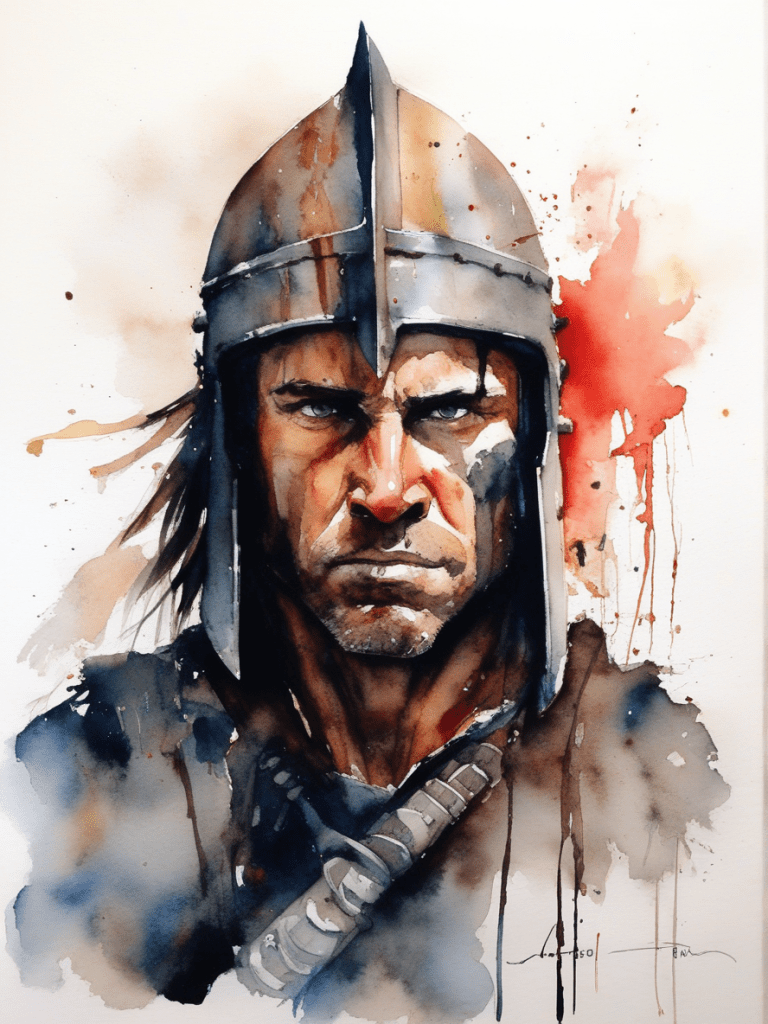
The reality is that the aggressive mediocrity that rules our spayed and neutered world today is quite allergic to the kind of warrior-like values that Eights tend to embody. Eights are not inoffensive, they are not conciliatory and they don’t give a flying fig about not hurting other people’s emotions. They are, in the best sense of the word, predators, and predators go for the jugular.
This is not to say that Eights must be protected from criticism, either. First of all, they don’t need protection, and second of all, like every type they can become entangled in their own mechanism, with negative consequences for themselves and others.
What is true is that being in front of an average Eight *is* confronting, for two reasons: because Eights’ way of asserting themselves is of confronting others directly, and because people are generally used to exactly the kind of tea-and-cookies social niceties that Eights rarely provide. As with any type, there is plenty of room for others to learn something from Eights.
Wings
8w7: Eights with a Seven wing are generally hard to miss when you come across them. The in-your-face quality of Type Eight is magnified. They tend to be extremely quick-witted, though they are also generally pachydermic in their way of dealing with subtle issues. They rarely complain about anything and are possessed of incredible endurance and willpower.
8w9: Eights with a Nine wing are the archetype of the lioness protecting her cubs. There is a more conciliatory aspect to this subtype, and a tendency to use their power to hold together and protect the important bonds in the Eight’s life (this can be for better or worse). Usually, this subtype is more tranquil and laid back, although it still cultivates its sense of condifence that, in case of need, it can break a bone or two.
(note that wings can have some minor descriptive power in terms of superficial behavior, but they are irrelevant in terms of what motivates the person. Many people have no noticeable wing, while few show signs of both.)