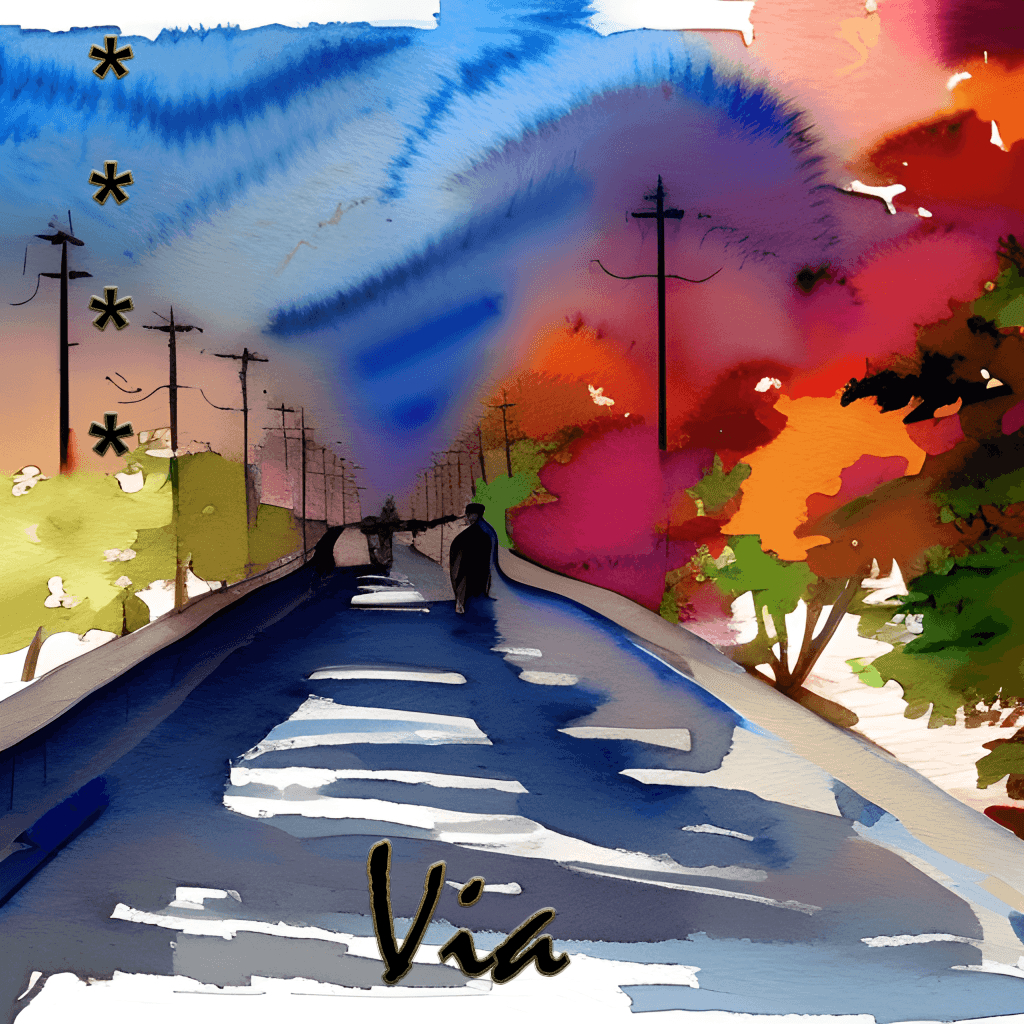
Following my deep dive into the Door Knockers, which seems to be an exclusive symbol (or almost) of Italian cartomancy, let’s talk about a much more universal presence in many traditions: the Road. Still, even though the symbol is widespread, the interpretations may vary.
I was introduced to the symbol of the road when being taught to read playing cards. In the system I was introduced to, the Two of Clubs is the card of the steps. Actually, the word for it was “cammino”, which means a way, road or path, but it also implies the idea of people taking steps on it. That is, a ‘cammino’ is a road that exists because people walk on it, rather than being a road that has been created so that people may or may not use it. An example would be a path through a forest or a road created by pilgrims as they progress on their pilgrimage.
The Two of Clubs therefore implies forward motion toward a goal of some kind, and the taking of steps, whether literal or figurative. In this, it is similar to the Two of Wands in some Piacentine cards systems, which interpret the card as a road, largely due to its design showing two parallel staves, no doubt (although in some other Piacentine systems the road is the Knight of Wands).
The Vera Sibilla doesn’t have a road card per se, although it does have various cards connected with movement, journeying or taking steps/fighting for something. For instance, the Journey card is connected to traveling, while the Soldier may imply fighting to attain a goal (although, being a Spade card, the struggle is more accentuated).
Etteilla famously attributed the meaning of road to the Six of Swords, and his pupils developed a whole vocabulary of synonyms that extend the meaning into other areas. An example of this is the meaning of conduct, which is, figuratively speaking, the path of the person’s actions through life. Etteilla’s attribution of the meaning of road to the Six of Swords remained attached to tarot through the Golden Dawn, who preserved it in part as a possible meaning in their Book T, and then through Waite, who had Smith design the Six of Swords as a card of journey. Even in the Crowley tradition this attribution has in part been rediscovered in Eshlemann’s Liber Theta.
In the Bolognese tarot, the meaning of road is attributed usually to the Six or Eight of Wands. Some strands of the tradition also distinguish between an open road (Six/Eight of Wands) and a closed road (Nine of Wands or Ten of Swords). The road is in itself a card of forward motion, like the Two of Clubs, it can indicate short trips and it is a card of openness.
The road or path is also present in the Lenormand and Kipper traditions. I am unclear on the Lenormand meaning, as the interpretation seems to have evolved considerably through time. Most contemporary English-speaking sources seem to see it as a card of choice (with two paths, although I am unsure if this duality was intended in the original design). Most German sources interpret it differently. Since I am not a Lenormand reader, I will leave it at that.
As for the Kipper cards, they have a card called Ein langer Weg, a long road. In most of the sources I have consulted, the card is more static than in the other traditions, highlighting the element of time (some call it the Two Years card). Interestingly, in many German Skat systems of divination, the suit of Spades / Leaves is connected with movement, and the low-numbered cards, mostly the Seven and Eight, can show a short trip or something happening quickly, while the Ten is also called the long road, and it can indicate an actual journey or the need to wait a long time.
BONUS: The Road is obviously present in Geomancy as well. The Geomantic figure Via, attributed to the Moon, is a symbol of journey and change. It is the symbol with the least amount of points, only one in every position, so some sources also attribute it to the concept of ‘little’ and to the waning of something.
Fludd discusses the meanings of Populus, Via, Conjunctio and Carcer in the various houses.
Populus
In the First House, a multitude of thoughts about water, journeys, peoples and nations. In the Second House, with good (figures), a much fortune and riches; with evil much trouble. In the Third House, multitude of relatives, neighbors, and little journeys, both good and bad, according to the nature of the figures.1
In the Fourth House, abundance of water, laboring for an inheritance, fruits, according to figures. In the Fifth House, a multitude of children, letters and news, joy or sorrow, kisses and embraces, gathering of people for delights and joys, fruits, according to figures, and so on in the rest according to figures. In the Sixth House, a number of animals, slaves, sickness, injuries, and other things according to the figures.
In the Seventh House, a multitude of people gathered, women, enemies, good or bad according to the nature of the figures. In the Eighth House, a multitude of people assembled for a death, or a multitude of good or evil, according to the goodness or malice of the figures. In the Ninth House, a multitude of journeys, dreams, knowledge, people on the way, multitudes.
In the Tenth House, a multitude of enemies, kings, of people before judges, doctrines, assembly for good or for evil, according to figures. In the Eleventh House, a multitude of friends, good fortune, beasts, servants, children, or inconveniences, according to the nature of the figures which have been found in the vicinity.2 In the Twelfth House, a multitude of enemies, inconvenience, long imprisonment, tears, debts, beasts, and slaves.
In the Thirteenth House, much profit to him that goes to any magnate,3 of loss, change, and the like. In the Fourteenth House, a multitude of people, assembled, either for good or for evil, according to the figures next to it. In the Fifteenth House a multitude of good or evil, a gathering of people for good or for evil, according to the figure from which it comes, for if it comes from good figures, it denotes much good, if from bad, the opposite.
Note that this figure, found in the first house, represents a merchant of various things passing through the countryside.
Via
In the First House, a good journey, little profit, thoughts of small fruits. In the Second House, loss or gain, according to the neighboring figures. In the Third House, brothers, neighbors, water, a good journey, light4 business, journeys for a brother or cousin, comparison of wealth.5
In the Fourth House, parents, labors, lands, the concealment of tainted things, the end of things, poverty, poor parents, poor inheritance. In the Fifth house, letters, messages of little importance, little fruits, poor manners, poor children, little joy. In the Sixth House, poor animals, bad luck, unstable servants, sudden increase of disease, deliverance from disease,6 misfortune of animals.
In the Seventh House, robbers, poor women, little sense,7 poor and weak enemies, a harlot, death of robbers. In the Eighth House, poverty in a foreign country, loss of inheritance. In the Ninth House, a change of letters,8 messengers of little knowledge, a good journey, benefit of the church, little gain and profit
In the Tenth House, small offices, little profit from lords and noble women, an old judge, little wisdom, loss in any thing. In the Eleventh House, poor friends, little fortune, little profit, gifts of merchandise and letters of joy. In the Twelfth House, useless animals, poor friends, easily coming out of prison, liberation from debts or from misery, and sometimes death in prison, according to the good or bad figures around, and from whom it is generated.9
In the Thirteenth House, profitable journeys and changes. In the Fourteenth House, loss in any matter, according to good or bad figures. In the Fifteenth House, travel, good outcome according to the figures from which it comes.
Note that when Via is found in the First House, it means a changeable, false and poor person.
Conjunctio
In the First House, a man of good speech, eloquence, subtlety, art and goodness, and if it is combined with good figures, goodness of heart and friends. In the Second House, the acquisition of good fortune, profits in commerce. In the Third House, the good will of relatives, the gathering of relatives and neighbors.
In the Fourth House a good path, a good end, a good friend, a profitable inheritance and legal proceedings, letters for inheritance. In the Fifth House, letters, news, gathering of good people. In the Sixth House, a long illness, evil servants and robbers.10
In the Seventh House, good company, thieves and subtle and eloquent enemies, whether in litigation or in battle. In the Eighth House, a gathering to divide the property of the dead. In the Ninth House, knowledge, a bad journey, robbers on the road, knowledge and eloquence in clerics and ecclesiastical men.
In the Tenth House, the service of lords, kings and profits in teaching or profession. In the Eleventh House, good luck, the gathering of all things, conjunction of love.11 In the Twelfth House, prisons, bad journey, bad assembly, bad people and bad life.
In the Thirtteenth House, goods and profits from one’s lord. In the Fourteenth House, a lot of luck in love and work. In the Fifteenth House, good luck in good things, bad in bad things according to the figures.
Note, when this figure is found in the First House, it signifies a prudent man, a clerk, or occupied in an office for money, of moderate build, as quickly consuming his fortunes as he is acquiring them, skilled in the liberal arts, and so on.
Carcer
In the First House, loss and imprisonment of men, timidity, sadness, sadness of heart, secret thoughts, hindrance of journey. In the Second House, servitude in all secret things, and thoughts of love of money.12 In the Third House, love of parents and profit, the love of God, hindrance and retardation of the journey, greedy brothers and neighbors.
In the Fourth House, inheritance, hidden treasures, underground houses, hidden and dark places, good inheritance. In the Fifth House, a few children, a pregnant woman, writing letters and news, rude people, raw food, dirty clothes, secret love affairs. In the Sixth House, disease in prison, a pregnant woman, a useless servant, a bad man and woman, death or a long illness, disease in a man’s secret place,13 a brute.
In the Seventh House, accidents, bad company, adultery and secret fornication with another’s woman, secret enemies, a vile thief who is caught in his robbery, ships going on water.14 In the Eighth House, death, inheritance of the dead, bad profits in a foreign land, fear of death. In the Ninth House, a road or journey from the country, death, letters and secret knowledge, secret roads, obstacles on the way, sadness in the church, sad and dangerous dreams, good sense.
In the Tenth House, good fortune, strength of dominion, a sad judge, secret opinions, dishonorable offices. In the Eleventh House, profitable friends, little profit from lords, profitable in trade through travels, gathering of good kings. In the Twelfth House, prisons, debts, graves, evil beasts, incurable disease, long imprisonment, long debts, secret enemies, but timid by nature.
In the Thirteenth House, profitable journeys, brothers and friends, gathering of good things, sad and secret thoughts. In the Fourteenth House, various thoughts, imprisonment with sadness and pain and work, debts and obligations, and these especially when it doesn*t come from good figures. In the Fifteenth House, much fire15 and destruction.
Note, when this figure is in the First House, it signifies a dark man, with a thick head, curly hair, and often ignorant carpenters, or otherwise working with wood.
General rule
It must be noted that good or evil, profit or loss, is promised through each house, according to the nature of the figures with which the figure of each house is conjoined, or from which it is generated.
MQS
Footnotes
Fludd often repeats this, but it is not always clear what other figures he means. Occasionally it seems he hints at the fact that the whole shield must be looked at and judged to see if it is broadly good or bad. ↩︎
It is not clear if Fludd is hinting at the doctrine of the company of houses. ↩︎
Abano discusses the various meanings of Via, Populus, Caput and Cauda when deriving from various figures.
Via
From Via and Populus, its meaning is weakened, but quickened.1 From Acquisitio and Amissio its efficacy is mediocre in every question. From Major and Minor it means good luck, but it is still mediocre. From Laetitia and Caput, it means good luck and success.
From Tristitia and Cauda it means misfortune in the question at hand, and it is very strong in its malice. From Albus and Puer it is mediocre good luck. From Rubeus and Puella it shows a mix of good and bad, but it brings about the thing quesited. From Conjunctio and Carcer it means good luck, stability and firmness in all one asks about.
Populus
From Populus and Populus it means stability, getting one’s wish, copious amounts. From Acquisitio and Acquisitio it means great good luck, great acquisition of what one wishes, usefulness. From Amissio and Amissio it shows good luck, and being venereal and lascivious. From Major and Major it means fortune, stability, great gain, honor. From Minor and Minor it means mediocre good fortune. From Via and Via it means weakness in the thing enquired about. From Caput and Caput it means good luck, usefulness. From Cauda and Cauda, it means great misfortune.
From Albus and Albus it means good effect, good outcome especially in watery things and womanly or white things. From Rubeus and Ruveus it means excessive evil, war, loss of blood. From Laetitia and Laetitia it means good luck, happiness, honor, easily getting what one wants. From Tristitia and Tristitia it means great misfortune, long lengths of time, difficulties and problems, enmities. From Conjunctio and Conjunctio it means good luck, getting one’s wish, good for marriage and partnerships. From Carcer and Carcer it means great good luck in everything, melancholy and difficulties, anger, discord, infirmity, prison. From Puella and Puella it means good luck and fortune, firmness, usefulness, getting one’s wish. From Puer and Puer it means war, fighting, discord, good for merchandise, mediocre gain, good for marriage.2
Caput
From Populus and Caput it means great firmness, good outcome. From Acquisitio and Albus it means great good luck, getting one’s wish. From Amissio and Puer it means misfortune, loss, difficulties. From Major and Rubeus great good luck, mediocre gain or honor, good fortune. From Tristitia and Conjunctio it means good luck and gain, but with delay and difficulties. From Cauda and Carcer it means misfortune and tragedy.
Cauda
From Populus and Cauda it means misfortune, long illness, difficulties, weakness in getting one’s wish. From Acquisitio and Puella it means good fortune, firmness, usefulness in mobile things.3 From Amissio and Rubeus it means misfortune and grave danger. From Major and Puer, it means misfortune under the guise of gain.
From Via and Tristitia it means misfortune in getting what one wishes, and long-lasting difficulties. From Caput and Carcer it means mediocrity, good for virtue and honorable things, otherwise loss. From Laetitia and Conjunctio it means mediocre fortune, but gain from merchandise. From Albus and Minor, it means good luck and freedom from difficulties, but mediocre gain.4
MQS
Footnotes
One of the reasons this Book IV is interesting is that it affords us a look into how old geomancers derived meanings from the interaction of figures. Unfortunately Abano’s process is not always clear. Furthermore, it is not clear whether Abano means what I have written (namely, Via’s meaning is weakened but quickened) or if he is saying that Via’s meaning is weakened more than any other figure. I have chosen my interpretation based on this logical argument: that Populus tends to accentuate the meaning of the figure it interacts with, and Via is weak and quick, so in interacting with Populus it would become weaker and quicker. ↩︎
Generally speaking, it seems the effect of Populus is that of accentuating the meaning of the figures it comes from (‘lots of…’). However, some interpretations are not clear, for instance Carcer and Carcer meaning great good luck. Note also that Populus is the only figure that Abano explains in full, giving all possible combinations. ↩︎
It seems here that the two positive figures rub off on the otherwise foreboding Cauda. ↩︎
Again, the two positive figures it comes from seem to bring out the best in Cauda, according to Abano. ↩︎
Abano discusses some of the meanings of Populus and Via in the houses of the chart.
Populus
Populus in the first house means change,1 a mutable life, but a long one, and water, rivers, company, ships, mills, prairies, rain. In the second it means gain of a lot of wealth, good merchandise, gain of money. In the third it means gaiety with siblings, union with one’s neighbors, dangerous travel, gardens, watery places.
In the fourth it means the city, castles, buildings, union, congregation of people, inheritance, usefulness, abundance throughout the year. In the fifth it means many children, succession, inheritance of a pregnant woman, unstable children. In the sixth good family, many animals, usefulness through servants, deadly illness.
In the seventh it means good marriage, good partnership or company, usefulness, love of unstable women. In the eighth it means tears, funerals,2 inheritance, usefulness from dead people, gain through women, fear of death. In the ninth it means long travel with gain, rain, storm while at sea, shipwreck but ending well, peregrination with company.
In the tenth it means congregation of lords, exaltation of common people over the lords,3 rebellion, schism, diversion, suffocation of common people, grave person. In the eleventh it means dignity, gifts from lords, usefulness from the mother.4 In the twelfth it means many occult enemies, damage from their coconspirators, unjust machinations, freedom from illness and by sea.
In the thirteenth it means good company, security, safety in travel, gain from friends, goodwill, gain from travel, good return of the absent party. In the fourteenth it means gain from the mother5 and from relatives, inheritance, good fame. In the fifteenth it means good things, but with delay.
Via
Via in the First House means a positive journey, whether long or short, poverty, a short life. In the second it means little wealth, toil, loss of money and possessions. In the third it means a short journey, gardens, pleasure, gain from the dead,6 few siblings.
In the fourth it means a small inheritance, little gain, desert places, lots of water, a year of dearth, being without a father or mother. In the fifth it means few children, good relatives, succession for the mother.7 In the sixth it means servants fleeing, small animals, little gain from them, short but dangerous illness, bad servants.
In the seventh it means an unstable woman, corrupt, sad, unstable marriage, company of few but good people. In the eighth it means liberation from infirmity and from prison, fleeing danger, return [of someone]. In the ninth it means a long journey soon, goods from the church, messengers, unstable and unfaithful religious people, a bad life.
In the tenth it means instability for the kingdom, lordship, dignity, unjust judges, infamy. In the eleventh it means little hope, vain hope, unfaithful soldiers and curials. In the twelfth it means few enemies, unfortunate journey, falling from a high place,8 danger of death, loss of inheritance due to the mother, freedom from prison.
In the thirteenth it means gain from travel, a secure street, little rain, good for selling. In the fourteenth it means damaged goods, short journey, dispatching goods, the absent party is coming back soon. In the fifteenth it means good change, a quick resolution.
MQS
Footnotes
Usually, Populus is taken as a rather stable figure, while Via should indicate change. Here Abano considers them both rather changeable, possibly due to the association with the Moon. ↩︎
Because Populus means the common folk, and finding it in the Tenth House it can show that the common folk take over the place of honor. Once again, this shows very well how we ought to interpret the chart. ↩︎
The mother is the Tenth House, her Second House shows gain from her. ↩︎
Because the Fourteenth derives from the Eleventh and Twelfth and the Eleventh is, as discussed, gain from the mother. ↩︎
I don’t understand why in this house Via should indicate gain from the dead. ↩︎
Possibly because the Twelfth House is cadent from the Tenth House, the highest place in the chart, and Via shows physical movement, thus “a movement that falls from a high place”. ↩︎
Name of the Figure: Via (The Way); some give it as Candela (Candle) Element: Water Planet: Moon (waning) Sign: Leo Quality: Common Fortune: Mixed
When interpreting Via, there’s a couple of notions to keep in mind. First, its interesting geomantic property of turning every figure into its opposite: If you add Via to Conjunctio, meaning connectivity, you get Carcer, isolation; if you add Via to Puella, innocence and balance, you get Rubeus, vice and lying; if you add Via to Caput Draconis, the beginning of something, you get Laetitia, its peak, etc. This is because Via has one point in each elemental row: one point in the Fire row, one in the Air row, one in the Water row, one in the Earth row. One point, when added to another single point, turns it into an even double point, while when added to a double point it turns it into an odd number again.
Illustration of the Geomantic figure Via, the Way
This property of Via connects well with its meaning of change, travel, etc. It is an active, transformative figure, indicating that the situation will not stay as it is. Something that began one way will finish as something different.
Another interesting and often mentioned property of Via is that it has the least amount of points of any figure in Geomancy, four. This can mean that Via stands for a small amount of something, whether for good or ill. This, however, is usually only in questions of quantity (“Will I get back the money?” “Yes, but only a small part.”)
Finally, because it is in contrast with the other figure of the Moon, Populus, which is the crowd, Via can represent aloneness, not necessarily in a bad sense. It can show someone doing something alone, following their own path. It may indicate independence. However, if you dabble in the old manuscripts, you will see that depending on the author Via is attributed better or worse qualities depending on that author’s own ideas. I personally find it a neutral figure, if an unstable one.
Common Keywords: Travel, path, journey, going, moving, acting, making inroads, change, transformation, one, only, lonely, small, little, small amount
Via in the Geomantic Houses (these are only examples. Use context to guide your interpretation)
House
Possible Meanings
First
A traveler, wayfarer, piligrim, small stature, phlegmatic temperament, changeable, A short life
Second
Traveling merchant, Little money, change in the economic situation, poverty
Third
Short trip, visit, younger siblings, arrival of news, partly true rumors, the garden or neighborhood
Fourth
mixed end results, instability at the end, a trip to see one’s parents of father, little inheritance
Fifth
Few children (possibly one), going to a party, little pleasure
Sixth
short illness, change in the health, servants are arriving or fleeing (traditionally), small animals, small gain from animals
Seventh
Unstable partner, highwaymen, little company, gain or loss of support (depending on how one is at the present moment)
Eighth
Fleeing danger or fearful situation, little money from other people
Ninth
Long travel, little faith, unworthy knowledge or teacher, a process of transformation, inner journey
Tenth
Unstable government, Unstable profession, change of job, traveling for work, authority figures are not to be trusted
Eleventh
vain hope, little hope, little help, changeable friends, few of them
Twelfth
Release from prison, Freedom from addiction, Few enemies
Thirteenth
Unstable past, ability to change, good for traveling, positive journey or path
Fourteenth
quick solution, the situation will evolve or change, issues while traveling
Fifteenth
There will be travel or change for good or ill, Quick solution
Possible meanings of Via in the various Geomantic Houses. Note that this is not meant to be exhaustive, and it only serves to jog your interpretive muscles