Tag Archives: Vera Sibilla

Vera Sibilla Cards That Indicate Loss

I’m going to write a few articles on the similarities and differences between cards in the Sibilla deck based on certain topics or concepts. Because I’m a positive person, let’s start with the concept of loss.

This list is not meant to be exclusive (for instance, most bad cards next to the Money card can show loss of money). Context is key, and each spread must be studied as its own thing. Furthermore, loss is not the only meaning of the cards I talk about here.

Five of Hearts Reversed (Happiness)

The 5♥R generally indicates failing to meet aims and failing to live up to promises and commitments. These ideas can easily be what leads to loss, whether material or in the field of relationship (though it also has a strong connection with cheating in the latter field).

Six of Hearts Reversed (Money)

This one doesn’t require much in terms of explanation. The Money card, when reversed, can indicate money troubles.

Eight of Hearts Reversed (Hope)

When upright, the 8♥ is connected with investments (things where there is a hope placed on future returns). When it is reversed, it often shows bad investments causing losses. It also indicates relationships that go up in smoke.

Ten of Hearts Reversed (Perseverance)

Traditionally, the 10♥R is really bad for commerce, as it shows loss of contracts and even of merchandise. More broadly, though, this card bodes ill for anything where you wish for smooth sailing.

Six of Clubs Reversed (Surprise)

When upright, the 6♣ represents a positive discrepancy between effort and returns: you get more than you hoped for based on your efforts. The 6♣R is the opposite: you put much effort into something but get little in return. It also shows excess confidence and ambition causing losses.

Five of Diamonds Upright or Reversed (Melancholy)

In general, this card represents unsatisfactory situations, but next to the card of something we hope to get it shows either we don’t get it or we are unsatisfied with it. When reversed it speaks more clearly of loss and debts.

Eight of Diamonds Reversed (Handmaid)

The 8♦R often speaks of the need of spending money or money going out in general. By itself not a tragic card, but its meaning can be exaggerated by the presence of other difficult cards. It also indicates lack of skill in balancing a checkbook.

Ten of Diamonds (Thief)

Obviously, a thief takes something from us, so we lose that something. The 10♦ represents all situations where we lose someone or something, and if other cards of dubious moral import add their meaning, foul play may be suspected.

Ace of Spades (Sorrow)

The A♠ is a strong card, which can modify most readings for the worse. It represents feelings of bereavement and loss, not necessarily material in nature. If it is material, it is likely to be a big loss, as it will shake the querent to the core, like a letter containing tidings of death (which is what the card represents). When reversed its meaning is lessened.

Three of Spades (Widower)

This is the ‘loss’ card. It represents the notion of ‘without’ and it brings loss to the fore as a concept. The loss doesn’t need to be material, so the 3♠ can show loss of friends or social support. As the title implies, it can show widowhood. When reversed the loss is more traumatic.

Five of Spades (Death)

The 5♠ is similar to the Widower in its depiction of loss, but the loss is sharper and is more likely to radically change (usually for the worse) the querent’s life.

Seven of Spades (Tragedy)

The 7♠ represents disruption, the surfacing of unaccounted or unexpected factors bringing the loss of what we hoped to achieve. As with most really bad cards, the Seven of Spades can add its meaning to other cards to bring most projects to their knees.

Eight of Spades (Desperation and Jealously)

The 8♠ is specifically connected with a crisis in material affairs (though of course it can bring problems to relationships as well). It is not uncommon to find it when the question is about investments or debts, showing a critical situation where the querent must tread carefully to avoid making mistakes they’ll deeply regret.

MQS
The Spiritual Aim of Divination

I had a short but interesting conversation with a visitor of this site. He quite liked many of my articles but was somewhat perplexed by my iconoclastic attitude toward the spiritual side of divination. I think this is a good time to clarify my views further, since the reason I am so scathing is not that I hate spiritual work, but that I take it seriously.

First off, let us distinguish inspired divination from technical divination. Inspired divination is the downloading of information, as it were, from a spirit, a deity, an inner contact or some such. This depends wholly on either the inborn talent or the level of initiation of the diviner.

Technical divination works for the same reason that stones fall: because that’s how things are. One learns it the same way one learns math: they must be predisposed to it and must put in the work. Of course, one can mix the two types of divination, but they are essentially different.

Either type can be used to obtain concrete information. Either type can be used to fool yourself or others (but especially yourself). The difference is that inspired divination, especially as a consequence of initiation, has the perk that the diviner must have somewhat balanced themselves out of many of the delusions typical of the spiritual community at large. Technical divination may be just as hard for other reasons, but the counters used in the prediction are available to everyone.

From here come the hordes of tarot readers and astrologers that (believe they) are using divination for spiritual aims, or inner work, when in fact they are sinking more and more into Delululand, as most of the time they aren’t really speaking to gods or angels or ancestors but rather to their own ego (have you ever heard any tarot reader or astrologer that uses this approach say something that goes against their convictions? How come their gods or ancestors always have their same values, their same political bias, their same preferences?)

The preconception here is that divination, in order to be spiritual, must be about spiritual topics. This is as a result of two widespread phenomena: 1) most people in our society see spirituality as something separate from concrete life, something that takes place in a bubble of white light 2) most people who become interested in divination are initially interested in concrete answers, but finding that getting these is hard and not immediately rewarding, they reframe divination as ‘not really to know the future but to improve yourself’. This is at the heart of the deadly divination/fortune-telling distinction that plagues our art.

In reality, divination is an inherently spiritual practice: 1) by the mere fact of working it deflates the modern ego 2) by its ability to pinpoint how the future is likely to pan out it puts a stop to the marketable but untrue ‘you are the master of your own destiny’ nonsense 3) by showing how the intricacies of real life can be mirrored in a microcosmic mirror it teaches the diviner to rise above himself and his preconceptions and adopt a more universal standpoint 4) by proving that some things are fated it teaches the practitioner to have compassion for themselves and others and to reevaluate their priorities.

Once again, a geographic analogy could help. A traditional diviner who seeks to understand life is like one using a map of a territory to find his way around. By studying it closely the traveler can eventually form a good understanding of the land he is in. A (pseudo)spiritual approach to divination though is like that same traveler painting the map with a uniform white paint because, at the end of the day, everything is one divine unity. That may very well be, but now the traveler is lost without the map and can only sink deeper in his preconceptions in trying to picture the route.

MQS

Can I Trust Him? Well, Can He Trust You? Vera Sibilla Reading With a Twist

Querents are not always paragons of virtue. There are usually two sides to most stories. I generally distrust people whose past is littered with psychos, crazy ex and narcissists. While someone CAN be that unlucky, the general trend seems to me to be more that people who have trouble in every relationship tend to be the cause of the trouble. “My love life is always a mess!” Of course it is, Rhonda, you are always in it!

As I said, there are usually two sides to each story, but as diviners we rarely hear the other one, so what we are stuck with is the querent’s own version, their word that the universe is constantly conspiring against them and a divination system usually saying exactly the opposite. And we are stuck in the middle of the perfect storm, carefully trying to thread the fine line between politeness and truth.

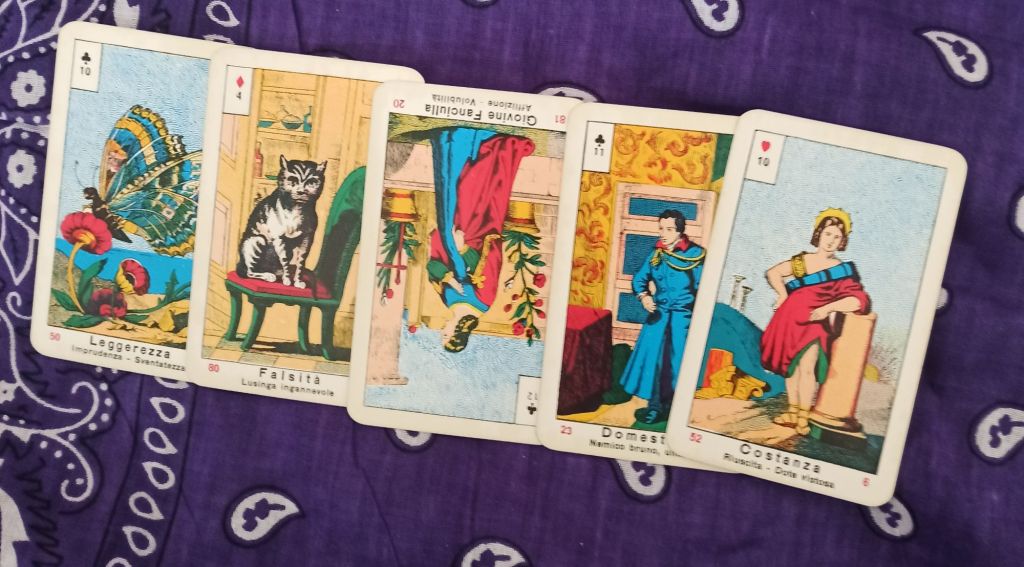
We were at a friend’s house and she had invited over another friend. The latter asked me the question: “I’m always unlucky in love. I’ve started dating this new guy, can I trust him?” Our friend made an odd face I could not decipher as we did the spread. These were the cards:

Is he reliable?

As I already discussed, sometimes the cards describe the development of a situation as if it were a book. At other times, they recreate a scene that can almost be observed with the characters calling attention to what they symbolize. This is one of those situations.

Right off the bat we notice that both querents are present. They are within the age range of the Queen of Clubs and Jack of Clubs. However, the mere fact that they are represented by these cards in a love question shows that this is not the romance of the century and will probably end, sooner or later. The cards, though, tell us something else.

Look at the Queen of Clubs! She is reversed and occupying the center of the spread. Usually, when the Young Maiden (Giovane Fanciulla) is reversed, she is afflicted by something, as opposed to other significators which, when reversed, tend to show problematic behavior.

This is unless the Maiden is reversed and near cards that show problematic behavior. This is exactly the case here. She is together with the Four of Diamonds, the Falsehood card (which, notice, is on her side of the spread, not on the guy’s side) and the Ten of Clubs, the Levity or Carefreeness card.

On the other hand, we have the Ten of Hearts, i.e., the Perseverance card, on the side of the boyfriend. Although the Perseverance card is not one of major feelings, it still shows him to be dependable. She, however, is depicted by the cards as being not only somewhat whiny, but also a little flighty (someone might say a little floozy, especially since she comes up reversed with the Ten of Hearts at the end of the spread)

In this situation, I tried to sugarcoat it to the querent by telling her that he is rather dependable, though this romance was probably not the one that would lead to marriage, and that he also had doubts about her, and that she should make sure not to send mixed signals.

Upon leaving, our friend pulled me aside and she told me that the girl has literally been the “butterfly” of the group, landing from man to man, being unreliable and not learning anything from experience. This is very well described by the reversed Queen of Clubs, who, in a negative context, can show a woman with a princess complex who thinks everyone else is at fault.

MQS

Three Enemies of Good Divination (and One Ally)

Remember those listicles that were much in demand about ten years ago, before people grew tired of the rage-bait? Yea, they still do them, but they have somewhat fallen out of favor, especially since they are so basic even AI can do them better than the poorly paid saps who wrote them back then. Anyway, here’s a short one, hopefully more interesting than the average listicle, on what generally hinders good divination, plus a bonus entry for what helps.

Mechanic Behavior

Divination eschews mechanic repetition. Asking the same question one or two times is fine because there is still enough emotion behind it to put the system into motion. In fact, it is fine to ask the same question many times as long as the querent is truly invested in it, but the more the querent asks the same question with the same emotional drive as the first time, the more you know the querent is cuckoo and is best avoided. In general, it is best to wait a little between divinations.

This point is one that skeptics seem unable to wrap their heads around, because it seems to run against the principle that experiments can be repeated ad libitum, but it is really quite simple: divination is not an experiment, and the more you mechanically ask the same question, the more the real question changes to whatever it was at the beginning to “does divination really work?” and this question cannot be answered by divination itself.

All in all, a balanced relationship to divination as a means of intelligence gathering, together with the understanding that we are attempting something more exceptional than cleaning the cat’s litterbox, is in order.

Shallow Understanding of the System You Work With

If you asked your doctor how he knows his diagnosis is right and he told you it was just his intuition, you’d feel justified in seeking a second opinion. Yet among ‘spiritual seekers’ anything that reeks of effort and study is frowned upon and people go to extraordinary lengths in order to avoid the simple fact that both knowledge and experience are needed to perform satisfactorily in any sector of life. So they come up with anything from intuitive advice (which essentially means “don’t ask me how I know”) to the great angel HRU to fairies to ‘kickass schools of non-duality.’

The reality is that divination is a method for the acquisition of knowledge. If we don’t make the effort of studying the method we don’t get much knowledge. I believe the current distrust of study comes in part from the distrust of intellectual knowledge (see the bonus entry in this list) and in part from the fact that many people who become interested in divination do it to create a little bubble of mystery and mysticism away from the golden cage that is modernity.

Either way, it is a misguided attitude. Divination requires study. Lots of it. In fact, the study will never end. The good news is that we can start practicing much sooner. As for intuition, it does have a place in divination, and I’ll talk about it in the future, but unbridled intuition is just a badly behaved kid.

Bias and Preconceptions

I’ve already talked at length about this, and I will probably still talk about it in the future. It bears repeating: the more we think we know, the less we’re open to discovery.

Aside from ideological forms of bias, which are always bad regardless of the ideology, there are also other forms. One of the most deadly forms of bias is, for instance, the belief that the querent knows what they are talking about. A querent doesn’t need to be malicious in order to confuse us: they can just be confused themselves, or they can have built a whole scenario inside their heads before sitting in front of us.

On the other hand, talking over our querent and treating them like a special needs child won’t do either. There needs to be a balance between our ability to see the truth of the matter in a dispassionate way (thanks to the divination system we are employing) and open-heartedness toward the querent. As a matter of fact, an open heart can go a long way.

Querents can also be biased against us, but we can do nothing about it. People sometimes ask me what happens when someone asks false questions maliciously. What happens is that if I’m lucky, I’ll understand it from the cards, while if I’m not lucky I’ll make a fool of myself. Either way, the person won’t change their mind about divination or about me, so why bother getting worked up about it? Stuff happens.

Your Brain, Your Best Friend

Ever since Madame Blavatsky disgracefully started peddling poorly understood principles of oriental philosophy, the Western esoteric world has become convinced that the “mind is the enemy”. People generally think so (isn’t it ironic? The mind thinking that the mind is the enemy) because they are incapable of using it but want to sound deep in their incompetence.

In reality, if there is such a thing as overthinking, there is also such a thing as underthinking. The idea that everything must come immediately and instinctively to us in a space of pure knowing and that everything resembling logic is the work of the devil is patently wrong.

Aside from the fact that this is philosophically delusional, most people who think only the mind lies never stop to consider how many times their instincts or their heart actually let them down on a day-to-day basis. The reality is that our mind, our body and our heart are ways for us to acquaint ourselves with the world, and all three can lead us astray depending on the context, just as much as they can guide us to profound insight.

Therefore, if it is not correct to let the other two dry up, it is also not correct to become mindless pseudomystics, sacrificing our understanding on the altar of an ill-digested and rather offensive orientalism (“Counterfeit Asian philosophy 101 says the mind is poo poo, therefore it’s true. See how smart I am? I misquote exotic people!”)

The funny thing is that most Eastern forms of divination are not at all intuitive, and in fact verge on the overly technical (see Da Liu Ren, Qi Men Dun Jia, Wen Wang Gua, Vedic Astrology, Purple Emperor Astrology, etc.) They are also incredibly accurate exactly because of how majestically brainy they are, though they may not have the glamour of the latest useless set of empowering witchy cards. Traditional Western divination systems, of course, can be just as accurate, but people usually have the expectation that they need to unplug their brains on the way in. Let’s not do this. Our mind can sometimes lead us astray. It can also help a great deal.

MQS

Should Diviners Give Advice? Yes, But…

I come from a rather traditionalist school of divination. One of the ways I learned was that my teacher often told me to do a spread on an aspect of her past I knew nothing about to see if I managed to discover what happened. Another way was when she told me to do a spread to see what would be the problem of the next person going to her for a reading. Interestingly, I have met other people, who have taught me other techniques, who used the same method.

As can be expected, there was little room for anything other than the literal interpretation of the cards. This has helped me a lot to remain  with my feet on the ground as I forged my path, which is very good, considering how littered with nonsense the esoteric landscape is.

On the other side of the spectrum you have a sizeable chunk of diviners today, though the situation now is slightly more balanced than it was just twenty years ago. These readers simply interpret the cards (or the planets, or whatever) as if they were benevolent tips from the universe about some inner issue that the person needs to work through to progress.

The problem I have with this approach, aside from the fact that it leads to unverifiable predicitions, is that it presupposes a superstitious view of the universe as some kind of benevolent nanny that teaches you how you ought to behave. These people, I should remind you, are the ones who often loathe Christianity as a bundle of silly dogmas and think they are the reasonable ones.

If there is one thing that my study of philosophy as well as my experience as fortune-teller has taught me is that there is no such thing as an ‘ought’. There’s what is and what isn’t, what was and what wasn’t, what will be and what won’t be, as well as what can be, or is more or less likely to be. For instance, there is no way you ‘ought’ to eat. You either eat well or you don’t. Eating well only becomes an ought when your current diet is checked against your desire to minimize health risks. It’s your desires that create oughts, not the universe.

I already discussed how I believe that divination tools are essentially something that gives us a bird-eye view of existence, affording us a glance at a number of considerations about our situation that we might not otherwise have. To use my old analogy, it is like being in a crowded city center and talking to a person on a walkie talkie, this person looking at your position from the top of a skyscraper and therefore seeing things you cannot see.

It goes without saying that I believe divination tools never give advice.* As maps, they simply tell you what is. Advice is contingent on what either someone wants to do or what they believe a superior authority wants them to do. My view of the superior authority is that it is too occupied exploring all its potential through us to pick and choose what’s best for us.

Does it therefore mean that a diviner should not give advice? I actually believe advice is a perfectly fine thing, as long as it is not delusional advice. I think a good divination session should always be of help to the querent in living their own life better. This is done by checking the querent’s wishes (sometimes implied, sometimes stated outright) against the wider situation as portrayed by the oracle, with its potentials, its risks, its possibilities and impossibilities, its certainties and its uncertainties.

In other words, advice must come from the diviner on the backdrop of the oracle, and not be projected onto the oracle, which just pictures reality as it is, not as it should be (because there is no way reality should be, from an objective standpoint). Sure, sometimes I tell my querents “the cards are advising you to do X”, but this is short for “I am advising you to do X based on what the cards are telling me about your situation.”

Sometimes the right bit of advice at the right time can help the querent make a turn for the better in life. These are the readings I love the most. Sometimes it can improve a situation. Sometimes, though, the advice is not enough to change an objectively difficult situation. The more heroic and nietzschean reaction to these slings and arrows that life throws at us is that of amor fati: in knowing what’s coming, one can learn to love it, thus overcoming it, making it part of oneself instead it being an alien destiny. But this is not always possible. Sometimes, all the querent can get from a difficult reading is peace of mind. And peace of mind is a great thing, all too often undervalued until it’s no longer there.

MQS

* In this, divination tools are very different from inspired divinations caused by spirits or deities, since these actually do have their own particular views and preferences.

A Clear Daily Sibilla Reading

Daily readings are not always very clear, for a couple of reasons. First, since we don’t live in an action movie, not every day is the setting of some memorable event. Second, the cards could sometimes bring up a minor situation that we barely pick up on. Third, I have personally found in my practice that torturing the cards for daily glimpses is not always a good idea, if done systematically, as sometimes it causes me to feel I’m losing my connection with the cards. That’s why I only draw three cards for the day every once in a while, when I feel inspired to.

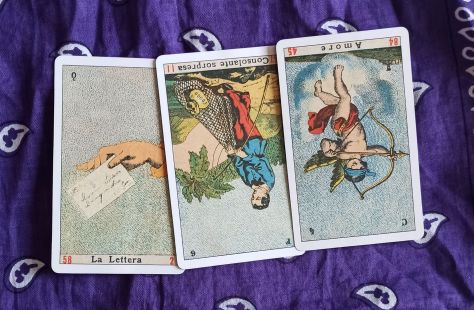
Today was one such day, and it was very clear:

Daily vera sibilla reading

The cards talked about a communication reaching me, but that was the extent of my interpretation. I did not try to read further into it, because what is valid for a general reading is not always valid in a daily reading, where the interpretation needs to often be toned down.

If I were to interpret these cards for someone in a regular reading, I would tell them that their partner would communicate to them that they no longer have anything in common and it’s over. The Surprise, The Six of Clubs, represents, when upright, all situations that flourish easily, and therefore it shows compatibility, while, when reversed, it represents falling out of love due to growing apart.

Well, this is exactly what happened today. Only, not to me. I was the one who received the communication, but not from my husband. I received it from a friend who told me she and her partner were breaking off their relationship, because “they don’t even recognize each other anymore”

MQS

Vera Sibilla – My Friend’s Misadventures

It is well-known that the Sibilla is damn chatty, sometimes too much. Every deck can veer off topic if it needs to, but the Sibilla has a penchant for it, whereas, for instance, regular playing cards are usually easier to keep on a leash. Still, I believe what I’m about to show would have popped up with any other deck, since the cards usually warn us of unexpected happenings, whether positive or negative. This is a spread we did for a friend of mine in January. He wanted to know about his love life.

Vera Sibilla Reading, my friend’s misadventure

The thing that immediately struck me is that the cards clearly were not talking about my friend’s love life. Instead, judging by the first line, they were depicting something difficult that was going to happen. I must confess I was not capable of organizing my garbled thoughts into a coherent prediction back then, even though looking at it now it seems obvious. I believe a part of me knew what the cards were talking about but didn’t want to give the news to my friend. I knew the cards were talking about danger at the hand of some people, and that a man would help him. I told him so much, but of course this was too vague to be of help.

Here is what happened around a month later, as told by the cards. While out of his house (Journey) he was attacked (Widower reversed. I made a mistake in reenacting the spread) by a small gang of criminals (Enemy, Fools). Fortunately (Levity reversed) a man saw the whole thing, chased off the strangers and helped my friend (Friend reversed, Fortune reversed). My friend sprained his ankle badly, I’m guessing this is why the Fortune card is reversed, showing delayed fortune, but is otherwise unharmed, except the anxiety (Sighs).

I think part of the problem of reading for friends is that, because you don’t want them to come to any harm, your mind tends to censor you a bit. Still, an interesting case study, and a story that could have ended much worse.

MQS

Sibilla Reading – Why Is He Acting Strange?

Sometimes the cards speak like directors of a theater piece, ordering characters around in a way that makes almost intuitive sense and gives a visual representation of the issue. This is not always the case (some readings are super hard to decipher) but when it is it becomes almost impossible to doubt that divination truly works.

Here’s an example. A friend of my husband asked me why her boyfriend was acting strange. These were the cards (the reading started out as a three card reading, but I kept adding cards until I was satisfied):

Vera Sibilla Reading: Why is he acting strange

Look how the characters seem to relate to one another like characters in a play. We have Juliette, the Queen of Hearts. Behind her is the Five of Diamonds, Melancholy. She is dissatisfied. Then we have the Jack of Hearts, Romeo. Between them is a card. This can either represent an action or a state of affairs. Because the Melancholy card describes a state of affair, it seems more likely that the reversed Ace of Hearts also represent their current state of affairs, one of miscommunication, instability and a general sense of incompleteness.

Following is the Queen of Clubs. This can be another character, but sometimes she acts as a “pointer”: wherever she points her finger is where the problem lies. In this case, because she is reversed, she points to her right (otherwise it would be to her left). Then we have the card of secrets (the Soldier, reversed) and that of homosexuality (the Love card, reversed) and a male figure. The answer is obvious.

A couple of months after the reading a gay friend of hers saw her boyfriend on an app, who then came out as bi, validating the spread. This is not the first time I’ve encountered this kind of issue. I may even have posted a spread about it before (I can’t remember).

One of my dreams is of writing a book about divination, not explaining any particular kind of divination, but exploring divination as a topic, its foundations and its place in the world. And this kind of spreads has me convinced that life is a drama, and divination is a tool capable of unveiling the script.

MQS

Sibilla Reading – Real Estate

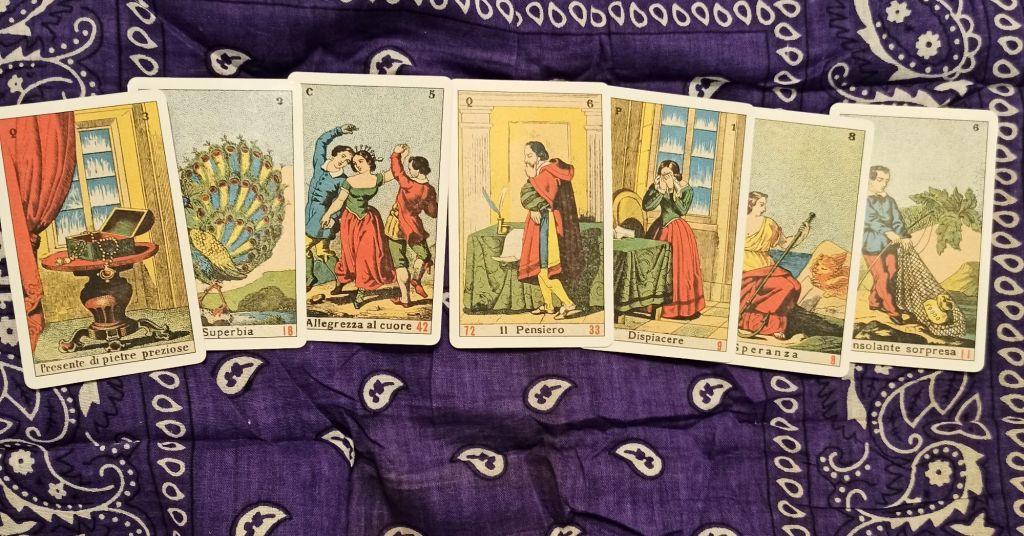
I said some time ago that my husband and I are looking for a home (I have a tarot reading ready for that). I also wholeheartedly believe that once you are interested in something, everyone else who has the same interest tends to show up in your life, and real estate questions have been common lately. Here’s the spread for a woman who asked if she would manage to buy a house she was interested in (it started out as a five card spread, but I asked her to draw two more cards, for reasons that will become obvious shortly, and then a third I forgot to take a picture of)

Real estate question with the Vera Sibilla Italiana

The first cards that caught my attention in the original five cards are the Five of Hearts and the Eight of Diamonds. Traditionally this means an engagement ring, but in this context it shows the proposal of a down payment (which is basically your engagement ring with the house you want to buy). According to the Peacock card between the two, this is a very high down payment, so I asked the querent, and she said they are (understandably) trying to pay off as much as possible in advance, almost half the total price.

The Thought card gives us some insight into the querent’s psyche: since it is followed by the Ace of Spades, she is worried, preoccupied or pessimistic. But the spread clearly isn’t complete, so I asked her to draw two more cards, and these were the Eight of Hearts, Hope, and the Six of Clubs, the Surprise. Clearly things will end up well, because these two cards together indicate the receipt of the hoped for money or the receipt of awaited money – for instance, money you’ve loaned or invested.

So I asked the querent if she’s waiting for money to invest into the home and she confirmed that she has some money tied down in an investment and she’s waiting for her bank to agree to free that money ahead of time. I was 99% sure this was possible, but to be on the safe side I asked her to draw a further card: this was the Seven of Clubs, the Realization (gran consolazione). Everything will be fine.

MQS

MQS

Vera Sibilla FAQ

My version has keywords. Should I use them?

Honestly? No. The keywords provided are extremely limiting, they are sometimes completely stupid (the Gift card does NOT mean obstacles) and they were clearly added by people working on the graphics of that particular version in the 60s or 70s. People working on a deck’s graphics in a big manufacturing company are NOT card readers. Their boss probably told them to add keywords so they could market the deck as ‘now improved and easier to read’ or something to that effect.

What are the little numbers supposted to mean?

They are lottery numbers. Some older versions even have three numbers. I’ve never paid attention to them, but then again my eyes glaze over at the mere mention of lottery and games of chance.

In my deck the cards of the Three of Diamonds and Eight of Diamonds are swapped. Why?

I honestly have no clue. My best guess is that there was an error made during the reelaboration of the deck for that specific edition. The traditional numbering is 3♦ for the Gift and the 8♦ for the Handmaid. If they are swapped in your version it’s not a big deal. Just don’t expect it to be due to some deep kabbalistic consideration. No “tzaddi is not the Star” and all that jazz. The Sibilla is much simpler.

Can I use playing cards with the meanings you provide?

Yes. If it helps you, write the title on each card.

What is the difference between the Vera Sibilla and the Sibilla della Zingara?

The Sibilla della Zingara (sometimes marketed as Gypsy oracle cards) is a reimagining of the Vera Sibilla, and is relatively recent compared to it. It was created because the Sibilla was popular and they wanted to update the graphics. Whether you choose it or the Vera Sibilla is a matter of taste, though I personally prefer the original. There is no difference in terms of meanings.

Do you recommend any books on the Vera Sibilla/Sibilla della Zingara?

I am a sucker for books. I believe I am aware of most, if not all books written on this deck in most languages, which isn’t to say much. I can, in all honesty, only recommend one which is still available: Alessandra Venturi’s Italian Cartomancy. It is poorly organized and it doles out information in hopes or making you fork out more money for the author’s course. There are no examples, no combinations, no spreads. But the information it does contain is solid. All other books on the Vera Sibilla/Sibilla della Zingara in all languages I PERSONALLY consider pretty bad (you are welcome to your own judgment). Italian cartomancer Etienne Valancourt is working on a book. It’s been years in the making, so I don’t know if he’ll ever publish it, but I have great respect for him and I already recommend it even before having read it.

Can I skip reversals?

Yes, you can do what you want. I myself do not actively create reversals when shuffling: any card reader will tell you that cards simply have a way of reversing themselves. I deal out the cards as they are, and then, in gathering them up, I don’t pay too much attention to how they face. However, I always try to start a new reading session with my cards upright. Even then, often one or two cards will reverse themselves. Call it chance, call it magic, but it happens. I would suggest that you pay attention when a card comes up reversed, but you can do what you want.

Can I make up my own meanings?

The first thing to realize when it comes to any psychic skill is that there is no psychic police. So yes. You can. I know some people who don’t use traditional meanings and give perfectly satisfactory readings. My own meanings are a mix of tradition and experience, and the numerology I use is invented, not traditional.
The second thing to realize is that if you are asking me, or anyone, for permission to do what you want, you’ve already lost. Detract further points if you pay someone in order to be told.
The third thing to realize is that just because you can reinvent the wheel doesn’t mean you have to. There is no psychic police, but there are established practices. To dismiss them out of hand without knowing them can be just as much an act of weakness as slavishly following them. Another point worth mentioning is that when we make up something we place our own limitations on it. It can be good to measure yourself against something you didn’t make up even just to stretch your imagination, skill and preconceptions.
My advice would be to educate yourself (here or somewhere else), make your own experience and adjust accordingly.
Or do what you want. Just don’t ask me to validate you. You don’t need validation and I am not inclined to validate people.

Can I just use the pictures as a guide?

Again, you can do what you want. Remember to keep a record of your readings, though, so you can go back to them and see what was accurate and what wasn’t.

Can I use the information you give as basis and develop it in my own way?

Of course! That’s what I did.

Do I have to memorize the combinations?

A handful of combinations are so classic (like that for pregnancy) that not to know them would be a mistake in my opinion, but combinations don’t need to be memorized, especially because you will find that the same combination could mean something totally different when surrounded by other cards. Just use the ones I provide as a mental gymnastics, but don’t confine yourself to them, nor to the interpretations I provide.

Do I need to consecrate/purify the deck?

No, but you can. I do. I would also suggest that you keep your deck near you for some time. As a rule, anything that helps you feel attuned to the deck is good.

Can I make up my own spread?

Absolutely!

Who taught you?

The mother of one of my professors. The numerology is something I made up to make sense of the meanings I learned and to expand on them.

Will you teach me one-to-one?

I will not. I don’t have the time. Besides, theory will only get you so far, and this blog is, I believe, most if not all the theory you need. You need to practice and keep a record of your readings. Don’t exaggerate with readings for yourself. Don’t force yourself to ask questions just out of idle curiosity to see what the cards say. Strive to read for others. Nag your friends and relatives. That’s the best way to start. That’s not to say you can’t read for yourself. Just know your limits.

If I send you my spread will you interpret it for me?

I will not. I don’t have the time. Also, I believe everyone should take responsibility for their spreads and I also think that the language of the cards is somewhat personal, just like different dialects within the same language. Just because all the words are found in the same general dictionary doesn’t mean every word has the same significance and importance for every speaker. Learn your own cartomancy language. You can do it!