MQS

MQS
This article is going to be as vague as it gets. It pertains to certain observations I’ve made over the course of the years practicing divination, first with playing cards and the Sibilla, then with regular Tarot and now with the Bolognese Tarot, but it is not a unified theory, and in fact, it is even hard for me to put it into words.
We all know how time is difficult to define in divination, especially by cards. Sometimes it’s even hard to say if the cards are describing the past, the present or they are directly starting off with the future. This is even more true when using non positional spreads, where one or more lines of cards are interpreted together. My observations are mainly about non positional spreads, and how sometimes they seem to signal that they are talking about the past.
In all decks (at least, in all decks I use) there are cards connected with the person’s thoughts, or at least with their inner or emotional world. A person’s inner world is a complex thing, since it is a mix of hopes for the future, memories of the past, illusions, dreams, traumas, etc. All decks I use also contain cards that show ending, death, disruption and radical change, indicating the end of a life path.
The thing I’ve noticed is that, when in the first couple of lines of a spread (or within the first couple of cards in a longish one-line spread) there is a card connected to the person’s inner world and then a card of ending, that section of the spread usually talks about the past, and more specifically the distant past (that is, not just a couple of months back). This is because the card of disruption tells me that the situation the cards are talking about is over, while the card relating to thoughts or emotions says that the thing exists only as a memory, something that has left a mark on the person’s soul.
I recently did a spread for someone with the Bolognese Tarot. Unfortunately I didn’t save a picture of it and forgot most of it (it was one of those “I’m sure I won’t forget it” moments). It was a question about love, and in it both querent and quesited (the love interest) showed up only as thoughts, followed by cards of disruption. It turned out they had been together eight years ago, she had left him on the advice of a friend who thought causing drama would strenghthen his commitment. Instead he moved on, and she was still waiting for him to come back. In this instance, the thoughts reenacting the break-up were like ghost impressions reliving that pivotal moment in her past.
Obviously, this sort of things tend to happen for major events, whether positive or negative, and it shows how our inner structure is a bit like a geological section, with different eras still present, but hidden from view.
MQS
Two of Hearts – The House
In most situations, the House card is relatively neutral, as it often indicates the person’s home environment or family, or some other place depending on the combinations. However, in itself the card, when upright, symbolizes a protective environment where the querent feels safe and taken care of. Figuratively, it shows situations that are solid, positive and protective (so you feel at home).
Eight of Hearts – Hope
The Hope card’s main meaning is that of representing the hopes and wishes of the querent, and the cards following it will tell us if they come true or not. However, it also indicates the solution of trouble or compensation for it, as the card says “there is hope”. This is especially the case when the Eight of Hearts comes up after a negative sequence of cards. Sometimes the Hope card’s intervention may not be enough to give us what we want, but it will make sure that we come out of a situation still alive and breathing, and with some kind of hope.
King of Hearts – The Gentleman
The King of Hearts is, in most situation, a neutral person card, indicating a married man or an older man. However, it does indicate someone who has our interest at heart (unless it is reversed or surrounded by cards of dubious moral quality). He is the archetype of the philanthropist who is out to help others. For this reason, in spiritual readings, it represents God or a saint.
Two of Clubs – The Peacock
The best card in the deck, the Two of Clubs represents divine intervention (due to its symbolism of completeness and rebirth). It often shows up to protect us from the worst that could happen, or to increase the quality of something that is already good. It often shows positive undercurrents that do not manifest immediately in all their positive import, but which will save us, protect us or enrich us when they do manifest. For this reason it is known as the talisman card.
Five of Clubs – Fortune
While the Two of Clubs indicates divine intervention, the Five of Clubs represents gifts from heaven in the form of good luck. It often indicates positive turns of events, a turn of the wheel that brings us something we want us, or at least something good. Unlike the Two of Clubs, it retains its positivity when reversed, but it becomes delayed or less blatant, maybe a bit less satisying
Seven of Clubs – Gratification
The Seven of Clubs is a card of satisfaction, but it also represents our ability to reach our aims and ambitions in the real world. It represents the achievement of goals and reaching of landmarks in one’s life (marriage, promotion, property, recognition, etc.) However, the card can also represent “a light at the end of the tunnel” when it falls after negative cards, indicating, as it were, our ability to pick ourselves up.
Ten of Clubs Reversed – Levity
The Butterfly is a symbol of carefreeness, lack of focus and lack of attention. When it is reversed, however, it shows carefulness with one’s finances and, even more importantly, the arrival of good occasions that need to be seized. Although it is not a card of protection per se, it does show us a way out (a new therapy, a new job opportunity, a new meeting, etc.)
Three of Diamonds Reversed – The Gift
Again, not a card of protection, but still a welcome sight. It shows situations that somehow sort themselves out, at least in part. It is a relatively weak card, so the presence of very difficult situations may be mitigated only in part, and often it shows some kind of improvement rather than triumph.
Four of Diamonds Reversed – Falsehood
When upright, the cat brings falseness and negativity in general. Negativity is to be understood broadly as situations that are negative or bad for us (even when there is no direct lying involved). When it is reversed, the same card brings positivity, relief, solution of trouble.
MQS
I finally decided that there was no point in learning the theory of how to make videos. Much better to make crappy ones until something goes right. So yea, here’s the first video on my channel.
Please be patient, I am a very special kid.
MQS
I find it funny how sometimes the Sibilla just steamrolls you with just three cards. A friend of mine had an appointment at a new psychiatric clinic and wanted to know if the new doctor was any good:

I don’t there is much need for interpretation here: the change brings her to someone who is her enemy. Doesn’t mean he will tie her to the train track, but he is not reliable (Butterfly). Interestingly, she was under the impression she was going to be visited by a female doctor, but it turned out that one had too much on her hand, so my friend ended up with the male enemy. In her words, he is probably the one who needs a psychiatrist.
MQS
Some weeks ago I got asked why I only present readings I did for myself or others, and don’t do interactive readings which may be useful to more people. The question was asked in good faith and in good faith I answered. But I thought it made for a nice article. As usual, I will be brash and abrasive, because I’m not an easy person, but I mean no disrespect to any particular individual.
Horoscopes. In reality, horoscopes are more the invention of journalists than of astrologers: astrologers just unwittingly lent themselves to the farce. Horoscopes are predicated on the fundamental misunderstanding that the place the Sun occupies at birth automatically has something to say about us. This is a relatively modern invention in the long history of astrology, and anyone who thinks about it seriously for even five minutes must conclude that, in order to say anything at all about one twelfth of the world population purely based on their month of birth, one needs to water down everything one says to the point that nothing is said at all except playing into the belief that everyone is adorably quirky (oh those Aries boys who ram through everything, oh those Gemini girls always being nutty). That some astrologers, realizing this, feel the need to add Moon signs, Rising signs etc. into the equation does not improve matters at all: a fundamentally silly idea multiplied by itself remains silly.
Taroscopes. Taroscopes are an even more modern invention. They substitute or complement the reading of a sun sign chart with a broad card reading (usually tarot, hence the name). They started popping up on social media some ten years ago as a way of feeding the sludgeflow of nonsense that is required to keep the algorithm satisfied. I am pretty sure they started out as a silly game, then some saw that it was good for business. I am even aware of established readers who haughtily denounced taroscopes for the travesty of divination that they are, only to bend the knee once it was clear the current flowed in one direction only.
Interactive Readings. Interactive readings are the height of silliness, and the perfect exemplification of the words ‘internet slop‘. Choose between Deck One and Deck Two and listen to why he doesn’t deserve you because you are such a special, intuitive an free-minded queen. Choose between the butterfly and the butter knife and listen to why all the narcissists in your life hate you for being such an authentic empath (somehow those buying into this nonsense are always surrounded by narcissists, yet they are never narcissists themselves). That’s the essence of interactive readings as a further development from taroscopes.
The reality is that divination is already hard as it is, being an imprecise and complex art due to the amount of factors to be considered and the fallibility of humans in considering them. Trying to extend it to a whole swath of people who randomly happen to bump into your video or post is beyond ludicrous.
In attempting to justify this to themselves, some readers are eternally caught between two stances: “if you bump into it, it is meant for you” and “if it doesn’t resonate it’s not the right message”, logic being the first thing to fly out the window once someone decides to be a brave and empowered little witch. Of course you’ll always find someone who responds to an interactive saying “I chose the butterfly. That’s exactly it, that’s me to a T”. And those are the unlucky ones, because they get roped into a world of self-delusion and meaningless hype: the universe seems to be constantly cooking up something big for you, according to interactive readers, so you better stick around for the next video!
So yeah, that’s why I stick to traditional readings.
MQS
The way we do things, the way we say things, matters. The same apologetic arguments we find in Blaise Pascal’s most feverish and haunting pages would be enough to bring a doubter to conversion, yet when coming out of the lips of a cheap street preacher holding a sign, they are often received with distrust, when not with disgust.
The way we do and say things matters in occultism as well. The old texts of magical tradition, and even some old accounts of rituals and supernatural occurrences, are full of the frenzy-stillness dichotomy: some things seem to happen in a state of ecstasy, others in a state of torpor.
My path, both as diviner and as occultist, has been informed by the pursuit of stillness more than by that of frenzy. All the teachers I’ve had the honor to learn from have always required of me to reach a state of calm rather than one of heightened overexcitement.
In divination, there is always a moment of randomness required in order to break the barrier between what the personality thinks it knows and what is actually the case. Arranging the cards (or geomantic points, or whatever) consciously in the order we wish they would come out may teach us something about ourselves, but very little about the reality of a situation. Randomness ensures that our self-consciousness doesn’t interfere with the process of allignment between oracle and reality.
Whether through a frenzy or through calmness, randomness introduces itself into the process by bypassing the limits of our personality’s structure, with its limits and its biases. The choice between the “inspired” moment of frenzy and the “deadened” moment of calm rests on a partially different view of the relationship between individual and whole, between ourselves and the divine.
Ecstasy, which is the process of leaving oneself behind, occurs in both cases, but it occurs differently. By achieving a drunken confusion one simply rams through the walls of one’s personality, achieving contact with what is outside of it. By stilling oneself, one reaches the point within one’s core where individual and divine coincide.
Obviously, once each option is brought to an extreme, it bleads into its opposite. Pure frenzy becomes absence of limits and therefore absence of what is limited, and its movement resolves itself in calm. Pure calm is delivered from all difference from change, so it coincides with pure frenzy.
MQS
There are plenty of cards, in the Vera Sibilla, that can indicate individuals (see here for groups). Here are the most common (keeping in mind that most of the cards have other associations as well, and may indicate concepts or situations):
Seven of Hearts – The Scholar
The Scholar can represent the figure of a lawyer, a notary, or more in general a professional. Traditionally he is said to be in his 40s or early 50s, but we need to be flexible with age. He can also be a member of the family or even a partner.
Eight of Hearts – Hope
There are two schools of thought concerning the Hope card. According to some it doesn’t represent a woman, while according to others it can (traditionally, a younger or blonde woman). I have found that it is rare for this to be the case, but it could happen.
Nine of Hearts – Faithfulness
The Faithfulness card can represent support, and occasionally it will show up alone indicating a concrete someone, i.e., a friend, who shows us support.
Jack of Hearts – The Boyfriend
It is common for this card to indicate an actual person, often the unmarried male querent or a male who is in love, or positive, or belonging to the family.
Queen of Hearts – The Girlfriend
Same as with the Jack, only applying to women.
King of Hearts – The Gentleman
The King of Hearts is traditionally the figure of a protector or benefactor, someone who aids us. He is typically in a good position to do so. He can be a father or loving husband (when upright), but can also represent the married male querent or a boyfriend who is older or has a position in society.
Four of Clubs – The Friend
The Friend card can represent friendship as a concept, as well as partnerships and other situations where people come together for a common goal. However, it can often indicate a female friend or relative.
Jack of Clubs – The Servant
The Jack often represents a younger man, one up to 30 years of age, or unmarried. However, it can also represent a colleague or friend, regardless of age. It can also indicate a son, if relevant. Usually he is already known to the querent (the Italian word ‘domestico’ can mean servant but it also implies familiarity with the house).
Queen of Clubs – The Maiden
The Maidan can be the female counterpart of the Servant, showing a younger unmarried woman, sometimes a daughter.
King of Clubs – The Doctor
The Doctor card often indicates health issues or the need to take care of something. However, it can also represent a man with a certain social position or with a degree (if next to a female card, then he turns into a woman with those characteristics). It can show the figure of a professional whose advice or help will be required, or a boss.
Seven of Diamonds – The Child
Often it is a metaphorical child, but sometimes the Seven of Diamonds can represent a literal one, usually very young (toddler). It can combine with other cards (the Servant or Maiden, for instance) to indicate a teenager. It is the card of pets as well.
Eight of Diamonds – The Handmaid
A card strongly connected with the coming and going of money and with work, the Handmaid can also be the figure of a female colleague or a female servant (like a cleaning lady). Traditionally she is from a different town, but this is not always the case. She can also be a stranger or a foreigner.
Ten of Diamonds – The Thief
Rarely a literal person, but in connection with negative cards it can show someone who steals, either literally or metaphorically.
Jack of Diamonds – The Messenger
Rarely a person card, the Messenger often heralds the arrival of news and the knowledge of facts. However, it can occasionally represent a young man, traditionally dark-haired.
Queen of Diamonds – The Wife
A card that often represents what it says on the tin, the wife shows a woman who is married and may have children. It can indicate a woman who has achieved some level of success (could be a colleague or boss).
King of Diamonds – The Merchant
Usually this card signifies the querent’s work life. However, it occasionally signifies a literal merchant or someone who a transactional view of life and relationships.
Two of Spades – The Old Lady
Often one of the most complex cards in the deck, the Old Lady has a whole host of metaphorical meanings. The literal meaning, though, is that of representing an older woman, a grandmother, a widow, someone close to retirement, a woman of 60+, and so on. The card can also stand for an ex (your old woman).
Three of Spades – The Widower
As with the Old Lady, so with the Widower, but for men. It can represent an older man, a grandfather, an ex, a widower or divorced man. It is somewhat rarer for the Widower to be a literal person, compared to the Old Lady.
Ten of Spades – The Soldier
Another often cryptic card to interpret, the Soldier can also indicate a young man, in his 30s or early 40s (again, taking it with a pinch of salt), who is muscular or sexy or who wears a uniform. It can also indicate a stranger or a foreigner.
Jack of Spades – The Enemy (male)
The male enemy card can stand for a literal enemy, or for someone who is against the querent for some reason, either as a rule or in a particular situation (your uncle whose car you crashed into a tree can be your enemy too, when he finds out). It can also represent a place where people are inimical to the querent.
Queen of Spades – The Enemy (female)
Same as with the Jack, but for women.
King of Spades – The Priest
The King of Spades often indicates an institution, the government, a judge, etc. It can also sometimes represent an older man who is not inimical to the querent, but who is somewhat cold toward him or her, but is still fair (unless the card is reversed).
MQS
Sometimes we spend a lot of time stuck in one phase of our life, only to be surprised by fate when we’d given up hope. This is a career reading for a man in his 40s:
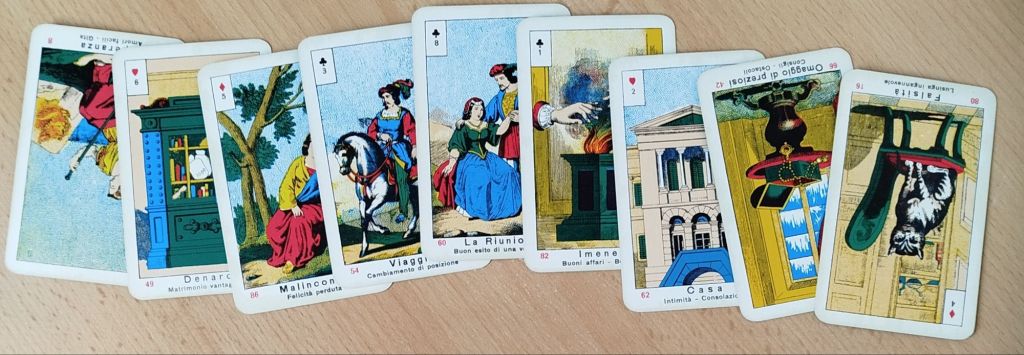
I started with three cards and then kept adding. The first three cards are Hope reversed, Money and Melancholy. It is true that the Six of Hearts, Money, generally has to do, well… With money. However, it is also the card of the past. The Five of Diamonds, Melancholy, also broadly describes the past, especially when occurring this early in the spread. However, it describes the past in a more negative light, as having somehow scarred us and left us dissatisfied or wounded.
Two cards talking about the past reinforce the idea of past. What has wounded the querent in the past? A reversal of his hopes (Eight of Hearts reversed) concerning his career!
Then we find the Three of Clubs, the Journey. The Journey can be literally about travelling, but it can also herald a transition from one phase to another. The Melancholy card itself, when not followed by evil cards, shows that the melancholy won’t last forever, but is just a phase. Once again: two cards talking about a transitory phase reinforce the idea of transitory phase!
What does the Journey bring? A meeting concerning a business or firm! The Ace of Clubs, Marriage, with the Two of Hearts, the House, can represent a relationship where we live together with the partner, but also a business or firm. Since we are talking about career, it must be the latter.
Finally, two reversed cards seal the spread in a positive way. Reversed cards have a bad reputation, but in this case they are life-savers: the reversed Gift card shows solution of problems, the reversed Falsehood card shows relief and supports the idea of a positive solution.
MQS