Tag Archives: Vera Sibilla

Which Deck is Chatty, and Why?

I recently received some questions from a visitor to this website. One of them was in which sense the Sibilla is considered “chiacchierina”, i.e., chatty.

This is an interesting question, because it gets to the heart of how divination works (and not just divination with cards). I don’t want to foster the belief that the Sibilla is more capable of conveying information than other divination systems. This would be false advertising. Every deck and every system is capable of informing us.

But the way in which the Sibilla informs us is rather unique. Here we get into the specific character that each deck and system has. The Sibilla is like an off-beat aunt with a poor sense of boundaries.

A girl once asked me how her crush for a guy would develop. The girl had moved in with her grandma and the grandma disapproved of the guy. The Sibilla started off not with an answer to the question, but by telling me that the girl’s grandma disapproved of the situation. If I had asked another one of the decks I work with, I probably would have gotten a more straightforward answer.

It takes working with each deck in order to understand their language and personality, but these always emerge sooner or later. This is also probably why old folk diviners believed that each deck has a spirit attached to it that lives inside its cards and infuses them with its peculiar traits, a belief that I tend to share, since it explains this phenomenon much better than the impersonal Jungian theory of synchronicity.

The reality is that each (valid) divination system is chatty in its own way. I’ve heard the Bolognese tarot being referred to as chatty, and as I work with it I understand that its chattiness really is a factor, even though it is less chaotic than the Sibilla.

MQS

The Bed – A Deep Dive Into Cartomancy

The bed symbolism is almost as widespread in cartomancy as that of the table, of which it is a natural counterpart. The table often stands for conviviality, nourishment, feasting and interpersonal contact, and it often represents situations happening during the day. The bed, by contrast, is a nocturnal symbol of retreat and rest, and can stand for sickness, but also for physical intimacy, depending on the other cards. As usual, it is admirable how the card readers of yore used to weave simple and effective symbols of daily life in their reading systems, which allowed them to talk about reality.

The oldest mention I could find of a card representing the bed is in a little-known system for reading Italian regional playing cards with a reduced pack of 25 (instead of the full deck of 40). In this method, the Four of Coins is the bed card. It tends to represent situations becoming static or sick, or it can talk about passion, depending on the other cards. It can also indicate that something happens in the evening or at night. Interestingly, in another system I’m aware of, this time utilizing the full pack, the Four of Coins is the table, while the Five of Wands is the bed.

In the Bolognese Tarot, which is the oldest used divination deck we have written records of, the Chariot is the bed card. This has got to be one of the most puzzling bits of symbolism of the deck: a card that is usually indicative of forward movement, travel, progress, launching forward is seen as a card of static sickness, likely due to how the chariot is represented, with the horses crouching at the sides, as if the forward movement had stopped.

Truth be told, in the oldest extant document on divination with the Bolognese tarot, which dates back to the Pre-Napoleonic period, the Chariot is still considered a card of journey, but shorter than the World card, which is assigned the meaning ‘long journey’. This may indicate that the meaning of the card evolved through time, from ‘little journey’ to ‘little movement’ to ‘not much movement’ to ‘staticity’. Another likely possibility is that different meanings were used by different strands of the tradition, one of which hadn’t yet been put down in writing. This latter possibility is confirmed by the fact that there are readers who who assign both meanings to the Chariot, depending on the cards that surround it (static cards activate the static meaning, active cards the moving, active meaning).

The bed card is also present in some of the oracle decks that originated in the XVIII century as parlor games. In the Sibilla we have two bed cards: one is the Four of Spades, the Sickness card, which interprets the symbolism of the bed in its more static and negative sense of needing to interrupt one’s routine and of situations that are not healthy. The other bed card is the Ace of Diamonds, the Room, which can indicate any room in a building, but which in itself stands for the bedroom. As an extended meaning, it is the card of intimacy, so the presence of cards indicating love or physical contact can lead to rather hot interpretations.

The Kipper deck does not have two bed cards, but it does contemplate the symbol of the bed in the card “a short sickness”, which depicts a patient in bed being visited by a doctor. This is mostly a card of sickness, but many German-language sources I’ve read consider it also an ingredient in combinations about intercourse, partly due to the presence of the bed and partly due to the doctor touching the sick man’s wrist, which is supposed to be indicative of physical contact, if supported by other cards.

MQS

Do You HAVE To Change Your Deck?

This is a recurrent question I get. Some people are of the opinion that reading decks have something akin to a shelf life, after which they stop answering or they become impregnated with negative energy from all the readings. I often get asked if this is the case.

To which my answer is: under normal circumstances, your deck will keep answering you (or at least it will keep working, even if it occasionally snubs your questions) for as long as you use it. This has been my experience, as well as that of all my teachers, and I’ve had the good luck having many teachers.

My first teacher, from whom I learned to read playing cards and the Sibilla, followed the Italian tradition that divination decks need to be old, must have been used to play at the local inn and the people playing with them must have covered them in offensive swearwords (read here my hypothesis on why this tradition exists).

This obviously doesn’t apply to the Sibilla, since Sibilla decks, as well as similar decks like Lenormand or Kipper cards, are pretty much the only card decks specifically designed for divination. But tarot was a playing card game, and playing cards… well, it’s in the name, and so, according to my teacher, they needed to be “giocati e bestiemmati” (played with and offended with swearwords). And after you got a hold of one such deck, you probably were going to use it for as long as you lived.

When I started learning the tarot, my other teacher held on to her first deck as if it was a relic, and it did answer her beautifully. She was of the opinion, however, that the deck could stop answering correctly or become more negative in its answers if you read for many people with a tragic life. When this happened, she usually took the deck to church and had it blessed by the priest. I honestly cannot say I ever needed this, but there you have it.

As for the Bolognese tarot, I do not know what deck the person who taught me the 45-card system used, but I do know that my teacher for the 50-card system still uses her grandmother’s deck. Another person I am in contact with, who uses 49 cards, still uses the deck her teacher gifted her.

As for me, I have a conservative outlook on life, and I don’t throw away something unless I really, really have to. The Sibilla deck I use is the one I bought when I started learning, and while I don’t insist on always using the same playing card deck, I still occasionally whip out my old one.

Still, there are people who believe decks can stop working after a while, including people I admire (see Josephine MacCarthy). Is there anything to it? Obviously, much depends on the theoretical framework one uses for their magical activities (which includes divination).

I was taught that divination (any divination) can stop working if you are the recipient of a curse, but that’s an extreme scenario. More often, the people who complain about their deck going lazy on them tend to torture them with repeated questions on the same topic over and over.

As much as skeptics may point out that this is proof that divination doesn’t work because it cannot be repeated ad libitum in lab conditions, it is simply how it is: if you annoy the deck it will stop answering. This simple fact shows, at least in my opinion, that there is something alive attached to the deck.

Usually, in traditional divination folklore, we would say that the deck has a little spirit hidden inside. And while this may sound like a childish explanation, it is the one that best explains my experience, as well as being perfectly in line with traditional hermetic principles. The point is that while many valiant attempts have been made at explaining divination using more or less recognized principles (see Jung’s views), we are at work with something we don’t fully understand. Some level of respect is due to this something, if for nothing else than to keep the work environment positive with whatever it is.

MQS

Vera Sibilla Cards That Indicate Ambiguity

There is a number of cards in the Vera Sibilla that can indicate ambiguity and unreliability. As usual, context is key, but the following ones are the most common.

Four of Hearts Reversed – Love

As I discussed in my recent video about the Fours, traditionally the Four of Hearts is the card of homosexuality. And it can still mean that in particular situations, but more broadly, aside from the other main meaning of ‘lack of love’, it can also indicate an unhealthy approach to love (hence the XIX century association with homosexuality). An unhealthy approach to love can also involve secret perversions or cheating, so the Love card reversed can be an indicator of unreliability in love.

Five of Hearts Reversed – Happiness

Being a card that represents more than one person, being in the suit of Hearts and being reversed, the Happiness card can indicate betrayal. However, traditionally, this more commonly refers to relatives (since the upright card can stand for relatives in a neutral sense). It can show disharmony among relatives, and relatives you must guard against, especially with people cards next to it.

Seven of Hearts Reversed – The Scholar

Upright, the Scholar is a symbol of the positive use of the intellect in a creative or constructive way. Reversed, the card can symbolize nonsensical or useless abstraction from reality, impotence (in all senses) but also the negative use of the intellect. Hence, the card can indicate ulterior motives and a sneaky disposition of character.

Eight of Hearts Upright/Reversed – Hope

The Hope card has many spiritual and moral virtues, among them that of choosing the high road and doing what’s good. When the card is next to cards of ambiguity, or when reversed, it can stand for someone who is extremely fickle and even promiscuous in love.

Nine of Hearts Reversed – Faithfulness

Upright, the dog symbolizes fidelity, friendship, sincerity in the affections. Reversed it can, quite literally, indicate unfaithfulness. It is also the proverbial dog biting the hand that feeds it, showing ungratefulness, anarchy, rebellion.

Ten of Hearts Reversed – Perseverance

Upright, the Ten of Hearts can indicate a stable, reliable character. Like the dog card, it reversed this symbolism when reversed, showing situations that are not stable, but also people who are unreliable.

Two of Clubs Reversed – The Peacock

When upright, the card emanates the positive energy of the peacock symbolism, showing beauty, marvel, art, beauty, completion, immortality. Reversed, it takes on its more sinister characteristics: vanity, being full of oneself, being blinded by one’s ego, which can all of course make us unreliable.

Ten of Clubs – Levity

The butterfly symbol speaks for itself. It shows someone who is fickle, not thorough, changeable, too easygoing or carefree. Still, the unreliability indicated by this card, unless supported by cards of dubious moral character, can also be of the innocent kind, due to superficiality rather than to some grand secret plan.

Four of Diamonds – Falsehood

The cat card is obviously the opposite of the dog: it indicates everything that isn’t as it seems, and so is the card of lies and cover-ups. But don’t go crying foul too easily: this is also the card of everything that is wrong, and so it also covers such things as mistakes and oversights. Still, it is never good when coming up next to a significator.

Six of Diamonds Reversed – Thought

Somewhat similarly to the Scholar, the Thought card is connected with what goes on between one’s ears. When it is reversed, the card indicates negative thoughts, which must be understood broadly to signify negative thinking or the thought of doing something negative. As such, if a significator comes up with the Thought card reversed after it, look at the other cards to see if they are feeling down, are deluded or a plotting something.

Seven of Diamonds Upright/Reversed – The Child

The Child card is neutral and has many positive undertones, but it is also card of immaturity. If it comes up upright with cards that highlight this side of its symbolism, or even worse if it comes up reversed, then you may be dealing with people who are not mature enough to be trusted, in whatever sense that might be meaningful in the context.

Eight of Diamonds Reversed – The Handmaid

Upright, the Handmaid is a card of morality and education. But when it is reversed, it becomes a card of the shallow trashy character that you should not take seriously. It can stand for someone who will betray your confidence.

Ten of Diamonds – The Thief

Obviously, the Thief is the card of betrayal par excellence. It always shows something that sneaks into a situation to ruin it from the inside. A person card with the Thief card next to it should make you think twice about trusting them.

Six of Spades Reversed – Sighs

The Sighs card is complex in its meanings, especially when reversed. Its broadest meaning is that of “no sighs”, so it can be good. But this can also signify that someone is not losing any sleep over the evil they are concocting, and so it can be a symptom of an unscrupulous character. This submeaning of the card usually emerges when other cards of similar signification are next to it.

Nine of Spades Reversed – The Prison

As with the Sighs card, the Prison reversed can be positive, as it shows freedom, being unchained or unburdened, repentance, and similar concepts. But with cards of dubious moral character it can indicate that someone is unhinged, lacking restraint and giving into unscrupulous ambitions.

Ten of Spades Upright/Reversed – The Soldier

The Soldier is the card of the night, and of everything that happens at night, including shady dealings. Because of this, especially when reversed, it can sound the alarm on the fact that something is going on behind your back. A person card next to the Soldier reversed is rarely someone you can trust.

People Cards

The general rule is that a person card reversed is either suffering or is against the querent. Especially the Heart court cards must be treated with caution, as they can become traitors and cheaters. It goes without saying that the two Enemy cards already have this potential indication baked into their upright meaning.

A Warning

You may have noticed that a lot of cards in the Sibilla can indicate unreliability. Follow these indications strictly and you’ll go around accusing everyone and their mother of being a cheater and a fraud. Interpretation is never a matter of a single card: it is important to see if cards of similar import accumulate, how the court cards relate to them and if there aren’t more likely explanations.

MQS

Get Out And Read!

When it comes to divination, theory can only get you so far. The best way to improve your reading skills is to learn the basics of a *valid* system and then start reading.

For most of us, we are our own first querents, and that is a problem. I don’t have a 100% accuracy record when reading for others, but I barely reach 60% when reading for myself, especially if I’m invested in the topic. It is not just a matter of wrong interpretation, which can and does happen. I am more and more convinced that sometimes, when we read for ourselves and we are not perfectly at peace, we tend to get readings that reflect what we think rather than what is happening or will happen.

Furthermore, the tendency that many people have to start obsessively putting questions to the cards just to see if they say something vaguely understandable (which doesn’t mean true) is dangerous, and can get us in a warped frame of mind.

I know that for many, especially coming from certain societal backgrounds, reading for others can be a big step into the unknown, but I would advise anyone to start reading for some sympathetic friends or relatives (and when I say for them I mean in front of them, not asking questions about them) and then to graduate as soon as possible to readings for people we don’t know or know little about.

I don’t have too many friends, but they do a good job of talking about me to their friends and to their friends’ friends, which is how I get my supply of test anim-ehm, querents. If you start reading for your friends and ask them to spread the word the same will happen to you.

The cool thing about reading for people we don’t know is that it is so much easier than you might think. Divination DOES work! And divining for someone when there is no chance of you knowing the information in advance is very impressive for them and very satisfying for us as diviners. It will build your confidence much more quickly than torturing the cards about your own mental dramas. Plus, the oracles always seem to be much clearer and much more crisp when I divine for strangers.

One thing I would advise is to be as scientific as possible: record the question, the reading, your interpretation and the results. Don’t think you cannot build your vocabulary because the only right answer is the one offered to you by your intuition. 99% of intuitive readers are terrible, and what they call intuition is not actual intuition: it’s their stupidity echoing in the empty chambers of their mind. Be systematic and slowly you will gain experience.

MQS

Was That On Purpose? (Example Reading)

This one’s a quickie. A friend of mine who tends to take things way more seriously than she should asked if the boyfriend had really misplaced the small gift they had bought for her mother or if he had hidden it out of spite (he doesn’t like her mother). Knowing the dude I was quite sure she was overreacting. Still we asked the Sibilla:

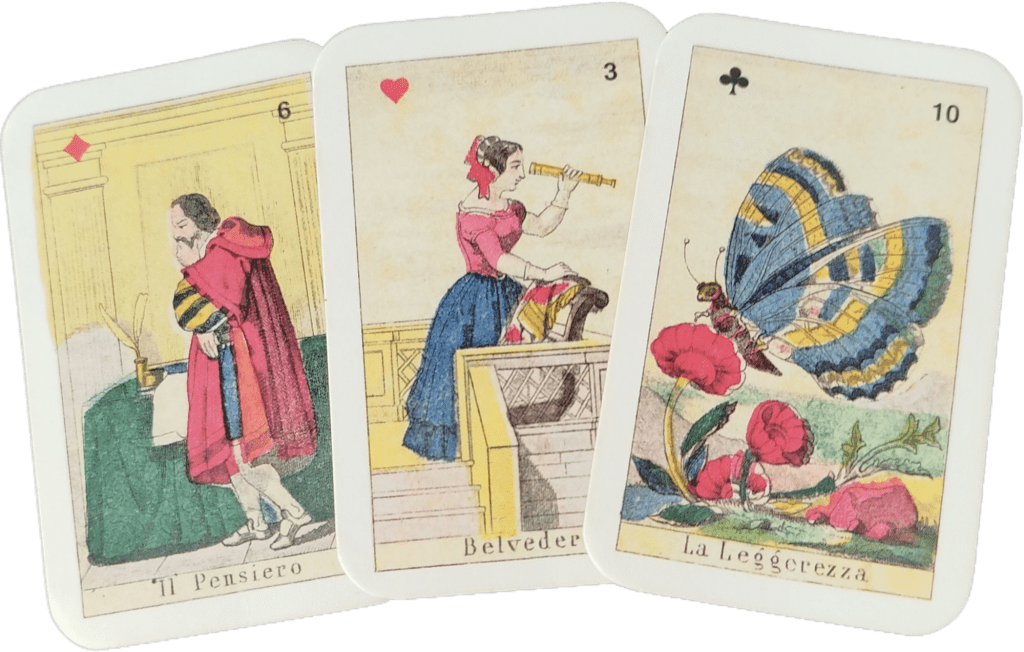
Vera Sibilla reading: was that on purpose?

The Thought card is indicative of someone’s inner reality (their thoughts, plans, character, proclivities, etc). Since we asked about the boyfriend’s intention, the thought is his. The Belvedere card is usually associated with the arrival of something. However, it is also the card of sight. Next to the Ten of Clubs, which is a card of carefreeness, this seems to point to an oversight.

It turned out the gift had been left in the car, where it had lodged itself between the the two front seats. As silly as the reason for the reading is, it’s nice to have the cards confirm our suspicion.

MQS

The Home – A Deep Dive Into Cartomancy

Following my deep dive into the symbols of the door knockers and the road in divination by cards, I want to tackle the symbol of the home. This, too, like the road, is a widespread symbol that is almost never absent from any divination system of a practical nature (I am aware of systems for playing card divination based on Rider Waite symbolism, but they have very little practical use).

The popularity of the symbol of the home is simply a consequence of its importance in people’s lives. The home or house card is, in most systems, a ‘topic’ or significator card indicating the querent’s or someone else’s house, and the cards surrounding it show us the atmosphere or happenings of the household. Its practical value, therefore, is immense.

In the earliest recorded system for reading the tarot, which is Pratesi’s guide for the Bolognese tarot, the house card is the Ace of Cups. This meaning is retained in the more modern variants of the method. This is also an almost universal constant in cartomancy, since the Ace of Cups or Hearts is almost always taken as a symbol of the home.

Whether this association originates with the Bolognese tarot I don’t know. It is possible that the symbolism is simply suggested by the shape of the Ace of Cups. In the Visconti tarot, the Ace of Cups is a water spring similar to a baptismal font, but in many old decks it can look similar to a walled structure. If we add to this the fact that the function of the cup is to contain, it may be that this could have suggested the idea of the house to old cartomancers, since a house is a large (the ace is large) containment structure.

Similarly, in almost all card reading systems using Italian regional cards, the Ace of Cups is the home, although I am aware of a couple where the meaning is attributed to the Four of Cups, possibly due to the squarish form suggested by the arrangement of the pips. The Ace of Cups is also the house card in the Sibilla regionale, which is the second-most widespread sibilla deck in Italy.

Why the same idea of home as the Ace was suggested by people using regular playing card suits is unclear, since the Ace of Hearts does not look like anything but a heart. Still, if the system I was taught is anything to go by, the main idea is that hearts deal with one’s emotional life and nourishment, and the home is the origin and source (ace) of our emotional life, the place where our first (ace) needs are met. As a matter of fact, the person who taught me cartomancy with playing cards often insisted that the Ace of Hearts is not just any house (though it can be, in practice) but especially one’s home, where we come from (the ‘spring’ we come from, in the Visconti sense), which is why an extended meaning of the house card is often one’s family.

The same attribution of the Ace of Hearts to the home is found in most systems I am aware of, including German cartomancy and most English and French methods. As far as tarot is concerned, we find that, in some earlier tarot documents, the Tower is simply called ‘casa’ (house), before being called House of God or House of the Devil in some other decks (the title ‘Tower’ is actually a rather late innovation).

Etteilla assigned the house to the Ten of Coins, which Waite retains in his illustration of the Ten of Pentacles, while Paul Case generally matched the house with the Two of Cups, among other things. However, this was more of an accidental consequence of the Golden Dawn attribution of the first cards of the suit of Cups to the zodiac sign of Cancer and, according to the sign/house equivalence theory, to the fourth house, which is the house of the father and therefore of one’s fathers and one’s family/house.

The Sibilla is a partial exception to the rule of the ace as the home, as the House card is given to the Two of Hearts. The meaning of origin (which metaphorically, depending on the reading, can also indicate the origin of a problem) is retained. Still, the Ace of Hearts is also given to the family and to people living together, among other meanings.

The Sibilla, like the Kipper cards, distinguishes between a House card and a Room card. This is probably because both decks seem to have been consolidated from earlier German or Austrian decks which also had similar cards, although the makers of the Sibilla also took playing cards into consideration.

I cannot speak to the Kipper cards (nor to Lenormand, where there is a House card, attributed to the King of Hearts), but in the Sibilla, the Room can represent a small(er) apartment, as well as a place in general, but it doesn’t usually have a connection with the emotional side of life, like the House, although it can represent intimacy, since it is connected with rooms in general, but with the bedroom specifically.

MQS

Fixed Significators and Modern Issues

Some decks have variable significators, while others assign certain cards to always represent the querent and their partner. This can cause confusion when reading for people who would not have lived their life out in the open back when cartomancy emerged, such as gay or trans people. Following are some experimental notes on how to deal with such instances in the various decks I use.

I want to stress that these are based on my practical experience, not on that of someone else and not on some theory I am trying force onto the cards. My aim is to improve my accuracy as a diviner, not to pontificate on academic eventualities.

Vera Sibilla

The Sibilla doesn’t have fixed significators, meaning that the querent will, if at all, be represented by a court card that indicates their role in the situation and/or society at the moment of the reading, always compatibly with their sex.1

And this is already problematic nowadays. I haven’t read for too many trans people, but I have noticed that if the person has either transitioned, fully or in part, or has at least adapted considerably to the other sex, then they are represented by a court card of that sex (ftm as a male, mtf as a female).

To be blunt: Jane, cashier, who has been living as Jane despite being born as Jim, and lives out her concrete life as Jane, is described as a woman in the cards, although the cards may hint at the transition, if relevant in the context; Jim, cashier, who would like to become Jane and maybe one day will, is represented as a man, even if he’s started to play with makeup since watching Myra Breckinridge; Becky, professional TikTok cheese grater, special traits no personality, who thinks an androgynous look makes her stand out, still comes up as a woman even if she pretends to identify as a man on every day with an R in it.

This has nothing to do with politics or tolerance or “passing as the other sex” and everything to do with concrete life: divination mirrors life, but social media clout simply doesn’t transfer to the cards, and there’s nothing I can do about it, even if it may offend some. The good news is that indentification with a significator is just a divinatory device and lasts only for the fifteen minutes needed to conduct a reading, and then is over.

IMPORTANT: we are talking about trans people, not crossdressers. A crossdressing man is a man who cosplays as a woman for whatever reason, but remains a man and lives as a man, at least until that fake business trip to Atlanta that his wife knows nothing about.

Talking about gay people, the Sibilla is very straightforward. In the few readings I do for myself, I usually come up as the Boyfriend, my husband as the Gentleman, and some years ago I came up as the Helper and my husband as the Boyfriend.

As for “but what about…” particular cases about any of the identities that are created daily, the best I can offer is: I’ll cross that bridge when I get to it. I trust the cards to simply describe the situation as it is and I accept the risk of not being able to understand how complex it may be, either in reality or in someone’s perception.

Playing cards and Bolognese Tarot

In some systems of cartomancy with playing cards, significators are not fixed. The way I was taught, though, the male querent is the King of Clubs and the female querent the Queen of Clubs, and the other card is the person they love. Similarly, in the Bolognese tarot the male querent is the King of Wands and the female querent the Queen of Wands.

For trans people, I think what I said about the Sibilla still holds true. Again, all I can say is to keep your mind and your eyes open (on the cards, I mean. Looking if the querent has an adam’s apple doesn’t count.)

For gay people, I have generally found that a degree of flexibility is required on the diviner’s part. Some readers seem to believe that you can just dictate to the cards how to behave, including in the case of gay querents. If that works, then bully for you, but I have always found the cards to have a mind of their own, regardless of the conventions we try to establish for them, so all I can do is be flexible.

Some people think the querent is represented by the court card of their gender, the partner by the other main significator, regardless of their sex. This theory is predicated on the fact that the two main significators are meant to show those people, and the fact that they are of two different genders is accidental or a matter of historical bias.

This may sound convincing, but have I found it to be true in practice? Sometimes. Sometimes the partner will come up as the other Club/Wand figure and there is simply no way of interpreting it other than as the partner, even if the stuff under the dress doesn’t match. Sometimes the cards will represent the partner as a court card of another suit that matches them. Sometimes the cards will throw in both cards for good measure: hubby has come up as the Queen of Clubs + King of Hearts together on more than one occasion in the past. Talk about a big personality.

Tarot

This is like the Sibilla, and doesn’t require much discussion. The male querent is usually the Emperor or the Pope, the female querent is usually the Empress or the Popess. Two men in a relationship can be shown as Emperor and Pope.

MQS

  1. I am aware of the difference between the word ‘sex’ and the word ‘gender’, but I am going to use them quasi-interchangeably to avoid too many repetitions that hurt the ear. ↩︎