Tag Archives: Venus

Tarot Encyclopedia – The Nine of Pentacles or Coins

(Note: this is a collection of the meanings attributed to the cards by some occultists in the past centuries. It does not reflect my own study or opinion of the cards. It is only meant as a quick comparative reference as I develop my own take.)
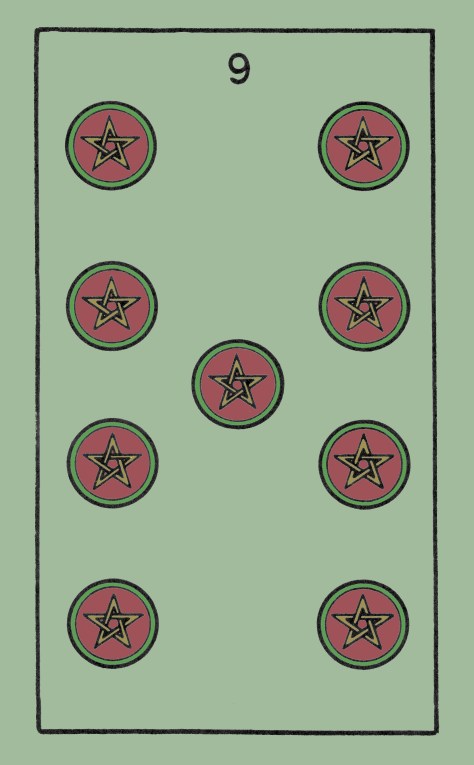
The Nine of Pentacles from the Builders of the Adytum (BOTA) tarot deck

Paul Foster Case (and Ann Davies)

The time period is the second decanate of Virgo, under the rulership of Saturn, September 3 to September 12. Meanings:
Well-Dignified: reserve, discretion, caution, frugality; some worries over money matters because of slow-maturing of plans; gain through careful investment. Occasionally when this card is especially welldignified, and other cards in the layout confirm it, this Key represents inheritance, material gain and much increase of goods, corresponding to the positive meanings of Saturn in Capricorn.
Ill-Dignified: discouragement; troubles through theft and knavery.
Keyword: Harvest.
(From the Oracle of Tarot course)

A. E. Waite

A woman, with a bird upon her wrist, stands amidst a great abundance of grapevines in the garden of a manorial house. It is a wide domain, suggesting plenty in all things. Possibly it is her own possession and testifies to material well-being. Divinatory Meanings: Prudence, safety, success, accomplishment, certitude, discernment. Reversed: Roguery, deception, voided project, bad faith.
(From The Pictorial Key to the Tarot)
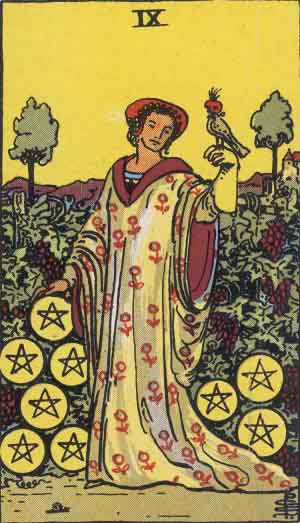
The Nine of Pentacles from the Rider Waite Smith tarot

Aleister Crowley

The Nine of Disks is called Gain. The suit of Disks is much too dull to care; it reckons up its winnings; it does not worry its head about whether anything is won when all is won. This card is ruled by Venus. It purrs with satisfaction at having harvested what it sowed; it rubs its hands and sits at ease. As will be understood from the consideration of the Tens, there is no reaction against satisfaction as there is in the other three suits. One becomes more and more stolid, and feels that “everything is for the best in the best of all possible worlds”.

[…]

The number Nine, Yesod, inevitably brings back the balance of Force in fulfilment. The card is ruled by Venus in Virgo. It shows good luck attending material affairs, favour and popularity.

The disks are arranged as an equilateral triangle of three, apex upwards, close together; and, surrounded at some distance by a ring, six larger disks in the form of a hexagon. This signifies the multiplication of the original established Word-by the mingling of “good luck and good management”. The three central disks are of the magical pattern as in earlier cards; but the others, since the descent into matter implies the gradual exhaustion of the original whirling energy, now take on the form of coins. These may be marked with the magical images of the appropriate planets.

As a general remark, one may say that the multiplication of a symbol of Energy always tends to degrade its essential meaning, as well as to complicate it.
(From The Book of Thoth)

The Nine of Disks from the Thoth tarot deck

Golden Dawn’s Book T

A WHITE Radiating Angelic Hand, holding a rose branch with nine white roses, each of which touches a Pentacle. The Pentacles are arranged thus

* *
* *
*
* *
* *


and there are rosebuds on the branches as well as flowers. Venus and Virgo above and below.

Complete realization of material gain, good, riches; inheritance; covetous; treasuring of goods; and sometimes theft and knavery. The whole according to dignity.
Yesod of HB:H (Inheritance, much increase of goods).
Herein those mighty Angels HB:HZYAL and HB:ALDYH have rule and
dominion

Etteilla

Effect
Upright. In terms of the medicine of the spirit, this card, in its natural position, signifies: Effect, Realization, Positive, Accomplishment, Success.
Reversed. Deception, Fraud, Disappointment, Empty promises, Vain hopes, Failed projects.

MQS
Tarot Encyclopedia – The Seven of Cups

(Note: this is a collection of the meanings attributed to the cards by some occultists in the past centuries. It does not reflect my own study or opinion of the cards. It is only meant as a quick comparative reference as I develop my own take.)

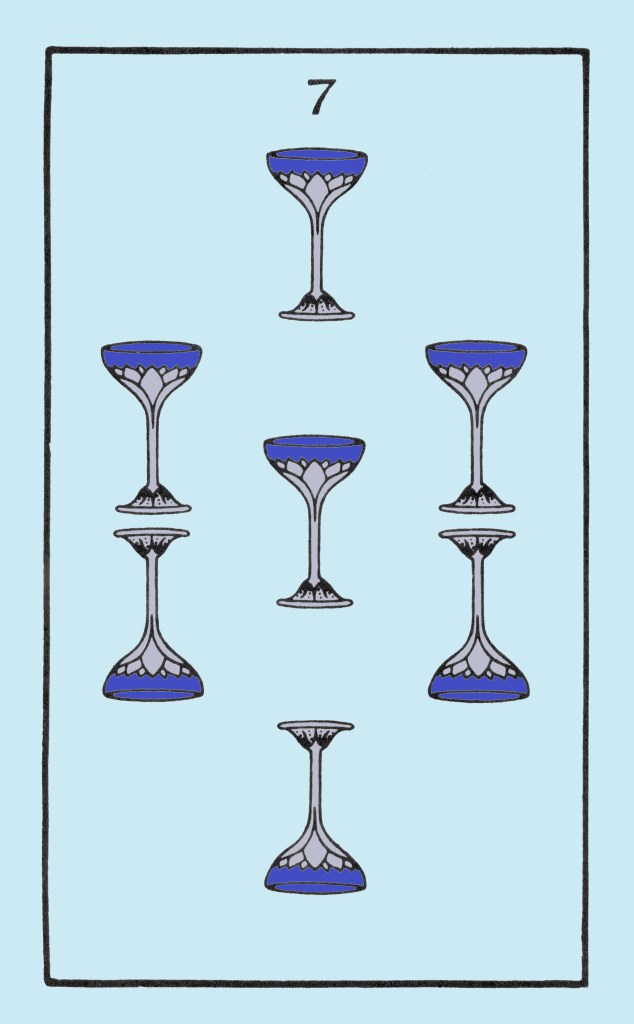
The Seven of Cups from the Builders of the Adytum (BOTA) tarot deck

Paul Foster Case (and Ann Davies)

The time period is the third decanate of Scorpio, November 11 to November 20, under the subrulership of the Moon.
Well-Dignified: possible victory, but the person to whom the card applies may be too indolent to take advantage of his opportunities for commanding circumstance. Success may be gained, but not followed up; necessity for choosing only the highest objectives.
lll-Dignified: illusionary success; lying and deceit; drunkenness; violence, even lust.
Keyword: Illusion
(From the Oracle of Tarot course)

A. E. Waite

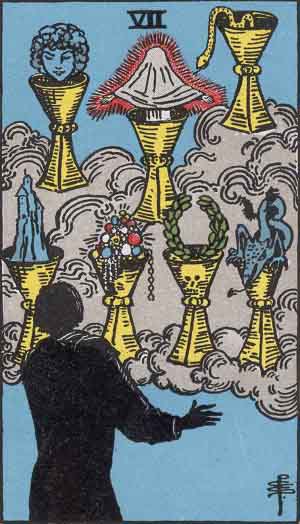
Strange chalices of vision, but the images are more especially those of the fantastic spirit. Divinatory Meanings: Fairy favours, images of reflection, sentiment, imagination, things seen in the glass of contemplation; some attainment in these degrees, but nothing permanent or substantial is suggested. Reversed: Desire, will, determination, project.
(From The Pictorial Key to the Tarot)

The Seven of Cups from the Rider Waite Smith Tarot Deck

Aleister Crowley

The Seven of Cups is called Debauch. This is one of the worst ideas that one can have; its mode is poison, its goal madness. It represents the delusion of Delirium Tremens and drug addiction; it represents the sinking into the mire of false pleasure. There is something almost suicidal in this card. It is particularly bad because there is nothing whatever to balance it-no strong planet to hold it up. Venus goes after Venus, and Earth is churned into the scorpion morass.

[…]

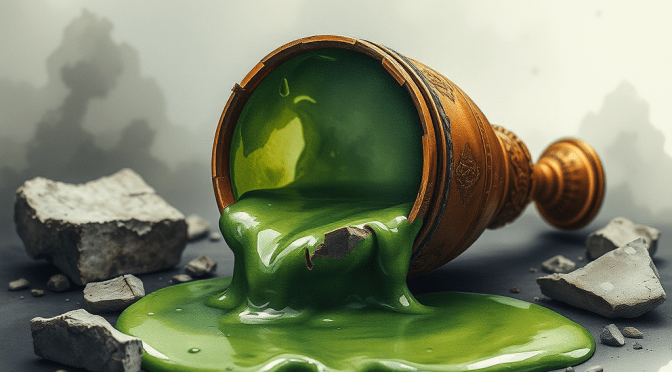
This card refers to the Seven, Netzach, in the suit of Water. Here recurs the invariable weakness arising from lack of balance; also, the card is governed by Venus in Scorpio. Her dignity is not good in this Sign; one is reminded that Venus is the planet of Copper, “external splendour and internal corruption”. The Lotuses have become poisonous, looking like tiger-lilies; and, instead of water, green slime issues from them and overflows, making the Sea a malarious morass. Venus redoubles the influence of the number Seven.

The cups are iridescent, carrying out the same idea. They are arranged as two descending triangles interlaced above the lowest cup, which is very much larger than the rest. This card is almost the “evil and averse” image of the Six; it is a wholesome reminder of the fatal ease with which a Sacrament may be profaned and prostituted.

Lose direct touch with Kether, the Highest; diverge never so little from the delicate balance of the Middle Pillar; at once the holiest mysteries of Nature become the obscene and shameful secrets of a guilty conscience.
(From The Book of Thoth)

The Seven of Cups from the Thoth Tarot

Golden Dawn’s Book T

THE seven cups are arranged as two descending triangles above a point: a hand, as usual, holds lotus stems which arise from the central lower cup. The hand is above this cup and below the middle one. With the exception of the central lower cup, each is overhung by a lotus flower, but no water falls from these into any of the cups, which are all quite empty. Above and below are the symbols of the Decanate Venus and Scorpio.

Possible victory, but neutralized by the supineness of the person: illusionary success, deception in the moment of apparent victory. Lying, error, promises unfulfilled. Drunkenness, wrath, vanity. Lust, fornication, violence against women, selfish dissipation, deception in love and friendship. Often success gained, but not followed up. Modified as usual by dignity.

Netzach of HB:H (Lying, promises unfulfilled; illusion, deception, error; slight success at outset, not retained).
Herein the Angels HB:MLHAL and HB:ChHVYH rule.

Etteilla

Thought
Upright. This card, as far as the medicine of the spirit is concerned, means, in its natural position: Thought, Soul, Spirit, Intelligence, Idea, Memory, Imagination, Understanding, Conception, Meditation, Contemplation, Reflection, Deliberation, Viewpoint, Opinion, Feeling.
Reversed. Plan, Design, Intention, Desire, Will, Resolution, Determination, Forethought.

MQS

Tarot Encyclopedia – The Five of Swords

(Note: this is a collection of the meanings attributed to the cards by some occultists in the past centuries. It does not reflect my own study or opinion of the cards. It is only meant as a quick comparative reference as I develop my own take.)

The Five of Swords from the Builders of the Adytum (BOTA) tarot deck

Paul Foster Case (and Ann Davies)

The time period is the first decanate of Aquarius, from January 20 to 29, under the rulers hip of Saturn and Uranus.
Well-Dignified: the decision is adve rse to the Querent in any matter of a material nature. In spiritual affairs this card portends apparent troubles which work out ultimately to good result. Thus this Key is one of trouble and anxiety, but rightly comprehended can be the turning point for positive good .
Ill-Dignified: the troubles are intensified and are probably due to the Querent’s own lack of understanding of the true nature of the situation. If the question is one of speculation, the Querent is likely to be disappointed due to his own desire to get something for nothing, to over-reach somebody else,
or to get rich quick.
Keyword: Defeat.
(From the Oracle of Tarot Course)

A. E. Waite

A disdainful man looks after two retreating and dejected figures. Their swords lie upon the ground. He carries two others on his left shoulder, and a third sword is in his right hand, point to earth. He is the master in possession of the field. Divinatory Meanings: Degradation, destruction, revocation, infamy, dishonour, loss, with the variants and analogues of these. Reversed: The same; burial and obsequies.
(From The Pictorial Key to the Tarot)

Aleister Crowley

The Five of Swords is similarly [to the other fives] troublesome; the card is called Defeat. There has been insufficient power to maintain the armed peace of the Four. The quarrel has actually broken out. This must mean defeat, for the original idea of the Sword was a manifestation of the result of the love between the Wand and the Cup. It is because the birth had to express itself in the duality of the Sword and the Disk that the nature of each appears so imperfect.

[…]

Geburah, as always, produces disruption; but as Venus here rules Aquarius, weakness rather than excess of strength seems the cause of disaster. The intellect has been enfeebled by sentiment. The defeat is due to pacifism. Treachery also may be implied.

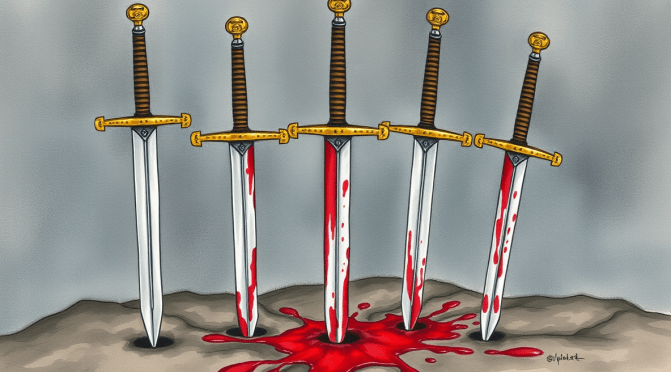
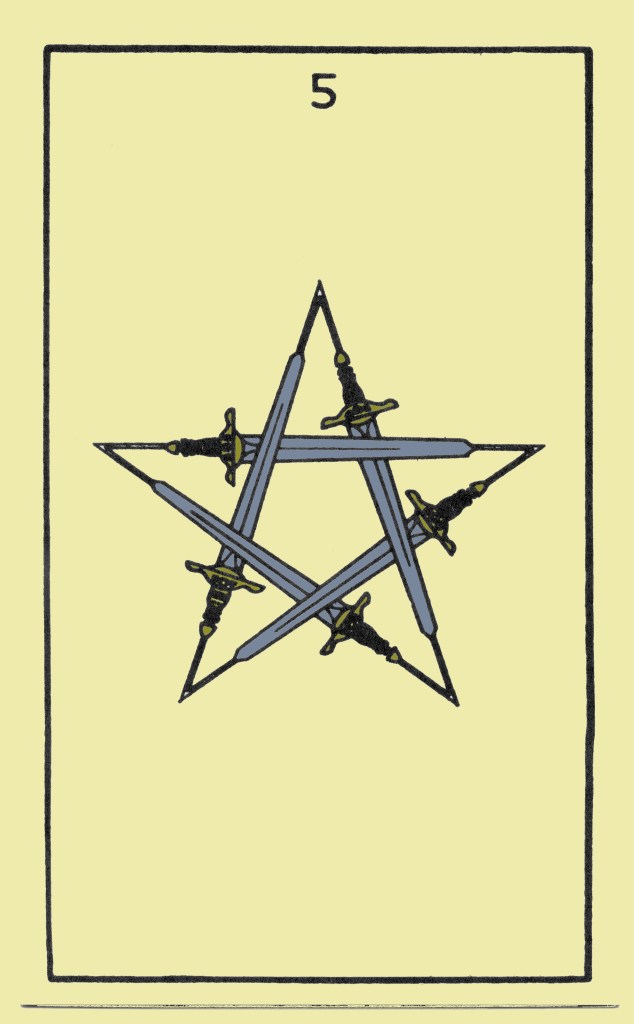
The hilts of the swords form the inverted pentagram, always a symbol of somewhat sinister tendency. Here matters are even worse; none of the hilts resembles any of the others, and their blades are crooked or broken. They give the impression of drooping; only the lowest of the swords points upwards, and this is the least effective of the weapons. The rose of the previous card has been altogether disintegrated.

The historian is happy to observe two perfect illustrations of the mode of this card and the last in the birth of the Aeon of (1) Osiris, (2) Horus. He will note the decay of such Virtue as characterized Sparta and Rome, ending in the establishment of the Pax Romana. As Virtue declined, corruption disintegrated the Empire from within. Epicene cults, such as those of Dionysus (in its degraded form), of Attis, of Adonis, of Cybele, the false Demeter and the prostituted Isis, replaced the sterner rites of the true Solar-Phallic gods; until finally (the masters having lost the respect, and so the control, of the plebs, native and alien) the lowest of all the slave-cults, dressed up in the fables of the vilest of the parasitic races, swept over the known world, and drenched it in foul darkness for five hundred years. He will delight to draw close parallels with the cognate phenomena displayed before the present generation.
(From The Book of Thoth)

AI-generated illustration for the Five of Swords

Golden Dawn’s Book T

TWO Rayed Angelic Hands each holding two swords nearly upright, but falling apart of each other, right and left of the card. A third hand holds a sword upright in the centre as though it had disunited them. The petals of the rose, which in the four had been reinstated in the centre, are torn asunder and falling. Above and below are Venus and Aquarius for Decan.

Contest finished and decided against the person; failure, defeat, anxiety, trouble, poverty, avarice, grieving after gain, laborious, unresting; loss and vileness of nature; malicious, slanderous, lying, spiteful and tale-bearing. A busybody and separator of friends, hating to see peace and love between others. Cruel, yet cowardly, thankless and unreliable. Clever and quick in thought and speech.
Feelings of pity easily roused, but unenduring.

Geburah of HB:V (Defeat, loss, malice, spite, slander, evil-speaking).
Herein the Angels HB:ANYAL and HB:Cha’aMYH bear rule.

Etteilla

Loss
Upright. This card, as far as the medicine of the spirit is concerned, means, in its natural position: Loss, Alteration, Discredit, Degradation, Perdition, Decay, Destruction, Deterioration, Deterioration, Diminution, Depression, Diminution, Damage, Failure, Prejudice, Blemish, Torts, Avarice, Decline of business, Failure, Disadvantage, Devastation, Dilapidation, Dissipation, Injury, Disgrace, Reversal, Reversal of fortune, Ruin. – Defeat – Debauchery, Disgrace, Dishonor, Infamy, Ignominy, Affront, Ugliness, Difformity, Humiliation. – Theft, Thievery, Rape, Plagiarism, Abduction, Filthy, Horrible. – Infamy, Corruption, Profligacy, Seduction, Libertinism.
Reversed. Mourning, Abasement, Affliction, Sadness, Grief, Pain of spirit, Funeral pump, Burial, Funeral, Inhumation, Burial.

MQS

Tarot Encyclopedia – The Four of Wands

(Note: this is a collection of the meanings attributed to the cards by some occultists in the past centuries. It does not reflect my own study or opinion of the cards. It is only meant as a quick comparative reference as I develop my own take.)

The Four of Wands from the Builders of the Adytum (BOTA) Tarot deck

Paul Foster Case (and Ann Davies)

The Four of Wands is associated with the third decanate of Aries, the time period April 10 to April 19, ruled by Jupiter.
Well-Dignified: this card signifies success through personal merit, good
social standing, influential friends, the perfection of something built
up after labor, benefit through travel, shipping and business with foreign countries.
lll-Dignified: loss in the same things, or in consequence of unpreparedness or by hasty action.
Keyword: Perfected work.
(From the Oracle of Tarot course)

A. E. Waite

From the four great staves planted in the foreground there is a great garland suspended; two female figures uplift nosegays; at their side is a bridge over a moat, leading to an old manorial house. Divinatory Meanings: They are for once almost on the surface–country life, haven of refuge, a species of domestic harvest-home, repose, concord, harmony, prosperity, peace, and the perfected work of these. Reversed: The meaning remains unaltered; it is prosperity, increase, felicity, beauty, embellishment.
(From The Pictorial Key to the Tarot)

Aleister Crowley

In the Wand suit, the card is called Completion. The manifestation promised by Binah has now taken place. This number must be very solid, because it is the actual dominating influence on all the following cards. Chesed, Jupiter-Ammon, the Father, the first below the Abyss, is the highest idea which can be understood in an intellectual way, and that is why the Sephira is attributed to Jupiter, who is the Demiurge.

[…]

This card refers to Chesed in the suit of Fire. Being below the Abyss, it is the Lord of all manifested active Power. The original Will of the Two has been transmitted through the Three, and is now built up into a solid system:-Order, Law, Government. It is also referred to Venus in Aries, which indicates that one cannot establish one’s work without tact and gentleness.

The wands are headed by the Ram, sacred to Chesed, the Father-god Amoun-Ra, as also to Aries; but at the other end of the wands are the Doves of Venus.

In the symbol, the ends of the wands touch a circle, showing the completion and limitation of the original work. It is within this circle that the flames (four double, as if to assert the balance) of the Energy are seen to play, and there is no intention to increase the scope of the original Will. But this limitation bears in itself the seeds of disorder.
(From The Book of Thoth)

AI-generated illustration for the Four of Wands

Golden Dawn’s Book T

TWO White Radiating Angelic Hands, as before, issuing from clouds right and left of the card and clasped in the centre with the grip of the First Order, holding four wands or torches crossed. Flames issue from the point of junction. Above and below are two small flaming wands, with the symbols of Venus and Aries representing the Decan.
Perfection or completion of a thing built up with trouble and labour. Rest after labour, subtlety, cleverness, beauty, mirth, success in completion. Reasoning faculty, conclusions drawn from previous knowledge. Unreadiness, unreliable and unsteady through over-anxiety and hurriedness of action. Graceful in manner, at times insincere, etc.
Chesed of HB:Y (Settlement, arrangement, completion).
Herein are HB:NNAAL and HB:NYThHL Angelic rulers

Etteilla

Company
Upright. This card, as far as the medicine of the spirit is concerned, in its natural position means: Society, Association, Assembly, Relation, Confederation, Alliance, Union, Gathering, Circle, Community, Assembling, Multitude, Mass, Crowd, Troop, Band, Company, Cohort, Army. – Convocation, Accompaniment, Mixing, Mixture, League, Amalgamation. – Contract, Convention, Covenant, Treaty.
Reversed. Prosperity, Increase, Accretion, Advancement, Success, Succeeding, Fortune, Blossoming, Happiness. – Beauty, Beautification.

MQS

The Geomancy of Peter of Abano – Book III Pt. 9

Previous / Back to Index / Next

Here Abano talks about the meanings of Caput Draconis and Cauda Draconis in the various houses.

Caput Draconis (The Dragon’s Head or North Moon Node)

Caput Draconis in the first house means good luck, noble people, wise people, leaders, captains, honor, dignity, a prelate.1
In the second it means good success, gaining wealth or dignity or money.
In the third it means noble brothers and sisters, lucky siblings, good through them, isolated gardens2, pleasures.

In the fourth it means good for the parents, inheritance, buildings, cities, citizens, noble people, good end to an issue.
In the fifth it means science, good children, gain and help through them.
In the sixth it means good servants, faithful servants, good officials, grave infirmity, melancholic infirmity,3 long fevers.

In the seventh it means honorable women, good marriage, good company, gain from noble people or from women and thanks to them.
In the eighth it means inheritance, goods gain from the dead, usefulness through women and noble people, gain through war and by violence against life, being beheaded.4
In the ninth it means honoring God, ecclesiastical dignity, religious people, noble people, good journeys, delay in coming back but with good results, a messenger with bad news, messenger bearing news of legal issues, ingeniousness in a noble science.

In the tenth it means the king, the emperor, the lord, a magistrate, dignity, honor, good regents and orators, noble people.
In the eleventh it means noble soldiers, captains, dignity, sublimation5, succeeding one’s lord, faithfulness, valor, good luck.
In the twelfth it means noble inheritance through the mother, honorable things for [or through] women, few enemies, weak enemies, certainty, fame.

In the thirteenth it means journeys, messengers, a king, lords, usefulness, gain, honor, dignity, friendship and good recoglientia.6
In the fourteenth it means coming back from a journey with dignity and mirth and gain, letters, positive answer, honors, dignity, usefulness.
In the fifteenth it means a good end to the question and strong hope.7

Cauda Draconis (The Dragon’s Tail or South Moon Node)

Cauda draconis in the first house means evil disposition of the querent or of the quesited, fear of death, being murdered.8
In the second it means wealth gain through illicit means, theft, violence.
In the third it means iniquity against siblings and relatives, remains, retaliations, killings on the streets.

In the fourth it means loss of inheritance, evil lands, evil people, betrayals, false rumors, destruction of a city or fortress.
In the fifth it means evil children or women, loss of children, danger during childbirth, loss of blood.
In the sixth it means evil servants, runaways, grave illness, bodily fluids, killing, desperation, damage.

In the seventh it means a harlot, vile marriage, evil company, unfaithfulness, betrayal, violence, enmity.
In the eighth it means fear of death for [or through] women, rumors, freedom from prison and from illness, loss through women, being killed, loss of blood and flobotomia.9
In the ninth it means being forced on a journey, loss, danger of death, toil, changing one’s religion, evil or false religious people, evil Christians,10 evil messengers, death during a journey.

In the tenth it means an evil lord, traitors of one’s country, iniquitous judges or orators, overthrowing tyrants, loss of dignity, destruction of one’s kingdom.
In the eleventh it means wrongful succession, betrayal, violence, rebellion, death of one’s lord.
In the twelfth it means hidden enemies of the kingdom, machinations, treason against one’s lord, assassinations both public and private, violence.

In the thirteenth it means betrayals during a journey, hate from noble people, the absent party doesn’t come back.
In the fourteenth it means toiling for gain and honor, bad luck, hatred from underlings and very evil enemies, overcoming one’s enemies,.
In the fifteenth it is the worst of all, eccept for doing evil things.11

MQS

Footnotes
  1. Possibly due to the Moon’s North Node connection with beginnings and with increase, as well as the connection of the term ‘head’ with leadership. ↩︎
  2. The text seems to say “giardini solati”, and I am not sure if it means isolated gardens or gardens in the sun or something else that escapes me. The connection with gardens is clear, as the Third House rules neighborhoods and therefore what’s around the house. ↩︎
  3. Illnessess were traditionally categorized based on the prevailing humor. ↩︎
  4. This is another excellent example of how to read the meaning of the figure into the meaning of the house. Caput Draconis is the head, and the Eighth House rules death, thus giving beheading (death by losing one’s head). Of course much depends on the question and the rest of the Shield. ↩︎
  5. This is not clear. ↩︎
  6. An archaic Italian word of whose meaning I am unaware. ↩︎
  7. Caput cannot be the Judge. ↩︎
  8. It is usually said that Cauda being in the First House is enough to break the figure. However, here Abano gives us coherent interpretations. Most of them are very dramatic, but it’s the principle that counts and needs to be assimilated. ↩︎
  9. A term belonging to the vocabulary of Medieval medicine. I do not know what it means. ↩︎
  10. Probably to be interpreted as evil believers in general, nowadays. ↩︎
  11. Cauda cannot be the Judge. ↩︎

The Geomancy of Peter of Abano – Book III Pt. 6

Previous / Back to Index / Next

Here Abano examines some of the meanings of Puer and Puella in the various houses.

Puella

Puella in the first house means happy things, fleeing from adversity, singing, dancing, usefulness, younger siblings or dead siblings.1
In the second it means usefulness for women and for merchandise, good luck, clothes.
In the third house it means love between siblings and relatives, good friends, usefulness through them.

In the fourth it means fighting over inheritance, difficulty in whatever you wish to gain from your father or mother,2 hiding secrets, good profession.
In the fifth house it means good messenger and letters, gaiety with children, obtaining your wish.
In the sixth house it means lovesickness,3 good servants, harlots, fornication, lasciviousness.

In the seventh it means a marriage of love,4 lucky marriage, lascivious women, lack of stability.
In the eighth it means death of small children, arms and swords.5
In the ninth it means usefulness through travel, good change of place, gain through merchanidse, knowledge, good news.

In the tenth it means honor from lords, good servants, good things for powerful people, happiness, goodness in everything.
In the eleventh it means happiness from friends, good luck for sick people, gain, usefulness through injustice, good in everything.
In the twelfth it means being firm, scams, gain through animals, problems through servants and evil people and phony people.

In the thirteenth it means usefulness through travel and lords, happiness, good news, good messenger.
In the fourteenth it means freedom from danger, usefulness, happiness, gain through toil.
In the fifteenth it depends on the other figuers, depending on where they fall.6

Puer

Puer in the first house means happiness, hope of gain, having kids, obtaining your wish, money.7
In the second it means gain through merchandise, selling, abundance, obtaining the wish.
In the third it means discord among siblings and relatives, gain with difficulty and with company, difficulties, useless dream.

In the fourth it means controversy, fighting, discord, rumors about the father or mother due to inheritance, it brings to light the hidden, useful strategies.
In the fifth it means happiness, false messenger, fights, wealth from minors.
In the sixth it means fled servants, dishonest women, danger from giving birth, male child.

In the seventh it means illegal marriage, harlots, dirty words, useful company.
In the eighth it means death of an enemy or of a minor, inheritance, fraud, if with Rubeus8 it means wounds and loss of blood.
In the ninth it means long travel, reunion, false science and false people, false news.

In the tenth fight, bad judge, dishonor, one’s lord is too credulous, loss of dignity and wealth.
In the eleventh it means false soldiers, false friends, false churchmen, unfaithfulness, treason, contrarieties.
In the twelfth it means enemies, invasion, bad for journeying, subjects, the sick person is evil and a traitor.

In the thirteenth it means travel, impediments, murder, evil people, violence, eviction, loss of inheritance.
In the fourteenth it means evil company, false marriage, harlots, instability.
In the fifteenth it is always evil except in war.9

MQS

Footnotes
  1. This last correspondence escapes me. ↩︎
  2. Puella is usually presented as a positive, if weak, figure. Why it should cause strife over inheritance is not clear. In some Medieval books on Geomancy it seems as though Puer and Puella are often mixed together. ↩︎
  3. The connection of love, one of the meanings of Venus/Puella, with the sickness typical of the Sixth House, is rather smart here, and should be taken as example of how to derive meanings from the Figure-in-House combination. ↩︎
  4. That is, as opposed to a marriage of convenience or marriage for money, which were common back in the day. ↩︎
  5. This latter correspondence seems more plausible for Puer. ↩︎
  6. Puella cannot be the Judge. ↩︎
  7. Once again, this feels like a mix between Puer and Puella. ↩︎
  8. It is not clear where Rubeus should appear in order for Puer to be ‘with’ it. Perhaps in company. At any rate, it is an interesting comment as it reinforces the idea that the figures combine their meanings to give us a clearer picture of the situation. ↩︎
  9. Puer cannot be the Judge. ↩︎

Tarot Encyclopedia – The Two of Cups

(Note: this is a collection of the meanings attributed to the cards by some occultists in the past centuries. It does not reflect my own study or opinion of the cards. It is only meant as a quick comparative reference as I develop my own take.)

The Two of Cups from the Builders of the Adytum (BOTA) tarot deck

Paul Foster Case (and Ann Davies)

The Two of Cups, astrologically, is assigned to the first decanate of Cancer, ruled by the Moon, time period June 22 to July 1.
The specific divinatory ideas associated with this Key are:
Well Dignified: reciprocity, reflection; gain and benefit through parents;
favors from the opposite sex; changes of residence.
Ill Dignified: reverses and losses through parents or the opposite sex; unfortunate changes of residence; fluctuations of mood; unwise decisions.
Keyword: Response to environment.
(From the Oracle of Tarot course)

A. E. Waite

A youth and maiden are pledging one another, and above their cups rises the Caduceus of Hermes, between the great wings of which there appears a lion’s head. It is a variant of a sign which is found in a few old examples of this card. Some curious emblematical meanings are attached to it, but they do not concern us in this place. Divinatory Meanings: Love, passion, friendship, affinity, union, concord, sympathy, the interrelation of the sexes, and–as a suggestion apart from all offices of divination–that desire which is not in Nature, but by which Nature is sanctified.
(From The Pictorial Key to the Tarot)

Aleister Crowley

The Two always represents the Word and the Will. It is the first manifestation. Therefore, in the suit of Water, it must refer to Love, which recovers unity from dividuality by mutual annihilation.

The card also refers to Venus in Cancer. Cancer is, more than any other, the receptive Sign; it is the House of the Moon, and in that Sign Jupiter is exalted. These are, superficially, the three most friendly of the planets.

The hieroglyph of the card represents two cups in the foreground, overflowing upon a calm sea. They are fed with lucent water from a lotus floating upon the sea, from which rises another lotus around whose stem are entwined twin dolphins. The symbolism of the dolphin is very complicated, and must be studied in books of reference; but the general idea is that of the “Royal Art”. The dolphin is peculiarly sacred to Alchemy.

The number Two referring to Will, this card might really be renamed the Lord of Love under Will, for that is its full and true meaning. It shows the harmony of the male and the female: interpreted in the largest sense. It is perfect and placid harmony, radiating an intensity of joy and ecstasy.

Of necessity, the realization of the idea in the Four (as the suit develops) will gradually diminish the purity of its perfection.
(From the Book of Thoth)

A somewhat mundane AI-generated illustration for the Two of Cups

Golden Dawn’s Book T

A WHITE Radiant Hand, issuant from the lower part of the card from a cloud, holds lotuses. A lotus flower rises above water, which occupies the lower part of the card rising above the hand. From this flower rises a stem, terminating near the top of the card in another lotus, from which flows a sparkling white water, as from a fountain. Crossed on the stem just beneath are two dolphins, Argent and Or, on to which the water falls, and from which it pours in full streams, like jets of gold and silver, into two cups; which in their turn overflow, flooding the lower part of the card. Venus and Cancer above and below.

Harmony of masculine and feminine united. Harmony, pleasure, mirth, subtlety:
but if ill dignified — folly, dissipation, waste, silly actions.
Chokmah of HB:H (Marriage, love, pleasure).
Therein rule the Angels HB:AVa’aAL and HB:ChBVYH.

Etteilla

Love
Upright. This card, as far as the medicine of the spirit is concerned, means, in its natural position: Love, Passion, Inclination, Sympathy, Attraction, Propensity, Friendship, Benevolence, Affection, Attachment, Taste, Bonding, Galantry, Attraction, Affinity.
Reversed. Desire, Augury [= Aspiration], Vow, Will, Want, Cupidity, Concupiscence, Jealousy, Passion, Illusion, Appetite.

MQS

Caput Draconis / Dragon’s Head (Geomancy Figures)

Name of the Figure: Caput Draconis (Dragon’s Head), sometimes called Inner Threshold
Element: Earth
Planet: None; North Node (some say also the benefics, Venus and Juputer)
Sign: Virgo
Quality: Entering
Fortune: Good

Caput Draconis, like its counterpart Cauda, is a special figure in the geomantic family. These are the only two that are not canonically assigned to any traditional planet. Instead, they are given to the nodes of the Moon, i.e. the points where the Moon intersects the Sun’s ecliptic. These were held in exceptionally high regard in traditional astrology, at least from Arab astrology moving forward (but apparently also in Hellenistic astrology, though their function there is debated.) Caput Draconis, the North Node, is usually said to be expansive and broadly positive, or at least augmenting. The symbol of the geomantic figure is usually likened to a series of steps leading toward a threshold.

Illustration for the geomantic figure Caput Draconis, the Dragon’s Head

Some say that Caput is associated with the two benefics of traditional astrology, Venus and Jupiter. More specifically, though, Caput is not automatically a good figure. It often represents an onrush of new energy, indicating everything new or everything that starts afresh.

More generally, it is associated with everything that develops, grows, becomes more stable and certain. This, of course, is a double-edged sword, as not everything that is stable is good for us. Often, Caput shows the impossibility to get rid of something, even if it is bad for us. It shows long illnesses, for instance.

Often, however, Caput is in fact a positive figure. It represents things coming to us, and as most questions get a positive answer when something comes to us, Caput is mostly a welcome figure.

Common Keywords: Arrival of new situations, beginning, fresh air, new enterprises, dynamic energy, development, deepening, stabilizing, long-lasting

Caput Draconis in the Geomantic Houses (these are only examples. Use context to guide your interpretation)

HousePossible Meanings
FirstPositive, taking initiative, going, doing, starting something, good luck
SecondIncome, new income stream
ThirdNews, important information, help from siblings
FourthBuying real estate, help from the father
FifthFun, pregnancy, conception
SixthLong illness, good servants
SeventhNew relationship, lasting bond
EighthBeing shielded from danger, gain from other people
NinthConversion, signing up for a course, good at learning, spiritual evolution
TenthNew job, lasting stability in one’s career
EleventhNew friends, realization of hopes
TwelfthLong prison sentence, safety from occult enemies
ThirteenthQuerent has initiative, something has already started
FourteenthQuerent lacks initiative or needs to exert it more, there will be a new beginning
FifteenthCaput cannot be Judge
Possible meanings of Caput Draconis in the various Geomantic Houses. Note that this is not meant to be exhaustive, and it only serves to jog your interpretive muscles

MQS

Amissio / Loss (Geomancy Figures)

Name of the Figure: Amissio (Loss)
Element: Fire
Planet: Venus (retrograde)
Sign: Libra
Quality: Exiting
Fortune: Bad

Amissio is another rather straightforward figure, with a caveat that I will address at the end. It is the opposite of Acquisitio, and its symbol shows it, as it seems to depict a bag with its mouth held downward, signifying loss. Tradition assigns this figure to Venus retrograde, meaning that while it is bad in most things, some see it as good in love affairs.

Illustration for the geomantic figure Amissio, Loss

Mainly, Amissio is a figure of loss, especially financial or material loss. It is also often associated with losing items or having them stolen from you. Needless to say, it is bad in any situations where we hope for increase, gain and the like. It is good in situations where you want to lose something, such as weight, illness, prison sentences, etc. Some say that Amissio is good for love because in love you “lose yourself” in the other.

Frankly, I believe we need to be very cautious with this line of reasoning, as it can be played with and made to say whatever we want. “Will I find a job?” “Why, yes! Here it says you will lose your lack of employment!” Furthermore, even in matters of love I have personally found that there are better figures to represent love (Puella) elation (Laetitia), ardor (Puer) or commitment (Conjunctio). I have the sneaking suspiscion that the only reason the Medievals assigned Amissio to Venus was that Saturn already had two figures to its name and nothing else was available, so always take the attributions with a grain of salt. The main meaning is loss, plain and simple.

Common Keywords: Loss, Difficulties, Hardships, Theft, Healing, Liberation, Letting go, Falling in love

Amissio in the Geomantic Houses (these are only examples. Use context to guide your interpretation)

HousePossible Meanings
FirstLoss, Depression, In love, Lost, Needy, In need
SecondLoss of money or valuables, Loss of an object, Hardhips, Sacrifices
ThirdThieves in the neighborhood, Bad relationship with siblings, rumors, gossip
FourthLoss of inheritance, Loss from real estate or from the father
FifthLosing yourself in pleasures, Loss of pregnancy, Sadness
SixthHealing, Loss from servants and subordinates or from small animals, losing your pet
SeventhFalling in love, Losing your partner, Thieves
EighthBereavement, Loss, Loss of partner’s money
NinthLoss during journey, Losing your way, Bad skill or bad science
TenthLoss of employment, Inability to find a job
EleventhLoss of friendship, loss of hope, Loss of government support
TwelfthBeing freed from prison or a curse, Loss through large cattle
ThirteenthPast expenses, Past sacrifices
FourteenthFuture loss, Expenses, If the Judge is positive, there may be bad consequences in the future
FifteenthNot getting what you want (may be good in “Venusian” pursuits)
Possible meanings of Acquisitio in the various Geomantic Houses. Note that this is not meant to be exhaustive, and it only serves to jog your interpretive muscles

MQS

Puella / Girl (Geomancy Figures)

Name of the Figure: Puella (The Girl)
Element: Water
Planet: Venus (direct)
Sign: Libra (Sometimes given as Aries)
Quality: Entering
Fortune: Good (with neutral undertones)

Puella is the counterpart to Puer, the boy, and the opposite figure of Rubeus (if you push Puella through Via you get Rubeus, not Puer). It is a figure of Venus direct. Just as Venus is the lesser fortune in astrology, Puella is a positive figure, but not very strong. Its testimony is easily overruled by other consideration. Its figure has two points in the Air line. This fact has been interpreted variously in modern literature. From a visual standpoint, this is said to represent a mirror or a woman’s breasts.

Illustration of the geomantic figure Puella, girl

Puella represents a girl’s or woman’s influence in the querent’s life. In this sense, the figure is neutral, and its meaning must be clarified by the rest of the chart. It also represents things we traditionally associated with women. This ranges from objects typically used by women (mirrors, lipsticks, gowns, etc.) to a feminine attitude and feminine interests.

Obviously, given its association with Venus and with womanhood, Puella has to do with love, harmony, balance, in all their applications. For instance, Puella tends to bring affection, love, togetherness. It is a good figure for interpersonal relationship, as it shows tactfulness, although it can signify someone who is easily influenced. It also has a connection with the arts, just like Venus. Everything that is pleasing to the eye falls under its jurisdiction.

Another idea connected with Puella is that of innocence. This can be played with if it is relevant to the question. Finally, Puella can represent an inability to assert oneself. If found in an unfavorable position, it can point to laziness and wastful behavior.

Common Keywords: A girl or a woman, female things (gowns, stockings, lipsticks, etc.) beauty, art, creativity, gentleness, harmony, girlish, unstable, submissive, (re)conciliation, love, feelings, easily swayed or overwhelmed, broadly positive outcome but with instability

Puella in the Geomantic Houses (these are only examples. Use context to guide your interpretation)

HousePossible Meanings
FirstHarmonious, girlish, pleasing, conciliatory, well-meaning, prissy
Secondfinery, nice things, good for money
Thirdsisters, good siblings and neighbors, good news, true rumors
Fourthharmony in the family, homemaking, gardening
Fifthsinging, dancing, arts, beauty, fun, love, kisses, a baby girl
Sixthrest, good servants, lovesickness, female pets
Seventhmarriage, wife, harmony with other people or with partner
Eighthdowry, gain through others
Ninthholiday, vacation, respite, fun, learning an art
Tenthpleasure from one’s occupation, good relationship with people above
Eleventhfemale friends, realization of hopes, help
Twelfthfemale animals, wastefulness, lack of effort, an evil woman
Thirteenthgoodwill, acceptance, loving nature, a woman from the past, a woman’s help
Fourteenthlack of harmony, there will be harmony in the future, a future woman, a woman’s opposition, indecision
FifteenthPuella cannot be Judge
Possible meanings of Puella in the various Geomantic Houses. Note that this is not meant to be exhaustive, and it only serves to jog your interpretive muscles

MQS