Enneagram Type One and Enneagram Type Nine are different in many respects. Both are Body types, and are therefore concerned with issues of autonomy. Neither of them is as assertive and warrior-like as Type Eight, the other Body type, but both find different strategies to preserve their autonomy. Nines seek to maintain their autonomy by being friendly and avoiding conflict with others. Ones maintain their autonomy by justifying it rationally as a means for them to pursue an ideal of rightness or justice.
While both Nines and Ones can believe that justice is important, for Nines justice is more a matter of harmonious balance with others. They do not quibble about rules and methodologies and are more than happy to accept (or even to sugarcoat) the world’s and other people’s shortcomings. They usually do not go out of their way to convert others to their point of view and prefer to keep peace, something alien to Ones.
Both Nines and Ones have a difficult relationship with anger. Nines are the least choleric of the nine types, and often need to work hard on themselves to learn to express anger and disappointment when it is appropriate. Average Nines may even feel that the notion of anger is completely alien to them. Ones certainly feel their anger simmering inside of them, but they have a difficult time expressing it directly.
harmony
Both types can be passive-aggressive.Nines are so in an attempt to neutralize other people’s agendas that risk disturbing their peaceful flow. In this sense, they are passive saboteurs. Ones are passive-aggressive because they would like everything to be perfect and everyone to accept that they are right about what it means for everything to be perfect, but they generally find it hard to boldly force others to comply. Furthermore, they often project onto others the anger they feel at their own shortcomings.
In general, Nines believe that the world is (or could very easily become) a good place, and usually keep themselves mentally occupied with bucolic platitudes about themselves and the world. Ones are more pessimistic about the world and about human nature, as they tend to see the world as the negative of a perfect picture that requires an inordinate amount of effort to reach. Furthermore, Ones tend to be methodical and spurred on by clear objectives. Nines, on the contrary, are more placid and, while not necessarily inactive, they can content themselves with following their routine without rigid aspirations and methods.
Enneagram Type One and Enneagram Type Eight can showcase some similarities, but they are also quite easy to tell apart. Both are Body types, and both are concerned with the issue of autonomy. Eights want to be autonomous in that they dislike having to bow to powers other than their own. This distaste for others’ control is behind the Eight’s attempt to assert themselves and to force others to deal to them upfront. Deep down, Ones would also like to have the drive and magnetism of an Eight, but they feel they need to justify their autonomy, which is why they mediate it by turning into ‘the right kind of autonomy’, i.e., right action.
This is the basis of the distinction between the two types. Both are highly choleric,* but the Eight’s choler flows free and unhindered, in an instinctual and preintellectual way, while that of a One stagnates inside of them, welling up while awaiting release once it is intellectually justified (but often finding expression in passive-aggressive ways).
In Eights, the energy goes outward and others must learn to live with it, whether they like it or not; in Ones, energy is blocked inside of them and they must try to convince others of their reasons. In this sense, while both Ones and Eights can be rigid and controlling, Ones never try to submit others to their personal power, but rather to the ideal that they themselves submit to.
Fairness
Both Ones and Eights often hold concepts such as truth, justice, fairness, etc. dear to their heart. Eights, though, have an immediate and almost bodily understanding of them, as they react with immediate action as soon as an instance of injustice or untruth appears before them. Ones, once again, have a more intellectual and systematic approach to them.
Therefore, while Eights are certainly more heroic, they may fail to be able to make finer distinctions even when they are important, thus quickly becoming unjust themselves (you stole an apple, so I’m going to cut off your hand.) Ones, of course, may very well believe in dangerous ideas of justice, but they tend to elaborate them in such a systematic way that a whole society would be able to function according to them, and they would be the first to submit to the system.
Furthermore, Ones may very well be heroic themselves. For instance, my father, a One, has ended up on the newspaper a couple of times for tackling thieves on the street. Ones, however, know that a single act of courage is not enough to substitute a general, impersonal system of rules, whereas Eights may have a more maverick idea of justice as administered by courageous superheroes.
A wonderful example of the difference between Ones and Eights in matters of justice is seen in Plato’s dialogues, where Socrates, the mouthpiece of Plato’s one-ish idealism, often goes up against Sophists who are more eight-ish in their beliefs, wanting to assert the reasons of driven, powerful individuals as opposed to more abstract systems of law. Of course, the story is always told from the One’s perspective, but it is instructive nonetheless.
MQS
* I use the words ‘choleric’ and ‘choler’ in the old-fashioned way. Choler is just the bodily energy that leads to self-assertion and is behind our ability to tackle obstacles and enemies. Anger is only one of its expressions.
Enneagram Type One and Enneagram Type Seven are very much unlike each other, so much so that they are each other’s arrow: Ones grow at Seven, Sevens stress at One. Ones are a Body type, and their primary focus is on right action as autonomous beings; Sevens are a Head type, and they focus mainly on security, which they seek to achieve by planning their comfort and diversions.
Both Ones and Sevens are, in a sense, idealistic, but their idealism has different roots and different effects on their worldview: Ones believe in high ideals and standards and, by consequence, see the world as imperfect and fallen; Sevens idealize their potential for future enjoyment and so see the world as their oyster, full of cool stuff to be hyped about.
Ones are known for their harsh inner critic, which constantly nags them about what they are doing wrong and why. Everyone, including Sevens, may have a strong inner critic depending on their particular life story, but what’s usually even stronger than any inner critic in a Seven’s mind is their inner Yes-Man, a voice that constantly justifies and encourages their desire for more and broader avenues of enjoyment.
Ideals
In a social context, Ones and Sevens are also very different. Average Ones are generally restrained and somewhat uncomfortable. They may love to try to be more personable and warm, but they also feel that something is holding them back and doesn’t allow them to just relax and enjoy others’ company. Even Ones that have worked a lot on themselves usually retain a degree of inner tension.
Sevens, on the other hand, are people magnets (even when they don’t want to be). They love quick and witty banter with others, and even more introverted Sevens relate to others with peculiar ease, and are often capable of making fun of themselves and of odd or paradoxical everyday situations in a way that Ones would find disconcerting.
The difference between Sevens and Ones is the difference between fun and duty: they are notoriously tricky to reconcile. Unhealthy, stressed Sevens who have strayed too far may suddenly try to save their wanton selves from their mistakes by suddenly developing the rigidity of a One, but in more regular circumstances they are positive, upbeat and open to the world’s possibilities. Healthy Ones, by contrast, are usually capable of incorporating some Seven traits in their behavior by becoming more serene and developing a more positive attitude, but in general they remain tense perfectionists.
Enneagram Type One and Enneagram Type Six can sometimes be similar, but their differences are even more striking. Ones are a Body type, and focus on how to act rightly as autonomous beings. Sixes are a Head type, and their focus is on security from potential threats and uncertainties, which they try to achieve by thinking about all possibilities and by finding allies and leaders they can rely on.
Both Ones and Sixes tend to be dependable, dutiful and reasonable, linear in their thinking. They usually dislike extravagance and iffy ideas. Ones dislike them because they see themselves as the keepers of the orthodoxy, while Sixes dislike them because they want to try to focus on things and ideas that give them certainty.
Sixes have a marked social component that is not very prevalent in Ones. Sixes appreciate group cohesion and therefore conformity of opinions. They like their beliefs being reflected back at them by others like them. A Six with rebellious ideas tend to like being together with other rebels like them. Even Sixes who appreciate or accept pluralism and settings where pluralism is accentuated want to make sure that everyone is on board at least on the fact that pluralism is good.
Ones, on the other hand, do not need social validation and do not look for someone to tell them what’s right or wrong, what’s true or false, so while they are by no means loners, they can accept that their beliefs will make them some enemies. By contrast, Sixes can accept the existence of an enemy as long as there is a “we the people” fighting against it that can provide them group protection, even if just in their heads.
Duty
Both can have an ambivalent relationship with authorities: Ones ultimately obey their conscience, which can cause frictions with the powers that be; Sixes are desperately looking for someone or something whose authority they can rely on, but they also distrust authorities on the grounds of them either being potentially dangerous or not providing them enough protection or peace of mind. Both Ones and Sixes can occupy themselves with ideas of justice and can be very ideological, but Ones have a selfless relation with justice (“this is what is right. We must do it. Period”), while Sixes want to create a society in which they or those like them can feel safe or nurtured.
Ones rarely question their values and ideals and are possessed of a certain inner certainty about what’s to be done and what’s to be left alone. Sixes definitely lack this sense of inner guidance as they are known for sometimes spinning in circles about even the most trivial matters and are forever drowning in a sea of questions in their search for an unquestionable dry land. Of course, they may adhere blindly to a belief, an ideology, a religion, a group, etc. as a way to rescue themselves from their uncertainties, but there is always, even if just subconsciously, a nagging sensation that they may be wrong, and are always looking for external reassurance that the path they’ve chosen is the right one. Even the most committed Six will occasionally look at someone outside of them with a “This is the absolute truth, right?” look in their face.
If Ones can quite easily play the role of the lone martyr, Sixes tend to play that of the party members getting each other going at a political rally, or that of brave warriors inspired by a great speech their leader made in an epic movie.
Enneagram Type One and Enneagram Type Five can occasionally resemble each other in that both are rational, unsentimental, emotionally controlled, but they are also very different. Ones are a Body type, and they are concerned with acting rightly as an autonomous being in the world. Fives are a Head type, and they are focused on security, which they get by detaching from the world and identifying with their rational power, which is often considerable.
Both Ones and Fives have a difficult relationship with emotions. Both tend to set their own subjective reaction to reality aside: Ones to make truth and righteousness prevail; Fives to quickly get to the logical core of a given situation and analyze it from that objective standpoint. Fives, however, do not consider emotions such as anger as something that needs to be justified, as Ones do, but rather know emotions to be logically meaningless and therefore unimportant to their survival strategy. Ones on the other hand are nagged by emotions (especially anger) that they would love to express but fail to.
Both Ones and Fives can care little about social approval, but while Ones can stand up to the crowd for what they believe to be the right ideal, that is, the one everyone should obey, Fives are more clearly anarchic and chaotic, and laugh in the face of consensus not because they have the ultimate solution to push, but because they know this consensus to be relative, arbitrary, meaningless. In the end, Fives are inherently outsiders, while Ones are only outsiders if they deem the insiders wrong.
Truth
Ones use their mind as a tool to strategize the best, most moral and most correct way to embody their ideal. However, they rarely question this ideal from a rational standpoint, although they are keen on finding positive proofs that it is, indeed, the right ideal. In a way, they resemble those Medieval theologians who made up proofs of the existence of a God they already believed in anyway. Ones are rarely concerned with ideas for the sake of ideas. They are action-oriented and want to improve themselves and the world. In this, they have a very somber, serious, practical demeanor.
Fives, on the other hand, would perceive this behavior as an arbitrary limitation of their analytical faculties. They are far more playful and far more unrestrained, almost Dionysian, in their rationality. They entertain thoughts and create new concepts, worlds, stories just for the joy of doing so, or just for the joy derived from destroying them, like a child on a beach gleefully destroying a sand castle it just spent an hour building. Fives rarely care about right and wrong, moral and immoral, or rather, they usually don’t let these concepts color their objectivity. Their rational abilities are like a highly corrosive substance that burns its way out of every container: no concept, ideal, belief can stop it and keep it sealed forver. Of course, Fives are also terribly impractical and usually care as little to lead others as they care to follow them.
Enneagram Type One and Enneagram Type Four are almost nothing alike, so much so that they represent the arrow each of the other (Four grows at One, One stresses at Four). Ones are a Body type and are concerned with acting rightly in order to justify their existence as autonomous beings, while Fours are a Heart type and focus on what they are missing that would allow them to be happy.
Both Ones and Fours usually have a somewhat negative view of the world. However, Ones see the world as something to redeem, while Fours see the world as something they long to be redeemed from. For a One, most things are imperfect and require their guidance and action in order to be straightened out; for a Four, the world is a place of exile, and the best they can do is either to tolerate the pain or to wait for someone to rescue them.
Both Ones and Fours can focus on what they are missing or lacking, but in different ways: Ones feel that they are falling short of an objective ideal, and this spurs them into action, while Fours feel they are missing something more existential, and this lack (which they may not even be able to put a word to) singles them out as tragic victims.
Longing
Ones are usually objective, rational and somewhat impersonal, and as such there is a sobriety in them that is missing in Fours. They deal in terms of facts, albeit facts colored by their value judgements, and tend to be practical. They are extremely organized, dependable, tidy and usually try to take themselves out of the equation when judging a situation.
None of this is true of Fours. Fours relate everything to themselves, put great value on their subjective reactions and feelings and whatever schedule they try to submit themselves to is almost sure to be disrupted by their need to withdraw from objective reality to take an aromatic bath in some mix of dark emotions they’ve saved for a special occasion. Furthermore, Fours may feel that rules are unimportant or beneath them, because they fail to capture the essence of their life. Indeed, one of the reasons Four grows at One is that they learn to be more principled and consistent.
On the other hand, there is an interpersonal component in Fours that is almost completely absent from Ones. Fours feel rejected by the world and envy others, but they also long to be rescued from this state by the right people who will relate to them in a special way. Ones, of course, long for relationships like most other human beings, but their primary focus is on changing themselves and the world so that everything is as it should be.
Enneagram Type One and Enneagram Type Three belong to different centers: Ones are a Body type and Threes a Heart type. Therefore, there are broad differences between them, although they may have some similarities on the surface, depending on their particular life circumstances. Ones’ main aim is autonomous action, which they believe themselves entitled to only in so far as it is the right action. Threes, though, are not especially concerned with right or wrong, but rather with recognition and admiration.
From this fact alone it is clear that Ones and Threes live in vastly different worlds. Of course, Threes who have been socialized in an environment where morality and righteousness are, for better or worse, the standard to meet may occasionally behave like Ones. However, even in this case, Threes will generally do so as long as recognition is forthcoming.
Achieving
Furthermore, both Threes and Ones tend to be unsentimental and action-oriented, but again, in different ways. Ones feel the need to suppress their particular feelings, preferences and desires in order to abide by an ideal they believe to be more or less absolute. Threes, on the other hand, file their feelings away for later consideration in order to achieve a goal not necessarily because it is good, but because they believe it will bring them prestige.
In a word, if a One is the crusader converting the infidels of distant lands, the Three is the Roman emperor conquering a new province to be remembered forever. If Threes are the competitors, Ones are the referees.
Shame can be a powerful experience for both Ones and Threes. Ones constantly feel they need to work on themselves in order to improve their adherence to their ideal, and may feel shame in front of themselves if they feel they have failed to do so. Threes feel shame in a more mundane sense, as internalized social pressure to achieve a certain goal and improve their performance.
While both types can be perfectionistic, Threes are motivated by the joy and sense of challenge of making others see how praiseworthy they are, while Ones are prepared to go through the desert alone, or even for martyrdom if necessary.
Ultimately, like all Heart types, Threes are not necessarily principled individuals, which doesn’t mean they are immoral, but that the core structure of their personality does not revolve around principles as it does around interpersonal dynamics, and the opposite is true for Ones.
Enneagram Type One and Enneagram Type Two are quite different, although they can share some traits. Ones are a Body type, meaning they are chiefly concerned with autonomy, while Twos are Heart type, whose main preoccupation is recognition by others. Ones defend their autonomy by abiding by rules and trying to enforce them so as to justify their actions. Twos seek recognition in the eyes of others by being ‘helpful’ to them, that is, they try to carve themselves a place in another person’s life.
These different motivations can lead both Ones and Twos to similar activities and superficial behavior, such as being altruistic and of service to others, taking care of things the right way and just generally being a goody-two-shoes.
However, the two types are vastly different in most respects. Ones are dry, unemotional and often suppress their subjective preferences in the name of their ideal, while Twos are very wet in their behavior, being emotional and subjective, and they are less interested in how things are supposed to be than in doing what it takes to receive the love and appreciation they need.
Service
Ones are famous for telling people off (“this is against the rules”) and are somewhat pessimistic, while Twos usually limit themselves in this regard, at most advising you in a motherly way (“that’s not good for you”) and tend to be upbeat and positive. Furthermore, Ones are more formal and rigid, while Twos tend to be informal and almost flirty with others, seeking close contact with them. Ones rarely unclench and are highly methodical, while Twos love to be in a flow in all their activities. Also, ultimately, Twos tend to be self-serving, even though an average Two would never admit it, even to themselves, while Ones usually deny themselves for the ideal they serve.
Interestingly, both types tend to have a problem with anger, but for different reasons: Ones can’t let the choler flow unhindered through them, so they put it in the service of a law (“it’s only ok to be angry if I get angry at things not being right”) which leads them to passive-aggressive behavior; Twos usually shy away from anger altogether because they feel it would endanger their relationship with the object of their desire, and only when they move to Eight under stress can they explode into a fit of rage if they feel scorned, unseen or when they see that their attempts at creating complicity (or codependence) with others are failing. But this rarely lasts.
Both Ones and Twos, though, tend to feel shame after a bout of anger: Twos almost always, because they fear their behavior has made them unlovable and unworthy of appreciation; Ones when they feel the anger wasn’t perfectly justified.
Often Known As: Perfectionist, Reformer, Idealist, Judge, Critic (note that names are as limiting as they are revealing.) Sin/Passion: Anger Focus: What is right or good Fear: Of being wrong, imperfect or at fault Energy Center: Body (energy is transformed) Social Stance: Compliant Key Positive Traits (embodied at their best): Just, Fair, Idealistic, Perfectionistic, Consistent, Principled, Tidy, Moral, Orderly, Disciplined, Sober, Rational, Impartial, Objective, Organized, Straightforward, Driven by rules and ideals rather than by personal profit Key Negative Traits (embodied at their worst): Critical, Judgmental, Angry, Moralistic, Authoritarian, Uncompromising, “On the right side of history”, Castrating, Controlling, Unbending, Nitpicky, Soapboxing, Self-Righteous Growth and Stress Direction: to Seven and Four respectively
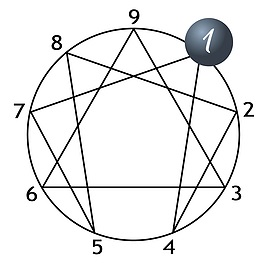
Enneagram chart with Type One highlighted.
Introduction
Type One is the person that walks toward you and you suddenly become aware that you have your zipper down. They have an incredibly keen eye for what needs to be done to improve the situation and to do things right. Nor do they stand by the wayside, but often get involved personally.
This ability that Ones have to see what ought to be done means that they are also keenly aware of what is wrong in every situation, that is, they immediately see when, where and how the standard is not being met. A healthy One is definitely someone whose advice you want to listen to, as they often have incredible foresight in predicting the consequences of letting small imperfections snowball into bigger and bigger ones.
Ones are usually fair in an impersonal and impartial sort of way. If anything, when they highlight your faults, they tend to do it out of love. They often cannot conceive how someone could be driven by anything except what’s right (either morally or technically), because they themselves seek to identify what they want with what is right.
However, Ones are famous in the Enneagram community for being the ones with the loudest and harshest inner critic. Their every action tends toward conformity with what the critic says. Whenever an action has been carried out (by them or by someone next to them) the inner critic’s sentence immediately highlights what has been done wrong and what could have been done better.
Although Ones can at times appear to be very mental or rational in their behavior, they have very strong beliefs that they rarely question, since these form the basis for their action in the world, and therefore removing them would remove One’s justification for acting. And Ones are, despite all, people of action.
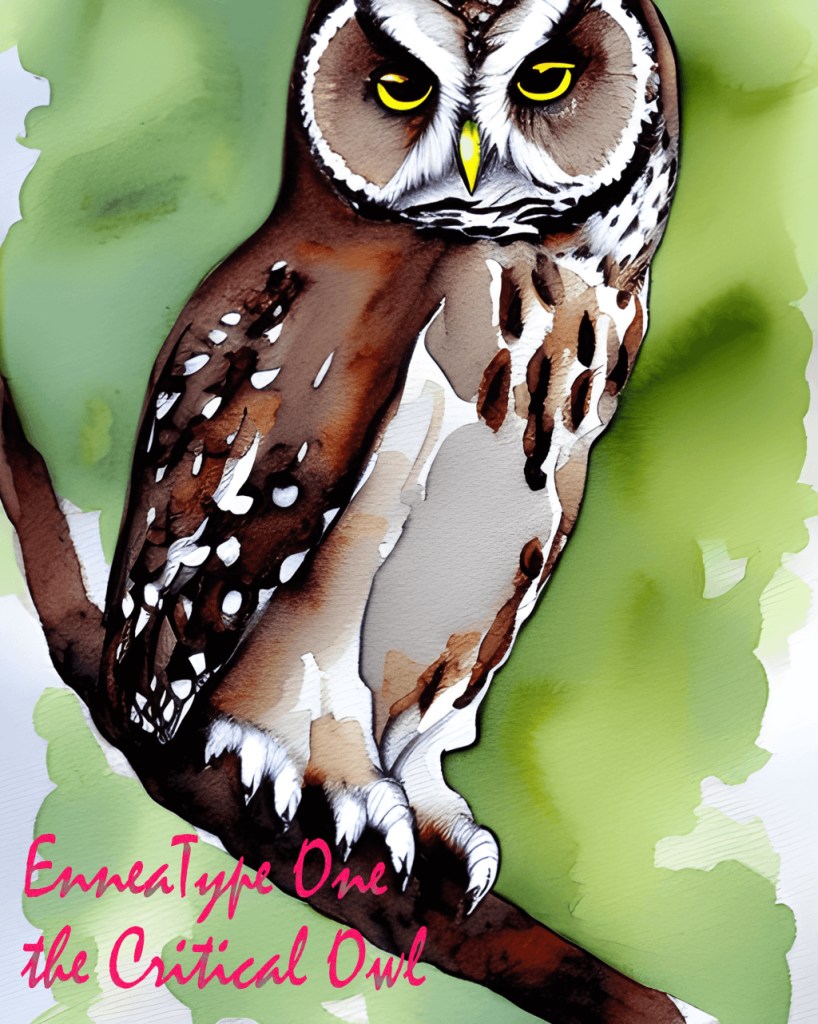
The Critical Owl, a good symbol for Enneagram Type One
Core Mechanism
Ones see the world as a place to reform or straighten out. Out of all the types, Ones most clearly embody the archetype of the reformer or the activist (although Sixes also fulfill this latter role, in another sense.) Ones give themselves ideals to follow and toward which to direct their great energy.
This happens because, on some level, Ones do not feel that they can just be in the world, but need to justify their own existence by complying with some higher standard. With Ones it is rarely “I want this” but rather “It ought to be this way”. They often seek to sublimate their subjective will by checking it against higher laws. The more Ones seek to sublimate themselves to match an ideal or to transform themselves and reality, the more they move the goalpost of what they consider to be perfect, or even just okay.
The world, and their own life, becomes by definition “not okay”, and while in average Ones this can be a stimulus to improve things, in more difficult cases it can lead to situations where the more Ones seek to perfect life, the more they become aware of every imperfection, leading them down spirals of self-hatred, puritanism and intolerance.
Sin/Passion
Type One’s passion is anger. All Body types (Eight, Nine and One) center around the issue of autonomy and self-assertion. Their basic energy is essentially choleric in the traditional sense. However, Ones are incapable of asserting themselves directly and immediately.
Instead, they seek to justify their self-assertion as autonomous beings by complying with standards, rules, morals, etc. Their unspoken contract with themselves is “I have a right to be here if I do my best to perfect myself or the world around me.”
Anger stems from their sense of impotence in making themselves and the world around them match the vision of them that would justify their existence. Ones see the difference between what is and what ought to be, and choler builds up in them. In other words, the normal flow of choleric energy that forms part of everyone’s bodily existence finds itself flowing through the strictures of One’s inner critic, turning from natural assertive drive into wrath–at themselves and at the world.
Ones are often very controlled in their behavior, exactly because their bodily energy is deviated in its course by normative structures, yet they often do not seem very relaxed. Their being in control of themselves usually betrays signs of an inner tension, an unresolved struggle for peace. Their anger often transpires as frustration toward life, themselves and others, depending on their particular life patterns and individual condition.
Anger, the Passion of Enneagram Type One
Misconceptions
The biggest misconception about Type One is that they delight in criticizing others. In fact, delight may be the last thing a One feels when being critical of what other people do. There is never anything personal in an average One’s criticism (this doesn’t necessarily make it ok, though.)
Although sometimes they may relish in being the ones who “told you so”, by and large Ones abide by standards and seek to enforce them, and often simply don’t see how others may either have different standards or not be dedicated to enforcing them. Usually, when a One criticizes you, it’s not the person that speaks: it’s the rule. By extension, Ones often believe they are helping you by criticizing you.
Furthermore, Ones’ attention to what you do and how you do it is often an indirect reflection of their own inner discourse toward themselves. Usually, their criticism of others and their criticism of themselves coincide. See it like this: in speaking on behalf of the standard or rule, Ones seek to become embodiments of it, and become aware of their own inability to ever bridge the gap between ideal and reality. In this process, they also become aware of your inability to do so, but often they fail to realize that this may not be your problem.
Wings
1w9 – Ones with a Nine wing tend to have a more laid-back demeanor, although One’s inner tension is still quite noticeable. They are often more accomodating on the surface, but their strictness usually manages to transpire anyway, especially in passive-aggressive ways (passive-aggressive behavior being something that Ones share with Nines, in different forms.) Also, the ideals they serve tend to be more all-encompassing and broad.
1w2 – Ones with a Two wing have a more marked interpersonal quality. They are usually highly involved in other people’s lives, on whose behalf and (supposed) best interest they act. Their actions, which are usually carried out in service of an ideal, can have an additional, albeit shallower, layer of motivation in pleasing others. Also, their activism tends to be based on solving concrete problems in their immediate surroundings.
(note that wings can have some minor descriptive power in terms of superficial behavior, but they are irrelevant in terms of what motivates the person. Many people have no noticeable wing, while few show signs of both.)