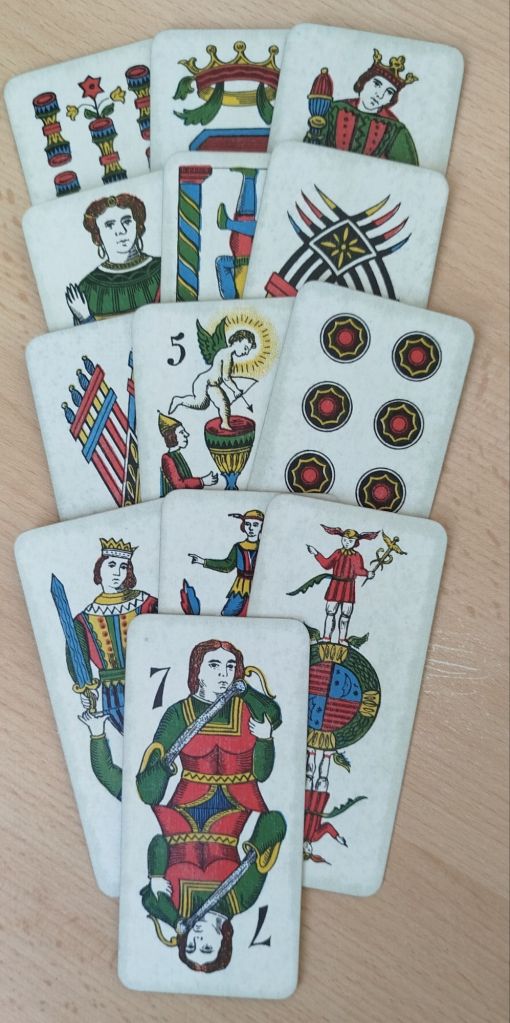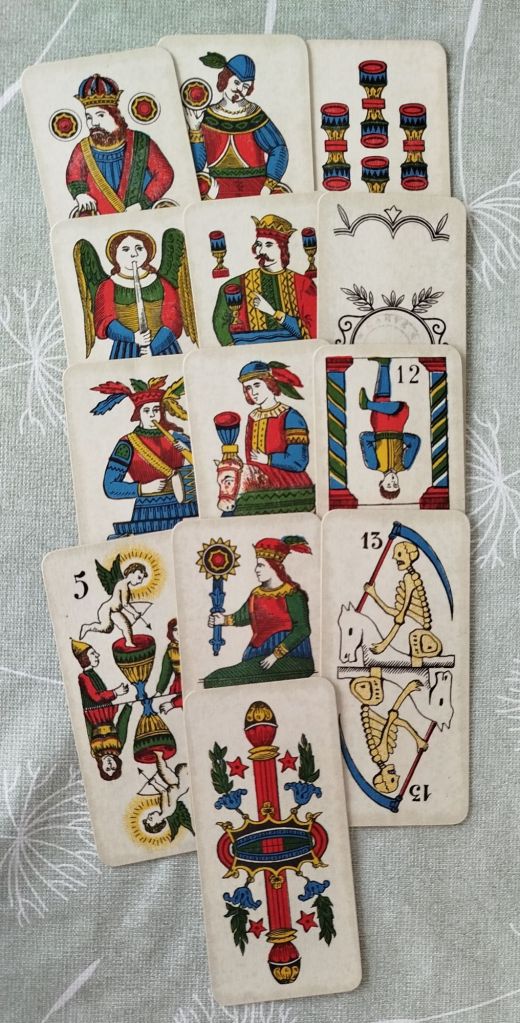
A querent (a man) asked how his relationship would evolve:
A relationship reading
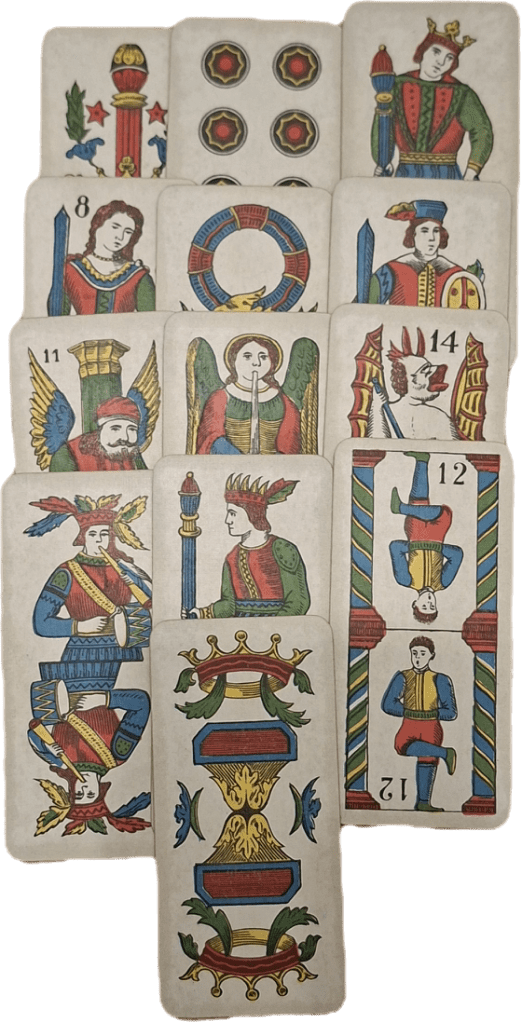
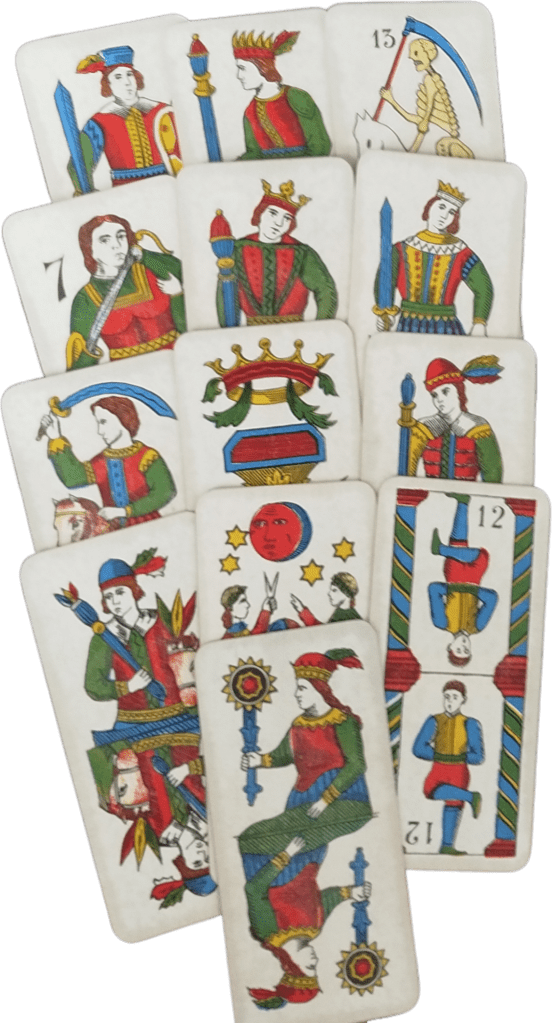
The first thing to notice is that both main figures appear (King and Queen of Wands) and both their thoughts (Page and Knight of Wands). The two significators are in the central column, so let’s read the central column first: King of Wands, Queen of Wands, Ace of Cups (house), Moon (darkness), Queen of Coins (truth). Clearly their relationship is not based on clarity, because the truth is hidden, and there would be a need for honesty.
The Death card next to her might show that she is the one going through some kind of transition, and it’s probably not something that has just happened (Temperance shows time). The house is not positive to the couple, as there is hurt or arguments around it (Knight of Swords).
The King of Swords was hard to interpret. It was, until the querent asked out of the blue “Do you see her cheating on me?”
Look at the column the King of Swords falls in: Death, King of Swords, Her Thoughts and the Betrayal card. In her thoughts there’s someone else. Note also that his thoughts (Knight of Wands) is next to the Moon and the Hanged Man, so he suspects.
The Queen of Coins, which is the truth, here seems to have two meanings here. One is that it shows the need for clarity (and therefore the lack of it), and secondly it acts as a sort of punctuation, as I discussed before, sealing the reading as if to say “yup, that’s exactly what you’re thinking”
Obviously we need to be very careful when announcing this sort of situations, even if the querent suspects. It is much better to caution them to seek clarity with their partner (especially in this case with the Truth card so prominent in the reading)
Another reason is that it showcases what I suspect to be an interesting quirk of the thirteen-card spread. This is a purely experimental anecdote, so take it with a pinch of salt, but I have found it to be true on more than one occasion.
The quirk is that, in the thirteen-card spread (which I discussed here), the rows seem to be connected not just one after the other, but also alternately, i.e., the first row with the third row and the second row with the fourth row.
I cannot stress this enough: this is NOT a rule, it is simply something I have found to be true on occasion. There are situations where the thirteen-card spread is perfectly smooth from start to finish, reading like a little story with a beginning, a middle and an end. In this sort of situation we don’t need to pair up the rows 1-3 and 2-4.
However, sometimes we can recognize snippets of story mixed together in an odd way. I have found that pairing odd rows together and then even rows together can help sort these snippets out, giving them a more logical order.
In the example of the spread I posted, the second and fourth rows seemed to talk more about material issues, whereas the first and third were more centered on the person’s emotional life. Pairing them odd-with-odd and even-with-even, the spread became more clear.
If the spread is talking about more than one issue at once (which can happen), then this kind of pairing often makes sense. However, sometimes it makes sense even if there is only one topic in play, and this particular case the rows that we pair up talk about subtopics within the same topic.
It may be that this technique simply stems from my limitations as a reader, so that I find ways to circumvent difficulties in the interpretation of the spread. Still, I found this to be accurate enough to bring up, in case anyone wants to experiment with it.
Finally, it may simply be that we need to be very flexible with the rows, and take for granted that they may pair up in unlikely ways. Who knows, maybe I’ll find that the first and fourth row really go well together in some readings. The point is always that the techniques we apply need to shed light on the querent’s life, not simply add flourishes and complications to the interpretation.
This is a cool reading because it shows that the cards tend to describe a situation and take their time to do so, so that trying to immediately get a yes or no out of them can be problematic and cause mistakes (though making mistakes is part of the human condition, obviously). This is the reason why, talking about the Bolognese tarot, I tend to disregard the yes and no rule of the Death card. It is also the reason why I don’t believe in the yes and no value of playing card colors. To me, that’s just a coin flip, and coin flips don’t work as reliably as actual divination, which is a language.
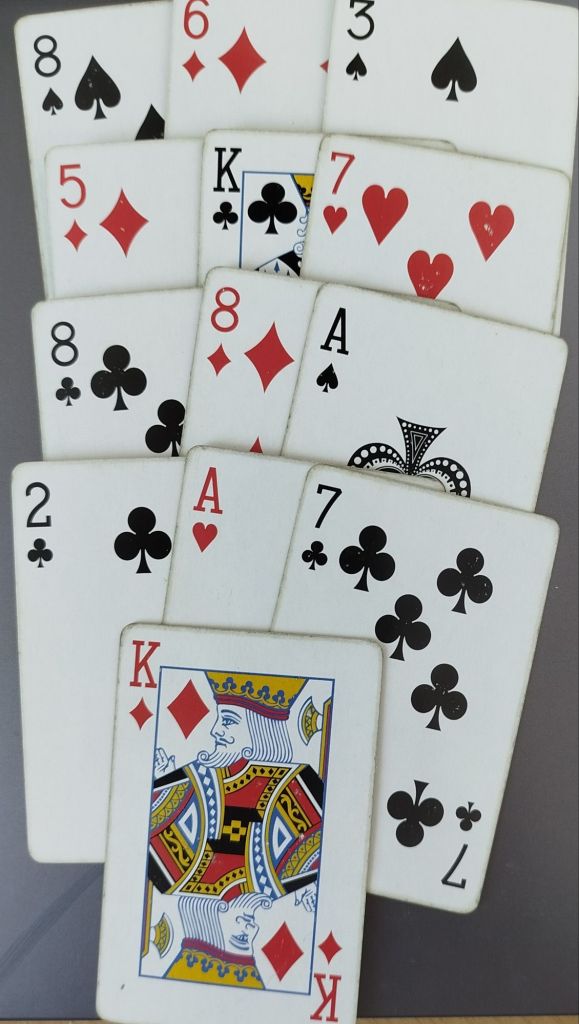
Here the question was if an unemployed man would get a job.
A career spread. Divination with playing cards.
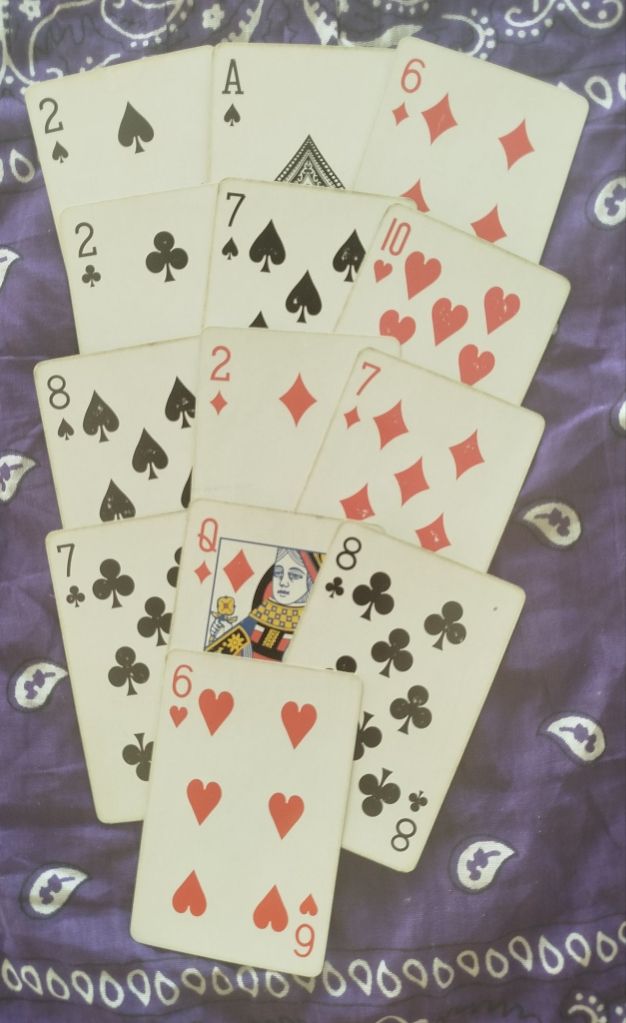
The first thing I noticed is that the reading ends with a very positive combination of Queen of Diamonds, Eight of Clubs (work) and Six of Hearts (reconciliation/solution/adjustment). This bodes well, but the rest of the spread is more disastrous.
The first row shows that the subject is a thorn in the heart of the person (Two of Spades, Ace of Spades and the Six of Diamonds showing worry). Then we see that every step taken (Two of Clubs) to solve the issue has met with misfortune (Seven of Spades), meaning that the person has probably tried to find a job repeatedly but failed. This explains the very emotional cards in the first row, as well as the fact that the Happiness card (Ten of Hearts) is squeezed between Misfortune (Seven of Spades) and Tears (Eight of Spades). This is a whole unfortunate period unfolding in the person’s life.
There are some cards I am not quite sure about: the Two of Diamonds, Seven of Diamonds, Seven of Clubs. 2♦️ + 7♦️ can be a cheque or paper money, or projects about money. I asked the querent a couple of questions and it didn’t really help. I think a more general reading would be that, quite obviously, the lack of a job has impacted negatively (7♣️) his financial situation.
Then finally we have a woman who is either going to help him find a job or give him a job. If I had to bet I would say this is a female boss, since she shows up as a Diamond and not as a Heart. Either way, the period of misfortune is going to thankfully end.
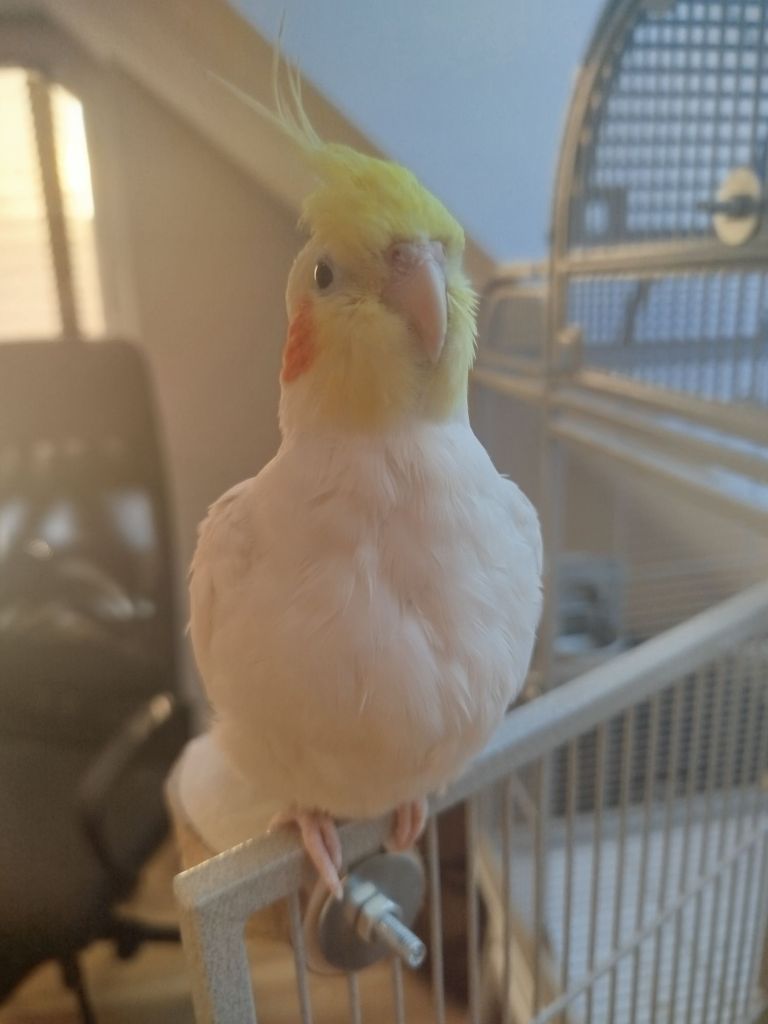
My two cockatiels couldn’t be more different from one another. Ciuffy, the white one, is a sweet cuddlebug who’ll do anything for a head scratch. He’s never nipped me, let alone bitten me. The only time he hurts me a little is when he tries to preen my ear.
“I’m the guy you want your daughter to bring home”
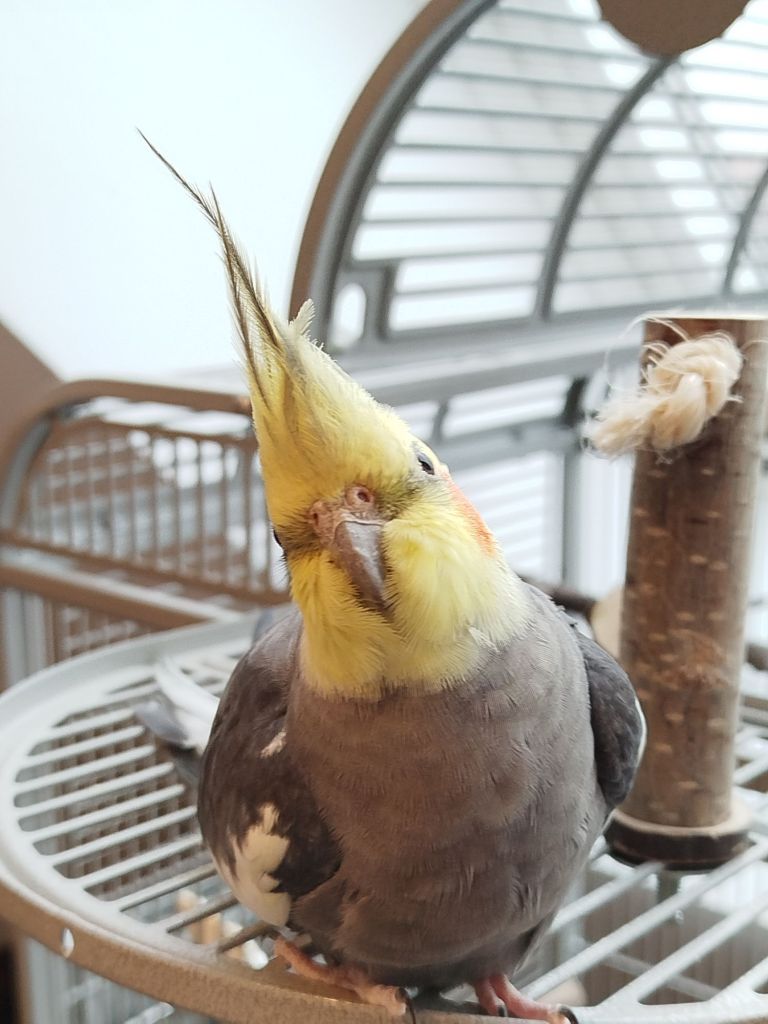
Zazu, the gray one, is a beaky, bossy, overbearing prick. He does have his sweet side, and considering I’ve had him for only a little over a month we’ve made huge progress, but when I have him on my shoulder I KNOW I’m going to get hurt at some point, and when he bites he really means it.
“I’m the guy your daughter brings home”
Now that I’ve set the scene and used the excuse to show you a couple of pics of my cutie pies, let’s get to the point. A couple of days ago, while Zazu was on my shoulder, he bit my earlobe incredibly hard out of nowhere (maybe he saw me move my head and didn’t like it).
I shooed him away with my hand, but he spooked and flew against a wall. Although he wasn’t hurt, he spent the day avoiding me and hissing (for those who don’t know, cockatiels can hiss, like cats).
I knew that the accident set some of that hard-won progress back, but I wanted to know Zazu’s perspective and how it would likely evolve. Here’s what the Bolognese Tarot had to say:
What’s the featherball thinking? Tarot reading
One thing that surprised me is the first row, where we have happiness (Ten of Cups) in the house (Ace of Cups) with me (King of Wands). I know I try to care for the two little balls of feathers as best I can, but Zazu is always grumpy and old-farty in his behavior, so I assumed he didn’t like me very much. Apparently that’s just his character.
The second row is interesting, since we have unexpected (Stranger) betrayal (Hanged Man) leading to negative emotions (Eight of Swords). Clearly his good vibes were somewhat disrupted by the incident.
The third has a path (Eight of Wands) toward Love with harmony or small satisfactions (Ten of Coins). So even though there was a setback, there is room for moving toward love. Obviously we should be very careful when projecting human sentimentalism onto animals, but then again, divination is a language understandable to humans, so the tarot is probably translating Zazu’s reality in terms that are understandable to me.
I have some doubts about the last line. The King of Swords might be Zazu himself (it could represent my husband, but my husband isn’t particularly involved). Technically, pets are represented by the Juggler, but then again, the King of Swords does have some characteristics of the Juggler, so it’s a possibility. At any rate, the King is next to the sickbed. There are no combinations talking explicitly about sickness, so I believe this just shows his being cranky or a bit uncertain, but the World card at the end of the row indicates that this uncertainty doesn’t cause breaks: the situation remains open and moving.
The Temperance card at the end simply shows that patience and time are needed. I expected no less.
For now, the reading seems to be accurate. The day after the little bastard had gone back to his old behavior, being just a little more shy than usual, and the day following that he was back to normal.
Here the querent is a friend of mine whose live-in boyfriend is acting aloof toward her. She was afraid that he was either having an affair or he was falling out of love with her, or that she had done something to him (he does have a tendency to keep things in until it’s time to explode).
Divination with playing cards: have I done something to him?
My querent doesn’t come up, so we can exclude that she has done something to him or that his love toward her is an issue. There is also a complete absence of mistresses, so we can immediately rule out that he is cheating, especially since there are no cards indicating sneakiness (like the Ten of Spades or the Jack of Spades). There is a Three of Spades, which might indicate intrigue, but clearly this is not what the spread is driving at, and the Three of Spades can also indicate a ‘knotted’, complex situation that doesn’t flow harmoniously.
His significator comes up in the second line, surrounded by cards that show positive development, so the situation is not permanent. However, the first line is a bit concerning, since we have tears, worry and the complex situation. Note that the worry card (the Six of Diamonds) is hemmed in by the spades, so it gives us a picture of the person being somewhat overwhelmed.
Then we have the two Eights and the Ace of Spades. As I wrote sometime ago, the Ace of Spades is often sterilized as a card of change, but at least in my tradition it shows great grief. The grief here is connected to cards of work and business, so this is the problem. The querent said that he doesn’t know if his temp job is going to be renewed. So that’s the problem.
Finally, to complete the picture, there is the house card with problems (Seven of Clubs) next to it. The steps (Two of Clubs) he takes at home (Ace of Hearts) are problematic, as a consequence of the issues shown in the cards above.
We have a final card, the King of Diamonds. We couldn’t identify him, although we suspect it’s either a colleague or a boss. We don’t know from the cards if his influence is positive or negative. It would require another spread, but it doesn’t matter since my friend’s worry was of a different nature.
Nothing prohibits anyone from using whatever spread they prefer, or even just from laying out a row of cards. However, traditionally, the smallest spread used with the Bolognese Tarot is the thirteen card spread, which is a small tableau of cards used to answer a specific question or explore a specific theme (although nothing prevents you from laying it out for a general reading. It will respond anyway). This is a spread I have already presented, and it is one that is used with many decks in Central and Northern Italy in particular. The layout is as follows:
1
2
3
4
5
6
7
8
9
10
11
12
13
The Thirteen Card Spread
Some readers take out the significator for the querent or even the significator for the question and put them on top of the layout (above card 2) before starting to shuffle. I prefer to have all cards in the deck and have not found it necessary, but feel free to experiment.
The cards may be read in rows or in columns, and which direction is the primary one depends on which tradition you come from. Personally I tend to see rows as the primary reading direction, but I will look at columns if there is clear information contained in them. I have found that the columns tend to describe the situation rather than to predict it. But don’t force yourself to read in every direction possible: simply read the information where it is found, and leave the rest.
There is no strict differentiation between past, present and future. However, I have found, personally, that at least the first row, or sometimes two (and on occasion even three), contains the past or present of the situation. Occasionally the cards simply jump ahead into the future from the start.
Be open about it: it may sound confusing in theory but in practice it is often quite clear. For instance, if you see the cards changing from good to bad or vice versa (or simply changing “tone”) in the first row or two, that’s usually a sign that the cards before the change happens are the past/present, and the others the future. In doubt, simply ask the querent: we are not there to play Nostradamus, so it’s fine to ask for help in interpreting the spread.
The final card, number 13, doesn’t have any specific preassigned meaning. However, I have found that it can either simply be a regular part of the spread (simply coming after card 12 or under card 11), or it can highlight an important detail, or something that will be true, regardless of what the previous cards say. For instance, if the spread is a disaster but the thirteenth card is good, it can tell us the querent will have some kind of satisfaction, or will be protected.
Yes-or-No Questions
Now we come to an odd bit of tradition. I will relay it as it has been taught to me, and then I’ll give you my two cents. Although the thirteen card spread is not unique to the Bolognese Tarot, the Bolognese Tarot adds another layer to the spread.
This is relevant only when the question is a yes-or-no question. If it is, then, according to some traditions, the answer is yes if the Death card comes up in the spread or while cutting the deck (it says: “yes, as sure as the fact we all die”). If the Angel card comes up, according to some it’s a maybe, while according to others it’s a no but with positive developments; if the Death and Angel cards both come up, not necessarily together, it’s the best possible outcome (a super yes, as it were). If neither card comes up, it’s a no.
Some also add that if the Death card doesn’t come up but the Angel and Devil card come up in the spread, not necessarily together, it’s also a yes (the Devil card alone would be a no, but if you remember the combinations, Angel+Devil means good news or satisfaction). Others still also believe the answer is yes if three or four Kings come up in the spread.
Now I’m going to tell you what my experience is. My experience is that there is something to these rules, but it is not all so cut-and-dry. The spread always needs to be interpreted as describing a concrete situation, and the yes or no comes from our evalutation of whether the picture presented by the cards matches what the querent wants or not. It’s happened more than once that the Death card was present but the answer (confirmed by experience) was a no, or vice versa, the answer was yes with no yes-marker present.
Focus on interpreting the cards. If the Death card comes up, what does it say in the context? Does it show some sharp change? Does it show inner suffering? Does it confirm something? If so, look at the cards around it: what is it saying yes to? Sometimes it is obvious that the Death card comes up for no reason other than to say “yes” to the question, while at other times it is a regular card, like the others. Again, be flexible, record your experience and learn from it.
As I mentioned here, I got a new parrot from a local breeder and I had an interesting reading concerning it. The reading was done using the Bologna Tarot in its 45-card variant. We had already gotten some pictures of some of the available birds, and we had settled on a gray cockatiel, because it looked like the one I had as a kid. As the day approached, I asked the cards if everything would go alright. This is the spread I got:
Is the bird handover going to go smoothly?
Although I’ve already talked about the 13 card spread, when used with the Bolognese tarot there are some peculiar aspects to it (it is, after all, one of the “official” traditional spreads to be used with this deck). Traditionally, when a yes-or-no question is asked, the following rules apply:
If the Death card shows up in the spread, it’s a yes (as sure as we all die)
If the Angel (Judgement) card shows up, it’s a good chance
If both show up, it’s a sure thing
If the Angel and the Devil show up, it represents great satisfaction within the context (the Devil is in itself a negative card, but it is redeemed by the presence of the Angel)
Well, in my (still limited) experience with this tarot deck, I have found that it’s best not to rely too much on mechanical rules: the cards must always be interpreted, and exceptions allowed for. Still, it is encouraging to see both the Angel and the Death card as answer. Let’s interpret the cards row by row, as they came up very clear and orderly (it is not always like this, unfortunately):
King of Coins – Page of Coins – Seven of Cups: there have been talks (Page) with a man concerning business (King). The Seven of Cups is generically positive here. Angel – King of Cups – Ace of Coins: There is help (Angel) from a man of the house (King) concerning money (Ace). My husband paid in part for the parrot and the cage and food. Fool – Knight of Cups – Hanged Man: This is the most interesting row in the spread. It shows something that brings chaos or confusion (Fool) and that betrays or upends (Hanged Man) the agreement (Knight of Cups) Love – Queen of Coins – Death: True (Queen of Coins) Love (Love) is confirmed (Death) Ace of Wands: Success, positive ending
So in general what we can say from the spread is that the breeder is trustworthy, my husband helps me and I will be very satisfied, but still the deal will somehow be changed in an unexpected/confused way.
What ended up happening: we got there and the breeder introduced us to the various chicks that were ready for adoption, including the one we had settled on. But as we were playing with them, a white cockatiel chick quickly flew onto my shirt looking for cuddles. Obviously, it was love at first sight (see the true love in the spread), and we got that one instead.
I believe this change of plans is shown in the spread by combination of Knight of Cups (agreement, conciliation) followed by the Hanged Man (betrayal, upending). Our initial agreement was upended (or “betrayed” in a metaphorical sense), but still everything ended on a positive note.
NOTE: look how “dry” this reading is. Traditionally, tarot was not interpreted by musing on how the pictures looked, but by applying clear and specific meanings.
The spread used for this reading is a spread of thirteen cards that I’ve learned from the person who’s teaching me to read the Bologna Tarot, and it is typical of that tradition. It is a small tableau of cards that is generally used to explore a single issue (though nothing forbids you to use it for general readings.)
1
2
3
4
5
6
7
8
9
10
11
12
13
There are several traditions varying from town to town. According to one, the cards are to be read in columns only, with one indicating the past, one the present and another one the future. My teacher however reads them primarily in rows, though sometimes columns can be read too, and usually, the central column holds some importance. More often than not, the last card is especially important because it will either contain a general answer or give you an important detail, or determining factor.
Although this spread is especially linked to the Northern Italian tarot tradition, I’ve seen it used with regional playing cards as well, and I don’t think there is any reason why it wouldn’t work with any deck tradition you practice. I will certainly use it with the Sibilla as well, one of these days.
Will She Learn to Love Herself?
The querent in this case is an acquaintance of mine, but the question was not about her, but rather about her sister. The question was “Will she learn to love herself?” and it came with no further detail. This is fine, as often when a querent feels the need to talk there is a risk that they end up feeding me their perspective. So here are the cards that came out:
Will she learn to love herself? Divination with playing cards, thirteen-card spread
Right off the bat, we notice that the significator for the querent (the Queen of Clubs) is present, so since this is a tableau we might as well look at the cards surrounding it. She has the Jack of Hearts, the Queen of Spades and the Eight of Spades above her. These cards could mean a number of things, such as problems with a daughter or problems with an immature woman, or problems in the person’s childhood. Let’s file all this away and move on.
Next to the Queen of Clubs we have the Nine of Clubs and the Six of Clubs, which represent long-term toil and struggle. Clearly, whatever this is, it is not something that is going away soon. But the spread ends with the Nine of Hearts which indicates triumph. There is light at the end of the tunnel.
Technically, we already have our answer: the querent’s sister will struggle with self-love a long time, but she will improve. But the cards tell us more. Let’s turn to the first row, where we find the Queen of Hearts hemmed in by Spades. There is some kind of blockage or problem (Four of Spades) that causes the shedding of tears (Eight of Spades) relating to a woman (the Queen of Hearts).
Usually, the Queen of Hearts is either a relative or someone with our best interest at heart. In this case, though, she is strongly afflicted by the Spades. So I asked the querent if the issue relates to the sister’s poor relationship with her mother or another female figure close to her that impacted her self-love negatively. The querent confirmed that their mother was a raging alcoholic who worked overtime to tear them down when they were little. Note how the cards highlight the cause of the sister’s suffering by placing it right on top of the spread!
Right underneath we have the Queen of Spades, the Four of Clubs and the Five of Diamonds. This line was a little cryptic, and I must confess I did rely a little bit on my intuition, but the interpretation was still logical. There is a woman of spades who is saying words (Four of Clubs) that cause change (Five of Diamonds). Who is this woman? Usually the Spade suit is problematic, but it can also indicate certain professional figures (doctors, military figures, judges, etc.) It stood to reason that this figure could be a female therapist that is helping the sister. I asked and the querent confirmed to me that the sister is seeing a female psychologist who “means business but is very competent” (Spades).
The line just above the querent contains the Jack of Hearts, the Six of Hearts and the Three of Spades. This time I felt confident interpreting the Jack of Hearts as the sister’s “inner child” or, to avoid woo woo terminology, it represents the issues accumulated since childhood. The Six of Hearts talks about healing, and the Three of Spades indicates intrigue, but also in the metaphorical sense of a knot, something that needs to be unravelled or clarified. For the time being, therefore, the sister’s issue will persist, but the final Nine of Hearts is promising.