Enneagram Type Three and Enneagram Type Five are quite different and are not easily mistaken. Threes are a Heart type, whose main preoccupation is recognition of their merits and outstanding qualities. Fives are a Head type, and they focus on security, which they achieve by withdrawing from the world and identifying with their intellectual prowess.
Threes are usually driven, adaptable and outgoing, while Fives tend to be withdrawn, aloof and preoccupied solely with what’s between their ears. While many Threes may seek recognition in whatever field they have a shot at succeeding in, Fives rarely care about social approval and in fact may go out of their way to defend outlandish ideas to scandalize their peers.
This paradoxically makes Threes better fits for places like the academia, since they are more likely to be performance-oriented, adhere to social conventions and run with the Zeitgeist rather than against it. On the other hand, Fives tend to be more original and deep, almost deriving pride from how offbeat and weird their ideas may sound, sometimes to the detriment of clarity.
Mind
Socially, the two types couldn’t be more distant. Even more reservedThrees are generally good at reading social cues and put a good deal of thought into making a good impression or being appropriate, while Fives tend to dislike people and their expectations, so much so that they seek to reduce their expectations toward people as a way to avoid having expectations placed on them. What many Fives fail to understand is that expectations are a natural part of our social existence, so while blind compliance is not necessarily good, there is something important about social interactions that Threes understand on an intuitive level and from which Fives may learn.
Both Threes and Fives have a hard time processing their emotions. Both see them as distractions: Threes see them as distractions from working on success, while Fives see them as distractions from a clear and objective view of reality. However, Threes usually display emotions in social contexts if it seems like the appropriate thing to do, while Fives generally remain aloof. In general, there is a “See? I’m hitting all the right notes!” attitude to Threes and a “Let’s get this over with quickly so I can go back to my own thing” attitude to Fives.
Enneagram Type Two and Enneagram Type Five are opposite in almost every way. No one with a brain stem connected would see many similarities between them. Twos are a Heart type, and their main issue is with recognition and validation, which they seek by taking care of others. Fives are a Head type, focused on security, which they seek by detaching from the insecurities of the world and identifying with their mental prowess.
The only similarity between the two types is that both assert the energy of their respective center: Twos assert the energy of the Heart, Fives that of the Head. In this sense, both tend to sacrifice everything else to make exclusive use of their gift: even very intelligent Twos tend to place little value in arid reasoning, and even lovestruck Fives tend to have a logical way of dealing with their partner.
Furthermore, both types have a complex relationship with otherness: Twos cannot tolerate the idea of the other existing without needing their love, help or presence, so they try to merge inseparably with them, creating a psychological unity; Fives often cannot tolerate an idea, theory or concept that they have not personally created, so they attack it until it either falls or it is as good as if they had conceived it (this drive is behind their often sardonic behavior).
Separation
That being said, Twos and Fives are opposite in every aspect: Twos are mushy, sentimental, emotionally expressive, personable and other-oriented; Fives are aloof, secretive, dry, rational and focused on themselves and on what they risk losing by interacting with other people. Twos are giving, although the things they give usually come with some strings attached; Fives are withholding, although on the rare occasion when they share they can be touchingly honest, because they have likely pondered long and hard about losing for themselves what they are giving away.
In general, Twos and Fives value different things in life. Twos value soulful connections, Fives value complex knowledge. Twos need company (at least in their head), fear losing connections by behaving badly and tend to be gentle, at least until they feel slighted; Fives are highly individualistic, iconoclastic, sometimes intractable, at least until they form a connection they really care about. Needless to say, Two and Five are an awfully common pairing in relationships.
Often Known As: Observer, Thinker, Investigator, Philosopher (note that names are as limiting as they are revealing.) Sin/Passion: Avarice Focus: on competence and knowledge Fear: of being incompetent Energy Center: Head (energy is asserted) Social Stance: Withdrawing Key Positive Traits(embodied at their best): Analytical, Objective, Unsentimental, Penetrating, Philosophical, Deep, Focused, Unswayed by mass opinion, Independent, Offbeat, Whimsical, Original, Humorous in presenting own observations, Good at making distinctions and connecting disparate subjects and details Key Negative Traits (embodied at their worst): Remote, Unavailable, Preoccupied, Sardonic, Socially inept, Self-isolating, Secretive, Unwilling to share, Impractical, Hyperfixated on trivia, Relishing in proving others wrong, Argumentative, Rational but unreasonable, Hair-splitting, Nihilistic, Destructive, Emotionally constipated Growth and Stress Directions:to Eight and Seven respectively
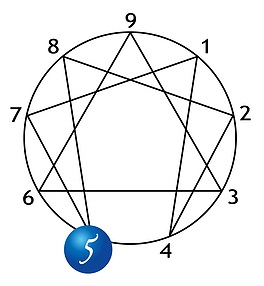
Enneagram chart with Type Five highlighted
Introduction
Fives are the unmistakable intellectuals of the Enneagram. Cool-headed, detached and curious, they rarely speak on what they aren’t sure about, and they usually find it hard to connect with people on an emotional level.
A Five’s expertise is often precious for those that need a pointer, although Fives may not always be willing to share it, as they tend to be very selective with their social contacts. In fact, they almost seem to have a tendency to disappear in interpersonal contexts. If they show up at all at social events, you will likely find them in a corner or outside, absorbed in their own inner discourse.
Fives are often innovative in their way of thinking, not necessarily because they are contrarians (this is often more the case with other types) but because they don’t let conventional prejudices taint their reasoning, which means that they will uphold any view that they find rational, regardless of its popularity or the controversies surrounding it, and even regardless of their personal preference.
Offbeat and eccentric in their interests, Fives would love to live in a world where people put their emotional reaction to things aside and simply use their heads. Fives find it very easy to do, as this is precisely part of their survival strategy: feelings just cloud reality, so better keep them to yourself and take an objective look at things.
They have a tendency to live in their head, with the consequence that they look ill at ease with their physical existence, where they often appear clumsy like fish out of water. They easily feel intruded upon by others and consequently develop very strong boundaries, keeping any but their closest friends at arm’s length.
The hiding tortoise, a good symbol for Enneagram Type Five
Core Mechanism
Fives are a Head type, and they rely on their considerable intellectual power to get by. They process the world in terms of information, facts, logical relations and concepts. They grow their notions organically rather, like unfolding crystals, developing them coherently without regard with their own personal feelings and preferences.
Out of all the types, Fives are the most likely to follow premises to their logical conclusions without batting an eye if they don’t like the conclusions. Sometimes, due to their mental prowess, Fives reach conclusions almost intuitively, embracing large quantities of rational passages in the blink of an eye. Their thinking process is rarely linear. The speed of their rational mind is a counterpart to their awkwardness on the physical plane.
Fives’ reliance on their mind is primarily a defense against the uncertainty of the world. Fives feel small and powerless compared to the vast unpredictable universe around them. They seek to remedy their sense of impotence by accumulating knowledge, often in very specialistic and abstruse fields, which become their anchor in times of turbulence.
As they accumulate knowledge, they retreat from the world, often developing frugal habits. Ideally, they feel that one day they will know enough to be able to join the world as competent individuals who are capable of performing normally. Unfortunately, for many Fives such time never comes.
The world becomes a distraction from their absorption in more and more abstruse layers of thought. Human interaction is often dialed down to a minimum and everything, even well-meaning attempts at socializing, is perceived as an intrusion, a waste of energy and/or time.
While healthy Fives are often capable of surprising and deep insights and manage to integrate themselves, less healthy individuals paint themselves into a corner where the only thing they can do is digging further into the same arcane topics and their distance from their fellow humans widens, incommunicability grows, others are seen as idiots who simply do not understand the subtlety of their vision, the world becomes more unpredictable and dangerous, and this cycle continues.
Passion
Avarice is the passion of Enneagram Type Five. As with many types, this is to be taken figuratively. Fives are rarely attached to money or material possessions, and they tend rather to become minimalists and to learn to do without whatever is not a bare necessity.
This is partly because they feel that having too many needs will put them in danger of being dependent on others or on outside factors they feel unable to control, and it will therefore increase their chances of not meeting those needs, so they learn to go without the unessential.
Avarice, as far as Type Five is concerned, is referred mainly to their tendency to withhold themselves from the world and from others. Fives have a keen awareness of how much energy they feel they can spend on any given day, and they administer it very sparingly. It is as if their fuel gauge were constantly in the red, and contact with other people were extremely draining.
Therefore, they go without the human contact they cannot avoid, and when they do accept contact this is usually an unspoken sign of great appreciation for the person: it means the person is so in tune with the Five that the Five does not consider them a hinderance to their energetic survival.
Fives are elusive to most people: even when they are there with you, you cannot really tell what they are thinking or feeling. This is because the act of opening up is energetically costly for them, as it implies an act of trust, and Fives are usually only capable of trusting themselves, even though ideally they long for people to open up with.
Avarice, the passion of Enneagram Type Five
Misconceptions
There is a tendency on other people’s part to think that Fives don’t have feelings, mostly because Fives don’t show them. Unless they suffer from specific mental illnesses (which any type can suffer from) this is not true.
Fives do have an often rather intense emotional life and are often incredibly sensitive, but because they don’t know how to deal with it, they learn to put these feelings into brackets, sometimes resorting to thinking them rather than feeling them.
They normally see their feelings as something that has no bearing on the world, on how things really are, and on some level feel they must not visit their emotional issues on others (of course, they expect the same in return.) However, unhealthy Fives can become so detached from their concrete life that they fail to locate anything within themselves except arid mental abstractions.
Deep down, Fives would love to find someone with whom they can open up about their emotions, but depending on how entangled they are in their mechanism, this can take quite a while, because they are not used to giving importance to subjective reactions.
Furthermore, Fives tend to feel very easily rejected by others, in part because they expect people will find their personal presence as intolerable and intrusive as Fives usually find the personal presence of others. Therefore, anything except the most ideal response to a Five’s intimate feelings is interpreted by them as proof that they should have kept those feelings to themselves and that they are silly anyway.
Wings
5w4: Fives with a Four wing tend to have a melancholic and poetic streak to them. Their ceaseless intellectual activity is both personal and universal and often has an autobiographical slant (think Nietzsche). More rhapsodic and less systematic than other Fives, they usually dislike canned notions and beaten paths and have a certain aesthetic appreciation of the truth. Deeply individualistic and somewhat aristocratic in their demeanor, they often come into conflict with the prevailing ideas of what is acceptable and become easily disdainful of them.
5w6: Fives with a Six wing are usually more clearly intellectual and somewhat more conventional in their reasoning style and possibly their interests. Nervous and high-strung, they are good at systematically formulating and probing hypotheses. They are more clearly detached from their feelings and their explorations have less to do with their own life and more to do with life in itself (think Darwin). Out of the two variants, Fives with a Six wing tend to fare better in academic and scientific settings, although this is more due to the Six wing than the Five type, as Fives in themselves are not especially academically minded (Fives often don’t give a rat’s behind about academic conventions)
(note that wings can have some minor descriptive power in terms of superficial behavior, but they are irrelevant in terms of what motivates the person. Many people have no noticeable wing, while few show signs of both.)