Tag Archives: Theory of Divination

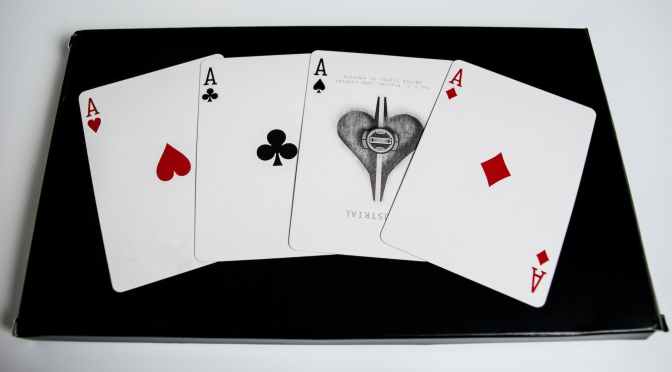
Playing Cards | The Four Suits

The two colors divide into four suits, two for each color.

Red splits into Hearts, which represent emotions and easy triumph, and Diamonds, which represent energy and the reward for positive action taken. Of the two, Hearts are generally more positive.

Black splits into Clubs, which represent effort and toil and the need to act, and Spades, which represent serious trouble. Of the two, Spades are more negative.

At a glance it is clear that Hearts tend to be antithetical to Spades, while Clubs and Diamonds complement each other.

Hearts signify love, family, emotion, religion, art, philosophy, nourishment, miracles, celebrations, gifts. They give freely (out of the goodness of their heart, you may say). They are connected to the home environment, and by analogy to the inner side of the individual. They are also connected to warm climates and the sea and all bodies of water. They are also erratic and lazy. They are associated with the clergy and with nobility.

Spades are the opposite. Whereas Hearts give freely, Spades take away easily. They represent obstacles, enmity, obstructions to the querent’s desires, restriction, punishment and all things that are either bad for the querent (sickness) or are neutral to positive but cause pain or are associated with it(medicine, the legal system, the state). In a word, all those things that create a rigid armor of rules and punishments that keep the individual from getting what he wants. They are associated with cold climates and the mountain, and with hostile environments in general. They are connected with the army and with the state as a means of threatening the citizens.

Hearts are Spades cannot be reconciled. They represent two opposite modes of existence: pure bliss and pure pain, heaven and hell. When only Hearts and Spades litter the reading, you have either miracles or tragedies, depending on which one prevails.

Clubs and Diamonds are the conciliation of the pure redness of Hearts and the pure blackness of Spades. They represent toil and rewards. Toil implies difficulties and the need for action (but also the possibility of action), while rewards imply some action, or they wouldn’t be rewards, but gifts (Hearts).

Clubs are associated with action, physical activity, the physical body, and with the world “out there”, as opposed to the inner reality of the Hearts. They symbolize vegetation and growth, both in plants and in humans, and they stand for the countryside and for the peasantry or with the common folk, those who need to work to get by. They also are a symbol of other people outside of the querent’s family, as an extension of the idea of “out there”. Usually, Clubs are friends or more distant relatives. Clubs are different from Spades because the latter often signify obstacles that are either impossible or very hard to plough through, while Clubs put the accent on action, and therefore on the turning of something from an obstacle into a resource. If Spades are a wall that confines the querent, Clubs are a steep slope to climb.

Diamonds show the rewards reaped from the toil of the Clubs. They signify money, energy (because money can be transformed into anything that money buys, just like energy can be transformed into anything that is made of energy). They also signify the mind and progress, inventions, etc. They are associated with the city and with merchants and the bourgeoisie. They differ from Hearts, the other red suit, because although they are still connected with some sort of inner side of the querent, it is more practical and aimed at achieving the goods of this world. It is inventiveness rather than contemplation, science rather than philosophy or religion.
Vera Sibilla | Twenty Five Card Spread

A last spread I wanted to cover with you, another one that can be used for general readings, is the twenty five card spread. This is similar to the twenty one card spread, but instead of seven packs of three, you use five packs of five cards.

Pack 1: The Querent
Pack 2: The Home
Pack 3: Work
Pack 4: Love
Pack 5: What you don’t expect

This method also has a short time frame, rarely beyond three months. As usual, lay out the cards and see what your interpretations are before reading mine.

Example with the twenty-five card method

This was a general fortune for a friend, more than two years ago.

Pack 1: 2♥R + 5♦ + 6♦ + 3♠ + 3♣
Pack 2: Q♦R + 4♥ + 4♠ + K♥R + A♣R
Pack 3: 3♥ + 4♣R + 9♥ + 6♣ + 6♥
Pack 4: 9♠ + 10♥ + A♠R + 2♦ + 10♣R
Pack 5: K♠R + Q♠R + 5♥R + 4♦R + 2♣

Pack one tells of a difficult situation at home, which makes the querent sad and makes her want to leave. Since the 3♣ is a card of movement, it is probably going to happen (it did)

Pack two tells of tensions in the family between two married relatives (turned out it was the aunt and uncle who lived on the second floor of the querent’s home). Their love is sick and the situation will likely lead to a divorce (A♣R)

Pack three shows that there is an upcoming recommendation or help. The querent’s interests will be fostered on the job and her finances will improve.

Pack four shows a long period of solitude. The A♠ is reversed, which makes it mildly negative together with the 9♠, as they sandwich the 10♥. However, in reference to the following cards, which are positive, the A♠R shows the end of sorrow. Probably thanks to meeting someone online. This doesn’t tell us about their story, only that she will start dating.

Pack five shows the unmasking of a negative relative, a woman who will give the querent’s family much grief and be unjust. All will be well though in the end. It turned out that a distant cousin was trying to claim the will of a common relative for herself. I don’t know the details, but she was stopped.

On Querent / Reader Dynamics

When someone other than a friend sits at the table to have a reading with you, they are going to come in with their own expectations of what a card reading is or isn’t. Actually, your friends have expectations too, but they are also more likely to be good sports and forgiving. When someone wants a more or less professional reading (whether you get paid or not) they are going to be pissed if what you provide isn’t what they expect.

Some querents lie to you, either to prove you wrong or to put you to the test. The cards can detect this, but it is obviously easier to conduct a reading with a well-meaning querent, especially because it’s easy to misread the cards on the background of what your querent tells you. It’s like going to the doctor insisting your leg hurts even if it doesn’t. Sooner or later you are going to have something prescribed for it regardless of whether it’s good for you.

Some querents lie to themselves, and this makes matters even harder, because the cards have a way of being brutal. When I notice that the querent has decided in advance what truth they want to see in the cards, my rule of thumb is to drop hints. While the great benefit of divination is that it affords us a dispassionate bird-eye-view on our life, it is not the reader’s job to yank the querent kicking and screaming out of their delusion, especially because we, as readers, can be deluded too.

Some readers will sit across from you, cross their arms and wait to be astounded. Sometimes they don’t even do it out of spite–they genuinely think that’s how you behave during a divination session. While it is possible to give a reading in this situation, I always prefer for there to be an exchange, especially because I have better things to do with my time.

So, let me reassure you that it is within your rights to torture your querent for all the information you need and to ask them for feedback at every turn of the reading. This is not called fishing for information, it’s called saying “ouch” when the doctor touches you where it hurts.

It is your right to demand that the person sitting in front of you respects you and keeps an open mind. Your mileage may vary, but my rule of thumb is, if you antagonize me, you can read your own cards.

It is your right to say “I don’t know” if you don’t know and “I’m not sure, but…” if you are not sure, but…

It is your right to refuse to answer any question you don’t feel like answering, for whatever reason. Just be kind and tactful in refusing, as sometimes questions are asked out of despair.

It is NOT your right to demand that the querent hangs off your every word and accepts everything unquestioningly like a divine revelation. A healthy dose of skepticism is natural and to be expected in sane individuals. It is not true that the cards will only work if the querent believes in them. I don’t believe in many of the predictions I make, both for myself and for others. What is true is that if the querent unnerves the reader with his skepticism, the reading may be less than optimal (see the paragraph on antagonistic questioners). If the querent starts off with “I don’t really believe in this stuff” you can say “me neither, let’s see what happens”. Even if the reading goes south, I swear you won’t find your face on national television with the title “Fortune-teller gets it wrong”.

Finally, let me say that the measure of a good reading is not whether the querent instantly believes what you read “resonates” with them. Sometimes you are reading along and everything seems to be going smoothly and then when you ask for feedback you get a big fat nope. At other times the querent leaves scowling at you like you’re worse than an amoeba, but then when you hear from them again they are delighted. I find that the easiest way for me to give a reading is just to surrender control over it: it will go as it must.

Vera Sibilla | Twenty One Card Spread

This spread can be used to tell a general fortune, but it is somewhat vague, meaning you will need to follow up with other spreads. It also tends not to go beyond one or two months.
You simply shuffle and cut the cards and then deal them out into seven packs of three cards each. Each small pack has a correspondence.
Pack 1: the querent (usually, but not invariably, the present moment)
Pack 2: the house
Pack 3: external influences
Pack 4: work and money
Pack 5: love life
Pack 6: potential for trouble
Pack 7: something unexpected

If a pack is not clear, shuffle the remaining cards and add two more

If you look up online, you will see that there are many different variations of this spread. This is how it was taught to me, but feel free to adopt the one that you find resonates better with you. I should also point out this is not a spread I use very often with other people, mostly I do it for myself every month or so to see what’s ahead. There are exceptions, or course.

Remember to lay out the cards as in the example and try to come up with your interpretation before reading mine

Example of 21 card spread
Pack 1: 5♦ + 9♠ + 3♣R
Pack 2: 9♣ + 8♣ + 3♦
Pack 3: J♦ + 8♦R + K♠R
Pack 4: 10♥ + 4♠ + 7♣
Pack 5: 5♥ + A♥ + 2♥
Pack 6: 9♦ + 5♣R + 2♣
Pack 7: 10♣ + 2♦ + 10

This is an old spread from some year backs. The first pack shows that I was coming out of a bout of depression. The 3♣R breaks negative cycles.
Pack 2 shows a family gathering with the exchange of gifts. A couple of weeks later was my nephew’s first birthday.
Pack 3 shows the arrival of negative communications from the authorities, possibly something to be paid or some money not granted. I hadn’t asked for money though. Around a month later I received communication that I needed to pay for the public broadcast network (even though I never watch it. Yay for unwanted public services)
Pack 4 shows that a long spell of unemployment was coming to an end. I did find a job soon after.
Pack 5 shows harmony in the relationship I’m in and talks about consolidating it. It was around the time we had started considering marriage.
Pack 6 shows that althouth there may be difficulties, all will sort itself out, albeit with a delay
Pack 7 shows the loss of correspondence. I actually ended up losing my phone (which can be signified by the Letter, considering that the Gift card was already in play). A tourist found it and I got it back (remember Pack 6)

Vera Sibilla | The Pyramid Spread

Another spread that can be used is that of the reversed pyramid. It is rather intuitive and not especially complicated. The base of the pyramid can be any number of cards, usually 4, 5, 6 or 7. I usually limit myself to 4 or 5. You can allot the first row to the past, the second to the present and the subsequent ones to the future, or you can just see what comes up. Usually, this spread is good for exploring topics (“tell me about my love life”) before using a row of cards to answer more specific questions. It can also be used without a question. The tip of the pyramid, i.e., the last three cards, is usually read together, but be flexible.
If you have questions about a particular row of cards, you can still either fan out the deck and choose three cards at random to clarify it, or shuffle the deck and draw three cards from the top. Either way, don’t abuse clarification cards. Sometimes we understand something perfectly well. We are just not willing to accept it. What follows are two examples, one with a 10 card pyramid and one with a 15 card one. Lay out the cards and follow along. Strive to come up with your interpretation before reading mine.

Example of 10 card pyramid


The querent asked if his marriage, which was hitting the rocks, was salvageable. The cards were
A♦R + Q♥R + A♠ + 8♠
7♠ + 3♣ + 2♥R
10♥R + 2♠
7♦

The first row speaks quite obviously of the discovery of some form of negative behavior on the part of the woman, which led to sorrow, strife and jealousy. She was probably cheating on him, which he confirmed.
The second row shows either the immediate past or immediate future, usually. There is an abrupt move away from a house he doesn’t like anymore.
The third row shows that there won’t be a continuation of the marriage and that the situation is waning. The spread ends with the Child, which shows new situations, a new life, a new love story. A few days after the reading, the querent left the house after an argument and they divorced some time later. He is now with a different woman.

Example of a 15 card pyramid

A querent asked a general fortune. Here were the cards:
Q♦ + 2♥R + K♥ + 5♦ + Q♣R
2♦ + K♠ + 8♣ + 4♦
J♥ + 9♥ + 6♣R
A♥ + 10
4♥

The first line clearly speaks of family matters. There’s a married couple in the family, probably her parents, who make life difficult for her. They likely don’t get along together (they are connected by the reversed House card). The mother is probably more at fault than the father. All this creates sadness and melancholy in the querent, showing up as the Q♣ reversed, which emphasizes her sense of helplessness.
The second row speaks of some communication or document concerning a legal or bureaucratic practice that will arrive. The thing will resolve itself (8♣) but it won’t be very satisfactory (4♦). What ended up happening was that quite soon after the reading (the second line shows the present or near future) the querent received her tax return documents, which showed all was in order but she would receive less money in deductions than she expected.
The following line shows that the girl will enter a rough patch with her boyfriend due to growing apart with him and not finding common interests (6♣R). However, the following lines show that they will talk at length (A♥ + 10♥) and will rekindle their relationship.

Note: due to formatting, it looks like the cards are laid out in a right triangle. In reality it is an inverted pyramid. It doesn’t really change anything, but I thought I’d let you know.

Vera Sibilla | Interpreting Rows of Cards

We start off easy with spreads. And, in truth, I don’t use very convoluted ones.

The easiest way to answer a question with the sibilla is by drawing a line of cards. Any number will do, but I would limit the number to 7 at most, and in general, 5 is an ideal number. Contrary to some popular opinions, it is perfectly acceptable for the number of cards to be even, even though I find odd numbers more aesthetically pleasing. Be sure, when you settle on a number, that you stick to it unless you truly find that the answer is not complete (it can happen). In that case, add two cards to the tail of the reading.

Rows can be used without question, to get a glimpse into the future (or past) or they can be used to answer specific questions. Following are three examples of readings, one with three, one with five and one with seven cards. I suggest that you take out the cards I indicate, so you can better follow the explanation. If possible, try to give your own interpretation before reading mine.

Example with Three Cards, 1

A querent asked if the house he had seen would be the one he would move into. I don’t remember if I already posted this example, but it’s a good one. The following cards came up:
2♠ + J♦ + 10

The Old Lady and the Messenger together often mean a visit, a short trip or a movement of short duration. This is already not promising: we want the movement to be definitive. What seals the negative answer is the 10♣, Levity. This card is connected to everything that is not rooted in the querent’s life and is therefore passing. The visit he made will be passing. He did not move into the house.

Example with three cards, 2

The querent asked if the man she was seeing, a recent divorcé, still thought about his ex.
The cards that came up were
K♥ + 6♦R + Q♠R
The answer is quite obvious: yes, he is thinking about her, but not in a flattering way. His showing up as the Gentleman, furthermore, bodes well for the future of the relationship with the querent as, unless the it is afflicted, the K♥ is honorable and good. The Q♠ shows up reversed, which is quite typical of “my crazy ex” stories, when the ex is actually crazy.

Example with Five cards, 1

A querent asked if her husband liked his job because he wouldn’t give her a straight answer. The cards were:
6♦R + J♣R + K♥ + 2♣R + 7♣R

The predominance of reversed cards is not a great sign to begin with, but let’s dig further. The husband occupies the center of the spread, indicating that this spread is very much about his feelings and perceptions. The first card is the 6♦R showing a negative attitude. The negative attitude is toward the reversed J♣, which can be a younger colleague. I asked if the husband worked with younger people and, unexpectedly, the woman said the husband was a high school teacher. Clearly one or more students are giving him problems and his own attitude worsens the situation. He probably thinks too highly of himself (he shows up as the Gentleman and has the reversed Peacock card next to him) which prevents him from taking his students’ disrespect lightly. He thinks they are disrespecting him, which makes things worse. The reversed Gratification card shows lack of confidence, lack of fulfillment and confirms the husband’s fear for his own “reputation”. He doesn’t like the job.

Example with 5 cards, 2.

The querent asked if the his classmate’s father would be reelected as mayor of their town. The cards were: 8♣ + 10♥R + 9♥R + 9♣ + 2♣.
The ending of the spread is very positive, showing satisfaction, public honor and success with the public. The first three cards show the coming together of people (8♣) with negative intentions (10♥R) and not very clean methods (9♥R) to stop him. The man was reelected despite an attempt to dig up some dirt about him which turned out to be false.

Example with seven cards, 1

The querent asked if he would have to shut down his business forever. This spread was made during one of the lockdowns. The cards were:
K♠R + 9♠ + 6♦ + 7♦ + 10♠ + A♦ + 8♣
The first card, the reversed Priest, shows that the law is playing a negative role in the matter, quite obviously, and is creating a blockage (9♠). The querent, however, is in the position to come up with new strategies (6♦ + 7♦), the implementation of which will be an uphill battle (10♠), but they will bring economic renewal (A♦ + 8♣).  He won’t close his business down in the foreseeable future. Nor did he. He could expand his online presence and did it.

Example with Seven cards, 2

The querent asked if she would get a job she had applied for. The cards that came up were:
Q♣ + 10♣ + J♥R + A♣R + 7♦ + 5♦ + 8♥

Ready with your answer? Good. The cards have nothing to do with the question asked by the querent. It happens at times, if something important is imminent in the querent’s life. The cards hint at a flirty casual relationship with a man (Q♣, 10♣, J♥R). Since the Lover is reversed, the situation is completely devoid of love and is only sexual, confirmed by the reversed Marriage card which is the sex card par excellence. The A♣R plus the Child card indicate a pregnancy, and the girl won’t be too happy at the beginning (5♦), but she’ll come around and keep the baby (the Hope card falling last clearing the air of all sadness and trouble). I told the querent to be careful and take precautions when with men. She didn’t heed (the 10♣ next to the Queen of Clubs) and is now a happy mom who shares custody of her son with the father.

Vera Sibilla | Embracing Fallibility

Before moving on to the spreads, I should point out one last thing. For whatever reason, the psychic community seems often reluctant to admit that they are fallible (but then again, trying to get officially recognized experts to say “I’m sorry for having been full of shit” is also hard, possibly because expertise is turning into a new form of religion, but I digress).

I believe the reason for this is that, since there is no scientific certainty that divination “works”, then divination requires blind faith, and blind faith can never accept being called out. Doubt and reason, which have raised the human race above the others in so many ways (no, I am not anti-specist. Sue me) are seen critically among psychics because they open one to the possibility that not everything that leaves their mouth when they are not thinking about it is pure gold.

While it’s true that the sure hand is more likely to  shoot the arrow that hits the mark than the trembling one, reason and doubt are still your friends, if you use them wisely. And the first requirement of a reasonable practice is that you keep a log of your readings and check them for accuracy without holding back. Don’t dissolve into a puddle of tears as soon as you get something wrong–everyone does! No one is 100% accurate.

Accepting your fallibility frees up a lot of space in your psyche for other useful things, such as the ability to listen, to interpret, to feel, to empathize. It is also much less stressful than holding yourself up to an impossible standard. And it turns you into an honest experimenter in the psychic arts.

Vera Sibilla | Your Own Language

Divination systems are like languages. We’ve seen in the previous post how true this is. But it is even truer when we consider that whatever you learn from a book or a blog post is actually a standardized version of the language of the cards.

Now, standard language is an abstraction. Nobody speaks it. Shakespeare spellt the same word in two or three different ways over the course of the same play. The same goes for older writers in most languages. Standard language is an invention of the modern nation state, just like statistics. In order to exert clearer clontrol over their often large territory, the intellectual class of the various nations came up with rigid rules which are more or less helpful, but they are just that–made up rules that capture a measure of truth, but leave other things out.

Language is a more fluid phenomenon.
But you will find that no real person on the street actually speaks standard English or Italian or German, unless they are “highly educated”, which just means that they have absorbed more rules. I do noy mean to disparage rules. I’m merely observing that language is a living thing, which lives through the mouths of those who speak it. Therefore it is always a rather individual phenomenon: everyone has their dialect, their accent, their pet words, their filler words, those expressions that they constantly use because their grandma used them even though even other natives don’t use it, those expressions that mean something to the people in their hometown but something wholly different in a different region, etc.

The same is true for divination systems, especially complex ones like cards. You need to find your language with the cards. This can only be done by using them for yourself and even more for others. Studying meanings and combinations is useful to make up for the fact that you are not a “native speaker” (nobody is) and traditional meanings are usually passed down for the good reason that they are often valid. I have tried to make the traditional meanings as palatable as possible by creating a numerology to make sense of it (which I will revise as better ideas arise). But you can’t let yourself be drowned in rules, or you’ll never speak the language of the cards fluently. I’m still discovering my own language as it is a life-long endeavor.

To help you, I’m going to post some interpretations of some card spreads in the future, so that you may see how I do it. Take it as a jumping off point, not as something to slavishly adhere to. 

Vera Sibilla | The Moment of Silence

We’ve talked about some of the basics of interpreting the cards. The most important thing is to practice, though, as only your own practice can reveal how the cards communicate to you. In this light, I would like to address something that is not strictly speaking a point of interpretation, but which I find is still helpful. It’s what I would call “the moment of silence” and I believe it holds true for all card systems you study.

Especially at the beginning, when you get your hands on some cool material about the deck, your head is going to be brimming over with facts. This is a preliminary step which, I think, is unavoidable, just as it’s unavoidable, in learning a foreign language, to assimilate words and some grammar. You can go with the “natural approach”, but sooner or later, if you want to rise above mediocrity, you need some serious study.*

But study brings with it a new host of issues. Ever listened to a non native trying speak English (or your language) for the first time after completing a course? You can barely understand them. And for a good reason: they are constantly trying to reach for information in their heads that they haven’t assimilated in practice. They are trying to remember rules and exceptions and words and word connections, and the pronunciation of this or that words, all the while trying to understand what you, the native speaker, are telling them etc.

It’s a lot. Then, as they practice, they evolve toward a type of English (or any other language) that is hopelessly broken, but somewhat understandable. As they refine their skill, they assimilate in practice what they have had in their heads all the time, and their use of the language improves.

But just as you can have a bad hair day, you can also have a bad English day, or a bad German day, or a bad Italian day. It’s those days where you feel like you are here and your language skills are somewhere else and you need to constantly grope for them, which makes for some very clunky sentences and dialogues. If you are having one of those days, you need to relax, take in a deep breath, wait a moment, center yourself and stop *trying* to speak the language–and just speak it.

With divination it’s similar, with the added difficulty that there is no native speaker to learn from. But the concept of “waiting a moment” and centering yourself is still valid. Having three, five, fifteen, twenty one cards in front of you can intimidating, so you jump into it in a kind of panic and start assembling meanings. That’s not helpful. When you start a reading, always make sure to stop for a second and keep quiet. Not just quiet in the sense of not speaking, but also in the sense of not trying to have your attention drawn immediately by a tree as opposted to taking in the forest. The spread is a whole, and it must be approached as such. Take a deep breath, forbear from trying to read the cards. Let your eyes wander for a second over the whole spread without digging anywhere. Survey the territory in a kind of bird-eye view. And then speak.

* conversely, if you start with some serious study, you also need the natural approach.

Vera Sibilla | Cards That Modify the Reading

We’ve seen that the cards are generally read from left to right. Often, the last card in a row can change the meaning of the row itself completely. Sometimes, instead, it’s the card in the middle that changes the reading (when I say in the middle I don’t necessarily mean exactly in the middle, just not first or last). At other times, finally, a card can have a different meaning when it falls first.
Note: when I say the beginning or end of a sequence, this may or may not be the beginning or end of a row of cards: a sequence is a number of cards forming a coherent picture of a situation present, past or future. A single row can have more than one sequence.

Following are some examples.

The 2♥, the House, has the power to consolidate the meaning of the cards preceding it, so if the preceding cards show a well-defined situation for better or worse and the 2♥ comes up without any specific reason, it can mean that the situation is destined to consolidate itself in the direction signified by those cards.

The 4♥ coming up in the middle of a sequence and having no specific meaning can highlight the querent’s emotional involvement in the situation. This is also true when it’s reversed, in which case it’s negative involvement. The 4♥ coming up at the beginning or a sequence and having no specific connection to the rest of the reading can signify that the events shown are what the querent is attracting to himself or herself.

The 6♥R, coming up as the first card of a line and having no immediate obvious meaning can signify that the situation represented by the cards following it will happen unexpectedly and will be completely new. Coming up in the middle of a sequence and having no specific meaning it can highlight the duration of the situation into the future.
The 8♥ coming at the end of a row of cards or of a sequence shows that things will go as the querent hopes. If the cards preceding it are negative, it shows that there will be cause for hope nonetheless. If it comes up reversed, it shows situations going up in smoke.

The 10♥ coming up in the middle of positive or negative cards highlights their duration over time.

The 2♣ coming up at the end of a sequence shows divine intervention, protection, liberation from hardships.

The 3♣ coming up after difficult cards shows a change of direction in the querent’s life, usually for the better.

The 3♣R coming up in the middle of a sequence and followed by positive cards show the end of negative cycles and the end of hardships in general.

The 5♣ coming up at the end or a sequence shows a stroke of luck that will change the querent’s life in the field asked about.

The 6♣ coming up at the beginning of a sequence without apparent reason shows very quick events.

The 7♣ ending a negative sequence signifies a light at the end of the tunnel, especially when followed by positive cards.

The 8♣R coming up in the middle of a sequence without reason can signify things not going as the querent expects, for better or ill.

The A♦ coming up without reason at the beginning of a sequence can show dynamic change, new impulses, etc.

The 3♦R (the Gift) coming up at the end of a difficult sequence signifies the slow resolution of hardships. This is also true when it comes in the middle, but then you need to pay attention to the cards afterward.

The 4♦R coming up at the end of a negative sequence shows relief and positivity.

The 8♦ (the Handmaid) coming up for no reason at the beginning of a sequence can show that the sequence represents a new phase or evolution in the querent’s life. Coming up for no reason at the end, it shows that the querent evolves away toward a new phase.

The 10♦ coming up at the end of a sequence which seems promising steals the positivity away (but be careful, if it is a long, extremely positive sequence, the Thief alone is not strong enough to negate it). The 10♦R coming up at the end or toward the end of a negative sequence shows that there is nothing left to do. It’s over.

The J♦ coming up at the beginning of a series for no reason announces quick developments.

The A♠R coming up in the middle of a sequence and followed by positive cards shows the end of sorrow.

The 2♠U/R coming up at the end of a negative sequence shows the waning of the matter, more or less sharply depending on whether the card is upright or reversed.

The 4♠R coming up in the middle of a sequence and followed by positive cards shows the end of a period of standstill and blockage. Followed by negative cards shows the beginning or duration of the standstill.

The 5♠ coming up in the middle of a sequence and followed by positive cards shows a difficult but positive change. If followed by negative cards, it’s difficult and negative.

The 8♠R coming up in the middle of a sequence and followed by positive cards shows the end of a period of crisis.

The 9♠R coming up in the middle of a sequence and followed by positive cards signifies liberation and unblocking. Followed by negative cards it signifies the beginning of blockage.