Tag Archives: Theory of Divination

Cards That Change Topic

In the latest reading I presented, an interesting phenomenon occurred. At some point during the reading, two cards came up that seemed very negative, but which actually had nothing to do with the reading in itself. Instead, they simply acted as some form of punctuation. This happens especially with simple methods like the one I used, called ‘alla zdoura’ (literally, ‘method of the housewife’, or ‘like the housewives do it’ in dialect), where we start with a very limited number of cards, usually one, two or three, and then we keep adding them without following a specific layout.

In this type of reading, if the cards need to signal that we are changing topics and moving on to a new one, they may use cards or combinations that show an ending (sometimes even just the Death card). Of course, I had a huge deal of luck in this reading, because it came up clear. It isn’t always like that. Often, these combinations look really bad, but if we look around we see that they feel out of place.

In playing cards, the same can happen when the Four of Spades and Five of Spades, or the Ace of Spades, or the Five of Diamonds come up. Usually, in these situations, it pays to zoom out of the reading and catch the general flow of it: it will become apparent, generally, whether these cards are part of the reading or if they act as punctuation. 

I am also experiencing a similar phenomenon while experimenting with the Bolognese tarot. For instance, in the first few lines of a thirteen- card spread, it may happen that the Angel and Death cards come up together, and then the cards seem to discuss other topics. In this case, the cards seem to be answering the question positively and quickly, only to introduce new discussions. At other times, the Queen of Coins comes up to say “and that’s the truth about it, period.” or the Justice card, to say “and that ok the way it is.” Of course, I need to experiment a little more, especially to see if apparently negative combinations can act in the same way.

MQS

An Interesting Divinatory Phenomenon About The Past

This article is going to be as vague as it gets. It pertains to certain observations I’ve made over the course of the years practicing divination, first with playing cards and the Sibilla, then with regular Tarot and now with the Bolognese Tarot, but it is not a unified theory, and in fact, it is even hard for me to put it into words.

We all know how time is difficult to define in divination, especially by cards. Sometimes it’s even hard to say if the cards are describing the past, the present or they are directly starting off with the future. This is even more true when using non positional spreads, where one or more lines of cards are interpreted together. My observations are mainly about non positional spreads, and how sometimes they seem to signal that they are talking about the past.

In all decks (at least, in all decks I use) there are cards connected with the person’s thoughts, or at least with their inner or emotional world. A person’s inner world is a complex thing, since it is a mix of hopes for the future, memories of the past, illusions, dreams, traumas, etc. All decks I use also contain cards that show ending, death, disruption and radical change, indicating the end of a life path.

The thing I’ve noticed is that, when in the first couple of lines of a spread (or within the first couple of cards in a longish one-line spread) there is a card connected to the person’s inner world and then a card of ending, that section of the spread usually talks about the past, and more specifically the distant past (that is, not just a couple of months back). This is because the card of disruption tells me that the situation the cards are talking about is over, while the card relating to thoughts or emotions says that the thing exists only as a memory, something that has left a mark on the person’s soul.

I recently did a spread for someone with the Bolognese Tarot. Unfortunately I didn’t save a picture of it and forgot most of it (it was one of those “I’m sure I won’t forget it” moments). It was a question about love, and in it both querent and quesited (the love interest) showed up only as thoughts, followed by cards of disruption. It turned out they had been together eight years ago, she had left him on the advice of a friend who thought causing drama would strenghthen his commitment. Instead he moved on, and she was still waiting for him to come back. In this instance, the thoughts reenacting the break-up were like ghost impressions reliving that pivotal moment in her past.

Obviously, this sort of things tend to happen for major events, whether positive or negative, and it shows how our inner structure is a bit like a geological section, with different eras still present, but hidden from view.

MQS

Cartomancy with Playing Cards | Ace of Spades

In cartomancy with playing cards, the Ace of Spades is the death card. This is another almost universal card, like the Ace of Hearts, and it keeps its meaning in most systems.

All aces in cartomancy have to do with beginnings, but because the suit of Spades is negative, it turns the meaning into the opposite, that of ending. Ending comes in many forms, although the most vivid archetype of change is, of course, death. This meaning, however, is drastic and should only be applied when with other horrible cards. More often than not, the Ace of Spades brings change. We have another card in the deck that brings change, namely the Five of Diamonds. In the case of the Ace of Spades, though, the change is drastic and likely to be less gradual and more important, often (but not always) negative and usually rather traumatic even when it ends well.

The Ace of Spades is connected through the notion of death to the idea of cutting and therefore to all sharp instruments. Think of a scythe fatally swinging through the barley, felling it. The accent, in this card, is on what ends, rather than what begins, even if what begins is positive.

Death is the last thing we experience in life, so the Ace of Spades is connected to everything that is last, as opposed to the Ace of Diamonds which is everything that is first. It represents the poor (the last in society), it represents a country’s borders (the last thing before the country ends), a last place in a competition, etc. Figuratively, the last thing in something is its extremity, so the Ace of Spades also represents extreme things, extremism, excess, violence.

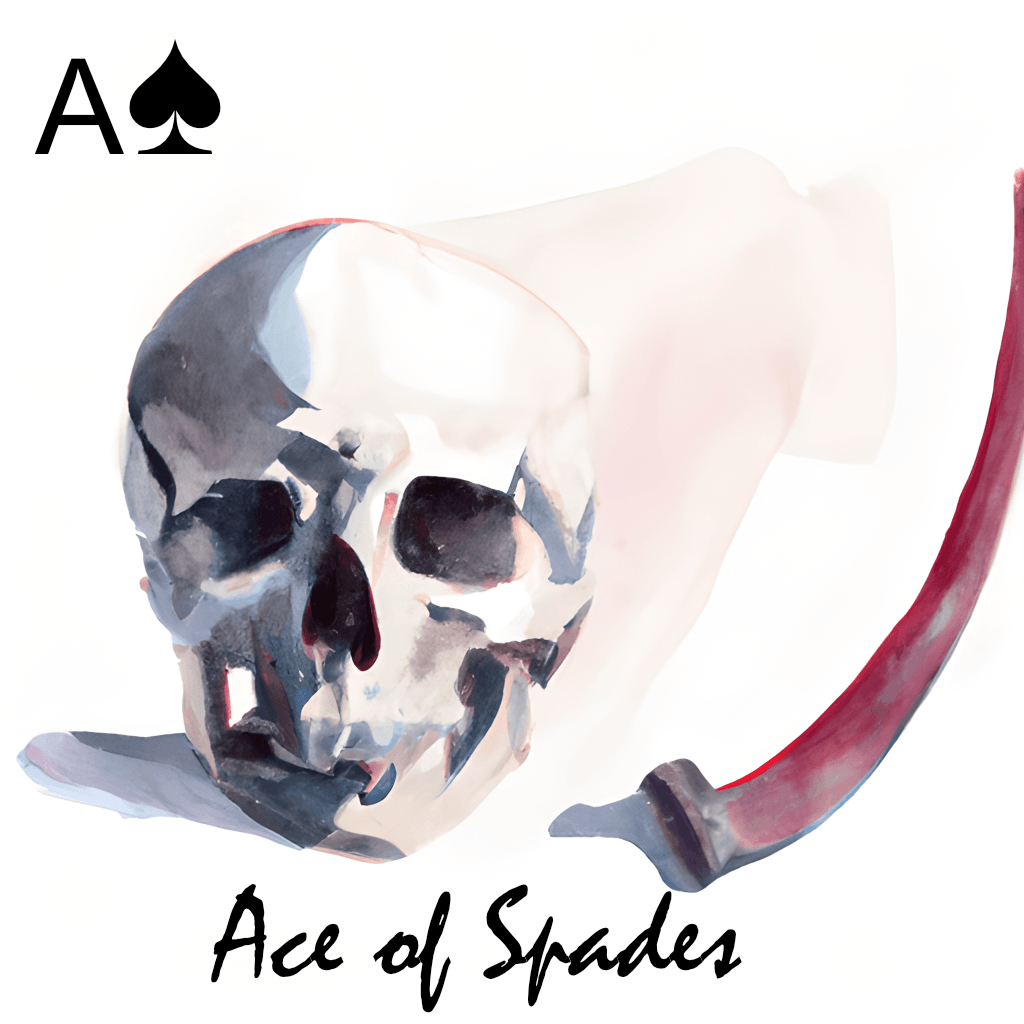
Illustration of the Ace of Spades in cartomancy with playing cards

Aces also have to do with the idea of source, and the Ace of Spades is definitely a source of trouble or of grief. Figuratively, it becomes a thorn, something that makes you suffer. When surrounded by Hearts, it can mean that the querent suffers emotionally (with other negative cards it can point to traumas and great disappointments, sometimes leading to depression). With Diamonds it points to financial hardships, while with Clubs it shows obstacles of all kind, especially of an objective nature, hardships at work and difficulties realizing your plans. If the cards are bad, the Ace of Spades bring failure, the abandonment of a plan.

In love readings, sometimes the card describes a widow or widower (especially when near a Spade Face card). At other times it can signify someone who has come out of an important story, not necessarily due to the partner going legs up. Broadly, the Ace of Spades is a card of great suffering, but when bombarded by positive cards it shows positive, if drastic, changes.

In more material affairs, the card is very seldom positive. It announces stressful times where the querent’s nerves will be put under great strain. It can, of course, announce a will or inheritance with the appropriate cards.

Psychologically and spiritually this is not a good card. It brings great worry, grief even at times, and in general it shows a nervous mind, often due to great uncertainty or owing to a sharp change of direction in the querent’s life. With very positive cards following it, it announces a new way of thinking or even a conversion.

Some Combinations:

A♠ – 3♠ – 9♠ = Death (often other bad cards show up)
A♠ – 9♠ = a bad combination in general. It augurs ill.
A♠ – 3♠ – A♣ and/or 4♦ – 7♦ or 10♦ = inheritance
K♠ – A♥ – A♠ – 2♠ = eviction
A♠ – 9♥ = a drastic change that leads to the fulfillment of your wishes

Cartomancy with the Skat / Piquet Deck of 32 Cards – Spreads

The German Skat / Piquet deck is normally read in a großes Blatt or große Tafel, i.e., a grand tableau. Usually, the composition of the Blatt is 8×4 or, alternatively, 6×5 plus two remaining cards in the last row. Maybe I will cover it in a future post, but as it’s a method I’m still studying and am not familiar with, it may take a while 🙂 there are, however, other methods.

For starters, nothing prevents you from using regular rows of cards for answering simple questions or just to get a general look at the future.  You can also take a look at the spreads I presented for the Sibilla and adapt them.

Another popular method used with Skat cards is that of the star. There are several variations online. The star spread is relatively simple and is normally used for general readings.
You place the significator card for the querent on the table, shuffle (or have the querent shuffle, depending on who you listen to). You then cut three times and read the cut. You restore the cut by placing the central heap on the last and then on the first, and you start dealing the cards.

One goes to the left of the significator, one to the right, one above, one below, one in the upper left corner, one in the lower right corner, one in the upper right corner, one in the lower left corner. You now have the significator completely surrounded by cards, like in a square of 9. But it’s not over. You then place another card to the left, one to the right, one above, one below, upper left, lower right, upper right, lower left. This will get you the shape of a star.

You then go on to interpret the spread, with the cards to the left as the past, those to the right as the future and those in the middle as the present. As I said, there are many variations on this spread, and I haven’t personally used it yet. I will update this post when I do.

Playing Cards and Numerology – The Tens

The tens in playing cards represent goals and destinations.

The Ten of Hearts is another lucky card in the deck, signifying happiness and well-being. Just like the Nine of Hearts, the Ten has the power to greatly reduce the negative impact of other cards. It represents lasting joy and a sense of not needing to look further. It is a great love card. It is also connected with the querent’s city or homeland.

The Ten of Clubs is the card of travel. Clubs are cards of action, but the aim of the action is represented by Diamonds. By themselves, Clubs are just a means, and travel is the means to get from where you are to your destination. Likewise, the Ten of Clubs signifies metaphorical pathways, the course of action.

The Ten of Diamonds is the card of success, and broadly speaking of accomplishment of aims. It is a generally material card, and can signify a large sum of money, or at the very least that money is not an issue. It also represents cities other than the querent’s, seen as goals or destinations to travel toward.

The Ten of Spades has a variety of meanings. Some are neutral. For instance, it represents unknown destinations, stranger places and destinations abroad. It is also a card of negative goals, illegal aims and, more generally, of secrets and silence. It is connected to night time, just as the Ten of Hearts is connected to day time. Broadly, it is a card of failure, but only if together with other cards that point in that direction.

Playing Cards and Numerology – The Nines

The nines in cartomancy with playing cards are associated with the idea of wishes and hopes.

The Nine of Hearts is, as in many other systems, the wish card. It represents realization, fulfillment, sincerity of heart and, in general, things going as we wish them to go. It’s a positive card in most instances, as it has the power to alleviate the negative import of other cards that precede it.

The Nine of Clubs represents distance. It is a neutral card that represents things of long duration, long waits and delays, matters slowing down. It can also relate to physical distance. Generally, it shows the separation between what what we want and us. It’s the long road ahead.

If the Nine of Clubs is the road, the Nine of Diamonds is making progress on that road, and advancement in general. It is an extremely positive card, showing improvement, recognition, increase, fame, even. It represents other people’s views and expectations concerning the querent, if he has a good name or not, etc. By itself, it shows a good name. It is symbolic of career.

The Nine of Spades is notoriously the worst card in the deck, and some call it the wish denied card. If the Nine of Hearts shows things going as we wish them to go, the Nine of Spades mean things going against our wish. As a further consequence, it signifies things happening that we don’t want to happen, and against which we are relatively powerless.

Playing Cards and Numerology – The Sevens

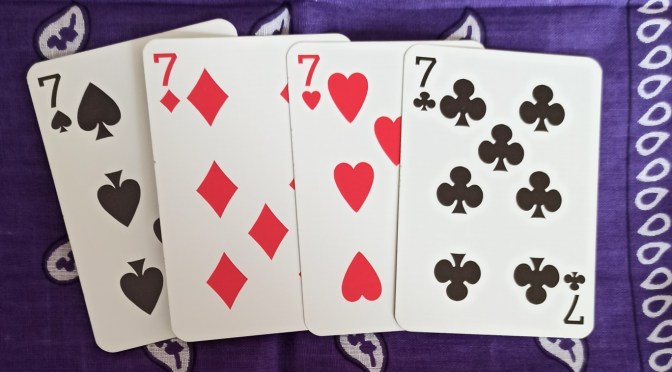
In cartomancy with playing cards, the sevens in general represent the idea of achievement.

The Seven of Hearts has the general meaning of surprise. This is because the suit of Hearts does not contemplate the notion of effort, so anything that happens happens either thanks to other people or thanks to positive circumstances. This card signals positive turns of events, fortunate breakthroughs and good luck. It is also connected with the idea of talent, because if we have a talent for something, achieving great results in it is easy.

The Seven of Clubs is less fortunate. It is a card of problems, things that stand in the way of achievement and that need to be worked through. It is not a tragic card. Sometimes it limits the amount of success shown by the other cards, while at other times it signifies that the sailing will be less than smooth. Either way, the problems shown by this card are solvable (which doesn’t automatically mean they will be solved). Supported by positive cards, the Seven of Clubs becomes a card of hard-won achievement. It can signal the conclusion of an agreement or that of a practical project.

The Seven of Diamonds is the card of money and financial achievement, and of achievement in general. It is a simple card most of the times. Unlike the Seven of Hearts, here effort is implied. By extension, this card is positive for recognition and winning prizes, and allegorically it is connected to harvesting.

The Seven of Spades is a card of misfortune. It shows obstacles that are difficult to solve, against which the querent has little power. More broadly, the card has to do with all negative unforeseen circumstances that either prevent us from achieving what we want or strongly limit us. With positive cards it shows that success won’t be complete, while with negative cards it’s a sign of utter capitulation.

Playing Cards and Numerology – The Fives

In cartomancy with playing cards, fives have an affinity with the idea of change, just as fours are related to stability.

The Five of Hearts shows positive change coming our way without effort. It is a card of evolution, good opportunities, gifts, offers (it is somewhat similar to the Three) and in general it shows that the querent thrives. Its general meaning is that of abundance and flourishing, freedom and being in a positive environment.

The Five of Clubs also signifies change, but change that is enacted by the querent. It implies effort, even physical effort. Nothing is free in the realm of Clubs, and therefore the card implies combativeness and even competition and the need to fight for what you want. While the Five of Hearts shows abundance, this card has an inherent sense of scarcity to it and the need to make the best of your chances.

The Five of Diamonds is the card that I thought exemplifies this number best, because in my system it just means change in a neutral sense. Generally it’s a positive card and it can bring some dynamic energy to a static spread. Of course it is also connected to the movement of money, information and energy, all of which are themes of the suit of Diamonds.

The Five of Spades is a bad card. The main meaning is that of prison, but of course it needs to be interpreted figuratively most of the times. It signifies the inability to move or to act, and it is symbolic of all things that keep us fenced in (like the pip in the middle) and chained, unable to change, be it guilt or an addiction. In general it signifies lack of opportunities, scarcity, dejection, the need for great sacrifice or, if followed by negative cards, a definite turn for the worse.

Playing Cards and Numerology – The Fours

In most systems of cartomancy with playing cards, the fours are cards of stability. However, a further connotation that I think attaches to them is that of pact or agreement between parts. Possibly this is due to the four pips resembling the legs of a table where people sit to talk.

The Four of Hearts is the card of reunions, gatherings and positive social occasions. It is also a symbol of agreements that come easy or are easily restored (Hearts): harmony and affinity all play into the meaning of the card. Because of the emotional connotation of the suit, the card can signify sex.

The Four of Clubs represents talks, and it is mainly the conversation card. However, it is not splendid. Because of the neutral nature of the suit of Clubs, which implies struggle and the need for action, the Four can go either way: toward agreement or toward breakup. It implies a degree of difference that needs to be reconciled, which is why talks are necessary. It’s not a bad card, but it is open-ended.

The Four of Diamonds is the card of formal agreements. It represents all things to do with papers, documents, offices, etc. Because the suit is more material than that of Hearts, the agreement can be interpreted as a transaction, and therefore the card represents buying and selling, and, by extension, all objects. In general, it signifies economic activity and has an affinity with the more material side of life.

The Four of Spades takes the basic theme of the number and runs it into the ground. The card represents loneliness and isolation. It shows the inability to get along or reach a positive conclusion. It shows complete disharmony and the impossibility of proceeding in a given direction, thus implying blockage. With other negative cards it means failure and trouble that cannot be overcome.

Playing Cards and Numerology – The Twos

The Twos or Deuces in the playing card deck are often considered of low value, the reason being that they are the smallest number beside the Aces, which however have great symbolic value, and even great value in many games. In general, when taken alone, the Twos do not have tremendous power in changing the course of a reading, but of course they gain it by connecting to other cards.

All Twos are connected to the idea of movement in some form or another.

The Two of Hearts was taught to me as the card of the “Door Knockers”. Just as the Ace is the home, the Two is what is coming to the home. Broadly speaking, it shows things happening in a short timeframe. The general idea is that of imminent arrival. Being the card of arrival and visits, it signifies the shortening of distances and a principle of reconciliation when appropriate (but other cards must be present). Having a connection with expectation, it can show the arrival of a child if with other cards (note how this card is similar to the Three of Hearts in the Vera Sibilla).

The Two of Clubs does not signal arrival, where the querent is passively waiting for something. It shows the taking of steps. Literally, this is the card of walking and of moving, usually a short distance, visiting instead of being visited. It shows going out (as befits the Club suit) and being active in a matter. Figuratively, it can signify the idea of putting things into motion and getting your ducks in a row.

The Two of Diamonds heralds letters. It is the card of messages and all that is written: invitations, post, emails, etc. Nowadays, though, the card covers telephone calls as well. Figuratively, the card is connected with the movement of ideas, the elaboration of the thoughts and with all that has to do with evolving your perspective. It’s movement, but of the mind.

The Two of Spades is the opposite of the Two of Hearts. It’s the card of anger and of all those feelings that create fractures and distance. It can signify a separation and movement away from something or someone. Broadly, the card means annoyances and small difficulties that frustrate the querent, obnoxious things coming your way. If drowned in a sea of positive cards, the Two of Spades simply heralds delays and small difficulties. It is not a tragic card. It does show frustrations and differences of opinion.