Tag Archives: Tarot

Tarot Encyclopedia – The Seven of Pentacles or Coins

(Note: this is a collection of the meanings attributed to the cards by some occultists in the past centuries. It does not reflect my own study or opinion of the cards. It is only meant as a quick comparative reference as I develop my own take.)
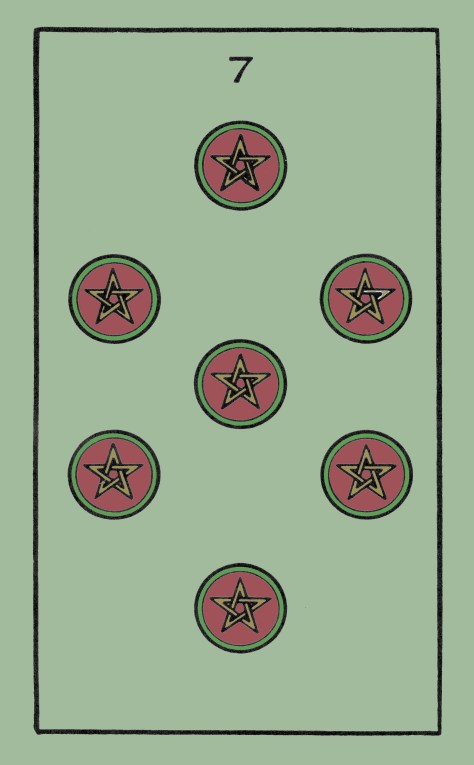
The Seven of Pentacles from the Builders of the Adytum (BOTA) tarot deck

Paul Foster Case (and Ann Davies)

The time period is the third decanate of Taurus, under the rulership of Saturn, May 11 to 20. Meanings:
Well-Dignified: slight gains, but of small account; much labor for small returns.
Ill-Dignified: something promising turns out badly; loss in speculation and unprofitable employment; financial restriction; unrealized hopes and
wishes.
Keyword: Loss
(From the Oracle of Tarot course)

A. E. Waite

A young man, leaning on his staff, looks intently at seven pentacles attached to a clump of greenery on his right; one would say that these were his treasures and that his heart was there. Divinatory Meanings: These are exceedingly contradictory; in the main, it is a card of money, business, barter; but one reading gives altercation, quarrels–and another innocence, ingenuity, purgation. Reversed: Cause for anxiety regarding money which it may be proposed to lend.
(From The Pictorial Key to the Tarot)
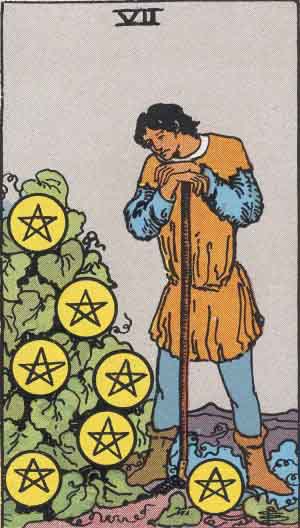
The Seven of Pentacles from the Rider Waite Smith tarot

Aleister Crowley

The Seven of Disks is called Failure. This suit gives the extreme of passivity; there is no positive virtue in it below the Abyss. This card is ruled by Saturn. Compare it with the three other Sevens; there is no effort here; not even dream; the stake has been thrown down, and it is lost. That is all. Labour itself is abandoned; every thing is sunk in sloth.

[…]

The number Seven, Netzach, has its customary enfeebling effect, and this is made worse by the influence of Saturn in Taurus. The disks are arranged in the shape of the geomantic figure Rubeus, the most ugly and menacing of the Sixteen. (See Five of Cups.) The atmosphere of the card is that of Blight. On the background, which represents vegetation and cultivation, everything is spoiled. The four colours of Netzach appear, but they are blotched with angry indigo and reddish orange. The disks themselves are the leaden disks of Saturn. They suggest bad money.
(From The Book of Thoth)

The Seven of Disks from the Thoth Tarot

Golden Dawn’s Book T

A WHITE Radiating Angelic Hand issuing from a cloud, and holding a white rose branch. Seven Pentacles arranged like the geomantic figure Rubeus. There are only five buds, which overhang, but do not touch the five uppermost Pentacles. Above and below are the Decan symbols, Saturn and Taurus respectively.

Promises of success unfulfilled. (Shewn, as it were, by the fact that the rosebuds do not come to anything.) Loss of apparently promising fortune. Hopes deceived and crushed. Disappointment, misery, slavery, necessity and baseness. A cultivator of land, and yet a loser thereby. Sometimes it denotes slight and isolated gains with no fruits resulting therefrom, and of no further account, though seeming to promise well.

Netzach of HB:H (Unprofitable speculations and employments; little gain for much labour).
Therein HB:HRChAL and HB:MTzRAL are ruling Angels.

Etteilla

Money
Upright. This card, as far as the medicine of the spirit is concerned, means, in its natural position: Money, Wealth, Sum, Coin. – Silver. – Whiteness, Purity, Candor, Innocence, Naiveté, Moon. – Purgation, Purification.
Reversed. Restlessness, Torment of spirit, Impatience, Affliction, Remorse, Concern, Solicitude, Care, Attention, Diligence, Application. – Apprehension, Fear, Distrust, Misgiving, Suspicion.

MQS
What’s the Bird Thinking? (Example Reading)

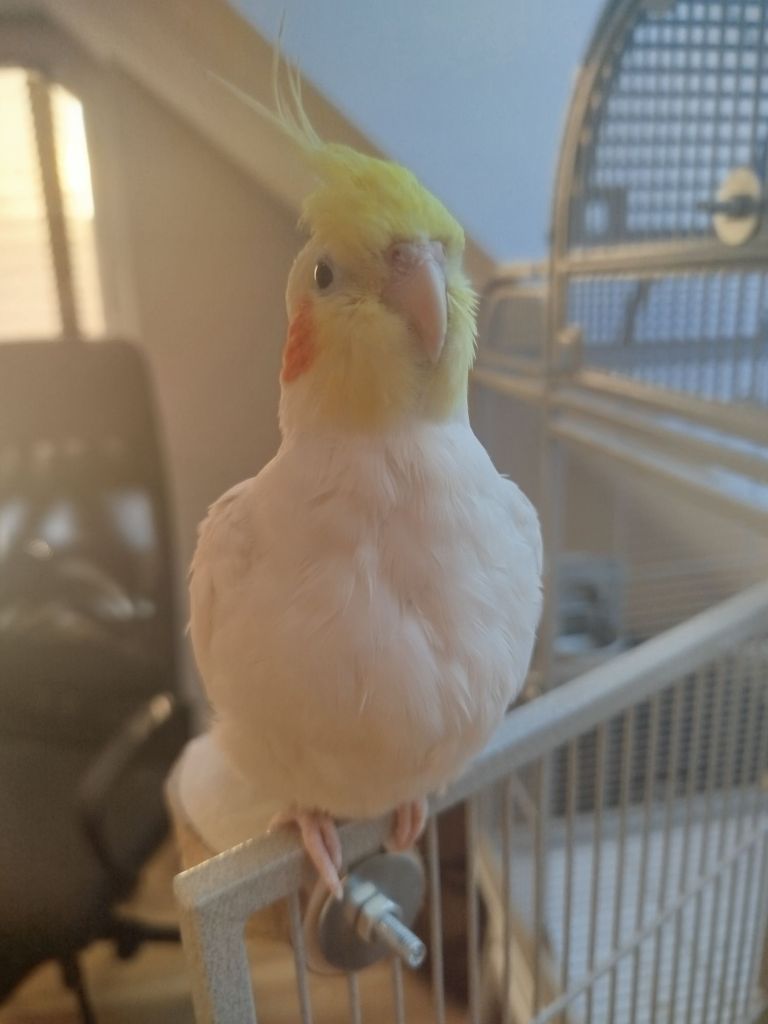
My two cockatiels couldn’t be more different from one another. Ciuffy, the white one, is a sweet cuddlebug who’ll do anything for a head scratch. He’s never nipped me, let alone bitten me. The only time he hurts me a little is when he tries to preen my ear.

“I’m the guy you want your daughter to bring home”

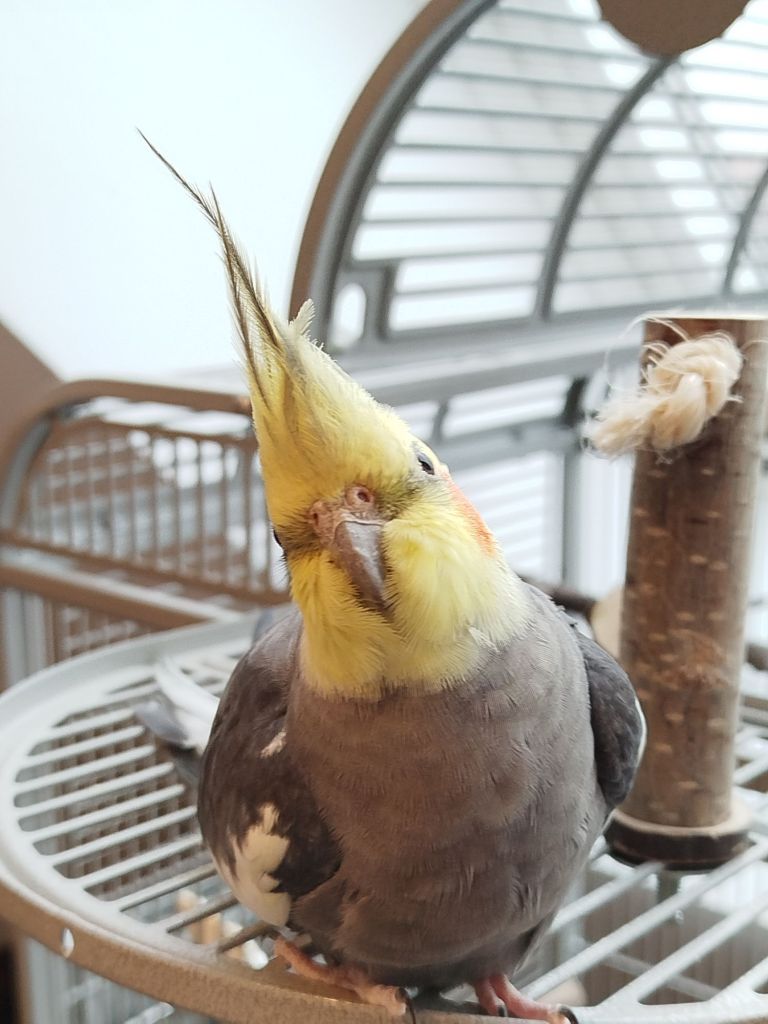
Zazu, the gray one, is a beaky, bossy, overbearing prick. He does have his sweet side, and considering I’ve had him for only a little over a month we’ve made huge progress, but when I have him on my shoulder I KNOW I’m going to get hurt at some point, and when he bites he really means it.

“I’m the guy your daughter brings home”

Now that I’ve set the scene and used the excuse to show you a couple of pics of my cutie pies, let’s get to the point. A couple of days ago, while Zazu was on my shoulder, he bit my earlobe incredibly hard out of nowhere (maybe he saw me move my head and didn’t like it).

I shooed him away with my hand, but he spooked and flew against a wall. Although he wasn’t hurt, he spent the day avoiding me and hissing (for those who don’t know, cockatiels can hiss, like cats).

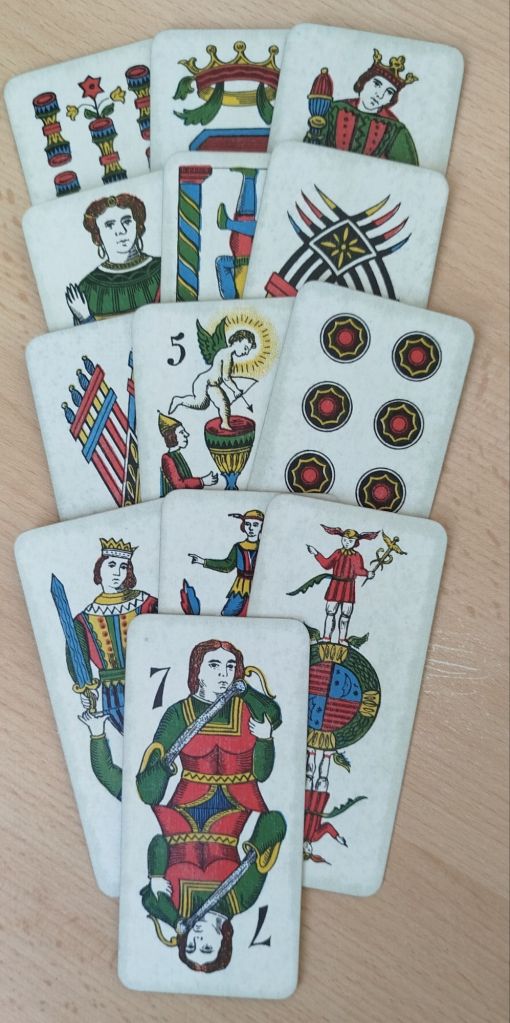
I knew that the accident set some of that hard-won progress back, but I wanted to know Zazu’s perspective and how it would likely evolve. Here’s what the Bolognese Tarot had to say:

What’s the featherball thinking? Tarot reading

One thing that surprised me is the first row, where we have happiness (Ten of Cups) in the house (Ace of Cups) with me (King of Wands). I know I try to care for the two little balls of feathers as best I can, but Zazu is always grumpy and old-farty in his behavior, so I assumed he didn’t like me very much. Apparently that’s just his character.

The second row is interesting, since we have unexpected (Stranger) betrayal (Hanged Man) leading to negative emotions (Eight of Swords). Clearly his good vibes were somewhat disrupted by the incident.

The third has a path (Eight of Wands) toward Love with harmony or small satisfactions (Ten of Coins). So even though there was a setback, there is room for moving toward love. Obviously we should be very careful when projecting human sentimentalism onto animals, but then again, divination is a language understandable to humans, so the tarot is probably translating Zazu’s reality in terms that are understandable to me.

I have some doubts about the last line. The King of Swords might be Zazu himself (it could represent my husband, but my husband isn’t particularly involved). Technically, pets are represented by the Juggler, but then again, the King of Swords does have some characteristics of the Juggler, so it’s a possibility. At any rate, the King is next to the sickbed. There are no combinations talking explicitly about sickness, so I believe this just shows his being cranky or a bit uncertain, but the World card at the end of the row indicates that this uncertainty doesn’t cause breaks: the situation remains open and moving.

The Temperance card at the end simply shows that patience and time are needed. I expected no less.

For now, the reading seems to be accurate. The day after the little bastard had gone back to his old behavior, being just a little more shy than usual, and the day following that he was back to normal.

MQS

Tarot Is Not Deep (and Its Limits as a Tool for Self-Reflection)

I always bring up poor Rachel Pollack whenever I need to give a paradigmatic example of someone who utterly ruined tarot divination by turning it into a heap of psychobabble, though in reality the list is quite long. At some point, it was decided that 1) divination could not be a serious undertaking in an age of reason, and 2) we still wanted to think our illustrious predecessors who bought into it were not poor saps. The compromise therefore was that there was something deeper to divination, and so divination had to be reassessed and purged in accordance to this new ideology of ‘depth’ or *shudders* ‘wisdom’.

The reality is that in the “I’m too special for religion but wouldn’t it be fun if there was something more to life” community, where most people tend to think exactly alike in spite of how different they think they are, depth is a misunderstood concept.

Something is considered deep if it will allow them to talk themselves or others silly while giving them plenty of safe thrills and predictable a-ha moments by hurling around the latest buzzwords (try finding a tarot reader who doesn’t talk about narcissists, gaslighting or inner truth).

Thankfully, the tarot is not deep, just like playing cards–and tarot cards ARE playing cards–or tea leaves or dice or geomantic figures are not deep, which is what makes them marvellous divination tools. Even astrology is not deep by today’s standards, if by astrology we mean astrology in its traditional forms (Hellenistic, medieval, Chinese, etc.)

But the depth that is found in divination, just like the depth that is found in all other branches of magic, has nothing to do with finding abstract meanings or deep doctrines that move us beyond real life. Although there can be space of deep philosophy, the real depth is found in the shift in our consciousness of existence and of our place in it as we practice it concretely and see its concrete impact on real life.

I will forever be grateful to my GD supervisor, who always insisted that I practice tarot in real life and not as a mere metaphysical plaything (people will be surprised by how concrete the GD tarot system is, in spite of its metaphysical underpinnings). Traditionally, in magical practice, people are advised on how to recognize when they have established contact with an entity other than themselves.

The risk is sometimes that of contacting parasites masquerading as great beings, but the even higher (and more common) risk is that of simply contacting one’s ego. Psychic onanism IS a thing, and a much worse vice than the physical counterpart.

This is what limits, in my view, the potential for tarot as a tool for self-reflection or meditation or scrying. Granted, most symbols can be used as doorways for these aims, and therefore also the tarot. There is some value to it, especially when done under supervision or with the proper frame of mind. There is also some value in allowing symbols to bring certain aspects of oneself to the surface, if one has the necessary detachment.

Wisdom is a great thing, and it is something that can be pursued on the path of magic, including divination. But more often than not, those who are too good for simple divination and want to discover the “deeper layers” of the tool simply end up massaging the shallower parts of their own psyche without realizing it, and often even thinking they are making some kind of psychological or occult progress when in fact they are simply digging themselves a deeper hole in their own ego.

MQS

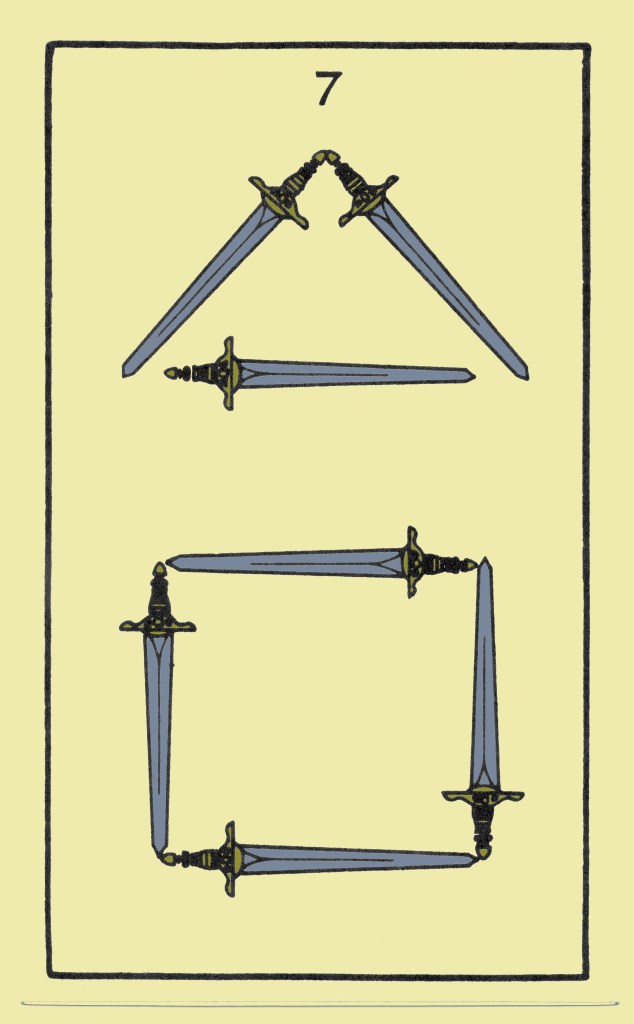
Tarot Encyclopedia – The Seven of Swords

(Note: this is a collection of the meanings attributed to the cards by some occultists in the past centuries. It does not reflect my own study or opinion of the cards. It is only meant as a quick comparative reference as I develop my own take.)

The Seven of Swords from the Builders of the Adytum (BOTA) tarot deck

Paul Foster Case (and Ann Davies)

The time period is the third decanate of Aquarius, February 9 to 18, under the rulership of Venus.
Well-Dignified: partial success; the Querent is too easy-going or does not draw sufficiently on his reserve force; he has good opportunities but may not make the most of them; he is likely to compromise too easily.
Ill-Dignified: love of ease and display cause loss; the Querent suffers from the insolence of others and may be insolent himself; there is danger that his own confidence may be betrayed, or that he may be led into betraying the confidence of others.
Keyword: Instability.
(From the Oracle of Tarot course)

A. E. Waite

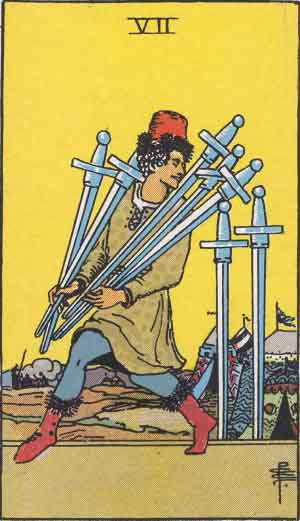
A man in the act of carrying away five swords rapidly; the two others of the card remain stuck in the ground. A camp is close at hand. Divinatory Meanings: Design, attempt, wish, hope, confidence; also quarrelling, a plan that may fail, annoyance. The design is uncertain in its import, because the significations are widely at variance with each other. Reversed: Good advice, counsel, instruction, slander, babbling.
(From The Pictorial Key to the Tarot)

The Seven of Swords from the Rider Waite Smith tarot

Aleister Crowley

The Seven of Swords is called Futility. This is a yet weaker card than the Seven of Wands. It has a passive sign instead of an active one, a passive planet instead of an active one. It is like a rheumatic boxer trying to “come back” after being out of the ring for years. Its ruler is the Moon. The little energy that it possesses is no more than dream-work; it is quite incapable of the sustained labour which alone, bar miracles, can bring any endeavour to fruition. The comparison with the Seven of Wands is most instructive.

[…]

Netzach, in the suit of Swords, does not represent such catastrophe as in the other suits, for Netzach, the Sephira of Venus, means victory. There is, therefore, a modifying influence; and this is accentuated by the celestial rule of the Moon in Aquarius.

The intellectual wreckage of the card is thus not so vehement as in the Five. There is vacillation, a wish to compromise, a certain toleration. But, in certain circumstances, the results may be more disastrous than ever. This naturally depends upon the success of the policy. This is always in doubt as long as there exist violent, uncompromising forces which take it as a natural prey.

This card, like the Four, suggests the policy of appeasement. The symbol shows six Swords with their hilts in crescent formation. Their points meet below the centre of the card, impinging upon a blade of a much larger up-thrusting sword, as if there were a contest between the many feeble and the one strong. He strives in vain.
(From the Book of Thoth)

The Seven of Swords from the Thoth tarot deck

Golden Dawn’s Book T

TWO Angelic Radiating Hands as before, each holding three swords. A third hand holds up a single sword in the centre. The points of all the swords “just touch” each other, the central sword not altogether dividing them.
The Rose of the previous symbols of this suit is held up by the same hand which holds the central sword: as if the victory were at its disposal. Symbols of Moon and Aquarius.

Partial success. Yielding when victory is within grasp, as if the last reserves of strength were used up. Inclination to lose when on the point of gaining, through not continuing the effort. Love of abundance, fascinated by display, given to compliments, affronts and insolences, and to spy upon others. Inclined to betray confidences, not always intentionally. Rather vacillatory and unreliable.
Netzach of HB:V (Journey by land: in character untrustworthy).
Herein rule the Great Angels HB:HHHAL and HB:Ma’aKAL.

Etteilla

Hope
Upright. This card, as far as the medicine of the spirit is concerned, means, in its natural position: Hope, Expectation, Expectation, Pretending, Founding, Overestimating, Founding, Designing, Willing, Wanting, Wishing, Vowing, Wanting, Taste, Fantasy.
Reversed. Wise opinion, Good advice, Salutary warnings, Instruction, Lesson. – Observation, Reflection, Note, Caution, Thoughtfulness. – Reprehension, Reprimand. – News, Announcement, Posting. – Consultation, Admonition.

MQS

Bolognese Tarot Spreads – The Thirteen Card Spread

Nothing prohibits anyone from using whatever spread they prefer, or even just from laying out a row of cards. However, traditionally, the smallest spread used with the Bolognese Tarot is the thirteen card spread, which is a small tableau of cards used to answer a specific question or explore a specific theme (although nothing prevents you from laying it out for a general reading. It will respond anyway). This is a spread I have already presented, and it is one that is used with many decks in Central and Northern Italy in particular. The layout is as follows:

123
456
789
101112
13
The Thirteen Card Spread

Some readers take out the significator for the querent or even the significator for the question and put them on top of the layout (above card 2) before starting to shuffle. I prefer to have all cards in the deck and have not found it necessary, but feel free to experiment.

The cards may be read in rows or in columns, and which direction is the primary one depends on which tradition you come from. Personally I tend to see rows as the primary reading direction, but I will look at columns if there is clear information contained in them. I have found that the columns tend to describe the situation rather than to predict it. But don’t force yourself to read in every direction possible: simply read the information where it is found, and leave the rest.

There is no strict differentiation between past, present and future. However, I have found, personally, that at least the first row, or sometimes two (and on occasion even three), contains the past or present of the situation. Occasionally the cards simply jump ahead into the future from the start.

Be open about it: it may sound confusing in theory but in practice it is often quite clear. For instance, if you see the cards changing from good to bad or vice versa (or simply changing “tone”) in the first row or two, that’s usually a sign that the cards before the change happens are the past/present, and the others the future. In doubt, simply ask the querent: we are not there to play Nostradamus, so it’s fine to ask for help in interpreting the spread.

The final card, number 13, doesn’t have any specific preassigned meaning. However, I have found that it can either simply be a regular part of the spread (simply coming after card 12 or under card 11), or it can highlight an important detail, or something that will be true, regardless of what the previous cards say. For instance, if the spread is a disaster but the thirteenth card is good, it can tell us the querent will have some kind of satisfaction, or will be protected.

Yes-or-No Questions

Now we come to an odd bit of tradition. I will relay it as it has been taught to me, and then I’ll give you my two cents. Although the thirteen card spread is not unique to the Bolognese Tarot, the Bolognese Tarot adds another layer to the spread.

This is relevant only when the question is a yes-or-no question. If it is, then, according to some traditions, the answer is yes if the Death card comes up in the spread or while cutting the deck (it says: “yes, as sure as the fact we all die”). If the Angel card comes up, according to some it’s a maybe, while according to others it’s a no but with positive developments; if the Death and Angel cards both come up, not necessarily together, it’s the best possible outcome (a super yes, as it were). If neither card comes up, it’s a no.

Some also add that if the Death card doesn’t come up but the Angel and Devil card come up in the spread, not necessarily together, it’s also a yes (the Devil card alone would be a no, but if you remember the combinations, Angel+Devil means good news or satisfaction). Others still also believe the answer is yes if three or four Kings come up in the spread.

Now I’m going to tell you what my experience is. My experience is that there is something to these rules, but it is not all so cut-and-dry. The spread always needs to be interpreted as describing a concrete situation, and the yes or no comes from our evalutation of whether the picture presented by the cards matches what the querent wants or not. It’s happened more than once that the Death card was present but the answer (confirmed by experience) was a no, or vice versa, the answer was yes with no yes-marker present.

Focus on interpreting the cards. If the Death card comes up, what does it say in the context? Does it show some sharp change? Does it show inner suffering? Does it confirm something? If so, look at the cards around it: what is it saying yes to? Sometimes it is obvious that the Death card comes up for no reason other than to say “yes” to the question, while at other times it is a regular card, like the others. Again, be flexible, record your experience and learn from it.

MQS

Exploring the Present Or Scrying the Future?

As a diviner, I have no objection to making predictions about what is likely to happen. I see the current taboo about the future as a mix of delusion and ignorance. Our current culture comes at the tail-end of the myth of the self-made man that has animated much of our recent (and even not-so-recent) past. This myth has strongly influenced the Zeitgeist of the current occult wave, which started at the end of the XVIII century and continues, though declining–putrefying, even–to this day.

The occult developments have in turn trickled down into pop spirituality and have fostered the belief, now extremely popular, that all it takes to change one’s reality is to tune into the wavelength where one’s delusion corresponds to objective facts, and that nothing about one’s identity is more than a socially-conditioned self-identification that can be simply deconstructed and cast off like a cloak in favor of something else as the whim of the day dictates.

This implies the idea that the future is a completely blank slate and that therefore divination can only be used as a tool for self-reflection on the present to facilitate this process of self-making and self-remaking. Unfortunately, the self-reflection in question regularly resolves itself into simply telling the querent what they already think or would like to think of themselves, but packaged in empowering language within a context in which they assume they are communing with divinity. “Wow, the Gods think exactly the same as I do! How wise!”

Anyone who lives in actual reality and has spent five minutes reflecting on it know that this view of existence is demonstrably false (although, like many false things, it contains faint traces of truth). Each of us has a path in life that is unique, containing specific challenges and opportunities, possibilities and impossibilities. Divination is good at detecting these patterns and their likely outcome in the near future.

Still, I find that there is value in employing traditional divination in exploring the present. The language of traditional divination is frank, crisp and concrete, as it comes from a deep understanding of the fact that, if what is above is as what is below and what is within is as what is without, then what is above or within cannot be a metaphysical soup of saccarine inanities, but must correspond to the complex interplay of pleasure and sorrow of the below and without.

In other words, if a tiktok psychic might tell you that you always end up with the wrong guy because you have a soul contract that stipulates that you need to come into contact with your inner queen, traditional divination is more than happy to let you know that it’s because you are a basic harlot who chooses basic idiots.

This is not to say that there is a god or a spirit judging the querent through us or through the oracle: it is merely a dispassionate look at your life from a dispassionate observer on a simple example of causality. It also does not imply that we, as diviners, shouldn’t learn to speak with tact and diplomacy. However, the employment of actual divination techniques allows us to shed light on the querent’s present in terms that might actually be helpful to them.

We never leave a divination session unaltered. The knowledge we gain changes us necessarily: me knowing about X is not the same as me not knowing about it. If X is in my hands, then knowing about it can give me some power over it. If it isn’t in my hands, then knowing about it gives me awareness of the limits that define my unique path through life. That’s growth, too.

MQS

Tarot Encyclopedia – The Seven of Cups

(Note: this is a collection of the meanings attributed to the cards by some occultists in the past centuries. It does not reflect my own study or opinion of the cards. It is only meant as a quick comparative reference as I develop my own take.)

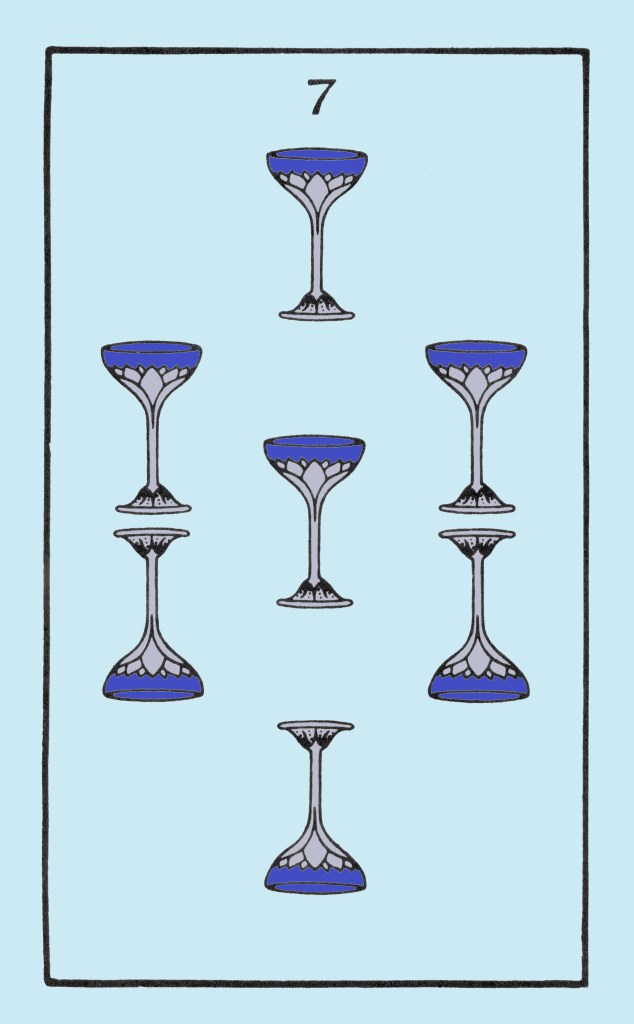
The Seven of Cups from the Builders of the Adytum (BOTA) tarot deck

Paul Foster Case (and Ann Davies)

The time period is the third decanate of Scorpio, November 11 to November 20, under the subrulership of the Moon.
Well-Dignified: possible victory, but the person to whom the card applies may be too indolent to take advantage of his opportunities for commanding circumstance. Success may be gained, but not followed up; necessity for choosing only the highest objectives.
lll-Dignified: illusionary success; lying and deceit; drunkenness; violence, even lust.
Keyword: Illusion
(From the Oracle of Tarot course)

A. E. Waite

Strange chalices of vision, but the images are more especially those of the fantastic spirit. Divinatory Meanings: Fairy favours, images of reflection, sentiment, imagination, things seen in the glass of contemplation; some attainment in these degrees, but nothing permanent or substantial is suggested. Reversed: Desire, will, determination, project.
(From The Pictorial Key to the Tarot)

The Seven of Cups from the Rider Waite Smith Tarot Deck

Aleister Crowley

The Seven of Cups is called Debauch. This is one of the worst ideas that one can have; its mode is poison, its goal madness. It represents the delusion of Delirium Tremens and drug addiction; it represents the sinking into the mire of false pleasure. There is something almost suicidal in this card. It is particularly bad because there is nothing whatever to balance it-no strong planet to hold it up. Venus goes after Venus, and Earth is churned into the scorpion morass.

[…]

This card refers to the Seven, Netzach, in the suit of Water. Here recurs the invariable weakness arising from lack of balance; also, the card is governed by Venus in Scorpio. Her dignity is not good in this Sign; one is reminded that Venus is the planet of Copper, “external splendour and internal corruption”. The Lotuses have become poisonous, looking like tiger-lilies; and, instead of water, green slime issues from them and overflows, making the Sea a malarious morass. Venus redoubles the influence of the number Seven.

The cups are iridescent, carrying out the same idea. They are arranged as two descending triangles interlaced above the lowest cup, which is very much larger than the rest. This card is almost the “evil and averse” image of the Six; it is a wholesome reminder of the fatal ease with which a Sacrament may be profaned and prostituted.

Lose direct touch with Kether, the Highest; diverge never so little from the delicate balance of the Middle Pillar; at once the holiest mysteries of Nature become the obscene and shameful secrets of a guilty conscience.
(From The Book of Thoth)

The Seven of Cups from the Thoth Tarot

Golden Dawn’s Book T

THE seven cups are arranged as two descending triangles above a point: a hand, as usual, holds lotus stems which arise from the central lower cup. The hand is above this cup and below the middle one. With the exception of the central lower cup, each is overhung by a lotus flower, but no water falls from these into any of the cups, which are all quite empty. Above and below are the symbols of the Decanate Venus and Scorpio.

Possible victory, but neutralized by the supineness of the person: illusionary success, deception in the moment of apparent victory. Lying, error, promises unfulfilled. Drunkenness, wrath, vanity. Lust, fornication, violence against women, selfish dissipation, deception in love and friendship. Often success gained, but not followed up. Modified as usual by dignity.

Netzach of HB:H (Lying, promises unfulfilled; illusion, deception, error; slight success at outset, not retained).
Herein the Angels HB:MLHAL and HB:ChHVYH rule.

Etteilla

Thought
Upright. This card, as far as the medicine of the spirit is concerned, means, in its natural position: Thought, Soul, Spirit, Intelligence, Idea, Memory, Imagination, Understanding, Conception, Meditation, Contemplation, Reflection, Deliberation, Viewpoint, Opinion, Feeling.
Reversed. Plan, Design, Intention, Desire, Will, Resolution, Determination, Forethought.

MQS

An Interesting Divinatory Phenomenon About The Past

This article is going to be as vague as it gets. It pertains to certain observations I’ve made over the course of the years practicing divination, first with playing cards and the Sibilla, then with regular Tarot and now with the Bolognese Tarot, but it is not a unified theory, and in fact, it is even hard for me to put it into words.

We all know how time is difficult to define in divination, especially by cards. Sometimes it’s even hard to say if the cards are describing the past, the present or they are directly starting off with the future. This is even more true when using non positional spreads, where one or more lines of cards are interpreted together. My observations are mainly about non positional spreads, and how sometimes they seem to signal that they are talking about the past.

In all decks (at least, in all decks I use) there are cards connected with the person’s thoughts, or at least with their inner or emotional world. A person’s inner world is a complex thing, since it is a mix of hopes for the future, memories of the past, illusions, dreams, traumas, etc. All decks I use also contain cards that show ending, death, disruption and radical change, indicating the end of a life path.

The thing I’ve noticed is that, when in the first couple of lines of a spread (or within the first couple of cards in a longish one-line spread) there is a card connected to the person’s inner world and then a card of ending, that section of the spread usually talks about the past, and more specifically the distant past (that is, not just a couple of months back). This is because the card of disruption tells me that the situation the cards are talking about is over, while the card relating to thoughts or emotions says that the thing exists only as a memory, something that has left a mark on the person’s soul.

I recently did a spread for someone with the Bolognese Tarot. Unfortunately I didn’t save a picture of it and forgot most of it (it was one of those “I’m sure I won’t forget it” moments). It was a question about love, and in it both querent and quesited (the love interest) showed up only as thoughts, followed by cards of disruption. It turned out they had been together eight years ago, she had left him on the advice of a friend who thought causing drama would strenghthen his commitment. Instead he moved on, and she was still waiting for him to come back. In this instance, the thoughts reenacting the break-up were like ghost impressions reliving that pivotal moment in her past.

Obviously, this sort of things tend to happen for major events, whether positive or negative, and it shows how our inner structure is a bit like a geological section, with different eras still present, but hidden from view.

MQS

My First YT Video: Cross Spread Tutorial

I finally decided that there was no point in learning the theory of how to make videos. Much better to make crappy ones until something goes right. So yea, here’s the first video on my channel.

Please be patient, I am a very special kid.

MQS