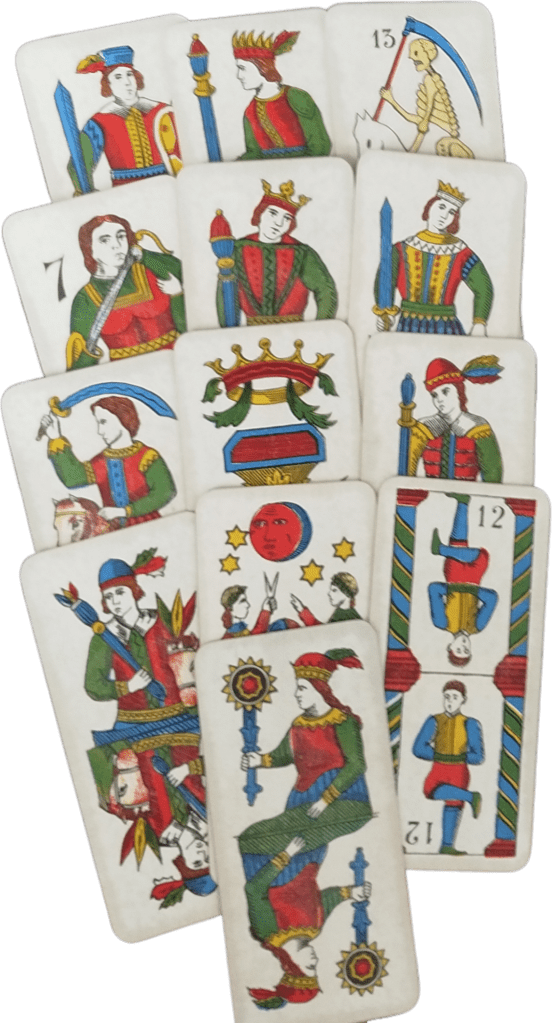
A querent (a man) asked how his relationship would evolve:
A relationship reading
The first thing to notice is that both main figures appear (King and Queen of Wands) and both their thoughts (Page and Knight of Wands). The two significators are in the central column, so let’s read the central column first: King of Wands, Queen of Wands, Ace of Cups (house), Moon (darkness), Queen of Coins (truth). Clearly their relationship is not based on clarity, because the truth is hidden, and there would be a need for honesty.
The Death card next to her might show that she is the one going through some kind of transition, and it’s probably not something that has just happened (Temperance shows time). The house is not positive to the couple, as there is hurt or arguments around it (Knight of Swords).
The King of Swords was hard to interpret. It was, until the querent asked out of the blue “Do you see her cheating on me?”
Look at the column the King of Swords falls in: Death, King of Swords, Her Thoughts and the Betrayal card. In her thoughts there’s someone else. Note also that his thoughts (Knight of Wands) is next to the Moon and the Hanged Man, so he suspects.
The Queen of Coins, which is the truth, here seems to have two meanings here. One is that it shows the need for clarity (and therefore the lack of it), and secondly it acts as a sort of punctuation, as I discussed before, sealing the reading as if to say “yup, that’s exactly what you’re thinking”
Obviously we need to be very careful when announcing this sort of situations, even if the querent suspects. It is much better to caution them to seek clarity with their partner (especially in this case with the Truth card so prominent in the reading)
(Note: this is a collection of the meanings attributed to the cards by some occultists in the past centuries. It does not reflect my own study or opinion of the cards. It is only meant as a quick comparative reference as I develop my own take.)
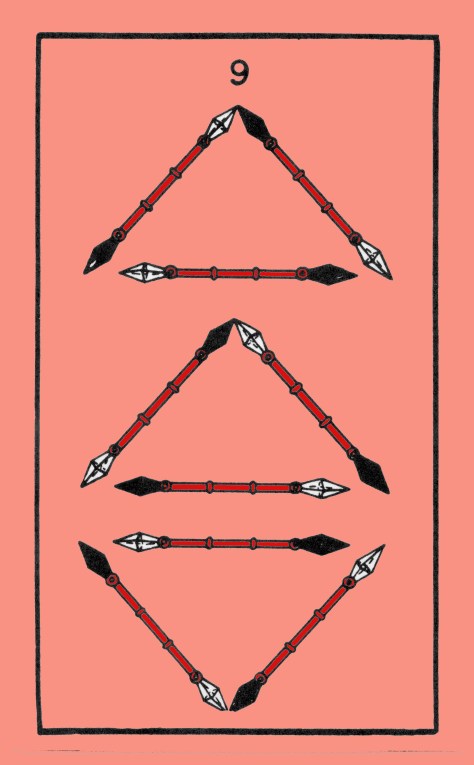
The Nine of Wands from the Builders of the Adytum (BOTA) tarot deck
Paul Foster Case (and Ann Davies)
In Tarot divination this Key combines the forces of the Moon, Mars and Jupiter and the zodiacal influences of Sagittarius and Aries, together with the Ninth house of the Higher Mind. Well Dignified: well placed in a divination, this Key suggests originality, independence and daring. It has meanings that include strength in reserve; health after illness; success, but attended with some strife. Ill-Dignified: danger; violence in foreign places or during long journeys; difficulties with relatives of the marriage partner; conflict with persons prominent in religion or law; obstinancy. Keyword: Preparedness (From the Oracle of Tarot course)
A. E. Waite
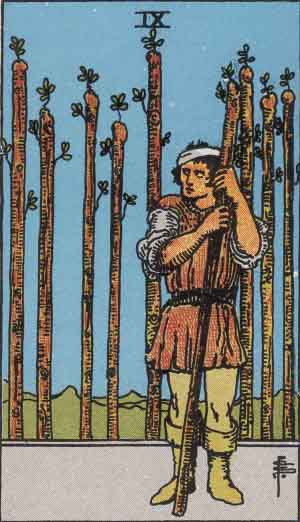
The figure leans upon his staff and has an expectant look, as if awaiting an enemy. Behind are eight other staves–erect, in orderly disposition, like a palisade. Divinatory Meanings: The card signifies strength in opposition. If attacked, the person will meet an onslaught boldly; and his build shews, that he may prove a formidable antagonist. With this main significance there are all its possible adjuncts–delay, suspension, adjournment. Reversed: Obstacles, adversity, calamity. (From The Pictorial Key to the Tarot)
The Nine of Wands from the Rider Waite Smith Tarot
Aleister Crowley
The Nine of Wands is called Strength. It is ruled by the Moon and Yesod. In “The Vision and the Voice”, the eleventh Aethyr gives a classical account of the resolution of this antinomy of Change and Stability. The student should also consult the works of any of the better mathematical physicists.
Of all important doctrines concerning equilibrium, this is the easiest to understand, that change is stability; that stability is guaranteed by change; that if anything should stop changing for the fraction of a split second, it would go to pieces. It is the intense energy of the primal elements of Nature, call them electrons, atoms, anything you will, it makes no difference; change guarantees the order of Nature. This is why, in learning to ride a bicycle, one falls in an extremely awkward and ridiculous manner. Balance is made difficult by not going fast enough. So also, one cannot draw a straight line if one’s hand shakes. This card is a sort of elementary parable to illustrate the meaning of this aphorism: “Change is Stability.”
Here the Moon, the weakest of the planets, is in Sagittarius, the most elusive of the Signs; yet it dares call itself Strength. Defence, to be effective, must be mobile.
[…]
This card is referred to Yesod, the Foundation; this brings the Energy back into balance. The Nine represents always the fullest development of the Force in its relation with the Forces above it. The Nine may be considered as the best that can be obtained from the type involved, regarded from a practical and material standpoint.
This card is also governed by the Moon in Sagittarius; so here is a double influence of the Moon on the Tree of Life. Hence the aphorism “Change is Stability”.
The Wands have now become arrows. There are eight of them in the background, and in front of them one master arrow. This has the Moon for its point, and the Sun for the driving Force above it; for the path of Sagittarius on the Tree of Life joins the Sun and Moon. The flames in the card are tenfold, implying that the Energy is directed downwards. (From The Book of Thoth)
The Nine of Wands from the Thoth tarot deck
Golden Dawn’s Book T
FOUR hands, as in the previous symbol, holding eight wands crossed four and four; but a fifth hand at the foot of the card holds another wand upright, which traverses the point of junction with the others: flames leap herefrom. Above and below are the symbols Moon and Sagittarius.
Tremendous and steady force that cannot be shaken. Herculean strength, yet sometimes scientifically applied. Great success, but with strife and energy. Victory, preceded by apprehension and fear. Health good, and recovery not in doubt. Generous, questioning and curious; fond of external appearances: intractable, obstinate.
Yesod of HB:Y (Strength, power, health, recovery from sickness). Herein rule the Angels HB:YRThAL and HB:ShAHYH.
Etteilla
Delay Upright. This card, as far as the medicine of the spirit is concerned, means, in its natural position: Delayed, Dilated, Removed, Suspended, Stretched, Slowed, Slowly. Reversed. Travail, Obstacle, Impediment, Contrariness, Disadvantage, Adversity, Penalty, Accident, Misfortune, Calamity.
The Bolognese Tarot is traditionally read using a reduced pack of either 45 or 50 cards (the 35 card system, of historical interest, is no longer practiced today). However, since it is a tradition that varies locally, the make-up of the deck varies. In other words, the 45 cards I use are not necessarily the same used by another person who uses 45 cards. The same is true for the 50 card deck.
This uncertainty is what contributes to the relative obscurity of the method. At the end of the day, many people want a clear standard to follow. For my part, I practice the systems I have been taught: the 45-card system you often see in my readings, which I was taught three or four years ago but had left alone until recently, and the 50-card system I have been taught by Germana Tartari.
Many of the sources I have consulted seem to believe that the 45-card system is older, and later five extra cards were added by some. Germana herself told me she remembers her grandma telling her that she (her grandma) had seen the full pack of 62 used (this reconstructed system is the topic of Germana’s newer book, which I will review in the near future).
So we have several systems, which isn’t surprising: if we look at Piacentine playing cards, there are at least several full-deck methods, at least one method with 30 cards and several with 25 cards.
Going back to the tarocchino bolognese, and limiting ourselves to the two most used systems of 45 and 50, usually the cards that overlap tend to have the same or similar meanings, at least in part. For instance the Ace of Coins can be the table or desk in all systems I am aware of. Additionally, in the 45-card system I know, the Ace of Coins can also be the card of money (relatively big money). In Germana’s 50-card system, the Ace of Coins can be a table, but also a letter or document. In Ingallati’s system, the Ace of Coins is the table or the work card.
As for the work card, both Germana’s 50-card system and the 45-card system I know assign it to the Star, but the Star is also the card of material possessions and possibly of gifts, which is the main meaning assigned to the card by Ingallati. In another book on the 45-card method I have yet to review, the Star represents the health status (in my system it can represent meds), but also ‘good job opportunities’.
As you can see, there is overlap, but also space for divergence. To avoid confusion, both for myself and for the readers, I tend to stick to the meanings I know, but I think it’s fair that I bring this up.
As for the five extra cards that some add to the initial 45, there isn’t great uniformity either. Some don’t even add five cards: I know a reader who uses a pack of 49, while Giliberti, whose book I reviewed, seems to use 51 in one video I saw (how many cards she uses in the book I don’t know, due to the book’s chaotic nature).
All this chaos may be frustrating for someone who is approaching the bolognese tarot for the first time, especially from outside of Italy. One thing is growing up with a particular system, another thing is having to randomly choose one.
I don’t believe any system is inherently better or worse. All have the same potential for describing life, if properly used, and much also depends on the person’s inclination. For instance, having studied the 50-card system under Germana’s supervision, there should apparently be no reason for me to go back to the 45-card system. Yet I found myself always coming back to it, despite integrating insights from Germana’s system and from the books I read.
Ultimately I recognized that the 45-card system simply resonates with me beautifully, and while we are still in an open relationship, I tend to gravitate toward it. Certainly, if I had to write a full guide on the Bolognese tarot, I would illustrate this method. You may find otherwise.
I think anyone who is interested in this deck should take their time to explore their options. Mixing and matching randomly without having first studied the various strands of the tradition is not recommended, but as we study and practice we may find that a more individual approach emerges.
Some decks have variable significators, while others assign certain cards to always represent the querent and their partner. This can cause confusion when reading for people who would not have lived their life out in the open back when cartomancy emerged, such as gay or trans people. Following are some experimental notes on how to deal with such instances in the various decks I use.
I want to stress that these are based on my practical experience, not on that of someone else and not on some theory I am trying force onto the cards. My aim is to improve my accuracy as a diviner, not to pontificate on academic eventualities.
Vera Sibilla
The Sibilla doesn’t have fixed significators, meaning that the querent will, if at all, be represented by a court card that indicates their role in the situation and/or society at the moment of the reading, always compatibly with their sex.1
And this is already problematic nowadays. I haven’t read for too many trans people, but I have noticed that if the person has either transitioned, fully or in part, or has at least adapted considerably to the other sex, then they are represented by a court card of that sex (ftm as a male, mtf as a female).
To be blunt: Jane, cashier, who has been living as Jane despite being born as Jim, and lives out her concrete life as Jane, is described as a woman in the cards, although the cards may hint at the transition, if relevant in the context; Jim, cashier, who would like to become Jane and maybe one day will, is represented as a man, even if he’s started to play with makeup since watching Myra Breckinridge; Becky, professional TikTok cheese grater, special traits no personality, who thinks an androgynous look makes her stand out, still comes up as a woman even if she pretends to identify as a man on every day with an R in it.
This has nothing to do with politics or tolerance or “passing as the other sex” and everything to do with concrete life: divination mirrors life, but social media clout simply doesn’t transfer to the cards, and there’s nothing I can do about it, even if it may offend some. The good news is that indentification with a significator is just a divinatory device and lasts only for the fifteen minutes needed to conduct a reading, and then is over.
IMPORTANT: we are talking about trans people, not crossdressers. A crossdressing man is a man who cosplays as a woman for whatever reason, but remains a man and lives as a man, at least until that fake business trip to Atlanta that his wife knows nothing about.
Talking about gay people, the Sibilla is very straightforward. In the few readings I do for myself, I usually come up as the Boyfriend, my husband as the Gentleman, and some years ago I came up as the Helper and my husband as the Boyfriend.
As for “but what about…” particular cases about any of the identities that are created daily, the best I can offer is: I’ll cross that bridge when I get to it. I trust the cards to simply describe the situation as it is and I accept the risk of not being able to understand how complex it may be, either in reality or in someone’s perception.
Playing cards and Bolognese Tarot
In some systems of cartomancy with playing cards, significators are not fixed. The way I was taught, though, the male querent is the King of Clubs and the female querent the Queen of Clubs, and the other card is the person they love. Similarly, in the Bolognese tarot the male querent is the King of Wands and the female querent the Queen of Wands.
For trans people, I think what I said about the Sibilla still holds true. Again, all I can say is to keep your mind and your eyes open (on the cards, I mean. Looking if the querent has an adam’s apple doesn’t count.)
For gay people, I have generally found that a degree of flexibility is required on the diviner’s part. Some readers seem to believe that you can just dictate to the cards how to behave, including in the case of gay querents. If that works, then bully for you, but I have always found the cards to have a mind of their own, regardless of the conventions we try to establish for them, so all I can do is be flexible.
Some people think the querent is represented by the court card of their gender, the partner by the other main significator, regardless of their sex. This theory is predicated on the fact that the two main significators are meant to show those people, and the fact that they are of two different genders is accidental or a matter of historical bias.
This may sound convincing, but have I found it to be true in practice? Sometimes. Sometimes the partner will come up as the other Club/Wand figure and there is simply no way of interpreting it other than as the partner, even if the stuff under the dress doesn’t match. Sometimes the cards will represent the partner as a court card of another suit that matches them. Sometimes the cards will throw in both cards for good measure: hubby has come up as the Queen of Clubs + King of Hearts together on more than one occasion in the past. Talk about a big personality.
Tarot
This is like the Sibilla, and doesn’t require much discussion. The male querent is usually the Emperor or the Pope, the female querent is usually the Empress or the Popess. Two men in a relationship can be shown as Emperor and Pope.
MQS
I am aware of the difference between the word ‘sex’ and the word ‘gender’, but I am going to use them quasi-interchangeably to avoid too many repetitions that hurt the ear. ↩︎
(Note: this is a collection of the meanings attributed to the cards by some occultists in the past centuries. It does not reflect my own study or opinion of the cards. It is only meant as a quick comparative reference as I develop my own take.)
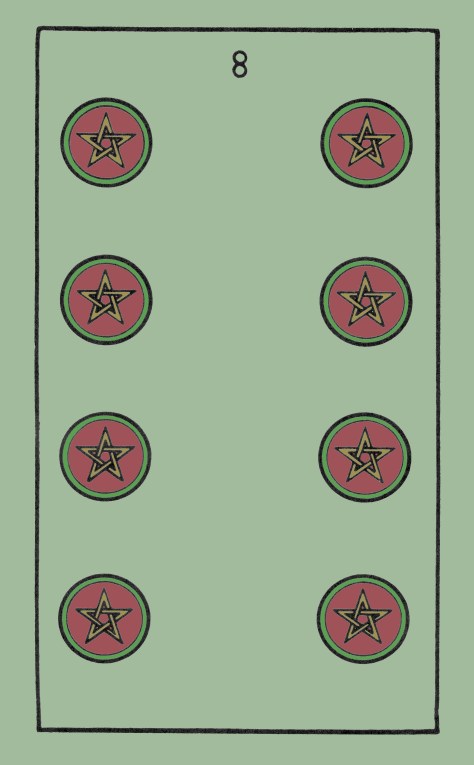
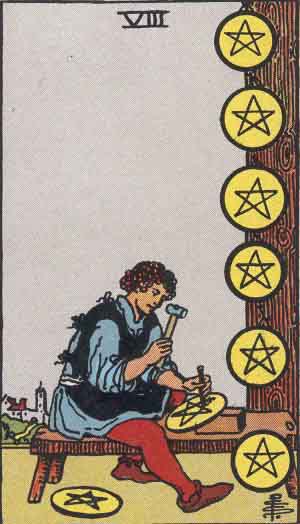
The Eight of Pentacles from the Builders of the Adytum (BOTA) tarot
Paul Foster Case (and Ann Davies)
The time period is the first decanate of Virgo, under the rulership of Mercury, from August 23 to September 2. Meanings: Well-Dignified: skill in the management of material affairs; industry; gain in subordinate positions through writing, clerical work or travel; gain of ready money in small sums. lll-Dignified: avarice and hoarding; penny wisdom and pound foolishness; meanness in money matters; loss through travel or writings; the Querent is likely to be in difficulties with superiors and also with inferiors; he may lose through trying to overreach somebody else. Keyword: Prudence (From the Oracle of Tarot course)
A. E. Waite
An artist in stone at his work, which he exhibits in the form of trophies. Divinatory Meanings: Work, employment, commission, craftsmanship, skill in craft and business, perhaps in the preparatory stage. Reversed: Voided ambition, vanity, cupidity, exaction, usury. It may also signify the possession of skill, in the sense of the ingenious mind turned to cunning and intrigue. (From The Pictorial Key to the Tarot)
The Eight of Pentacles from the Rider Waite Smith tarot
Aleister Crowley
The Eight of Disks is called Prudence. This card is a great deal better than the last two [Eights], because, in purely material matters, especially those relating to actual money, there is a sort of strength in doing nothing at all. The problem of every financier is, first of all, to gain time; if his resources are sufficient, he always beats the market. This is the card of “putting something away for a rainy day”.
[…]
The number Eight, Hod, is very helpful in this card, because it represents Mercury in his most spiritual aspect, and he both rules and is exalted in the sign of Virgo, which belongs to the Decan, and is governed by the Sun. It signifies intelligence lovingly applied to material matters, especially those of the agriculturalist, the artificer and the engineer.
One might suggest that this card marks the turn of the tide. The seven of Disks is in one sense the fullest possible establishment of Matter-compare Atu XV-the lowest fallen and therefore the highest exalted. These last three cards seem to prepare the explosion which will renew the whole Cycle. Note that Virgo is Yod, the secret seed of Life, and also the Virgin Earth awaiting the Phallic Plough.
The interest of this card is the interest of the common people. The rulership of the Sun in Virgo suggests also birth. The disks are arranged in the form of the geomantic figure Populus. These disks may be represented as the flowers or fruits of a great tree, its solid roots in fertile land.
In the Yi King, Sol in Virgo is represented by the 33rd Hexagram, Thun, “Big Air”. It means “retiring”; and the commentary indicates how best to make use of that manoeuvre. This is congruous enough with the essence of Virgo, the secret withdrawing of Energy into the fallow Earth. Populus, moreover, is the Moon retiring from manifestation to her conjunction with the Sun. (From The Book of Thoth)
The Eight of Disks from the Thoth tarot
Golden Dawn’s Book T
A WHITE Radiating Angelic Hand, issuing from a cloud, and grasping a branch of a rose tree, with four white roses thereon, which touch only the four lowermost Pentacles. No rosebuds even, but only leaves, touch the four uppermost disks. All the Pentacles are similar to that of the Ace, but without the Maltese cross and wings. They are arranged like the geomantic figure Populus:
* * * * * * * *
Above and below them are the symbols Sun and Virgo for the Decan. Over-careful in small things at the expense of great: “Penny wise and pound foolish”: gain of ready money in small sums; mean; avaricious; industrious; cultivation of land; hoarding, lacking in enterprise. Hod of HB:H (Skill: prudence: cunning). Therein rule those mighty Angels HB:AKAYH and HB:KHThAL
Etteilla
Brunette Girl Upright. This card, as far as the medicine of the spirit is concerned, means, in its natural position: Brunette Girl, Passive, Great Night. Reversed. Empty aspiration, Avarice, Usury.
Another reason is that it showcases what I suspect to be an interesting quirk of the thirteen-card spread. This is a purely experimental anecdote, so take it with a pinch of salt, but I have found it to be true on more than one occasion.
The quirk is that, in the thirteen-card spread (which I discussed here), the rows seem to be connected not just one after the other, but also alternately, i.e., the first row with the third row and the second row with the fourth row.
I cannot stress this enough: this is NOT a rule, it is simply something I have found to be true on occasion. There are situations where the thirteen-card spread is perfectly smooth from start to finish, reading like a little story with a beginning, a middle and an end. In this sort of situation we don’t need to pair up the rows 1-3 and 2-4.
However, sometimes we can recognize snippets of story mixed together in an odd way. I have found that pairing odd rows together and then even rows together can help sort these snippets out, giving them a more logical order.
In the example of the spread I posted, the second and fourth rows seemed to talk more about material issues, whereas the first and third were more centered on the person’s emotional life. Pairing them odd-with-odd and even-with-even, the spread became more clear.
If the spread is talking about more than one issue at once (which can happen), then this kind of pairing often makes sense. However, sometimes it makes sense even if there is only one topic in play, and this particular case the rows that we pair up talk about subtopics within the same topic.
It may be that this technique simply stems from my limitations as a reader, so that I find ways to circumvent difficulties in the interpretation of the spread. Still, I found this to be accurate enough to bring up, in case anyone wants to experiment with it.
Finally, it may simply be that we need to be very flexible with the rows, and take for granted that they may pair up in unlikely ways. Who knows, maybe I’ll find that the first and fourth row really go well together in some readings. The point is always that the techniques we apply need to shed light on the querent’s life, not simply add flourishes and complications to the interpretation.
Daily readings are not my passion. Divination moves from the assumption that something is going to happen. But life is full of uneventful days, where time seems to stand still. Yet the oracle must necessarily tell us something, for the simple fact that we allow it to speak.
This is not to say that the cards (or other means) don’t mean anything, but often we need to tone down the interpretation to such a degree, or retrieve such inconsequential shades of meaning that, unless you are a god of divination, you aren’t going to be able to consistently predict much, and I am definitely not a god of divination.
On the other hand, daily readings can sometimes be easy to read into once the event has come to pass (see my recent example). Reading into the oracle always leaves us in danger of deluding ourselves. The question I always ask myself is: would I be able to see it if I didn’t know it? Often a vaguer prediction that is true to what we can see in the cards is preferable to a highly detailed account that simply regurgitates what we already know or what we have been fed.
Still, sometimes we can afford the luxury of reading-into after the fact, and daily readings can be one such instance, because at least we can learn something, if we are careful. In the example I posted about the pregnancy, the three cards, called at random to disclose a daily influence, could have meant a variety of different things, but news about a pregnancy is without a doubt one possible interpretation. Furthermore, sometimes if we know that something is bound to happen, we may gauge by the daily reading if it is likely to happen on a particular day, or if it is going to go well.
Another thing to consider is that limiting the timeframe is always somewhat arbitrary. Do you seriously think that if you ask the cards what is going to happen this week and in ten days something terrible or wonderful is bound to happen the cards are going to keep quiet about it? Just because you told them to keep it within the week?
Often, if you pull daily cards, a major event or major influence or vibe shift will start manifesting in the cards many days in advance. A romantic reunion happening next week may start manifesting with cards of love now, even if today or tomorrow aren’t especially romantic days.
What I personally prefer to do is occasionally pulling three cards for the day, while knowing that they may describe something happening further along the way. By occasionally I mean every two or three weeks, rarely every week. That way the cards are usually more meaningful than if I stress them every day on how the day is going to go. This doesn’t mean I’m going to be able to predict something, but the careful, tentative reading-into is going to be more certain and less based on wishful thinking.
In my latest reading, an interesting phenomenon happened: I had to partly go beyond the basic rules of the oracle (in this case the tarot) in order to interpret its message. Specifically, I had to get past the rule that only the Wand figures represent the querents and accept the Queen of Cups as an alternative version of the subject in question.
There is always a reason why something happens, and in this case I believe the possible reasons were 1) that I was asking about my mother, so the cards described her not only as the protagonist of the reading (Wand) but also as mother of the person asking the question (Cup) 2) the reading was, in part, about her still viewing herself as wife, even though she is widowed, so not only is she the protagonist (Wand) but also a wife (Cup).
I am pretty sure this sort of things (that is, the need to apply the ground rules with discretion) can happen in different respects with any deck. In fact, I think it can happen with any oracle. The late Robert Zoller often showed that good astrologers need to be guided by what the chart is saying, which often requires one to start from recorded knowledge and then stretch that knowledge to cover each individual case. William Lilly, possibly the most important horary astrologer in history, often repeated that one must “mix discretion with art”, that is, understand the rules and then apply them intelligently.
The thing is, divination is not an assembly line type of work: it’s a Hermetic art (where the word ‘Hermetic’ is understood in its classical sense, not the Kybalion-style crap). If even the rules of biology need to be interpreted smartly by doctors in order to cure the human body, then how much more flexible do we need to be to interpret a device whose permutations can give us the blueprint for anything that could happen?
Anything goes vs informed pragmatism
My understanding of divination is a never-ending journey. The way I currently see the rules of divination is as posts along the way in a thick snowstorm. If a post has been put somewhere, that means someone was there before and has figured out something. We do not discard such knowledge lightly, unless the contingent reality of our current situation makes us prefer another route.
This approach is very different from the ‘anything goes’ non-method used by so many, which is almost expected and even bragged about, largely due to the widespread rejection of rationality in our milieu. Too many people who dabble into esoteric subjects today seem to believe that throwing overboard logic is the first step on the journey. In part this is due to mistaken orientalist fantasies, in part to a post-modern Zeitgeist that sees all structures as dispensable, reactionary dead weight only good for restraining us– who wants to be restrained?
The way I currently see rules in the esoteric arts is neither reactionary nor revolutionary. It is an attempt at appraising reality through lenses as simple as possible and as complex as they need to be, a kind of pragmatism that is informed by the past but future-oriented in looking for concrete solutions to concrete issues.
As far as divination is concerned, it is a language, but it is a language with no native speakers, and for which no Rosetta stone exists, except the tentative hypotheses of those who have grappled with the language before. We don’t need to vest them with our superstitious awe, but we do owe them a serious, dispassionate look at the conclusions they have reached before either accepting them as they are, discarding them or expanding them with discretion.
a reading with interesting implications. Like and subscribe to support my work
I thought this was a rather interesting reading, in part because of what it revealed and in part because it shows that divination requires rules and flexibility. I’ll probably talk about it again in an article.
(Note: this is a collection of the meanings attributed to the cards by some occultists in the past centuries. It does not reflect my own study or opinion of the cards. It is only meant as a quick comparative reference as I develop my own take.)
The Eight of Swords from the Builders of the Adytum (BOTA) tarot deck
Paul Foster Case (and Ann Davies)
The time period is the first decanate of Gemini, May 21 to May 31, under the rulership of Mercury. Well-Dignified: even well-dignified, the excessive Mercurial influence expressing in the Yetziratic field of unstable forces and changing forms, symbolized by the Eight of Swords, gives a marked tendency toward ill-directed or wasted action. Meanings in divination: force wasted in petty affairs; too much talk; too much illdirected action; the state of being terribly busy without accomplishing much; over-careful about details; could possibly intimate a crisis in affairs, and probably much talk, correspondence and moving about. Ill-Dignified: malice; ill-natured gossip; pettiness; too much concern with personalities; disagreements with brothers and sisters. This Key divinatorily expresses unbalanced or excessive Gemini qualities in third house affairs. The se negative Gemini qualities portend the need for balancing the quick-mindedness and penchant for action of this astrological type with the d e pth of feeling and emotional warmth corresponding to Netzach and Venus. Keyword: Mediocrity (From the Oracle of Tarot course)
A. E. Waite
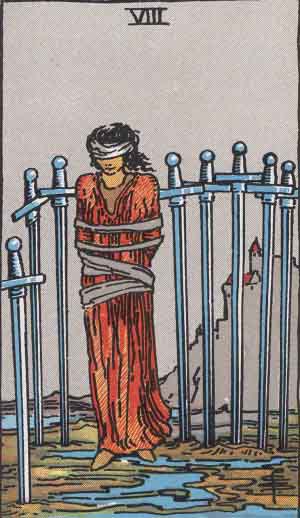
A woman, bound and hoodwinked, with the swords of the card about her. Yet it is rather a card of temporary durance than of irretrievable bondage. Divinatory Meanings: Bad news, violent chagrin, crisis, censure, power in trammels, conflict, calumny; also sickness. Reversed: Disquiet, difficulty, opposition, accident, treachery; what is unforeseen; fatality. (From The Pictorial Key to the Tarot)
The Eight of Swords from the Rider Waite Smith tarot
Aleister Crowley
The Eight of Swords is called Interference. At first sight, it would seem easy to confuse it with the Eight of Cups; but the idea is, in reality, quite different. The card is attributed to Jupiter and Gemini; accordingly, there is no weighing down of the will by internal or external stress. It is simply the error of being good-natured when good-nature is disastrous. Gemini is an airy sign, an intellectual sign; Jupiter is geniality and optimism. This will not do in the world of Swords; if one must hit at all, a knock-out blow is best.
But there is another element in this card; that of unexpected (the Eights, being at heart Mercurial, are always that) interference, sheer unforeseen bad luck. Trivial incidents have often altered the destiny of empires, brought to naught “the best laid plans of mice and men”.
[…]
The number Eight, Hod, here signifies lack of persistence in matters of the intellect and of contest. Good fortune, however, attends even these weakened efforts, thanks to the influence of Jupiter in Gemini, ruling the Decan. Yet the Will is constantly thwarted by accidental interference.
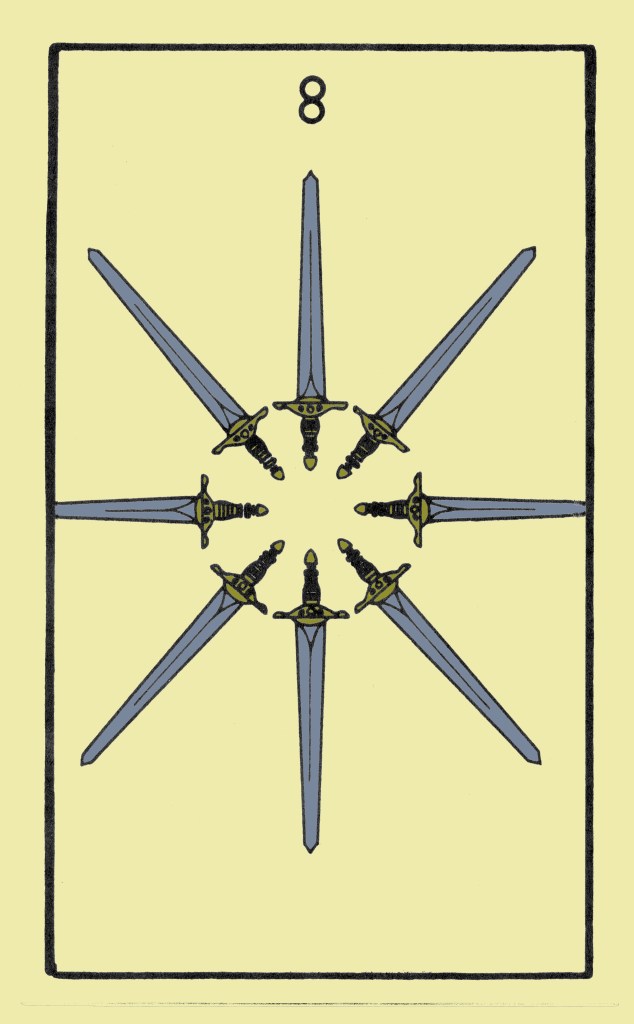
The centre of the card is occupied by two long Swords pointed downward. These are crossed by six small swords, three on each side. They remind one of weapons peculiar to their countries or their cults; we see here the Kriss, the Kukri, the Scramasax, the Dagger, the Machete and the Yataghan. (From The Book of Thoth)
The Eight of Swords from the Thoth tarot deck
Golden Dawn’s Book T
FOUR White Radiant Angelic Hands issuing from clouds, each holding two swords, points upwards; all the points touch near the top of the card. Hands issue, two at each bottom angle of the card. The pose of the other sword symbols is reestablished in the centre. Above and below are the Decan symbols Jupiter and Gemini.
Too much force applied to small things: too much attention to detail at the expense of the principal and more important points. When ill dignified, these qualities produce malice, pettiness, and domineering characteristics. Patience in detail of study; great care in some things, counterbalanced by equal disorder in others. Impulsive; equally fond of giving or receiving money or presents;
generous, clever, acute, selfish and without strong feeling of affection. Admires wisdom, yet applies it to small and unworthy objects.
Hod of HB:V (Narrow, restricted, petty, a prison). Therein rule the Angels HB:VMBAL and HB:YHHAL.
Etteilla
Criticism Upright. This card, as far as the medicine of the spirit is concerned, means, in its natural position: Criticism, Unfortunate position, Critical moment, Critical time, Decisive instant, Unfortunate situation, Delicate circumstance, Crisis. – Examination, Discussion, Research, Blame, Censure, Critical comment, Critical epilogue, Control, Disapproval, Condemnation, Cassation, Judgment, Contempt. Reversed. Accident, Difficulty, Particular circumstance, Conjunction, Occurrence, Accessory, Unconscious, Obstacle, Delay, Hindrance. – Abjection. – Contestation, Contradiction, Opposition, Resistance, Divergence. – Unplanned, Unforeseen, Chance, Adventure, Occurrence, Destiny, Fatality, Accident, Misfortune, Symptom