Tag Archives: Tarot

Tarot Encyclopedia – The King of Swords

(Note: this is a collection of the meanings attributed to the cards by some occultists in the past centuries. It does not reflect my own study or opinion of the cards. It is only meant as a quick comparative reference as I develop my own take.)

A collection of interpretations for the King of Swords
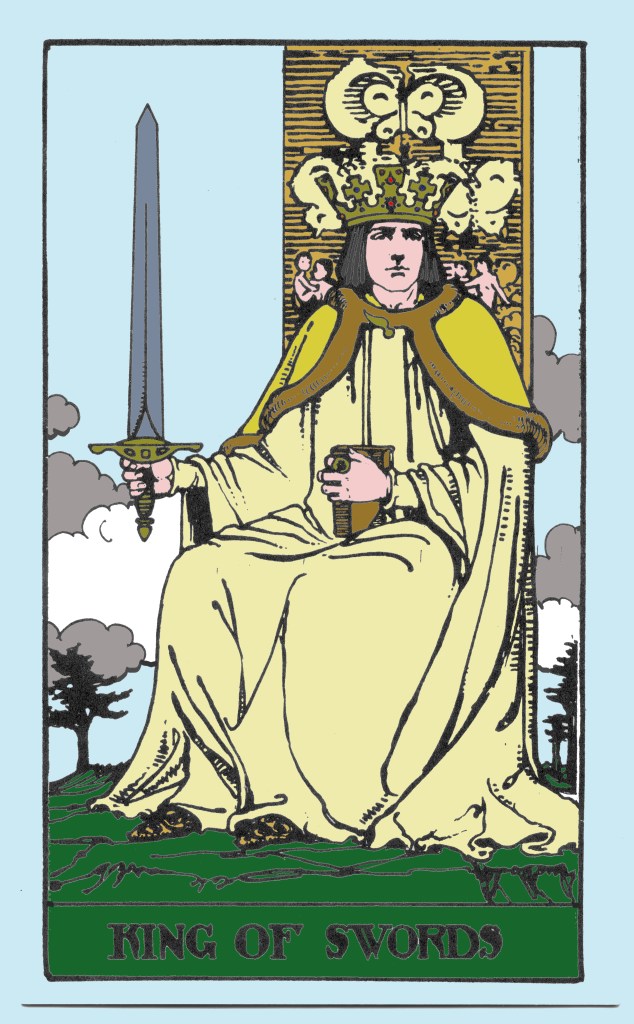
The King of Swords from the Builders of the Adytum (BOTA) tarot deck

Paul Foster Case (and Ann Davies)

The time period is from the beginning of the last decanate of Virgo to the end of the second decanate of Libra, September 13 to October 12, under the combined rulerships of Venus in Taurus, Venus in Libra, and Saturn-Uranus in Aquarius. Meanings: a man of strong and powerful imagination; hard worker and having authority; keen in understanding law and capable of excellent cooperation; somewhat distrustful and suspicious and therefor e hard to convince. He sometimes surprises his friends by sudden changes of attitude, although he is usually overcautious and analytical. In a divinatory lay-out:
Well Dignified: he is friendly to the Querent and will cooperate with him. lll Dignified: he is inimical, harsh, malicious and plotting, obstinate and wholly unreliable.
Dark hair and dark eyes.
(From the Oracle of Tarot course)

A. E. Waite

He sits in judgment, holding the unsheathed sign of his suit. He recalls, of course, the conventional Symbol of justice in the Trumps Major, and he may represent this virtue, but he is rather the power of life and death, in virtue of his office. 
Divinatory Meanings: Whatsoever arises out of the idea of judgment and all its connexions-power, command, authority, militant intelligence, law, offices of the crown, and so forth. 
Reversed: Cruelty, perversity, barbarity, perfidy, evil intention.
(From The Pictorial Key to the Tarot)

Aleister Crowley

(Note: Crowley and the Golden Dawn swapped around King and Knight. This is in part true of Waite as well.)

The Knight of Swords represents the fiery part of Air; he is the wind, the storm. He represents the violent power of motion applied to an apparently manageable element. He rules from the 21st degree of Taurus to the 20th degree of Gemini. He is a warrior helmed, and for his crest he bears a revolving wing. Mounted upon a maddened steed, he drives down the Heavens, the Spirit of the Tempest. In one hand is a sword, in the other a poniard. He represents the idea of attack.

The moral qualities of a person thus indicated are activity and skill, subtlety and cleverness. He is fierce, delicate and courageous, but altogether the prey of his idea, which comes to him as an inspiration without reflection.

If ill-dignified, the vigour in all these qualities being absent, he is incapable of decision or purpose. Any action that he takes is easily brushed aside by opposition. Inadequate violence spells futility. “Chimaera bombinans in vacuo”.

In the Yi King, the fiery part of Air is represented by the 32nd hexagram, Hang. This is the first occasion on which it has been simple to demonstrate the close technical parallelism which identifies Chinese thought and experience with that of the West. For the meaning is long continuance: “perseverance in well-doing, or continuously acting out the law of one’s being”, as Legge puts it in his note on the hexagram; and this seems incongruous with the Qabalistic idea of violent energy applied to the least stable of the elements. But the trigram of Air also indicates wood; and the hexagram may have Suggested the irresistible flow of the sap, and its effect in strengthening the tree. This conjecture is supported by the warning in line 6: “The topmost line, divided, shows its subject exciting himself to long continuance. There will be evil.”

Allowing this, the image of “the extended flame of mind”, as Zoroaster calls it, may well be subjoined to the former description. It is the True Will exploding the mind spontaneously. The influence of Taurus makes for steadiness, and that of the first decanate of Gemini for inspiration. So let us picture him, “integer vitae scelerisque purus”, a light-shaft of the Ideal absorbing the entire life in concentrated aspiration, passing from earthy Taurus to exalted Gemini. Here, too, is shewn (as in the Yi) the danger to the subject of this symbol; for the first decan is the card called “Interference”; or, in the old pack, “Shortened Force”.
(From the Book of Thoth)

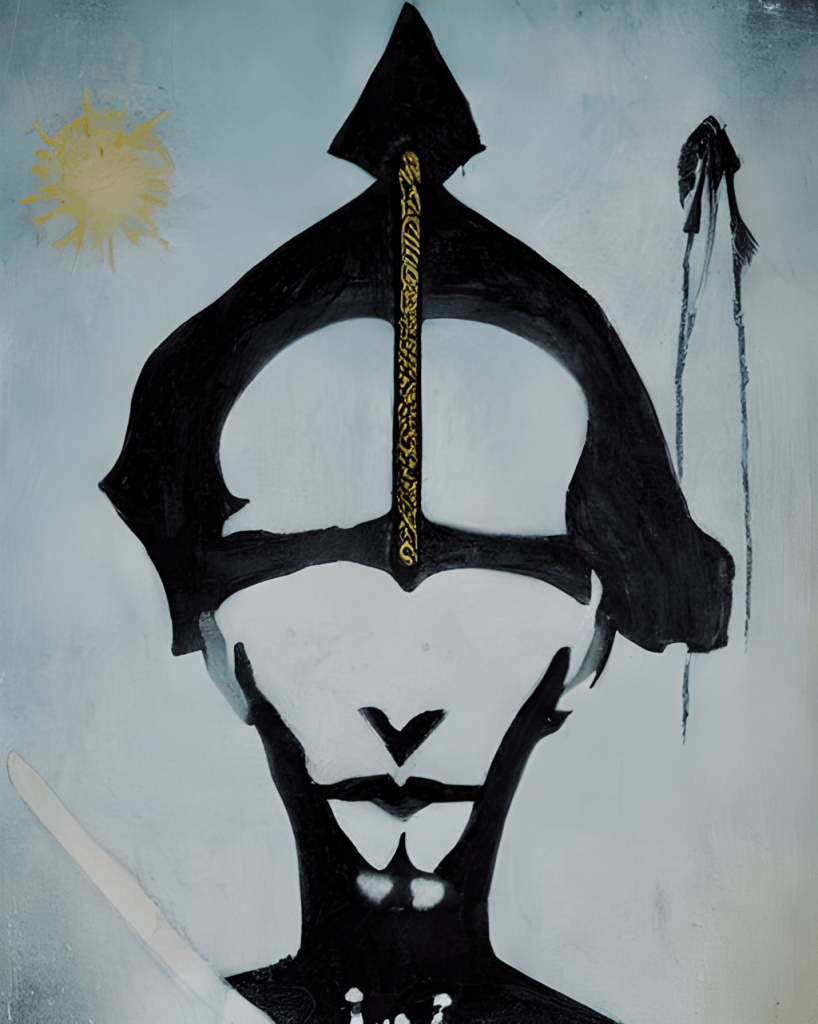
Oddly Bismarckian AI-generated Illustration for the King of Swords

Golden Dawn’s Book T

A WINGED Warrior with crowned Winged Helmet, mounted upon a brown steed. His general equipment is as that of the Knight of Wands, but he wears as a crest a winged six-pointed star, similar to those represented on the heads of Castor and Pollux the Dioscuri, the twins Gemini (a part of which constellation is included in his rule). He holds a drawn sword with the sigil of his scale upon its pommel. Beneath his horse’s feet are dark-driving stratus clouds. He is active, clever, subtle, fierce, delicate, courageous, skilful, but inclined to domineer. Also to overvalue small things, unless well dignified. If ill dignified, deceitful, tyrannical and crafty.
Rules from 20 Degree Taurus to 20 Degree Gemini.

Etteilla

Man in Uniform
Upright: This card, as far as the medicine of the spirit is concerned, means, in its natural position: Man in Uniform, Man of the Law, Judge, Councilor, Assessor, Senator, Business Man, Medical Practitioner, Lawyer, Prosecutor, Doctor, Physician. – Jurist, Law-making. – Litigant [= Party to litigation], Jurisconsult.
Reversed: Malicious, Maliciousness, Perversity, Perfidy, Crime, Cruelty, Atrocity, Inhumanity.

MQS

A Tarot Reading is like a Movie (Example)

The astounding thing about all oracular forms is that they reflect the real world in the same way a recording of a scene does. This reading is from five or six months back, and it was partially confirmed a couple of weeks later, but the final feedback came only very recently.

I friend of ours was dating a new man. She’d been out of the dating scene for a while due to focusing on other things in her life. But she noticed that the guy was acting weird, as if he was looking for any excuse to cause a fight that would end the (still budding) relationship. We asked the cards and this is what happened:

Relationship reading with the tarot (Tarocchi di Layla, by Elisa Scerrato)

The cards of the cut are the Fool and Justice. Justice usually represents a solid union, not one that has just started and where the partners don’t even live together. The instability caused by the fool was already an alarm bell.

Then we have a full scene playing out: the Tower breaks up the relationship between her (Empress) and him (Emperor), but there is an obscure (Moon) influence next to him. Another woman (Popess / High Priestess). This is not even a new girl he met. The Popess has the World card next to her, showing a solid family, and the Hanged Men indicates being bound to someone, a serious commitment. I told our friends that I didn’t think the relationship had much of a future, and that she should be careful that there wasn’t any other woman around the dude.

A couple of weeks later he left her abruptly via text message. A couple of days ago, we met with our friend and she confirmed the guy was married all along, although he has an on again, off again relationship with his wife and, due to his cultural background, he doesn’t see it as strange to date multiple women, even without them knowing.

Notice how the readings flows from one card to the next in true cinematic fanshion. This ability of divination to act as a mirror is partly why I don’t believe in asking the cards for advice. This would be like asking a map for advice on where to go. The map gives you a larger picture, but the advice doesn’t come from the map: it comes from checking your plans against the available options.

MQS

AI-Generated Judgement Tarot Card Illustrations

Rebirth has never been creepier. Probably because you have to pay taxes again.

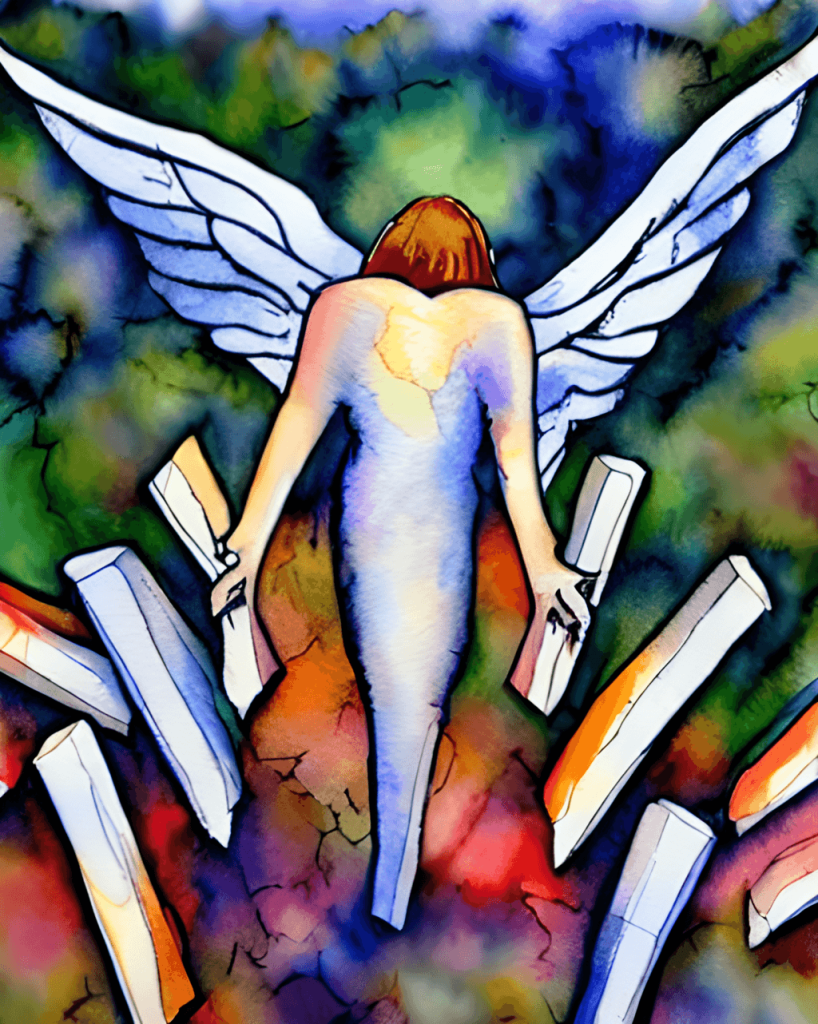
Judgement tarot card, generated through AI
Judgement tarot card, illustrated through Artificial Intelligence
Judgement tarot card, illustrated through AI
Judgement tarot card, illustrated through Artificial Intelligence
Justement tarot card, illustrated through AI
Judgement tarot card, illustrated through Artificial intelligence

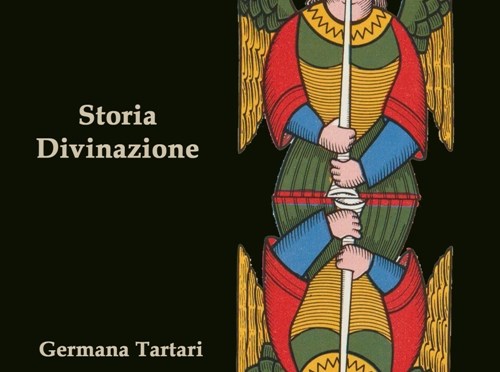
Tarocchino Bolognese. Storia Divinazione, by Germana Tartari (A Short Review)

English Version (scroll down for the Italian version)

In this blog I haven’t yet talked about one of the decks I am most interested in learning, yet one about which very little material is to be found. I’m talking about the Bolognese Tarot, or Tarocchino Bolognese.

The word “tarocchino” is a diminutive form of “tarocco”, thus meaning “small tarot.” I am not going to cover the history of the cards here. There’s plenty of great sources online. The reason for the diminutive form is that the deck is actually a reduced pack, with some variations in the order and makeup of the Major Trumps.

What I am going to discuss is a marvelous little book that has been recently published on the matter: Tarocchino Bolognese. Storia Divinazione, by Germana Tartari. The book is currently available only in Italian.

Miss Tartari has been taught to read the Bolognese Tarot by her grandmother, and has started teaching it in turn following what she describes as a call to spread the traditional meanings she has received.

The book is relatively short, but it succeeds as a comprehensive introduction for neophytes. As most books on the tarot, it starts with what I usually consider the “boring part”, i.e., the history of the cards. I say “boring” because most of the times, writers feel that it is bad to lead off with the juicy stuff and sense that it’s best to preface it with some historical remarks fished at random from the most dubious sources.

But this is not the case for Miss Tartari’s book. The historical introduction is not at all boring. It has been handled by the Museo Internazionale dei Tarocchi, and it is as succinct as it is interesting, as well as historically accurate.

Miss Tartari then goes on to describe her history and relationship with the cards in moving detail. The great passion that animates her shines through every single turn of phrase and choice of words. What also struck me was her understanding of cartomancy as an activity that is deeply embedded in the way people relate to one another: as described by her, cartomancy is almost an interpersonal skill, a way of caring for other people. I greatly enjoyed her take, and think most people who are into traditional tarot would profit from reading it.

The meat of the book consists of the divinatory meanings and combinations of the cards. As is usual for the Bolognese Tarot, the meanings have nothing grandiose and philosophical about them. There is no flight of fancy. There are no pseudo-deep elucubrations as usual among tarot readers who try to remove the tarot from observable reality by relegating it to a vapid mystical system.

The Bolognese Tarot is earthbound. It concerns the ordinary life of ordinary people. And, frankly, there is more depth in the recognition that the Sun means “by day” rather than in some obscure intellectual abstraction. As Miss Tartari put it in a video about the book, people once consulted the tarot about whether they would be able to put food on the table or not. They wanted to know whether the year’s crop would be good or poor. This is not to say that more spiritual concerns cannot be part of ordinary life, nor that the tarot cannot answer such questions, but its language remains clear, the language of simple people with their feet firmly planted on the ground.

The last part of the book describes two types of spread, and what distinguishes this book from many other books on the subject is that the writer describes some real readings she has done for querents. I thought this was a great way to demonstrate the great potentiality that the tarot has for describing real life and real concerns. In fact, I would gladly buy another book by Miss Tartari that his wholly focused on interpreting practical examples of real spreads.

In short: a must-have for anyone who is interested in the Bolognese Tarot, in the actual (and not fanciful) history of Tarot, and in one of the most traditional systems of divination in the West.

Where to buy: Mutus Liber

Versione Italiana

In questo blog non ho ancora parlato di uno dei mazzi che più mi interesserebbe studiare, ma sul quale si trova pochissimo materiale. Sto parlando dei Tarocchi Bolognesi, o Tarocchino Bolognese.

La parola “tarocchino” è una forma diminutiva di “tarocco”, quindi significa “piccolo tarocco”. Non tratterò qui la storia delle carte. Ci sono molte ottime fonti online. La ragione del diminutivo è che il mazzo è in realtà un mazzo ridotto, con alcune variazioni nell’ordine e nella composizione dei Trionfi.

Quello di cui parlerò è un meraviglioso piccolo libro pubblicato di recente sull’argomento: Tarocchino Bolognese. Storia Divinazione, di Germana Tartari. Il libro è attualmente disponibile solo in italiano.

La signora Tartari è stata educata alla lettura del tarocchino bolognese dalla nonna e ha iniziato a insegnarlo a sua volta seguendo quella che lei stessa definisce una vocazione a diffondere le conoscenze tradizionali che ha ricevuto.

Il libro è relativamente breve, ma riesce ad essere un’introduzione completa per i neofiti. Come la maggior parte dei libri sui tarocchi, inizia con quella che di solito considero la “parte noiosa”, cioè la storia delle carte. Dico “noiosa” perché la maggior parte delle volte gli scrittori ritengono che non sia appropriato iniziare con le cose più succose e pensano che sia meglio farle precedere da alcune osservazioni storiche pescate a caso dalle fonti più dubbie.

Ma questo non è il caso del libro della signora Tartari. L’introduzione storica non è affatto noiosa. È stata curata dal Museo Internazionale dei Tarocchi ed è tanto sintetica quanto interessante, oltre che storicamente accurata.

La signora Tartari descrive poi la sua storia e il suo rapporto con le carte con parole toccanti. La grande passione che la anima traspare ad ogni singolo passaggio e da ogni scelta di parole. Mi ha colpito anche il suo modo di intendere la cartomanzia come un’attività profondamente radicata nel modo in cui le persone si relazionano tra loro: così come da lei descritta, la cartomanzia è quasi una competenza interpersonale, un modo di prendersi cura degli altri. Ho apprezzato molto il suo punto di vista e penso che la maggior parte delle persone che sono appassionate di tarocchi tradizionali trarrebbero beneficio dalla sua lettura.

Il cuore del libro è costituito dai significati divinatori e dalle combinazioni delle carte. Come di consueto per i Tarocchi bolognesi, i significati non hanno nulla di grandioso e filosofico. Non ci sono voli pindarici. Non ci sono elucubrazioni pseudo-profonde, come di solito accade tra i lettori di tarocchi che cercano di allontanare i tarocchi dalla realtà osservabile relegandoli a un vago sistema mistico.

I Tarocchi bolognesi sono legati alla terra. Riguardano la vita ordinaria della gente comune. E, francamente, c’è più profondità nel riconoscere che il Sole significa “di giorno” piuttosto che in qualche oscura astrazione intellettuale. Come dice la signora Tartari in un video di presentazione sul libro, una volta le persone consultavano i tarocchi per sapere se sarebbero state in grado di mettere pane in tavola o meno. Volevano sapere se il raccolto sarebbe stato buono o meno. Questo non vuol dire che le preoccupazioni più spirituali non possano far parte della vita ordinaria, né che i tarocchi non possano rispondere a tali domande, ma il loro linguaggio rimane chiaro, il linguaggio di persone semplici con i piedi ben piantati a terra.

L’ultima parte del libro descrive due tipi di stesa, e ciò che distingue questo libro da molti altri libri sull’argomento è che la scrittrice descrive alcune letture reali che ha fatto per i propri consultanti. Ho pensato che questo fosse un ottimo modo per dimostrare la grande potenzialità che i tarocchi hanno nel descrivere la vita reale e preoccupazioni reali. In effetti, comprerei volentieri un altro libro della signora Tartari che si concentri interamente sull’interpretazione di esempi pratici di stese reali.

In breve: un libro imperdibile per chiunque sia interessato ai Tarocchi bolognesi, alla storia reale (e non fantasiosa) dei Tarocchi e a uno dei sistemi di divinazione più tradizionali dell’Occidente.

Dove Acquistarlo: Mutus Liber