Tag Archives: Tarot

Tarot Encyclopedia – The Two of Swords

(Note: this is a collection of the meanings attributed to the cards by some occultists in the past centuries. It does not reflect my own study or opinion of the cards. It is only meant as a quick comparative reference as I develop my own take.)
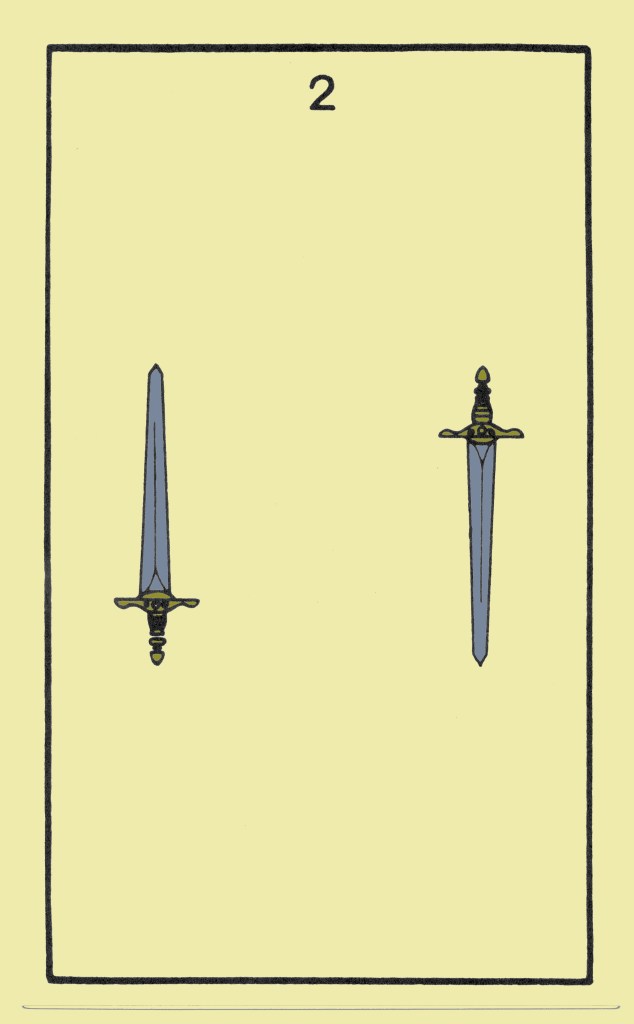
The Two of Swords from the Builders of the Adytum (BOTA) tarot deck

Paul Foster Case (and Ann Davies)

The time period is the first decanate of Libra from September 23 to October 2, under the rulership of Venus.
Well-Dignified: contradictory characteristics in the same nature; strength through suffering; pleasure after pain; delay in the realization of objectives. This card sometimes indicates a period of uncertainty, during which the Querent, though he has a sense of adequate power, does not know just what to do with it. It also indicates justice, unselfishness and the restoration of peace.
Ill-Dignified: falsehood; sorrow; injury from another who really means well to the Querent, or injury by the Querent to another whom he wishes to help; always a symbol of tension, of want of tact, and suggests force held in abeyance, awaiting some announcement or revelation that will make decision possible.
Keyword: Indecision.
(From the Oracle of Tarot course)

A. E. Waite

A hoodwinked female figure balances two swords upon her shoulders. Divinatory Meanings: Conformity and the equipoise which it suggests, courage, friendship, concord in a state of arms; another reading gives tenderness, affection, intimacy. The suggestion of harmony and other favourable readings must be considered in a qualified manner, as Swords generally are not symbolical of beneficent forces in human affairs. Reversed: Imposture, falsehood, duplicity, disloyalty.
(From The Pictorial Key to the Tarot)

Aleister Crowley

The Two of Swords was formerly called the Lord of Peace Restored; but this word “restored” is incorrect, because there has been no disturbance. The Lord of Peace is therefore a better title: but it needs thinking hard to work this out, since the Sword is so intensely active. It may be helpful to study the Essay on Silence (p. 120) for a parallel: the Negative Form of the Positive Idea. See also the Essay on Chastity (Little Essays toward Truth, pp. 70-74) which concludes: Sir Knights, be vigilant: watch by your arms and renew your oath; for that day is of sinister augury and deadly charged with danger which ye fill not to overflowing with gay deeds and bold of masterful, of manful Chastity.

Witness also Catullus: domi maneas paresque nobis Novem continuas futationes. Nor does he misunderstand the gesture of Harpocrates; Silence and Chastity are isomers.
It is all one case of the general proposition that the sum of the infinite Energy of the Universe is Zero.

[…]

This card is ruled by Chokmah in the Element of Air. This suit, governing all intellectual manifestations, is always complicated and disordered. It is subject to change as is no other suit. It represents a general shaking-up, resulting from the conflict of Fire and Water in their marriage; and proceeds, when Earth appears, to crystallization. But the purity and exaltation of Chokmah are such that this card manifests the very best idea possible to the suit. The energy abides above the onslaught of disruption. This comparative calm is emphasized by the celestial attribution: the Moon in Libra.

The Moon is change, but Nature is peaceful; moreover, Libra represents balance; between them, they regulate the energy of the Swords.

In the card appear two swords crossed; they are united by a blue rose with five petals. This rose represents the influence of the Mother, whose harmonizing influence compounds the latent antagonism native to the suit. The Rose emits white rays, producing a geometrical pattern that emphasizes the equilibrium of the symbol.
(From The Book of Thoth)
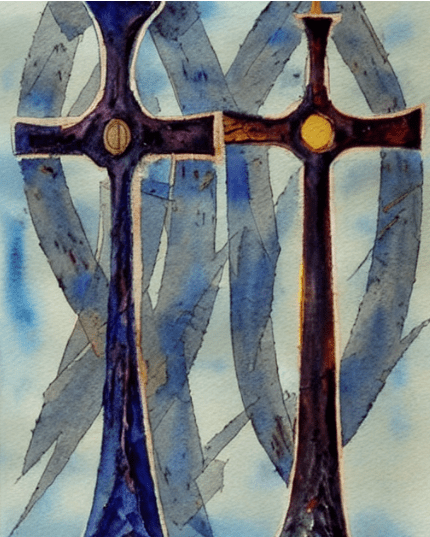
An ominous AI-generated illustration for the Two of Swords

Golden Dawn’s Book T

Two crossed swords, like the air dagger of a Zelator Adeptus Minor, each held by a White Radiant Angelic Hand. Upon the point where the two cross is a rose of five petals, emitting white rays. At the top and bottom of the card are two small daggers, supporting respectively the symbol {Crescent moon with horns upward} thus, and Libra representing the Decanate.
Contradictory characters in the same nature, strength through suffering; pleasure after pain. Sacrifice and trouble, yet strength arising therefrom, symbolized by the position of the rose, as though the pain itself had brought forth beauty. Arrangement, peace restored; truce; truth and untruth; sorrow and sympathy. Aid to the weak; arrangement; justice, unselfishness; also a tendency to repetition of affronts on being pardoned; injury when meaning well; given to petitions; also a want of tact, and asking question of little moment; talkative.
Chokmah of Vau. Quarrel made up, yet still some tension in relations: actions, sometimes selfish, sometimes unselfish.
Herein rule the Great Angels HB:YZLAL and HB:MNHAL.

Etteilla

Friendship
Upright. This card, as far as the medicine of the spirit is concerned, means, in its natural position: Friendship, Attachment, Affection, Tenderness, Benevolence, Relationship, Identity, Intimacy, Convenience, Correspondence, Interest, Conformity, Sympathy, Affinity, Attraction.
Reversed. Falsehood, Falsehood, Lying, Imposture, Duplicity, Bad faith, Overbearingness, Dissimulation, Cunning, Deceit, Superficial, Superficiality, Surface.

MQS
Do You Need To Believe In It For It To Work?

One of the questions that occupy way too many people in the esoteric community is whether divination or even magic require the person to believe in it in order for it to work. If you’ve ever watched the movie The Skeleton Key, you’ll know that this concept has seeped into the collective consciousness enough for it to find its way into mainstream products (I will not spoil the movie here, since it is actually a fun watch, but it depends heavily on its twist).

If you open most premodern books on magic, you’ll be stunned to discover that their content bears very little resemblance to the post-Golden Dawn landscape. This, by the way, is neither good nor bad. Things change. But we need to be aware of the change to avoid being unconsciously ruled by it. One clear difference is that the magician’s will1 or his imagining/manifesting faculties are barely taken into consideration in older sources, at least outwardly.

This is not to say that there aren’t sources that encourage the practitioner to be of firm mind and clear intent (after all, you’d want your doctor to focus, too, even though their focus is not what make their science work), but even those old sources do not consider, generally speaking, the magician’s mind to be the cause of the change. Broadly speaking, when dealing with sources that date back to before the invention of modern psychoanalysis and psychology, we must be extremely careful when interpreting their concept of mind, soul, psyche, etc.

An example will suffice. In his De Vita, Neoplatonic Renaissance philosopher and magus Marsilio Ficino encourages us, among other things, to “think solar thoughts”, or jovial, or venusian, depending on the aim. Similar remarks are found, in various form, in many old sources. A contemporary practitioner might be tempted to interpret Ficino’s invitation as saying that we must envision solar things in order for them to manifest. But neither the language nor the substance of this interpretation belong to his worldview.

Ficino’s view of the cosmos is essentially the same as Agrippa’s and that of many other premodern magi: we are surrounded by chains of sympathy and antipathy between universal powers (typified by the planets). When we think “solar thoughts” we are doing essentially nothing except stepping inside a current of power that has its own metaphysical reality regardless of our attitude toward it. This is because in Renaissance naturalism, the mind is essentially like the body, i.e., a part of the cosmos, and a movement of the mind is like a movement of the body, and just like the body can create a talisman or a concoction, so can the mind shape images that allow it to shower in certain currents of universal power.

Thus, the invitation to think certain thoughts found in Ficino (and others) is not a precursor to manifestation, attraction and other modern concepts, but a natural consequence of the old view of the mind and the world.

On the other hand, from a postmodern standpoint, reality is for us to create at will. Yes, I am exaggerating, but not too much. Therefore, there is the widespread idea, or at least the widespread implication, that what happens happens because we believe in it.

Let us leave magic alone for now and concentrate on divination. Does divination work because we believe in it? Well, no. Certainly divination doesn’t require the querent to believe in it in order for it to work. In fact, it is my belief that, considering how many frauds there are in this field, a querent should be borderline psychotic to blindly believe in divination without a healthy dose of scepticism.

What about diviners? Do they need to believe in divination in order for it to work? That’s complicated, in my view. On the surface of it I would argue that, again, no, we don’t need to believe in divination for it to work. Divination systems work because they have their own internal consistency. The most obvious is Natal Astrology, which presents us with an objective set of symbols that have nothing to do with the manipulation of counters on the part of the diviner.

On the other hand, we need to allow for the fact that divination is not a mechanic set of behaviors, especially with the overwhelming majority of divination systems that do require manipulation (cartomancy, geomancy, dice, etc.) As I often repeat on this blog, divination is and remains something extraordinary. The honest desire for an answer, or at least for a picture of the future, tends to guarantee a crisp and clear answer. This is because the honest desire for an answer allows us to honestly connect with the symbols in a way that makes them fall in the appropriate order.

The querent doesn’t need to be honest in his or her desire, unless they are also the diviner. But if the diviner does not have at least a degree of confidence in what he or she is doing, then the question they put to the system is not the surface question (e.g., “Does X love Y?”) but “Do you really work?” which is an impossible question for the system to answer (if the answer is no, then the system does work).

Even then, I would be cautious in overexaggerating the importance of the diviner’s attitude. As I believe I have mentioned, one of the ways my teacher trained me was by asking me to discover secrets about her past. Clearly, the exercise was not meant to discover something new that might benefit my querent or me, but rather to build my confidence and skill. Yet it worked, and it worked well. Maybe the diviner doesn’t need to believe in divination (I know I am always skeptical until proven right), but they do need to at least be open to the idea that this is a legitimate way of receiving information, just enough to enter into the system rather than operating it from the outside as a scientist would manipulate a bunch of molecules.

My general belief at this point is that the esoteric arts do not require our consent in order to work, but they are also not the product of the mechanistic application of abstract principles. It is indeed a fine balance.

MQS

  1. Let’s leave aside the fact that the concept of Will found in modern magic is actually more complex than what it appears to be on the surface ↩︎

Tarot Encyclopedia – The Two of Cups

(Note: this is a collection of the meanings attributed to the cards by some occultists in the past centuries. It does not reflect my own study or opinion of the cards. It is only meant as a quick comparative reference as I develop my own take.)

The Two of Cups from the Builders of the Adytum (BOTA) tarot deck

Paul Foster Case (and Ann Davies)

The Two of Cups, astrologically, is assigned to the first decanate of Cancer, ruled by the Moon, time period June 22 to July 1.
The specific divinatory ideas associated with this Key are:
Well Dignified: reciprocity, reflection; gain and benefit through parents;
favors from the opposite sex; changes of residence.
Ill Dignified: reverses and losses through parents or the opposite sex; unfortunate changes of residence; fluctuations of mood; unwise decisions.
Keyword: Response to environment.
(From the Oracle of Tarot course)

A. E. Waite

A youth and maiden are pledging one another, and above their cups rises the Caduceus of Hermes, between the great wings of which there appears a lion’s head. It is a variant of a sign which is found in a few old examples of this card. Some curious emblematical meanings are attached to it, but they do not concern us in this place. Divinatory Meanings: Love, passion, friendship, affinity, union, concord, sympathy, the interrelation of the sexes, and–as a suggestion apart from all offices of divination–that desire which is not in Nature, but by which Nature is sanctified.
(From The Pictorial Key to the Tarot)

Aleister Crowley

The Two always represents the Word and the Will. It is the first manifestation. Therefore, in the suit of Water, it must refer to Love, which recovers unity from dividuality by mutual annihilation.

The card also refers to Venus in Cancer. Cancer is, more than any other, the receptive Sign; it is the House of the Moon, and in that Sign Jupiter is exalted. These are, superficially, the three most friendly of the planets.

The hieroglyph of the card represents two cups in the foreground, overflowing upon a calm sea. They are fed with lucent water from a lotus floating upon the sea, from which rises another lotus around whose stem are entwined twin dolphins. The symbolism of the dolphin is very complicated, and must be studied in books of reference; but the general idea is that of the “Royal Art”. The dolphin is peculiarly sacred to Alchemy.

The number Two referring to Will, this card might really be renamed the Lord of Love under Will, for that is its full and true meaning. It shows the harmony of the male and the female: interpreted in the largest sense. It is perfect and placid harmony, radiating an intensity of joy and ecstasy.

Of necessity, the realization of the idea in the Four (as the suit develops) will gradually diminish the purity of its perfection.
(From the Book of Thoth)

A somewhat mundane AI-generated illustration for the Two of Cups

Golden Dawn’s Book T

A WHITE Radiant Hand, issuant from the lower part of the card from a cloud, holds lotuses. A lotus flower rises above water, which occupies the lower part of the card rising above the hand. From this flower rises a stem, terminating near the top of the card in another lotus, from which flows a sparkling white water, as from a fountain. Crossed on the stem just beneath are two dolphins, Argent and Or, on to which the water falls, and from which it pours in full streams, like jets of gold and silver, into two cups; which in their turn overflow, flooding the lower part of the card. Venus and Cancer above and below.

Harmony of masculine and feminine united. Harmony, pleasure, mirth, subtlety:
but if ill dignified — folly, dissipation, waste, silly actions.
Chokmah of HB:H (Marriage, love, pleasure).
Therein rule the Angels HB:AVa’aAL and HB:ChBVYH.

Etteilla

Love
Upright. This card, as far as the medicine of the spirit is concerned, means, in its natural position: Love, Passion, Inclination, Sympathy, Attraction, Propensity, Friendship, Benevolence, Affection, Attachment, Taste, Bonding, Galantry, Attraction, Affinity.
Reversed. Desire, Augury [= Aspiration], Vow, Will, Want, Cupidity, Concupiscence, Jealousy, Passion, Illusion, Appetite.

MQS

The Downgrading of Intuition

Many people of the ‘spiritual but not religious’ milieu tend to believe they invented intuition, or that intuition came into existence when glossy oracle cards with gaudy images and inspirational quotes started being published–the kind that was especially en vogue before Doreen Virtue went from a fundamentalist with a deck of cards in her hands to a fundamentalist without a deck of cards in her hands.

But, believe it or not, intuition is a concept with a legitimate philosophical history. It is present, either implicitly or explicitly, in the epistemology (theory of how knowledge happens) of many great traditional Western and non Western philosophers.

If had to provide a generalization of what the tradition meant by intuition, I would say that it’s the immediate apprehension of universal principles and truths. It had nothing to do with the stream-of-consciousness-like association of ideas that many moderns mistake for psychic ability.

Old philosophers held that true intuition could only happen when someone had developed all their human faculties (including, and especially, reason) to their utmost degree, so that such faculties, having been tamed and trained, fell into place and were ready to receive truths otherwise reserved to the gods. In other words, intuition was the reward of the flourishing human.

Nowadays, “I’m intuitive” is usually synonymous with “I’m incapable of simple deduction but I am also deep up my ass and don’t take well to criticism.” Back in the day, intuition was regarded as the efflorescence of the rightly cultivated mind. Put simply, in the past intuition was considered suprarational. Now it is implicitly considered irrational.

So much so that intuition is today relegated to psychic exercise, whereas in days of yore prophecy through psychic means was regarded as a wholly separate matter: the famous prophetess of the Oracle of Delphi, for instance, entered a state of ‘enthusiasm’, that is, of literal divine possession, whereas intuition was, essentially, a gift of God to the philosopher who had educated himself to the point where his excelling human faculties grazed on the superior sphere of divine knowledge, allowing some of it to filter down to him.

This fact is especially clear when we consider the old conception of the cosmos as an onion-like set of emanated spheres, with humans in the middle, capable of either falling deeper or rising above. But the modern intuitive moves in a world that has no clear up or down and where over a century of psychologizing everything has planted in people’s minds the impression that everything is in their head and that, therefore, if it’s in their head it’s true. We could summarize this by saying that intuition in the older sense required people to get out of their ass and become bigger than they were, whereas by today’s standards it requires them to entangle themselves even further in their delusions.

MQS

On Readings Without Question

The following is an attempt at reorganizing some old notes I have taken on the subject of divinations without a specific question, adding to them some new insights,

Divination Without Questions Is Possible (With Exceptions)

There is a relatively well-known tarot reader who says that a reading without a question is basically two people talking over a bunch of colored cardboards.

This is not true. It was customary, among old-time fortune-tellers, to have the querent sit in front of them and never have them speak anything that wasn’t their name at the beginning of the consultation. I know for a fact that this is a tradition in the Italian countryside, and I believe it is the case all over the world as soon as one leaves the hipster pseudointellectual tarot community bubble and seeks the real deal.

Let’s leave aside the fact that, technically speaking, there is always a question. Even if the querent sits with their arms crossed in front of you waiting to be astounded, the implicit question is “What’s going on in my life, now and in the near future?”

Times change, and sensibilities change with the times. Many querents nowadays wish to take a more active part in the reading. Furthermore, readings without a question are obviously more difficult, and the modern diviner who doesn’t have time to waste is certainly happy to get more cooperation. I know I do. But this doesn’t mean that a reading without a question isn’t possible.

There are exceptions to this, of course. Some oracles do require a question. Horary Astrology, for instance, usually needs one, and the more specific and focused it is, the better. True, some old authorities give rules for judging “Universal Questions“, but these universal questions were asked back when many people didn’t know their birth time and often had to travel for days to see the astrologer for probably the one and only time in their life, so instead they asked the astrologer to tell them about their future in general in more than one sector of life.

Confronted with the impossibility of looking at the person’s birth chart, the astrologer erected a horary chart for the time the consultation took place, a moment that was probably significant, since the querent had gone to great trouble to visit him. Today, the astrologer is one Zoom call away, so this hardly justifies vague Horary questions.

The peculiarity that makes Horary more sensitive than other oracles is that there is no manipulation of physical counters involved: you don’t reshuffle the planets whenever the querent’s whim settles on a new fancy. Therefore, the question put to the heavens must be meaningful and at least relatively important to the person asking it. In a way, this limitation of Horary is due to Astrology’s nobility, seeking as it does answers from the heavens themselves.

Cartomancy is not noble. It spreaded like wildfire among the lower classes exactly because you didn’t need to have studied trigonometry in order to deal out a spread. Cartomancy is therefore as sturdy as the beasts of burden that the lower classes used in the fields. Like all beasts of burden, of course, cartomancy too has its limits: you can ask random questions (“Tell me about my life. Now tell me about my sweatheart. Now tell me about my job. Now about my neighbor”) but if you abuse it, it collapses to the ground exhausted.

But the fact remains that cartomancy (and tarot reading is a form of cartomancy) is a trusty, resistant beast.

Vague Questions Don’t Necessarily Yield Vague Answers

Another common myth is that if one asks a general question the reader is entitled to give them a general answer. Even worse, some readers say that, in the absence of a question, they can read “the general energies surrounding your life.” The problem is that there is no such thing as a (meaningful) general answer. “Tell me about myself.” Well, you seem to be a featherless biped with one heart, two lungs, etc.

The thing is that when the cards have been shuffled and dealt, they always tell a specific story. Sometimes this story is not what the querent secretly wishes us to talk about, but that’s not our fault–we are merely reading what’s there. Furthermore, we as readers may sometimes not be able to decipher the story in the cards, but it’s there. We may, as a result of our confusion, try to string together the cards in a looser way than usual (“There seems to be a woman next to you whom you love dearly and is going through a rough patch in life. It could be health-related, but I may be wrong. Can you help me with this?”). The cards, however, are always specific, never vague.

As a matter of fact, our life is never vague. It is always made up of details. These details may be mundane, but they are specific. In our life there is never “the general energy of the moment”. You don’t go the supermarket and find the general energy of the moment on sale. There is no such thing.

There is the coffee I’m brewing, the floor I’m sweeping, the feeling of dread I’ve been struggling with for some months, the mom I just talked to on the phone, etc. And the mom I talked to is my mom, not a general mom floating in the world of Platonic ideas. No energy. No universals. Universals are always embodied in our limited existence. I don’t talk to “momness in itself”. I talk to my mom. Therefore, the fact that our querent asks us a general question cannot embolden us to give a general answer, though it CAN justify us in being more cautious and loose in the interpretation.

Again, if we don’t have a specific question, it may be harder to interpret the cards, especially because certain cards together may appear to be open to more than one interpretation if we don’t have enough context.

And here we come to an important point. Some diviners think they need to be able to awe the querent with incredible details without missing a beat and think they should never ask them for clarification. I say that the querent exists in order to be tortured until every last bit of useful information that I need in order to interpret his damn spread has been wrung out of his writhing body, because at the end of the day it’s him who wants to know about his future, not I.

This authoritarianism is all the more justified in case of a general question. I am not going to talk for ten minutes straight without catching my breath only to be told “no that’s not me.” I’d much rather proceed cautiously and ask the querent for clarification step by step (and, if nothing makes sense, start anew).

BUT, the point remains that when we lay out the cards, the cards are going to talk about specific situations in the querent’s past, present or future. They are not going to give us “the general energy”.

MQS

Tarot Encyclopedia – The Ace of Pentacles or Coins

(Note: this is a collection of the meanings attributed to the cards by some occultists in the past centuries. It does not reflect my own study or opinion of the cards. It is only meant as a quick comparative reference as I develop my own take.)

The Ace of Coins or Pentacles from the Builders of the Adytum (BOTA) tarot

Paul Foster Case (and Ann Davies)

The time period is from the beginning of Capricorn to the end of Pisces, December 22 to March 20. Occult title: The Root of the Powers of Earth. Divinatory meanings: The power of Will as expressed on the physical plane. Materiality in all its phases, whether good or evil. “The things that are Caeser’s.” The power of the world-illusion. Material gain, contentment, wealth, and the things, conditions and
works which contribute to such gain.
Keyword: Materiality.
(From the Oracle of Tarot course)

A. E. Waite

A hand–issuing, as usual, from a cloud–holds up a pentacle. Divinatory Meanings: Perfect contentment, felicity, ecstasy; also speedy intelligence; gold. Reversed: The evil side of wealth, bad intelligence; also great riches. In any case it shews prosperity, comfortable material conditions, but whether these are of advantage to the possessor will depend on whether the card is reversed or not.
(From The Pictorial Key to the Tarot)

Aleister Crowley

The Ace of Disks pictures the entry of that type of Energy which is called Earth. It is here proper to insist a little strongly upon one of the essential theoretical theses which have inflamed the constitution of this present pack of Tarot cards; for this feature is significant, and distinguishes it from the numerous crude efforts of uninitiates to put themselves forward as adepts. The grotesque barber Alliette, the obscurely perverse Wirth, the poseur-fumiste Peladan, down to the verbose ignorance of such Autolycus-quacks as Raffalovitch and Ouspensky; none of these or their kin have done more than “play the sedulous ape” to the conventional Mediaeval designs. (Their luck was out: the Tarot is a razor!)

Eliphaz Levi was a master-scholar, and knew the true attributions; but his grade in the Great White Brotherhood was only 6=5 (Adeptus Major); and he had no instructed foresight of the New Aeon. He did indeed hope to find a Messiah in Napoleon III; but of the complete spiritual upheaval which accompanies the Proclamation of a new Magical Formula he had no glimpse; no, not though he had Maistre Alcofribas Nasier to guide him! [See The Grands Annales ou croniques Tresveritables des filz. Roy des Dipsodes. 1542. Book I, Chapter LVIII, where is given not only a remarkable description of the social conditions of the twentieth century e.v., but even, in the last line of the Prophetic Riddle, a clear indication of the Magical Motto of the Adept chosen by the Masters to announce this Formula-this Word, openly given in the name of the Abbey itself. But, as so often is the case, it was too simple and straightforward to be seen!]

Dr. Gerard Encausse, “Papus”, who followed Eliphaz Levi, felt himself even more closely bound by his Oath of Secrecy, so that his dealings with the Tarot are worthless; and that although he was Grand Master of the O.T.O. in France, and Grand Hierophant 97° of the Rite of Memphis on the death of John Yarker.

These historical data are necessary to explain why all previous packs are of little more than archaeological interest; for the New Aeon demanded a new system of symbolism. Thus, in particular, the old conception of the Earth as a passive, immobile, even dead, even “evil” element, had to go. It was imperative to restore the King-Scale colour attribution to that of the Aeon of Isis, Emerald Green, as was understood by the Egyptian Hierophants. This green is, however, not the original vegetable green of Isis, but the new green of spring following the resurrection of Osiris as Horus. Nor are the Disks any more to be considered as Coins; the Disk is a whirling emblem. Naturally so; since it is now know that every Star, every true Planet, is a whirling sphere. The Atom, again, is no more the hard, intractable, dead Particle of Dalton, but a system of whirling forces, comparable to the Solar hierarchy itself.

This thesis dovetails perfectly with the new Doctrine of Tetragrammaton, where the Earthy component, He’ final, the Daughter, is set upon the Throne of the Mother, to awaken the Eld of the All-Father. The NAME itself, accordingly, is no longer a fixed symbol, emblem of extension and limit, but a continuously revolving sphere; in the words of Zoroaster, “rebounding, whirling forth, crying aloud”.

It has been the custom of publishers or designers of packs to set their personal seal upon the Ace of Disks, for grammatical reasons not unconnected with the perhaps arbitrary differentiation in the Latin Language between the pronouns “meum” and “tuum”. Saith not the Bard?

“Steal not this Book for fear of shame!
The Ace of Disks-the Author’s name.
The Ace of Swords-thy corpse shall look
Like Agag’s did, in Samuel’s book.
The Ace of Cups-drink thou no less
Than Brinvilliers the Marchioness!
The Ace of Wands-thy death be reckoned
Like that of good King Edward Second!”

The central symbol of the Ace of Disks is consequently the personal Hieroglyph of “the chosen priest and apostle of infinite space”, “the prince-priest the Beast”. (Liber AL. 1.15.)

This is to be compared with the Sigillum Sanctum of the Order of A∴A∴

In the centre of all is yet another form of Tetragrammaton, the Phallus, showing Sol and Luna, with the number 666 duly inscribed, as if to equilibrate, to fit into the Vesica, with the seven sevens adding to 156 (BABALON 2 + 1 + 2 + 1 + 30 + 70 + 50=(7 + 7) divided by 7 + 77+ 77=156) as the Magick Square of 6 adds to 666 (1=62= TO MEGA QHRION 300 + 70 + 40 + 5 + 3 + I + 9 + 8 + 100 + 10 + 70 + 50=]Vyrt 400 + 200 + 10 + 6 + 50). Should one choose to interpret the vertical line above 666 as 1, and add it, the number of the Scarlet Woman, 667, appears. (667 = H KOKKINH GUNH =8 + 20 + 70 + 20 + 20 + 10 + 50 + 8 + 3 + 400 + 50+ 8.) This cipher is enclosed in a Heptagram, as manifestly needful; and this figure again in interlaced Pentagons whose sides are extended, so forming a Wheel of 10 spokes whose boundary is a Decagon; and this again within a circular band, upon which is inscribed in full the name TO MEGA QHRION, of 12 (6 x 2) letters.

About this whirling Disk are its six Wings; the entire symbol is not only a glyph of Earth as understood in this New Aeon of Horus, but of the number 6, the number of the Sun. This card is thus an affirmation of the identity of Sol and Terra-and that will be best understood by those who have punctually practised Liber Resh for the necessary number of years, preferably in such Hermitages as those of the Sahara Desert, where the Sun and the Earth can soon be instinctively recognized as living Beings, one’s constant companions in a Universe of Pure Joy.
(From The Book of Thoth)

AI generated illustration for the Ace of Pentacles or Ace of Coins

Golden Dawn’s Book T

A WHITE Radiant Angelic Hand, holding a branch of a Rose Tree, whereon is a large Pentacle, formed of Five concentric circles. The Innermost Circle is white, charged with a red Greek Cross. From this White Centre, Twelve Rays, also white, issue: these terminate at the circumference, making the whole something like an Astrological figure of the Heavens.
It is surmounted by a small circle, above which is a large white Maltese Cross, and with two white wings. Four Crosses and two buds are shewn. The Hand issueth from the Clouds as in the other three cases.
It represents materiality in all senses, good and evil: and is, therefore, in a sense, illusionary: it shows material gain, labour, power, wealth, etc.

Etteilla

Perfect contentment
Upright. This card, as far as the medicine of the spirit is concerned, means, in its natural position: Perfect contentment, Happiness, Fortune, Rapture, Enchantment, Ecstasy, Wonder, Complete satisfaction, Unspeakable joy, Inexpressible pleasure, Red color, Perfect medicine, Solar medicine, Pure, Fulfillment.
Reversed. Amount, Capital, Coin of great value. – Treasure, Wealth, Opulence. – Rare, Dear, Precious, Priceless.

MQS

The Copyright Claim (Example Reading)

This is a fun little reading I did some time ago for myself. I’ve waited enough to know with relative confidence that it was accurate. Basically, one day, about four or so months ago, I found a message in my folder by someone claiming I had appropriated their image without asking them for permission.

Since I only use stock photos from WP’s archives or pictures I have taken myself, I knew this could not be the case. Still, the person was threatening legal action against me, and I wanted to avoid issues, so I sent them an email asking what picture they were referring to, and saying that I could take the picture down although I highly doubted I was in the wrong.

I also pulled some cards from the playing card deck. This was the reading:

Q♠ – 2♣ – 3♥ – 10♠ – 9♥

Notice immediately the Queen of Spades. The person who sent me the email was a woman. If it had been a man, in the absence of mentions of a woman, I could have taken it to indicate some evil intent on his part. The fact that the woman is represented by a Spade does not necessarily indicate that she is trying to scam me or anything. It could very well be that she thought she was in the right and was angry (Spades) at me. The reality is that I have no real evidence from the spread about her true motives.

She is immediately followed by the Two of Clubs, which indicates a step taken, so obviously the angry woman took a step, or I wouldn’t have an email in my folder accusing me of breaking the copyright law.

Finally, note the Ten of Spades, a usually negative card, besieged by two of the most positive cards in the deck, the Three of Hearts and the Nine of Hearts. The Ten of Spades is the night, and it indicates everything that is dark, secret or obscure, but also all things that come out of nothing. The two positive cards surrounding it represent the positive solution of the problem. Therefore, the solution comes out of nothing, which, I reasoned, is the same as saying that the person writing me that email will, more or less, disappear into the night. Thus, I judged that little or nothing would come of the situation. So far I seem to be correct. The woman hasn’t answered my email. It may be that she realized she had made a mistake.

MQS

Tarot Encyclopedia – The Ace of Swords

(Note: this is a collection of the meanings attributed to the cards by some occultists in the past centuries. It does not reflect my own study or opinion of the cards. It is only meant as a quick comparative reference as I develop my own take.)

The Ace of Swords from the Builders of the Adyum (BOTA) tarot deck

Paul Foster Case (and Ann Davies)

The time period is from the beginning of Libra to the end of Sagittarius, Sept. 23 to Dec. 21., representing the conjoined power of Venus, Mars and Jupiter. In divination , when the sword is turned downward it is ill-dignified and has a negative significance. In ceremonial magic the sword in this position is used for the invocation of evil forces, while with the point upward it denotes invocation of spiritual forces. Keep this in mind in divination , as an ill-dignified Ace of Swords shows need to control and overcome negative emotions and thoughts.
Keyword: Activity (particularly mental force in operation).
(From the Oracle of Tarot course)

A. E. Waite

A hand issues from a cloud, grasping as word, the point of which is encircled by a crown. Divinatory Meanings: Triumph, the excessive degree in everything, conquest, triumph of force. It is a card of great force, in love as well as in hatred. The crown may carry a much higher significance than comes usually within the sphere of fortune-telling. Reversed: The same, but the results are disastrous; another account says–conception, childbirth, augmentation, multiplicity.
(From The Pictorial Key to the Tarot)

Aleister Crowley

The Ace of Swords is the primordial Energy of Air, the Essence of the Vau of Tetragrammaton, the integration of the Ruach. Air is the result of the conjunction of Fire and Water; thus it lacks the purity of its superiors in the male hierarchy, Fire, Sol and the Phallus. But for this same reason it is the first card directly to be apprehended by the normal consciousness of Mankind. The errors of such cards as the 7 and 10 of Cups are yet of an Order altogether higher than the apparently much milder 4 of Swords. The study of the subtle and gradual degradation of the planes is excessively difficult.

In nature, the obvious symbol of Air is the Wind “which bloweth whithersoever it listeth”. It lacks the concentrated Will of Fire to unite with Water: it has no corresponding passion for its Twin Element, Earth. There is indeed, a notable passivity in its nature; evidently, it has no self-generated impulse. But, set in motion by its Father and Mother, its power is manifestly terrific. It visibly attacks its objective, as they, being of subtler and more tenuous character, can never do. Its “all-embracing, all-wandering, all-penetrating, all-consuming” qualities have been described by many admirable writers, and its analogies are for the most part patent to quite ordinary observers.

But, it will instantly be asked, what of the status of this Element in the light of other attributions? In the Yetziratic World, is not Air the first element to follow Spirit? Is not Vayu the first emergence of the phenomenal from the arcane obscurity of Akasha? How may one reconcile the doctrine of Mind with the fact that Ruh, or Ruach, actually means Spirit itself? “Achath Ruach Elohim Chiim” (777) means “One is the Spirit (not Air) of the Gods of the Living”? And is not Air, the element attributed to Mercury, also most properly the Breath of Life, the Word, the Logos itself?

The student must be referred to some less raw, cursory, elementary and superficial Treatise than this present bat-eyed, penguin-winged, bluebottle-brained buzzing. Nevertheless, although Air is in no system the lowest, and so cannot claim benefit of clergy from the doctrine that Malkuth automatically resolves into Kether, the following reference seems not wholly to lack either cogency or pertinence.

The Ruach is centred in the airy Sephira, Tiphareth, who is the Son, the first-born of the Father, and the Sun, the first emanation of the creative Phallus. He derives directly from his mother Binah through the Path of Zain, the sublime intuitive sense, so that he partakes absolutely of the nature of Neschamah. From his father, Chokmah, he is informed though the Path of Heh’, the Great Mother, the Star, our Lady Nuit, so that the creative impulse is communicated to him by all possibilities soever. [How strikingly this fact confirms the counterchange of IV and XVII, above fully expounded: as a link between Chokmah and Tiphareth, the Emperor would have no great significance, and this exquisite doctrine of the Three Mothers would be lost.] Finally, from Kether, the supreme, descends directly upon him, though the Path of Gimel, the High Priestess, the triune light of Initiation. The Three-in-One, the Secret Mother in her polymorphous plenitude; these, these alone, hail him thrice blessed of the Supernals!

The card represents the Sword of the Magus (see Book 4, Part II) crowned with the twenty-two rayed diadem of pure Light. The number refers to the Atu; also 22=2 X II, the Magical manifestation of Chokmah, Wisdom, the Logos. Upon the blade, accordingly, is inscribed the Word of the Law, This Word sends forth a blaze of Light, dispersing the dark clouds of the Mind.
(From The Book of Thoth)

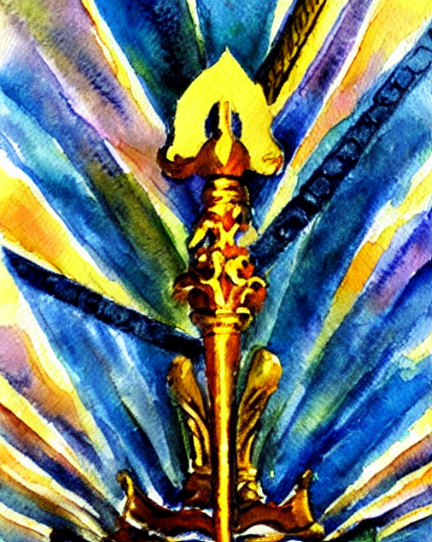
AI generated illustration for the Ace of Swords, looking more like a spear

Golden Dawn’s Book T

A WHITE Radiating Angelic Hand, issuing from clouds, and grasping the hilt of a sword, which supports a White Radiant Celestial Crown; from which depend, on the right, the olive branch of Peace; and on the left, the palm branch of suffering.
Six Vaus fall from its point. It symbolizes “Invoked,” as contrasted with Natural Force: for it is the Invocation of the Sword. Raised upward, it invokes the Divine crown of Spiritual Brightness, but reversed it is the Invocation of Demonic Force; and becomes a fearfully evil symbol. It represents, therefore, very great power for good or evil, but invoked; and it also represents whirling Force, and strength through trouble. It is the affirmation of Justice upholding Divine Authority; and it may become the Sword of Wrath, Punishment, and Affliction.

Etteilla

Fructification
Upright. This card, as far as the medicine of the spirit is concerned, means, in its natural position: Extreme, Great, Excessive. – Exaggerated, Furious, Choleric. – Extremely, Passionately, Excessively. – Vehemence, Animosity, Carriage, Impetus, Anger, Fury, Rage. – Extremity, Terms, Boundary, End, Limits. – Last sigh, Last extremity. – Divergence.
Reversed. Pregnancy, Germ, Seed, Sperm, Matter, Impregnation, Generation, Conception, Fructification. – Childbirth, Puerperium. – Fertilization, Production, Composition. – Enlargement, Increase, Multiplicity.

MQS

Tarot Encyclopedia – The Ace of Cups

(Note: this is a collection of the meanings attributed to the cards by some occultists in the past centuries. It does not reflect my own study or opinion of the cards. It is only meant as a quick comparative reference as I develop my own take.)

The Ace of Cups from the Builders of the Adytum (BOTA) tarot deck

Paul Foster Case (and Ann Davies)

Well Dignified: fertility, productiveness, development, multiplication, happiness, pleasure, gratification, fruition of desires; cheerfulness, geniality, gaiety.
lll Dignified: too much emphasis on pleasure; over-intensity of the desire nature; trouble in love.
Keyword: Desire force
(From the Oracle of Tarot course)

A. E. Waite

The waters are beneath, and thereon are water-lilies; the hand issues from the cloud, holding in its palm the cup, from which four streams are pouring; a dove, bearing in its bill a cross-marked Host, descends to place the Wafer in the Cup; the dew of water is falling on all sides. It is an intimation of that which may lie behind the Lesser Arcana. Divinatory Meanings: House of the true heart, joy, content, abode, nourishment, abundance, fertility; Holy Table, felicity hereof. Reversed: House of the false heart, mutation, instability, revolution.
(From The Pictorial Key to the Tarot)

Aleister Crowley

This card represents the element of Water in its most secret and original form. It is the feminine complement of the Ace of Wands, and is derived from the Yoni and the Moon exactly as that is from the Lingam and the Sun. The third in the Hierarchy. This accordingly represents the essential form of the Holy Grail. Upon the dark sea of Binah, the Great Mother, are Lotuses, two in one, which fill the cup with the Life-fluid, symbolically represented either as Water, as Blood, or as Wine, according to the selected purpose of the symbolism. This being a primordial card, the liquid is shown as water; it can be transformed into Wine or Blood as may be required.

Above the Cup, descending upon it, is the Dove of the Holy Ghost, thus consecrating the element.

At the base of the Cup is the Moon, for it is the virtue of this card to conceive and to produce the second form of its Nature.
(From The Book of Thoth)

AI-generated illustration for the Ace of Cups

Golden Dawn’s Book T

A WHITE Radiant Angelic Hand, issuing from clouds, and supporting on the palm thereof a cup, resembling that of the Stolistes.
From it rises a fountain of clear and glistening water: and sprays falling on all sides into clear calm water below, in which grow Lotuses and Water-lilies. The great Letter of the Supernal Mother is traced in the spray of the Fountain.
It symbolizes Fertility — productiveness, beauty, pleasure, happiness, etc.

Etteilla

Table
Upright. This card, as far as the medicine of the spirit is concerned, means, in its natural position: Table, Meal, Feast, Gala, Banquet, Nourishment, Food, Nutrition. – Guests, Services. – Invitation, Prayer, Supplication, Convocation. – Guest, Hotel, Inn, Tavern. – Abundance, Fertility, Production, Soundness, Stability, Steadfastness, Constancy, Perseverance, Continuance, Duration, Follow-through, Assiduity, Persistence, Steadfastness, Courage. – Picture, Painting, Image, Hieroglyphic, Description. – Tablet, Portfolio, Office, Secretary. – Natural tablet, Bronze tablet, Marble tablet, Law. – Catalog, Index of subjects. – Harmonic table, Garden table, Holy table.
Reversed. Mutation, Permutation, Transmutation, Alteration, Vicissitude, Variety, Variation, Inconstancy, Lightness. – Exchange, Barter, Purchase, Sale, Market, Treaty, Convention. – Metamorphosis, Diversity, Versatility, Reversal, Reversal, Revolution, Reversal. – Version, Translation, Interpretation.

MQS

Tarot Encyclopedia – The Ace of Wands

(Note: this is a collection of the meanings attributed to the cards by some occultists in the past centuries. It does not reflect my own study or opinion of the cards. It is only meant as a quick comparative reference as I develop my own take.)

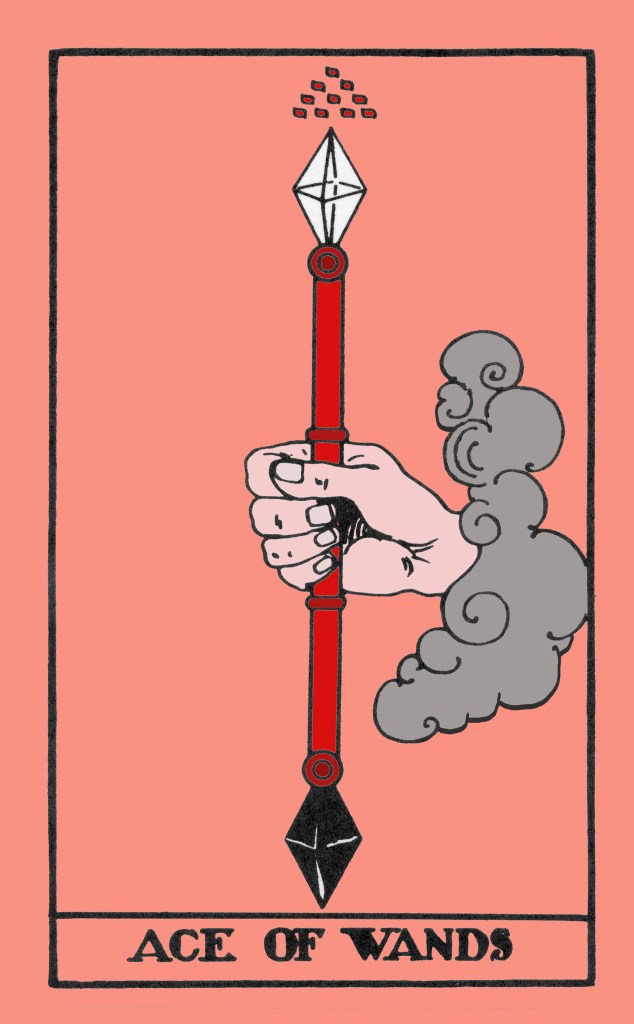
The Ace of Wands from the Builders of the Adytum (BOTA) Tarot deck

Paul Foster Case (and Ann Davies)

In Tarot Divination the Ace of Wands has these key meanings: natural as opposed to invoked force; strength; force; vigor; vitality; particularly the force of concentrated will; the principle of beginning; initiation or inception of any enterprise or activity; concentration of power; involution of force.
Keyword: Initiative
(From the Oracle of Tarot course)

A. E. Waite

A hand issuing from a cloud grasps a stout wand or club. Divinatory Meanings: Creation, invention, enterprise, the powers which result in these; principle, beginning, source; birth, family, origin, and in a sense the virility which is behind them; the starting point of enterprises; according to another account, money, fortune, inheritance. Reversed: Fall, decadence, ruin, perdition, to perish also a certain clouded joy.
(From The Pictorial Key to the Tarot)

Aleister Crowley

This card represents the essence of the element of Fire in its inception. It is a solar-phallic outburst of flame from which spring lightnings in every direction. These flames are Yods, arranged in the form of the Tree of Life. (For Yod, see Atu IX supra.) It is the primordial Energy of the Divine manifesting in Matter, at so early a stage that it is not yet definitely formulated as Will.

Important: although these “small cards” are sympathetic with their Sephirotic origin, they are not identical; nor are they Divine Persons. These (and the Court Cards also) are primarily sub-Elements, parts of the “Blind Forces” under the Demiourgos, Tetragrammaton. Their rulers are the Intelligences, in the Yetziratic world, who go to form the Schemhamphorasch. Nor is even this Name, “Lord of the Universe” though it be, truly Divine, as are the Lords of the Atu in the Element of Spirit. Each Atu possesses its own private, personal and particular Universe, with Demiourgos (and all the rest) complete, just as every man and every woman does.

For example II’s or VI’s Three of Disks might represent the establishment of such an oracle as that of Delphi, or VIII’s might be the first formula of a Code such as Manu gave to Hindustan; V’s, a cathedral, XVI’s, a standing army; and so on. The great point is that all the Elemental Forces, however sublime, powerful, or intelligent, are Blind Forces and no more.
(From The Book of Thoth)

Golden Dawn’s Book T

A WHITE Radiating Angelic Hand, issuing from clouds, and grasping a heavy club, which has three branches in the colours, and with the sigils, of the scales. The Right-and Left-hand branches end respectively in three Flames, and the Centre one in four Flames: thus yielding Ten: the Number of the Sephiroth. Twoand-twenty leaping Flames, or Yodh, surround it, answering to the Paths; of these, three fall below the Right branch for Aleph, Men, and Shin, seven above the Central branch for the double letters; and between it and that of the Right twelve: six above and six below about the Left-hand branch. The whole is a great and flaming Torch. It symbolizes Force — strength, rush, vigour, energy, and it governs, according to its nature, various works and questions. It implies Natural, as opposed to Invoked, Force.

Etteilla

Birth
Upright. This card means, in its natural position, as far as the medicine of the spirit is concerned: Birth, Beginning. – Nativity, Origin, Creation. – Source, Beginning, Primacy. – Extraction, Race, Family, Condition, House, Lineage, Posterity, Occasion, Cause, Reason, First, First fruits.
Reversed. Fall, Decadence, Decay, Decline, Decay, Decay, Dissipation, Failure, Bankruptcy, Ruin, Destruction, Demolition, Damage, Devastation. – Guilt, Error, Contempt, Abatement, Depression, Discouragement. – Perdition, Abyss, Chasm, Precipice. – Dying, Falling, Decay, Derogation. – Depth.

MQS