Tag Archives: tarot tradition

Parrots and Betrayed Deals (13 Card Spread Reading Example)

As I mentioned here, I got a new parrot from a local breeder and I had an interesting reading concerning it. The reading was done using the Bologna Tarot in its 45-card variant. We had already gotten some pictures of some of the available birds, and we had settled on a gray cockatiel, because it looked like the one I had as a kid. As the day approached, I asked the cards if everything would go alright. This is the spread I got:
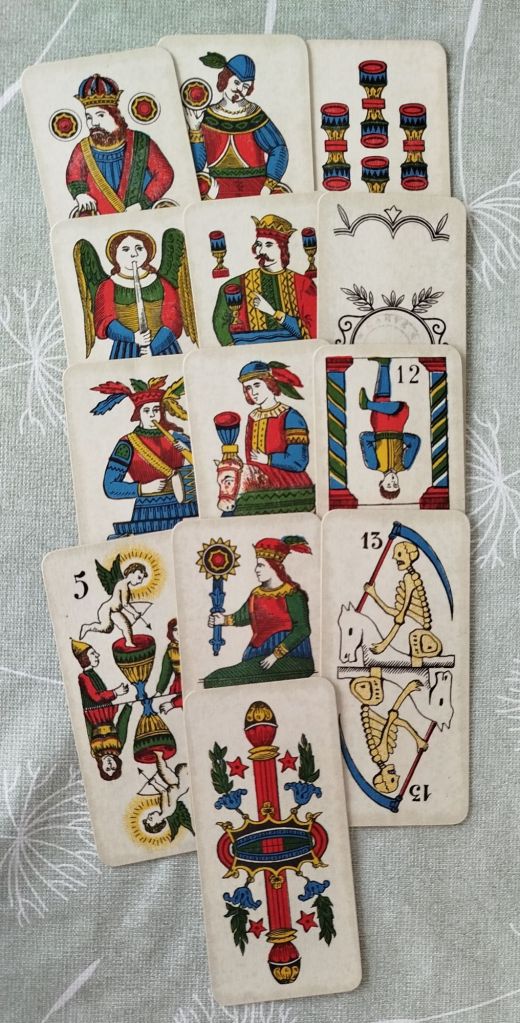
Is the bird handover going to go smoothly?

Although I’ve already talked about the 13 card spread, when used with the Bolognese tarot there are some peculiar aspects to it (it is, after all, one of the “official” traditional spreads to be used with this deck). Traditionally, when a yes-or-no question is asked, the following rules apply:

  1. If the Death card shows up in the spread, it’s a yes (as sure as we all die)
  2. If the Angel (Judgement) card shows up, it’s a good chance
  3. If both show up, it’s a sure thing
  4. If the Angel and the Devil show up, it represents great satisfaction within the context (the Devil is in itself a negative card, but it is redeemed by the presence of the Angel)

Well, in my (still limited) experience with this tarot deck, I have found that it’s best not to rely too much on mechanical rules: the cards must always be interpreted, and exceptions allowed for. Still, it is encouraging to see both the Angel and the Death card as answer. Let’s interpret the cards row by row, as they came up very clear and orderly (it is not always like this, unfortunately):

King of Coins – Page of Coins – Seven of Cups: there have been talks (Page) with a man concerning business (King). The Seven of Cups is generically positive here.
Angel – King of Cups – Ace of Coins: There is help (Angel) from a man of the house (King) concerning money (Ace). My husband paid in part for the parrot and the cage and food.
Fool – Knight of Cups – Hanged Man: This is the most interesting row in the spread. It shows something that brings chaos or confusion (Fool) and that betrays or upends (Hanged Man) the agreement (Knight of Cups)
Love – Queen of Coins – Death: True (Queen of Coins) Love (Love) is confirmed (Death)
Ace of Wands: Success, positive ending

So in general what we can say from the spread is that the breeder is trustworthy, my husband helps me and I will be very satisfied, but still the deal will somehow be changed in an unexpected/confused way.

What ended up happening: we got there and the breeder introduced us to the various chicks that were ready for adoption, including the one we had settled on. But as we were playing with them, a white cockatiel chick quickly flew onto my shirt looking for cuddles. Obviously, it was love at first sight (see the true love in the spread), and we got that one instead.

I believe this change of plans is shown in the spread by combination of Knight of Cups (agreement, conciliation) followed by the Hanged Man (betrayal, upending). Our initial agreement was upended (or “betrayed” in a metaphorical sense), but still everything ended on a positive note.

NOTE: look how “dry” this reading is. Traditionally, tarot was not interpreted by musing on how the pictures looked, but by applying clear and specific meanings.

MQS

Bolognese Tarot – The 50 Card Method Meanings

Following my introductory article about the Bolognese Tarot, I want to introduce some quick meanings for the cards. No current method of reading the Bolognese Tarot employs all 62 cards. Instead, two main variants exist: the 45-card method and the 50-card method. I learned the 50-card method from my current teacher (whose book on the Bolognese tarot I reviewed some time ago). I have the 45-card method from another source, and I’ll talk about it separately.

My teacher’s hypothesis as to why traditional fortune-tellers seem to only use a reduced deck is that the cards were all employed in some older method, but the oral transmition of the tradition caused some meanings to go lost. I incline more toward the idea that the fortune-tellers of Bologna simply wanted a slimmer deck that could be used in large spreads (we will see in a future article that most spreads using this tarot deck employ many cards, some even the whole deck).

What follows is a quick summary of the main meanings. Note that: 1) the meanings are quick, concrete and to the point. Yet, in divination, it is possible to use the cards to write whole sentences 2) The major trumps are arranged according to our current system, but in reality the Bolognese tarot follows a different numbering tradition1

Major Trumps

Major Trumps of the Bolognese Tarot: The Fool, The Juggler, Love, The Charriot, Justice, The Hermit

The Fool. Foolishness, Originality, Confusion
The Juggler. A child, naive, uncertain, unreliable. A beginning
Love. Love, Good feelings, Joy
The Chariot. Moving toward something, but also the bed card (because in the picture the chariot seems to be static, with the horses resting)
Justice. Justice, Fairness, the law
The Hermit. Blockage, Obstacle, Small health issues

Major Trumps of the Bolognese Tarot: The Wheel, Strength, The Hanged Man, Death, Temperance, The Devil

The Wheel. Upright (king with crown ascending): Good luck, positive development; Reversed (page without crown ascending): Instability, need for effort
Strength. Strength, Power, Energy, Effort, Health
The Hanged Man. Betrayal,2 Cheating, Feeling betrayed or cheated, Sudden reversal
Death. A sharp ending, The confirmation of something3
Temperance. Time, the passage of time, the need to wait, stability over time
The Devil. Wrath, Anger, Being bedeviled, Passion, Jealousy, Magic

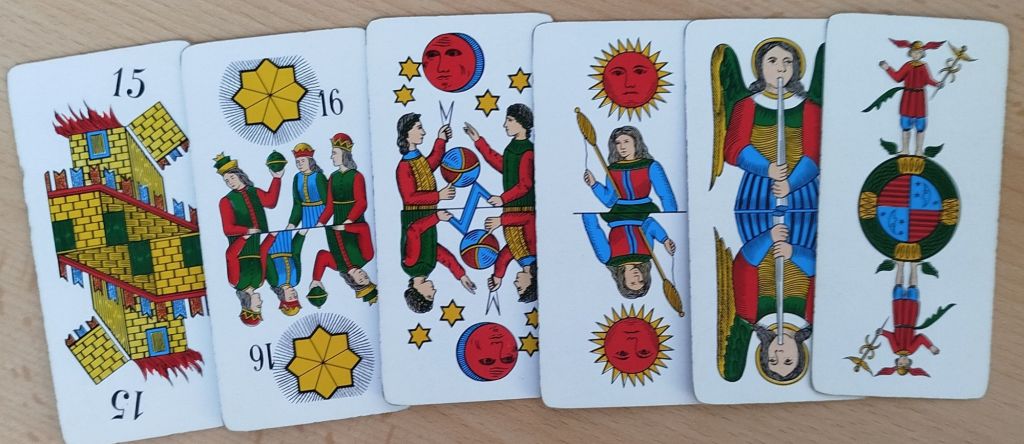
Major Trumps of the Bolognese Tarot: The Tower, The Star, The Moon, The Sun, The Angel (Judgement), The World

The Tower. A large building (usually, but not always, with a negative connotation), A prison, A hosipital. Obstruction, being imprisoned or limited (imagine being trapped in a burning building)
The Star. Objects, Gifts, Merchandise, Commerce, Work4, A positive card
The Moon. By night, Darkness, Sadness, Negativity, Secret
The Sun. By day, Light, Happiness, Positivity, Clarity
The Angel. Goodness, Friendship, Peace, Solution, Spirituality
The World. Around the world, From afar, Journey, Movement

The Moors

The three Moors used in divination with the Bolognese Tarot (the fourth one, similar to the third, is discarded)

Moor with three Arrows. Intrigue, Danger, Something that is difficult and requires to be disentangled or clarified
Moor with a Turban. A doctor, someone wearing a uniform, sickness, melancholy. A priest
Moor with one Spear. Surprise, something unexpected for good or ill, Bump on the road

The Suit of Cups

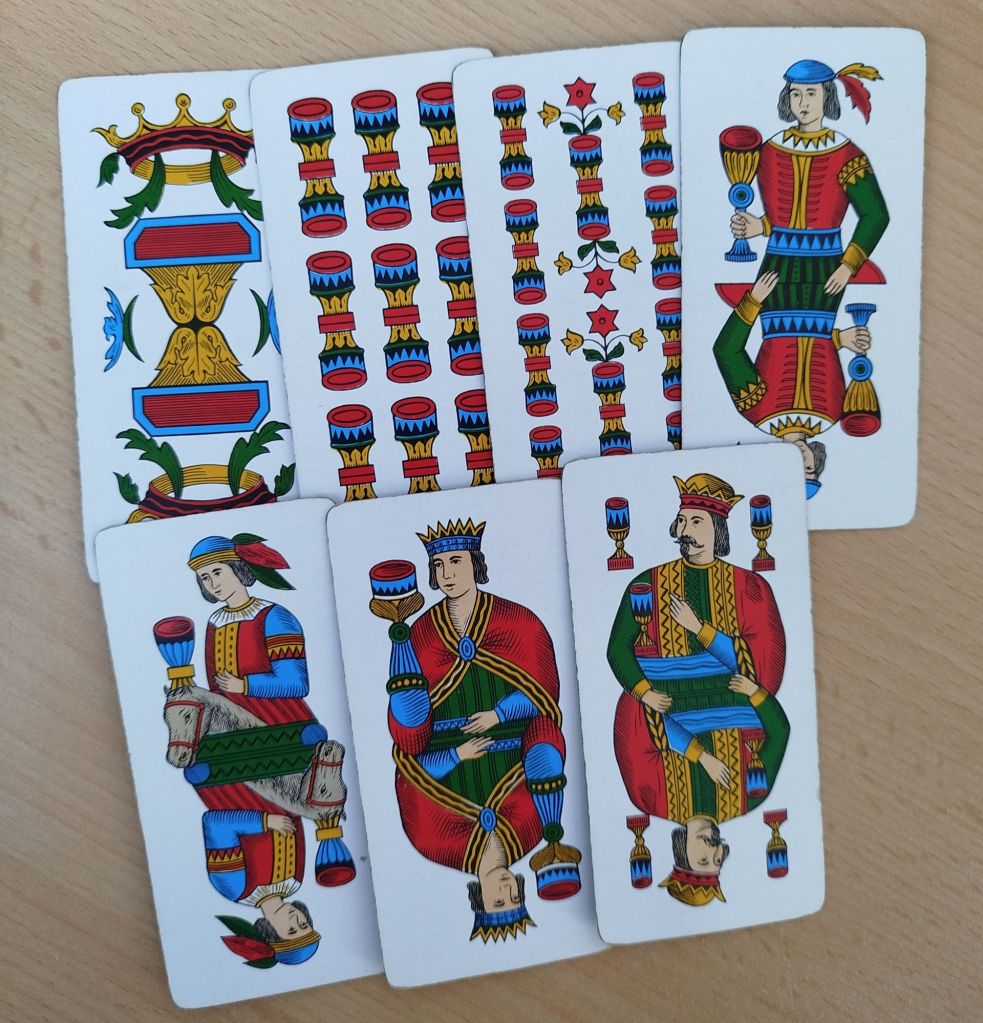
The Suit of Cups in the Bolognese Tarot

Ace. The Home, the Family
Nine. Close to home, Something on its way to us or something/someone close
Ten. Flourishing, Blooming, Feasting, Partying, Blood, Wine
Page. A young(er) woman, a small opportunity or consolation
Knight. Solution, Agreement, Reconciliation, Making peace or making your peace
Queen. A woman close to us or who loves us, archatypally a mother
King. A man close to us or who loves us, archetypally a father

The Suit of Wands

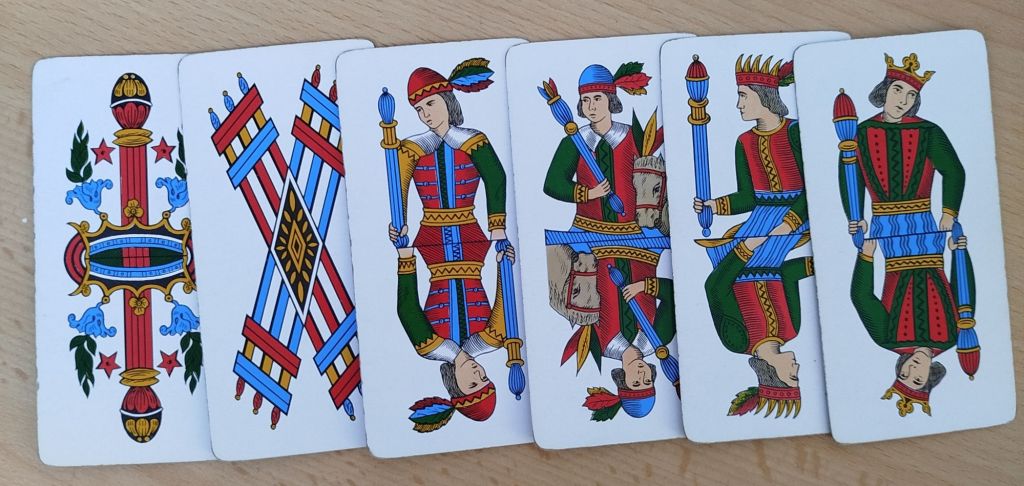
The Suit of Wands in the Bolognese Tarot

Ace. Sex, Pleasure, Triumph, Personal success
Six. A road, a path (literal or figurative), an opening
Page. The female querent’s thoughts
Knight. The male querent’s thoughts
Queen. The female querent
King. The male querent

The Suit of Coins

The Suit of Coins in the Bolognese Tarot

Ace. A document or letter, test results, contracts, etc. The table (sitting at the table, etc.)
Six. Tears, sadness
Nine. Money, assets
Ten. Well-being, lots of money
Page. Words, talks, communications
Knight. News (usually good)
Queen. The truth, wisdom, knowledge, trustworthy. Sometimes a woman embodying these traits
King. An important man, a gentleman, a lawyer or doctor, wise, with a degree

The Suit of Swords

The Suit of Swords in the Bolognese tarot

Ace. The door knockers, something about to happen.5 Also something binding, a union, a prison sentence, a contract (notice they look like rings or handcuffs)
Six. Within a three (three hours, three days, three weeks, three months)
Nine. Destiny. It highlights the other cards.
Ten. A gate, end of the road, something closing down, Suffering
Page. A letter, a message, interpersonal relationships
Knights. Cuts, Stitches, Arguments, Attacks, Fractures (real or metaphorical)
Queen. A strict woman. Affliction.
King. A younger or strict man. Childishness

MQS

  1. In reality, our current order of the major trump also differs from all other ways of numbering them in the first centuries of the tarot’s existence. ↩︎
  2. In all ancient documents concerning the tarot, the Hanged Man was called “the traitor”, because being hanged by the feet was a the punishment for traitors (see Mussolini in Italy). In the old Medieval trumps, the Hanged Man represented the person who had betrayed God ↩︎
  3. “Sicuro come la morte”, i.e., “As sure as the fact that we all die”. it is the ‘yes’ card in the Thirteen card spread. ↩︎
  4. Usually the iconography of the card is interpreted as the three Magi bringing their gifts to Jesus, but some Bolognese fortune-tellers see three merchants striking a deal ↩︎
  5. Interestingly, in many system of fortune-telling by cards practiced in Italy, there is always a card called “the door knockers”. In the system of cartomancy by playing cards I was taught, this card is the Two of Hearts ↩︎

Bolognese Tarot – Introduction to an Old Fortune-Telling Tradition (Part I)

As I’ve mentioned on this blog, I’ve been studying the divination tradition of the Bolognese Tarot (Tarocchino Bolognese, literally the Small Tarot of Bologna) for some months now. I’ve been doing it under the direction of a traditional practitioner of this art, whom I’ve befriended and with whom a wonderful exchange of ideas has started.

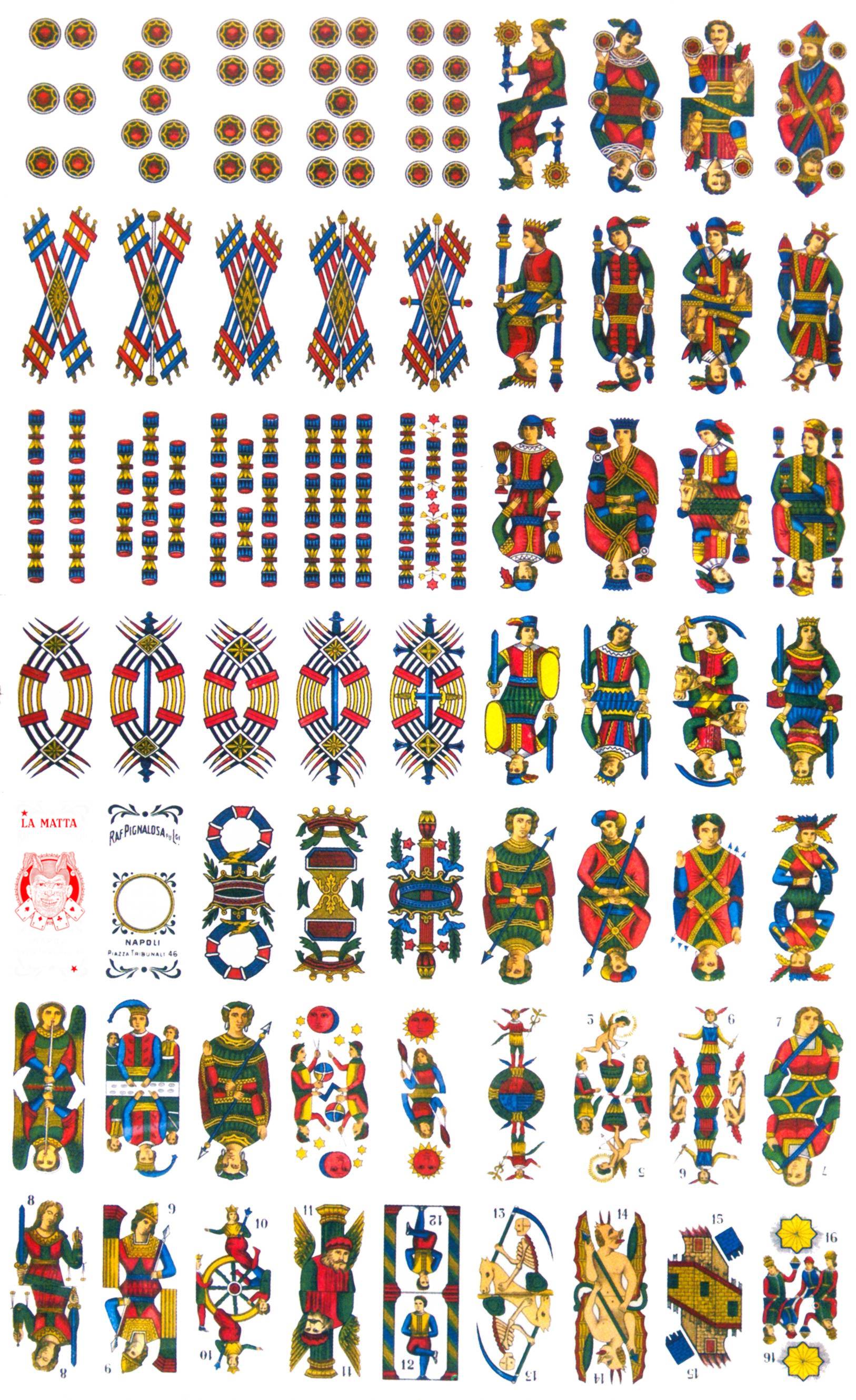
The full deck. Image from the website Labirinto Ermetico

I plan on introducing this form of divination in its main lines for a couple of reasons: 1) it is little known outside of Italy and it deserves some love 2) Its reading techniques are markedly different from the current approach and allow for a very concrete, down-to-earth approach 3) I want to discuss some spreads done with it in the future, and I can’t do it without introducing it first 4) it is the oldest tarot-related divination tradition that we know of, and it is therefore cool from a historical standpoint.1

The Ugly Duckling and Its Quirks

Like the almost totality of very old decks, with a couple of exceptions (the Visconti deck is one) the Bolognese tarot is distinctively unappealing from an esthetic standpoint, largely because, like other popular pre-RWS decks, it was meant to be used by poor people as a playing deck at the local inn.

A selection of cards from the Bolognese Tarot. As may be noted, they are symmetrical, like playing cards, though the earliest packs had full images.

The reason it is called ‘tarocchino’ (small tarot) has to do with its reduced size, probably to enhance its handlability. However, it is not just the size of the cards that is reduced, but also the number of the cards that comprise the deck: all pip cards from Two to Five are removed, leaving only the Ace of each suit plus the cards from Six to Ten and the court cards.

Furthermore, the Pope (Hierophant), Popess (High Priestess) Empress and Emperor are absent from the deck for political reasons, as Bologna was directly under the control of the Church. Instead, the deck includes four ‘Moors‘ (the Moors were Muslim colonizers that had conquered parts of Italy.)

Three of the ‘Moors’. The Fourth one is a copy of the third on the right.

Finally, the Bolognese Tarot has another peculiarity, in that the Major Trumps are out of order compared to our regular system. This may sound surprising to some, but our current ordering of the trumps is a relatively recent development and has nothing mystical about it (the oldest preserved document with the order of the trumps gives a rather different sequence).

An Old Tradition

The Bolognese Tarot tradition was almost entirely confined to the city of Bologna and the surrounding areas, and was at risk of dying out, until both the card game and the divination tradition were transmitted to a larger public thanks to the power of the Internet.

Interestingly, to this tradition is connected the most ancient set of meanings handed down by old sources. The following list dates back to the pre-Napoleonic period and gives the meanings of a reduced pack of thirty five cards. I’m copying it here for its historical interest, but it does not correspond to the system I have been taught:

  1. The Juggler (Magician): Married Man
  2. The Lovers: Love
  3. The Chariot: Journey
  4. Temperance: Time
  5. Strength: Violence
  6. The Hermit: Old (Person)
  7. The Hanged Man: Treason
  8. Death (called ‘Thirteen’): Death
  9. The Devil: Wrath
  10. The Star: A Gift
  11. The Moon: Night
  12. The Sun: Day
  13. The Angel (Judgement): Marriage or Agreement
  14. The World: Long travel
  15. The Fool: Madness
  16. King of Wands: A Bachelor
  17. Queen of Wands: A Prostitute
  18. Knight of Wands: Something Knocking at the Door
  19. Page of Wands: Thoughts of the Female Querent
  20. Ace of Wands: Sexual Escapades
  21. King of Cups: An Old Man
  22. Queen of Cups: Married Woman
  23. Knight of Cups: Reconciliation
  24. Page of Cups: The Female Querent
  25. Ten of Cups: The Roof of the House
  26. Ace of Cups: The House
  27. King of Swords: An Evil Tongue
  28. Ten of Swords: Tears
  29. Ace of Swords: A Letter
  30. King of Coins: The Male Querent
  31. Queen of Coins: The Truth
  32. Knight of Coins: Thoughts of the Male Querent
  33. Page of Coins: Unmarried Woman
  34. Ten of Coins: Money
  35. Ace of Coins: The Table

As I said, this is not the system that I’ve been taught, and it is very likely that even back then more than one system existed (usually, significant differences are found from quarter to quarter in Bologna and from small village to small village in the surrounding areas). Since this cartomantic tradition predates Etteilla’s by at least a quarter of a century, and probably more, and since Etteilla says he learned to read the tarot from an Italian card reader (though he pretends it was Alexis of Piedmont to add to the mystery), it is not to be excluded that the Bolognese tarot had some influence on him.

But this is speculation. What is clear is that tarot divination, whenever it was born, was brought into the world as a way of addressing concrete issues. This series of articles is dedicated to bringing the tarot back to these roots.

MQS

  1. If you want to read more, you can start with the Wikipedia page. More Information is contained on the webside of the Associazione Le Tarot ↩︎