MQS
MQS
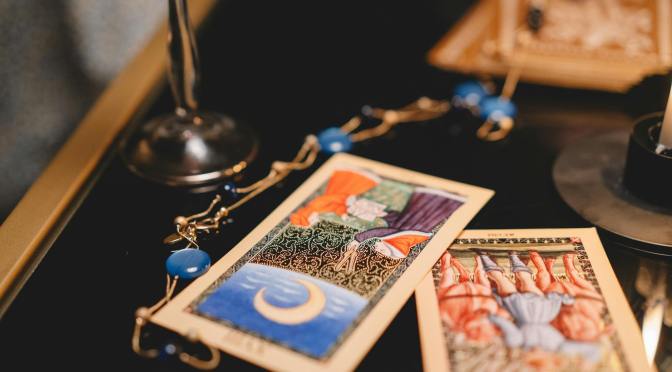
Nothing prohibits anyone from using whatever spread they prefer, or even just from laying out a row of cards. However, traditionally, the smallest spread used with the Bolognese Tarot is the thirteen card spread, which is a small tableau of cards used to answer a specific question or explore a specific theme (although nothing prevents you from laying it out for a general reading. It will respond anyway). This is a spread I have already presented, and it is one that is used with many decks in Central and Northern Italy in particular. The layout is as follows:
| 1 | 2 | 3 |
| 4 | 5 | 6 |
| 7 | 8 | 9 |
| 10 | 11 | 12 |
| 13 |
Some readers take out the significator for the querent or even the significator for the question and put them on top of the layout (above card 2) before starting to shuffle. I prefer to have all cards in the deck and have not found it necessary, but feel free to experiment.
The cards may be read in rows or in columns, and which direction is the primary one depends on which tradition you come from. Personally I tend to see rows as the primary reading direction, but I will look at columns if there is clear information contained in them. I have found that the columns tend to describe the situation rather than to predict it. But don’t force yourself to read in every direction possible: simply read the information where it is found, and leave the rest.
There is no strict differentiation between past, present and future. However, I have found, personally, that at least the first row, or sometimes two (and on occasion even three), contains the past or present of the situation. Occasionally the cards simply jump ahead into the future from the start.
Be open about it: it may sound confusing in theory but in practice it is often quite clear. For instance, if you see the cards changing from good to bad or vice versa (or simply changing “tone”) in the first row or two, that’s usually a sign that the cards before the change happens are the past/present, and the others the future. In doubt, simply ask the querent: we are not there to play Nostradamus, so it’s fine to ask for help in interpreting the spread.
The final card, number 13, doesn’t have any specific preassigned meaning. However, I have found that it can either simply be a regular part of the spread (simply coming after card 12 or under card 11), or it can highlight an important detail, or something that will be true, regardless of what the previous cards say. For instance, if the spread is a disaster but the thirteenth card is good, it can tell us the querent will have some kind of satisfaction, or will be protected.
Now we come to an odd bit of tradition. I will relay it as it has been taught to me, and then I’ll give you my two cents. Although the thirteen card spread is not unique to the Bolognese Tarot, the Bolognese Tarot adds another layer to the spread.
This is relevant only when the question is a yes-or-no question. If it is, then, according to some traditions, the answer is yes if the Death card comes up in the spread or while cutting the deck (it says: “yes, as sure as the fact we all die”). If the Angel card comes up, according to some it’s a maybe, while according to others it’s a no but with positive developments; if the Death and Angel cards both come up, not necessarily together, it’s the best possible outcome (a super yes, as it were). If neither card comes up, it’s a no.
Some also add that if the Death card doesn’t come up but the Angel and Devil card come up in the spread, not necessarily together, it’s also a yes (the Devil card alone would be a no, but if you remember the combinations, Angel+Devil means good news or satisfaction). Others still also believe the answer is yes if three or four Kings come up in the spread.
Now I’m going to tell you what my experience is. My experience is that there is something to these rules, but it is not all so cut-and-dry. The spread always needs to be interpreted as describing a concrete situation, and the yes or no comes from our evalutation of whether the picture presented by the cards matches what the querent wants or not. It’s happened more than once that the Death card was present but the answer (confirmed by experience) was a no, or vice versa, the answer was yes with no yes-marker present.
Focus on interpreting the cards. If the Death card comes up, what does it say in the context? Does it show some sharp change? Does it show inner suffering? Does it confirm something? If so, look at the cards around it: what is it saying yes to? Sometimes it is obvious that the Death card comes up for no reason other than to say “yes” to the question, while at other times it is a regular card, like the others. Again, be flexible, record your experience and learn from it.
MQS
In a previous article I discussed how the original Golden Dawn spread known as Opening of the Key fits perfectly into the mold of traditional divination by cards, although it adds certain occult layers to it. This is largely due to the absence of one-card-per-position layouts, the presence of peculiar techniques and the tendency to read cards in rows.
To sum up how the spread worked:
As you may have guessed, the Opening of the Key was a cumbersome spread, and while it was used for the solution of practical matters (Crowley famously remarked on this fact), it clearly was meant to be used primarily within a ritual setting, at least in its entirety.
What is also clear, though, is that the Opening of the Key is less a spread in itself than a blueprint for a complete tarot reading made up of five individual spreads, each of which analyzes the issue from a different standpoint, or rather by tapping into a different layer of it. The experienced card reader could simply choose one of the five spreads and use it without resorting to the others, as need dictates.
For the most part, it seems that many Golden Dawn members simply stuck to the first operation, which is consequently the most famous and iconic, where one cuts the pack into four smaller stacks and reads the one with the significator. The possible reason why the other operations were generally discounted is probably that almost all of them required the deck to be dealt out into small stacks, only one of which is read, so that it takes more time to deal the cards than to read them.
Other members, though, were more inventive. In his Oracle of the Tarot booklet, Paul Foster Case offers a simpler alternative to the five-operation extravaganza of the full method (which he nonetheless describes and recommends for more serious or complex questions)1
The divination starts as usual: by finding the stack containing the significator and telling the querent what he or she has come for without them telling us, based on the stack. In the original instructions, if the diviner is wrong in assessing the nature of the question, the divination should be abandoned. In reality, aside from the initial period of training, it seems that the location of the significator was simply used to color the interpretation of the cards.
At this point, Case’s simplified method diverges from the original. Instead of spreading out the stack into a single row or ring of cards and starting the counting technique from the significator, Case says the diviner must shuffle the stack and then deal it out into three smaller stacks, corresponding to the past, present, and future. Each stack is then read sequentially (as you would in playing card, Sibilla or Lenormand divination).
The simplification of the method is due to the fact that, instead of starting the exploration of the issue from the past/present with the first operation and then moving on to the further future with the other operations, one has immediately past, present and future condensed into a single method.
There are other ways of simplifying the Opening of the Key. Paul Hughes Barlow rose to some prominence a couple of years ago for his idiosyncratic way of reading the first of operation without relying on a significator, instead reading all four stacks, something for which he was reproved by some.
Personally, I have found Paul Case’s simplification very effective in my experiments, and I’ll probably post an example reading in the future.
MQS
A recent exchange in the comment section made me go back to some notes I’ve been sitting on for a while about how different card spreads used to be in the past, compared to how they tend to be nowadays. A good example for this is the famous spread used by the Golden Dawn, which has become known as the Opening of the Key.
The Opening of the Key is a complex, multi-stage spread that was (and still is) used within the Golden Dawn system and has been adopted by Paul Foster Case’s and Crowley’s followers as well.
From a magical standpoint, the allure of this spread is that it mirrors within its layouts the whole GD system, being therefore a tool for learning it. Since I do not particularly advocate the Golden Dawn system, I’ll leave this aspect to your consideration, should you be so inclined.
From a purely divinatory standpoint, though, the interesting aspect of the Opening of the Key is that it affords us a glance at how card spreads used to work in traditional cartomancy.
Nowadays we are used to what many call “positional spreads“, that is, spreads where each single card is read more or less independently from the others based on the meaning of the position. The most famous positional spread is certainly the Celtic Cross, also taken from the GD system and popularized by Waite. Over time, though, more and more ridiculous spreads have emerged, with positional meanings as abstracted from actual reality as possible.
If we take a look at many books on divinations published before the 60s, when the Rider Waite deck truly took off, and with it the Celtic Cross spread, we find very different spreads.
Many traditional spreads, used both for tarot and for playing cards, share the following characteristics:
One of the characteristics of the early Golden Dawn, before it became a battle of egos, was its (relatively intelligent) syncretism, as well as its attempt to act as a reservoir of everything the occult Western tradition had created over the centuries. Many of the founding members of the Golden Dawn were very well acquainted with, and even contributed to the then-growing literature on fortune-telling.
It comes therefore as little surprise that THE Golden Dawn spread, the Opening of the Key, is just as much an occult compendium as it is a compendium of quaint fortune-telling techniques. Let’s read the original instructions together (From Book T):
A Method of Divination by the Tarot
- THE Significator.
Choose a card to represent the Querent, using your knowledge or
judgment of his character rather than dwelling on his physical
characteristics.- Take the cards in your left hand. In the right hand hold the wand over
them, and say: I invoke thee, I A O, that thou wilt send H R U, the great
Angel that is set over the operations of this Secret Wisdom, to lay his hand invisibly upon these consecrated cards of art, that thereby we may obtain true knowledge of hidden things, to the glory of thine ineffable Name. Amen.- Hand the cards to Querent, and bid him think of the question attentively, and cut.
- Take the cards as cut, and hold as for dealing.
“First Operation”
This shows the situation of the Querent at the time when he consults you.
- The pack being in front of you, cut, and place the top half to the left.
- Cut each pack again to the left.
- These four stack represent I H V H, from right to left.
- Find the Significator. It be in the HB:Y pack, the question refers to work,
business, etc.; if in the HB:H pack, to love, marriage, or pleasure; if in the
HB:H pack, to money, goods, and such purely material matters.- Tell the Querent what he has come for: if wrong, abandon the divination.
- If right, spread out the pack containing the Significator, face upwards.
Count the cards from him, in the direction in which he faces.
The counting should include the card from which you count.
For Knights, Queens and Princes, count 4.
For Princesses, count 7.
For Aces, count 11.
For small cards, count according to the number.
For trumps, count 3 for the elemental trumps; 9 for the planetary trumps;
12 for the Zodiacal trumps.
Make a “story” of these cards. This story is that of the beginning of the affair.- Pair the cards on either side of the Significator, then those outside them, and so on. Make another “story,” which should fill in the details omitted in the first.
- If this story is not quite accurate, do not be discouraged. Perhaps the
Querent himself does not know everything. But the main lines ought to be
laid down firmly, with correctness, or the divination should be abandoned“Second Operation”
Development of the Question
- Shuffle, invoke suitably, and let Querent cut as before.
- Deal cards into twelve stacks, for the twelve astrological houses of
heaven.- Make up your mind in which stack you ought to find the Significator,
“e.g.” in the seventh house if the question concerns marriage, and so on.- Examine this chosen stack. If the Significator is not there, try some
cognate house. On a second failure, abandon the divination.- Read the stack counting and pairing as before.
“Third Operation”
Further Development of the Question- Shuffle, etc., as before.
- Deal cards into twelve stacks for the twelve signs of the Zodiac.
- Divine the proper stack and proceed as before.
“Fourth Operation”
Penultimate Aspects of the Question
- Shuffle, etc., as before.
- Find the Significator: set him upon the table; let the thirty-six cards
following form a ring round him.- Count and pair as before.
Fifth Operation
Final Result
- Shuffle, etc., as before.
- Deal into ten packs in the form of the Tree of Life.
- Make up your mind where the Significator should be, as before; but failure
does not here necessarily imply that the divination has gone astray.- Count and pair as before.
There are many characteristics to the Opening of the Key that mirror the checklist I’ve created above:
Quite clearly, there is more to the Opening of the Key than what I’ve listed, aside from the heavy occult overlays. For one, the GD added a method for discerning whether the divination is valid: one needs to find the significator in the appropriate stack. This is in part due to the desire to import the notion of ‘radicality’ used by many horary astrologers, according to which certain charts cannot be judged if certain configurations are present or absent; and in part it is a system of magical checks and balances to avoid idle curiosity (again, more on this in a later post).
MQS