Tag Archives: tarot reading

Tarot Encyclopedia – The Four of Wands

(Note: this is a collection of the meanings attributed to the cards by some occultists in the past centuries. It does not reflect my own study or opinion of the cards. It is only meant as a quick comparative reference as I develop my own take.)

The Four of Wands from the Builders of the Adytum (BOTA) Tarot deck

Paul Foster Case (and Ann Davies)

The Four of Wands is associated with the third decanate of Aries, the time period April 10 to April 19, ruled by Jupiter.
Well-Dignified: this card signifies success through personal merit, good
social standing, influential friends, the perfection of something built
up after labor, benefit through travel, shipping and business with foreign countries.
lll-Dignified: loss in the same things, or in consequence of unpreparedness or by hasty action.
Keyword: Perfected work.
(From the Oracle of Tarot course)

A. E. Waite

From the four great staves planted in the foreground there is a great garland suspended; two female figures uplift nosegays; at their side is a bridge over a moat, leading to an old manorial house. Divinatory Meanings: They are for once almost on the surface–country life, haven of refuge, a species of domestic harvest-home, repose, concord, harmony, prosperity, peace, and the perfected work of these. Reversed: The meaning remains unaltered; it is prosperity, increase, felicity, beauty, embellishment.
(From The Pictorial Key to the Tarot)

Aleister Crowley

In the Wand suit, the card is called Completion. The manifestation promised by Binah has now taken place. This number must be very solid, because it is the actual dominating influence on all the following cards. Chesed, Jupiter-Ammon, the Father, the first below the Abyss, is the highest idea which can be understood in an intellectual way, and that is why the Sephira is attributed to Jupiter, who is the Demiurge.

[…]

This card refers to Chesed in the suit of Fire. Being below the Abyss, it is the Lord of all manifested active Power. The original Will of the Two has been transmitted through the Three, and is now built up into a solid system:-Order, Law, Government. It is also referred to Venus in Aries, which indicates that one cannot establish one’s work without tact and gentleness.

The wands are headed by the Ram, sacred to Chesed, the Father-god Amoun-Ra, as also to Aries; but at the other end of the wands are the Doves of Venus.

In the symbol, the ends of the wands touch a circle, showing the completion and limitation of the original work. It is within this circle that the flames (four double, as if to assert the balance) of the Energy are seen to play, and there is no intention to increase the scope of the original Will. But this limitation bears in itself the seeds of disorder.
(From The Book of Thoth)
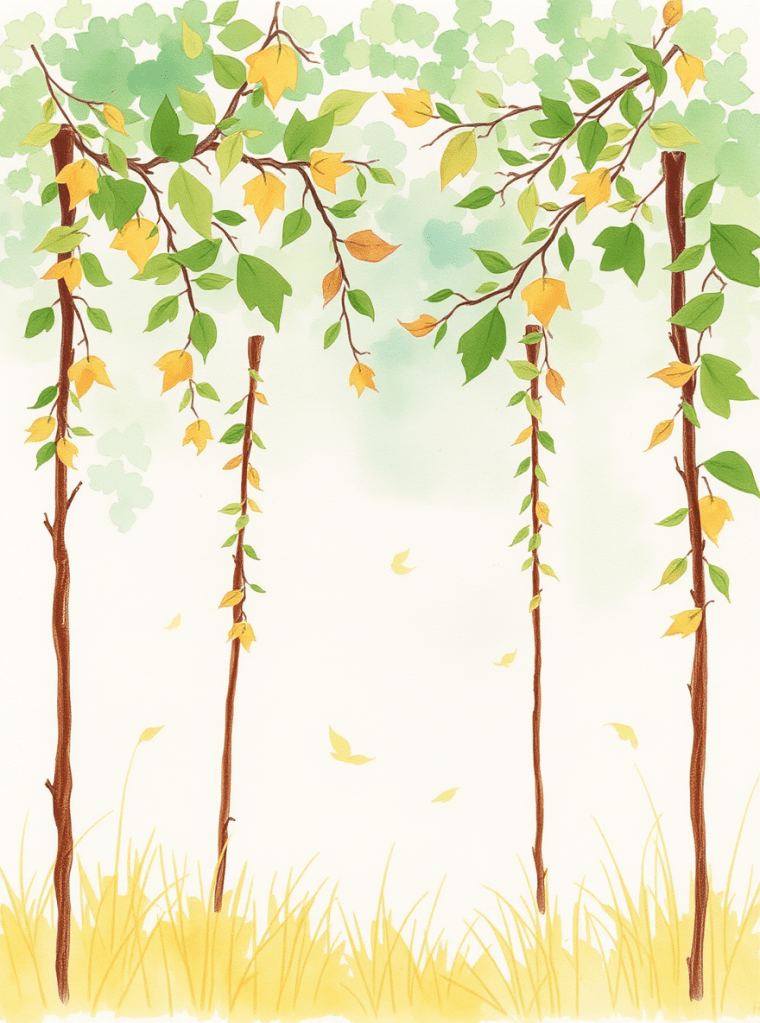
AI-generated illustration for the Four of Wands

Golden Dawn’s Book T

TWO White Radiating Angelic Hands, as before, issuing from clouds right and left of the card and clasped in the centre with the grip of the First Order, holding four wands or torches crossed. Flames issue from the point of junction. Above and below are two small flaming wands, with the symbols of Venus and Aries representing the Decan.
Perfection or completion of a thing built up with trouble and labour. Rest after labour, subtlety, cleverness, beauty, mirth, success in completion. Reasoning faculty, conclusions drawn from previous knowledge. Unreadiness, unreliable and unsteady through over-anxiety and hurriedness of action. Graceful in manner, at times insincere, etc.
Chesed of HB:Y (Settlement, arrangement, completion).
Herein are HB:NNAAL and HB:NYThHL Angelic rulers

Etteilla

Company
Upright. This card, as far as the medicine of the spirit is concerned, in its natural position means: Society, Association, Assembly, Relation, Confederation, Alliance, Union, Gathering, Circle, Community, Assembling, Multitude, Mass, Crowd, Troop, Band, Company, Cohort, Army. – Convocation, Accompaniment, Mixing, Mixture, League, Amalgamation. – Contract, Convention, Covenant, Treaty.
Reversed. Prosperity, Increase, Accretion, Advancement, Success, Succeeding, Fortune, Blossoming, Happiness. – Beauty, Beautification.

MQS

The Mystery of the Seven of Swords

Waite the Juggler

The Rider Waite’s minor arcana (which I already talked about here) are based on the Golden Dawn’s correspondences and titles found in Mathers’ and Felkin’s Book T. Yet Waite, who was very fond of showing off his erudition, made it a point to look for as many similarities as possible between the Book T system and other lists of meanings such as Etteilla’s, Christian’s and others.

This is reflected in the accompanying book to his deck, The Pictorial Key to the Tarot, where he tries to find similarities between various sources for each minor card. He never mentions the Golden Dawn material, despite the fact that knowing the GD’s card names would clarify most of the designs.

The 1 to 1 correspondence between GD meanings and Waite’s minor arcana is self-evident, and once it is noted it cannot be unseen. Yet in his book he makes it a point to just rely on non-esoteric sources, or at least on non-GD sources.

Note that the Golden Dawn did something similar, despite the claim that the card titles were revealed to them. Take the Four of Cups, for instance, which technically should be ascribed to the rulership of the Moon in the third decan of Cancer and to the sephira Chesed (mercy). All these things sound very promising. Yet the card is called Blended Pleasure and it is less positive than the previous two, largely (I believe) in an attempt to accomodate Etteilla’s relatively negative interpretation of the Four of Cups as a card of boredom, annoyance, etc.

Similarly, the Golden Dawn retained certain meanings found in traditional fortune-telling, such as ‘travel by water’ for the Six of Swords. This can be seen as part of the GD’s attempt at summarizing the whole of the Western magical tradition in a new synthesis.

Going back to Waite, it is clear that in his book he is also trying to balance various sources, but if in doubt about which one to follow, he will stick (without saying so explicitly) to the GD tradition. An example I already discussed is the Five of Pentacles, which Etteilla calls the card of the lovers, but the Golden Dawn called it ‘Material Trouble’.

Another example is the Two of Wands, which Etteilla calls a card of sorrow, but for the GD it is a card of Dominion, so Waite goes with the GD but tries to stretch the interpretation in his text by saying that it could be the sorrow of a great leader, like Alexander the Great, at the height of his power.

But What About the Seven of Swords?

With that in mind, what the hell is going on with the Seven of Swords? Let me explain: most people who pick up a Rider Waite tarot deck, even today, have no idea about the esoteric stuff behind it, so they base their interpretation on the design (which, incidentally, Waite thought very little of). This is how, for instance, the Two of Pentacles, the Lord of Harmonious Change according to GD, became the card of juggling, or how the Seven of Cups, the Lord of Illusionary Success, became the card of options.

In this new folk approach to the Waite deck, the Seven of Swords became known as the thief card due to the design.

Yet Waite does not even mention thieves in his description. He says:

A man in the act of carrying away five swords rapidly; the two others of the card remain stuck in the ground. A camp is close at hand. Divinatory Meanings: Design, attempt, wish, hope, confidence; also quarrelling, a plan that may fail, annoyance. The design is uncertain in its import, because the significations are widely at variance with each other. Reversed: Good advice, counsel, instruction, slander, babbling.

The meanings he gives are from Etteilla, where the Seven of Swords is one of the few non negative Sword cards. The description of the card, however, is far more consonant with what we find in Book T, which is:

The Lord of Unstable Effort […]Partial success. Yielding when victory is within grasp, as if the last reserves of strength were used up. Inclination to lose when on the point of gaining, through not continuing the effort. Love of abundance, fascinated by display, given to compliments, affronts and insolences, and to spy upon others. Inclined to betray confidences, not always intentionally. Rather vacillatory and unreliable.
Netzach of HB:V (Journey by land: in character untrustworthy)

This thing with the yielding when victory is within grasp is clearly depicted in the card, where the thief takes away most of the enemy’s swords, but not all, as Waite clearly states.

But why did Waite (and, maybe, Smith) decide to depict a thief in the Seven of Swords despite it being so thematically different from Waite’s actual inspiration (Book T) and even his cover-up inspiration (Etteilla)?

The only hints we find in Book T that seem to point in this direction are “to spy upon others” and “in character untrustworthy”. In an attempt to accomodate Etteilla, Waite probably saw the man looking longingly at the swords he left on the ground as a symbol of hope, which is Etteilla’s meaning for the card.

One possible explanation is that Waite and/or Smith probably thought the type of action that is best suited to the Suit of Swords is the kind of sneaky, underhanded action depicted in the final design of the card. Be it as it may, this is one of the cards that always stood out to me when studying the history of this deck, because it takes a very non-obvious approach to its theme.

MQS

Tarot Encyclopedia – The Three of Pentacles or Coins

(Note: this is a collection of the meanings attributed to the cards by some occultists in the past centuries. It does not reflect my own study or opinion of the cards. It is only meant as a quick comparative reference as I develop my own take.)

The Three of Pentacles from the Builders of the Adytum (BOTA) deck

Paul Foster Case (and Ann Davies)

The time period is the second decanate of Capricorn, under the rulership of Venus, from January 1 to January 9.
Well-Dignified: construction; increase, growth; financial gain; the building up of favorable conditions; gain in commercial transactions; rank or prestige in vocation or business; beginning of matters to be perfected later.
Ill-Dignified: selfishness; cleverness in business, but lack of scruples;
narrowness and prejudice; too much ambition.
Keyword: Constructiveness.
(From the Oracle of Tarot course)

A. E. Waite

A sculptor at his work in a monastery. Compare the design which illustrates the Eight of Pentacles. The apprentice or amateur therein has received his reward and is now at work in earnest. Divinatory MeaningsMétier, trade, skilled labour; usually, however, regarded as a card of nobility, aristocracy, renown, glory. Reversed: Mediocrity, in work and otherwise, puerility, pettiness, weakness.
(From The Pictorial Key to the Tarot)

Aleister Crowley

The Three of Pentacles, in a similar manner, exhibits the result of the idea of Earth, of the crystallization of forces; and so the Three of Pentacles is called the Lord of Work. Something has definitely been done.

[…]

The influence of Binah in the sphere of Earth shows the material establishment of the idea of the Universe, the determination of its basic form. It is ruled by Mars in Capricornus; he is exalted in that Sign, and therefore at his best. His energy is constructive, like that of the builder or engineer. The card represents a pyramid viewed from above the apex. The base is formed by three wheels-Mercury, Sulphur, and Salt; Sattvas, Rajas, and Tamas in the Hindu system; Aleph, Shin, and Mem-Air, Fire, and Water-the three Mother letters of the Hebrew alphabet.

This pyramid is situated in the great Sea of Binah in the Night of Time, but the sea is solidified; hence the colours of the back-ground are mottled, a cold thin dark grey with a pattern of indigo and green. The sides of the pyramid have a strong reddish tint, showing the influence of Mars.
(From The Book of Thoth)

AI-generated illustration for the Three of Pentacles or Coins

Golden Dawn’s Book T

A WHITE-WINGED Angelic Hand, as before, holding a branch of a rose tree, of which two white rosebuds touch and surmount the topmost Pentacle. The Pentacles are arranged in an equilateral triangle. Above and below the symbols Mars and Capricorn.
Working and constructive force, building up, creation, erection; realization and increase of material things; gain in commercial transactions, rank; increase of substance, influence, cleverness in business, selfishness. Commencement of matters to be established later. Narrow and prejudiced. Keen in matters of gain; sometimes given to seeking after impossibilities.
Binah of HB:H (Business, paid employment, commercial transaction).
Herein are HB:YChVYH and HB:LHChYH Angelic Rulers.

Etteilla

Important
Upright. This card, as far as the medicine of the spirit is concerned, means, in its natural position: Noble, Considerable, Famous, Important, Great, Major, Extended, Vast, Sublime, Renowned, Famous, Powerful, Elevated, Illustrious. – Excellence, Consideration, Greatness of mind, Nobility of conduct, Generous deeds, Magnificently, Splendidly.
Reversed. Puerility, Childhood, Infantilism, Frivolity. – Weakening, Lowering, Diminishing, Education, Modicity, Mediocrity, Minuity, Inezia, Frivolity, Lowness, Vileness, Poltrony, Rampant, Small, Puerile, Petty, Low, Servile, Vile, Abject, Humble. – Abjection, Humility, Humiliation.

MQS

On Readings Without Question

The following is an attempt at reorganizing some old notes I have taken on the subject of divinations without a specific question, adding to them some new insights,

Divination Without Questions Is Possible (With Exceptions)

There is a relatively well-known tarot reader who says that a reading without a question is basically two people talking over a bunch of colored cardboards.

This is not true. It was customary, among old-time fortune-tellers, to have the querent sit in front of them and never have them speak anything that wasn’t their name at the beginning of the consultation. I know for a fact that this is a tradition in the Italian countryside, and I believe it is the case all over the world as soon as one leaves the hipster pseudointellectual tarot community bubble and seeks the real deal.

Let’s leave aside the fact that, technically speaking, there is always a question. Even if the querent sits with their arms crossed in front of you waiting to be astounded, the implicit question is “What’s going on in my life, now and in the near future?”

Times change, and sensibilities change with the times. Many querents nowadays wish to take a more active part in the reading. Furthermore, readings without a question are obviously more difficult, and the modern diviner who doesn’t have time to waste is certainly happy to get more cooperation. I know I do. But this doesn’t mean that a reading without a question isn’t possible.

There are exceptions to this, of course. Some oracles do require a question. Horary Astrology, for instance, usually needs one, and the more specific and focused it is, the better. True, some old authorities give rules for judging “Universal Questions“, but these universal questions were asked back when many people didn’t know their birth time and often had to travel for days to see the astrologer for probably the one and only time in their life, so instead they asked the astrologer to tell them about their future in general in more than one sector of life.

Confronted with the impossibility of looking at the person’s birth chart, the astrologer erected a horary chart for the time the consultation took place, a moment that was probably significant, since the querent had gone to great trouble to visit him. Today, the astrologer is one Zoom call away, so this hardly justifies vague Horary questions.

The peculiarity that makes Horary more sensitive than other oracles is that there is no manipulation of physical counters involved: you don’t reshuffle the planets whenever the querent’s whim settles on a new fancy. Therefore, the question put to the heavens must be meaningful and at least relatively important to the person asking it. In a way, this limitation of Horary is due to Astrology’s nobility, seeking as it does answers from the heavens themselves.

Cartomancy is not noble. It spreaded like wildfire among the lower classes exactly because you didn’t need to have studied trigonometry in order to deal out a spread. Cartomancy is therefore as sturdy as the beasts of burden that the lower classes used in the fields. Like all beasts of burden, of course, cartomancy too has its limits: you can ask random questions (“Tell me about my life. Now tell me about my sweatheart. Now tell me about my job. Now about my neighbor”) but if you abuse it, it collapses to the ground exhausted.

But the fact remains that cartomancy (and tarot reading is a form of cartomancy) is a trusty, resistant beast.

Vague Questions Don’t Necessarily Yield Vague Answers

Another common myth is that if one asks a general question the reader is entitled to give them a general answer. Even worse, some readers say that, in the absence of a question, they can read “the general energies surrounding your life.” The problem is that there is no such thing as a (meaningful) general answer. “Tell me about myself.” Well, you seem to be a featherless biped with one heart, two lungs, etc.

The thing is that when the cards have been shuffled and dealt, they always tell a specific story. Sometimes this story is not what the querent secretly wishes us to talk about, but that’s not our fault–we are merely reading what’s there. Furthermore, we as readers may sometimes not be able to decipher the story in the cards, but it’s there. We may, as a result of our confusion, try to string together the cards in a looser way than usual (“There seems to be a woman next to you whom you love dearly and is going through a rough patch in life. It could be health-related, but I may be wrong. Can you help me with this?”). The cards, however, are always specific, never vague.

As a matter of fact, our life is never vague. It is always made up of details. These details may be mundane, but they are specific. In our life there is never “the general energy of the moment”. You don’t go the supermarket and find the general energy of the moment on sale. There is no such thing.

There is the coffee I’m brewing, the floor I’m sweeping, the feeling of dread I’ve been struggling with for some months, the mom I just talked to on the phone, etc. And the mom I talked to is my mom, not a general mom floating in the world of Platonic ideas. No energy. No universals. Universals are always embodied in our limited existence. I don’t talk to “momness in itself”. I talk to my mom. Therefore, the fact that our querent asks us a general question cannot embolden us to give a general answer, though it CAN justify us in being more cautious and loose in the interpretation.

Again, if we don’t have a specific question, it may be harder to interpret the cards, especially because certain cards together may appear to be open to more than one interpretation if we don’t have enough context.

And here we come to an important point. Some diviners think they need to be able to awe the querent with incredible details without missing a beat and think they should never ask them for clarification. I say that the querent exists in order to be tortured until every last bit of useful information that I need in order to interpret his damn spread has been wrung out of his writhing body, because at the end of the day it’s him who wants to know about his future, not I.

This authoritarianism is all the more justified in case of a general question. I am not going to talk for ten minutes straight without catching my breath only to be told “no that’s not me.” I’d much rather proceed cautiously and ask the querent for clarification step by step (and, if nothing makes sense, start anew).

BUT, the point remains that when we lay out the cards, the cards are going to talk about specific situations in the querent’s past, present or future. They are not going to give us “the general energy”.

MQS

Tarot Encyclopedia – The Ace of Cups

(Note: this is a collection of the meanings attributed to the cards by some occultists in the past centuries. It does not reflect my own study or opinion of the cards. It is only meant as a quick comparative reference as I develop my own take.)

The Ace of Cups from the Builders of the Adytum (BOTA) tarot deck

Paul Foster Case (and Ann Davies)

Well Dignified: fertility, productiveness, development, multiplication, happiness, pleasure, gratification, fruition of desires; cheerfulness, geniality, gaiety.
lll Dignified: too much emphasis on pleasure; over-intensity of the desire nature; trouble in love.
Keyword: Desire force
(From the Oracle of Tarot course)

A. E. Waite

The waters are beneath, and thereon are water-lilies; the hand issues from the cloud, holding in its palm the cup, from which four streams are pouring; a dove, bearing in its bill a cross-marked Host, descends to place the Wafer in the Cup; the dew of water is falling on all sides. It is an intimation of that which may lie behind the Lesser Arcana. Divinatory Meanings: House of the true heart, joy, content, abode, nourishment, abundance, fertility; Holy Table, felicity hereof. Reversed: House of the false heart, mutation, instability, revolution.
(From The Pictorial Key to the Tarot)

Aleister Crowley

This card represents the element of Water in its most secret and original form. It is the feminine complement of the Ace of Wands, and is derived from the Yoni and the Moon exactly as that is from the Lingam and the Sun. The third in the Hierarchy. This accordingly represents the essential form of the Holy Grail. Upon the dark sea of Binah, the Great Mother, are Lotuses, two in one, which fill the cup with the Life-fluid, symbolically represented either as Water, as Blood, or as Wine, according to the selected purpose of the symbolism. This being a primordial card, the liquid is shown as water; it can be transformed into Wine or Blood as may be required.

Above the Cup, descending upon it, is the Dove of the Holy Ghost, thus consecrating the element.

At the base of the Cup is the Moon, for it is the virtue of this card to conceive and to produce the second form of its Nature.
(From The Book of Thoth)

AI-generated illustration for the Ace of Cups

Golden Dawn’s Book T

A WHITE Radiant Angelic Hand, issuing from clouds, and supporting on the palm thereof a cup, resembling that of the Stolistes.
From it rises a fountain of clear and glistening water: and sprays falling on all sides into clear calm water below, in which grow Lotuses and Water-lilies. The great Letter of the Supernal Mother is traced in the spray of the Fountain.
It symbolizes Fertility — productiveness, beauty, pleasure, happiness, etc.

Etteilla

Table
Upright. This card, as far as the medicine of the spirit is concerned, means, in its natural position: Table, Meal, Feast, Gala, Banquet, Nourishment, Food, Nutrition. – Guests, Services. – Invitation, Prayer, Supplication, Convocation. – Guest, Hotel, Inn, Tavern. – Abundance, Fertility, Production, Soundness, Stability, Steadfastness, Constancy, Perseverance, Continuance, Duration, Follow-through, Assiduity, Persistence, Steadfastness, Courage. – Picture, Painting, Image, Hieroglyphic, Description. – Tablet, Portfolio, Office, Secretary. – Natural tablet, Bronze tablet, Marble tablet, Law. – Catalog, Index of subjects. – Harmonic table, Garden table, Holy table.
Reversed. Mutation, Permutation, Transmutation, Alteration, Vicissitude, Variety, Variation, Inconstancy, Lightness. – Exchange, Barter, Purchase, Sale, Market, Treaty, Convention. – Metamorphosis, Diversity, Versatility, Reversal, Reversal, Revolution, Reversal. – Version, Translation, Interpretation.

MQS

Spirituality and the Sibilla (Example Reading)

As promised in a previous post, I’m discussing a (rather old) reading on spiritual issues. It is common to believe that the Tarot is better suited to talk about spiritual issues and oracles such as the Sibilla or Lenormand are more useful for practical, everyday events. This is not true. The Tarot can be just as practical, and the Sibilla (and, I assume, other oracles) can be just as clear about spiritual issues. The thing that makes people think otherwise is that they are used to that kind of tarot reading where the psychic spends the whole time pulling pseudodeep psychobabble out of their butt by looking at the pictures on the cards. That’s not a tarot reading, that’s a therapy session (for the reader, not for the querent).

Spirituality is part of real life, and as such all oracles can talk about it, but always in real-life terms. Here the querent was a man and had asked me generically about his spiritual life.

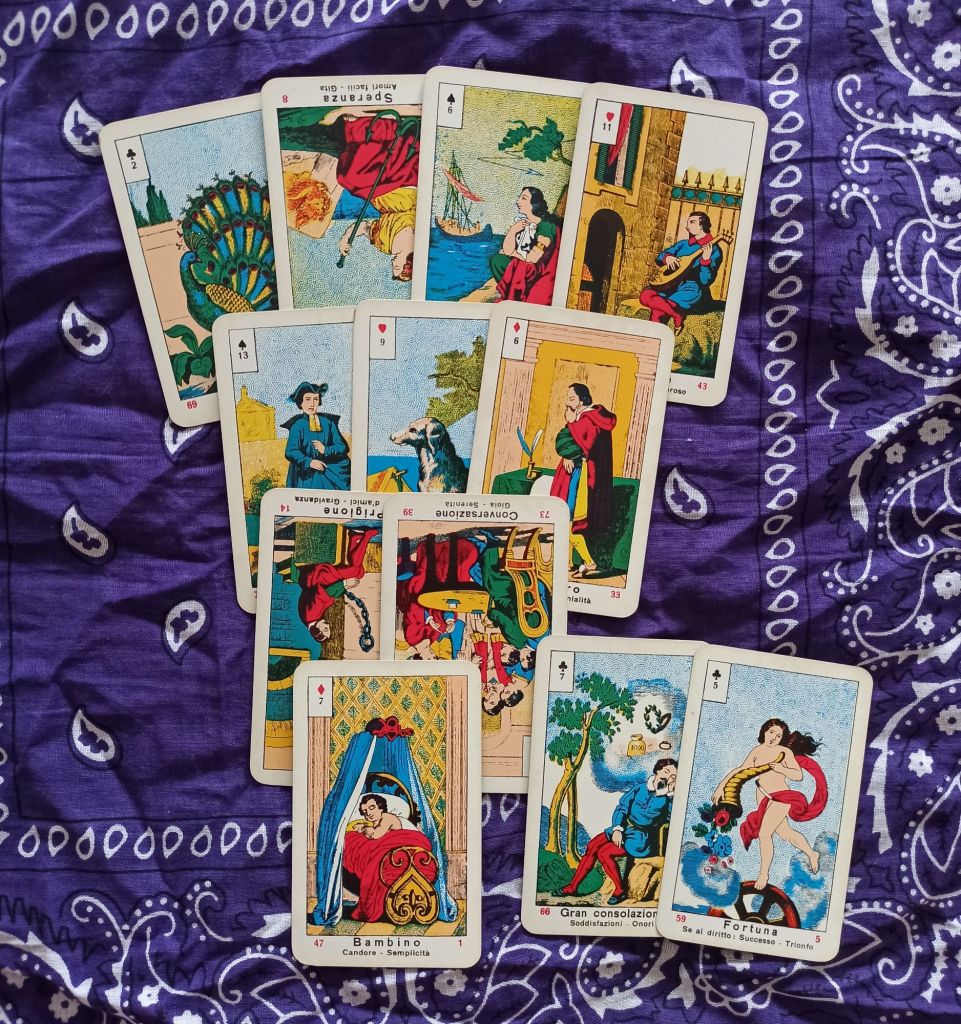
A spiritual reading with the Vera Sibilla cards

The first thing I was able to detect was the presence of the Priest in the second row. The Priest is usually not a real priest, and rather indicates a figure of authority. We also have, it seems, the significator card for the querent, represented by the Boyfriend, or Jack of Hearts, in the first line. The Priest is accompanied by the Dog/Faithfulness. This is a very good card, even outside of a love reading. It shows that, whoever the Priest is, he (or she) is good, trustworthy and has the querent’s best interest at heart. Furthermore, they are true believers.

The Thought card perplexed me a little, so I skipped over it (though you can see that the Thought card is just under the querent, so it turned out that it was the querent’s thinking process setting into motion). However, I did ask the querent if he was in contact with some kind of spiritual authority and he confirmed it, though he said it wasn’t a traditional priest or minister. This doesn’t matter: all kind of spiritual authorities can be signified by the Priest card.

The querent’s line, the first, has the card of God in it. This is the Peacock (when reversed, it represents the Devil and demons, as well as pride and haughtiness). The Peacock indicates totality, wholeness, miracles, etc. when upright. But it is followed by the Hope card reversed. Hope is the card of faith, but it is reversed, thus showing unbelief.

Yet it is not a clear atheism. Look at the Six of Spades, the Sighs card, right between the querent and the combination of lack of faith in God: the querent is sighing about his lack of faith. He is uncertain and tormented. I remember judging that he was probably a wobbly agnostic, and upon asking he confirmed that he had doubts (I didn’t ask him “are you a wobbly agnostic?” of course. We need to be kind to the querent).

It turned out, the querent had long banished spirituality from his life, had gone for an engineering degree, had been active in the skeptic community online, etc. However, some personal experiences had made him doubt his position.

Look at the last three cards of the pyramid. The Prison reversed shows unburdening, unshackling, freedom, etc. (when not followed by negative cards). Then we have the Conversation card. When reversed, it shows change. Finally, the Child, which shows a new beginning. I don’t know about you, but liberation + change + new beginning sounds like a spiritual conversion.

Furthermore, look at the angles of the pyramid plus the center: the Peacock (God), the querent, the new beginning (Child) and the Faithfulness card. This is a very positive indication.

Still, just to make sure, I asked the querent to draw two cards, and these were the Gratification and Fortune, confirming the good outcome.

As far as I know, the querent has since chosen his spiritual path.

MQS

Tarot Encyclopedia – The Ace of Wands

(Note: this is a collection of the meanings attributed to the cards by some occultists in the past centuries. It does not reflect my own study or opinion of the cards. It is only meant as a quick comparative reference as I develop my own take.)

The Ace of Wands from the Builders of the Adytum (BOTA) Tarot deck

Paul Foster Case (and Ann Davies)

In Tarot Divination the Ace of Wands has these key meanings: natural as opposed to invoked force; strength; force; vigor; vitality; particularly the force of concentrated will; the principle of beginning; initiation or inception of any enterprise or activity; concentration of power; involution of force.
Keyword: Initiative
(From the Oracle of Tarot course)

A. E. Waite

A hand issuing from a cloud grasps a stout wand or club. Divinatory Meanings: Creation, invention, enterprise, the powers which result in these; principle, beginning, source; birth, family, origin, and in a sense the virility which is behind them; the starting point of enterprises; according to another account, money, fortune, inheritance. Reversed: Fall, decadence, ruin, perdition, to perish also a certain clouded joy.
(From The Pictorial Key to the Tarot)

Aleister Crowley

This card represents the essence of the element of Fire in its inception. It is a solar-phallic outburst of flame from which spring lightnings in every direction. These flames are Yods, arranged in the form of the Tree of Life. (For Yod, see Atu IX supra.) It is the primordial Energy of the Divine manifesting in Matter, at so early a stage that it is not yet definitely formulated as Will.

Important: although these “small cards” are sympathetic with their Sephirotic origin, they are not identical; nor are they Divine Persons. These (and the Court Cards also) are primarily sub-Elements, parts of the “Blind Forces” under the Demiourgos, Tetragrammaton. Their rulers are the Intelligences, in the Yetziratic world, who go to form the Schemhamphorasch. Nor is even this Name, “Lord of the Universe” though it be, truly Divine, as are the Lords of the Atu in the Element of Spirit. Each Atu possesses its own private, personal and particular Universe, with Demiourgos (and all the rest) complete, just as every man and every woman does.

For example II’s or VI’s Three of Disks might represent the establishment of such an oracle as that of Delphi, or VIII’s might be the first formula of a Code such as Manu gave to Hindustan; V’s, a cathedral, XVI’s, a standing army; and so on. The great point is that all the Elemental Forces, however sublime, powerful, or intelligent, are Blind Forces and no more.
(From The Book of Thoth)

Golden Dawn’s Book T

A WHITE Radiating Angelic Hand, issuing from clouds, and grasping a heavy club, which has three branches in the colours, and with the sigils, of the scales. The Right-and Left-hand branches end respectively in three Flames, and the Centre one in four Flames: thus yielding Ten: the Number of the Sephiroth. Twoand-twenty leaping Flames, or Yodh, surround it, answering to the Paths; of these, three fall below the Right branch for Aleph, Men, and Shin, seven above the Central branch for the double letters; and between it and that of the Right twelve: six above and six below about the Left-hand branch. The whole is a great and flaming Torch. It symbolizes Force — strength, rush, vigour, energy, and it governs, according to its nature, various works and questions. It implies Natural, as opposed to Invoked, Force.

Etteilla

Birth
Upright. This card means, in its natural position, as far as the medicine of the spirit is concerned: Birth, Beginning. – Nativity, Origin, Creation. – Source, Beginning, Primacy. – Extraction, Race, Family, Condition, House, Lineage, Posterity, Occasion, Cause, Reason, First, First fruits.
Reversed. Fall, Decadence, Decay, Decline, Decay, Decay, Dissipation, Failure, Bankruptcy, Ruin, Destruction, Demolition, Damage, Devastation. – Guilt, Error, Contempt, Abatement, Depression, Discouragement. – Perdition, Abyss, Chasm, Precipice. – Dying, Falling, Decay, Derogation. – Depth.

MQS

Divination vs Fortune-Telling: History of a False Dichotomy

The founder of BOTA, Paul Foster Case, proudly started his short book “Oracle of the Tarot” with the assertion that Tarot divination is not fortune-telling. The reason, he explains, is that fortune-telling is grounded in the belief in luck, chance or fate, while divination understands that everything is about our personality. The same statement is found at the beginning of the advanced BOTA course on tarot divination (Oracle of Tarot, without the ‘the’). Ann Davies clearly had a hand in rewriting it, considering how verbose the course is, but the substance was similar.

Paul Case was tapping into the spirit of the times when he made that statement. Since Tarot had the (mis)fortune of attracting the attention of XVIII and XIX century occultists, it hasn’t enjoyed a moment of peace: everyone wants to believe it to be not an obvious masterpiece of Renaissance art and Medieval philosophy, but an occult device made to transmit mystical knowledge unknown to most people (even though most people prior to the Enlightenment and the French revolution would have been able to tell you what the Tarot was about).

The same has happened to Astrology. Once a practical art for foretelling the ups and downs of actual life, it became the victim of the occult intelligentsia of the last couple of centuries and was turned into a hodgepodge of pseudomysticism, ill-digested psychoanalytic concepts and “it’s true if you believe it” New Thought crap.1

But this is not the whole story. If one takes the time to study, say, the Golden Dawn system, one quickly finds out that their traditional way of reading the Tarot is grounded in fortune-telling (just read MacGregor Mathers’ example of the Opening of the Key spread). Even the BOTA system, which derives from it, preserves very concrete meanings to be strung together into sentences, despite Ann Davies’ attempt to turn divination into a form of Kabbalistic meditation.

In other words, the occultist attempt at reappropriating the Tarot and Astrology (which in part continues to this day with some bogus theories about the so-called Tarot of Marseille, but more on this in another post) is only partly responsible for the divination/fortune-telling dichotomy. Much of contemporary occultism is grounded in the psychoanalyzation of magic and spirituality, which, in turn, is a defense mechanism against the death of the classical spiritual worldview. Yet, for all its shortcomings, it at least preserves some core tenets of the magical worldview.

But the problem with this is that while it does preseve in some ways the roots of the worldview in which divination can flourish, it has lost the intellectual basis for defending it. Intellectually speaking, even today occultism is largely stuck in the pre-WWII era, with its myths of scientific positivism, of constant historical progress and of magic as misunderstood technology (while I would argue the opposite, namely that technology is misunderstood magic).

Essentially, what has gone lost is the philosophical framework that allows us to keep together divination as spiritual practice and divination as uttering of concrete, verifiable truths.2 That’s largely because spirituality, in the post-XVIII-century Western world, was only allowed to survive as private indulgence in irrational behavior, a weakness to be tolerated.

Thus the split was born: 1) on one hand divination: a ‘serious’, and therefore unverifiable endeavor, a tool for vague self-reflection, cheap catharsis and shallow instagrammable aha moments. In other words, something that the small judgmental scientist constantly perched on most people’s shoulder could smile upon as at least benign, if not really true; 2) on the other hand fortune-telling: a crass or quaint superstition that is just a scam when it gets things wrong and just a coincidence when it gets them right. The little scientist can be free to frown on it. In other words, the distinction was born out of the guilty conscience of “spiritual” people, i.e., out of their subconscious scientism, as a way of telling themselves and society “I indulge in this silliness, but I am just quirky, not stupid.”

The occultists of yore were at least intelligent men and women who actually had something to say. They may have worked in an intellectually hostile environment, but they at least gave it their best shot, and for this they deserve leniency. What happened next is worse: that the already battered art of divination fell into the hands of stoned hippies and people with degrees in the most useless branches of socially acceptable knowledge. Then along came the Liz Greene’s and the Rachel Pollack’s (to make just two examples) who destroyed Astrology and Tarot even further. From then on it could only go in one direction: past life readings, divine feminine, empty motivationalism and strategizing, healing of generational traumas and all the attendant nonsense.3

Interestingly, the more contemporary divination’s fake husk rots, the more one needs to be intellectually dead to practice it, the more it becomes reintegrated in the higher spheres of society. I believe I already talked about a friend of mine who works for Google and has to endure meaningless meetings with tarot readers and astrologers because her boss is the manifestation-obsessed boss babe type. Nor are tarot readers a rarity in corporate America. This probably says something about how brain-damaged this kind of environments is. The nicest thing we can say about this part of society and this strand of divination is that they deserve each other.

MQS

  1. This is not to say that Astrology or divination were unanimously accepted, but the debate was much more complex. ↩︎
  2. This, by the way, is not a call to “go back” to some long lost good old times. I am no reactionary. Nor am I a progressive. I am a realist. ↩︎
  3. By which, of course, I do not mean that there is not a feminine side of the divine, nor that trauma cannot be a real thing. I only mean that these words correspond to nothing but the most vapid pseudointellectual nonsense when coming out of most people’s mouths nowadays. ↩︎

Is He An Atheist? (Card Reading Example)

Traditional cartomancy, like all traditional divination systems, is full of tips on how to handle spiritual topics. The difference with contemporary psychobabble is that in traditional cartomancy we deal with a spirituality that is rooted in the earth and in everyday life rather than in Mind/Body/Spirit section poppycock. As I often remark, in such systems spirituality is seen as the logical next step for someone who is acquainted with real life, not as a consolation prize for someone who is trying to avoid it.

The querent asked if her boyfriend believes in “a superior being”, by which I assume she meant God (“being” is probably a more reassuring term compared to “bearded guy holding a lightning bolt”). She places great importance on the topic, but he seems to avoid talking about it. This is a playing card reading. In the next days I will also post a Vera Sibilla reading done on a similar question by a different person some time ago.

A♥ – 8♣ – 9♣ – K♥ – 7♣

Seeing this, I asked the querent to draw three more cards to open the reading on the Ace of Hearts, which yielded the 2♠, the 2♣ and the 6♣.

The first thing I noticed was the complete absence of Spades (except in opening the spread, but that’s a very weak Spade). This generally bodes well for spirituality. However, there is also a majority of Clubs, which indicate struggles and difficulties. There is no need to interpret the spread card by card. The spread indicates a slow or difficult relation with the divine. Belief is not denied, but it is rendered heavy, problematic.

The first card is the Ace of Hearts, which can indicate “inner” issues, but because the first card in a spread can also represent the cause of a situation described by the following cards, I ventured to interpret it as issues relating to the home causing the querent’s boyfriend to falter in his faith. The three additional cards with which I opened the spread on the Ace of Hearts reinforced my idea that there must have been a difficult atmosphere at home surrounding the topic.

What about the King of Hearts? Is it the dad? Well, no. Traditionally, in spiritual readings the King of Hearts is God himself (just like in the Sibilla): he is the lord (King) of your inner life (Hearts). Surrounded by all those Clubs, the God-side of the boyfriend’s life suffers, is stifled. Yet it is there, since the King of Hearts comes up and is not surrounded by Spades.

I asked the querent to give another three cards to open the spread on the King of Hearts. These were the 10♠, the 4♣ and the 10♥. At night (Ten of Spades) he speaks (Four of Clubs) spiritually/finding consolation (Ten of Hearts). He prays to God at night.

MQS

Tarot Encyclopedia – Index

Back to the Tarot Index

This is intended as a collection of meanings attributed by some sources to the Major Arcana and Minor Arcana of the Tarot. I will add sources as I study them. If you have sources to recommend, hit me up.

If you are interested in a (partial) list of the meanings I attribute to the Major arcana in my reading examples and case studies, click here.

Court Cards

Kings Wands, Cups, Swords, Coins/Pentacles
Queens Wands, Cups, Swords, Coins/Pentacles
Knights Wands, Cups, Swords, Coins/Pentacles
Pages Wands, Cups, Swords, Coins/Pentacles

Small Cards

Aces Wands, Cups, Swords, Coins/Pentacles
Twos Wands, Cups, Swords, Coins/Pentacles
Threes Wands, Cups, Swords,Coins/Pentacles
Fours Wands, Cups, Swords, Coins/Pentacles
Fives Wands, Cups, Swords,Coins/Pentacles
Sixes Wands, Cups, Swords, Coins/Pentacles
Sevens Wands, Cups, Swords, Coins/Pentacles
Eights Wands, Cups, Swords, Coins/Pentacles
Nines Wands, Cups, Swords, Coins/Pentacles
Tens Wands, Cups, Swords, Coins/Pentacles

MQS