Tag Archives: tarot reading

Bolognese Tarot – Introduction to Combinations

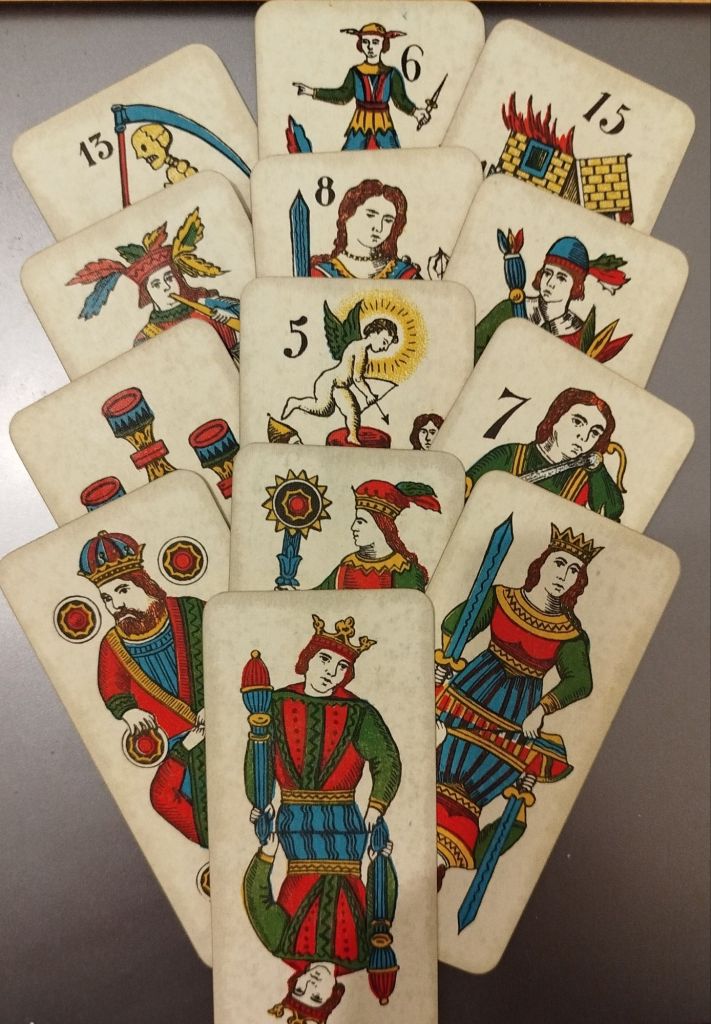
The Tarocco Bolognese is famous in Italy for relying heavily on combinations of cards. Rather than each card being a full picture, the cards are like small tiles in a mosaic, and need to be interpreted as a whole. No individual card can tell us much of anything. Let’s take the most favorable card in the deck, the Angel. In itself a wonderful card of protection and solution. Yet, alone, the Angel merely says “protection” or “solution” or “friendship” or any other keyword. We still don’t know if this protection exists, is longed for, is missing, is crumbling, or what effects it will have.

In this, the Bolognese tarot is much closer to the Sibilla or Playing Cards or other traditional oracles than to how tarot is often read nowadays (but regular tarot did use to be read in a combinatory manner in the past, before the Waite deck became popular and people started focusing on illustrations).

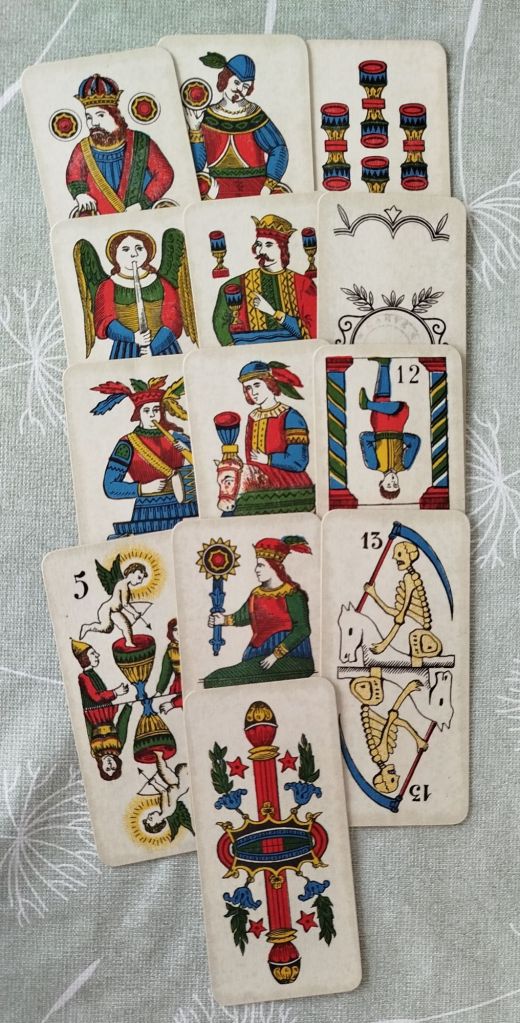
Since each individual card doesn’t say much by itself, the spreads tend to rely on a larger number of cards. The smallest traditional spread done with the Bolognese tarot is the thirteen card spread, which I have already shown, and which I will cover again. This is a small tableau of three columns of four cards (or four rows of three cards) plus one at the end. In this small tableau, the cards are interpreted in their interaction with one another.

Often, therefore, it is necessary to be able to see the big picture when interpreting the Bolognese Tarot. Occasionally, all cards are important and need to be considered. At other times, one or two cards come up in the spread that we don’t know how to interpret and don’t make sense to us, and there is no point in banging our head against them, trying to fit them into the interpretation at all costs: we should be able to see where the answer to our question lies, where the cards that are clearly forming a message are clustering, and go from there.

Look at the spread as if it were a bunch of people in central square. Some are there to meet other people and discuss something important or go somewhere interesting together. Others are simply sitting there because their wife kicked them out so she can finish waxing the floor in peace, so they just sit alone. They don’t have much to add. They are just there. Or, if you prefer the image of the mosaic I used earlier, some tiles go together to show the cool angel warding off the horde of demons, while other tiles are just vaguely blue and form the sky in the background.

This sounds complicated but it isn’t necessarily, once we have developed an eye for which cards tend to go together. Don’t fixate on rigid 1+ 1 + 1 + 1 +1 = 5 kind of combinations. In cartomancy, 1 + 1 +1 + 1 +1 often equals a bunch of crap if you are not careful. Who says that it’s 1 + 1 +1 +1 +1, and not 1 + 1 on one hand and then 1 +1 +1 on the other? Or 1 + 1 + 1 + 1 and then one left over? Who says the cards add up, instead of detracting from each other? The Angel is good, but followed by the Hermit and the Tower it is diminished. Strength makes you strong, but Strength followed by the Moon? Not so much.

Look at the flow and apply logic to it. See how the small meanings of the cards cluster together to form one coherent bit of mosaic. That coherent bit of mosaic may be next to another bit that is coherent in itself, without the two going together: in one corner you may have the scene with the angel warding off the demons, but right next to it you could have God creating Adam and Eve. Mix them the wrong way and you’ll have the angel warding off God, while the demons create Adam and Eve. Not good on the angel’s resume.

Also, don’t fixate rigidly on methods like “the first card is the noun and the second is the adjective” that were popular some time ago in the Lenormand community. I don’t use Lenormand, don’t know if that’s how they work, but it certainly doesn’t help with the Bolognese tarot. Again, the big picture is essential. Once we have that down, we can carefully add the details.

Finally, go for concrete life. The cards can talk about many things, from the most mundane to the most deep, including spirituality, psychology and so on. Do keep in mind, though, that the card readers of yore didn’t ponder too many questions we (often deludedly) consider deep. Not because they were dumb (they weren’t) but because they had other priorities: they were too occupied seeing if they could put away enough food for the winter or if the doctor would be able to come in time from two towns over on his rickety buggy to see what was wrong with little Guido.

Ordinary life is our starting point. It is in it that more spiritual or introspective topics are nestled. Without real life, spirituality falls into the void, failing to manifest, and it therefore remains an abstract collection of feel-good statements. But just because we start from real life doesn’t mean the tarot can’t talk about it in sometimes strikingly deep or metaphorical ways.

The tarot is highly metaphorical. Never forget that the old card readers had entire poems, folk songs, stories and even Bible books committed to memory. They were often capable of seing meaning in things we consider bland. Again, they were practical, not dumb. Life is highly metaphorical and symbolic if you know how to look at it, and the tarot is a good lens. Of course Truth (Queen of Coins) and Love can mean a true love, but what does it mean that your job is true? Think about it.

MQS

An Assault (Example Reading)

I don’t often pick three cards for the day, and usually when I do they show very minor situations, for the very good reason that most days are very minor in themselves. The day before yesterday I shuffled the Bolognese Tarot and this came up for the following day:

Three cards for the day

The Sun and Moon, in the Bolognese Tarot tradition, indicate sorrow or tribulation. Usually, when the Moon falls last, the sorrow is serious or lasting, while if the Sun falls last it eventually overcomes the Moon, so the sorrow is shorter or less impactful. Still, what we have here, is sorrow knocking at the door, even though it’s passing. Curious, I decided to deal out some other cards, even though I wasn’t sure the cards would keep talking about the same thing. This came up:

The rest of the deck

Clearly this is not a happy string of cards, and it seems to be dealing with a young woman (the Page of Cups). I wasn’t sure if the young woman had anything to do with me or was experiencing something herself, so I left it at that.

Yesterday, aside from being a mentally taxing day for me, a friend of mine was assaulted by a junkie while walking the dogs, but she managed to make it out of it with nothing more than a big scare and a broken fingernail. She alerted the police, and she asked me what I thought would come of it. This time I whipped out the playing cards.

What will be the consequences of the assault?

The Jack of Spades immediately calls attention to himself, showing a criminal in this case. It is surrounded by two Spades, so trouble or inconvenience for him. The Four is also a card of violence, but I don’t think it has anything to do with it: they are describing what happens to him. Then the spread takes a sharp turn for the better (for the criminal, that is): things change (Five of Diamonds) and he walks (Two of Clubs). I doubted there would be serious consequences. Note also the absence of the law (the King of Spades) or of the prison card (the Five of Spades).

The man was stopped, since he is known around town for being a weirdo, but my friend is probably not going to press charges since she was told there were no witnesses and it would turn into an endless battle of he-says-she-says for what, in the eyes of the law, was a minor scuffle on the streets between two adults. I’ll update the post if anything new happens.

MQS

The Main Problem (Cross Spread Example Reading)

Those who read my Sibilla and Playing Cards sections are probably familiar with the cross spread I use with those decks. Turns out, the same spread can be used with the Bolognese tarot.

This querent is the same I read for here and had a crush on a colleague. The cross spread I present here is a prequel to that spread.

A general cross spread

The cross spread may be used to look at a person’s life in general or to answer general questions (“tell me about my career”). In this case it was general. I’ll keep it short:

  1. Above the head position (what the querent would like or is thinking about): King of Cups, Juggler/Magician, Ace of Cups. This screams “pucture perfect family” with a husband (King), children (Juggler) and a hearth (Ace of Cups)
  2. Under her feet (what she doesn’t want or what she has trouble with): Love, Ace of Wands and Eight of Wands. Love and Ace of Wands together represent a relationship, and the Eight of Wands is a road or path, so it could indicate a love life. Note that this position could indicate that she doesn’t want a relationship, but considering what the cards on her head are saying, it is more plausible that she wants a relationship but has trouble obtaining it.
  3. To her left (past or present): Star, King of Coins, Death. This position talks about work. After checking with her, I discovered she had lost her job in the months prior to the reading and had found a new one.
  4. To her right (near future): Page of Swords, Fool, Seven of Cups. This speaks generically about confusing messages concerning the home.
  5. Center (in her heart): Angel/Judgement, Devil and King of Wands. Well, Angel and Devil together represent, traditionally, great satisfaction, connected to a man. This seems to be the cards’ polite way of saying she’s turned on by him.
  6. To the side (for her): Ace of Swords, Knight of Coins, Ace of Coins. Speedy positive news about money. Probably connected to the near future position, but we didn’t look further into it.

And the reason we didn’t look further into it is that the most important cards (those comprising the central column, i.e., above, heart and below) are all connected with love. This is how the spread about the colleague was born. Note, however, that this spread, when done in general, can give us brief messages about the most disparate fields of life, and it is up to us then to expand on them by either adding cards or doing other spreads.

MQS

A Crush on an Unhappy Man! (Example Reading)

This is not the first time I do a reading for someone who has a crush on a colleague. The girl in question asked me if a love story could start with him

A love reading using the Bolognese Tarot (Thirteen Card Spread)

I used the Bolognese Tarot to answer this.

This is one of those spreads that let themselves be interpreted in more than one direction: not just horizontally but vertically as well. The First two things that caught my eye were the first line, with the King of Wands (him) trapped between the Tower (prison) and the Seven of Coins (tears); and the vertical line on the right, with the Ace of Wands and the Ace of Cups together, indicating a family, but the two cards are hemmed in by the tears and the Moon (again, negativity).

So this is an unhappy man we are talking about. In the following line, the Angel card, which would provide happiness and solutions or at least peace, is blocked by the Hermit. Note that the Ace of Wands, which can indicate attraction, is also affected by the blockage, so while he may be somewhat attracted by the querent, he is not gonna act out on it.

The following line was a bit harder to decipher, but I saw it as him having a daughter and being especially attached to her: note the Page of Cups, the girl, of the house (Ace of Cups) brings him jollity or happiness (Ten of Cups). It later turned out he has more than one child but he is more attached to the girl. It is possibly one of the things that keep him in the marriage.

In the end, there is probably going to be no relationship with the man: the relationship card (te Ace of Swords) is negatively affected by the Moon, and the querent will only have a business relationship (Star) with him.

One thing I need to emphasize is that the querent knew the dude is married, but didn’t tell me, not because she wanted to try me, but because in her mind she thought it was somehow “obvious”. It is always interesting to see how querents take our ability to see things for granted (only to be sorely disappointed when we make the most minor mistake).

MQS

Psychological Hang-Ups of Diviners and Querents

When a person sits in front of a diviner, a number of preconceptions have often already been set off in their mind, and sometimes even in the mind of the diviner.

We must always remember that, nowadays, many people don’t visit an astrologer or card reader by chance, nor (usually) as their first go-to choice. Often, they have made a deliberate choice to step outside of the norm, for better or for worse, meaning that they have found the norm to be lacking in its ability to provide certainty. For many, therefore, the underlying presupposition seems to be: “I accept to take part in something that operates outside of consensus reality as long as it gives me the certainty I can’t find any other way.”

As diviners, we instinctively know it, and we may feel pressured to play into this presupposition or swim directly against it, thus falling into the opposite error.

Some diviners may feel they need to provide the querent with the unreasonable all-knowledge that only God can gift them with, only to end up providing uncertain information with unreasonable confidence. Others may push in the direction of vague self-help: We may not know if Mr. Right is behind the corner for our love-starved querent, but her divine feminine or other buzzword can still derive important lessons and “aha moments” from reflecting on the whole situation.

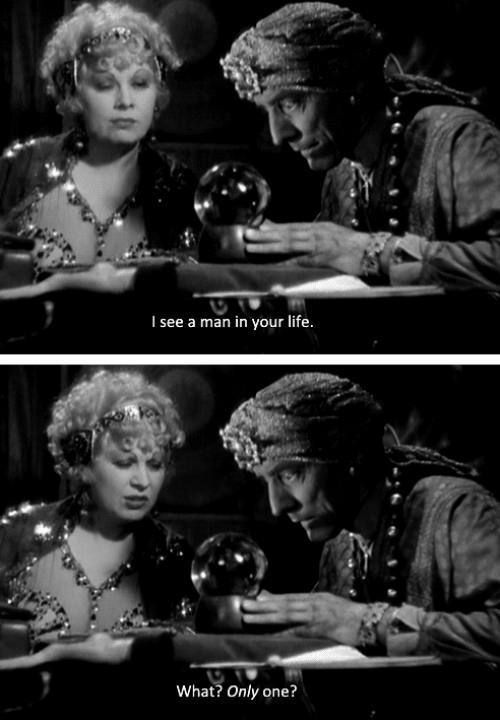
Mae West said it best. Picture by Sophie Charlotte on Pinterest

There are many dimensions to divination, some of which are indeed very deep. However, as far as our relationship with querents is concerned, we are simply an added means of intelligence-gathering, which, like all tools at our disposal, may fail for a variety of reasons, not the least of which is the diviner’s limited knowledge (our knowledge is always limited).

“But I came here to have undebiable, clearcut answers,” one might argue. To which I anwer: Tough titties! If you want undeniable clearcut answers shake a magic eightball. Divination is, quite literally, a divine language, and is not always so cleacut, either in itself or due to our limitations, or sometimes simply because the situation isn’t clearcut in itself. This is especially the case for issues involving human emotions.

As a rule, honesty is the best policy. I believe in voicing my procress to the querent, and the querent has a right to as clear an answer as I am capable of giving them, but we should never feel pressured to give them more certainty than we can truly see in the oracle.

It is perfectly acceptable to talk to the querent about our doubts or about the possible interpretations we are seeing in the oracle. For instance, it is ok to say “it seems like x, but y is also a possibility, while z seems less likely and w is out of the question.” It is also acceptable to say “these cards seem to point to such and such being the case, but I’m uncertain, as this other interpretation might also be right”. More often than not, the querent will say that both interpretations apply, and when this is not the case they can help us disambiguate the oracle.

Ultimately, the fact that divination has no legitimate place in our society implies as a consequence that, because our society believes itself to be held together by reasonable rules and processes, then divination must be either complete poppycock for delusional idiots or it must be capable of unreasonable fits of prowess in other to justify its existence in spite of its current ostracism.

This in turn creates expectations and hang-ups on both ends of the divination process that need to be analyzed and clarified to avoid them subconsciously ruling our practice. Doing so can make divination much more valuable and much more enjoyable.

MQS

Recovery From Surgery (Example Reading)

Plenty of readings this time of year, and an above average number on health issues. An acquaintance of ours, an elderly man whom we know from theater, had to go under the knife for major surgery, my husband and I decided to see how the situation would evolve. I used the 45-card Bologna tarot system and the 13 card spread.

Recovery from Surgery. Spread with the Bologna

I am immediately reassured by the lack of dramatic sequences. However, the first row is interesting: Death can indicate a major turning point, the Chariot is the bed card in this tradition, and the Tower is a place of suffering, such as a hospital. Death and Tower can be a tragedy or painful situation. Technically you’d need the Knight of Swords together with the Chariot and Tower to predict surgery, but considering I didn’t even need to predict it (I knew it already) the cards are being remarkably specific.

We also find that his thoughts (the Knight of Wands) are not at ease (the Fool and Justice, that is, irrgularities on his idea of what is right). It could simply indicate bewilderment at the question of how he is going to move on from this. Note that the Tower weighs his thoughts down.

In the following row we see that there is love and care around him (Seven of Cups and Love) and that this care is going to have to last quite a while (Temperance). The recovery is going to take its time. Finally, the cards reassure us that the people and doctors taking care of him mean well and know what they are doing (the Queen of Coins is the truth, wisdom and knowledge).

All in all it could certainly have been worse.

MQS

The Great Spreads with the Bologna Tarot – The Staircase

Following up on my previous post about the “bed sheet” spread with the Bologna tarot, I wanted to cover another full-deck spread: la scala, i.e., the staircase spread. You could also call it a pyramid spread, but I’ve never heard it being referred to as ‘pyramid’, possibly because pyramids were quite outside of the daily experience of the old ladies of Bologna. Here is the layout:

The staircase spread (la scala) with the Bologna Tarot

Note that this spread is intended for a 45-card deck. If you use a 50-card deck you’ll have five cards left over that you can put to the side as describing something imminent or something that is outside of the querent’s life (your choice).

The principles for interpreting this spread are the same as with the previous one: we look at the angles, then we locate the significator (Queen of Wands for a woman, King of Wands for a man). Generally speaking, anything above or before the significator shows the past, and anything after or under it shows the future, but we need to be flexible: sometimes we can just read the full column or row of the significator as a single sentence.

Furthermore, while the angles are important, we must not forcefully insert them into the reading: if they seem meaningful we can look at them, if they don’t, we can ignore them. Sometimes their significance becomes clear as the reading progresses.

Finally, we can look at the cards forming the outer diagonal side of the triangle as giving us one or more predictions concerning the future. In this case, the cards are read from the bottom to the top, walking up the stairs as it were.

In this case, let us suppose we are reading for a man. The angles of the spread are formed by Temperance, the Moor and the World. The cards are not especially clear. Let us move on for now. The King of Wands is found in the fourth column and third row. The row is quite negative: Justice is in the dark (Moon) causing suffering (Eight of Swords) at home (Ace of Cups) and confusion (Fool) that requires an expert (King of Coins). This could relate to something legal or bureaucratic.

In his column we find that there are messages and talks (Page of Swords, Page of Coins) with a woman who is close to him (Queen of Cups) and these communications are sad (Seven of Coins) but will be required to clarify some things (Queen of Coins).

Note that not everything we read in this spread must necessarily be connected to everything else, since this spread is supposed to be general. However, in this case we find that the querent’s card is close to the house card and the conversations happen with a family woman, so we can guess that the two things are related. Looking back at the angles, they cound indicate that this situation is requiring unexpected journeys.

Now let us look at the diagonal: the World and the Juggler could indicate a small trip or, considering the Ace of Wands is next to the Juggler, it might refer to hearing about a pregnancy. The Love card would confirm the joyful occasion. If we connect these cards, together with the Queen of Coins and the Strength card, to the issues we’ve seen relating the family, it could show the solution coming after a bit of uncertainty.

Considering the final cards on the stair, namely the King of Coins and the Chariot with the Moor, it could indicate an unexpected need to see a doctor (Chariot = sick bed, King of Coins = important man).

MQS

The Great Spreads With the Bologna Tarot – The Bed Sheet

The Bologna Tarot is typically read in large spreads. This is because each card has very simple meanings, so one cannot spend their time musing on them at length as often happens in contemporary tarot practice. The Bologna Tarot is closer to the Sibilla or to playing cards or Lenormand in this sense (or even to how regular tarot readings used to be).

Many general spreads done to tell a broad fortune use the whole deck. This is the case of the Lezuolata, or bed sheet spread. It is a 5×9 spread similar to the Lenormand or Kipper Grand Tableau (this is for the 45-card deck. If you use the 50-card deck just add a tenth row). Here is an example:

The Bed Sheet spread (Lenzuolata) with the Bologna tarot

This spread is typically used to “locate” the querent’s card (either the King or the Queen of Wands) and see how their general circumstances are. It is typical to start the reading by having a look at the four cards in the angles. In this case we have the Tower, the Hermit, the Ace of Coins and the Page of Cups. This could indicate money trouble relating to a young woman (maybe a daughter). If we interpret the Page figuratively, then it shows that the querent has no (bad cards) monetary (Ace of Coins) satisfaction (Page).

Let us suppose we are reading for a woman. The Queen of Wands is located in the second-to-last row and in the second-to-last column. She looks at the Moon, behind which there is the Ace of Cups (the house) and the Ace of Swords (relationships, or something close). Behind her is the King of Swords, a young man, and underneath her is the Juggler, which is a kid. So possibly she has kids (remember the Page of Cups), and she is worried about her financial situation at home.

Let’s look at the column where she appears. Broadly, this is a positive column, with a King and Queen of Cups possibly indicating figures in the family. Right above the Queen is the Chariot, which in this tradition indicates the sick bed, again reinforcing the idea of suffering (not necessarily physical). But the two figures of the Queen and King bring her the Ten of Cups, flourishing, and some minor good luck thanks to the Wheel.

Above the Wheel we find the Page of Wands, her thoughts, and the Seven of Cups, which also relates to the family, especially protection from the family. Possibly, therefore, the Queen is worried about having money for her kids, but her parents or another couple from her family are helping her.

As can be seen, this spread is not meant to let you talk at length, but it does give you a snapshot of the querent’s life at that moment.

MQS

Parrots and Betrayed Deals (13 Card Spread Reading Example)

As I mentioned here, I got a new parrot from a local breeder and I had an interesting reading concerning it. The reading was done using the Bologna Tarot in its 45-card variant. We had already gotten some pictures of some of the available birds, and we had settled on a gray cockatiel, because it looked like the one I had as a kid. As the day approached, I asked the cards if everything would go alright. This is the spread I got:

Is the bird handover going to go smoothly?

Although I’ve already talked about the 13 card spread, when used with the Bolognese tarot there are some peculiar aspects to it (it is, after all, one of the “official” traditional spreads to be used with this deck). Traditionally, when a yes-or-no question is asked, the following rules apply:

  1. If the Death card shows up in the spread, it’s a yes (as sure as we all die)
  2. If the Angel (Judgement) card shows up, it’s a good chance
  3. If both show up, it’s a sure thing
  4. If the Angel and the Devil show up, it represents great satisfaction within the context (the Devil is in itself a negative card, but it is redeemed by the presence of the Angel)

Well, in my (still limited) experience with this tarot deck, I have found that it’s best not to rely too much on mechanical rules: the cards must always be interpreted, and exceptions allowed for. Still, it is encouraging to see both the Angel and the Death card as answer. Let’s interpret the cards row by row, as they came up very clear and orderly (it is not always like this, unfortunately):

King of Coins – Page of Coins – Seven of Cups: there have been talks (Page) with a man concerning business (King). The Seven of Cups is generically positive here.
Angel – King of Cups – Ace of Coins: There is help (Angel) from a man of the house (King) concerning money (Ace). My husband paid in part for the parrot and the cage and food.
Fool – Knight of Cups – Hanged Man: This is the most interesting row in the spread. It shows something that brings chaos or confusion (Fool) and that betrays or upends (Hanged Man) the agreement (Knight of Cups)
Love – Queen of Coins – Death: True (Queen of Coins) Love (Love) is confirmed (Death)
Ace of Wands: Success, positive ending

So in general what we can say from the spread is that the breeder is trustworthy, my husband helps me and I will be very satisfied, but still the deal will somehow be changed in an unexpected/confused way.

What ended up happening: we got there and the breeder introduced us to the various chicks that were ready for adoption, including the one we had settled on. But as we were playing with them, a white cockatiel chick quickly flew onto my shirt looking for cuddles. Obviously, it was love at first sight (see the true love in the spread), and we got that one instead.

I believe this change of plans is shown in the spread by combination of Knight of Cups (agreement, conciliation) followed by the Hanged Man (betrayal, upending). Our initial agreement was upended (or “betrayed” in a metaphorical sense), but still everything ended on a positive note.

NOTE: look how “dry” this reading is. Traditionally, tarot was not interpreted by musing on how the pictures looked, but by applying clear and specific meanings.

MQS

Simplifications of the Opening of the Key Spread

In a previous article I discussed how the original Golden Dawn spread known as Opening of the Key fits perfectly into the mold of traditional divination by cards, although it adds certain occult layers to it. This is largely due to the absence of one-card-per-position layouts, the presence of peculiar techniques and the tendency to read cards in rows.

To sum up how the spread worked:

  • You selected a significator for the querent (usually among the court cards)
  • You shuffled the deck and let the querent cut it into four stacks (corresponding to the four letters of the Tetragrammaton)
  • You found the stack with the significator and had to divine, based on its position, the nature of the querent’s problem. If wrong, the divination wasn’t radical.
  • You had to spread out the cards into a row or arrange them into a ring and count starting from the querent’s card. Then, you had to pair the cards on either side of the querent to fill out the details.
  • Then you shuffled the deck again and dealt it out into the twelve houses. You had to find the querent’s significator and count and pair as before based on the house.
  • You shuffled the deck again and dealt it into the twelve signs. You found the stack, counted and paired.
  • You shuffled the deck, then looked for the significator and dealt out the 36 cards following it into a ring symbolizing the decans of the zodiac. You counted and paired.
  • Finally, you shuffled and dealt the deck into the ten Sephiroth of the Tree of Life, found the stack, counted and paired.

As you may have guessed, the Opening of the Key was a cumbersome spread, and while it was used for the solution of practical matters (Crowley famously remarked on this fact), it clearly was meant to be used primarily within a ritual setting, at least in its entirety.

What is also clear, though, is that the Opening of the Key is less a spread in itself than a blueprint for a complete tarot reading made up of five individual spreads, each of which analyzes the issue from a different standpoint, or rather by tapping into a different layer of it. The experienced card reader could simply choose one of the five spreads and use it without resorting to the others, as need dictates.

For the most part, it seems that many Golden Dawn members simply stuck to the first operation, which is consequently the most famous and iconic, where one cuts the pack into four smaller stacks and reads the one with the significator. The possible reason why the other operations were generally discounted is probably that almost all of them required the deck to be dealt out into small stacks, only one of which is read, so that it takes more time to deal the cards than to read them.

Other members, though, were more inventive. In his Oracle of the Tarot booklet, Paul Foster Case offers a simpler alternative to the five-operation extravaganza of the full method (which he nonetheless describes and recommends for more serious or complex questions)1

The divination starts as usual: by finding the stack containing the significator and telling the querent what he or she has come for without them telling us, based on the stack. In the original instructions, if the diviner is wrong in assessing the nature of the question, the divination should be abandoned. In reality, aside from the initial period of training, it seems that the location of the significator was simply used to color the interpretation of the cards.

At this point, Case’s simplified method diverges from the original. Instead of spreading out the stack into a single row or ring of cards and starting the counting technique from the significator, Case says the diviner must shuffle the stack and then deal it out into three smaller stacks, corresponding to the past, present, and future. Each stack is then read sequentially (as you would in playing card, Sibilla or Lenormand divination).

The simplification of the method is due to the fact that, instead of starting the exploration of the issue from the past/present with the first operation and then moving on to the further future with the other operations, one has immediately past, present and future condensed into a single method.

There are other ways of simplifying the Opening of the Key. Paul Hughes Barlow rose to some prominence a couple of years ago for his idiosyncratic way of reading the first of operation without relying on a significator, instead reading all four stacks, something for which he was reproved by some.

Personally, I have found Paul Case’s simplification very effective in my experiments, and I’ll probably post an example reading in the future.

MQS

  1. He also introduces certain specifications that are also found in the advanced BOTA course on divination elaborated by Ann Davies based on his notes. ↩︎