(Note: this is a collection of the meanings attributed to the cards by some occultists in the past centuries. It does not reflect my own study or opinion of the cards. It is only meant as a quick comparative reference as I develop my own take.)
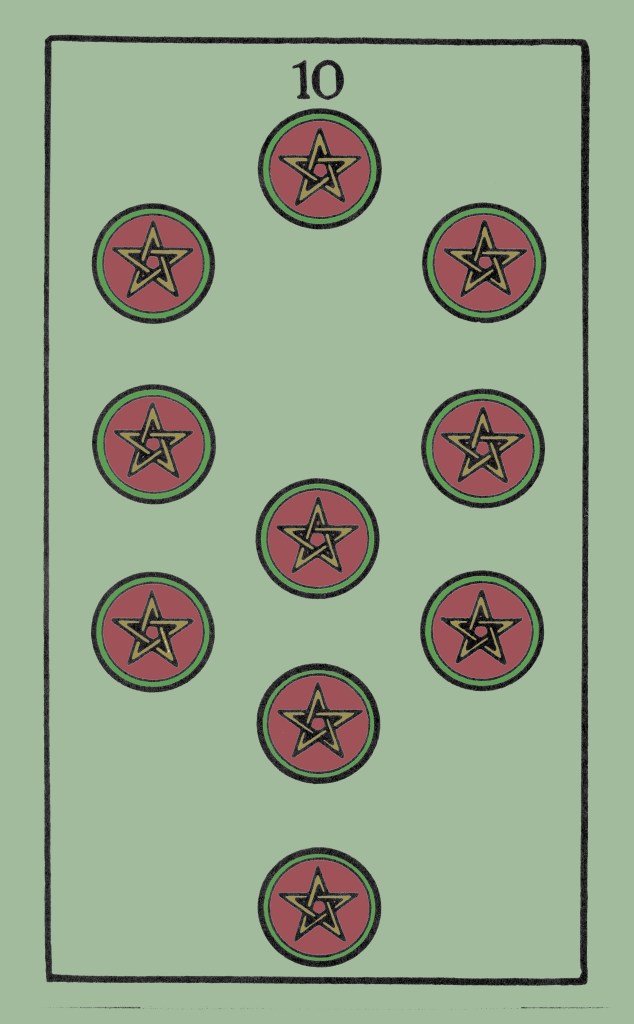
The Ten of Pentacles from the Builders of the Adytum (BOTA) tarot deck
Paul Foster Case (and Ann Davies)
The time period is the third decanate of Virgo, under the rulership of Venus, September 13 to September 22. Meanings: Well-Dignified: money through servants or subordinates; gain in matters connected with medicine, drugs, food, nursing, farming or gardening; completion in material gain and fortune, but nothing beyond. Ill-Dignified: material success, but heaviness and dullness of mind; sometimes loss through the matters listed above; slothfulness. Keyword: Wealth. (From the Oracle of Tarot course)
A. E. Waite
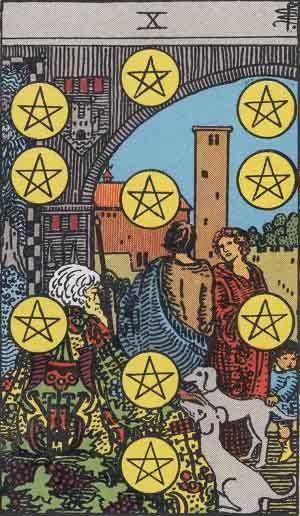
A man and woman beneath an archway which gives entrance to a house and domain. They are accompanied by a child, who looks curiously at two dogs accosting an ancient personage seated in the foreground. The child’s hand is on one of them. Divinatory Meanings: Gain, riches; family matters, archives, extraction, the abode of a family. Reversed: Chance, fatality, loss, robbery, games of hazard; sometimes gift, dowry, pension. (From The Pictorial Key to the Tarot)
The Ten of Pentacles from the Rider Waite Smith tarot
Aleister Crowley
The Ten of Disks is called Wealth. Here again is written this constantly recurring doctrine, that as soon as one gets to the bottom one finds oneself at the top; and Wealth is given to Mercury in Virgo. When wealth accumulates beyond a certain point, it must either become completely inert and cease to be wealth, or call in the aid of intelligence to use it rightly. This must necessarily happen in spheres which have nothing whatever to do with material possessions, as such. In this way, Carnegie establishes a Library, Rockefeller endows Research, simply because there is nothing else to do.
But all this doctrine lies behind the card; it is the inner meaning of the card. There is another view to consider, that this is the last of all the cards, and therefore represents the sum total of all the work that has been done from the beginning. Therefore, in it is drawn the very figure of the Tree of Life itself. This card, to the other thirty-five small cards, is what the twenty-first Trump, The Universe, is to the rest of the Trumps.
[…]
The number Ten, Malkuth, as always, represents the final issue of the Energy. Here is great and final solidification. The force is completely expended and results in death. Mercury rules this card in Virgo; and this may imply that the acquired wealth, being inert, will be dissipated unless put to further use by devoting its power to objects other than mere accumulation.
The disks, or (as they have now become) coins, are arranged on the Tree of Life, but the Tenth coin is much larger than the rest; the image indicates the futility of material gain.
These disks are inscribed with various symbols of mercurial character except that the coin in the place of Hod (Mercury) on the Tree is marked with the cipher of the Sun. This indicates the only possibility of issue from the impasse produced by the exhaustion of all the elemental forces. At the end of matter must be complete stagnation, were it not that in it is always inherent the Will of the Father, the Great Architect, the Great Arithmetician, the Great Geometer. In this case, then, Mercury will represent the Logos, the Word, the Will, the Wisdom, the Eternal Son, and Virgo the Virgin, in every implication of that symbol. This card is in fact a hieroglyph of the cycle of regeneration.
Among the Geomantic figures, Mercury in Virgo is Conjunctio. The meaning, conjunction, is shown plainly by the attraction of the descending (female) Triangle, the cipher of the Yoni, to the ascending (male) Triangle, that of the Lingam. This union completed, they appear interlaced, forming the figure of Capricornus, the Sign in which the Sun finds his rebirth. It is the holy Hexagram, the symbol of the uniting of the Macrocosm and the Microcosm, the accomplishment of the Great Work, the Summum Bonum, True Wisdom and Perfect Happiness. Sic sit vobis! (From the Book of Thoth)
The Ten of Disks from the Thoth Tarot deck
Golden Dawn’s Book T
AN Angelic Hand, holding by the lower extremity a branch whose roses touch all the Pentacles. No buds, however, are shewn. The symbols of Mercury and Virgo are above and below. The Pentacles are thus arranged:
* * * * * * * * * * Completion of material gain and fortune; but nothing beyond: as it were, at the very pinnacle of success. Old age, slothfulness; great wealth, yet sometimes loss in part; heaviness; dullness of mind, yet clever and prosperous in money transactions. Malkuth of HB:H (Riches and wealth). Herein are HB:LAVYH and HB:HHa’aYH set over this Decan as Angel Rulers
Etteilla
The house Upright. In terms of spiritual medicine, this card, in its natural position, signifies: Home, Household management, Economy, Savings. – Dwelling, Domicile, Residence, Manor, Lodging, Regiment, Ship, Vessel, Vase. – Archive, Castle, Hut. – Family, Origin, Race, Posterity. – Cave, Cavern, Refuge. Reversed. Lottery, Luck, Gambling, Chance, Accident, Ignorance, Fate, Destiny, Predestination, Fatality. – Fortunate or unfortunate opportunity.
(Note: this is a collection of the meanings attributed to the cards by some occultists in the past centuries. It does not reflect my own study or opinion of the cards. It is only meant as a quick comparative reference as I develop my own take.)
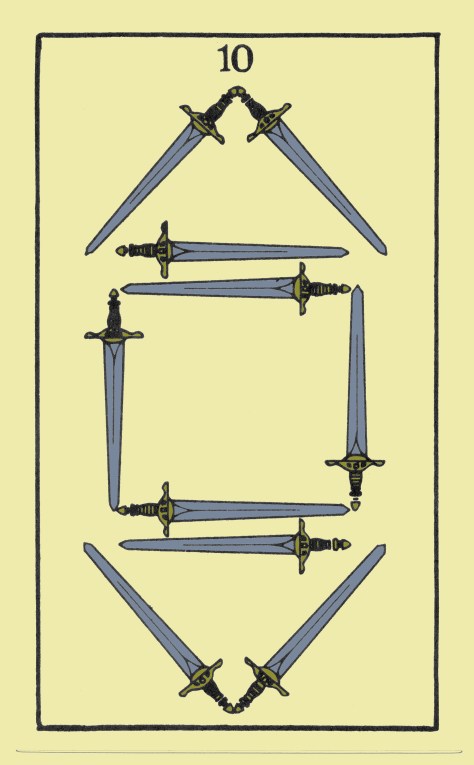
The Ten of Swords from the Builders of the Adytum (BOTA) tarot deck
Paul Foster Case (and Ann Davies)
The time period is the third decanate of Gemini, June 11 to June 21, under the rulership of Saturn and Uranus. Well-Dignified: in spiritual matters, the end of delusion; the overthrow of limiting conditions; break-up of restrictions. In material affairs, sudden and unexpected changes, not always unfortunate in the long run, but disappointing when experienced: interference from from others. and.loss through indiscretion in writmg or signing contracts. lll-Dignifled: failure, desolation, misery. Keyword: Destruction (From the Oracle of Tarot course)
A. E. Waite
A prostrate figure, pierced by all the swords belonging to the card. Divinatory Meanings: Whatsoever is intimated by the design; also pain, affliction, tears, sadness, desolation. It is not especially a card of violent death. Reversed: Advantage, profit, success, favour, but none of these are permanent; also power and authority. (From The Pictorial Key to the Tarot)
The Ten of Swords from the Rider Waite Smith tarot
Aleister Crowley
The Ten of Swords is called Ruin. It teaches the lesson which statesmen should have learned, and have not; that if one goes on fighting long enough, all ends in destruction.
Yet this card is not entirely without hope. The Solar influence rules; ruin can never be complete, because disaster is a sthenic disease. As soon as things are bad enough, one begins to build up again. When all the Governments have smashed each other, there still remains the peasant. At the end of Candide’s misadventures, he could still cultivate his garden.
[…]
The number Ten, Malkuth, as always, represents the culmination of the unmitigated energy of the idea. It shows reason run mad, ramshackle riot of soulless mechanism; it represents the logic of lunatics and (for the most part) of philosophers. It is reason divorced from reality. The card is also ruled by the Sun in Gemini, but the mercurial airy quality of the Sign serves to disperse his rays; this card shows the disruption and disorder of harmonious and stable energy.
The hilts of the Swords occupy the positions of the Sephiroth, but the points One to Five and Seven to Nine touch and shatter the central Sword (six) which represents the Sun, the Heart, the child of Chokmah and Binah. The tenth Sword is also in splinters. It is the ruin of the Intellect, and even of all mental and moral qualities.
In the Yi King, Sol in Gemini is the virtue of the 43rd Hexagram, Kwai, the Watery modification of the Phallus; also, by the interlacing interpretation, the harmony of these two same Trigrams.
The signification is perfectly harmonious with that of the Ten of Swords It represents the damping down of the Creative impulse, weakness, corruption, or mirage affecting that principle itself. But, viewing the Hexagram as a weapon or method of procedure, it counsels the ruler to purge the state of unworthy officers. Curiously, the invention of written characters to replace knotted strings is ascribed among Chinese scholars to the use of this hexagram by the sages. Gemini is ruled by Thoth; 10 is the key of the Naples Arrangement; and Apollo (Sol) is the patron of literature and the arts: so his suggestion might appear at least no less suitable to the Qabalistic correspondences than to their double emphasis on Water and the Sun. Apart from this, however, the parallelism is complete. (From the Book of Thoth)
The Ten of Swords from the Thoth tarot deck
Golden Dawn’s Book T
FOUR hands holding eight swords, as in the preceding symbol; the points falling away from each other. Two hands hold two swords crossed in the centre, as though their junction had disunited the others. No rose, flower or bud, is shewn. Above and below are Sun and Gemini, representing the Decan.
Almost a worse symbol than the Nine of Swords. Undisciplined, warring force, complete disruption and failure. Ruin of all plans and projects. Disdain, insolence and impertinence, yet mirth and jollity therewith. A marplot, loving to overthrow the happiness of others; a repeater of things; given to much unprofitable speech, and of many words. Yet clever, eloquent, etc., according to dignity.
Malkuth of HB:V (Ruin, death, defeat, disruption). Herein the Angels HB:DMBYH and HB:MNQAL reign
Etteilla
Affliction Upright. In terms of spiritual medicine, this card, in its natural position, signifies: Crying, Tears, Sobbing, Moaning, Sighing, Lamenting, Complaining, Afflictions, Regrets, Sadness, Pain, Wailing, Lamentations [= Poetic lamentations], Desolation. Reversed. Advantage, Gain, Profit, Success. – Grace, Favor, Benefit. – Ascendant, Power, Empire, Authority, Might, Usurpation.
The 45-card method, which is the one I’m trying to specialize in on this blog, despite being acquainted with and using the other methods as well, tends to be rather more obscure than the better-known 50-card one. One possible reason is that Maria Luigia Ingallati’s niche-defining book discusses the latter, and has consequently inspired others who follow her school.
Another separate source for the 50-card system is Germana Tartari’s book, whose approach I follow when using the 50-card deck, having been her student and now friend. Tartari’s book was also met with good success, further cementing the 50-card system in people’s imagination.
But before Ingallati made the Bolognese tarot available to a wider public there were a couple of books on the 45-card method, and Lia Celi’s Il Manuale di Cartomanzia (The Cartomancy Handbook) is one of them. The book was first published in 1999 and is very difficult to come by (don’t ask me how I got my copy. Or maybe do ask me, who knows.)
The subtitle of the book, “How to read tarot cards without boring yourself to death” serves as a good introduction to the style in which the book is written. Lia Celi is not a card reader, but a writer and journalist, and this is immediately evident in the refreshingly irreverent tone of the book. She did collaborate with some card readers to put together this book.
The second thing to notice is that, if you were to buy the book based on the front or back covers, you’d never know it’s about the Tarocchino Bolognese, as the title, subtitle and description simply talk about tarot cards and cartomancy, and even the cover art pictures regular tarot cards (I believe Sergio Ruffolo’s tarot).
The third thing to take notice of is that this is, broadly speaking, a good book. Honestly, it would be worth a read even if you had no interest in cartomancy, simply because it is guaranteed to tickle your funny bone on more than one occasion. And this is probably how the book was commissioned in the first place: as a fun and exotic read for the beach, aimed mostly at young women who may or may not choose to pursue cartomancy as a passion.
Given these presuppositions, Celi’s work has no right to be this informative. Pretty much everything you need in order to start using the 45-card system is offered to you in easily digestible bits: the various traditional methods on how to acquire, christen,1 study, shuffle and lay out the deck, the individual meanings of the cards (which are often easy to remember thanks to Celi’s sharp humor), a decent, if small, selection of traditional combinations, some of which I recognize from my own source, some practical advice on how to deal with various types of querents, and a final interview with the daughter of a card reader who is just setting out to practice the art herself, and who offers some advice. Clearly, Celi did her homework and did not skimp on looking for good information.
The card selection the author discusses is the same as the one I know, with one exception: she uses the Nine of Coins as the card of tears, while I use the Seven. Also, the meanings of some of the cards differ. For instance, she says that the Star is chiefly the card of health, while for me it is chiefly the card of business. Still, she does say that the Star is good for work and study, and even my own source taught me that the Star represents medications and healing in the right context. Besides, it is perfectly normal for a tradition like that of the Bolognese Tarot to differ a little from source to source.
The spreads Celi illustrates tend to be on the shorter side: a three-card spread, a four-card cross, a variation of the thirteen-card spread and a pyramid spread of fifteen cards that may be adapted to various questions.
So what is missing? Well, as in most books, what’s missing is the practical part. We have only brief mentions of how the cards interact with one another, so that if I didn’t come from a background in cartomancy and didn’t have access to first-hand information, I don’t know if I would be able to pick up a deck and start reading after finishing this book. Still, Celi’s Cartomancy Handbook is a good addition to your library if you are interested in the Bolognese tarot.
Where to find: This is the book’s amazon page. Unfortunately the book is unavailable, so your next best shot is ebay. However, the lord does work in mysterious ways…
MQS
The traditional practice of ‘christening’ the deck or having it blessed so that, according to popular superstition, it starts working properly. In reality the deck works anyway and only in particular situations (such as curses or difficult periods) does it need to be blessed. ↩︎
(Note: this is a collection of the meanings attributed to the cards by some occultists in the past centuries. It does not reflect my own study or opinion of the cards. It is only meant as a quick comparative reference as I develop my own take.)
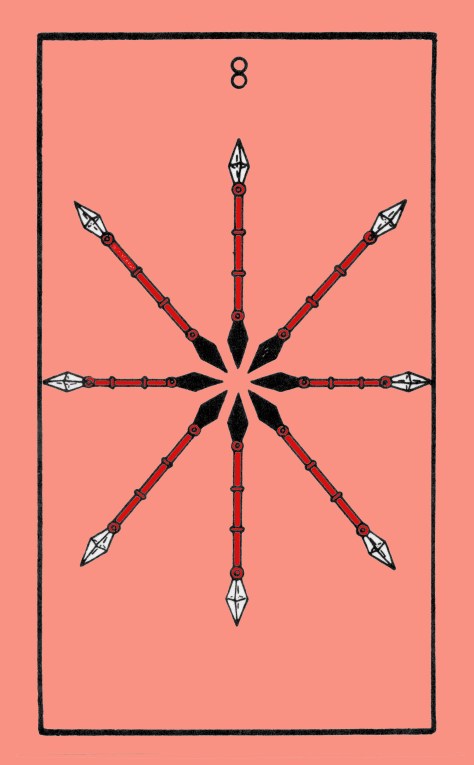
The Eight of Wands from the Builders of the Adytum (BOTA) Tarot deck
Paul Foster Case (and Ann Davies)
As the first decanate of Sagittarius, the Eight of Wands is the time period of November 22 to December 1, ruled by Jupiter, suggesting a combination of the powers of Mercury and Jupiter together with the zodiacal attributions of the sign Sagittarius and its natural 9th house. Well-Dignified: aspiration; foresight; rapid expression of force, but quickly expended; the acceleration of anything in which the querent is interested; generosity; confidence ; freedom. Ill-Dignified: violence; warfare; rapacity; insolence; theft or robbery. These are suggested by some of the evil meanings connected with Hermes or Mercury associated with misuse of human intellect. Keyword: Swiftness (From the Oracle of Tarot course)
A. E. Waite
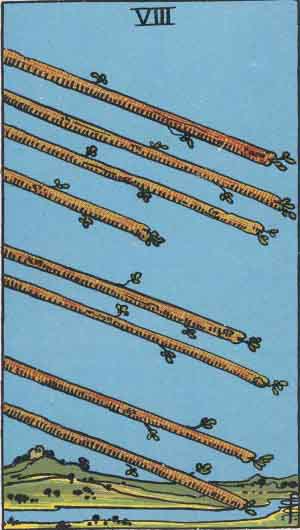
The card represents motion through the immovable-a flight of wands through an open country; but they draw to the term of their course. That which they signify is at hand; it may be even on the threshold. Divinatory Meanings: Activity in undertakings, the path of such activity, swiftness, as that of an express messenger; great haste, great hope, speed towards an end which promises assured felicity; generally, that which is on the move; also the arrows of love. Reversed: Arrows of jealousy, internal dispute, stingings of conscience, quarrels; and domestic disputes for persons who are married. (From The Pictorial Key to the Tarot)
The Eight of Wands from the Rider Waite Smith tarot
Aleister Crowley
The Eight of Wands is called Swiftness, as one might expect from its attribution to Mercury and Sagittarius. This is an etherealization of the idea of fire; all gross elements have disappeared.
[…]
The remaining three cards of the suit belong to Sagittarius, which represents the subtilizing of the Fiery energy; and Mercury rules the card, thus bringing down from Chokmah the message of the original Will.
The card also refers to Hod, splendour, in the suit of Fire, whence it refers to the phenomena of speech, light, electricity. The pictorial representation of the card shows the Light-wands turned into electrical rays, sustaining or even constituting Matter by their vibrating energy. Above this restored universe shines the rainbow; the division of pure light, which deals with maxima, into the seven colours of the spectrum, which exhibit interplay and correlation.
This card, therefore, represents energy of high velocity, such as furnishes the master-key to modern mathematical physics. It will be noted that there are no flames; they have all been taken up into the wands to turn them into rays. On the other hand, the electric energy has created intelligible geometrical form. (From The Book of Thoth)
The Eight of Wands from the Thoth Tarot
Golden Dawn’s Book T
FOUR White Radiating Angelic Hands (two proceeding from each side) issuant from clouds; clasped in two pairs in the centre with the grip of the First Order. They hold eight wands, crossed four with four. Flames issue from the point of junction. Surmounting the small wands with flames issuing down them, and placed in the centre at the top and bottom of the card respectively, are the symbols of Mercury and Sagittarius for the Decan.
Too much force applied too suddenly. Very rapid rush, but quickly passed and expended. Violent, but not lasting. Swiftness, rapidity, courage, boldness, confidence, freedom, warfare, violence; love of open air, field-sports, gardens and meadows. Generous, subtle, eloquent, yet somewhat untrustworthy; rapacious, insolent, oppressive. Theft and robbery. According to dignity.
Hod of HB:Y (Hasty communications and messages; swiftness). Therein rule the Angels HB:NThHYH and HB:HAAYH.
Etteilla
Countryside Upright. This card, as far as its medicine is concerned, means, in its natural position: Countryside, Field, Plain, Agriculture, Cultivation, Landed Property, Immovable Property, Farm, Homestead, Garden, Orchard, Prairie, Forest, Grove, Foliage, Pleasure, Amusement, Leisure, Pastime, Recreation, Enjoyment, Peace, Calm, Tranquility, Innocence, Country Life. – Forest, Valley, Mountain, Battlefield. Reversed. Inner dispute, Examination, Reasoning, Incomprehension. – Regret, Remorse, Repentance, Inner turmoil, Irresolution, Uncertainty, Indecision, Inconceivable, Incomprehensible, Doubt, Scruple, Fearful consciousness.
(Note: this is a collection of the meanings attributed to the cards by some occultists in the past centuries. It does not reflect my own study or opinion of the cards. It is only meant as a quick comparative reference as I develop my own take.)
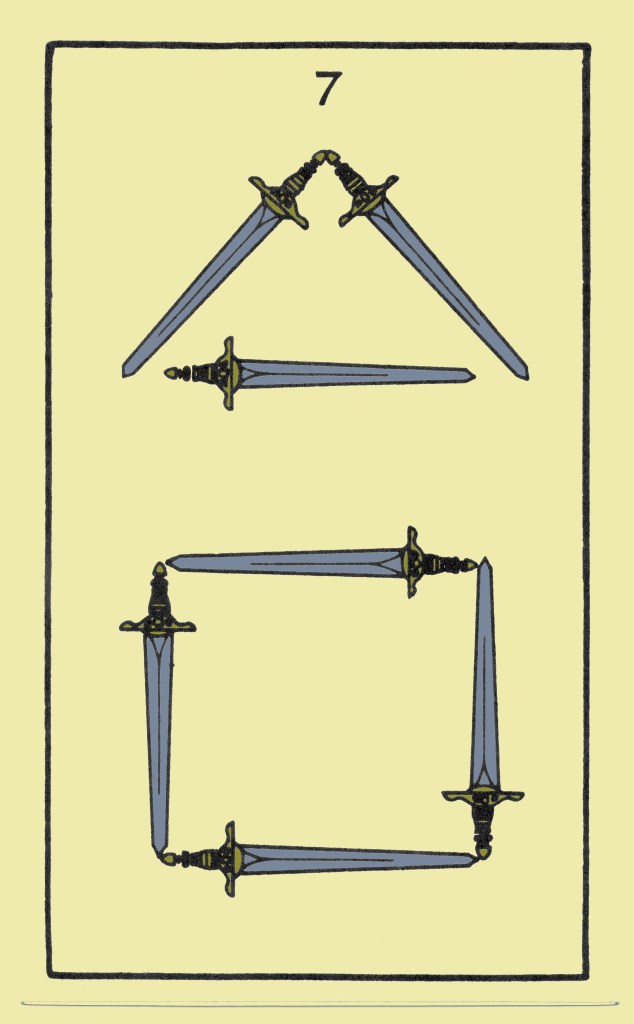
The Seven of Swords from the Builders of the Adytum (BOTA) tarot deck
Paul Foster Case (and Ann Davies)
The time period is the third decanate of Aquarius, February 9 to 18, under the rulership of Venus. Well-Dignified: partial success; the Querent is too easy-going or does not draw sufficiently on his reserve force; he has good opportunities but may not make the most of them; he is likely to compromise too easily. Ill-Dignified: love of ease and display cause loss; the Querent suffers from the insolence of others and may be insolent himself; there is danger that his own confidence may be betrayed, or that he may be led into betraying the confidence of others. Keyword: Instability. (From the Oracle of Tarot course)
A. E. Waite
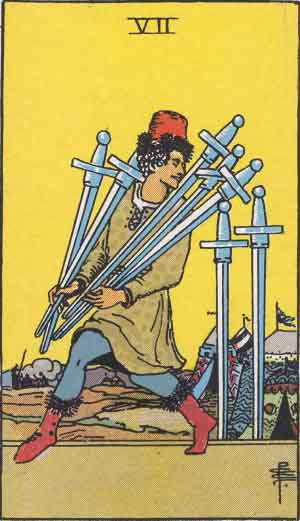
A man in the act of carrying away five swords rapidly; the two others of the card remain stuck in the ground. A camp is close at hand. Divinatory Meanings: Design, attempt, wish, hope, confidence; also quarrelling, a plan that may fail, annoyance. The design is uncertain in its import, because the significations are widely at variance with each other. Reversed: Good advice, counsel, instruction, slander, babbling. (From The Pictorial Key to the Tarot)
The Seven of Swords from the Rider Waite Smith tarot
Aleister Crowley
The Seven of Swords is called Futility. This is a yet weaker card than the Seven of Wands. It has a passive sign instead of an active one, a passive planet instead of an active one. It is like a rheumatic boxer trying to “come back” after being out of the ring for years. Its ruler is the Moon. The little energy that it possesses is no more than dream-work; it is quite incapable of the sustained labour which alone, bar miracles, can bring any endeavour to fruition. The comparison with the Seven of Wands is most instructive.
[…]
Netzach, in the suit of Swords, does not represent such catastrophe as in the other suits, for Netzach, the Sephira of Venus, means victory. There is, therefore, a modifying influence; and this is accentuated by the celestial rule of the Moon in Aquarius.
The intellectual wreckage of the card is thus not so vehement as in the Five. There is vacillation, a wish to compromise, a certain toleration. But, in certain circumstances, the results may be more disastrous than ever. This naturally depends upon the success of the policy. This is always in doubt as long as there exist violent, uncompromising forces which take it as a natural prey.
This card, like the Four, suggests the policy of appeasement. The symbol shows six Swords with their hilts in crescent formation. Their points meet below the centre of the card, impinging upon a blade of a much larger up-thrusting sword, as if there were a contest between the many feeble and the one strong. He strives in vain. (From the Book of Thoth)
The Seven of Swords from the Thoth tarot deck
Golden Dawn’s Book T
TWO Angelic Radiating Hands as before, each holding three swords. A third hand holds up a single sword in the centre. The points of all the swords “just touch” each other, the central sword not altogether dividing them. The Rose of the previous symbols of this suit is held up by the same hand which holds the central sword: as if the victory were at its disposal. Symbols of Moon and Aquarius.
Partial success. Yielding when victory is within grasp, as if the last reserves of strength were used up. Inclination to lose when on the point of gaining, through not continuing the effort. Love of abundance, fascinated by display, given to compliments, affronts and insolences, and to spy upon others. Inclined to betray confidences, not always intentionally. Rather vacillatory and unreliable. Netzach of HB:V (Journey by land: in character untrustworthy). Herein rule the Great Angels HB:HHHAL and HB:Ma’aKAL.
Etteilla
Hope Upright. This card, as far as the medicine of the spirit is concerned, means, in its natural position: Hope, Expectation, Expectation, Pretending, Founding, Overestimating, Founding, Designing, Willing, Wanting, Wishing, Vowing, Wanting, Taste, Fantasy. Reversed. Wise opinion, Good advice, Salutary warnings, Instruction, Lesson. – Observation, Reflection, Note, Caution, Thoughtfulness. – Reprehension, Reprimand. – News, Announcement, Posting. – Consultation, Admonition.
(Note: this is a collection of the meanings attributed to the cards by some occultists in the past centuries. It does not reflect my own study or opinion of the cards. It is only meant as a quick comparative reference as I develop my own take.)
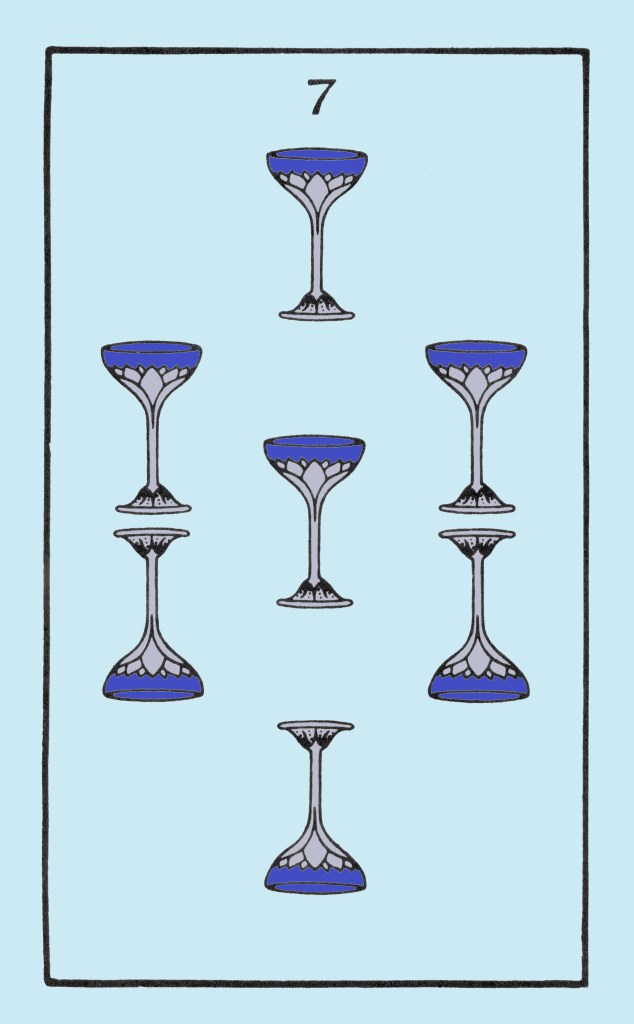
The Seven of Cups from the Builders of the Adytum (BOTA) tarot deck
Paul Foster Case (and Ann Davies)
The time period is the third decanate of Scorpio, November 11 to November 20, under the subrulership of the Moon. Well-Dignified: possible victory, but the person to whom the card applies may be too indolent to take advantage of his opportunities for commanding circumstance. Success may be gained, but not followed up; necessity for choosing only the highest objectives. lll-Dignified: illusionary success; lying and deceit; drunkenness; violence, even lust. Keyword: Illusion (From the Oracle of Tarot course)
A. E. Waite
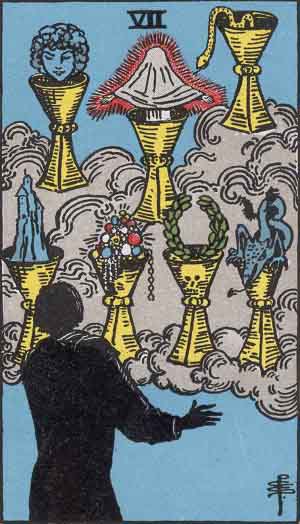
Strange chalices of vision, but the images are more especially those of the fantastic spirit. Divinatory Meanings: Fairy favours, images of reflection, sentiment, imagination, things seen in the glass of contemplation; some attainment in these degrees, but nothing permanent or substantial is suggested. Reversed: Desire, will, determination, project. (From The Pictorial Key to the Tarot)
The Seven of Cups from the Rider Waite Smith Tarot Deck
Aleister Crowley
The Seven of Cups is called Debauch. This is one of the worst ideas that one can have; its mode is poison, its goal madness. It represents the delusion of Delirium Tremens and drug addiction; it represents the sinking into the mire of false pleasure. There is something almost suicidal in this card. It is particularly bad because there is nothing whatever to balance it-no strong planet to hold it up. Venus goes after Venus, and Earth is churned into the scorpion morass.
[…]
This card refers to the Seven, Netzach, in the suit of Water. Here recurs the invariable weakness arising from lack of balance; also, the card is governed by Venus in Scorpio. Her dignity is not good in this Sign; one is reminded that Venus is the planet of Copper, “external splendour and internal corruption”. The Lotuses have become poisonous, looking like tiger-lilies; and, instead of water, green slime issues from them and overflows, making the Sea a malarious morass. Venus redoubles the influence of the number Seven.
The cups are iridescent, carrying out the same idea. They are arranged as two descending triangles interlaced above the lowest cup, which is very much larger than the rest. This card is almost the “evil and averse” image of the Six; it is a wholesome reminder of the fatal ease with which a Sacrament may be profaned and prostituted.
Lose direct touch with Kether, the Highest; diverge never so little from the delicate balance of the Middle Pillar; at once the holiest mysteries of Nature become the obscene and shameful secrets of a guilty conscience. (From The Book of Thoth)
The Seven of Cups from the Thoth Tarot
Golden Dawn’s Book T
THE seven cups are arranged as two descending triangles above a point: a hand, as usual, holds lotus stems which arise from the central lower cup. The hand is above this cup and below the middle one. With the exception of the central lower cup, each is overhung by a lotus flower, but no water falls from these into any of the cups, which are all quite empty. Above and below are the symbols of the Decanate Venus and Scorpio.
Possible victory, but neutralized by the supineness of the person: illusionary success, deception in the moment of apparent victory. Lying, error, promises unfulfilled. Drunkenness, wrath, vanity. Lust, fornication, violence against women, selfish dissipation, deception in love and friendship. Often success gained, but not followed up. Modified as usual by dignity.
Netzach of HB:H (Lying, promises unfulfilled; illusion, deception, error; slight success at outset, not retained). Herein the Angels HB:MLHAL and HB:ChHVYH rule.
Etteilla
Thought Upright. This card, as far as the medicine of the spirit is concerned, means, in its natural position: Thought, Soul, Spirit, Intelligence, Idea, Memory, Imagination, Understanding, Conception, Meditation, Contemplation, Reflection, Deliberation, Viewpoint, Opinion, Feeling. Reversed. Plan, Design, Intention, Desire, Will, Resolution, Determination, Forethought.
(Note: this is a collection of the meanings attributed to the cards by some occultists in the past centuries. It does not reflect my own study or opinion of the cards. It is only meant as a quick comparative reference as I develop my own take.)
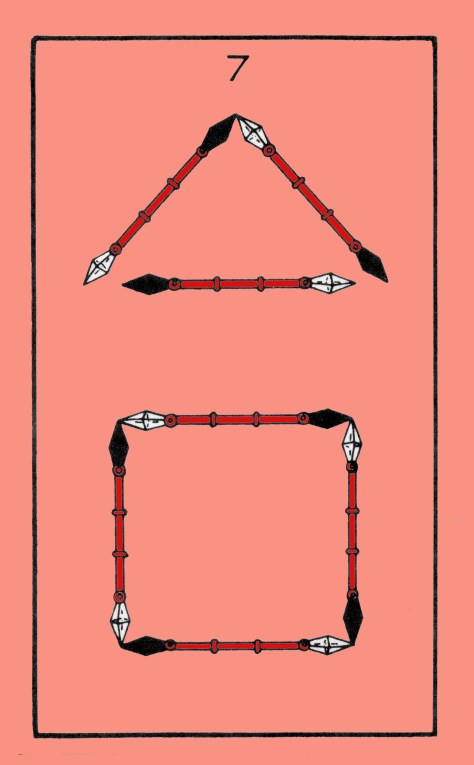
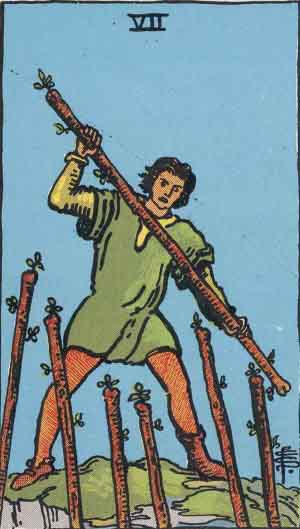
The Seven of Wands from the Builders of the Adytum (BOTA) tarot deck
Paul Foster Case (and Ann Davies)
Astrologically, the Seven of Wands, because it corresponds to the third decanate of Leo, is the time period from August 13 to August 22. In divination, the Seven of Wands combines the activities of the Keys listed in the Tableau [Empress, Sun, Tower, Strength, Emperor] together with ideas of pleasure and love connected with the fifth house in Astrology, the natural house of Leo. Well Dignified: denotes pleasure in strenuous action; some danger through love affairs or self indulgence; also strength and magnanimity; adventure; courage in the face of difficulties; influence over subordinates. lll Dignified: indicates ignorance, pretense, vain-glory, quarrels and wrangling, threats and very determined opposition, especially from subordinates and open enemies. Keyword: Valor (From the Oracle of Tarot course)
A. E. Waite
A young man on a craggy eminence brandishing a staff; six other staves are raised towards him from below. Divinatory Meanings: It is a card of valour, for, on the surface, six are attacking one, who has, however, the vantage position. On the intellectual plane, it signifies discussion, wordy strife; in business–negotiations, war of trade, barter, competition. It is further a card of success, for the combatant is on the top and his enemies may be unable to reach him. Reversed: Perplexity, embarrassments, anxiety. It is also a caution against indecision. (From The Pictorial Key to the Tarot)
The Seven of Wands from the Rider Waite Smith tarot deck
Aleister Crowley
The Seven of Wands is called Valour. Energy feels itself at its last gasp; it struggles desperately, and may be overcome. This card brings out the defect inherent in the idea of Mars. Patriotism, so to speak, is not enough.
[…]
This card derives from Netzach (Victory) in the suit of Fire. But the Seven is a weak, earthy, feminine number as regards the Tree of Life, and represents a departure from the balance so low down on the Tree that this implies a loss of confidence.
Fortunately, the card is also attributed to Mars in Leo. Leo is still the Sun in his full strength, but the marks of decadence are already to be seen. It is as if the wavering fire summoned the brutal energy of Mars to its support. But this is not enough to counter-act fully the degeneration of the initial energy, and the departure from equilibrium.
The army has been thrown into disorder; if victory is to be won, it will be by dint of individual valour-a “soldiers’ battle”. The pictorial representation shows the fixed and balanced wands of the last card relegated to the background, diminished, and become commonplace.
In front is a large crude uneven club, the first weapon to hand; evidently unsatisfactory in ordered combat. The flames are dispersed, and seem to attack in all directions without systematic purpose. (From The Book of Thoth)
The Seven of Wands from the Thoth Tarot deck
Golden Dawn’s Book T
TWO hands holding by grip six wands, three crossed. A third hand issuing from a cloud at the lower part of the card, holding an upright wand which passes between the others. Flames leap from the point of junction. Above and below the central wand are the symbols of Mars and Leo, representing the Decan.
Possible victory, depending on the energy and courage exercised; valour; opposition, obstacles and difficulties, yet courage to meet them; quarrelling, ignorance, pretence, and wrangling, and threatening; also victory in small and unimportant things: and influence upon subordinates.
Netzach of HB:Y (Opposition, yet courage). Therein rule the two great Angels HB:MHShYH and HB:LLHAL of the Schemhamphorash.
Etteilla
Talking Upright. This blade, as far as the medicine of the spirit is concerned, means, in its natural position: Talking, Negotiation, Conference, Colloquy, Conversation, Dissertation, Deliberation, Discussion. – Word, Pronunciation, Language, Idiom, Dialect, Negotiation, Market, Exchange, Measure, Trade, Traffic, Correspondence. – Talking, Saying, Proferring, Conferring, Discussing, Chatting, Dividing, Chattering, Gossiping. Reversed. Indecision, Irresolution, Uncertainty, Perplexity, Inconstancy, Lightness, Variation, Diversity, Hesitating, Hesitating. – Temptation, Vacillation, Versatility.
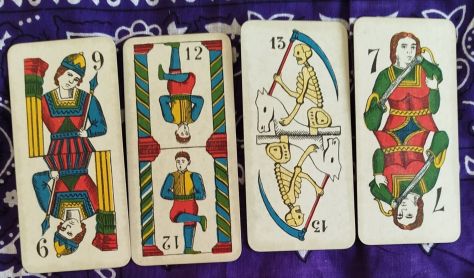
While the number of Minor Arcana differs from system to system, being usually comprised of the aces, court cards and a variable number of pips, the Major Arcana of Bolognese Tarot the are always the same: eighteen classically recognizable trumps (the regular ones, minus the Emperor, Empress, Pope/Hierophant and Popess/High Priestess), plus any number of Moors (from zero to all four, depending on the school of thought). For more information on the peculiarities of this deck read here. NOTE: when I was kindly taught the 45-card system, the person who taught it to me considered the Moor card to be part of the suit of swords, possibly due to the spear. I include it in the Major Arcana simply because the four Moors are replacements for the four missing trumps. NOTE 2: The Bolognese major arcana sequence is older than the one we are used to, and quite different. I stick to the sequence we know just to avoid confusion. It has no divinatory implications either way.
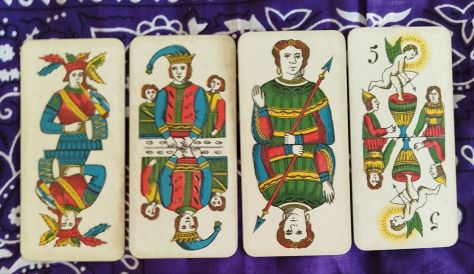
The Fool, The Juggler, The Moor, Love in the Bolognese Tarot
The Fool A neutral card, with both positive and negative implications. It represents oddity and strangeness, but also carefreeness and thoughtlessness, and possibly confusion, uncertainty, mental trouble, lack of restraint, etc. Its meaning is very sensible to how the cards surrounding it modify it. It is always a bit of a question mark in many spreads, so much so that a teacher and friend said that there is a tradition, when the cards are unclear and the Fool is among them, to put the deck back together and knock on it, asking the Fool to be more clear. It is also a card of creativity and inspiration, if it makes sense within the context. For instance, it can show a line of work where one needs to follow their own sensibility, vision or intuition.
The Juggler Again a neutral card that heavily depends on the others. It is mainly the significator of children. For this reason, it is important when we talk about pregnancies or the family, or when we explore someone’s childhood. It also has the implication of childishness or of things that are small and of little literal or moral value, or something that hasn’t found its footing or stability. For this reason, depending on the combinations, it can represent someone who is not to be trusted. It can also signify situations where we are like children, that is, powerless or passive. According to others it can also sometimes depict a beginning. According to most, it is also the card of pets.
The Moor or The Stranger In the 45-card system I know, only one of these cards is used, namely the one with the earring and the spear. It represents a stranger, and therefore things that disrupt regular life, hence the ideas of surprise, unexpected events or meetings, hiccups along the way, etc. The other cards will tell us if the unexpected situation is good or bad. In itself it can be mildly annoying, as we tend not to like disruptions to our routine. It is also traditionally associated with a priest (oddly enough) and therefore with all kinds of ceremonies.1
Love It means mostly what it says on the tin: love. It is possibly the single most important card in the single most requested type of consultation, i.e., about relationships. Whether the love is strong or weak, childish or mature, increasing or declining depends on the cards surrounding this one. It also represents one’s emotional world, emotions in general, and it is a card of good heart and good feelings. When not talking about love, it can show something that involves your heart (you are emotionally invested for good or ill), or something you love. In itself it is positive, signifying joy.
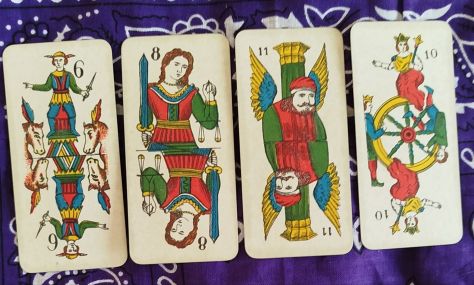
The Chariot, Justice, The Hermit and the Wheel of Fortune in the Bolognese Tarot
Chariot or The Bed This is where the Bolognese Tarot is at its oddest. In the card’s design, the Chariot appears to be still, with the horses resting on each side, and the man looks unhappy. For this reason, the Chariot has been called the Bed card. This led to interpreting it exactly the opposite way as most would: instead of movement, stasis. In itself it is a negative card of tribulation, illness, static situations, tiredness, exhaustion. It can also signify nooky time with other cards (like the Ace of Wands). Mostly, though, it signifies illness, either literal or figurative (e.g., an unhealthy love, an unhealthy way of expressing anger, etc.) Still, some card readers retain the traditional idea of moving toward a goal quickly, and attribute it to the card when surrounded by good cards.2
Justice Mainly this is the card of everything legal and justice-related. When talking about wills, fines, trials, bureaucracy and similar things, Justice is an important card, as the cards surrounding it can tell us if the situation is going to go well or not. It is also the card of fairness or of things that are just or ok, or equilibrated. It represents control, controlling, testing, etc. (including in a medical or academic sense). Justice next to a person can mean a just person, the person’s sense of justice, or someone wearing a uniform.
The Hermit The Bolognese variant of this card has none of the introspective undertones that it has been attributed in other traditions. This is a bad card: it is called blockage (in italian Blocco or Incaglio, the latter word indicating a ship that has run aground). It shows big obstacles that delay a situation, whether indefinitely or momentarily depends on the rest of the spread. It is also the card of small ailments, either seasonal (cold, flu), obnoxious but not life-threatening (like toothache) or age-related. Obviously it can also indicate a character that is reserved or tending to isolation, as the blockage can be inner as well as outer.
The Wheel This is the only card in the Bolognese tarot whose reversal is discernible and is read accordingly. Look to the left: if the crowned figure is ascending, the card is upright. If the young boy is ascending, it is reversed. According to some, when upright the Wheel represents good luck, when reversed bad luck. According to others, the Wheel represents movement and evolution of circumstances in general, but when upright it brings stability (stable good luck, decisive chances, etc) while when reversed it shows instability (unstable luck, with ups and downs, requiring effort). I have been taught according to the second school. Much also depends on the surrounding cards. Still, unstable luck is always more likely to turn into bad luck when surrounded by bad cards.
Strength, the Hanged Man, Death and Temperance in the Bolognese Tarot
Strength or Fortitude Considered a very good card, Strength brings energy, decisiveness, steadfastness, focus in meeting obstacles and taking action. The cards following it, however, can block it or diminish it, so it is important to pay attention to them as well. In itself, when coming up at the end of a sequence or with positive cards, it shows a situation that is reliable (“strong”) or a person (if next to a court card) who is strong in a positive sense, usually to help us. When following negative cards it can indicate the ability to pick yourselfup or stand your ground. It always indicates an active stance in the matter.
The Hanged Man or The Traitor Here we enter the realm of history. In spite of the many mystical interpretations of the Hanged Man that started popping up during the occult revival, traditionally the card was inserted in the oldest packs to represent how traitors were punished in the Middle Ages (namely, by being hanged by a foot), and thus served as a cautionary tale to those playing tarot games never to betray the church or the government: “Know your place and stay there. Don’t try to overreach, or we’ll hang you upside down, so instead of moving upward in life, you’ll be going downward to hell.” That’s the message. The Bolognese tarot retains this old tradition, as the Hanged Man is mainly the card of treason. The treason can be literal (cheating, betrayal, etc.) or it can be metaphorical (a situation that betrays you, stabs you in the back when you are heading for the finish line, that makes you feel cheated on or sorely disappoints you). It is one of the worst cards in the pack, and it can show situations that end badly (like traitors in the past), or that are being upended. Even when no one is betraying anyone in particular, it can still symbolize life kicking you in the nuts, so you feel betrayed by it, as if you’ve ended up in a bad place or situation. Sometimes, in my experience, the upending can be good, but only when the querent’s expectations are negative and the cards following the Hanged Man are positive. In this case, the negative expectations are betrayed. In itself, though, the upending tends to be of the negative kind.
Death or Thirteen This card is never actually called by its name, but by its number (tredici, i.e., thirteen). Different schools of thought interpret it slightly differently. It largely depends on the context though. Its first meaning is that of physical death, but this is rare and never by itself. In itself it shows the end of something. It can also indicate an inner sense of loss or death (“mortificazione”, which has the same root as the Italian “morte”, death, but indicates inner devastation and mortification). When, however, Death cannot be interpreted as ending, it can act as confirmation: “tredici conferma”, “the thirteenth card confirms”, or, if you will, “as sure as the fact we all die”. For instance, when it is surrounded by positive cards, it acts as a highlighter, confirming them. Same with negative cards: it makes them stronger and more important in the querent’s destiny. It can also indicate a situation that changes radically. Suppose, for instance, the cards preceding it are bad and those following it good: in this case it shows the end of the bad situation.
Temperance The old diviners must have taken a look at this card and thought it looked like an hourglass, because the main meaning is that of time, the passage or flow of time. It is usually a slow card, which slows down the reading. It is connected with such concepts as waiting, patience, stagnation, but also of things that last a long time, take a long time or happen after a lot of time has passed. For instance, if it is followed by cards that show falling in love, it might mean that we will fall in love after a long time, while if it is preceded by cards of love it indicates that the love will last a long time. Use your commonsense. I have also found that, when it falls in the first few lines of a spread, the cards surrounding it, and especially those preceding it, tend to either talk about the past (a long time ago) or have started a long time ago and still drag on. Finally, some card readers connect it with the flow of water, and therefore water in general. I haven’t verified this connection but it does make sense.
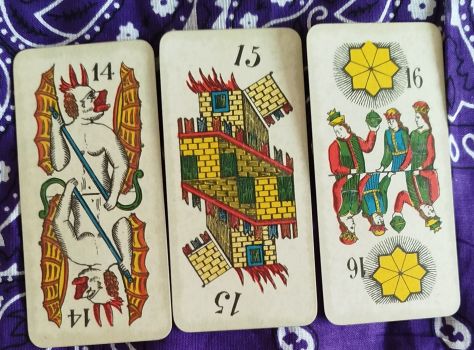
The Devil, The Tower, The Star in the Bolognese Tarot
The Devil In Italian “Diavolerie”, i.e., things that bedevil you. It is a deeply negative card, but with some redeeming qualities. In the main it is connected, traditionally, with anger, which depending on the context can range from annoyance to rage, due to things, people or circumstances bedeviling you. In general, though, it can indicate all passions that seize us and we fail to control. When falling with a person card, it is usually a sign the person is negative for us (depending on the context it can show jealousy or envy as well). When it describes a situation, it is bad for us. It is a card of excess all around, but it can indicate sexy energy, when with cards that talk about it, and it can also represent a strong energy when surrounded by very positive cards. Finally, it is one of the cards connected with magic.
The Tower The image shows a burning building, and the main meaning is consequently that of places we’d rather not find ourselves in, mostly prison or hospital (or, if next to the Ace of Cups, our home). However, it can also signify a metaphorical prison, that is, a situation that is strongly limiting for us and prevents us from fleeing or moving freely, where we must sacrifice our hopes and aspirationsor resources at least in part (“sacrificio” is one of the main Italian keywords for this card). Whether this card can indicate neutral or positive places is up for debate, as it depends on the school of thought. I guess in the appropriate context and with the appropriate cards it might, but generally, in my experience, it mostly shows negative places or negative situations. It can, however, show neutral places of authority (like a city hall, where there is an authority above us) or very large or foreboding buildings.
The Star Another peculiar card. The main keyword is “roba”, i.e., stuff, especially referred to one’s objects, belongings and possessions. This is because the image shows three people holding some unspecified object. Some say they are the three Wise Men bringing gifts to Jesus, others say they are merchants. Either way, the emphasis is on objects and materiality. This is the card of business, belongings, objects, work (either one’s work life or working on something). It can represent study (which is the student’s work). In health readings it shows the objects used in medicine, that is, meds (and therefore therapy in general). This card can represent gifts when coupled with other specific cards. To summarize: business, work, stuff (material/practical life), study, gifts.
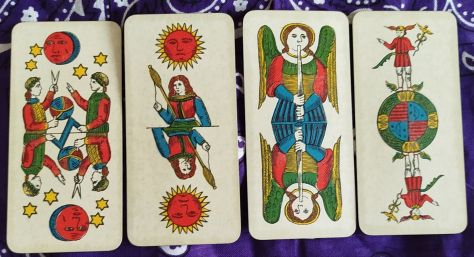
The Moon, The Sun, The Angel / Judgement and the World in the Bolognese Tarot
The Moon and the Sun The reason I talk about these two cards together is that they complement each other. They are also called “le due rosse”, “the two red (cards)”. Their main meaning is temporal: the Moon shows things happening by night or in the evening, the Sun shows things happening by day. But they are also two polar opposites. The Sun indicates positivity, life, energy, clarity, success, happiness, vitality. When coupled with other cards it slants them positively. The Moon indicates negativity, death, lethargy, secrets, falsity, dissatisfaction, sadness. When coupled with other cards, it slants them negatively.
The Angel or Judgement The best card in the deck, the Angel is the card of goodness, peace, friendship, protection. It brings solutions to difficult situations. However, if followed by cards indicating obstacles or impossibility, it can show the solution is delayed or impossible. When coupled with a person card, it can signify the person is an angel for us, helping and protecting us, or that they are good. It is also the main card connected with spirituality.
The World “Around the world“, “the world outside“. It is the card of travel and journeys, as well as of distance. It signifies movement, whether literal or metaphorical. Often it shows actual journeys, relocations and removals. The journey doesn’t have to be very long, however traditionally, when falling next to a court card it can show a person we don’t yet know (the person comes from the outer world, i.e., is not part of our daily life), although, depending on the context, it can also show someone who travels or someone who lives distant from us. It can indicate a stranger, though again, how much of a stranger depends on the context. It shows situations that are open, in motion, and it gives the sense of something big or large or important (as opposed to the Juggler, which is something small). It can be symbolic of life (the great journey). Finally, some attach the idea of something recurring to it (like recurring thoughts, etc.)
MQS
In other reading systems with more cards, where more Moors are used, the priest is often associated with the Moor with the hat, who is also the doctor. ↩︎
How positive or negative (or neutral) the card is depends on the system as well. In systems with more cards, where there is a specific illness card (the Moor with the hat) the Chariot is more neutral. In the 45-card system, it is more negative. ↩︎
It wouldn’t make sense, at this point, to talk about each single card individually, but I think the cards do warrant a bit more discussion. I am referring to the 45-card system, even though most considerations will apply to the other systems as well.
The Aces
The four Aces in the Bolognese Tarot
Ace of Cups. This is the card of the home environment and of the family, as in many fortune-telling and divination traditions. Its presence usually indicates that the issue somehow relates to the family or the house. However, the card can also occasionally function as a sort of adjective, in that it can indicate a situation or environment is like family. Broadly speaking, the cards surrounding it generally show us whether the family is positive or negative, or is going through a rough patch, etc. I have found that sometimes, when the home or familiar situations simply cannot be part of the interpretation, the Ace of Cups can hint at the intimate life of a person, their inner side, or the intimate relationship between two people.
Ace of Wands. This is a somewhat more complex card. In the main it is a card of sex and sexual interest (or interest in general). However, it represents anything done by two people together, especially marriage (or a strong relationship) or partnership. It portends great vigor, energy, creativity. Another important meaning of this card is that of achievement, personal triumph or personal success, i.e., the ability to reach one’s aims and fulfill one’s aspirations. It is a powerful, active card.
Ace of Coins. In the most ancient set of meanings, this is the card of the table, and it therefore represents sitting together for whatever reason. This meaning has been retained, as well as its metaphorical extensions (conviviality, etc.) It represents daylight. Its most frequent meaning, however, is that of representing finances. Compared to the other money card, i.e., the Ten of Coins, the Ace represents a bigger amount. Whether the amount is coming or going depends on the question and cards surrounding it. Metaphorically it can sometimes portend great satisfaction or a prize.
Ace of Swords. The most common meaning found attached to this card is that of symbolizing the door knockers (see design). The image of the door knockers is widespread in Italian cartomancy and is found in many traditional Italian card reading systems. It symbolizes something about to happen, because it is knocking at the door. However, the card symbolism has also been interpreted as representing two wedding bands being exchanged or a pair of handcuffs. Broadly speaking, therefore, it can show a commitment or a binding situation for better or worse, from marriage to prison, from a contract to an obligation, from an oath to an addiction. The emphasis here is on the binding aspect of it, which limits us, whereas in the Ace of Wands the emphasis is more on doing or achieving something together with someone else.
The Sevens
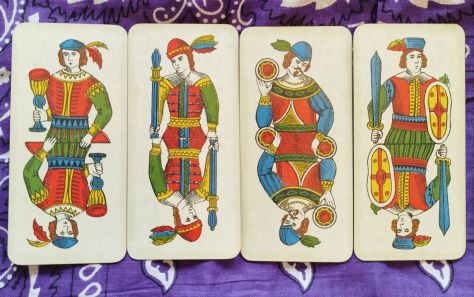
The two Sevens in the Bolognese Tarot
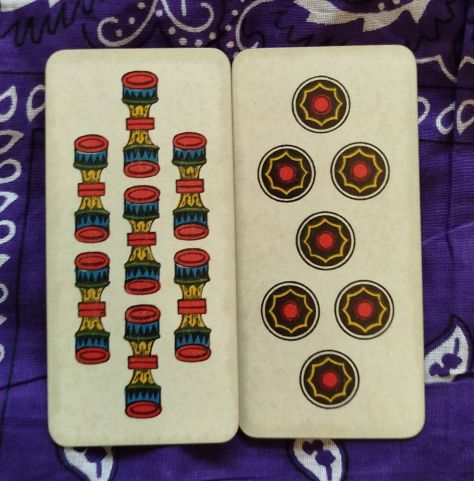
Seven of Cups. Called the card of the roof or the rooftops. Like all cups, it is strongly connected to the home environment. It is still a card of familiarity and closeness, but in a more extended sense than the Ace of Cups. Therefore, it also symbolizes the city or homeland (depending on the scope of the question). Due to its connection to the roof, it carries a certain connotation of protection with it. It is also another card that can show a quick timeframe.
Seven of Coins. The Seven of Coins is the card of tears. It shows melancholy, sadness, dissatisfaction. In itself it is not a tragic card, but it does indicate loss of heart, feeling down or blue, etc. When it falls together with other difficult cards, though, it compounds their effect, making it worse and showing that it affects the querent emotionally. On rare occasion, when with very positive cards (like the Sun and the Angel) it can show tears or joy, emotional relief in general. This is rare though. Note: some diviners use the Six of Coins instead of the Seven to symbolize tears.
The Eights
The two Eights in the Bolognese Tarot
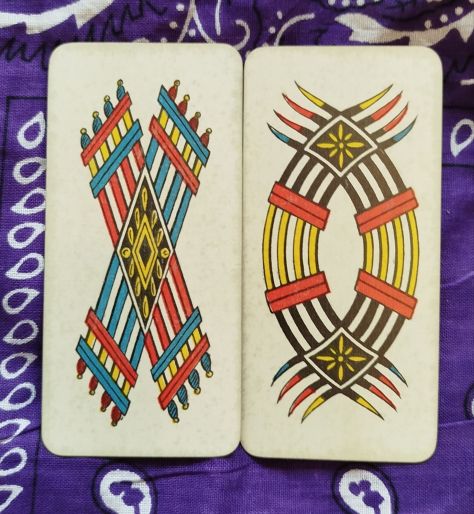
Eight of Wands. The Eight of Wands is the card of the road or path. The road can be literal, representing a short journey (as opposed to the World), even just going out to meet or visit someone, or it can be metaphorical, indicating something that is moving or requires movement or evolution (e.g., a professional path, a study course, the trajectory of a relationship, etc.) In itself, the card tends to be positive, indicating a situation that is ‘open‘ (like a road) and still developing, but with negative cards it can show the opposite. It can also represent something that is on the way, and therefore, like the Ace of Swords, is about to happen. Note that some diviners use the Six of Wands instead of the Eight.
Eight of Swords. This card is traditionally called ‘passione’, i.e., passion, but more in the sense of the passion of the Christ. It represents torment, suffering and similar fun concepts. It is connected to pain in all its manifestations, whether physical, mental, psychophysical or of different kind. It is also connected with addictions, again literal or metaphorical (as when you make yourself dependent on what your ex thinks or does). Some diviners use the Six of Swords instead of the Eight.
The Tens
The two Tens in the Bolognese Tarot
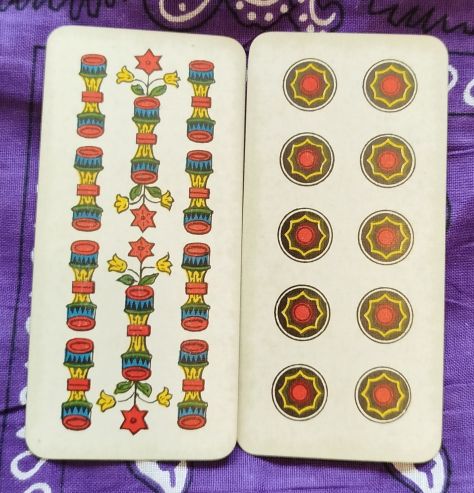
Ten of Cups. As the image suggests, this is the card of all things that bloom and flourish. It shows rebirth and increase in all fields of life, and situations that metaphorically sprout, bringing mirth. It is the card of fun, of jollity, of parties and of drinking, so with cards showing excess it can indicate alcoholism. It is also the card of blood, so if the other cards seem to point to a stay at the hospital, it doesn’t mean the querent is having the time of his life, only that he is being cut open and blood is coming out.
Ten of Coins. This is again a money card, but its amount is smaller than the Ace. Still, by itself it is a positive card, showing satisfaction and well-being. It represents a positive flow of things, a situation that is calm, tranquil, without major ups and downs (unless the surrounding cards are negative, in which case the calmness is denied, as it were.) With negative cards it can show the querent has little money or little satisfaction.
The Pages
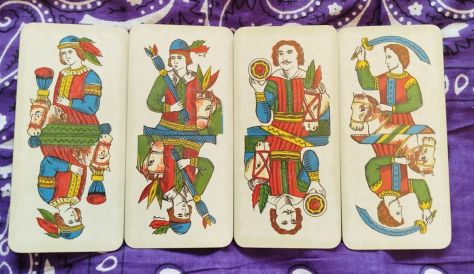
The four Pages in the Bolognese Tarot
Page of Cups. The Page of Cups has the traditional name of ‘coppina‘, i.e., little/young female cup-bearer. It signifies a young, younger or youthful woman, usually belonging to the family or to the querent’s everyday life. With negative cards confirming it, it can represent a rival in love (the fresh young thing snatching hubby from you) or an immature woman. When exploring a woman’s past, it can show “when she was young”. This is one of the hardest cards for me to read, as sometimes it shows up seemingly for no reason, even though there is no young woman involved. I have figured that in these situations she is still a small cup-bearer, cups being joyful, so it can represent the arriving or giving of small joys or satisfactions.
Page of Wands. In the Tarocchino Bolognese, we have not only cards for the male and female querents, but also for their thoughts. The Page of Wands represents the female querent’s thoughts, beliefs, plans, memories, character and inner side.
Page of Coins. This is the card of words, talks, conversations, dialogues. It heralds the arrival of meetings where situations are talked over, agreed on, clarified, etc. Cards surrounding the Page will show either the nature of the words (angry, loving, etc.) their content (work, love, money) or their outcome (agreement, disagreement and so on).
Page of Swords. Traditionally the letter card. Like the Page of Coins, it is a card of communication, but usually written or, nowadays, in the form of messages. It can symbolize documents and things made of paper. It also embodies the broader notion of contacts, developing contacts, coming into contact with others. This is especially relavant when we are not talking about a single specific letter or message.
The Knights
The four Knights in the Bolognese Tarot
Knight of Cups. In Italian, ‘accomodamento’, literally adjustment, compromise, agreement or even repair. This card’s main meaning is simple, but its applications are many: it shows situations that bring conciliation (or reconciliation), healing and the solution of trouble, or at least a way of dealing with it positively. It heralds harmonious interpersonal relationships, smooth sailing ahead, the ironing out of disagreements or difficulties, positive developments.
Knight of Wands. This is the male counterpart to the Page of Wands: the Knight represents the thoughts of the male querent or of a male figure that is involved in the situation. It is the thoughts, beliefs, character, memories and inner side of this male figure. Note, however, that sometimes, when it doesn’t make sense for this (and the Page) to represent thoughts, it can be taken as a secondary significator for the querent: if I show up not as a physical person (King) but as my thoughts (Knight) I am still there, the spread still talks about me.
Knight of Coins. This is the card of the ambassador, as it brings news, developments and similar things connected with the situation we are exploring. It can indicate knowledge of facts from third parties or other sources, but in general it is the card of news. In itself the news is implied to be good news (one of its traditional names is ‘cavallo di buona nuova’, ‘the horse(man) of good news’), because it brings a coin, and coins were considered good in traditionally poor Italian society. However, if the cards surrounding it are bad, the news may be less than positive, or the good news may be blocked or delayed. Sometimes this card can be ‘christened‘ as a young man, if you’ve run out of court cards.
Knight of Swords. The Knight of Swords is the opposite of the Knight of Cups. Where the Knight of Cups adjusts and irons out, the Knight of Swords complicates, twists, brings trouble, difficult situations that are not linear nor smooth (note the curved sword). Where the Knight of Cups conciliates, the Knight of Swords attacks. In interpersonal relationships it brings disagreements, misunderstandings and hurtful words (one of its names is ‘malalingua’, literally evil tongue). If the Knight of Cups brings healing and goodness, the Knight of Swords brings suffering and evil. One of its main symbolic connections is with cuts, either literal (cutting yourself, getting hurt, being cut open by a surgeon, wounds, breaking something) or figurative (cutting words, situations that hurt, etc.)
The Queens
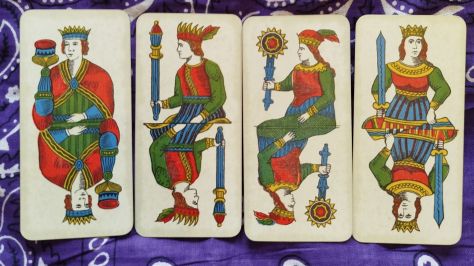
The four Queens in the Bolognese Tarot
Queen of Cups. A mother or a woman in your family, usually. If not in your family, then a friend or someone who acts in your interest. Or should. Always look at the cards surrounding her, as she can be a bad mother or friend if they confirm it, but one who is emotionally invested in you somehow. Mostly, though, it represents the figure of someone who holds you (look how she holds the cup) and has your back. Traditionally she is dark-haired or of dark complexion. Others say she is of medium complexion. Either way, we obviously need to be very careful with descriptions. The Queen of Cups can indicate femininity.
Queen of Wands. If the querent is female, then the Queen of Wands is going to represent her, and the Page of Wands her thoughts. If the querent is male, the Queen can be his partner, or it can be a woman who is somehow important in the situation. Note that when we are talking about triangles, the Queen of Wands is the person who is in the male querent’s heart, regardless of whether she is the official partner.
Queen of Coins. Traditionally ‘the truth‘. This is rarely a physical person. More often than not, it represents truth, reality, authenticity, wisdom, knowledge, education, exactitude, clarity, understanding and the like. It can also say that a situation is as it seems. Or isn’t, if it is surrounded by cards of deceit, indicating the truth is hidden. According to some, it can also sometimes stand for a blonde woman or a wise woman. A traditional phrase attached to this card is ‘di verità conferma’, meaning ‘confirming the truth’ or ‘and that’s the truth’: sometimes this card comes up at the end of a spread or of a group of cards, and acts like a sort of period, as if saying “and that’s exactly it.”
Queen of Swords. Its traditional name is ‘affliction.’ When this card doesn’t represent a woman, it indicates a situation that brings affliction, either physical or psychological. More often than not, though, it does indicate a woman. Tradition says she is gray-haired or a redhead. Others say she is dark. Again, I would advise caution. The Queen of Swords isn’t necessarily evil: she is another woman, usually less accomodating than the Queen of Cups, but not bad. She can be rigid, or she can be a competent but stern professional. With bad cards then she is a rival, the other woman, or a woman who is out to get you.
The Kings
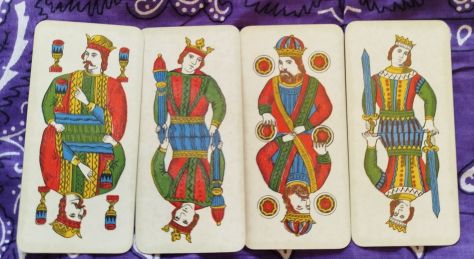
The four Kings in the Bolognese Tarot
King of Cups. The King of Cups is the male counterpart to the Queen of the same suit. He is typically the father or a man in your family. If not in your family, a friend, a wise male influence, someone who has a good word for you, who will help you (like the Queen, he can be a good boss or coworker). It can embody masculinity in general.
King of Wands. As with the Queen so with the King. This is the male querent, or the female querent’s partner, or another man that is important in the question at hand. The Knight of Wands indicates his thoughts. Again, in a triangle this is the man in the querent’s heart, regardless of whether he is the official partner.
King of Coins. It has several titles in the tradition: ‘uomo/vecchio da soldi’ (man/old man bringing money), doctor, important person, a good lord etc. More than a particular person, it represents a role: that of a professional, of someone who has an important job and/or money. Traditionally it shows someone with a degree, from back when degrees were something special. Being called the doctor, it indicates situations that bring healing and care for the querent’s needs. It can indicate a boss or superior. It can also indicate a situation, whether a job or a relationship or something else, which is helpful or nourishing or ‘important’. Traditionally the King is a man for obvious socio-historical reasons, but nowadays it can indicate a woman as well, especially if next to a female court card.
King of Swords. The male counterpart to the Queen, his traditional name is ‘spadino’, i.e., little/young sword-bearer. It can represent a man who is young and/or immature, like the Page of Cups, such as a son or nephew. When exploring a man’s past, it can indicate ‘when he was younger’. It can show a new entry in the querent’s love life, someone who hasn’t yet been promoted to King of Wands. He can be a rival or a problematic man, if with negative cards, or a problematic or immature situation in general. More often than not, it is a literal male figure. Whether positive or negative, it is shown by the other cards. In some traditions it can show a military man, a soldier, a policeman or similar. Look at the other cards for confirmation.
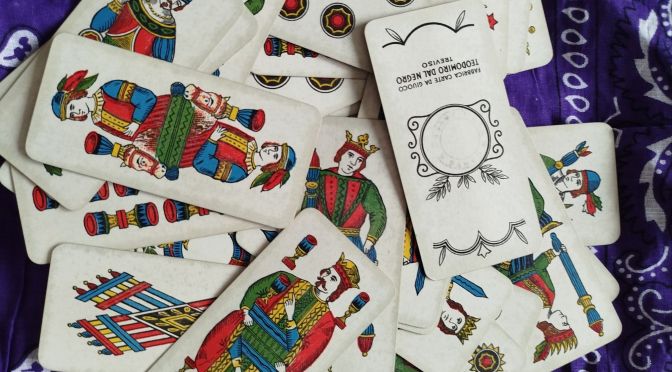
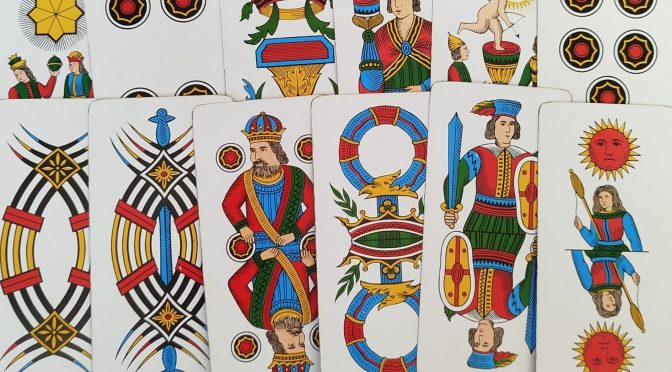
Here I gather all my writings about my explorations with the Tarocco Bolognese or Tarocchino Bolognese (literally Small Bolognese Tarot), a traditional Northern-Italian fortune-telling deck. There are traditionally several ways of using this deck, almost all of which require the reader to create a reduced pack (hence the ‘small tarot’). The most common systems use a reduced pack of 50 or 45 cards, with the 45-card deck being probably older. Although I quickly introduce both systems, I currently focus mainly on the 45-card system.