Here I gather all my writings about my explorations with the Tarocco Bolognese or Tarocchino Bolognese (literally Small Bolognese Tarot), a traditional Northern-Italian fortune-telling deck. There are traditionally several ways of using this deck, almost all of which require the reader to create a reduced pack (hence the ‘small tarot’). The most common systems use a reduced pack of 50 or 45 cards, with the 45-card deck being probably older. Although I quickly introduce both systems, I currently focus mainly on the 45-card system.
(Note: this is a collection of the meanings attributed to the cards by some occultists in the past centuries. It does not reflect my own study or opinion of the cards. It is only meant as a quick comparative reference as I develop my own take.)
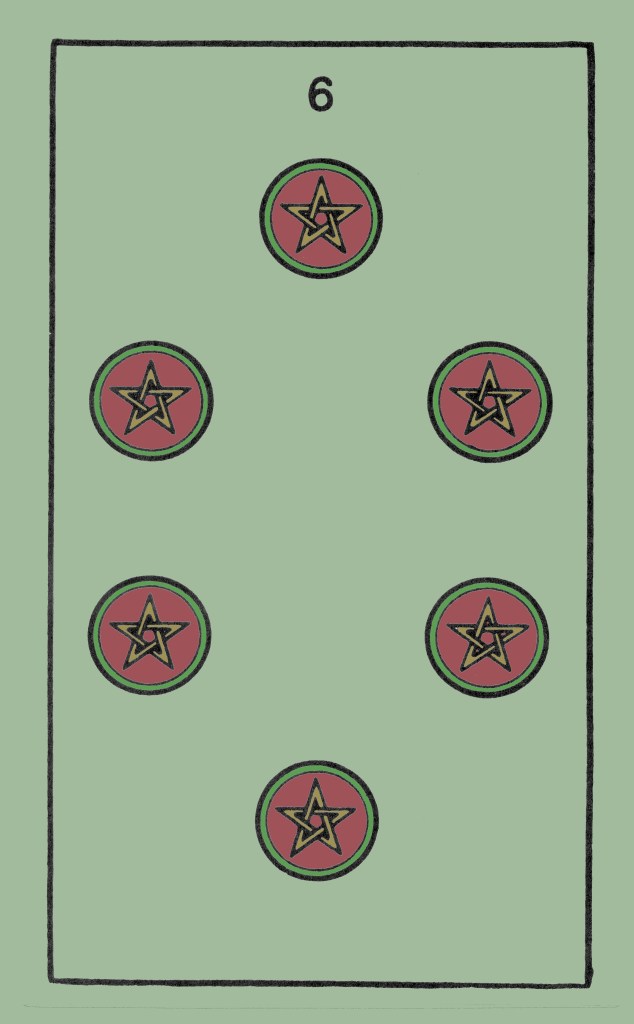
The Six of Pentacles from the Builders of the Adytum (BOTA) tarot deck
Paul Foster Case (and Ann Davies)
The time period is the second decanate of Taurus, under the rulership of Mercury, from April 30 to May 10. Meanings: Well-Dignified: practicality and determination; discretion and diplomacy; gain by letters, writing, travel, speaking, teaching, commissions and through advertising, study, books and all things ruled b Mercury. Ill-Dignified: Loss through the same things. Keyword: Prosperity. (From the Oracle of Tarot course)
A. E. Waite
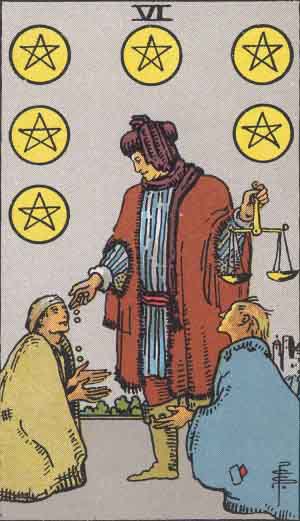
A person in the guise of a merchant weighs money in a pair of scales and distributes it to the needy and distressed. It is a testimony to his own success in life, as well as to his goodness of heart. Divinatory Meanings: Presents, gifts, gratification another account says attention, vigilance now is the accepted time, present prosperity, etc. Reversed: Desire, cupidity, envy, jealousy, illusion. (From The Pictorial Key to the Tarot)
The Six of Pentacles from the Rider Waite Smith Deck
Aleister Crowley
The Six of Disks is called Success; the ruler is the Moon. This is a card of settling down; it is very heavy, wholly lacking in imagination, yet somewhat dreamy. Change is soon coming upon it; the weight of earth will ultimately drag the current down to a mere eventuation of material things. Yet the Moon, being in Taurus, the sign of her exaltation, the best of the Lunar qualities are inherent. Moreover, being a Six, the solar Energy has fertilized her, creating a balanced system for the time being. The card is worthy of the name Success. Remember only that all success is temporary; how brief a halt upon the Path of Labour.
[…]
The Number Six, Tiphareth, as before, represents the full harmonious establishment of the Energy of the Element. The Moon in Taurus rules the card; and this, while increasing the approach to perfection (for the Moon is exalted in Taurus and therefore in her highest form) marks that the condition is transient.
The disks are arranged in the form of the Hexagram, which is shown in skeleton. In the centre blushes and glows the light rose-madder of dawn, and without are three concentric circles, golden yellow, salmon-pink, and amber. These colours show Tiphareth fully realized on Earth; it reaffirms in form what was mathematically set forth in describing the Ace.
The planets are arranged in accordance with their usual attribution; but they are only shown as disks irradiated by the Sun in their centre. This Sun is idolized as the Rose and Cross; the Rose has forty-nine petals, the interplay of the Seven with the Seven. (From The Book of Thoth)
The Six of Disks from the Thoth Tarot deck
Golden Dawn’s Book T
A WHITE Radiant Angelic Hand holding a rose branch with white roses and buds, each of which touches a Pentacle. Pentacles are arranged in two columns of three each:
* * * * * * Above and below are the symbols Taurus and Moon of the Decan. Success and gain in material undertakings. Power, influence, rank, nobility, rule over the people. Fortunate, successful, liberal and just. If ill dignified, may be purse-proud, insolent from excess, or prodigal.
Tiphareth of HB:H (Success in material things, prosperity in business). Herein rule the Angels HB:NMMYH and HB:YYLAL.
Etteilla
The present Upright. This card, as far as the medicine of the spirit is concerned, means, in its natural position: Present, Presently, Now, Immediately, At the instant, At this time, Today, Attending, Witnessing, Contemporary. – Attentive, Careful, Vigilant. Reversed. Desire, Vow, Ardor, Haste, Passion, Searches, Cupidity, Want, Jealousy, Illusion.
In another post, I detailed the main meanings of the 50-card method, which is the one my teacher uses. Here I am going to talk about the other main method for using the Bolognese tarot using 45 cards. I have this from a contact of mine, who gave me permission to explore it and talk about it. The two methods are equally powerful: the absence of 5 cards does not reduce the ability to predict, because the meanings, though similar to the 50-card method, are distributed slightly differently across the cards. Supposedly, the 45-card method is slightly older.
Note that 1) there are some books (in Italian) that discuss the 45-card method, but each gives its own version, and the method I know is also partially different. This is normal: every village and city has its own folk tradition, especially in a country as culturally decentralized as Italy 2) again, the meanings are eminently practical 3) as with the 50-card method, I arranged the majors in the usual order, even though it is different from the Bolognese order of the trumps
Major Trumps
Bolognese Tarot, Major Trumps
The Fool. Strangeness, Instability, Creativity The Juggler. A Child, A pet, Immaturity, Something New Love. Love, Feelings, Affection, Passion, Harmony Chariot. The bed card, Sickness, Static Situations (because the horses seem to rest) Justice. Justice, The Law, Fairness, Equilibrium The Hermit. Obstacle, Blockage, Small ailments
Bolognese Tarot, Major Trumps
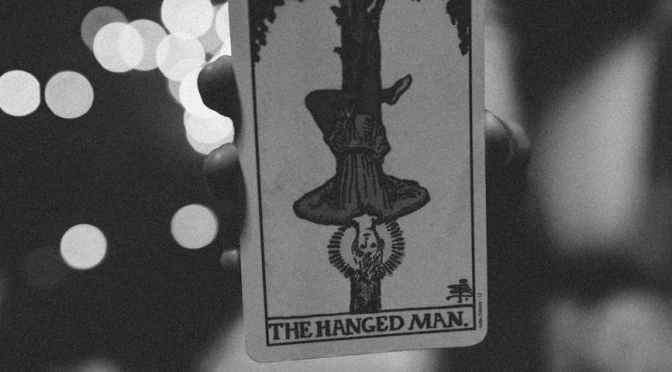
The Wheel. Fortune, Chance Strength. Energy, Power, Fortitude, Good Health, Active stance The Hanged Man. Betrayal,1 Upending Death. Loss, Mortification, Change, Yes to a yes-or-no question Temperance. Time, Patience, Waiting Devil. Being bedeviled, Anger, Jealousy
Bolognese Tarot, Major Trumps
The Tower. Prison, Hospital, Sacrifice, Being impeded or limited The Star. “Stuff”, Objects, Material things, Your work life, Business The Moon. By Night, Darkness, Sadness, Falsehood, Negativity The Sun. By Day, Light, Happiness, Positivity The Angel. Help, Friendship, Peace, Protection, Solution The World. Travel, Journey (literal or metaphorical), Around the world
The Suit of Cups
Bolognese Tarot, Suit of Cups
Ace. The Home, The House, The Family Seven. The City, The Surroundings, Also the family, Protection Ten. Blooming, Flourishing, Celebrating, Fun, Happiness Page. A young woman, sometimes a female rival, Comfort, Help Knight. Adjustment, Agreement, Positive development Queen. A mother, A woman in your family, A motherly figure King. A father, A man in your family, A fatherly figure
Suit of Wands
Bolognese Tarot, Suit of Wands
Ace. Victory, Union, Sex, Ability to succeed Eight. A road, A path, Taking Steps Page. The thoughts of the female querent Knight. The thoughts of the male querent Queen. The female querent, An important woman King. The male querent, An important man
Bolognese Tarot, Suit of Coins
Ace. Big Money, Abundance, Satisfaction, The table Seven. Tears, Sadness, Melancholy Ten. Small money card, Small satisfactions, Tranquillity Page. Discussions, Talks, Communications Knight. News (especially good news, but news in general), Sometimes a young man Queen. The Truth, Truthfulness, Wisdom, Knowledge, A blonde woman King. An important man, A doctor, A graduate, A professional, “Important” in general
Bolognese Tarot, Suit of Swords
Ace. Something knocking at the door, About to happen, Contract, Relationship, Being bound, Hands tied Eight. Suffering, A thorn in the heart The Moor.2 A priest, A person in uniform, A surprise, Unexpectedness Page. Letter, Message, Post, Contacts Knight. Fighting, Ill-disposition, Cutting, Problems Queen. A dark-haired woman, A problematic woman, Affliction in general King. A dark-haired man, A young man, A problematic man, Immaturity in general
As I’ve mentioned on this blog, I’ve been studying the divination tradition of the Bolognese Tarot (Tarocchino Bolognese, literally the Small Tarot of Bologna) for some months now. I’ve been doing it under the direction of a traditional practitioner of this art, whom I’ve befriended and with whom a wonderful exchange of ideas has started.
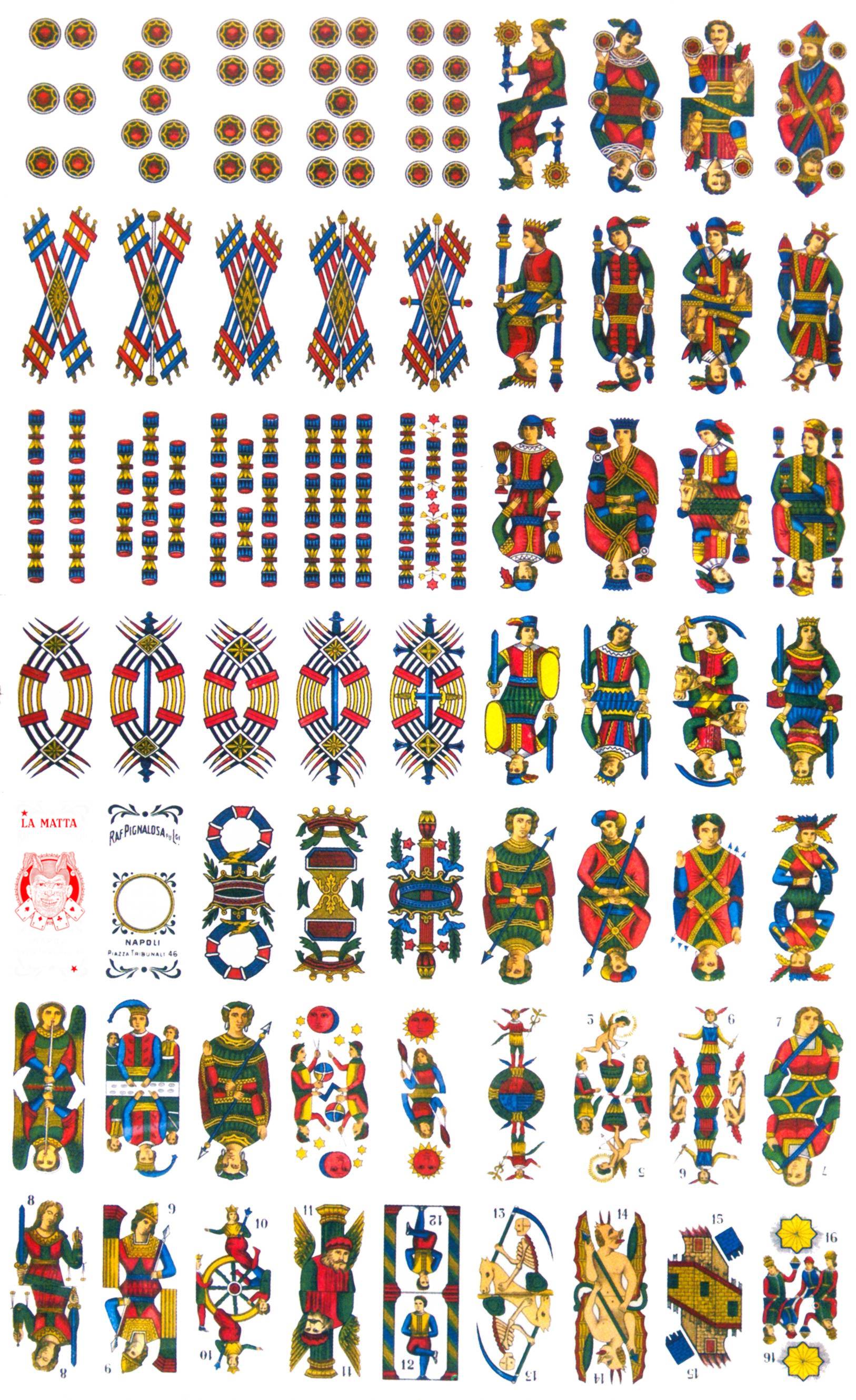
The full deck. Image from the website Labirinto Ermetico
I plan on introducing this form of divination in its main lines for a couple of reasons: 1) it is little known outside of Italy and it deserves some love 2) Its reading techniques are markedly different from the current approach and allow for a very concrete, down-to-earth approach 3) I want to discuss some spreads done with it in the future, and I can’t do it without introducing it first 4) it is the oldest tarot-related divination tradition that we know of, and it is therefore cool from a historical standpoint.1
The Ugly Duckling and Its Quirks
Like the almost totality of very old decks, with a couple of exceptions (the Visconti deck is one) the Bolognese tarot is distinctively unappealing from an esthetic standpoint, largely because, like other popular pre-RWS decks, it was meant to be used by poor people as a playing deck at the local inn.
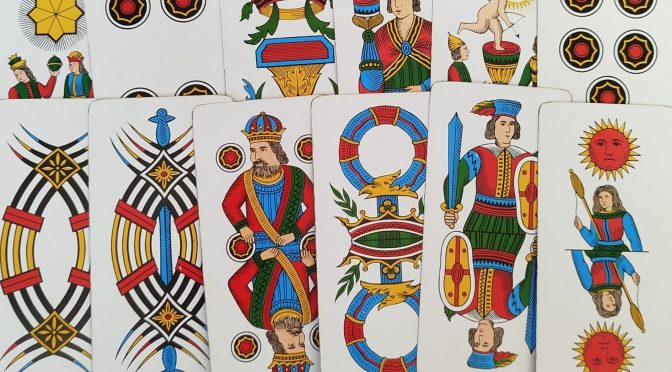
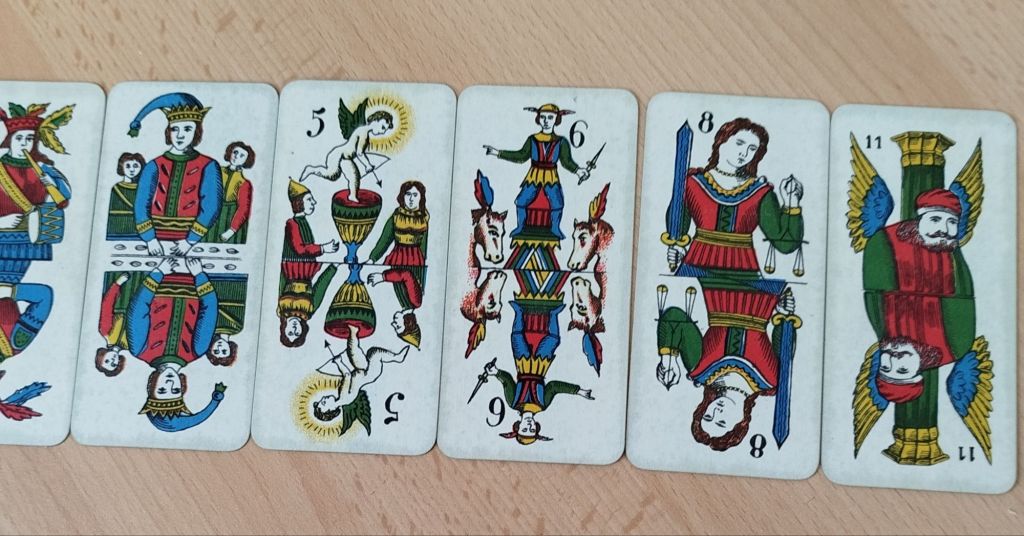
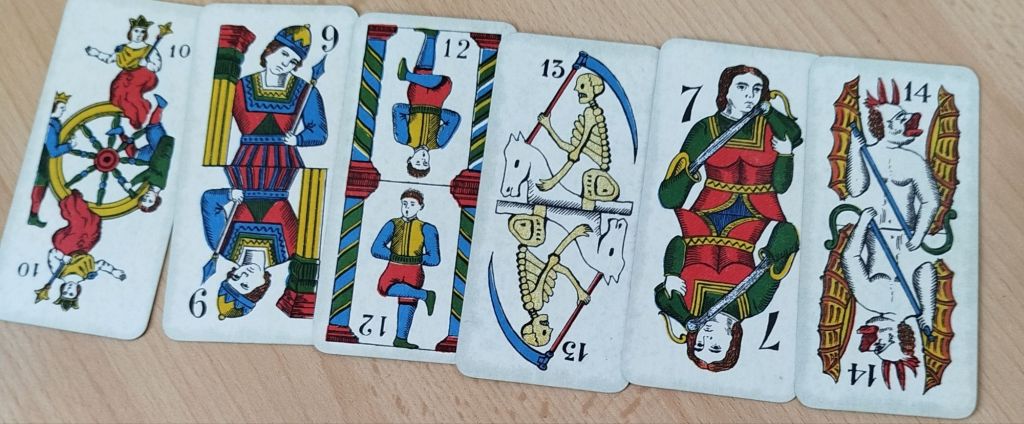
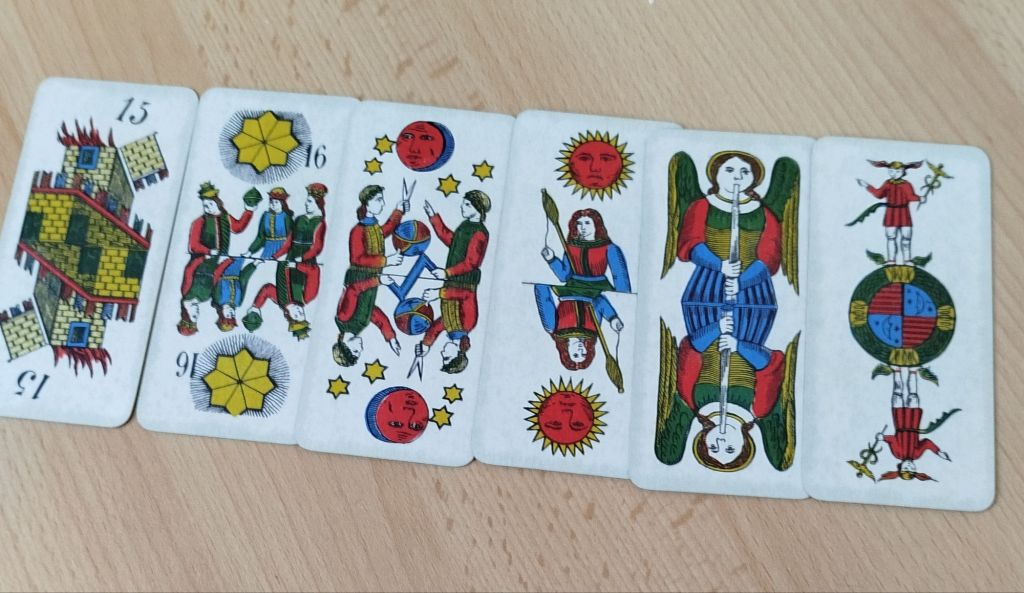
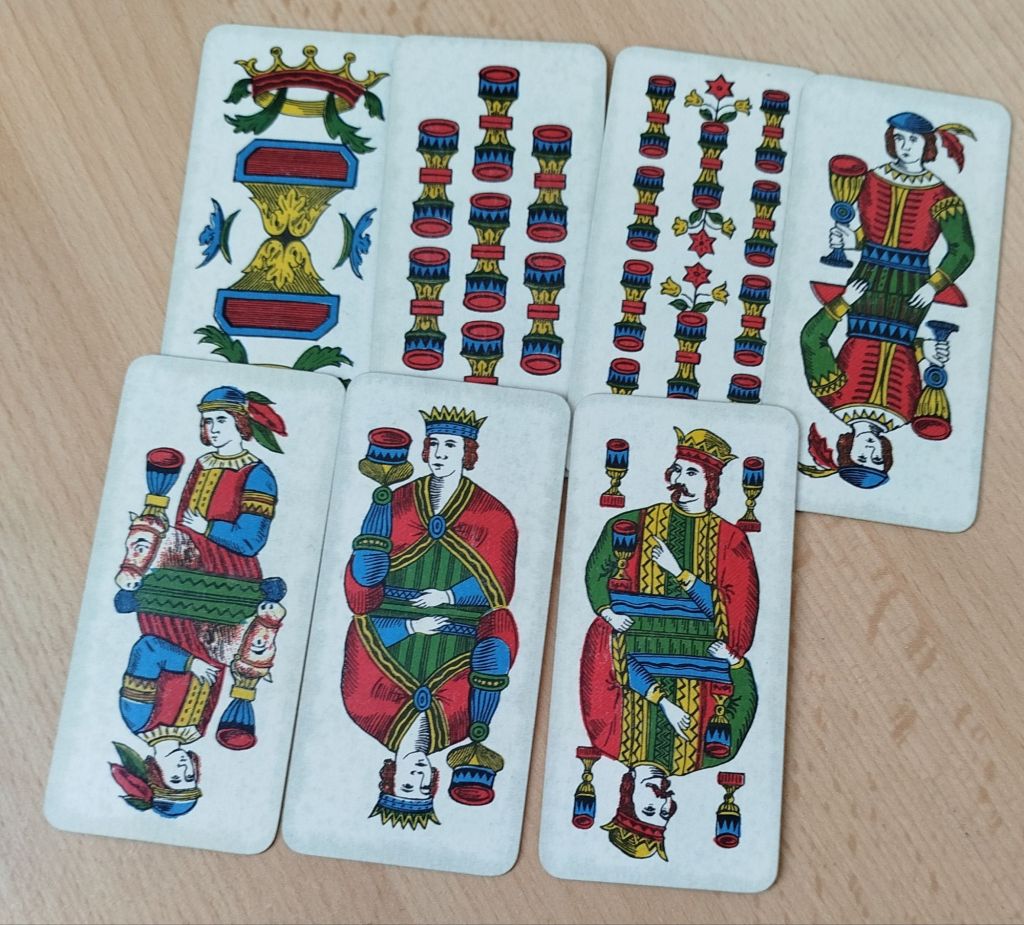
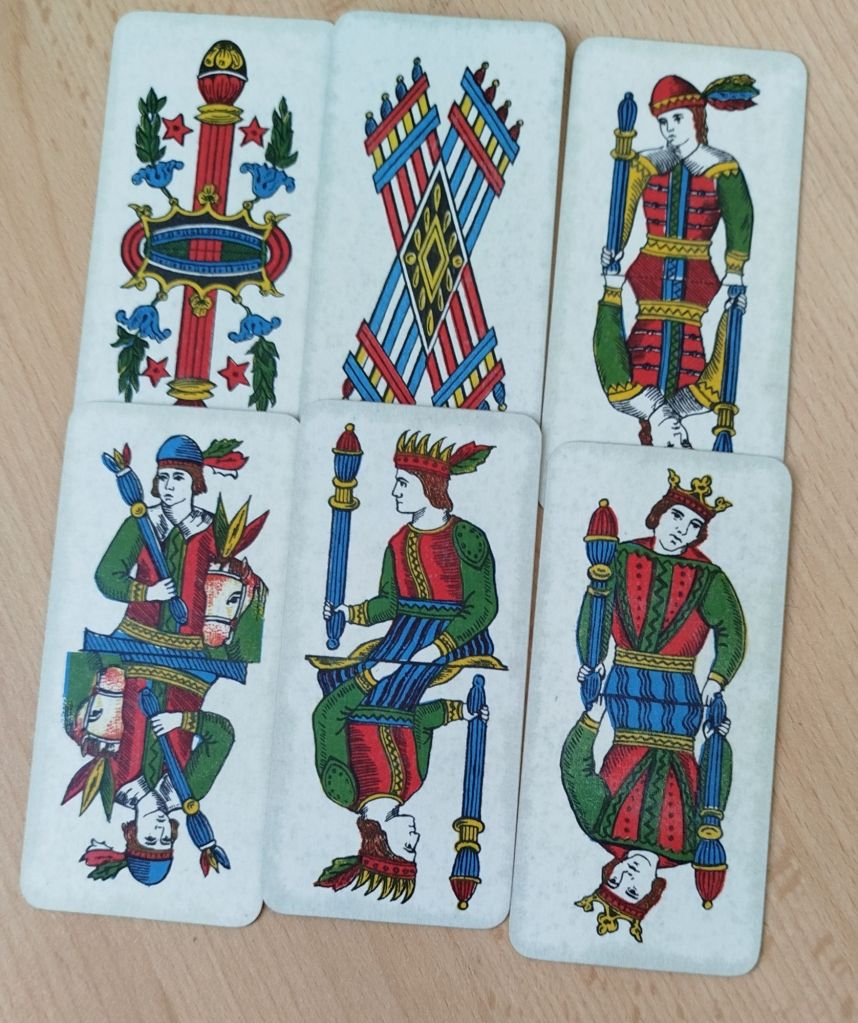
A selection of cards from the Bolognese Tarot. As may be noted, they are symmetrical, like playing cards, though the earliest packs had full images.
The reason it is called ‘tarocchino’ (small tarot) has to do with its reduced size, probably to enhance its handlability. However, it is not just the size of the cards that is reduced, but also the number of the cards that comprise the deck: all pip cards from Two to Five are removed, leaving only the Ace of each suit plus the cards from Six to Ten and the court cards.
Furthermore, the Pope (Hierophant), Popess (High Priestess) Empress and Emperor are absent from the deck for political reasons, as Bologna was directly under the control of the Church. Instead, the deck includes four ‘Moors‘ (the Moors were Muslim colonizers that had conquered parts of Italy.)
Three of the ‘Moors’. The Fourth one is a copy of the third on the right.
Finally, the Bolognese Tarot has another peculiarity, in that the Major Trumps are out of order compared to our regular system. This may sound surprising to some, but our current ordering of the trumps is a relatively recent development and has nothing mystical about it (the oldest preserved document with the order of the trumps gives a rather different sequence).
An Old Tradition
The Bolognese Tarot tradition was almost entirely confined to the city of Bologna and the surrounding areas, and was at risk of dying out, until both the card game and the divination tradition were transmitted to a larger public thanks to the power of the Internet.
Interestingly, to this tradition is connected the most ancient set of meanings handed down by old sources. The following list dates back to the pre-Napoleonic period and gives the meanings of a reduced pack of thirty five cards. I’m copying it here for its historical interest, but it does not correspond to the system I have been taught:
The Juggler (Magician): Married Man
The Lovers: Love
The Chariot: Journey
Temperance: Time
Strength: Violence
The Hermit: Old (Person)
The Hanged Man: Treason
Death (called ‘Thirteen’): Death
The Devil: Wrath
The Star: A Gift
The Moon: Night
The Sun: Day
The Angel (Judgement): Marriage or Agreement
The World: Long travel
The Fool: Madness
King of Wands: A Bachelor
Queen of Wands: A Prostitute
Knight of Wands: Something Knocking at the Door
Page of Wands: Thoughts of the Female Querent
Ace of Wands: Sexual Escapades
King of Cups: An Old Man
Queen of Cups: Married Woman
Knight of Cups: Reconciliation
Page of Cups: The Female Querent
Ten of Cups: The Roof of the House
Ace of Cups: The House
King of Swords: An Evil Tongue
Ten of Swords: Tears
Ace of Swords: A Letter
King of Coins: The Male Querent
Queen of Coins: The Truth
Knight of Coins: Thoughts of the Male Querent
Page of Coins: Unmarried Woman
Ten of Coins: Money
Ace of Coins: The Table
As I said, this is not the system that I’ve been taught, and it is very likely that even back then more than one system existed (usually, significant differences are found from quarter to quarter in Bologna and from small village to small village in the surrounding areas). Since this cartomantic tradition predates Etteilla’s by at least a quarter of a century, and probably more, and since Etteilla says he learned to read the tarot from an Italian card reader (though he pretends it was Alexis of Piedmont to add to the mystery), it is not to be excluded that the Bolognese tarot had some influence on him.
But this is speculation. What is clear is that tarot divination, whenever it was born, was brought into the world as a way of addressing concrete issues. This series of articles is dedicated to bringing the tarot back to these roots.
The Rider Waite’s minor arcana (which I already talked about here) are based on the Golden Dawn’s correspondences and titles found in Mathers’ and Felkin’s Book T. Yet Waite, who was very fond of showing off his erudition, made it a point to look for as many similarities as possible between the Book T system and other lists of meanings such as Etteilla’s, Christian’s and others.
This is reflected in the accompanying book to his deck, The Pictorial Key to the Tarot, where he tries to find similarities between various sources for each minor card. He never mentions the Golden Dawn material, despite the fact that knowing the GD’s card names would clarify most of the designs.
The 1 to 1 correspondence between GD meanings and Waite’s minor arcana is self-evident, and once it is noted it cannot be unseen. Yet in his book he makes it a point to just rely on non-esoteric sources, or at least on non-GD sources.
Note that the Golden Dawn did something similar, despite the claim that the card titles were revealed to them. Take the Four of Cups, for instance, which technically should be ascribed to the rulership of the Moon in the third decan of Cancer and to the sephira Chesed (mercy). All these things sound very promising. Yet the card is called Blended Pleasure and it is less positive than the previous two, largely (I believe) in an attempt to accomodate Etteilla’s relatively negative interpretation of the Four of Cups as a card of boredom, annoyance, etc.
Similarly, the Golden Dawn retained certain meanings found in traditional fortune-telling, such as ‘travel by water’ for the Six of Swords. This can be seen as part of the GD’s attempt at summarizing the whole of the Western magical tradition in a new synthesis.
Going back to Waite, it is clear that in his book he is also trying to balance various sources, but if in doubt about which one to follow, he will stick (without saying so explicitly) to the GD tradition. An example I already discussed is the Five of Pentacles, which Etteilla calls the card of the lovers, but the Golden Dawn called it ‘Material Trouble’.
Another example is the Two of Wands, which Etteilla calls a card of sorrow, but for the GD it is a card of Dominion, so Waite goes with the GD but tries to stretch the interpretation in his text by saying that it could be the sorrow of a great leader, like Alexander the Great, at the height of his power.
But What About the Seven of Swords?
With that in mind, what the hell is going on with the Seven of Swords? Let me explain: most people who pick up a Rider Waite tarot deck, even today, have no idea about the esoteric stuff behind it, so they base their interpretation on the design (which, incidentally, Waite thought very little of). This is how, for instance, the Two of Pentacles, the Lord of Harmonious Change according to GD, became the card of juggling, or how the Seven of Cups, the Lord of Illusionary Success, became the card of options.
In this new folk approach to the Waite deck, the Seven of Swords became known as the thief card due to the design.
Yet Waite does not even mention thieves in his description. He says:
A man in the act of carrying away five swords rapidly; the two others of the card remain stuck in the ground. A camp is close at hand. Divinatory Meanings: Design, attempt, wish, hope, confidence; also quarrelling, a plan that may fail, annoyance. The design is uncertain in its import, because the significations are widely at variance with each other. Reversed: Good advice, counsel, instruction, slander, babbling.
The meanings he gives are from Etteilla, where the Seven of Swords is one of the few non negative Sword cards. The description of the card, however, is far more consonant with what we find in Book T, which is:
The Lord of Unstable Effort […]Partial success. Yielding when victory is within grasp, as if the last reserves of strength were used up. Inclination to lose when on the point of gaining, through not continuing the effort. Love of abundance, fascinated by display, given to compliments, affronts and insolences, and to spy upon others. Inclined to betray confidences, not always intentionally. Rather vacillatory and unreliable. Netzach of HB:V (Journey by land: in character untrustworthy)
This thing with the yielding when victory is within grasp is clearly depicted in the card, where the thief takes away most of the enemy’s swords, but not all, as Waite clearly states.
But why did Waite (and, maybe, Smith) decide to depict a thief in the Seven of Swords despite it being so thematically different from Waite’s actual inspiration (Book T) and even his cover-up inspiration (Etteilla)?
The only hints we find in Book T that seem to point in this direction are “to spy upon others” and “in character untrustworthy”. In an attempt to accomodate Etteilla, Waite probably saw the man looking longingly at the swords he left on the ground as a symbol of hope, which is Etteilla’s meaning for the card.
One possible explanation is that Waite and/or Smith probably thought the type of action that is best suited to the Suit of Swords is the kind of sneaky, underhanded action depicted in the final design of the card. Be it as it may, this is one of the cards that always stood out to me when studying the history of this deck, because it takes a very non-obvious approach to its theme.
(Note: this is a collection of the meanings attributed to the cards by some occultists in the past centuries. It does not reflect my own study or opinion of the cards. It is only meant as a quick comparative reference as I develop my own take.)
The Three of Wands from the Builders of the Adytum (BOTA) tarot deck
Paul Foster Case (and Ann Davies)
In Tarot divination the key ideas related to the Three of Wands are: mental energy, leadership, ambition, determination. It is a card related to the realization of hopes and of success after struggle. Well-Dignified: it stands for courage, persistence, pride and nobility. Ill-Dignified: it represents conceit, arrogance, insolence. Keyword: Established strength. (From the Oracle of Tarot course)
A. E. Waite
A calm, stately personage, with his back turned, looking from a cliff’s edge at ships passing over the sea. Three staves are planted in the ground, and he leans slightly on one of them. Divinatory Meanings: He symbolizes established strength, enterprise, effort, trade, commerce, discovery; those are his ships, bearing his merchandise, which are sailing over the sea. The card also signifies able co-operation in business, as if the successful merchant prince were looking from his side towards yours with a view to help you. Reversed: The end of troubles, suspension or cessation of adversity, toil and disappointment. (From The Pictorial Key to the Tarot)
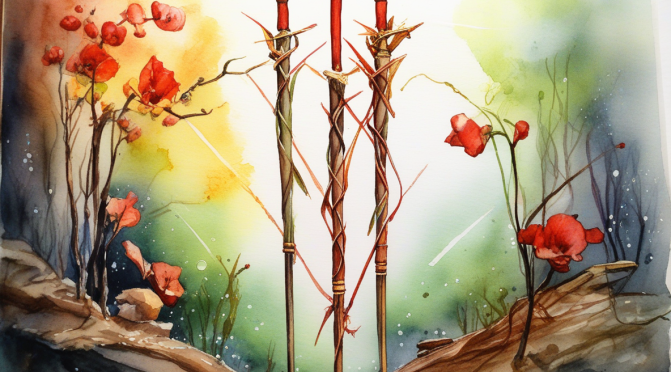
A beautifully essential AI-generated illustration for the Three of Wands
Aleister Crowley
The Three of Wands is […] the Lord of Virtue. The idea of will and dominion has become interpreted in Character.
[…]
This card refers to Binah in the suit of Fire, and so represents the establishment of primeval Energy. The Will has been transmitted to the Mother, who conceives, prepares, and gives birth to, its manifestation.
It refers to the Sun in Aries, the Sign in which he is exalted.
The meaning is harmonious, for this is the beginning of Spring. For this reason one sees the wand taking the form of the Lotus in blossom. The Sun has enkindled the Great Mother.
In the Yi King, Sol in Aries is represented by the 11th hexagram, Thai; its meaning is identical with the above description. (From The Book of Thoth)
Golden Dawn’s Book T
A WHITE Radiating Angelic Hand, as before, issuing from clouds and grasping three wands in the centre (two crossed, the third upright). Flames issue from the point of junction. Above and below are the symbols Sun and Aries. Established force, strength, realization of hope. Completion of labour. Success after struggle. Pride, nobility, wealth, power, conceit. Rude self-assumption and insolence. Generosity, obstinacy, etc. Binah of HB:Y (Pride, arrogance, self-assertion). Herein rule the Angels HB:HHShYH and HB:a’aMMYH.
Etteilla
Enterprise Upright. This card, as far as the medicine of the spirit is concerned, means, in its natural position: Enterprise, Undertake, Begin. – Usurp, Seize. – Boldness, Temerity, Fierceness. – Imprudence, Undertaking, Bold, – Committed, Embarrassed. Bewildered. – Paralyzed, Effort, Experiment, Attempt. Reversed. Interruption of misfortune, torment, sorrow or toil. – End, Cessation, Interruption, Pause, Rest, Influence, Intermediary, Intermittence.
(Note: this is a collection of the meanings attributed to the cards by some occultists in the past centuries. It does not reflect my own study or opinion of the cards. It is only meant as a quick comparative reference as I develop my own take.)
The Two of Pentacles / Coins from the Builders of the Adytum (BOTA) tarot deck
Paul Foster Case (and Ann Davies)
The time period is the first decanate of Capricorn, December 22 to December 31, under the rulership of Saturn. Meanings: Well-Dignified: harmony in the midst of change; alternation of gain and loss; change of occupation; travel in quest of wealth; ups and downs of fortune; a visit to friends. Ill-Dignified: intimates discontent; foolishness in the management of resources; restricted condition of material affairs due to bad management; the Querent is probably too talkative and too suspicious. He is kind, but inconsistent, and should avoid arguments. Keyword: Fluctuation (From the Oracle of Tarot course)
A. E. Waite
A young man, in the act of dancing, has a pentacle in either hand, and they are joined by that endless cord which is like the number 8 reversed. Divinatory Meanings: On the one hand it is represented as a card of gaiety, recreation and its connexions, which is the subject of the design; but it is read also as news and messages in writing, as obstacles, agitation, trouble, embroilment. Reversed: Enforced gaiety, simulated enjoyment, literal sense, handwriting, composition, letters of exchange. (From The Pictorial Key to the Tarot)
Aleister Crowley
The Two of Pentacles was of old time called the Lord of Harmonious Change. Now, more simply, Change; and here the doctrine must be stated a little more clearly. This suit being of Earth, there is a connection with the Princesses, and therefore with the final Heh of Tetragrammaton. Earth is the throne of Spirit; having got to the bottom, one immediately comes out again at the top. Hence, the card manifests the symbolism of the serpent of the endless band.
[…]
The number Two, Chokmah, here rules in the suit pertaining to Earth. It shows the type of Energy appropriate to Two, in its most fixed form. According to the doctrine that Change is the support of stability, the card is called Change.
Its celestial rulers are Jupiter and Capricornus; and these symbols are most inharmonious, so that in practical matters the good fortune of Jupiter is very limited. Their influence on the card is not great. Yet, Jupiter being himself the Wheel (Atu X), he emphasizes that idea.
The card represents two Pantacles, one above the other; they are the Chinese symbols of the Yang and Yin duplicated as in the Hsiang. One wheel is dextro- and the other laevo-rotatory. They thus represent the harmonious interplay of the Four Elements in constant movement. One may in fact consider the card as the picture of the complete manifested Universe, in respect of its dynamics.
About them is entwined a green Serpent (see Liber 65, chapter iii, verses 17-20). His tail is in his mouth. He forms the figure Eight, the symbol of the Infinite, the equation 0=2. (From The Book of Thoth)
Nice AI-generated illustration for the Two of Pentacles or Coins
Golden Dawn’s Book T
TWO wheels, disks or pentacles, similar to that of the Ace. They are united by a green-and-gold serpent, bound about them like a figure of 8. It holds its tail in its mouth. A White Radiant Angelic Hand holds the centre of the whole. No roses enter into this card. Above and below are the symbols of Jupiter and Capricorn. It is a revolving symbol.
The harmony of change, alternation of gain and loss; weakness and strength; everchanging occupation; wandering, discontented with any fixed condition of things; now elated, then melancholy; industrious, yet unreliable; fortunate through prudence of management, yet sometimes unaccountably foolish; alternatively talkative and suspicious. Kind, yet wavering and inconsistent. Fortunate in journeying. Argumentative. Chokmah of HB:H (Pleasant change, visit to friends). Herein the Angels HB:LKBAL and HB:VShRYH have rule.
Etteilla
Embarrassment Upright. This card, as far as the medicine of the spirit is concerned, means, in its natural position: Awkwardness, Obstacle, Commitment, Obstruction, Setback. – Disturbance, Bother, Emotion, Mess, Confusion, Difficulty, Impediment, Tangle, Obscurity. – Agitation, Restlessness, Perplexity, Concern. Reversed. Ticket, Piece of Writing, Writing, Text, Literature, Doctrine, Erudition, Work, Book, Production, Composition. – Dispatch, Epistle, Missive. – Written character. – Literal Meaning. – Alphabet, Elements, Principles. – Promissory note.
This is intended as a collection of meanings attributed by some sources to the Major Arcana and Minor Arcana of the Tarot. I will add sources as I study them. If you have sources to recommend, hit me up.
If you are interested in a (partial) list of the meanings I attribute to the Major arcana in my reading examples and case studies, click here.
I am old enough to remember a time when people did videos of tarot unboxings and would be shocked to discover that their deck had either unillustrated pips or different designs incompatible with the Rider-Waite-Smith tradition (which is not a tradition. I’ll come back to it)
In this regard, the average literacy of tarot enthusiasts has slightly increased in the last fifteen years or so. For whatever reason, people online still rave about the latest RWS clones, but they are also aware that the RWS is not THE tarot deck. It just happens to be a very popular variant.
As a matter of fact, its illustrated pips are probably the single major contributor to its success (it certainly wasn’t for Pamela Colman Smith’s talent or Waite’s approachable writing). Although the Waite deck is not the first to have illustrated minors (the the Sola Busca has this honor, and centuries later also the Tarot of the Master) it was the one which, after a couple of decades of obscurity between World Wars, accompanied the New Age-themed Tarot revival that lasts to this day.
The Waite deck essentially redifined tarot for decades as needing illustrated pips. People have come up with all sorts of fantastic interpretations of the most minute and inconsequential details found in the pips. We also have a relatively consolidated tradition that has nothing to do with Waite’s (or Smith’s) vision, such as for instance the Eight of Pentacles being the apprentice card, the Nine of Pentacles being basically the strong independent woman who don’t need no man card, the Seven of Swords as the thief card and so on.
This, I must confess, I find very amusing, considering Waite’s own attitude toward the minor arcana. Whoever takes the time to wade through Waite’s turgid prose quickly finds out that Waite couldn’t care less about the minor arcana in his deck (so much so that he had them almost completely eliminated from his later deck, the so-called Waite-Trinick)
Waite had been a member of the Golden Dawn, and as such he must have had to draw or color in his own deck at some point or another. He was instructed in the Golden Dawn system, wherein the pips (except the aces) are assigned to the decans of the zodiac (usually the Picatrix version) and given titles. So, for instance, the Two of Wands is the Lord of Dominion (and, lo and behold, the Two of Wands in the Waite deck has a lord observing his own dominion.)
All this is no secret, and has been discussed at length already. However, what is often not discussed enough is how scathing Waite’s attitude was toward both the Golden Dawn system and the minor arcana in general. He clearly believed that the Major Trumps were a separate, mystical device that had been merged with a regular playing deck with no meaning whatever. He certainly was intelligent enough to see that the Golden Dawn system was essentially made up and had no historical authenticity to it (though this is not to say one cannot work with it. Symbols are symbols.)
It is for this reason that he notoriously “spoon-fed” Smith the design of the Major Trumps. Because he deeply cared about them, or at least about his own interpretation of them. As far as the minor arcana are concerned, he generally had Smith follow the Golden Dawn system in illustrating the names of the pips.
This is clear when we read Waite’s interpretation of cards such as the Five of Pentacles, where the meaning of the Golden Dawn card (Lord of Material Trouble) cannot be harmonized with the other sources Waite draws from (such as Etteilla, for whom the Five of Coins is the Lovers card). That is, Waite seeks to find a harmony of the various meanings, but when this is impossible, he goes with the Golden Dawn variant, though not out of true conviction that the system is valid. He also very likely left Smith more creative freedom in decorating a bunch of cards he felt were useless distractions.
So what we have today is people finding meaning into something that never was intended to have much meaning in the first place. Surely it must be one of the great ironies of history that one of the most radical developments in the structure of the tarot, i.e., illustrated pips, came about not because the inventor cared about pip cards, but because he didn’t.