Tag Archives: tarot history

Who’s the Little Sword Bearer?

Working on my review of Andrea Vitali and Terry Zanetti’s book on the Bolognese tarot I came across some interesting information that matches what some Bolognese tarot readers have confirmed.

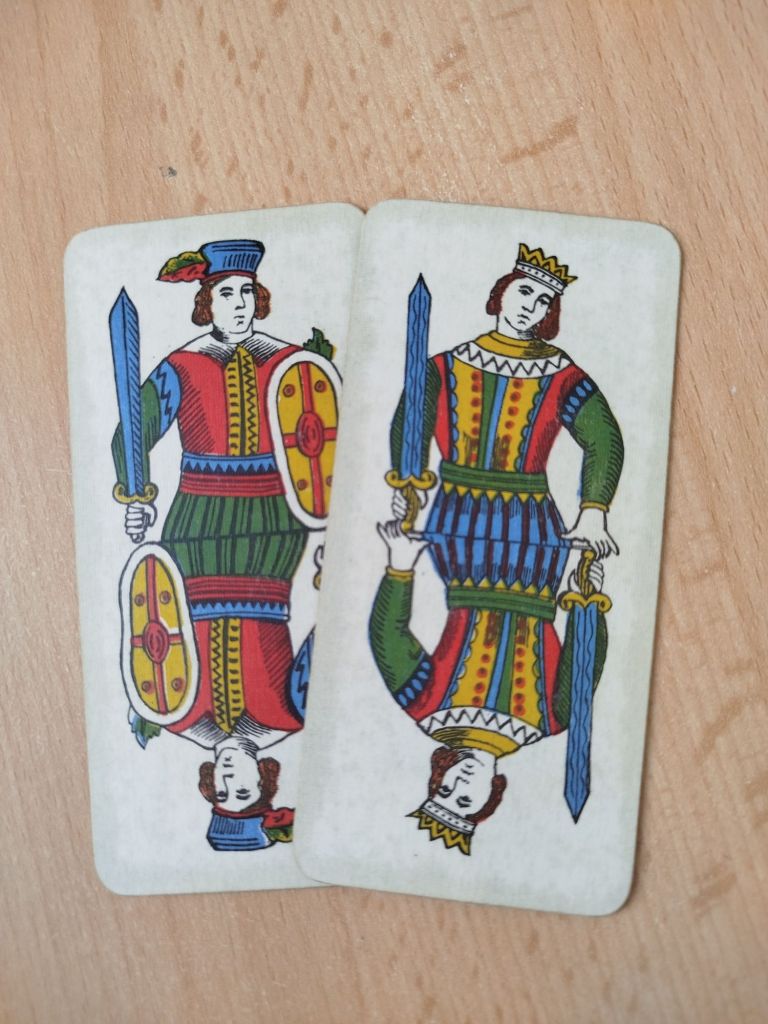
If you read my section on the card meanings of the Bolognese tarot, you will see that I call the King of Swords “Spadino”, which literally means “little sword” or, more appropriately in this context, “little sword bearer” (the ‘bearer’ part is implied). This is because the people I have chiefly learnt from all agreed on this one name, independently from one another.

When we read Zanetti’s section on the divinatory meanings of the cards, though, we find that she calls the Page of Swords ‘Spadino’, identifying the figure with a young man. This is in contrast with the tradition I’ve received, whereby the Page of Swords is just a letter or message. Zanetti does say that the card can also sometimes signify a disquieting letter, but she chiefly identifies the Page with a young man.

The Page of Swords and the King of Swords in the Bolognese tarot / Tarocchino bolognese

I must say I find this option strangely titillating, as the Page of Swords, Spadino, would then be a male counterpart to the Page of Cups, Coppina, ‘little cup bearer’. The ending -ino, which in Italian points to something small or young, definitely fits the Page more than the King. Zanetti denies that this parallel between Coppina and Spadino exists, because the Coppina is supposed to be always negative (she’s traditionally the little floozy who snatches hubby away). But I have not found this to be the case: the Page of Cups is just a young (or younger) woman.

Ultimately, as my understanding and practice with the Bolognese tarot evolves, I know I will have to create my own deck (all traditional readers seem to have done so, preserving a part of tradition and integrating it with their own discernment and experience). Tradition is, after all, not something fixed, but something that is handed over to us (from the Latin tradere) and that we must administer intelligently.

Another interesting fact is that Zanetti emphasizes the intellectual aspect of Spadino, calling the card “young man and his thoughts”. This is in contrast with what I’ve learned from Germana Tartari, my teacher for the 50-card method, whose grandma taught her that the Knight of Swords can sometimes represent the King of Swords’ thoughts, in a kind of parallel to the Knight of Wands being the thoughts of the King of Wands.

The fact that so many traditions seem to exist should not discourage us from engaging with them. Keep in mind that the Bolognese tarot tradition evolved locally, with each city, village or even street having slightly different versions of it. Thus, this is less a matter of who is right or wrong and more one of systemic preference and whether integrating different system together leads to new systems that work, or whether it is best to keep them separate. This is something that can be established only through trial and error.

MQS

A Cartomantic Chaos

The Bolognese Tarot is traditionally read using a reduced pack of either 45 or 50 cards (the 35 card system, of historical interest, is no longer practiced today). However, since it is a tradition that varies locally, the make-up of the deck varies. In other words, the 45 cards I use are not necessarily the same used by another person who uses 45 cards. The same is true for the 50 card deck.

This uncertainty is what contributes to the relative obscurity of the method. At the end of the day, many people want a clear standard to follow. For my part, I practice the systems I have been taught: the 45-card system you often see in my readings, which I was taught three or four years ago but had left alone until recently, and the 50-card system I have been taught by Germana Tartari.

Many of the sources I have consulted seem to believe that the 45-card system is older, and later five extra cards were added by some. Germana herself told me she remembers her grandma telling her that she (her grandma) had seen the full pack of 62 used (this reconstructed system is the topic of Germana’s newer book, which I will review in the near future).

So we have several systems, which isn’t surprising: if we look at Piacentine playing cards, there are at least several full-deck methods, at least one method with 30 cards and several with 25 cards.

Going back to the tarocchino bolognese, and limiting ourselves to the two most used systems of 45 and 50, usually the cards that overlap tend to have the same or similar meanings, at least in part. For instance the Ace of Coins can be the table or desk in all systems I am aware of. Additionally, in the 45-card system I know, the Ace of Coins can also be the card of money (relatively big money). In Germana’s 50-card system, the Ace of Coins can be a table, but also a letter or document. In Ingallati’s system, the Ace of Coins is the table or the work card.

As for the work card, both Germana’s 50-card system and the 45-card system I know assign it to the Star, but the Star is also the card of material possessions and possibly of gifts, which is the main meaning assigned to the card by Ingallati. In another book on the 45-card method I have yet to review, the Star represents the health status (in my system it can represent meds), but also ‘good job opportunities’.

As you can see, there is overlap, but also space for divergence. To avoid confusion, both for myself and for the readers, I tend to stick to the meanings I know, but I think it’s fair that I bring this up.

As for the five extra cards that some add to the initial 45, there isn’t great uniformity either. Some don’t even add five cards: I know a reader who uses a pack of 49, while Giliberti, whose book I reviewed, seems to use 51 in one video I saw (how many cards she uses in the book I don’t know, due to the book’s chaotic nature).

All this chaos may be frustrating for someone who is approaching the bolognese tarot for the first time, especially from outside of Italy. One thing is growing up with a particular system, another thing is having to randomly choose one.

I don’t believe any system is inherently better or worse. All have the same potential for describing life, if properly used, and much also depends on the person’s inclination. For instance, having studied the 50-card system under Germana’s supervision, there should apparently be no reason for me to go back to the 45-card system. Yet I found myself always coming back to it, despite integrating insights from Germana’s system and from the books I read.

Ultimately I recognized that the 45-card system simply resonates with me beautifully, and while we are still in an open relationship, I tend to gravitate toward it. Certainly, if I had to write a full guide on the Bolognese tarot, I would illustrate this method. You may find otherwise.

I think anyone who is interested in this deck should take their time to explore their options. Mixing and matching randomly without having first studied the various strands of the tradition is not recommended, but as we study and practice we may find that a more individual approach emerges.

MQS

Bolognese Tarot – I Tarocchi Parlano by Maria Luigia Ingallati (Review)

I Tarocchi Parlano (The Tarot Speaks) by Maria Luigia Ingallati is perhaps the most well-known book about the Tarocchino Bolognese in Italy, and the one that, thanks to its success, launched the rediscovery of this deck outside of its native region. Since the publication of Ingallati’s book, the Bolognese tarot has enjoyed a small but growing cult following. This, we shall see, is probably the book’s greatest merit, though not the only one.

Ingallati herself is not from Bologna. She relocated there many years prior to the publication of her first book (‘Il Tarocchino Bolognese’, which I will review separately). There, she started seeing the local card readers, getting her fortunes told and learning a great deal from them, until she began practicing the art herself and synthesizing a personal method from the Bolognese tradition and her own experience as a card reader.

The book does a good job of presenting Ingallati’s journey, and it is undeniable that her personality shines through the pages of the richly illustrated volume. Ingallati is a good story-teller, enjoys reading and talking about poetry, philosophy and psychology, all of which she uses to shed light on the Bolognese tarot.

Ingallati uses a personal variation of the 50-card method, comprised of the following cards: the 18 surviving Major Arcana; the 3 Strangers or Moors; 7 Cup cards (Ace, Nine, Ten and the Court); 6 Wand cards (Ace, Six and the Court); 8 Coin cards (Ace, Six, Nine, Ten and the Court); 7 Sword cards (Ace, Six, Seven and the Court); and the red Joker.

Of Ingallati’s selection, the choice to include the Joker is the one that has always stuck out like a sore thumb to me. The traditional deck includes no Jokers, since they are not needed for playing card games, and to this day only one producer has recently randomly decided to add them. That being said, Ingallati is very careful in acknowledging what she took from the tradition and what she introduced as her own innovation.

The book starts off with a chapter on the history of the Tarocchino. It is not the best and most accurate historical account, but it covers most of the basics and it is the one most people will skip anyway. Then, Ingallati presents the spreads she uses. This is a peculiar trait of her method, which she also teaches in her private classes: she uses a huge variety of spreads one after the other to move from an account of the querent’s past to the future.

No time is wasted on the technical details of how to lay out the cards, in what order, etc.: the reader is left to his or her own initiative of how to apply the traditional spreads. This may overwhelm us at the beginning, but it is clear that she thinks everyone should find their own way of laying out the traditional spreads, which is fair. This is possibly the most interesting part of the book: Ingallati’s method is a synthesis of many strands of traditional lore about the spreads which can be mined by reading the section carefully and comparing it to other sources.

Only after the section on the spreads does Ingallati start her discussion of the card meanings. Here, the writer spends, in my opinion, way too much time overanalyzing the various details of color and symbol. We learn, thus, that the shape of the lace on this or that character’s tunic has this or that meaning; that the number of triangular shapes on the Queen of Coin’s scepter suggests certain symbolic interpretations; that the colors of the Fool’s feathers is very important.

Of course, none of this has any historical relevance nor any bearing on the interpretation of the cards, nor with the traditional, succint meanings that Ingallati scatters around in the descriptions, sometimes almost as an afterthought. This leaves one wondering if the overzealous interpretation of the various bits of design was just the happy meeting point between the publisher needing a longer book and the writer being happy to provide it with a clear poetic gusto for the mysterious and the metaphorical. Almost every card is accompanied by snippets of poetry and aphorisms, anecdotes as well as by illustrations of some combinations.

The final part of the book is dedicated to Jungian character analysis based on the Bolognese tarot, something that the author clearly has a great deal of interest in, and for which she provides some curious combinations that might be worth trying.

Ingallati’s book is hard to review objectively. It has the incredible historical merit of having brought the Bolognese tarot to a wider public, and it is undeniable that her poetic and evocative style and her attempt at ennobling it as a ‘legitimate’ tool for divination is part of why she succeeded.

The esoteric landscape has a growing public of people I like to call educated suckers, those who think themselves too smart and learned for folk superstitions but can easily be sold on the idea of reinterpreting them as deeper mysteries of personal development and esoterically flavored self-help. This is the reason why so many ‘real and only’ Tarot of Marseilles’ get sold every year, together with ridiculously expensive courses on ‘this is not divination’ and books of metaphysical platitudes that sound deep if you don’t think too much about them.

Ingallati struck gold when she managed to appeal to this kind of public with her literary style while also preserving the teachings she received and developed from the card readers she met in Bologna. In doing so she succeeded where the small handful of other books published before and since failed: creating a niche for the Bolognese tarot. Despite my sarcasm in the previous paragraph, this is no small accomplishment. Pragmatically speaking, it is a serious merit.

The book also excels at being a treasure trove of meanings, spreads, combinations and suggestions that can be studied, reflected on and compared with other sources. It is certainly a book I recommend, in this regard.

Where to buy: Amazon

MQS

Tarot Encyclopedia – The Eight of Cups

(Note: this is a collection of the meanings attributed to the cards by some occultists in the past centuries. It does not reflect my own study or opinion of the cards. It is only meant as a quick comparative reference as I develop my own take.)

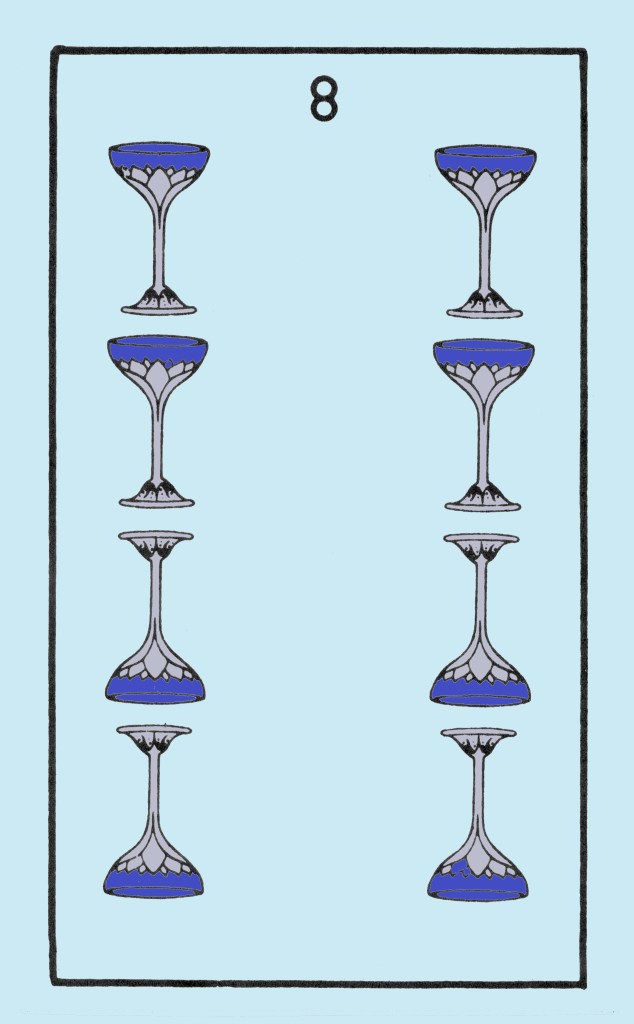
The Eight of Cups from the Builders of the Adytum (BOTA) tarot deck

Paul Foster Case (and Ann Davies)

The time period is the first decanate of Pisces, February 19 to February 28, ruled by Jupiter and Neptune.
Well-Dignified: renunciation of material success for something higher; interest in psychic and spiritual things; strong emotions; charity and helpfulness; love of travel and of scientific investigation.
Ill-Dignified: momentary success, but nothing lasting; the person to whom the card applies is overimpressionable, erratic and unsteady in his emotions; meaningless change of mood; purposeless journeying; querulous disposition.
Keyword: Instability
(From the Oracle of Tarot course)

A. E. Waite

A man of dejected aspect is deserting the cups of his felicity, enterprise, undertaking or previous concern. Divinatory Meanings: The card speaks for itself on the surface, but other readings are entirely antithetical–giving joy, mildness, timidity, honour, modesty. In practice, it is usually found that the card shews the decline of a matter, or that a matter which has been thought to be important is really of slight consequence–either for good or evil. Reversed: Great joy, happiness, feasting.
(From The Pictorial Key to the Tarot)

The Eight of Cups from the Rider Waite Smith tarot

Aleister Crowley

The Eight of Cups is called Indolence. This card is the very apex of unpleasantness. It is ruled by the planet Saturn; time, sorrow, have descended upon pleasure, and there is no strength in the element of water which can react against it. This card is not exactly “the morning after the night before”; but it is very nearly that. The difference is that the “night before” has not happened! This card represents a party for which all preparations have been made; but the host has forgotten to invite the guests; or, the caterers have not delivered the good cheer. There is this difference, though, that it is in some way or other the host’s own fault. The party that he planned was just a little bit above his capacity; perhaps he lost heart at the last moment.

[…]

The Eight, Hod, in the suit of Water, governs this card. It shows the influence of Mercury, but this is overpowered by the reference of the card to Saturn in Pisces. Pisces is calm but stagnant water; and Saturn deadens it completely. Water appears no longer as the Sea but as pools; and there is no florescence in this card as there was in the last. The Lotuses droop for lack of sun and rain, and the soil is poison to them; only two of the stems show blossoms at all. The cups are shallow, old and broken. They are arranged in three rows; of these the upper row of three is quite empty. Water trickles from the two flowers into the two central cups, and they drip into the two lowest without filling them. The background of the card shows pools, or lagoons, in very extensive country, incapable of cultivation; only disease and miasmatic poison can flourish in those vast Bad Lands.

The water is dark and muddy. On the horizon is a pallid, yellowish light, weighed down by leaden clouds of indigo. Compare with the last card; it represents the opposite and complementary error. The one is the Garden of Kundry, the other the Palace of Klingsor. In the psychopathology of The Path, this card is the German Measles of Christian Mysticism.
(From The Book of Thoth)

The Eight of Cups from the Thoth Tarot deck

Golden Dawn’s Book T

A WHITE Radiating Angelic Hand, holding a group of stems of lotuses or waterlilies. There are only two flowers shown, which bend over the two central cups, pouring into them a white water which fills them and runs over into the three lowest, which later are not yet filled. The three uppermost are quite empty.

U U U
U U
U U U

At the top and bottom of the card are symbols Saturn and Pisces.

Temporary success, but without further results. Thing thrown aside as soon as gained. Not lasting, even in the matter in hand. Indolence in success. Journeying from place to place. Misery and repining without cause. Seeking after riches. Instability.
Hod of HB:H (Success abandoned; decline of interest).
The Angels ruling are HB:VVLYH and HB:YLHYH.

Etteilla

Blonde girl
Upright. This card, as far as the medicine of the spirit is concerned, means, in its natural position: Blonde Girl, Honest Girl, Practical Girl, Honor, Modesty, Restraint, Timidity, Fear, Apprehension, Sweetness, Attraction.
Reversed. Satisfaction, Happiness, Contentment, Gaiety, Joy, Cheerfulness, Enjoyment, Fun, Celebration. – Apology, Reparation, Discompense. – Public Joy, Spectacle, Arrangement, Recollection, Preparations, Arrangements.

MQS

Tarot Encyclopedia – The Seven of Pentacles or Coins

(Note: this is a collection of the meanings attributed to the cards by some occultists in the past centuries. It does not reflect my own study or opinion of the cards. It is only meant as a quick comparative reference as I develop my own take.)

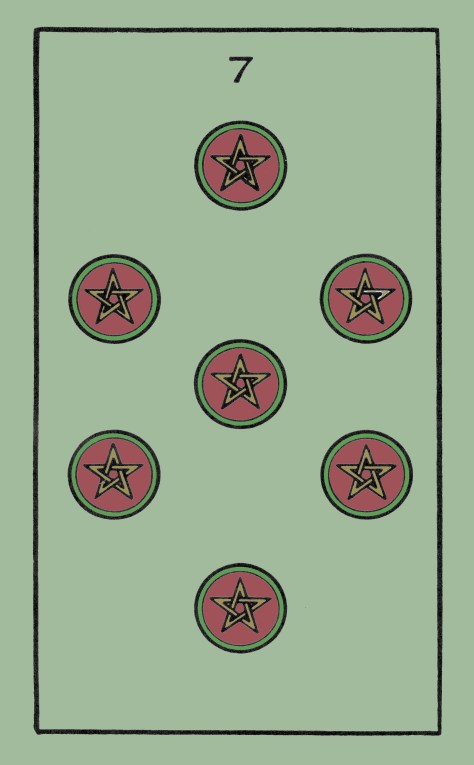
The Seven of Pentacles from the Builders of the Adytum (BOTA) tarot deck

Paul Foster Case (and Ann Davies)

The time period is the third decanate of Taurus, under the rulership of Saturn, May 11 to 20. Meanings:
Well-Dignified: slight gains, but of small account; much labor for small returns.
Ill-Dignified: something promising turns out badly; loss in speculation and unprofitable employment; financial restriction; unrealized hopes and
wishes.
Keyword: Loss
(From the Oracle of Tarot course)

A. E. Waite

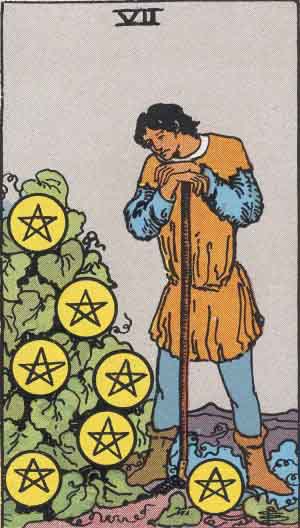
A young man, leaning on his staff, looks intently at seven pentacles attached to a clump of greenery on his right; one would say that these were his treasures and that his heart was there. Divinatory Meanings: These are exceedingly contradictory; in the main, it is a card of money, business, barter; but one reading gives altercation, quarrels–and another innocence, ingenuity, purgation. Reversed: Cause for anxiety regarding money which it may be proposed to lend.
(From The Pictorial Key to the Tarot)

The Seven of Pentacles from the Rider Waite Smith tarot

Aleister Crowley

The Seven of Disks is called Failure. This suit gives the extreme of passivity; there is no positive virtue in it below the Abyss. This card is ruled by Saturn. Compare it with the three other Sevens; there is no effort here; not even dream; the stake has been thrown down, and it is lost. That is all. Labour itself is abandoned; every thing is sunk in sloth.

[…]

The number Seven, Netzach, has its customary enfeebling effect, and this is made worse by the influence of Saturn in Taurus. The disks are arranged in the shape of the geomantic figure Rubeus, the most ugly and menacing of the Sixteen. (See Five of Cups.) The atmosphere of the card is that of Blight. On the background, which represents vegetation and cultivation, everything is spoiled. The four colours of Netzach appear, but they are blotched with angry indigo and reddish orange. The disks themselves are the leaden disks of Saturn. They suggest bad money.
(From The Book of Thoth)

The Seven of Disks from the Thoth Tarot

Golden Dawn’s Book T

A WHITE Radiating Angelic Hand issuing from a cloud, and holding a white rose branch. Seven Pentacles arranged like the geomantic figure Rubeus. There are only five buds, which overhang, but do not touch the five uppermost Pentacles. Above and below are the Decan symbols, Saturn and Taurus respectively.

Promises of success unfulfilled. (Shewn, as it were, by the fact that the rosebuds do not come to anything.) Loss of apparently promising fortune. Hopes deceived and crushed. Disappointment, misery, slavery, necessity and baseness. A cultivator of land, and yet a loser thereby. Sometimes it denotes slight and isolated gains with no fruits resulting therefrom, and of no further account, though seeming to promise well.

Netzach of HB:H (Unprofitable speculations and employments; little gain for much labour).
Therein HB:HRChAL and HB:MTzRAL are ruling Angels.

Etteilla

Money
Upright. This card, as far as the medicine of the spirit is concerned, means, in its natural position: Money, Wealth, Sum, Coin. – Silver. – Whiteness, Purity, Candor, Innocence, Naiveté, Moon. – Purgation, Purification.
Reversed. Restlessness, Torment of spirit, Impatience, Affliction, Remorse, Concern, Solicitude, Care, Attention, Diligence, Application. – Apprehension, Fear, Distrust, Misgiving, Suspicion.

MQS

Tarot Is Not Deep (and Its Limits as a Tool for Self-Reflection)

I always bring up poor Rachel Pollack whenever I need to give a paradigmatic example of someone who utterly ruined tarot divination by turning it into a heap of psychobabble, though in reality the list is quite long. At some point, it was decided that 1) divination could not be a serious undertaking in an age of reason, and 2) we still wanted to think our illustrious predecessors who bought into it were not poor saps. The compromise therefore was that there was something deeper to divination, and so divination had to be reassessed and purged in accordance to this new ideology of ‘depth’ or *shudders* ‘wisdom’.

The reality is that in the “I’m too special for religion but wouldn’t it be fun if there was something more to life” community, where most people tend to think exactly alike in spite of how different they think they are, depth is a misunderstood concept.

Something is considered deep if it will allow them to talk themselves or others silly while giving them plenty of safe thrills and predictable a-ha moments by hurling around the latest buzzwords (try finding a tarot reader who doesn’t talk about narcissists, gaslighting or inner truth).

Thankfully, the tarot is not deep, just like playing cards–and tarot cards ARE playing cards–or tea leaves or dice or geomantic figures are not deep, which is what makes them marvellous divination tools. Even astrology is not deep by today’s standards, if by astrology we mean astrology in its traditional forms (Hellenistic, medieval, Chinese, etc.)

But the depth that is found in divination, just like the depth that is found in all other branches of magic, has nothing to do with finding abstract meanings or deep doctrines that move us beyond real life. Although there can be space of deep philosophy, the real depth is found in the shift in our consciousness of existence and of our place in it as we practice it concretely and see its concrete impact on real life.

I will forever be grateful to my GD supervisor, who always insisted that I practice tarot in real life and not as a mere metaphysical plaything (people will be surprised by how concrete the GD tarot system is, in spite of its metaphysical underpinnings). Traditionally, in magical practice, people are advised on how to recognize when they have established contact with an entity other than themselves.

The risk is sometimes that of contacting parasites masquerading as great beings, but the even higher (and more common) risk is that of simply contacting one’s ego. Psychic onanism IS a thing, and a much worse vice than the physical counterpart.

This is what limits, in my view, the potential for tarot as a tool for self-reflection or meditation or scrying. Granted, most symbols can be used as doorways for these aims, and therefore also the tarot. There is some value to it, especially when done under supervision or with the proper frame of mind. There is also some value in allowing symbols to bring certain aspects of oneself to the surface, if one has the necessary detachment.

Wisdom is a great thing, and it is something that can be pursued on the path of magic, including divination. But more often than not, those who are too good for simple divination and want to discover the “deeper layers” of the tool simply end up massaging the shallower parts of their own psyche without realizing it, and often even thinking they are making some kind of psychological or occult progress when in fact they are simply digging themselves a deeper hole in their own ego.

MQS

Tarot Encyclopedia – The Seven of Cups

(Note: this is a collection of the meanings attributed to the cards by some occultists in the past centuries. It does not reflect my own study or opinion of the cards. It is only meant as a quick comparative reference as I develop my own take.)

The Seven of Cups from the Builders of the Adytum (BOTA) tarot deck

Paul Foster Case (and Ann Davies)

The time period is the third decanate of Scorpio, November 11 to November 20, under the subrulership of the Moon.
Well-Dignified: possible victory, but the person to whom the card applies may be too indolent to take advantage of his opportunities for commanding circumstance. Success may be gained, but not followed up; necessity for choosing only the highest objectives.
lll-Dignified: illusionary success; lying and deceit; drunkenness; violence, even lust.
Keyword: Illusion
(From the Oracle of Tarot course)

A. E. Waite

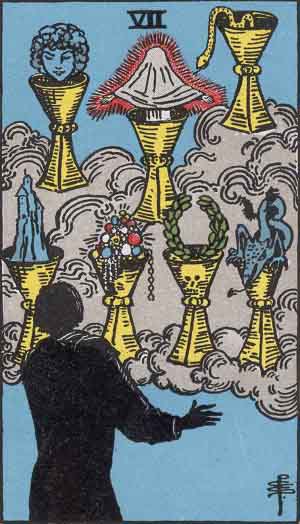
Strange chalices of vision, but the images are more especially those of the fantastic spirit. Divinatory Meanings: Fairy favours, images of reflection, sentiment, imagination, things seen in the glass of contemplation; some attainment in these degrees, but nothing permanent or substantial is suggested. Reversed: Desire, will, determination, project.
(From The Pictorial Key to the Tarot)

The Seven of Cups from the Rider Waite Smith Tarot Deck

Aleister Crowley

The Seven of Cups is called Debauch. This is one of the worst ideas that one can have; its mode is poison, its goal madness. It represents the delusion of Delirium Tremens and drug addiction; it represents the sinking into the mire of false pleasure. There is something almost suicidal in this card. It is particularly bad because there is nothing whatever to balance it-no strong planet to hold it up. Venus goes after Venus, and Earth is churned into the scorpion morass.

[…]

This card refers to the Seven, Netzach, in the suit of Water. Here recurs the invariable weakness arising from lack of balance; also, the card is governed by Venus in Scorpio. Her dignity is not good in this Sign; one is reminded that Venus is the planet of Copper, “external splendour and internal corruption”. The Lotuses have become poisonous, looking like tiger-lilies; and, instead of water, green slime issues from them and overflows, making the Sea a malarious morass. Venus redoubles the influence of the number Seven.

The cups are iridescent, carrying out the same idea. They are arranged as two descending triangles interlaced above the lowest cup, which is very much larger than the rest. This card is almost the “evil and averse” image of the Six; it is a wholesome reminder of the fatal ease with which a Sacrament may be profaned and prostituted.

Lose direct touch with Kether, the Highest; diverge never so little from the delicate balance of the Middle Pillar; at once the holiest mysteries of Nature become the obscene and shameful secrets of a guilty conscience.
(From The Book of Thoth)

The Seven of Cups from the Thoth Tarot

Golden Dawn’s Book T

THE seven cups are arranged as two descending triangles above a point: a hand, as usual, holds lotus stems which arise from the central lower cup. The hand is above this cup and below the middle one. With the exception of the central lower cup, each is overhung by a lotus flower, but no water falls from these into any of the cups, which are all quite empty. Above and below are the symbols of the Decanate Venus and Scorpio.

Possible victory, but neutralized by the supineness of the person: illusionary success, deception in the moment of apparent victory. Lying, error, promises unfulfilled. Drunkenness, wrath, vanity. Lust, fornication, violence against women, selfish dissipation, deception in love and friendship. Often success gained, but not followed up. Modified as usual by dignity.

Netzach of HB:H (Lying, promises unfulfilled; illusion, deception, error; slight success at outset, not retained).
Herein the Angels HB:MLHAL and HB:ChHVYH rule.

Etteilla

Thought
Upright. This card, as far as the medicine of the spirit is concerned, means, in its natural position: Thought, Soul, Spirit, Intelligence, Idea, Memory, Imagination, Understanding, Conception, Meditation, Contemplation, Reflection, Deliberation, Viewpoint, Opinion, Feeling.
Reversed. Plan, Design, Intention, Desire, Will, Resolution, Determination, Forethought.

MQS

Bolognese Tarot – Some Examples of Combinations

This is a short selection from a much longer list. Although there are a couple of traditional combinations that are not easy to read unless studied beforehand (like Sun + Moon or Angel + Devil), most of the times the combinations of cards are logical. For this reason I have omitted many obvious combos: Page of Coins (words) and Love is sweet talk or words about love. Thank you very much. The following list is just an example: I will talk more about combining cards in the future. Plus, always remember that much depends on the context of the question and of the other cards. Be flexible. The comments in brackets are my own.

Ace of Cups + Ace of Wands = 1. married life 2. a business (the interpretation depends on the question or on the surrounding cards. For instance, + Love, married life; + Star, business)

Ace of Cups + Seven of Cups = things related to the family, or strong family or family-like relationship

Seven of Cups + Sun or Angel = protection, either from the family/friends or whoever is specified in the spread

Seven of Cups + Juggler = small city or your hometown (where you grew up)

Seven of Cups + World = large city or foreign city (not necessarily in another country though)

Ten of Cups + Love = falling in love, usually being at the stage where love is more fun than hard work (if also + Juggler or + Fool, fun but immature love)

Ten of Cups + Moon = there is no happiness (the Moon covers it)

Ten of Cups + Hermit = traditionally for women it shows their period being blocked, and if the Juggler appears it can show a pregnancy

Ten of Cups + Knight of Swords = 1. Hurting yourself and bleeding (with cards showing hospitalization, an operation) 2. More metaphorically, the fun or joy is cut short

Page of Cups + Ace of Wands = prostitute, according to tradition (it can still be like this nowadays, but look at the context of the question and the other cards. Also, prostitute can sometimes simply indicate a slutty individual, especially if no money card is involved)

Page of Cups + Juggler = son and daughter or a young girl

Knight of Cups + Angel = peace, agreement, reconciliation

Knight of Cups + Person card = the person is gentle, kind or agreeable

Ace of Wands + Love = a love relationship

Ace of Wands + Star = success at work or in business, can be the signing of a contract

Ace of Wands + Fool = “baronate” in Italian/Bolognese dialect, meaning fun sex without much thought

Eight of Wands + World = travel, removal

Eight of Wands + Hanged Man = 1. danger on the road 2. A road or path that ends abruptly

Eight of Wands + Juggler = A trip, but can have other interpretations in context

Ace of Coins + Tower + Hermit = serious money trouble and the need for making sacrifices (I guess instead of the Hermit any other troublesome card would suffice)

Ace of Coins + Ten of Coins = finances (in itself good finances, material well-being)

Ace of Coins + Ten of Cups = 1. prosperous finances 2. Can be a festive table

Ace of Coins + King of Coins = a banker or someone commanding lots of money

Seven of Coins + Fool + Moon = the blues

Seven of Coins + Ten of Coins = having little money

Ten of Coins + Ace of Cups = spending a little money on the family or home (I guess depending on the context it can also be a little money coming from the family or home)

Page of Coins + Queen of Coins = clarification or explanation (words that give you the truth)

Page of Coins + Juggler + Hermit = stuttering (probably mataphorical as well)

Knight of Coins + Page of Swords = 1. Post 2. Good news by message

Knight of Coins + Ace of Coins = good financial developments, money coming easily

Queen of Coins + Moon = hiding the truth, lack of clarity

Queen of Coins + King of Coins = expert

King of Coins + Justice = legal or bureaucratic matters (in itself can be a lawyer, notary, red tape, etc.)

King of Coins + Chariot = a doctor

King of Coins + Angel = 1. powerful protector (the one you’d ask to pull some strings, for instance) 2. A positive entity

Ace of Swords + Page of Swords = letter coming soon

Ace of Swords + Justice + Tower = prison (here the Ace of Swords is the handcuffs)

Eight of Swords + Ace of Swords + Devil = addiction (A bond to the devil for something that torments you. But it can mean being dependent from someone or something in a negative way)

Eight of Swords + Love + Devil = strong jealousy (probably pathological)

Page of Swords + World = message from afar (nowadays also probably messaging with people around the world)

Page of Swords + Moon = 1. secret correspondence 2. Letter whose content displeases us

Queen of Swords + Seven of Coins = affliction (obviously it can also mean a sad woman or a woman who causes sadness, depending on the context)

Queen of Swords + Devil = witch (or, more probably, a negative woman)

King of Swords + Juggler = an immature man or a young boy, or two sons

King of Swords + Justice = law enforcement

Fool + Juggler = bewilderment, disorientation

Fool + Ten of Cups = creativity or levity (in a medical context, since the Fool is the head and the Ten of Cups is blood, if there are negative cards it can indicate blood clots, brain strokes, etc.)

Fool + Hanged Man = estrangement from reality (+ Moon and/or + Seven of Coins, serious mental suffering)

Fool + Devil = excesses (either excessive character or using funky stuff. It can probably also indicate a negative situation that confuses us)

Juggler + Ace of Wands = conception or inception

Juggler + Moon + Devil = untrustworthy character, dangerous individual

Juggler + Page of Cups + King of Swords = children or young people

Juggler + Wheel = gambling (but it can mean other things in context)

Stranger + Fool = overturned expectations (I have experimented this combination as overturning the status quo as well)

Stranger + Moon = disappointment (unexpected bad things)

Stranger + Star = can mean a gift (unexpected object)

Love + Ace of Swords + Stranger = Marriage (the Stranger here is a priest or celebrant, the Ace are the rings. I think the Ace of Wands might be there instead of that of Swords. Without the Stranger it can still show a relationship or, if you’re single, love about to knock at the door)

Stranger + Devil + Moon + Ace of Swords = black magic (here the Stranger is the person celebrating the ritual, the Ace of Swords is the creation of magic bonds. I’m wondering if the Angel and Sun came up instead of the Devil and the Moon if it would indicate white magic)

Love + Hanged Man + Queen of Swords or King of Swords = cheating

Love + Temperance = lasting love

Chariot + Ace of Wands = sex

Chariot + Death = deathbed (but unless the question is specific or there are other cards it probably means something else)

Chariot + Moon = sickness

Justice + Ace of Wands = marriage, partnership or important contract

Justice + Moon = injustice (can probably be interpreted in various ways, such as something being wrong or unfair or mistaken)

Hermit + Person = person is indisposed (or blocked within the context)

Hermit + Temperance = lasting blockage

Hermit + Page of Wands or Knight of Wands = person is shy or solitary (has inner blockage)

Wheel + Stranger = chance meeting (probably with a person card next to it, otherwise maybe also unexpected chance)

Strength + Hermit + Moon = exhaustion, weakness, ill-health

Strength + Ace of Wands = person is very willful (I’ve noticed that the Ace of Wands next to a person card also makes them very willful)

Strength + Devil + Knight of Swords = fights

Hanged Man + Death = paralysis (literal or metaphorical)

Hanged Man + Tower = ending

Death + Wheel = what’s been set in motion cannot be stopped (probably also a change for the better, if the Wheel is upright and/or followed by positive cards)

Death + Tower = 1. Tragedy 2. Disruption

Death + Justice + Ace of Cups + Star = inheritance (the Star here refers to material possessions. I think a money card could be there instead as well.)

Temperance + Hanged Man = end of something (that lasted a while)

Temperance + Ace of Swords = short (short-ish) timeframe (here the Ace of Swords reduces the slowness of Temperance. It can probably also indicate a lasting bond.)

Ace of Coins + Temperance + Ten of Cups = finances slowly flourishing

Page of Coins + Devil = angry words, fights

Devil + Angel = great satisfaction or good news (regardless of the order of the cards)

Devil + Ace of Wands = great passion (primarily sexual but to be adapted to the context)

Tower + Chariot + King of Coins = hospital (other cards like the Moon, the Seven of Coins etc. may be present)

Tower + Chariot + Knight of Swords = surgery (I’ve already experimented this combination. The Queen of Swords was present indicating the female surgeon. Otherwise a King of Swords would be probably a man or the King of Coins would generically indicate the doctor)

Tower + Ace of Coins = financial sacrifice, financial limitations, bankruptcy with other bad cards

Tower + Fool + Moon = mental breakdown

Star + Ace of Coins = a well-paid job

Star + Temperance = stable job (if followed by cards of ending like the Hanged Man, temporary job)

Star + Queen of Coins = intellectual job (but I think it depends on the context)

Chariot + King of Coins + Star = therapy, prescription (here the Star indicates meds)

Moon + Person card = traditionally a dead person (someone who is no longer visible to us. But it needs to make sense in the context. It can probably also mean someone who is sad or is hiding something)

Moon + Eight of Wands + Hanged Man + King of Swords = danger on the road at night (probably due to a man)

Sun + Moon = Sorrow (if the cards are swapped around, with the Sun last, it is still sorrow but it is lessened or it goes away more quickly)

Sun + King of Coins = the doctor’s cure works (probably to be extended to any kind of professional help)

Sun + Devil or Ace of Wands = strong vitality or energy

Angel + Queen of Coins = faith

Angel + Page of Coins = prayer (probably also good/positive words)

Angel + Juggler + World = pregnancy (the World is the belly)

Angel + Death = yes, for sure (either to a question or to the cards preceding them)

World + Person card = person is not yet known or comes from far away (keep in mind that once upon a time even the next town was far away) or travels

World + Star + Ace or Ten of Coins = commerce (but it can probably mean other things too)

Three Aces together = “Tre assi son tralasci”, three aces equal abandonment. Radical change, leaving the old for the new.

Four Aces together = “Quattro assi fan fracassi”, four aces make a lot of noise. Destabilizing situations, chaos, pandemonium

Three Kings together = Success

Four Kings together = Triumph

Three Queens together = Problem*

Four Queens together = Failure*

Three Knights together = Good news, Speed

Four Knights together = Speedy good news, great speed

Three Pages together = gossip, talking

Four Pages together = slander, bad people

*Some (including one of my teachers) see the Queens less unfavourably, as delays (Queens, in this case, are probably seen as taking a long time to deliver the heir/result)
Bolognese Tarot – Introduction to Combinations

The Tarocco Bolognese is famous in Italy for relying heavily on combinations of cards. Rather than each card being a full picture, the cards are like small tiles in a mosaic, and need to be interpreted as a whole. No individual card can tell us much of anything. Let’s take the most favorable card in the deck, the Angel. In itself a wonderful card of protection and solution. Yet, alone, the Angel merely says “protection” or “solution” or “friendship” or any other keyword. We still don’t know if this protection exists, is longed for, is missing, is crumbling, or what effects it will have.

In this, the Bolognese tarot is much closer to the Sibilla or Playing Cards or other traditional oracles than to how tarot is often read nowadays (but regular tarot did use to be read in a combinatory manner in the past, before the Waite deck became popular and people started focusing on illustrations).

Since each individual card doesn’t say much by itself, the spreads tend to rely on a larger number of cards. The smallest traditional spread done with the Bolognese tarot is the thirteen card spread, which I have already shown, and which I will cover again. This is a small tableau of three columns of four cards (or four rows of three cards) plus one at the end. In this small tableau, the cards are interpreted in their interaction with one another.

Often, therefore, it is necessary to be able to see the big picture when interpreting the Bolognese Tarot. Occasionally, all cards are important and need to be considered. At other times, one or two cards come up in the spread that we don’t know how to interpret and don’t make sense to us, and there is no point in banging our head against them, trying to fit them into the interpretation at all costs: we should be able to see where the answer to our question lies, where the cards that are clearly forming a message are clustering, and go from there.

Look at the spread as if it were a bunch of people in central square. Some are there to meet other people and discuss something important or go somewhere interesting together. Others are simply sitting there because their wife kicked them out so she can finish waxing the floor in peace, so they just sit alone. They don’t have much to add. They are just there. Or, if you prefer the image of the mosaic I used earlier, some tiles go together to show the cool angel warding off the horde of demons, while other tiles are just vaguely blue and form the sky in the background.

This sounds complicated but it isn’t necessarily, once we have developed an eye for which cards tend to go together. Don’t fixate on rigid 1+ 1 + 1 + 1 +1 = 5 kind of combinations. In cartomancy, 1 + 1 +1 + 1 +1 often equals a bunch of crap if you are not careful. Who says that it’s 1 + 1 +1 +1 +1, and not 1 + 1 on one hand and then 1 +1 +1 on the other? Or 1 + 1 + 1 + 1 and then one left over? Who says the cards add up, instead of detracting from each other? The Angel is good, but followed by the Hermit and the Tower it is diminished. Strength makes you strong, but Strength followed by the Moon? Not so much.

Look at the flow and apply logic to it. See how the small meanings of the cards cluster together to form one coherent bit of mosaic. That coherent bit of mosaic may be next to another bit that is coherent in itself, without the two going together: in one corner you may have the scene with the angel warding off the demons, but right next to it you could have God creating Adam and Eve. Mix them the wrong way and you’ll have the angel warding off God, while the demons create Adam and Eve. Not good on the angel’s resume.

Also, don’t fixate rigidly on methods like “the first card is the noun and the second is the adjective” that were popular some time ago in the Lenormand community. I don’t use Lenormand, don’t know if that’s how they work, but it certainly doesn’t help with the Bolognese tarot. Again, the big picture is essential. Once we have that down, we can carefully add the details.

Finally, go for concrete life. The cards can talk about many things, from the most mundane to the most deep, including spirituality, psychology and so on. Do keep in mind, though, that the card readers of yore didn’t ponder too many questions we (often deludedly) consider deep. Not because they were dumb (they weren’t) but because they had other priorities: they were too occupied seeing if they could put away enough food for the winter or if the doctor would be able to come in time from two towns over on his rickety buggy to see what was wrong with little Guido.

Ordinary life is our starting point. It is in it that more spiritual or introspective topics are nestled. Without real life, spirituality falls into the void, failing to manifest, and it therefore remains an abstract collection of feel-good statements. But just because we start from real life doesn’t mean the tarot can’t talk about it in sometimes strikingly deep or metaphorical ways.

The tarot is highly metaphorical. Never forget that the old card readers had entire poems, folk songs, stories and even Bible books committed to memory. They were often capable of seing meaning in things we consider bland. Again, they were practical, not dumb. Life is highly metaphorical and symbolic if you know how to look at it, and the tarot is a good lens. Of course Truth (Queen of Coins) and Love can mean a true love, but what does it mean that your job is true? Think about it.

MQS

Bolognese Tarot – The Major Arcana

While the number of Minor Arcana differs from system to system, being usually comprised of the aces, court cards and a variable number of pips, the Major Arcana of Bolognese Tarot the are always the same: eighteen classically recognizable trumps (the regular ones, minus the Emperor, Empress, Pope/Hierophant and Popess/High Priestess), plus any number of Moors (from zero to all four, depending on the school of thought). For more information on the peculiarities of this deck read here.
NOTE: when I was kindly taught the 45-card system, the person who taught it to me considered the Moor card to be part of the suit of swords, possibly due to the spear. I include it in the Major Arcana simply because the four Moors are replacements for the four missing trumps.
NOTE 2: The Bolognese major arcana sequence is older than the one we are used to, and quite different. I stick to the sequence we know just to avoid confusion. It has no divinatory implications either way.

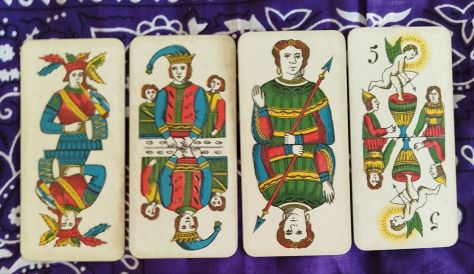
The Fool, The Juggler, The Moor, Love in the Bolognese Tarot

The Fool
A neutral card, with both positive and negative implications. It represents oddity and strangeness, but also carefreeness and thoughtlessness, and possibly confusion, uncertainty, mental trouble, lack of restraint, etc. Its meaning is very sensible to how the cards surrounding it modify it. It is always a bit of a question mark in many spreads, so much so that a teacher and friend said that there is a tradition, when the cards are unclear and the Fool is among them, to put the deck back together and knock on it, asking the Fool to be more clear. It is also a card of creativity and inspiration, if it makes sense within the context. For instance, it can show a line of work where one needs to follow their own sensibility, vision or intuition.

The Juggler
Again a neutral card that heavily depends on the others. It is mainly the significator of children. For this reason, it is important when we talk about pregnancies or the family, or when we explore someone’s childhood. It also has the implication of childishness or of things that are small and of little literal or moral value, or something that hasn’t found its footing or stability. For this reason, depending on the combinations, it can represent someone who is not to be trusted. It can also signify situations where we are like children, that is, powerless or passive. According to others it can also sometimes depict a beginning. According to most, it is also the card of pets.

The Moor or The Stranger
In the 45-card system I know, only one of these cards is used, namely the one with the earring and the spear. It represents a stranger, and therefore things that disrupt regular life, hence the ideas of surprise, unexpected events or meetings, hiccups along the way, etc. The other cards will tell us if the unexpected situation is good or bad. In itself it can be mildly annoying, as we tend not to like disruptions to our routine. It is also traditionally associated with a priest (oddly enough) and therefore with all kinds of ceremonies.1

Love
It means mostly what it says on the tin: love. It is possibly the single most important card in the single most requested type of consultation, i.e., about relationships. Whether the love is strong or weak, childish or mature, increasing or declining depends on the cards surrounding this one. It also represents one’s emotional world, emotions in general, and it is a card of good heart and good feelings. When not talking about love, it can show something that involves your heart (you are emotionally invested for good or ill), or something you love. In itself it is positive, signifying joy.

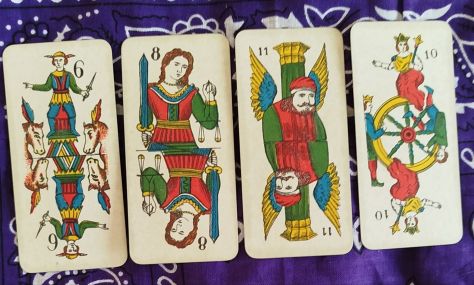
The Chariot, Justice, The Hermit and the Wheel of Fortune in the Bolognese Tarot

Chariot or The Bed
This is where the Bolognese Tarot is at its oddest. In the card’s design, the Chariot appears to be still, with the horses resting on each side, and the man looks unhappy. For this reason, the Chariot has been called the Bed card. This led to interpreting it exactly the opposite way as most would: instead of movement, stasis. In itself it is a negative card of tribulation, illness, static situations, tiredness, exhaustion. It can also signify nooky time with other cards (like the Ace of Wands). Mostly, though, it signifies illness, either literal or figurative (e.g., an unhealthy love, an unhealthy way of expressing anger, etc.) Still, some card readers retain the traditional idea of moving toward a goal quickly, and attribute it to the card when surrounded by good cards.2

Justice
Mainly this is the card of everything legal and justice-related. When talking about wills, fines, trials, bureaucracy and similar things, Justice is an important card, as the cards surrounding it can tell us if the situation is going to go well or not. It is also the card of fairness or of things that are just or ok, or equilibrated. It represents control, controlling, testing, etc. (including in a medical or academic sense). Justice next to a person can mean a just person, the person’s sense of justice, or someone wearing a uniform.

The Hermit
The Bolognese variant of this card has none of the introspective undertones that it has been attributed in other traditions. This is a bad card: it is called blockage (in italian Blocco or Incaglio, the latter word indicating a ship that has run aground). It shows big obstacles that delay a situation, whether indefinitely or momentarily depends on the rest of the spread. It is also the card of small ailments, either seasonal (cold, flu), obnoxious but not life-threatening (like toothache) or age-related. Obviously it can also indicate a character that is reserved or tending to isolation, as the blockage can be inner as well as outer.

The Wheel
This is the only card in the Bolognese tarot whose reversal is discernible and is read accordingly. Look to the left: if the crowned figure is ascending, the card is upright. If the young boy is ascending, it is reversed. According to some, when upright the Wheel represents good luck, when reversed bad luck. According to others, the Wheel represents movement and evolution of circumstances in general, but when upright it brings stability (stable good luck, decisive chances, etc) while when reversed it shows instability (unstable luck, with ups and downs, requiring effort). I have been taught according to the second school. Much also depends on the surrounding cards. Still, unstable luck is always more likely to turn into bad luck when surrounded by bad cards.

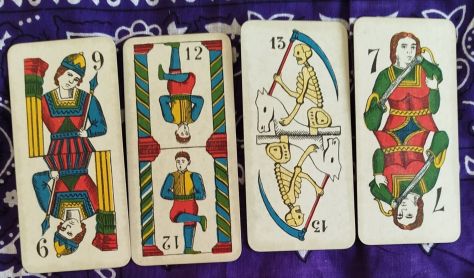
Strength, the Hanged Man, Death and Temperance in the Bolognese Tarot

Strength or Fortitude
Considered a very good card, Strength brings energy, decisiveness, steadfastness, focus in meeting obstacles and taking action. The cards following it, however, can block it or diminish it, so it is important to pay attention to them as well. In itself, when coming up at the end of a sequence or with positive cards, it shows a situation that is reliable (“strong”) or a person (if next to a court card) who is strong in a positive sense, usually to help us. When following negative cards it can indicate the ability to pick yourself up or stand your ground. It always indicates an active stance in the matter.

The Hanged Man or The Traitor
Here we enter the realm of history. In spite of the many mystical interpretations of the Hanged Man that started popping up during the occult revival, traditionally the card was inserted in the oldest packs to represent how traitors were punished in the Middle Ages (namely, by being hanged by a foot), and thus served as a cautionary tale to those playing tarot games never to betray the church or the government: “Know your place and stay there. Don’t try to overreach, or we’ll hang you upside down, so instead of moving upward in life, you’ll be going downward to hell.” That’s the message. The Bolognese tarot retains this old tradition, as the Hanged Man is mainly the card of treason. The treason can be literal (cheating, betrayal, etc.) or it can be metaphorical (a situation that betrays you, stabs you in the back when you are heading for the finish line, that makes you feel cheated on or sorely disappoints you). It is one of the worst cards in the pack, and it can show situations that end badly (like traitors in the past), or that are being upended. Even when no one is betraying anyone in particular, it can still symbolize life kicking you in the nuts, so you feel betrayed by it, as if you’ve ended up in a bad place or situation. Sometimes, in my experience, the upending can be good, but only when the querent’s expectations are negative and the cards following the Hanged Man are positive. In this case, the negative expectations are betrayed. In itself, though, the upending tends to be of the negative kind.

Death or Thirteen
This card is never actually called by its name, but by its number (tredici, i.e., thirteen). Different schools of thought interpret it slightly differently. It largely depends on the context though. Its first meaning is that of physical death, but this is rare and never by itself. In itself it shows the end of something. It can also indicate an inner sense of loss or death (“mortificazione”, which has the same root as the Italian “morte”, death, but indicates inner devastation and mortification). When, however, Death cannot be interpreted as ending, it can act as confirmation: “tredici conferma”, “the thirteenth card confirms”, or, if you will, “as sure as the fact we all die”. For instance, when it is surrounded by positive cards, it acts as a highlighter, confirming them. Same with negative cards: it makes them stronger and more important in the querent’s destiny. It can also indicate a situation that changes radically. Suppose, for instance, the cards preceding it are bad and those following it good: in this case it shows the end of the bad situation.

Temperance
The old diviners must have taken a look at this card and thought it looked like an hourglass, because the main meaning is that of time, the passage or flow of time. It is usually a slow card, which slows down the reading. It is connected with such concepts as waiting, patience, stagnation, but also of things that last a long time, take a long time or happen after a lot of time has passed. For instance, if it is followed by cards that show falling in love, it might mean that we will fall in love after a long time, while if it is preceded by cards of love it indicates that the love will last a long time. Use your commonsense. I have also found that, when it falls in the first few lines of a spread, the cards surrounding it, and especially those preceding it, tend to either talk about the past (a long time ago) or have started a long time ago and still drag on. Finally, some card readers connect it with the flow of water, and therefore water in general. I haven’t verified this connection but it does make sense.

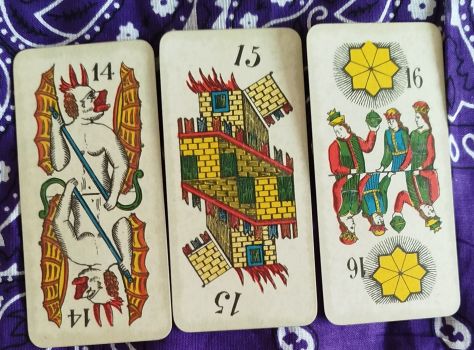
The Devil, The Tower, The Star in the Bolognese Tarot

The Devil
In Italian “Diavolerie”, i.e., things that bedevil you. It is a deeply negative card, but with some redeeming qualities. In the main it is connected, traditionally, with anger, which depending on the context can range from annoyance to rage, due to things, people or circumstances bedeviling you. In general, though, it can indicate all passions that seize us and we fail to control. When falling with a person card, it is usually a sign the person is negative for us (depending on the context it can show jealousy or envy as well). When it describes a situation, it is bad for us. It is a card of excess all around, but it can indicate sexy energy, when with cards that talk about it, and it can also represent a strong energy when surrounded by very positive cards. Finally, it is one of the cards connected with magic.

The Tower
The image shows a burning building, and the main meaning is consequently that of places we’d rather not find ourselves in, mostly prison or hospital (or, if next to the Ace of Cups, our home). However, it can also signify a metaphorical prison, that is, a situation that is strongly limiting for us and prevents us from fleeing or moving freely, where we must sacrifice our hopes and aspirations or resources at least in part (“sacrificio” is one of the main Italian keywords for this card). Whether this card can indicate neutral or positive places is up for debate, as it depends on the school of thought. I guess in the appropriate context and with the appropriate cards it might, but generally, in my experience, it mostly shows negative places or negative situations. It can, however, show neutral places of authority (like a city hall, where there is an authority above us) or very large or foreboding buildings.

The Star
Another peculiar card. The main keyword is “roba”, i.e., stuff, especially referred to one’s objects, belongings and possessions. This is because the image shows three people holding some unspecified object. Some say they are the three Wise Men bringing gifts to Jesus, others say they are merchants. Either way, the emphasis is on objects and materiality. This is the card of business, belongings, objects, work (either one’s work life or working on something). It can represent study (which is the student’s work). In health readings it shows the objects used in medicine, that is, meds (and therefore therapy in general). This card can represent gifts when coupled with other specific cards. To summarize: business, work, stuff (material/practical life), study, gifts.

The Moon, The Sun, The Angel / Judgement and the World in the Bolognese Tarot

The Moon and the Sun
The reason I talk about these two cards together is that they complement each other. They are also called “le due rosse”, “the two red (cards)”. Their main meaning is temporal: the Moon shows things happening by night or in the evening, the Sun shows things happening by day. But they are also two polar opposites. The Sun indicates positivity, life, energy, clarity, success, happiness, vitality. When coupled with other cards it slants them positively. The Moon indicates negativity, death, lethargy, secrets, falsity, dissatisfaction, sadness. When coupled with other cards, it slants them negatively.

The Angel or Judgement
The best card in the deck, the Angel is the card of goodness, peace, friendship, protection. It brings solutions to difficult situations. However, if followed by cards indicating obstacles or impossibility, it can show the solution is delayed or impossible. When coupled with a person card, it can signify the person is an angel for us, helping and protecting us, or that they are good. It is also the main card connected with spirituality.

The World
Around the world“, “the world outside“. It is the card of travel and journeys, as well as of distance. It signifies movement, whether literal or metaphorical. Often it shows actual journeys, relocations and removals. The journey doesn’t have to be very long, however traditionally, when falling next to a court card it can show a person we don’t yet know (the person comes from the outer world, i.e., is not part of our daily life), although, depending on the context, it can also show someone who travels or someone who lives distant from us. It can indicate a stranger, though again, how much of a stranger depends on the context. It shows situations that are open, in motion, and it gives the sense of something big or large or important (as opposed to the Juggler, which is something small). It can be symbolic of life (the great journey). Finally, some attach the idea of something recurring to it (like recurring thoughts, etc.)

MQS

  1. In other reading systems with more cards, where more Moors are used, the priest is often associated with the Moor with the hat, who is also the doctor. ↩︎
  2. How positive or negative (or neutral) the card is depends on the system as well. In systems with more cards, where there is a specific illness card (the Moor with the hat) the Chariot is more neutral. In the 45-card system, it is more negative. ↩︎