Tag Archives: tarot fortune-telling

Tarot Encyclopedia – The Four of Pentacles Or Coins

(Note: this is a collection of the meanings attributed to the cards by some occultists in the past centuries. It does not reflect my own study or opinion of the cards. It is only meant as a quick comparative reference as I develop my own take.)
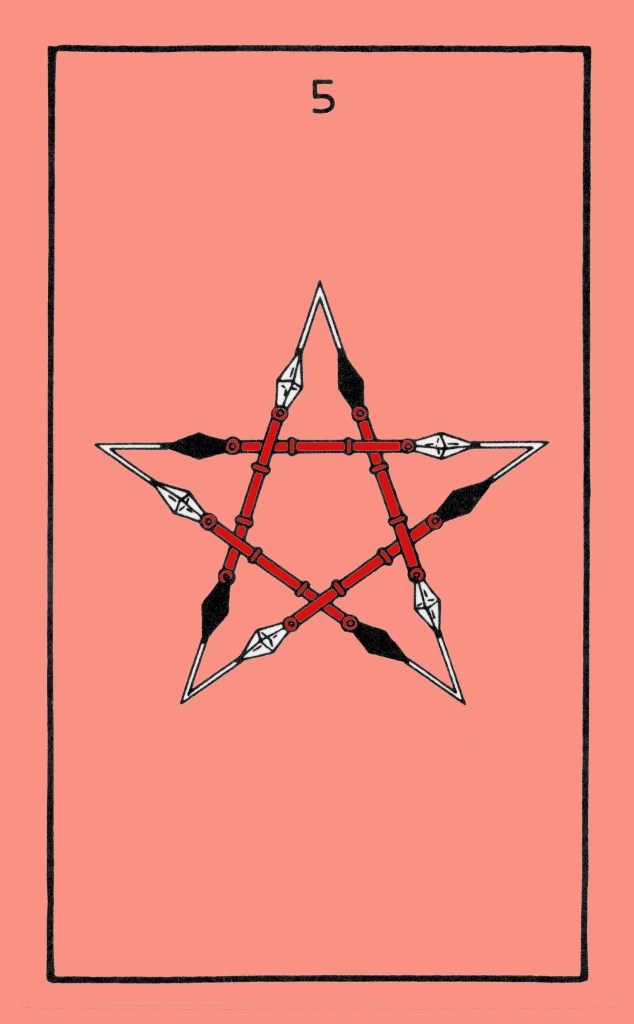
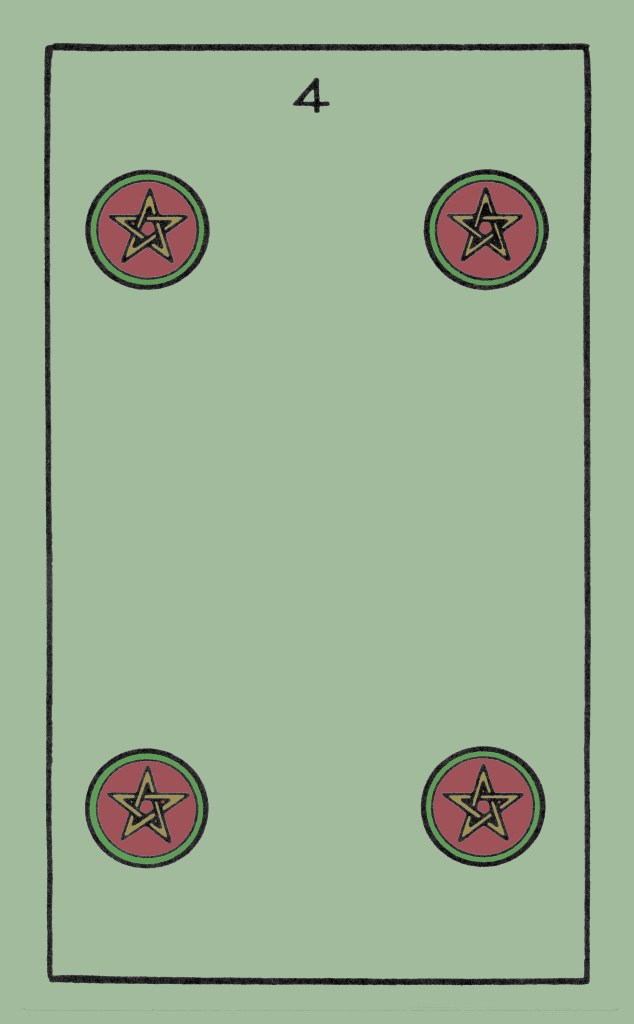
The Four of Pentacles from the Builders of the Adytum (BOTA) Tarot deck

Paul Foster Case (and Ann Davies)

The time period is the third decanate of Capricorn, under the rulership of Mercury, January 10 to 19.
Well-Dignified: opportunities for public service; an acute, sharp, penetrating, tactful temperament; economy in the arrangement of material affairs; activity in money matters.
Ill-Dignified: dangers to reputation; troubles through changes not carefully considered; desire for money, but unwisdom in its management; the Querent will meet with sharp criticism.
Keyword: Management.
(From the Oracle of Tarot course)

A. E. Waite

A crowned figure, having a pentacle over his crown, clasps another with hands and arms; two pentacles are under his feet. He holds to that which he has. Divinatory Meanings: The surety of possessions, cleaving to that which one has, gift, legacy, inheritance. Reversed: Suspense, delay, opposition.
(From The Pictorial Key to the Tarot)

Aleister Crowley

As to the Disks, the heaviness of the symbol rather outweighs any considerations of its weakness. The card is called Power. It is the power which dominates and stabilizes everything, but manages its affairs more by negotiation, by pacific methods, than by any assertion of itself. It is Law, the Constitution, with no aggressive element.

[…]

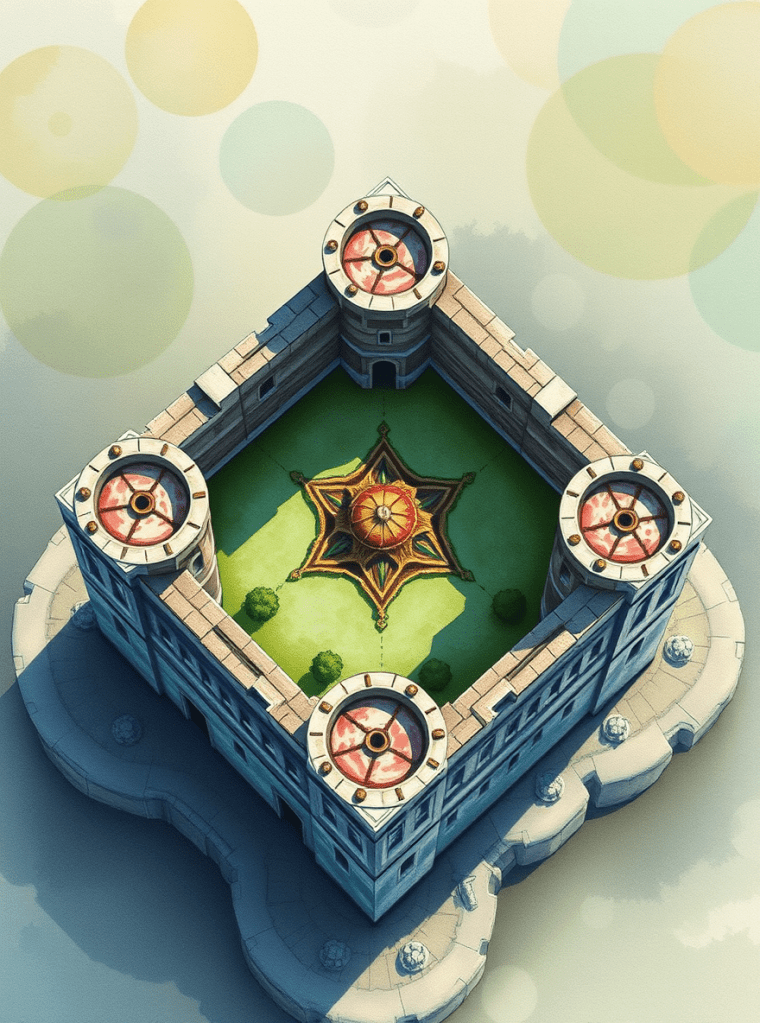
The Four, Chesed, shows the establishment of the Universe in three dimensions, that is, below the Abyss. The generating idea is exhibited in its full material sense. The card is ruled by the Sun in Capricornus, the Sign in which he is reborn. The disks are very large and solid; the suggestion of the card is that of a fortress. This represents Law and Order, maintained by constant authority and vigilance. The disks themselves are square; revolution is very opposite to the card; and they contain the signs of the Four Elements. For all that, they revolve; defence is valid only when violently active. So far as it appears stationary, it is the “dead centre” of the engineer; and Capricornus is the point at which the Sun “turns again Northward”. The background is of deep azure, flecked yellow, suggesting a moat; but beyond this is a pattern of green and indigo to represent the guarded fields whose security is assured by the fortress.

In the Yi King, Sol in Capricornus is represented by the Second Hexagram, Khwan, which is the Female Principle. Compare the English word Queen, Anglo-Saxon Cwen, old Mercian Kwoen. Cognate are Icelandic Kvan, Gothic Kwens, woman. The Indo-Germanic type is g (w)eni and the Sanskrit root GwEN. Note also Cwm, coombe, and agnate words, meaning an enclosed valley, usually with water running from it. Womb—possibly a softened form?

Compare also the innumerable words, derived from the root Gas, Which imply an enclosed and fortified space. Case, castle, chest, cyst, chaste, incest and so on.

The primary radicle in all this class of words is the guttural. Observe the Hebrew attributions: Gimel, the moon; Cheth, Cancer, the house of the moon; Kaph, the Wheel; Qoph, the Moon, XVIII, Guttur, the throat. Sounds so made suggest the other throat; one is the channel of respiration and nutrition, the other of reproduction and elimination.
(From The Book of Thoth)

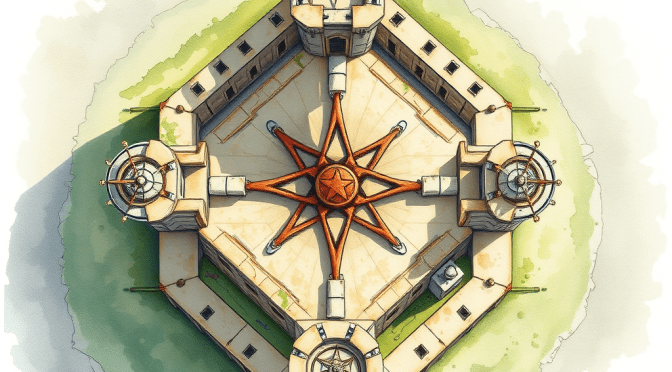
A Crowley-esque AI-generated illustration for the Four of Pentacles

Golden Dawn’s Book T

A HAND holding a branch of a rose tree, but without flowers or buds, save that in the centre is one fully blown white rose. Pentacles are disposed as on the points of a square; a rose in its centre. Symbols Sun and Capricorn above and below to represent the Decan.
Assured material gain: success, rank, dominion, earthy power, completed but leading to nothing beyond. Prejudicial, covetous, suspicious, careful and orderly, but discontented. Little enterprise or originality. According to dignity as usual.
Chesed of HB:H (Gain of money or influence: a present).
Herein do HB:KVQYH and HB:MNDAL bear rule

Etteilla

Benefit
Upright. This blade, as far as the medicine of the spirit is concerned, means, in its natural position: Present, Gift, Generosity, Beneficence, Liberality, Strenna, Grace, Offering, Giving, Gratification, Service. – White color, Lunar medicine, Stone to white.
Reversed. Enclosure, Circuit, Circumvolution, Circumscription, Circumference, Circle, Circulation. – Intercept, Obstruction, Engorgement, Hoarding, Cloister, Monastery, Convent. – Stop, Fixed, Determined, Definite, Extremity, Boundaries, Limits, Terms, End, Barrier, Dividing wall, Wall, Hedge, Wall. – Obstacles, Bars, Impediment, Suspension, Delay, Opposition.

MQS

Tarot Encyclopedia – The Four of Swords

(Note: this is a collection of the meanings attributed to the cards by some occultists in the past centuries. It does not reflect my own study or opinion of the cards. It is only meant as a quick comparative reference as I develop my own take.)

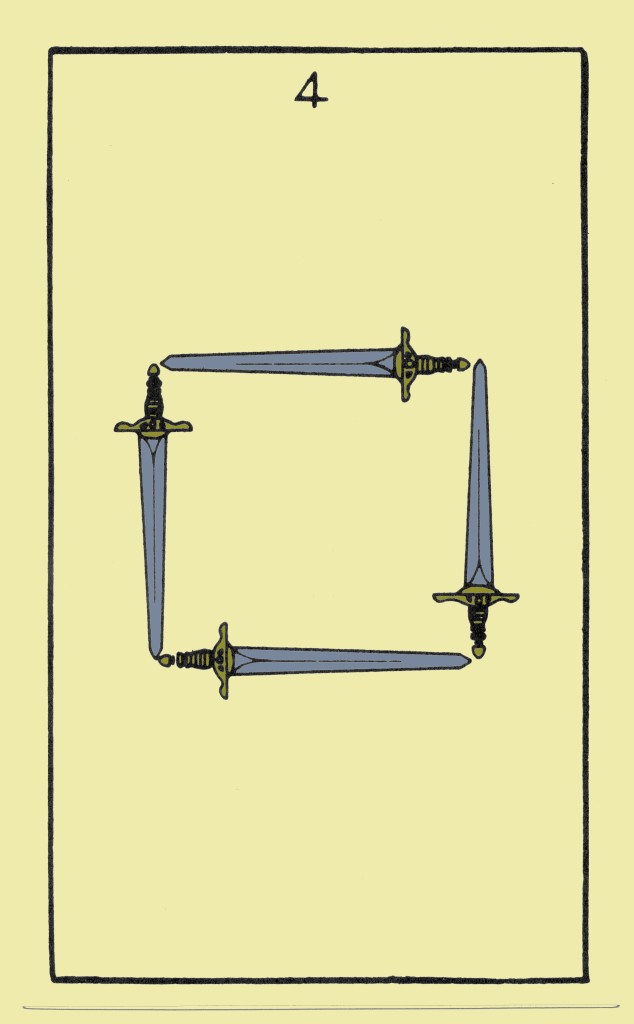
The Four of Swords from the Builders of the Adytum (BOTA) tarot deck

Paul Foster Case (and Ann Davies)

The time period is the last decanate of Libra, October 13 to October 23, under the rulership of Mercury.
Well-Dignified: rest from sorrow, yet after and through it; relief from anxiety; rest after illness; quietness; change for the better; success in legal affairs; association with others in Mercurial pursuits; strong mental attraction to a person of the opposite sex; activity in writing or short journeys.
Ill-Dignified: inharmony with partners; unsettled conditions in legal
affairs; disorder and loss through ill-considered writings or needless
short journeys; vexations through petty strife and sarcastic speech.
Keyword: Rest.
(From the Oracle of Tarot Course)

A. E. Waite

The effigy of a knight in the attitude of prayer, at full length upon his tomb. Divinatory Meanings: Vigilance, retreat, solitude, hermit’s repose, exile, tomb and coffin. It is these last that have suggested the design. Reversed: Wise administration, circumspection, economy, avarice, precaution, testament.
(From The Pictorial Key to the Tarot)

Aleister Crowley

The Four of Swords is called Truce. This seems rather on the lines of “the strong man armed, keeping his house in peace”. The masculine nature of air makes it dominant. The card is almost a picture of the formation of the military clan system of society.

[…]

The number Four, Chesed, is here manifested in the realm of the Intellect. Chesed refers to Jupiter who rules in Libra in this decanate. The sum of these symbols is therefore without opposition; hence the card proclaims the idea of authority in the intellectual world. It is the establishment of dogma, and law concerning it. It represents a refuge from mental chaos, chosen in an arbitrary manner. It argues for convention.

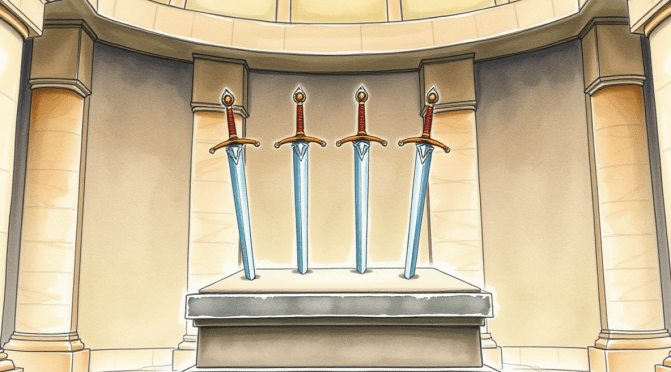
The hilts of the four Swords are at the corner of a St. Andrew’s cross. Their shape suggests fixation and rigidity. Their points are sheathed—in a rather large rose of forty-nine petals representing social harmony. Here, too, is compromise.

Minds too indolent or too cowardly to think out their own problems hail joyfully this policy of appeasement. As always, the Four is the term; as in this case there is no true justification for repose, its disturbance by the Five holds no promise of advance; its static shams go pell-mell into the melting-pot; the issue is mere mess, usually signalized by foetid stench. But it has to be done!
(From The Book of Thoth)

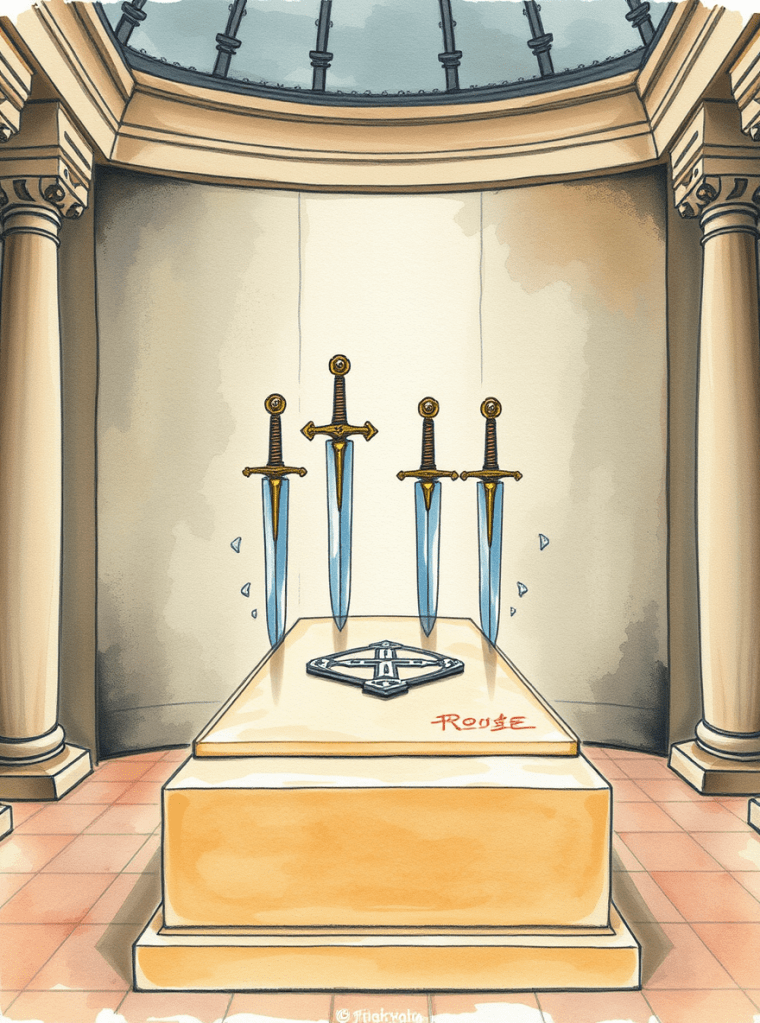
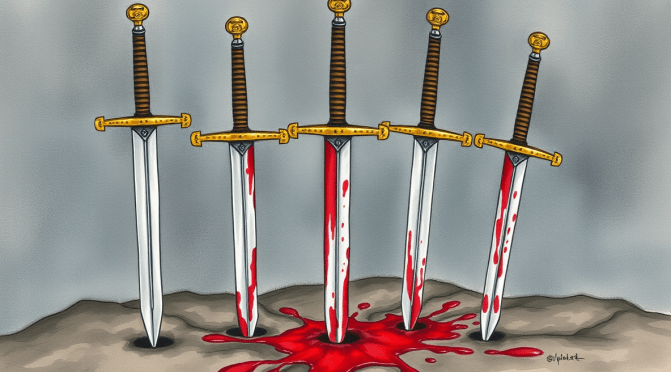
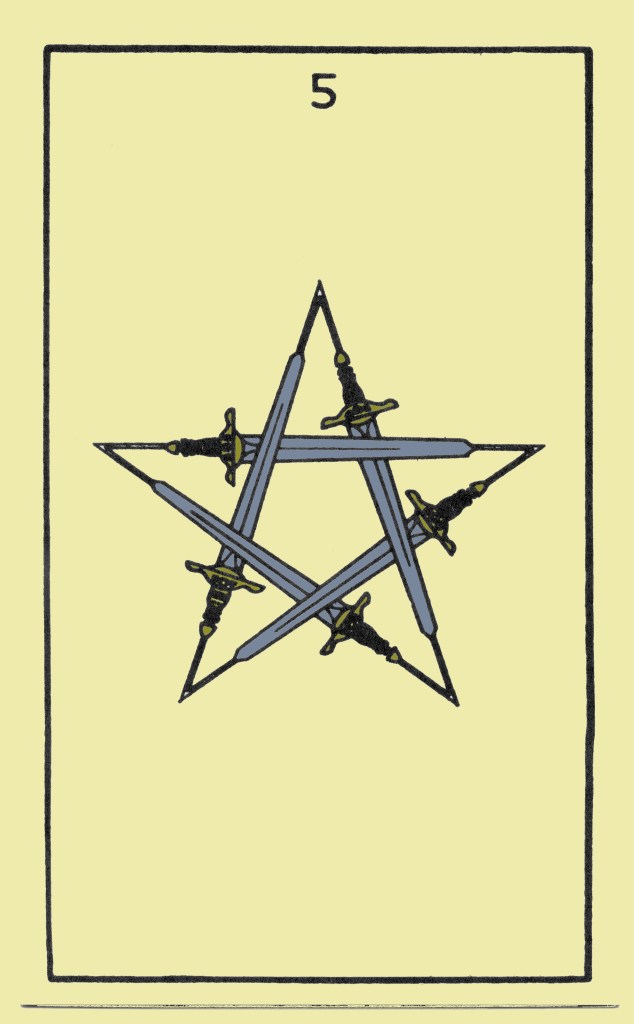
AI-generated illustration for the Four of Swords

Golden Dawn’s Book T

TWO White Radiating Angelic Hands, each holding two swords; which four cross in the centre. The rose of five petals with white radiations is reinstated on the point of their intersection. Above and below, on the points of two small daggers, are Jupiter and Libra, representing the Decanate.

Rest from sorrow; yet after and through it. Peace from and after war. Relaxation of anxiety. Quietness, rest, ease and plenty, yet after struggle. Goods of this life; abundance; modified by dignity as is usual.
Chesed of HB:V (Convalescence, recovery from sickness; change for the better).
Herein do HB:LAVYH and HB:KLYAL bear rule.

Etteilla

Solitude
Upright. This card means, as far as the medicine of the spirit is concerned and in its natural position: Solitude, Desert, Retired place, Hermitage. – Exile, Banishment, Proscription. – Uninhabited, Isolated, Abandoned, Neglected. – Tomb, Burial Ground, Coffin.
Reversed. Economy, Wise Conduct, Wise Administration. – Welfare, Management, Household management, Savings, Avarice. – Order, Arrangement, Relationship, Convenience, Concordance, Agreement, Harmony, Music, Disposition. – Will. – Reservation, Restriction, Exception. – Circumspection, Circumscription, Retention, Wisdom, Sympathy, Regard, Precaution.

MQS

Bolognese Tarot – Introduction to an Old Fortune-Telling Tradition (Part I)

As I’ve mentioned on this blog, I’ve been studying the divination tradition of the Bolognese Tarot (Tarocchino Bolognese, literally the Small Tarot of Bologna) for some months now. I’ve been doing it under the direction of a traditional practitioner of this art, whom I’ve befriended and with whom a wonderful exchange of ideas has started.

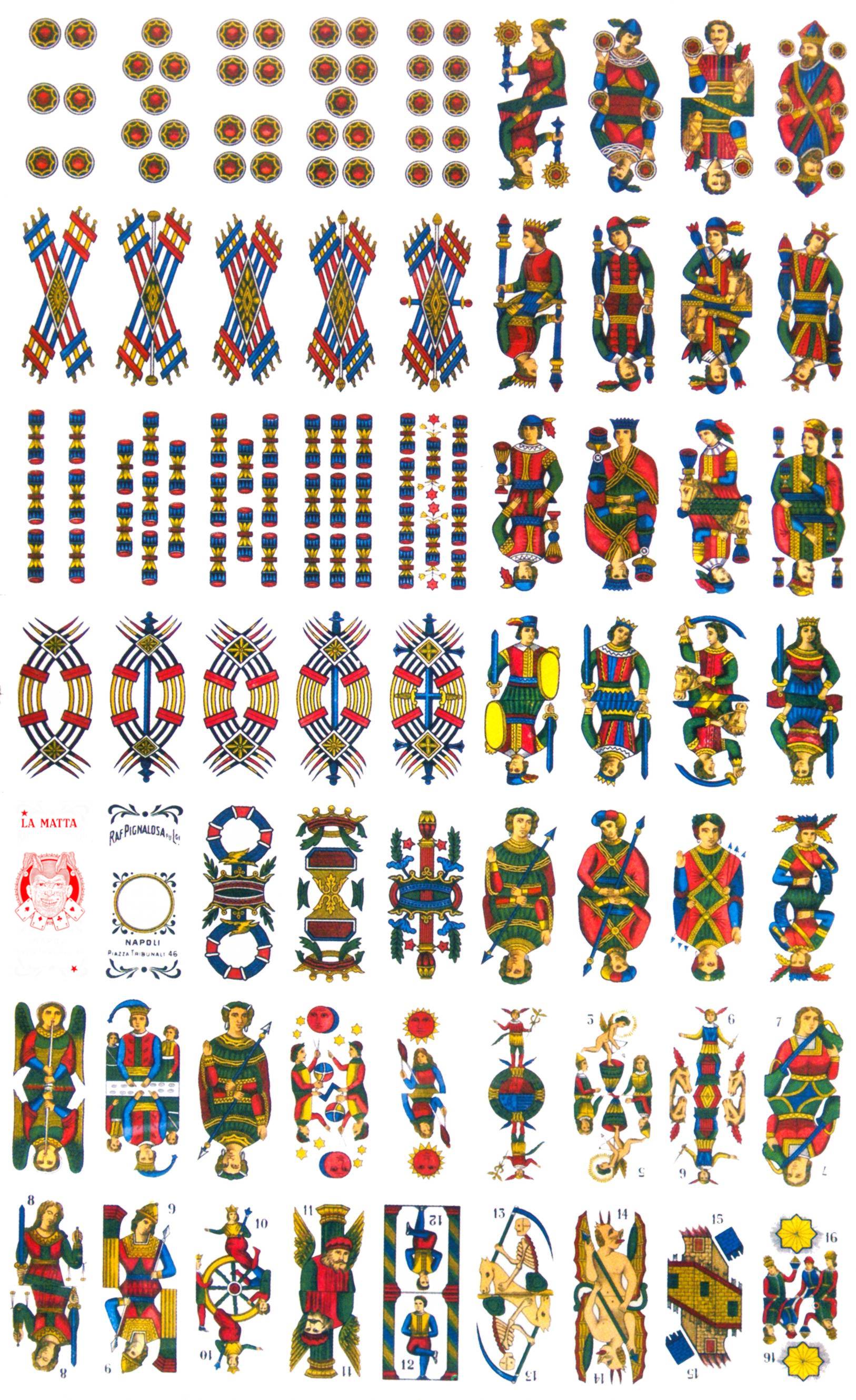
The full deck. Image from the website Labirinto Ermetico

I plan on introducing this form of divination in its main lines for a couple of reasons: 1) it is little known outside of Italy and it deserves some love 2) Its reading techniques are markedly different from the current approach and allow for a very concrete, down-to-earth approach 3) I want to discuss some spreads done with it in the future, and I can’t do it without introducing it first 4) it is the oldest tarot-related divination tradition that we know of, and it is therefore cool from a historical standpoint.1

The Ugly Duckling and Its Quirks

Like the almost totality of very old decks, with a couple of exceptions (the Visconti deck is one) the Bolognese tarot is distinctively unappealing from an esthetic standpoint, largely because, like other popular pre-RWS decks, it was meant to be used by poor people as a playing deck at the local inn.

A selection of cards from the Bolognese Tarot. As may be noted, they are symmetrical, like playing cards, though the earliest packs had full images.

The reason it is called ‘tarocchino’ (small tarot) has to do with its reduced size, probably to enhance its handlability. However, it is not just the size of the cards that is reduced, but also the number of the cards that comprise the deck: all pip cards from Two to Five are removed, leaving only the Ace of each suit plus the cards from Six to Ten and the court cards.

Furthermore, the Pope (Hierophant), Popess (High Priestess) Empress and Emperor are absent from the deck for political reasons, as Bologna was directly under the control of the Church. Instead, the deck includes four ‘Moors‘ (the Moors were Muslim colonizers that had conquered parts of Italy.)

Three of the ‘Moors’. The Fourth one is a copy of the third on the right.

Finally, the Bolognese Tarot has another peculiarity, in that the Major Trumps are out of order compared to our regular system. This may sound surprising to some, but our current ordering of the trumps is a relatively recent development and has nothing mystical about it (the oldest preserved document with the order of the trumps gives a rather different sequence).

An Old Tradition

The Bolognese Tarot tradition was almost entirely confined to the city of Bologna and the surrounding areas, and was at risk of dying out, until both the card game and the divination tradition were transmitted to a larger public thanks to the power of the Internet.

Interestingly, to this tradition is connected the most ancient set of meanings handed down by old sources. The following list dates back to the pre-Napoleonic period and gives the meanings of a reduced pack of thirty five cards. I’m copying it here for its historical interest, but it does not correspond to the system I have been taught:

  1. The Juggler (Magician): Married Man
  2. The Lovers: Love
  3. The Chariot: Journey
  4. Temperance: Time
  5. Strength: Violence
  6. The Hermit: Old (Person)
  7. The Hanged Man: Treason
  8. Death (called ‘Thirteen’): Death
  9. The Devil: Wrath
  10. The Star: A Gift
  11. The Moon: Night
  12. The Sun: Day
  13. The Angel (Judgement): Marriage or Agreement
  14. The World: Long travel
  15. The Fool: Madness
  16. King of Wands: A Bachelor
  17. Queen of Wands: A Prostitute
  18. Knight of Wands: Something Knocking at the Door
  19. Page of Wands: Thoughts of the Female Querent
  20. Ace of Wands: Sexual Escapades
  21. King of Cups: An Old Man
  22. Queen of Cups: Married Woman
  23. Knight of Cups: Reconciliation
  24. Page of Cups: The Female Querent
  25. Ten of Cups: The Roof of the House
  26. Ace of Cups: The House
  27. King of Swords: An Evil Tongue
  28. Ten of Swords: Tears
  29. Ace of Swords: A Letter
  30. King of Coins: The Male Querent
  31. Queen of Coins: The Truth
  32. Knight of Coins: Thoughts of the Male Querent
  33. Page of Coins: Unmarried Woman
  34. Ten of Coins: Money
  35. Ace of Coins: The Table

As I said, this is not the system that I’ve been taught, and it is very likely that even back then more than one system existed (usually, significant differences are found from quarter to quarter in Bologna and from small village to small village in the surrounding areas). Since this cartomantic tradition predates Etteilla’s by at least a quarter of a century, and probably more, and since Etteilla says he learned to read the tarot from an Italian card reader (though he pretends it was Alexis of Piedmont to add to the mystery), it is not to be excluded that the Bolognese tarot had some influence on him.

But this is speculation. What is clear is that tarot divination, whenever it was born, was brought into the world as a way of addressing concrete issues. This series of articles is dedicated to bringing the tarot back to these roots.

MQS

  1. If you want to read more, you can start with the Wikipedia page. More Information is contained on the webside of the Associazione Le Tarot ↩︎