Usually I’m not a huge fan of readings done on someone else without them knowing, not for ethical reasons but because I always feel there is more wiggle room for error if the person is not present. This is just my experience, but that’s how it works for me. Still, when a friend of mine started getting paranoid that his job contract might not get renewed I decided to ask, even though he didn’t feel like getting a reading (especially since we don’t live in the same country)
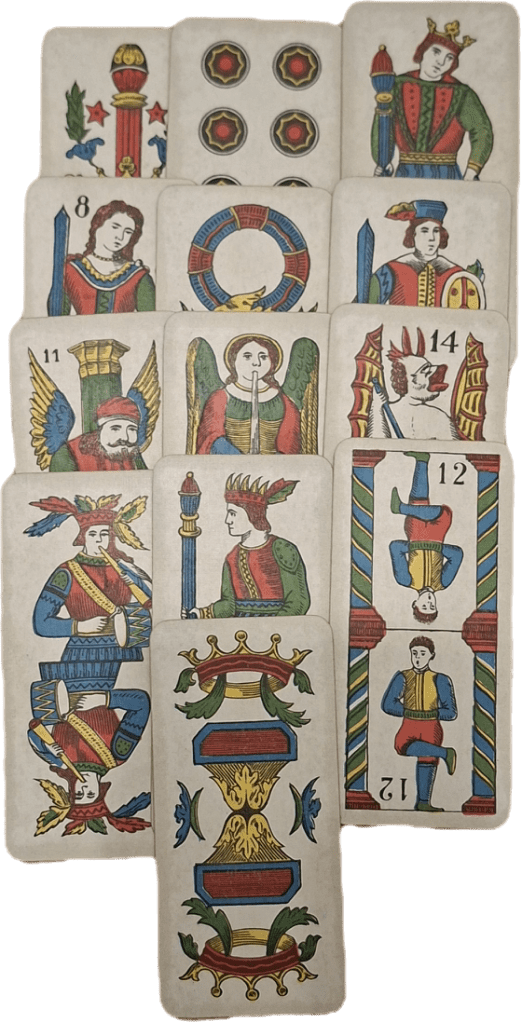
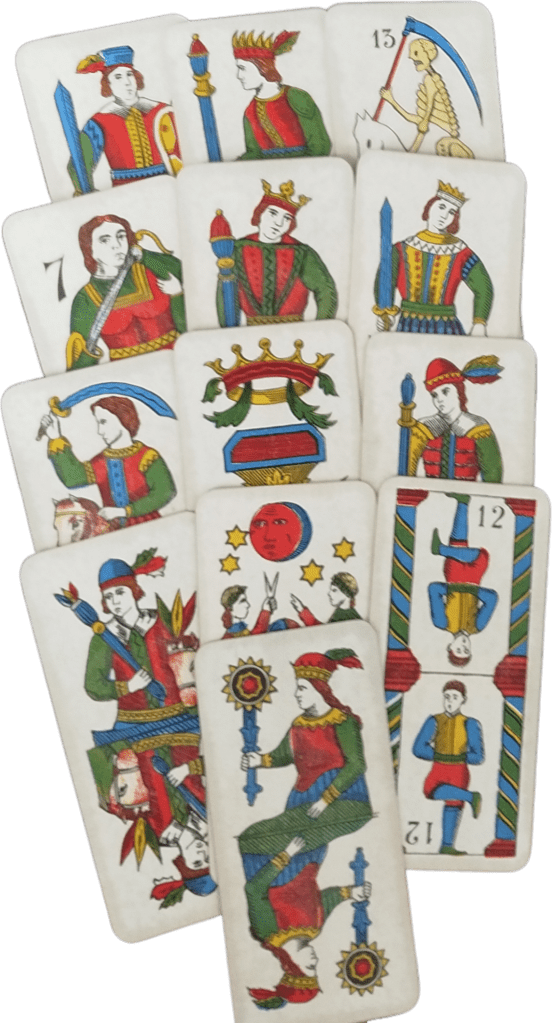
I used the Bolognese tarot, since this is the deck I’m currently studying, and the thirteen card spread, which is the most common spread with this deck.
Will the contract be renewed?
I believe the line that gives us a positive answer is the third, with the Hermit, the Angel and the Devil. Angel and Devil is one of those rare traditional combos that cannot be reduced to the basic meaning of the cards: it represents great news or great satisfaction. In general, when they fall together, they can be a hint at a yes.
Since the Hermit opens the line though, this is going to take some time (and it did: he was waiting for an answer any day from the date of the reading, instead it took two months). And the answer WAS positive, so the Hermit only influenced the time element, but it didn’t block the good news.
What about the other cards? Well, I believe the first two lines are simply describing the situation: in the first line we have the querent, my friend (the King of Wands) together with the little money card and the Ace of Wands. This can be interpreted as him having actually little (Ten of Coins) interest (Ace) for the job aside from needing it or, more positively, that the job brings him success (Ace) in little amounts (Ten of Coins). Both interpretations are actually true.
The second line has Justice and the Ace of Swords, which together can talk about a legally binding (Justice) contract (Ace of Swords). Then comes the letter card (the Page of Swords) which is followed in the next line by the Hermit, the blockage. This is where the delay was created.
What about the last line? Here I’m not sure. The cards talk about a woman, the Queen of Wands, possibly belonging to the family (she sits right on top of the Ace of Cups). She is surrounded by confusion (Fool) and betrayal (the Hanged Man). My only thought was that a woman close to him wasn’t at all expecting the contract to be renewed, was taken by surprise. I wasn’t able to confirm this detail, but there you go.
(Note: this is a collection of the meanings attributed to the cards by some occultists in the past centuries. It does not reflect my own study or opinion of the cards. It is only meant as a quick comparative reference as I develop my own take.)
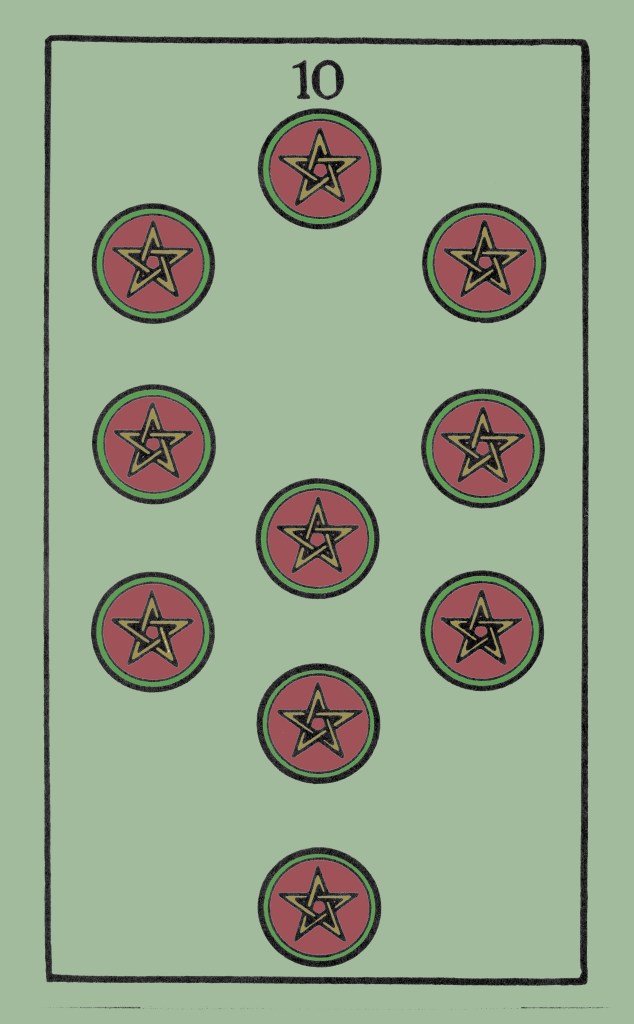
The Ten of Pentacles from the Builders of the Adytum (BOTA) tarot deck
Paul Foster Case (and Ann Davies)
The time period is the third decanate of Virgo, under the rulership of Venus, September 13 to September 22. Meanings: Well-Dignified: money through servants or subordinates; gain in matters connected with medicine, drugs, food, nursing, farming or gardening; completion in material gain and fortune, but nothing beyond. Ill-Dignified: material success, but heaviness and dullness of mind; sometimes loss through the matters listed above; slothfulness. Keyword: Wealth. (From the Oracle of Tarot course)
A. E. Waite
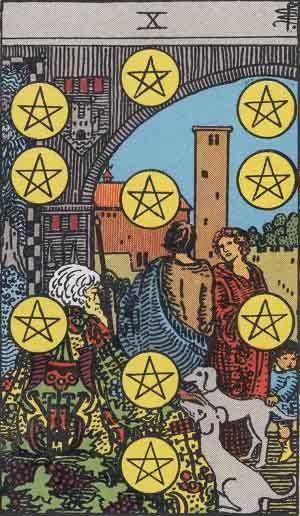
A man and woman beneath an archway which gives entrance to a house and domain. They are accompanied by a child, who looks curiously at two dogs accosting an ancient personage seated in the foreground. The child’s hand is on one of them. Divinatory Meanings: Gain, riches; family matters, archives, extraction, the abode of a family. Reversed: Chance, fatality, loss, robbery, games of hazard; sometimes gift, dowry, pension. (From The Pictorial Key to the Tarot)
The Ten of Pentacles from the Rider Waite Smith tarot
Aleister Crowley
The Ten of Disks is called Wealth. Here again is written this constantly recurring doctrine, that as soon as one gets to the bottom one finds oneself at the top; and Wealth is given to Mercury in Virgo. When wealth accumulates beyond a certain point, it must either become completely inert and cease to be wealth, or call in the aid of intelligence to use it rightly. This must necessarily happen in spheres which have nothing whatever to do with material possessions, as such. In this way, Carnegie establishes a Library, Rockefeller endows Research, simply because there is nothing else to do.
But all this doctrine lies behind the card; it is the inner meaning of the card. There is another view to consider, that this is the last of all the cards, and therefore represents the sum total of all the work that has been done from the beginning. Therefore, in it is drawn the very figure of the Tree of Life itself. This card, to the other thirty-five small cards, is what the twenty-first Trump, The Universe, is to the rest of the Trumps.
[…]
The number Ten, Malkuth, as always, represents the final issue of the Energy. Here is great and final solidification. The force is completely expended and results in death. Mercury rules this card in Virgo; and this may imply that the acquired wealth, being inert, will be dissipated unless put to further use by devoting its power to objects other than mere accumulation.
The disks, or (as they have now become) coins, are arranged on the Tree of Life, but the Tenth coin is much larger than the rest; the image indicates the futility of material gain.
These disks are inscribed with various symbols of mercurial character except that the coin in the place of Hod (Mercury) on the Tree is marked with the cipher of the Sun. This indicates the only possibility of issue from the impasse produced by the exhaustion of all the elemental forces. At the end of matter must be complete stagnation, were it not that in it is always inherent the Will of the Father, the Great Architect, the Great Arithmetician, the Great Geometer. In this case, then, Mercury will represent the Logos, the Word, the Will, the Wisdom, the Eternal Son, and Virgo the Virgin, in every implication of that symbol. This card is in fact a hieroglyph of the cycle of regeneration.
Among the Geomantic figures, Mercury in Virgo is Conjunctio. The meaning, conjunction, is shown plainly by the attraction of the descending (female) Triangle, the cipher of the Yoni, to the ascending (male) Triangle, that of the Lingam. This union completed, they appear interlaced, forming the figure of Capricornus, the Sign in which the Sun finds his rebirth. It is the holy Hexagram, the symbol of the uniting of the Macrocosm and the Microcosm, the accomplishment of the Great Work, the Summum Bonum, True Wisdom and Perfect Happiness. Sic sit vobis! (From the Book of Thoth)
The Ten of Disks from the Thoth Tarot deck
Golden Dawn’s Book T
AN Angelic Hand, holding by the lower extremity a branch whose roses touch all the Pentacles. No buds, however, are shewn. The symbols of Mercury and Virgo are above and below. The Pentacles are thus arranged:
* * * * * * * * * * Completion of material gain and fortune; but nothing beyond: as it were, at the very pinnacle of success. Old age, slothfulness; great wealth, yet sometimes loss in part; heaviness; dullness of mind, yet clever and prosperous in money transactions. Malkuth of HB:H (Riches and wealth). Herein are HB:LAVYH and HB:HHa’aYH set over this Decan as Angel Rulers
Etteilla
The house Upright. In terms of spiritual medicine, this card, in its natural position, signifies: Home, Household management, Economy, Savings. – Dwelling, Domicile, Residence, Manor, Lodging, Regiment, Ship, Vessel, Vase. – Archive, Castle, Hut. – Family, Origin, Race, Posterity. – Cave, Cavern, Refuge. Reversed. Lottery, Luck, Gambling, Chance, Accident, Ignorance, Fate, Destiny, Predestination, Fatality. – Fortunate or unfortunate opportunity.
(Note: this is a collection of the meanings attributed to the cards by some occultists in the past centuries. It does not reflect my own study or opinion of the cards. It is only meant as a quick comparative reference as I develop my own take.)
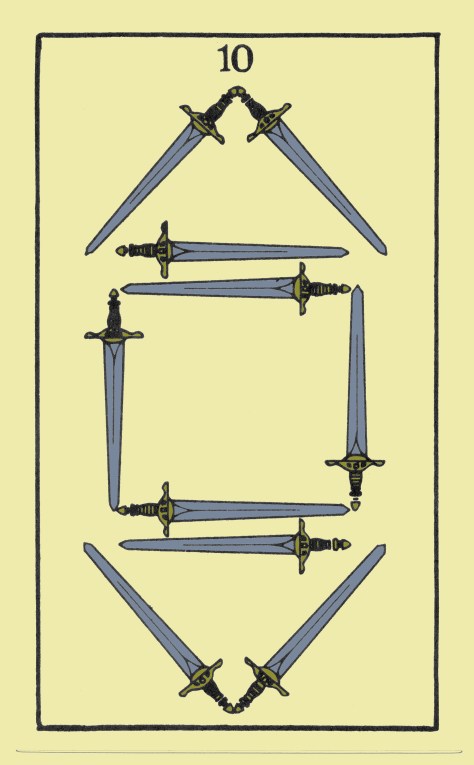
The Ten of Swords from the Builders of the Adytum (BOTA) tarot deck
Paul Foster Case (and Ann Davies)
The time period is the third decanate of Gemini, June 11 to June 21, under the rulership of Saturn and Uranus. Well-Dignified: in spiritual matters, the end of delusion; the overthrow of limiting conditions; break-up of restrictions. In material affairs, sudden and unexpected changes, not always unfortunate in the long run, but disappointing when experienced: interference from from others. and.loss through indiscretion in writmg or signing contracts. lll-Dignifled: failure, desolation, misery. Keyword: Destruction (From the Oracle of Tarot course)
A. E. Waite
A prostrate figure, pierced by all the swords belonging to the card. Divinatory Meanings: Whatsoever is intimated by the design; also pain, affliction, tears, sadness, desolation. It is not especially a card of violent death. Reversed: Advantage, profit, success, favour, but none of these are permanent; also power and authority. (From The Pictorial Key to the Tarot)
The Ten of Swords from the Rider Waite Smith tarot
Aleister Crowley
The Ten of Swords is called Ruin. It teaches the lesson which statesmen should have learned, and have not; that if one goes on fighting long enough, all ends in destruction.
Yet this card is not entirely without hope. The Solar influence rules; ruin can never be complete, because disaster is a sthenic disease. As soon as things are bad enough, one begins to build up again. When all the Governments have smashed each other, there still remains the peasant. At the end of Candide’s misadventures, he could still cultivate his garden.
[…]
The number Ten, Malkuth, as always, represents the culmination of the unmitigated energy of the idea. It shows reason run mad, ramshackle riot of soulless mechanism; it represents the logic of lunatics and (for the most part) of philosophers. It is reason divorced from reality. The card is also ruled by the Sun in Gemini, but the mercurial airy quality of the Sign serves to disperse his rays; this card shows the disruption and disorder of harmonious and stable energy.
The hilts of the Swords occupy the positions of the Sephiroth, but the points One to Five and Seven to Nine touch and shatter the central Sword (six) which represents the Sun, the Heart, the child of Chokmah and Binah. The tenth Sword is also in splinters. It is the ruin of the Intellect, and even of all mental and moral qualities.
In the Yi King, Sol in Gemini is the virtue of the 43rd Hexagram, Kwai, the Watery modification of the Phallus; also, by the interlacing interpretation, the harmony of these two same Trigrams.
The signification is perfectly harmonious with that of the Ten of Swords It represents the damping down of the Creative impulse, weakness, corruption, or mirage affecting that principle itself. But, viewing the Hexagram as a weapon or method of procedure, it counsels the ruler to purge the state of unworthy officers. Curiously, the invention of written characters to replace knotted strings is ascribed among Chinese scholars to the use of this hexagram by the sages. Gemini is ruled by Thoth; 10 is the key of the Naples Arrangement; and Apollo (Sol) is the patron of literature and the arts: so his suggestion might appear at least no less suitable to the Qabalistic correspondences than to their double emphasis on Water and the Sun. Apart from this, however, the parallelism is complete. (From the Book of Thoth)
The Ten of Swords from the Thoth tarot deck
Golden Dawn’s Book T
FOUR hands holding eight swords, as in the preceding symbol; the points falling away from each other. Two hands hold two swords crossed in the centre, as though their junction had disunited the others. No rose, flower or bud, is shewn. Above and below are Sun and Gemini, representing the Decan.
Almost a worse symbol than the Nine of Swords. Undisciplined, warring force, complete disruption and failure. Ruin of all plans and projects. Disdain, insolence and impertinence, yet mirth and jollity therewith. A marplot, loving to overthrow the happiness of others; a repeater of things; given to much unprofitable speech, and of many words. Yet clever, eloquent, etc., according to dignity.
Malkuth of HB:V (Ruin, death, defeat, disruption). Herein the Angels HB:DMBYH and HB:MNQAL reign
Etteilla
Affliction Upright. In terms of spiritual medicine, this card, in its natural position, signifies: Crying, Tears, Sobbing, Moaning, Sighing, Lamenting, Complaining, Afflictions, Regrets, Sadness, Pain, Wailing, Lamentations [= Poetic lamentations], Desolation. Reversed. Advantage, Gain, Profit, Success. – Grace, Favor, Benefit. – Ascendant, Power, Empire, Authority, Might, Usurpation.
(Note: this is a collection of the meanings attributed to the cards by some occultists in the past centuries. It does not reflect my own study or opinion of the cards. It is only meant as a quick comparative reference as I develop my own take.)
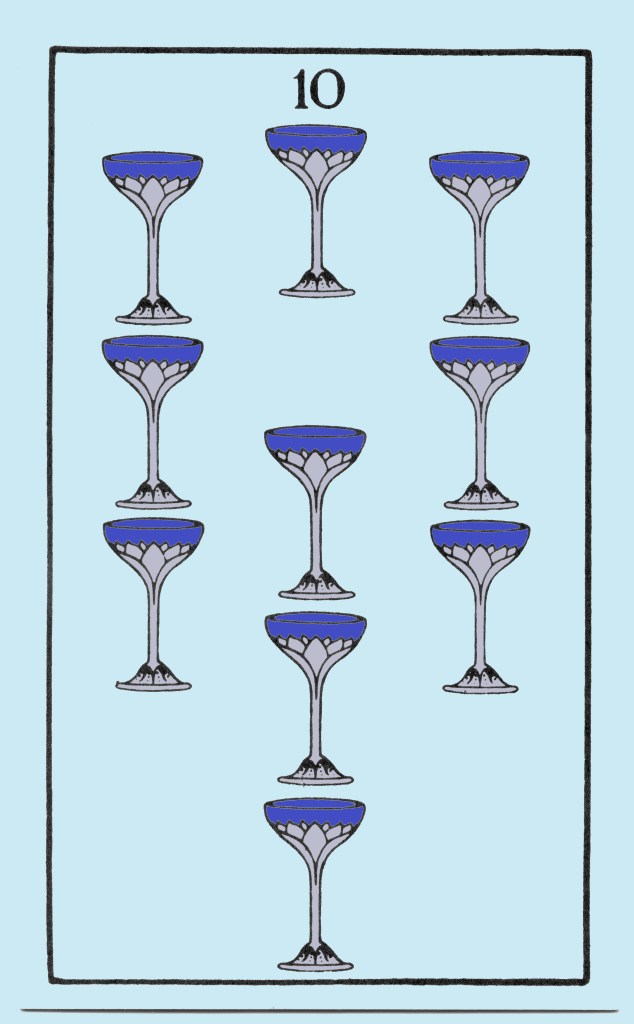
The Ten of Cups from the Builders of the Adytum (BOTA) tarot deck
Paul Foster Case (and Ann Davies)
The time period is the third decanate of Pisces, from March 11 to March 20, under the sub-rulership of Mars in its Scorpio aspect. The meanings are unfortunate unless the divination refers to spiritual matters; for the combined forces of Mars, Jupiter and Neptune in Pisces on the physical levels, while they mean tremendous power of desire and sometimes the satisfaction of desire, point rather to unbalanced force than otherwise, Well-Dignified: if relating to spiritual matters, permanent and lasting success through inspiration from higher levels of consciousness; high psychic development; realization of the highest aspirations; happiness. On questions at a lower level, even if well dignified: great ambition; ultra sensitiveness; great power of realizing desires, but equally great danger of misusing that power. lll-Dignified: in spiritual questions, danger from psychism; probability of being injured mentally through unwise attempts at meditation. On all other questions: danger of self-undoing from psychism; prodigality; possibility of being influenced by others through the desire-nature; tendency to drug habits and drunkenness; disgust resulting from overindulgence; excess in pleasure. Keyword: Excess . (From The Oracle of Tarot course)
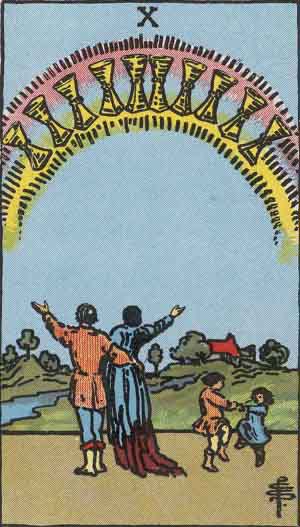
A. E. Waite
Appearance of Cups in a rainbow; it is contemplated in wonder and ecstacy by a man and woman below, evidently husband and wife. His right arm is about her; his left is raised upward; she raises her right arm. The two children dancing near them have not observed the prodigy but are happy after their own manner. There is a home-scene beyond. Divinatory Meanings: Contentment, repose of the entire heart; the perfection of that state; also perfection of human love and friendship; if with several picture-cards, a person who is taking charge of the Querent’s interests; also the town, village or country inhabited by the Querent. Reversed: Repose of the false heart, indignation, violence. (From The Pictorial Key to the Tarot)
The Ten of Cups from the Rider Waite Smith tarot
Aleister Crowley
The Ten of Cups is called Satiety. Its attribution is Mars in Pisces. The watery sign has sunk into a stagnant dream, but in it broods and breeds the violent quality of Mars, to putrefy it. As it is written: “Until a dart strike through his liver.” The pursuit of pleasure has been crowned with perfect success; and constantly it is discovered that, having got everything that one wanted, one did not want it after all; now one must pay.
[…]
This card represents a conflicting element. On the one hand, it receives the influence of the Ten, Malkah the Virgin. The arrangement of the cups is that of the Tree of Life. But, on the other hand, they are themselves unstable. They are tilted; they spill the water from the great Lotus which overhangs the whole system from one into the other.
The work proper to water is complete: and disturbance is due. This comes from the influence of Mars in Pisces. Mars is the gross, violent and disruptive force which inevitably attacks every supposed perfection. His energy displays the greatest possible contrast with that of Pisces, which is both peaceful and spiritualized. (From The Book of Thoth)
The Ten of Cups from the Thoth tarot deck
Golden Dawn’s Book T
HAND, as usual, holding bunch of water-lilies or lotuses, whose flowers pour a white water into all the cups, which “all run over.” The uppermost cup is held sideways by a hand, and pours water into the left-hand upper cup. A single lotus flower surmounts the top cup, and is the source of the water that fills it. Above and below the symbols Mars and Pisces.
Permanent and lasting success and happiness, because inspired from above. Not so sensual as “Lord of Material Happiness,” yet almost more truly happy. Pleasure, dissipation, debauchery, quietness, peacemaking. Kindness, pity, generosity, wantonness, waste, etc., according to dignity.
Malkuth of HB:H (Matter settled: complete good fortune). Herein the Great Angels HB:a’aShLYH and HB:MYHAL rule.
Etteilla
The city Upright. In terms of spiritual medicine, this card, in its natural position, signifies: City, City Center, Homeland, Country, Town, Village, Place, Site, Dwelling, Home, Residence. – Citizen, Group of citizens, City dweller. Reversed. Anger, Indignation, Agitation, Irritation, Outburst of rage, Wrath, Violence.
(Note: this is a collection of the meanings attributed to the cards by some occultists in the past centuries. It does not reflect my own study or opinion of the cards. It is only meant as a quick comparative reference as I develop my own take.)
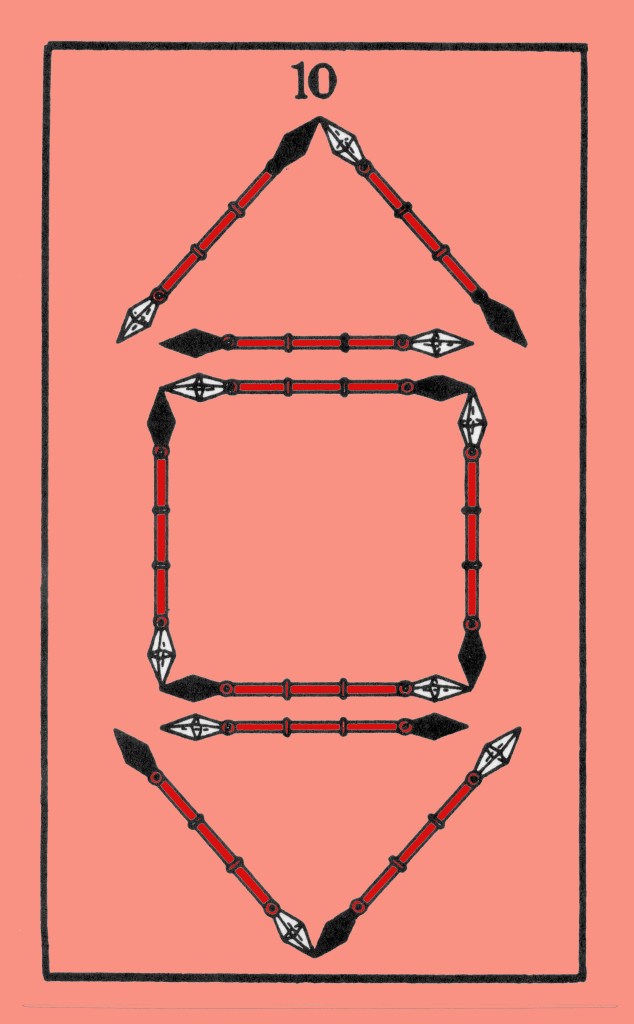
The Ten of Wands from the Builders of the Adytum (BOTA) tarot deck
Paul Foster Case (and Ann Davies)
The third decanate of Sagittarius is the time period from December 12 to December 21. In divination its meanings are those of the Tenth Sephirah combined with the planetary forces of the Sun and Jupiter, the zodiacal sign of Sagittarius together with its natural Ninth house of the Higher Mind. Well-Dignified: generosity; success and honor in connection with the law, religion or philosophy; possibility of post of responsibility; gain through travel. Ill-Dignified: ostentation; dogmatism; overbearing pride. Note :- this card often carries the significance of a burden of responsibility of ‘too many irons in the fire’, or the need for a rearrangement of the Querent’s affairs or activities so as to get them in better order. Keyword: Fullness of power. (From The Oracle of Tarot course)
A. E. Waite
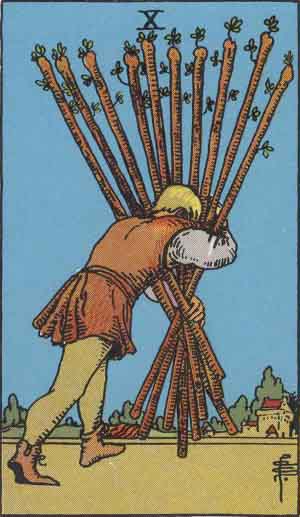
A man oppressed by the weight of the ten staves which he is carrying. Divinatory Meanings: A card of many significances, and some of the readings cannot be harmonized. I set aside that which connects it with honour and good faith. The chief meaning is oppression simply, but it is also fortune, gain, any kind of success, and then it is the oppression of these things. It is also a card of false-seeming, disguise, perfidy. The place which the figure is approaching may suffer from the rods that he carries. Success is stultified if the Nine of Swords follows, and if it is a question of a lawsuit, there will be certain loss. Reversed: Contrarieties, difficulties, intrigues, and their analogies. (From The Pictorial Key to the Tarot)
The Ten of Wands from the Rider Waite Smith tarot
Aleister Crowley
The Ten of Wands is called Oppression. This is what happens when one uses force, force, and nothing else but force all the time. Here looms the dull and heavy planet Saturn weighing down the fiery, ethereal side of Sagittarius; it brings out all the worst in Sagittarius. See the Archer, not shooting forth benign rays, but dealing the sharp rain of death! The Wand has conquered; it has done its work; it has done its work too well; it did not know when to stop; Government has become Tyranny. One thinks of the Hydra when one reflects that King Charles was beheaded in White hall!
[…]
The number Ten refers to Malkuth, which depends from the other nine Sephiroth, but is not directly in communication with them. It shows the Force detached from its spiritual sources. It is become a blind Force; so, the most violent form of that particular energy, without any modifying influences. The flames in the background of the card have run wild. It is Fire in its most destructive aspect.
The card also refers to the influence of Saturn in Sagittarius. Here is the greatest antipathy. Sagittarius is spiritual, swift, light, elusive, and luminous; Saturn is material, slow, heavy, obstinate, and obscure.
The eight Wands are still crossed, showing the enormous power of the completed energies of Fire; but they have lost their patents of nobility. Their ends seem more like claws; they lack the authority and intelligence shown in the earlier cards; and in front are the two formidable Dorjes of the Two of Wands, but lengthened to bars.
The whole picture suggests Oppression and repression. It is a stupid and obstinate cruelty from which there is no escape. It is a Will which has not understood anything beyond its dull purpose, its “lust of result”, and will devour itself in the conflagrations it has evoked. (From The Book of Thoth)
The Ten of Wands from the Thoth tarot deck
Golden Dawn’s Book T
FOUR hands holding eight wands crossed as before. A fifth hand holding two wands upright, which traverses the junction of the others. Flames issuant. Saturn and Sagittarius.
Cruel and overbearing force and energy, but applied only to material and selfish ends. Sometimes shows failure in a matter, and the opposition too strong to be controlled; arising from the person’s too great selfishness at the beginning. Illwill, levity, lying, malice, slander, envy, obstinacy; swiftness in evil and deceit, if ill dignified. Also generosity, disinterestedness and self-sacrifice, when well dignified. Malkuth of HB:V (Cruelty, malice, revenge, injustice). Therein rule HB:RYYAL and HB:AVMAL.
A querent (a man) asked how his relationship would evolve:
A relationship reading
The first thing to notice is that both main figures appear (King and Queen of Wands) and both their thoughts (Page and Knight of Wands). The two significators are in the central column, so let’s read the central column first: King of Wands, Queen of Wands, Ace of Cups (house), Moon (darkness), Queen of Coins (truth). Clearly their relationship is not based on clarity, because the truth is hidden, and there would be a need for honesty.
The Death card next to her might show that she is the one going through some kind of transition, and it’s probably not something that has just happened (Temperance shows time). The house is not positive to the couple, as there is hurt or arguments around it (Knight of Swords).
The King of Swords was hard to interpret. It was, until the querent asked out of the blue “Do you see her cheating on me?”
Look at the column the King of Swords falls in: Death, King of Swords, Her Thoughts and the Betrayal card. In her thoughts there’s someone else. Note also that his thoughts (Knight of Wands) is next to the Moon and the Hanged Man, so he suspects.
The Queen of Coins, which is the truth, here seems to have two meanings here. One is that it shows the need for clarity (and therefore the lack of it), and secondly it acts as a sort of punctuation, as I discussed before, sealing the reading as if to say “yup, that’s exactly what you’re thinking”
Obviously we need to be very careful when announcing this sort of situations, even if the querent suspects. It is much better to caution them to seek clarity with their partner (especially in this case with the Truth card so prominent in the reading)
In recent years, a small number of new books on the Bolognese tarot have been published to meet the demands of the small but growing niche of afficionados. This, as I explained, is largely the merit of Ingallati’s book, which, in spite of some limitations, managed to create that niche outside of Bologna.
Rossella Giliberti’s book is one of these new books. The title of the slim publication literally translates as ‘Practical Handbook for Reading the Bolognese Tarot’. It is a wonderful title, one that is likely to arouse hope in many people. Unfortunately, it has very little to do with the actual content of the book.
Giliberti uses a similar deck as Ingallati (49 cards plus the Joker). I have already explained in my review of Ingallati’s book why I don’t like this selection of cards, which however is unique to Ingallati’s style and must be accepted as such.
Seeing Giliberti’s choice of deck, one would think that she’s just a copycat of Ingallati. But this would be unfair to Giliberti. As short as it is, her book is filled to the brim with notes on combinations and meanings that Ingallati doesn’t talk about, plus she swaps certain cards for others. It is clear that Giliberti, despite obviously being inspired by Ingallati, also had other sources for learning the tarocco bolognese, and this alone makes her book worth buying if one is serious about this deck.
That said, there are some glaring issues with it. For starters, there is absolutely nothing practical or handbookish about it. It is a very (VERY) disorganized collection of notes which would have been fine as initial preparatory work for a book. After the skippable part (the initial chapter about history, which however is more interesting than that in Ingallati’s work) the book gives the usual rundown of the cards one by one, with their core meanings and a couple of classical combinations. For whatever reason, the picture of the Hanged Man is from the Marteau Marseille Tarot.
The merit of this section is that it is clearer, more concise and less fluffed up than Ingallati’s, and the symbolic interpretation more down-to-earth and more informed by Bolognese folklore, as it should be. The possible drawback is that there is space left for the reader to take notes, possibly in an attempt to make the book longer, with the result that the sections seem a bit disjointed and separated from one another. I guess that’s the ‘practical’ part of the book.
When Giliberti comes to the description of the minor arcana, the book starts to fall apart more clearly in terms of organization, with some cards often repeated, some out of order, lack of punctuation and proof-reading, tips on how to read the cards thrown in the mix in random places, some paragraphs all in caps lock, etc. At this point one would be excused for thinking the book is self-published, but it’s not. Some publisher took a look at this and said “yes, I want our brand to be linked to it”.
Giliberti also offers the meanings of the other minor arcana, the ones that are discarded from the 62-card deck. Unfortunately the meanings are taken from a famous discussion board post dating back several years, where one user had assigned the meanings of the Rider Waite deck to the discarded minor arcana.
Afterward there is a section on combinations, all rigorously in caps lock, all rigorously with huge amounts of blank space left between paragraphs. The wording of some of them even makes one think they were taken from other books that I shall review in the future. Some combinations make no sense (e.g., the Page of Coins and the Ace of Cups is a marriage). Some are repeated multiple times with different meanings. Typos and mistakes abound. Still, for all its limitations, an interesting section.
Then there is another section, organized differently in the form of a table, this time on… Combinations?And then there is another section, organized in yet another manner, which is about… Meanings and combinations, some of which have little to do with the ones presented in the first section, and which are more clearly taken “as is” from other sources.
At the end comes an extremely slim final section with some layouts, one of which is taken from Ingallati’s book (I do not mean the layout itself, which is traditional. I mean the actual spread, down to the cards shown in the example). The thirteen card spread is explained in two different ways. The cross spread is also explained in two different ways. You get the picture.
So, what to think of this book? It depends on how one sees it. As a ‘practical handbook’, as promised in the title, it is a bad joke bordering on false representation. As a disorganized mess of poorly edited notes taken from many different sources, some of which are credible, it is somewhat serviceable, especially if you know where and how to look, where and how to block out the information, and if there are no linguistic barriers between you and the text.
Whether it is worth your money depends on the level of autistic fixation you have for the Bolognese Tarot. As I am definitely on that spectrum, I’d rather have it than not, but I am not going to sit here and pretend it is a finished book worth 20€.
(Note: this is a collection of the meanings attributed to the cards by some occultists in the past centuries. It does not reflect my own study or opinion of the cards. It is only meant as a quick comparative reference as I develop my own take.)
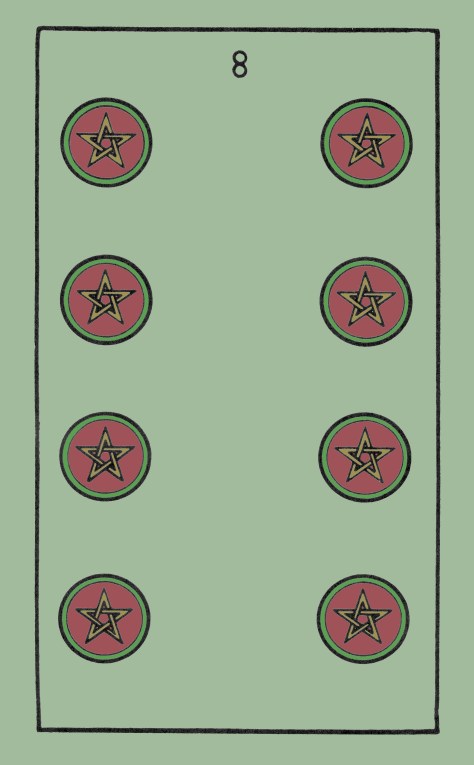
The Eight of Pentacles from the Builders of the Adytum (BOTA) tarot
Paul Foster Case (and Ann Davies)
The time period is the first decanate of Virgo, under the rulership of Mercury, from August 23 to September 2. Meanings: Well-Dignified: skill in the management of material affairs; industry; gain in subordinate positions through writing, clerical work or travel; gain of ready money in small sums. lll-Dignified: avarice and hoarding; penny wisdom and pound foolishness; meanness in money matters; loss through travel or writings; the Querent is likely to be in difficulties with superiors and also with inferiors; he may lose through trying to overreach somebody else. Keyword: Prudence (From the Oracle of Tarot course)
A. E. Waite
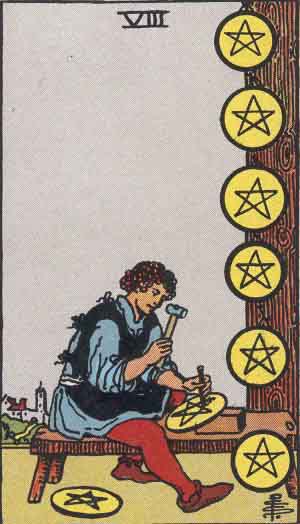
An artist in stone at his work, which he exhibits in the form of trophies. Divinatory Meanings: Work, employment, commission, craftsmanship, skill in craft and business, perhaps in the preparatory stage. Reversed: Voided ambition, vanity, cupidity, exaction, usury. It may also signify the possession of skill, in the sense of the ingenious mind turned to cunning and intrigue. (From The Pictorial Key to the Tarot)
The Eight of Pentacles from the Rider Waite Smith tarot
Aleister Crowley
The Eight of Disks is called Prudence. This card is a great deal better than the last two [Eights], because, in purely material matters, especially those relating to actual money, there is a sort of strength in doing nothing at all. The problem of every financier is, first of all, to gain time; if his resources are sufficient, he always beats the market. This is the card of “putting something away for a rainy day”.
[…]
The number Eight, Hod, is very helpful in this card, because it represents Mercury in his most spiritual aspect, and he both rules and is exalted in the sign of Virgo, which belongs to the Decan, and is governed by the Sun. It signifies intelligence lovingly applied to material matters, especially those of the agriculturalist, the artificer and the engineer.
One might suggest that this card marks the turn of the tide. The seven of Disks is in one sense the fullest possible establishment of Matter-compare Atu XV-the lowest fallen and therefore the highest exalted. These last three cards seem to prepare the explosion which will renew the whole Cycle. Note that Virgo is Yod, the secret seed of Life, and also the Virgin Earth awaiting the Phallic Plough.
The interest of this card is the interest of the common people. The rulership of the Sun in Virgo suggests also birth. The disks are arranged in the form of the geomantic figure Populus. These disks may be represented as the flowers or fruits of a great tree, its solid roots in fertile land.
In the Yi King, Sol in Virgo is represented by the 33rd Hexagram, Thun, “Big Air”. It means “retiring”; and the commentary indicates how best to make use of that manoeuvre. This is congruous enough with the essence of Virgo, the secret withdrawing of Energy into the fallow Earth. Populus, moreover, is the Moon retiring from manifestation to her conjunction with the Sun. (From The Book of Thoth)
The Eight of Disks from the Thoth tarot
Golden Dawn’s Book T
A WHITE Radiating Angelic Hand, issuing from a cloud, and grasping a branch of a rose tree, with four white roses thereon, which touch only the four lowermost Pentacles. No rosebuds even, but only leaves, touch the four uppermost disks. All the Pentacles are similar to that of the Ace, but without the Maltese cross and wings. They are arranged like the geomantic figure Populus:
* * * * * * * *
Above and below them are the symbols Sun and Virgo for the Decan. Over-careful in small things at the expense of great: “Penny wise and pound foolish”: gain of ready money in small sums; mean; avaricious; industrious; cultivation of land; hoarding, lacking in enterprise. Hod of HB:H (Skill: prudence: cunning). Therein rule those mighty Angels HB:AKAYH and HB:KHThAL
Etteilla
Brunette Girl Upright. This card, as far as the medicine of the spirit is concerned, means, in its natural position: Brunette Girl, Passive, Great Night. Reversed. Empty aspiration, Avarice, Usury.
In my latest reading, an interesting phenomenon happened: I had to partly go beyond the basic rules of the oracle (in this case the tarot) in order to interpret its message. Specifically, I had to get past the rule that only the Wand figures represent the querents and accept the Queen of Cups as an alternative version of the subject in question.
There is always a reason why something happens, and in this case I believe the possible reasons were 1) that I was asking about my mother, so the cards described her not only as the protagonist of the reading (Wand) but also as mother of the person asking the question (Cup) 2) the reading was, in part, about her still viewing herself as wife, even though she is widowed, so not only is she the protagonist (Wand) but also a wife (Cup).
I am pretty sure this sort of things (that is, the need to apply the ground rules with discretion) can happen in different respects with any deck. In fact, I think it can happen with any oracle. The late Robert Zoller often showed that good astrologers need to be guided by what the chart is saying, which often requires one to start from recorded knowledge and then stretch that knowledge to cover each individual case. William Lilly, possibly the most important horary astrologer in history, often repeated that one must “mix discretion with art”, that is, understand the rules and then apply them intelligently.
The thing is, divination is not an assembly line type of work: it’s a Hermetic art (where the word ‘Hermetic’ is understood in its classical sense, not the Kybalion-style crap). If even the rules of biology need to be interpreted smartly by doctors in order to cure the human body, then how much more flexible do we need to be to interpret a device whose permutations can give us the blueprint for anything that could happen?
Anything goes vs informed pragmatism
My understanding of divination is a never-ending journey. The way I currently see the rules of divination is as posts along the way in a thick snowstorm. If a post has been put somewhere, that means someone was there before and has figured out something. We do not discard such knowledge lightly, unless the contingent reality of our current situation makes us prefer another route.
This approach is very different from the ‘anything goes’ non-method used by so many, which is almost expected and even bragged about, largely due to the widespread rejection of rationality in our milieu. Too many people who dabble into esoteric subjects today seem to believe that throwing overboard logic is the first step on the journey. In part this is due to mistaken orientalist fantasies, in part to a post-modern Zeitgeist that sees all structures as dispensable, reactionary dead weight only good for restraining us– who wants to be restrained?
The way I currently see rules in the esoteric arts is neither reactionary nor revolutionary. It is an attempt at appraising reality through lenses as simple as possible and as complex as they need to be, a kind of pragmatism that is informed by the past but future-oriented in looking for concrete solutions to concrete issues.
As far as divination is concerned, it is a language, but it is a language with no native speakers, and for which no Rosetta stone exists, except the tentative hypotheses of those who have grappled with the language before. We don’t need to vest them with our superstitious awe, but we do owe them a serious, dispassionate look at the conclusions they have reached before either accepting them as they are, discarding them or expanding them with discretion.
(Note: this is a collection of the meanings attributed to the cards by some occultists in the past centuries. It does not reflect my own study or opinion of the cards. It is only meant as a quick comparative reference as I develop my own take.)
The Eight of Swords from the Builders of the Adytum (BOTA) tarot deck
Paul Foster Case (and Ann Davies)
The time period is the first decanate of Gemini, May 21 to May 31, under the rulership of Mercury. Well-Dignified: even well-dignified, the excessive Mercurial influence expressing in the Yetziratic field of unstable forces and changing forms, symbolized by the Eight of Swords, gives a marked tendency toward ill-directed or wasted action. Meanings in divination: force wasted in petty affairs; too much talk; too much illdirected action; the state of being terribly busy without accomplishing much; over-careful about details; could possibly intimate a crisis in affairs, and probably much talk, correspondence and moving about. Ill-Dignified: malice; ill-natured gossip; pettiness; too much concern with personalities; disagreements with brothers and sisters. This Key divinatorily expresses unbalanced or excessive Gemini qualities in third house affairs. The se negative Gemini qualities portend the need for balancing the quick-mindedness and penchant for action of this astrological type with the d e pth of feeling and emotional warmth corresponding to Netzach and Venus. Keyword: Mediocrity (From the Oracle of Tarot course)
A. E. Waite
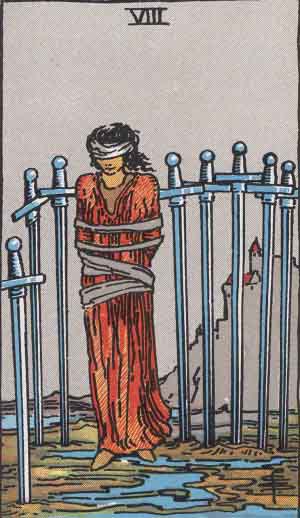
A woman, bound and hoodwinked, with the swords of the card about her. Yet it is rather a card of temporary durance than of irretrievable bondage. Divinatory Meanings: Bad news, violent chagrin, crisis, censure, power in trammels, conflict, calumny; also sickness. Reversed: Disquiet, difficulty, opposition, accident, treachery; what is unforeseen; fatality. (From The Pictorial Key to the Tarot)
The Eight of Swords from the Rider Waite Smith tarot
Aleister Crowley
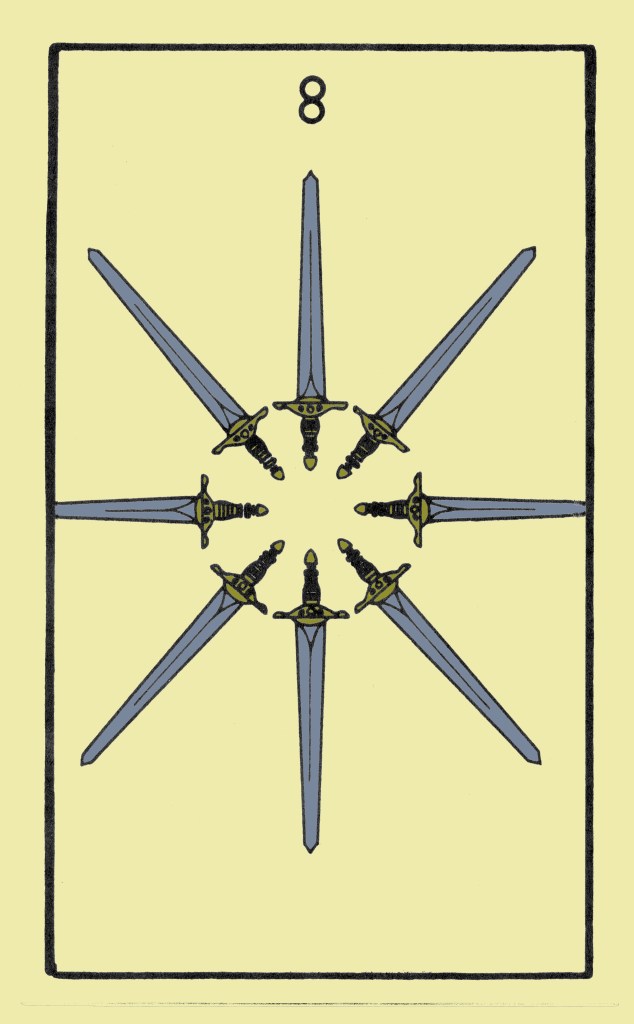
The Eight of Swords is called Interference. At first sight, it would seem easy to confuse it with the Eight of Cups; but the idea is, in reality, quite different. The card is attributed to Jupiter and Gemini; accordingly, there is no weighing down of the will by internal or external stress. It is simply the error of being good-natured when good-nature is disastrous. Gemini is an airy sign, an intellectual sign; Jupiter is geniality and optimism. This will not do in the world of Swords; if one must hit at all, a knock-out blow is best.
But there is another element in this card; that of unexpected (the Eights, being at heart Mercurial, are always that) interference, sheer unforeseen bad luck. Trivial incidents have often altered the destiny of empires, brought to naught “the best laid plans of mice and men”.
[…]
The number Eight, Hod, here signifies lack of persistence in matters of the intellect and of contest. Good fortune, however, attends even these weakened efforts, thanks to the influence of Jupiter in Gemini, ruling the Decan. Yet the Will is constantly thwarted by accidental interference.
The centre of the card is occupied by two long Swords pointed downward. These are crossed by six small swords, three on each side. They remind one of weapons peculiar to their countries or their cults; we see here the Kriss, the Kukri, the Scramasax, the Dagger, the Machete and the Yataghan. (From The Book of Thoth)
The Eight of Swords from the Thoth tarot deck
Golden Dawn’s Book T
FOUR White Radiant Angelic Hands issuing from clouds, each holding two swords, points upwards; all the points touch near the top of the card. Hands issue, two at each bottom angle of the card. The pose of the other sword symbols is reestablished in the centre. Above and below are the Decan symbols Jupiter and Gemini.
Too much force applied to small things: too much attention to detail at the expense of the principal and more important points. When ill dignified, these qualities produce malice, pettiness, and domineering characteristics. Patience in detail of study; great care in some things, counterbalanced by equal disorder in others. Impulsive; equally fond of giving or receiving money or presents;
generous, clever, acute, selfish and without strong feeling of affection. Admires wisdom, yet applies it to small and unworthy objects.
Hod of HB:V (Narrow, restricted, petty, a prison). Therein rule the Angels HB:VMBAL and HB:YHHAL.
Etteilla
Criticism Upright. This card, as far as the medicine of the spirit is concerned, means, in its natural position: Criticism, Unfortunate position, Critical moment, Critical time, Decisive instant, Unfortunate situation, Delicate circumstance, Crisis. – Examination, Discussion, Research, Blame, Censure, Critical comment, Critical epilogue, Control, Disapproval, Condemnation, Cassation, Judgment, Contempt. Reversed. Accident, Difficulty, Particular circumstance, Conjunction, Occurrence, Accessory, Unconscious, Obstacle, Delay, Hindrance. – Abjection. – Contestation, Contradiction, Opposition, Resistance, Divergence. – Unplanned, Unforeseen, Chance, Adventure, Occurrence, Destiny, Fatality, Accident, Misfortune, Symptom