Tag Archives: Tarot card illustrations

Tarot Encyclopedia – The Six of Wands

(Note: this is a collection of the meanings attributed to the cards by some occultists in the past centuries. It does not reflect my own study or opinion of the cards. It is only meant as a quick comparative reference as I develop my own take.)
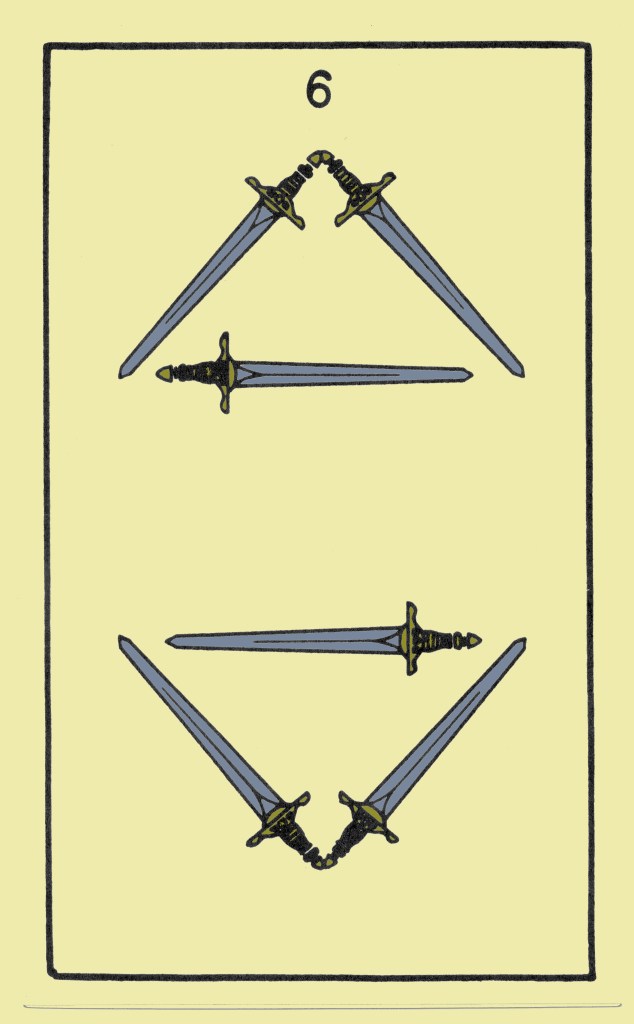
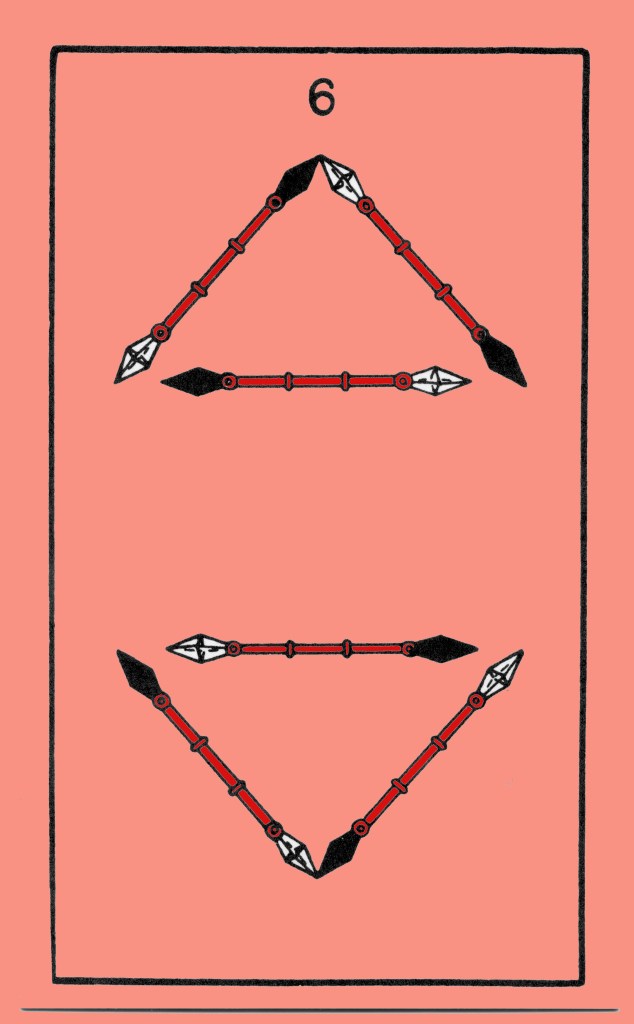
The Six of Wands from the Builders of the Adytum (BOTA) Tarot deck

Paul Foster Case (and Ann Davies)

The second decanate of Leo, related to this Key, is the time period of August 2 to August 12, ruled by Jupiter. In Tarot divination, the Six of Wands partakes of a meaning similar to the conjunction of the Sun and Jupiter, combined with the influence of Leo and its natural fifth house.
Well-Dignified: success, happiness, gain; gain through love affairs or by the opposite sex; pleasure in labor; gain after a period of uncertainty and competition.
lll-Dignified: loss through the same things; waste in pleasure; trouble through pride of riches or through insolence based on success.
Keyword: Victory
(From the Oracle of Tarot course)

A. E. Waite

A laurelled horseman bears one staff adorned with a laurel crown; footmen with staves are at his side. Divinatory Meanings: The card has been so designed that it can cover several significations; on the surface, it is a victor triumphing, but it is also great news, such as might be carried in state by the King’s courier; it is expectation crowned with its own desire, the crown of hope, and so forth. Reversed: Apprehension, fear, as of a victorious enemy at the gate; treachery, disloyalty, as of gates being opened to the enemy; also indefinite delay.
(From The Pictorial Key to the Tarot)
Aleister Crowley

The Six of Wands is called Victory. The outburst of energy in the Five of Wands, which was so sudden and violent that it even gave the idea of strife, has now completely won success. The rule, or lordship, in the suit of Wands is not quite as stable as it might have been if there had been less energy displayed. So, from this point, as soon as the current leaves the middle pillar, the inherent weakness in the element of Fire (which is this: that, for all its purity, it is not completely balanced) leads to very undesirable developments.

[…]

This card represents Tiphareth of the suit of Fire. This shows Energy in completely balanced manifestation. The Five has broken up the closed forces of the Four with revolutionary ardour, but a marriage has taken place between them; and the result is the Son, and the Sun.

The reference is also to Jupiter and Leo, which seems to imply a benediction on the harmony and beauty of this arrangement. It Will be seen that the Three Wands of the Three Adepts are now orderly arranged; and the flames themselves, instead of shooting out in all directions, burn steadily as in lamps. They are nine in number, in reference to Yesod and the Moon. This shows the stabilization of the Energy, and its reception and reflection by the Feminine.

There is no circle to enclose the system. It is self-supporting, like the Sun.
(From The Book of Thoth)

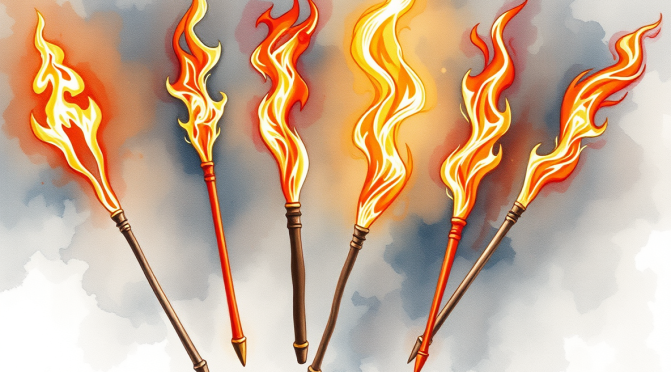
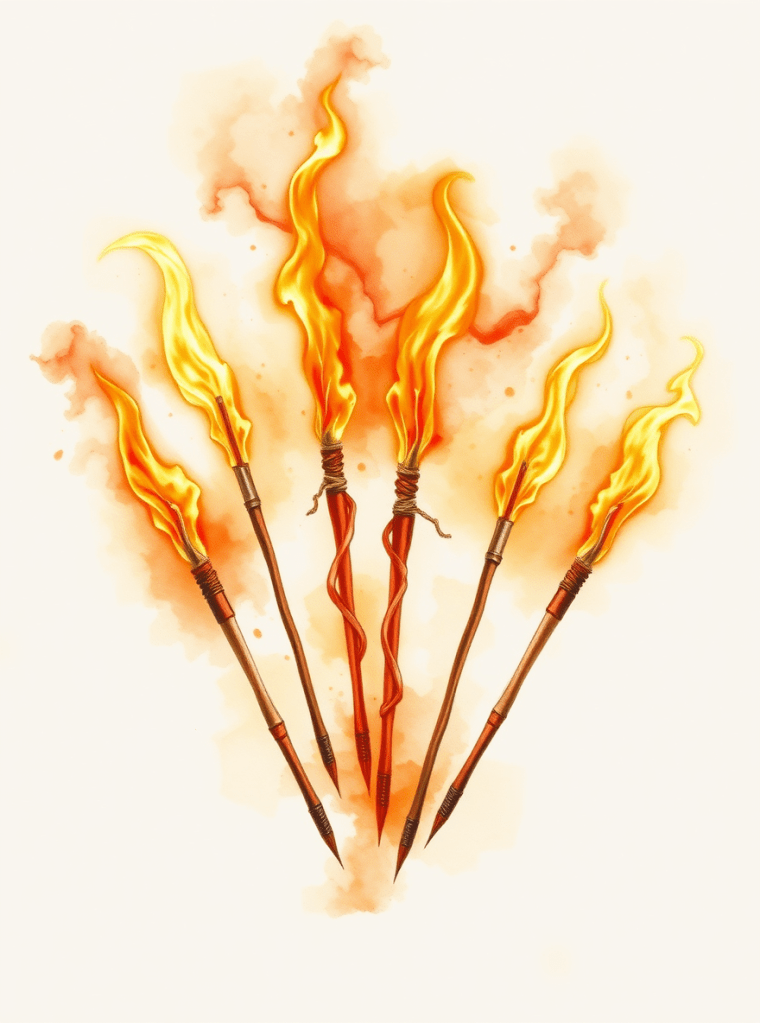
Rather prosaic AI-generated illustration for the Six of Wands

Golden Dawn’s Book T

TWO hands in grip as the last, holding six wands crossed three and three. Flames issue from the point of junction. Above and below are short wands with flames issuing, surmounted respectively by the symbols of Jupiter and Leo, representing the Decan.

Victory after strife: Love: pleasure gained by labour: carefulness, sociability and avoiding of strife, yet victory therein: also insolence, and pride of riches and success, etc. The whole dependent on the dignity.

Tiphareth of HB:Y (Gain).

Hereunto are allotted the great Angels HB:SYTAL and HB:a’aLMYH of the Schemhamphorash.

Etteilla

Servant
Upright. This card, as far as the medicine of the spirit is concerned, means, in its natural position: Housekeeper, Servant, Valet, Lackey, Slave, Mercenary, Inferior. – Courier, Commissary, Factor. – Interior of the house, Ménage, Family, Complex of the servants of the house.
Reversed. Expectation, Expectation, Hope, Relying on, Grounding, Trusting, Promise. – Confidence, Foresight. – Fear, Apprehension.

MQS

Tarot Encyclopedia – The Five of Pentacles or Coins

(Note: this is a collection of the meanings attributed to the cards by some occultists in the past centuries. It does not reflect my own study or opinion of the cards. It is only meant as a quick comparative reference as I develop my own take.)

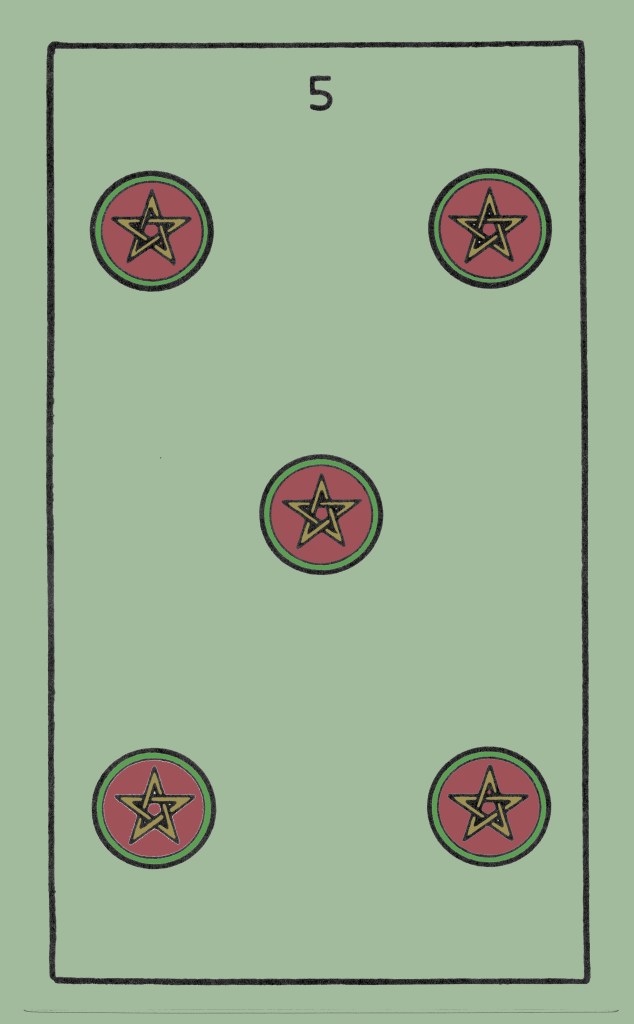
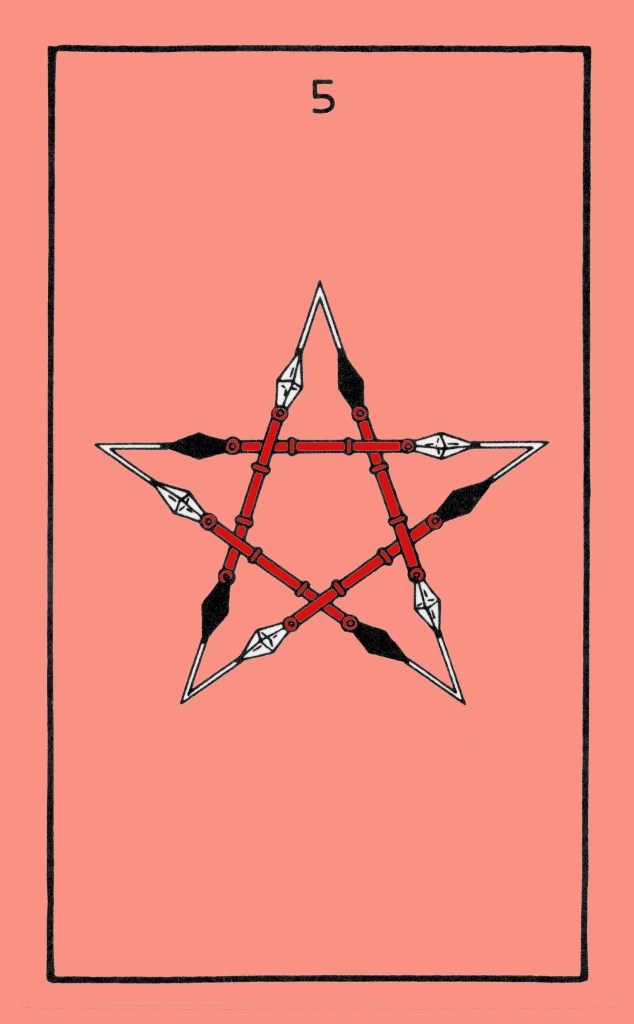
The Five of Pentacles from the Builders of the Adytum (BOTA) tarot deck

Paul Foster Case (and Ann Davies)

The time period is the first decanate of Taurus, under the rulership of Venus, April 20 to 29. Meanings:
Well-Dignified: labor, toil, the cultivation of the land; building, and plans concerning it; some anxiety over money.
lll-Dignified: toil unrewarded; loss of money; poverty; trouble for the Querent through lack of imagination and foresight.
Keyword: Uncertainty; material trouble.
(From the Oracle of Tarot course)

A. E. Waite

Two mendicants in a snow-storm pass a lighted casement. Divinatory Meanings: The card foretells material trouble above all, whether in the form illustrated–that is, destitution–or otherwise. For some cartomancists, it is a card of love and lovers-wife, husband, friend, mistress; also concordance, affinities. These alternatives cannot be harmonized. Reversed: Disorder, chaos, ruin, discord, profligacy.
(From The Pictorial Key to the Tarot)

Aleister Crowley

The Five of Disks is in equally evil case. The soft quiet of the Four has been completely overthrown; the card is called Worry. [See Skeat, Etymological Dictionary. The idea is of strangling, as dogs worry sheep. Note the identity with Sphinx.] The economic system has broken down; there is no more balance between the social orders. Disks being as they are, stolid and obstinate, as compared with the other weapons, for their revolution serves t9 stabilize them, there is no action, at least not in its own ambit, that can affect the issue.

[…]

The Number Five, Geburah, in the suit of Earth, shows the disruption of the Elements, just as in the other suits. This is emphasized by the rule of Mercury in Taurus, types of energy which are opposed. It needs a very powerful Mercury to upset Taurus; so the natural meaning is Intelligence applied to Labour.

The symbol represents five disks in the form of the inverted Pentagram, instability in the very foundations of Matter. The effect is that of an earthquake. They are, however, representative of the five Tatvas; these hold together, on a very low plane, an organism which would otherwise disrupt completely. The background is an angry, ugly red with yellow markings. The general effect is one of intense strain; yet the symbol implies long-continued inaction.
(From The Book of Thoth)

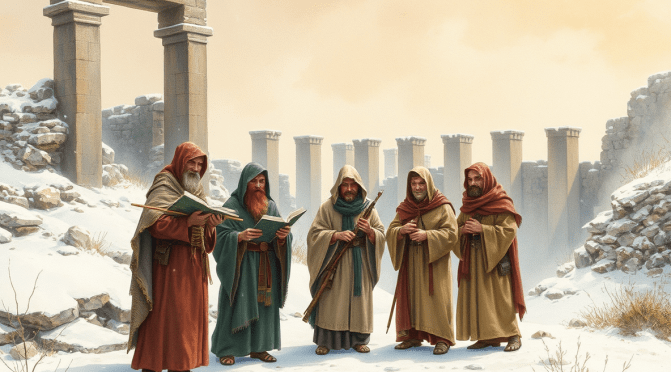
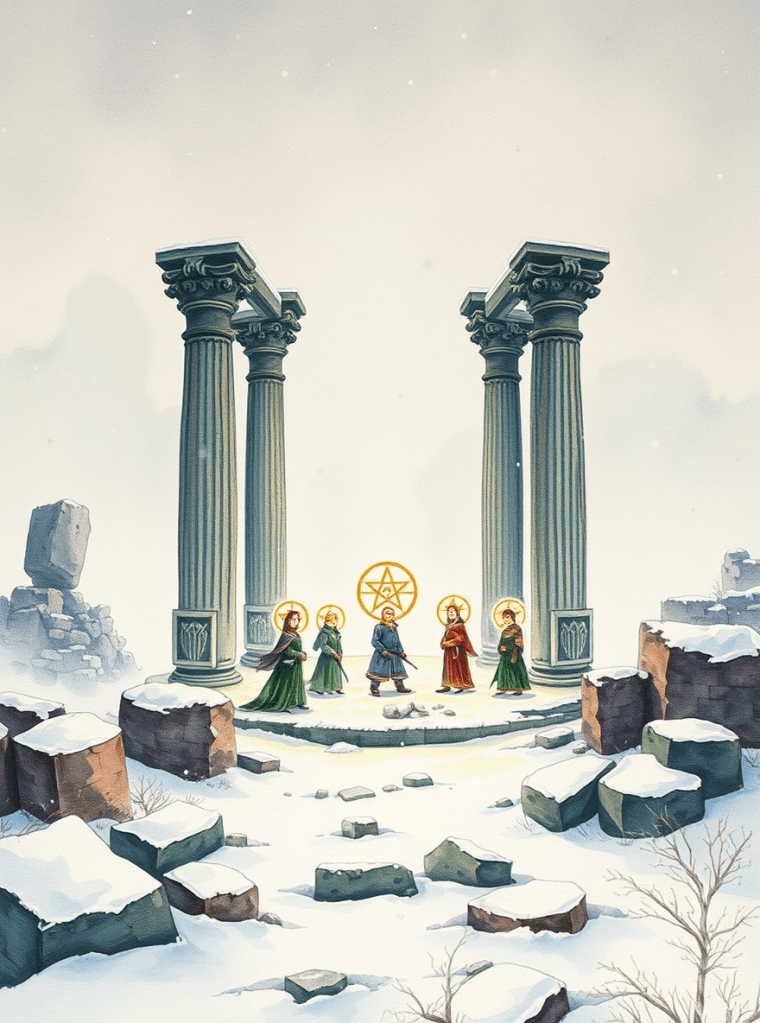
A peasantly mystical AI-generated illustration for the Five of Pentacles

Golden Dawn’s Book T

A WHITE Radiant Angelic Hand issuing from clouds, and holding a branch of the white rose tree, but from which the roses are falling, and leaving no buds behind.
Five Pentacles similar to the Ace. Above and below are Mercury and Taurus.

Loss of money or position. Trouble about material things. Labour, toil, land cultivation; building, knowledge and acuteness of earthly things, poverty, carefulness, kindness; sometimes money regained after severe toil and labour.
Unimaginative, harsh, stern, determined, obstinate.
Geburah of HB:H (Loss of profession, loss of money, monetary anxiety).
Herein the angels HB:MBHYH and HB:PNYAL rule.

Etteilla

Lover
Upright. This card, as far as the medicine of the spirit is concerned, means, in its natural position: Lover [man], Lover [woman], In love, Gallant man, Gallant woman, Husband, Wife, Groom, Bride, Friend, Friend. – Lover. – Loving, Lovingly, Adoring. – Harmony, Agreement, Convenience, Concordance, Good manners.
Reversed. Disorderly, Contrary to order. – Debauchery, Disorder, Turmoil, Confusion, Chaos. – Damage, Devastation, Ruin. – Dissipation, Consumption. – Unruliness, Libertinism. – Discord, Disharmony, Discordance.

MQS

Tarot Encyclopedia – The Five of Swords

(Note: this is a collection of the meanings attributed to the cards by some occultists in the past centuries. It does not reflect my own study or opinion of the cards. It is only meant as a quick comparative reference as I develop my own take.)

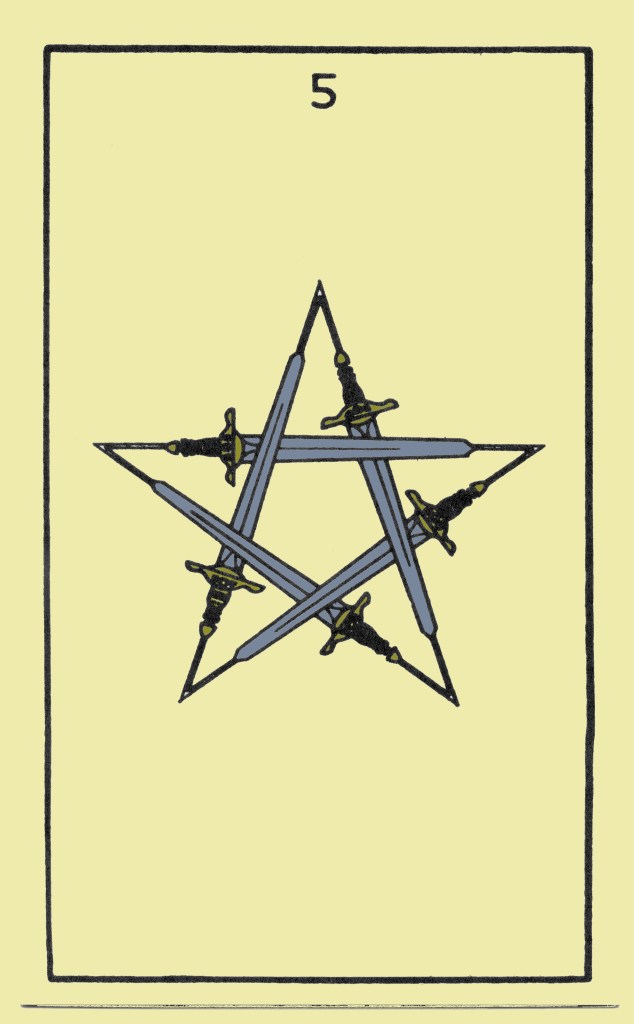
The Five of Swords from the Builders of the Adytum (BOTA) tarot deck

Paul Foster Case (and Ann Davies)

The time period is the first decanate of Aquarius, from January 20 to 29, under the rulers hip of Saturn and Uranus.
Well-Dignified: the decision is adve rse to the Querent in any matter of a material nature. In spiritual affairs this card portends apparent troubles which work out ultimately to good result. Thus this Key is one of trouble and anxiety, but rightly comprehended can be the turning point for positive good .
Ill-Dignified: the troubles are intensified and are probably due to the Querent’s own lack of understanding of the true nature of the situation. If the question is one of speculation, the Querent is likely to be disappointed due to his own desire to get something for nothing, to over-reach somebody else,
or to get rich quick.
Keyword: Defeat.
(From the Oracle of Tarot Course)

A. E. Waite

A disdainful man looks after two retreating and dejected figures. Their swords lie upon the ground. He carries two others on his left shoulder, and a third sword is in his right hand, point to earth. He is the master in possession of the field. Divinatory Meanings: Degradation, destruction, revocation, infamy, dishonour, loss, with the variants and analogues of these. Reversed: The same; burial and obsequies.
(From The Pictorial Key to the Tarot)

Aleister Crowley

The Five of Swords is similarly [to the other fives] troublesome; the card is called Defeat. There has been insufficient power to maintain the armed peace of the Four. The quarrel has actually broken out. This must mean defeat, for the original idea of the Sword was a manifestation of the result of the love between the Wand and the Cup. It is because the birth had to express itself in the duality of the Sword and the Disk that the nature of each appears so imperfect.

[…]

Geburah, as always, produces disruption; but as Venus here rules Aquarius, weakness rather than excess of strength seems the cause of disaster. The intellect has been enfeebled by sentiment. The defeat is due to pacifism. Treachery also may be implied.

The hilts of the swords form the inverted pentagram, always a symbol of somewhat sinister tendency. Here matters are even worse; none of the hilts resembles any of the others, and their blades are crooked or broken. They give the impression of drooping; only the lowest of the swords points upwards, and this is the least effective of the weapons. The rose of the previous card has been altogether disintegrated.

The historian is happy to observe two perfect illustrations of the mode of this card and the last in the birth of the Aeon of (1) Osiris, (2) Horus. He will note the decay of such Virtue as characterized Sparta and Rome, ending in the establishment of the Pax Romana. As Virtue declined, corruption disintegrated the Empire from within. Epicene cults, such as those of Dionysus (in its degraded form), of Attis, of Adonis, of Cybele, the false Demeter and the prostituted Isis, replaced the sterner rites of the true Solar-Phallic gods; until finally (the masters having lost the respect, and so the control, of the plebs, native and alien) the lowest of all the slave-cults, dressed up in the fables of the vilest of the parasitic races, swept over the known world, and drenched it in foul darkness for five hundred years. He will delight to draw close parallels with the cognate phenomena displayed before the present generation.
(From The Book of Thoth)

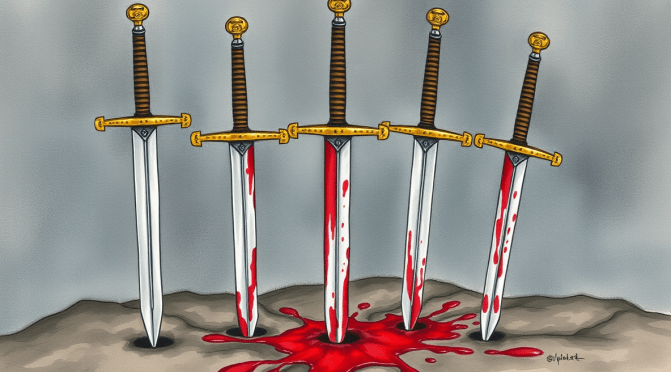
AI-generated illustration for the Five of Swords

Golden Dawn’s Book T

TWO Rayed Angelic Hands each holding two swords nearly upright, but falling apart of each other, right and left of the card. A third hand holds a sword upright in the centre as though it had disunited them. The petals of the rose, which in the four had been reinstated in the centre, are torn asunder and falling. Above and below are Venus and Aquarius for Decan.

Contest finished and decided against the person; failure, defeat, anxiety, trouble, poverty, avarice, grieving after gain, laborious, unresting; loss and vileness of nature; malicious, slanderous, lying, spiteful and tale-bearing. A busybody and separator of friends, hating to see peace and love between others. Cruel, yet cowardly, thankless and unreliable. Clever and quick in thought and speech.
Feelings of pity easily roused, but unenduring.

Geburah of HB:V (Defeat, loss, malice, spite, slander, evil-speaking).
Herein the Angels HB:ANYAL and HB:Cha’aMYH bear rule.

Etteilla

Loss
Upright. This card, as far as the medicine of the spirit is concerned, means, in its natural position: Loss, Alteration, Discredit, Degradation, Perdition, Decay, Destruction, Deterioration, Deterioration, Diminution, Depression, Diminution, Damage, Failure, Prejudice, Blemish, Torts, Avarice, Decline of business, Failure, Disadvantage, Devastation, Dilapidation, Dissipation, Injury, Disgrace, Reversal, Reversal of fortune, Ruin. – Defeat – Debauchery, Disgrace, Dishonor, Infamy, Ignominy, Affront, Ugliness, Difformity, Humiliation. – Theft, Thievery, Rape, Plagiarism, Abduction, Filthy, Horrible. – Infamy, Corruption, Profligacy, Seduction, Libertinism.
Reversed. Mourning, Abasement, Affliction, Sadness, Grief, Pain of spirit, Funeral pump, Burial, Funeral, Inhumation, Burial.

MQS

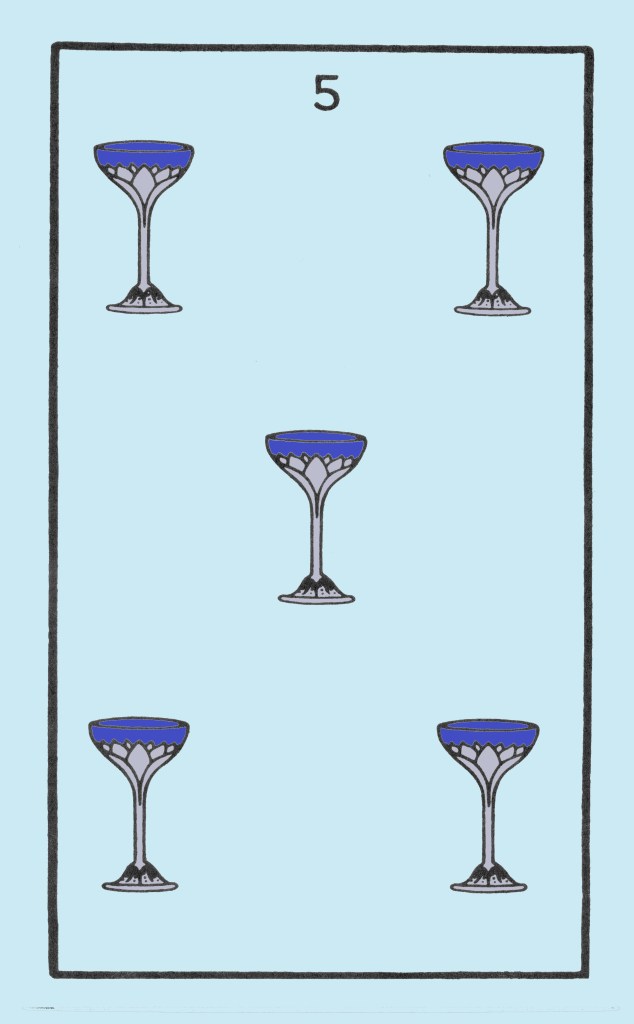
Tarot Encyclopedia – The Five of Cups

(Note: this is a collection of the meanings attributed to the cards by some occultists in the past centuries. It does not reflect my own study or opinion of the cards. It is only meant as a quick comparative reference as I develop my own take.)

The Five of Cups from the Builders of the Adytum (BOTA) tarot deck

Paul Foster Case (and Ann Davies)

The Five of Cups is the first decanate of Scorpio, ruled by Mars, time period October 22 to October 31.
Well-Dignified: strength, power to do; ability to introduce needed changes and let go of relationships, prejudices and false ideas that are hindering spiritual progress.
lll-Dignified: loss in pleasure, vain regret, disappointment, sorrow and loss of those things which have been much desired; treachery, deceit; unexpected troubles and anxieties; disappointments in love, broken engagements, broken friendships.
(Note: These sorrows and disappointments, as indicated by the Five of Cups, lll Dignified, are often the necessary destruction before the beginning of a new and greater expansion and growth in the life of the Querent, depending on his basic understanding and evolutionary level.)
Keyword: Defeated desire.
(From the Oracle of Tarot course)

A. E. Waite

A dark, cloaked figure, looking sideways at three prone cups two others stand upright behind him; a bridge is in the background, leading to a small keep or holding. Divanatory Meanings: It is a card of loss, but something remains over; three have been taken, but two are left; it is a card of inheritance, patrimony, transmission, but not corresponding to expectations; with some interpreters it is a card of marriage, but not without bitterness or frustration. Reversed: News, alliances, affinity, consanguinity, ancestry, return, false projects.
(From The Pictorial Key to the Tarot)

Aleister Crowley

 […] the Five of Cups is called Disappointment, as is only natural, because Fire delights in superabundant energy, whereas the water of Pleasure is naturally placid, and any disturbance of ease can only be regarded as misfortune.

This card is ruled by Geburah in the suit of Water. Geburah being fiery, there is a natural antipathy. Hence arises the idea of disturbance, just when least expected, in a time of ease.

The attribution is also to Mars in Scorpio, which is his own house; and Mars is the manifestation on the lowest plane of Geburah, while Scorpio, in its worst aspect, suggests the putrefying power of Water. Yet the powerful male influences do not show actual decay, only the beginning of destruction; hence, the anticipated pleasure is frustrated. The Lotuses have their petals torn by fiery winds; the sea is arid and stagnant, a dead sea, like a “chott” in North Africa. No water flows into the cups.

Moreover, these cups are arranged in the form of an inverted pentagram, symbolizing the triumph of matter over spirit.

Mars in Scorpio, moreover, is the attribution of the Geomantic figure Rubeus. This is of such evil omen that certain schools of Geomancy destroy the Map, and postpone the question for two hours or more, when Rubeus appears in the Ascendant. Its meaning is to be studied in the “Handbook of Geomancy” (Equinox Vol. I, No.2).
(From The Book of Thoth)

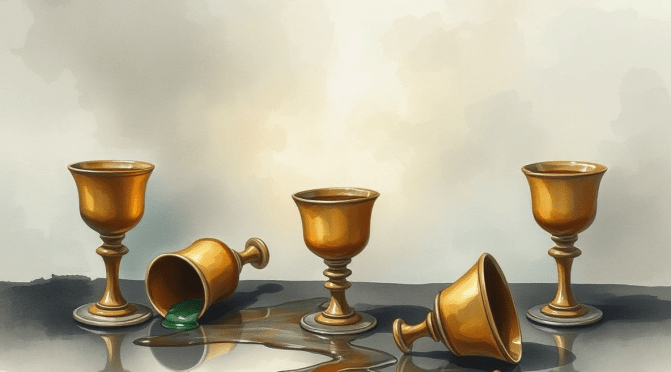
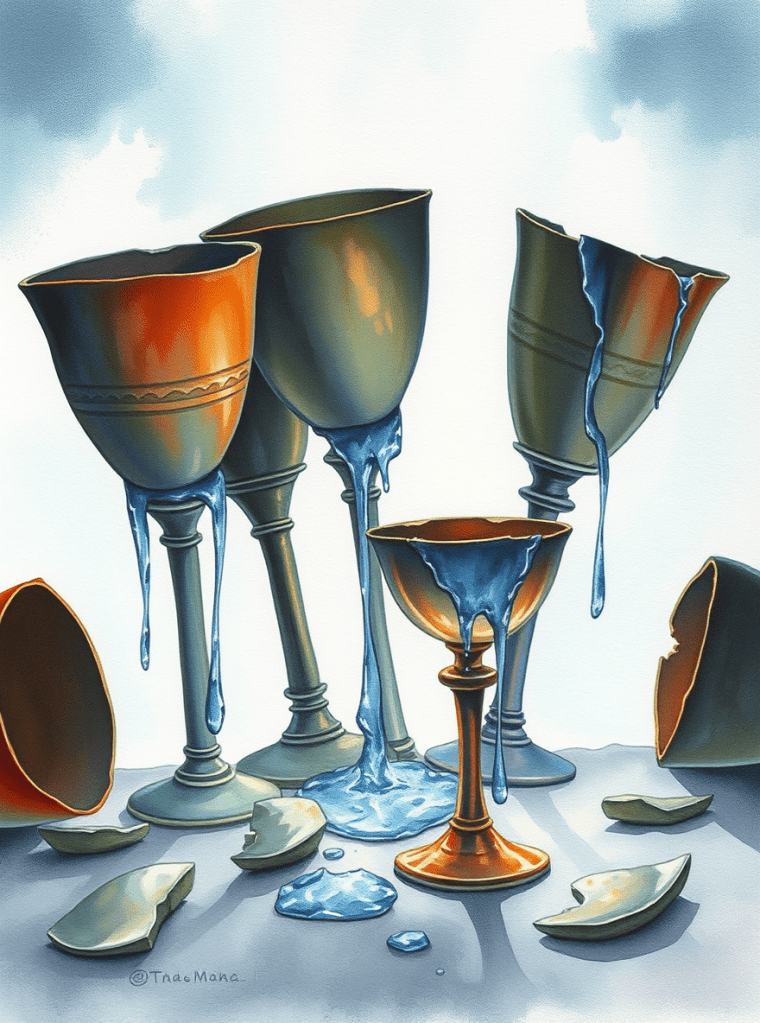
AI-generated illustration for the Five of Cups

Golden Dawn’s Book T

A WHITE Radiating Angelic Hand, holding lotuses or water-lilies, of which the flowers are falling right and left. Leaves only, and no buds, surmount them. These lotus stems ascend between the cups in the manner of a fountain, but no water flows therefrom; neither is there water in any of the cups, which are somewhat of the shape of the magical instrument of the Zelator Adeptus Minor. Above and below are the symbols of Mars and Scorpio for the Decan.

Death, or end of pleasure: disappointment, sorrow and loss in those things from which pleasure is expected. Sadness, treachery, deceit; ill-will, detraction; charity and kindness ill requited; all kinds of anxieties and troubles from unsuspected and unexpected sources.
Geburah of HB:H (Disappointment in love, marriage broken off, unkindness of a
friend; loss of friendship).
Herein rule HB:LVVYH and HB:PHLYH.

Etteilla

Legacy
Upright. This card, in its natural position, means, as far as the medicine of the spirit is concerned: Inheritance, Succession, Bequest, Gift, Donation, Endowment, Estate, Transmission, Will. – Tradition, Resolution [=Decision]. – Kabbalah.
Reversed. Consanguinity, Blood, Family, Avi, Ancestors, Father, Mother, Brother, Sister, Uncle, Aunt, Cousin, Cousin. – Filiation, Extraction, Race, Lineage, Alliance. – Affinity, Attachment, Relationship, Ties.

MQS

Tarot Encyclopedia – The Five of Wands

(Note: this is a collection of the meanings attributed to the cards by some occultists in the past centuries. It does not reflect my own study or opinion of the cards. It is only meant as a quick comparative reference as I develop my own take.)

The Five of Wands from the Builders of the Adytum (BOTA) tarot deck

Paul Foster Case (and Ann Davies)

The first decanate of Leo encompasses the time period from July 23 to August 1. It is ruled doubly by the Sun, so that the Sun and its attributions have a marked influence on the meanings of this Key.
Thus the Five of Wands is a combination of the powers of Mars, active in Geburah and the powers of the Sun in Leo, together with the meanings of the number five and the pentagram. Key ideas associated with the Five of Wands are power and pleasure in exercising it. This is the combined influence of the strength resident in Geburah together with the pleasure associated with Leo and its natural fifth house in astrology.
The Martian influence gives a spirit of adventure and speculation, together with some uncertainty in carrying out plans. The Leo influence, a fixed fire sign, intimates strong attachments, either to family or in love affairs.
Well-Dignified: boldness, command and generosity.
lll-Dignified: cruelty, violence, lust, prodigality. –
Keyword: Competition.
(From the Oracle of Tarot course)

A. E. Waite

A posse of youths, who are brandishing staves, as if in sport or strife. It is mimic warfare, and hereto correspond the Divinatory Meanings: Imitation, as, for example, sham fight, but also the strenuous competition and struggle of the search after riches and fortune. In this sense it connects with the battle of life. Hence some attributions say that it is a card of gold, gain, opulence. Reversed: Litigation, disputes, trickery, contradiction.
(From The Pictorial Key to the Tarot)

Aleister Crowley

This card is referred to Geburah of the suit of Fire. Geburah itself being fiery, it is a purely active ,force. It is ruled also by Saturn and Leo. Leo shows the element of Fire at its strongest and most balanced. Saturn tends to weigh it down and to embitter it. There is no limit to the scope of this volcanic energy.

The symbol represents the wand of the Chief Adept, showing that the authority is derived from the superiors; were it not so, this card would be thoroughly disastrous. Moreover, there are also two wands of the Second, or Major Adept. They have the head of the Phoenix, which gives the idea of destruction (or rather purgation) through fire, and the resurrection of the energy from its ashes.

There is also a pair of wands of the Third, or Minor, Adept, which are daughters, so to speak, of the wands in the Three of Wands. In this card there is the mitigating influence of the Mother. One of the most difficult doctrines with regard to Geburah is that, while it represents all this tameless irrational energy and disturbance, yet it derives from the benign and gentle influence of the feminine.

The Egyptians understood this doctrine perfectly. Their Lion goddess, Pasht, was hailed as “saeva” and “ferox”, was even called “red in tooth and claw” by those fanatical devotees who wished to identify her with Nature. The idea of sexual cruelty is often inherent in the highest divine nature; compare Bhavani and Kali in the Hindu system, and observe the Shiva-Sakti coition portrayed on many Tibetan banners. See also Liber 418,4th, 3rd, and 2nd Aethyrs; and the description supra of Atu XI.
(From The Book of Thoth)

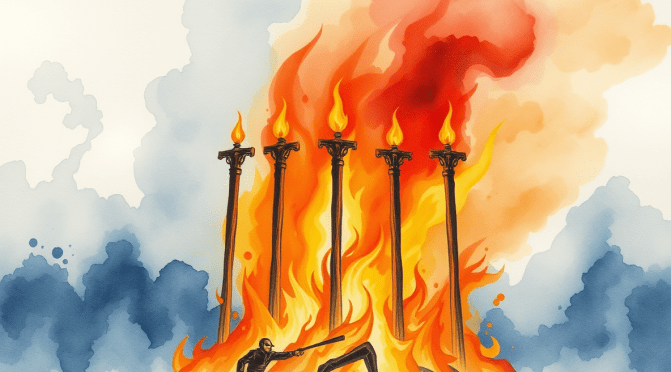
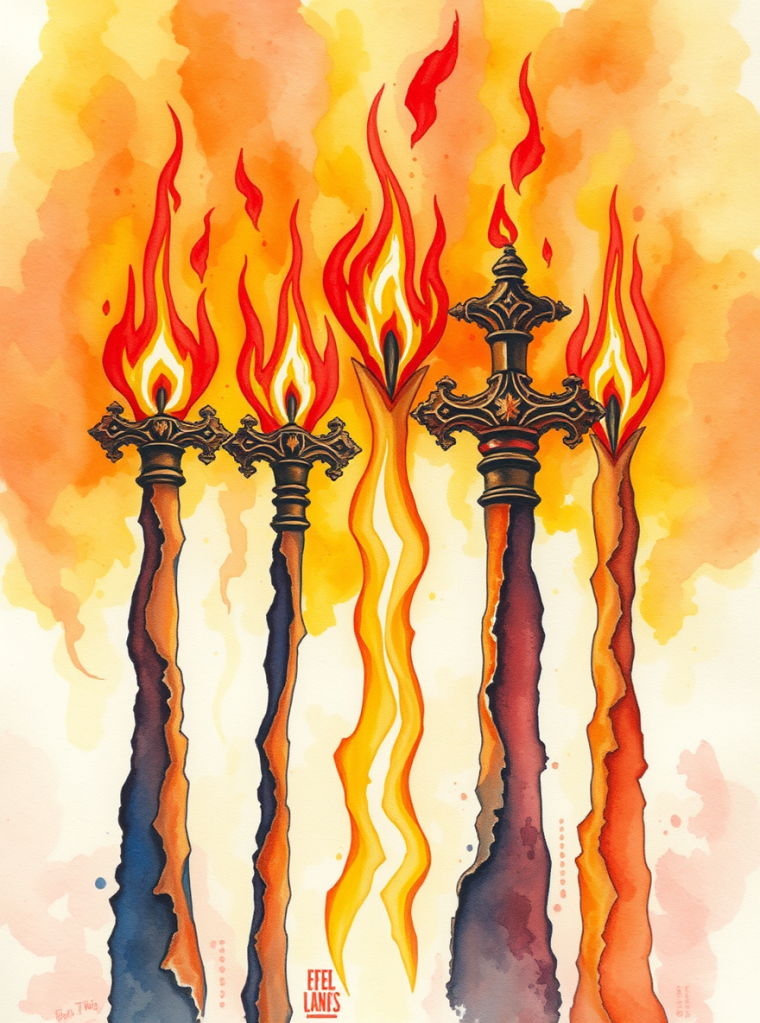
AI-generated illustration for the Five of Wands

Golden Dawn’s Book T

TWO White Radiant Angelic Hands issuant per nubes dexter and sinister. They are clasped together in the grip of the First Order, “i.e.” the four fingers of each right hand crooked into each other, the thumbs meeting above; and they hold, at the same time, by their centres, five wands or torches which are similar unto the wands of a Zelator Adeptus Minor. One wand is upright in the middle; the others cross each other. Flames leap from the point of junction. Above the middle wand is the sign Saturn, and below is that of Leo: thus representing the Decante.

Violent strife and boldness, rashness, cruelty, violence, lust, desire, prodigality and generosity; depending on whether the card is well or ill dignified.
Geburah of HB:Y (Quarrelling and fighting).
This Decan hath its beginning from the Royal Star of Leo: and unto it are allotted
the two great Angels of the Schemhamphorash HB:VHVYH and HB:YLYAL.

Etteilla

Gold
Upright. This card, as far as the medicine of the spirit is concerned, means, in its natural position: Gold, Wealth, Opulence, Magnificence, Sumptuousness, Splendor, Luxury, Abundance, Good. – Physical, philosophical and moral sunshine.
Reversed. Trial, Arguing, Differences, Altercations, Disputes, Disputes, Instance, Investigation, Judicial proceedings. – Contradictions, Arguments, Brig, Harassment. – Contradiction, Inconsistency.

MQS

Tarot Encyclopedia – The Four of Pentacles Or Coins

(Note: this is a collection of the meanings attributed to the cards by some occultists in the past centuries. It does not reflect my own study or opinion of the cards. It is only meant as a quick comparative reference as I develop my own take.)

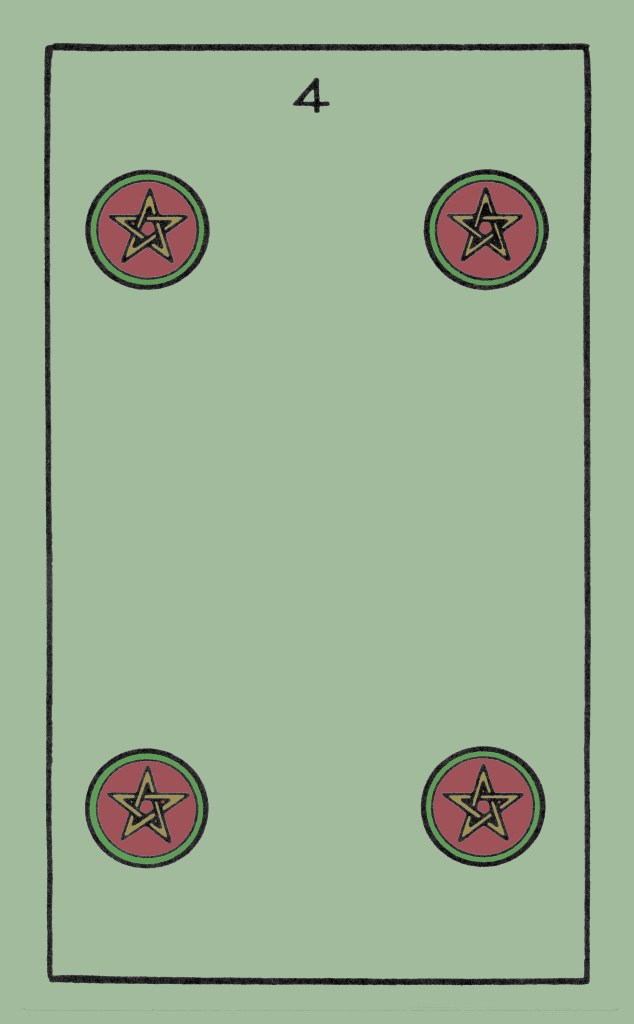
The Four of Pentacles from the Builders of the Adytum (BOTA) Tarot deck

Paul Foster Case (and Ann Davies)

The time period is the third decanate of Capricorn, under the rulership of Mercury, January 10 to 19.
Well-Dignified: opportunities for public service; an acute, sharp, penetrating, tactful temperament; economy in the arrangement of material affairs; activity in money matters.
Ill-Dignified: dangers to reputation; troubles through changes not carefully considered; desire for money, but unwisdom in its management; the Querent will meet with sharp criticism.
Keyword: Management.
(From the Oracle of Tarot course)

A. E. Waite

A crowned figure, having a pentacle over his crown, clasps another with hands and arms; two pentacles are under his feet. He holds to that which he has. Divinatory Meanings: The surety of possessions, cleaving to that which one has, gift, legacy, inheritance. Reversed: Suspense, delay, opposition.
(From The Pictorial Key to the Tarot)

Aleister Crowley

As to the Disks, the heaviness of the symbol rather outweighs any considerations of its weakness. The card is called Power. It is the power which dominates and stabilizes everything, but manages its affairs more by negotiation, by pacific methods, than by any assertion of itself. It is Law, the Constitution, with no aggressive element.

[…]

The Four, Chesed, shows the establishment of the Universe in three dimensions, that is, below the Abyss. The generating idea is exhibited in its full material sense. The card is ruled by the Sun in Capricornus, the Sign in which he is reborn. The disks are very large and solid; the suggestion of the card is that of a fortress. This represents Law and Order, maintained by constant authority and vigilance. The disks themselves are square; revolution is very opposite to the card; and they contain the signs of the Four Elements. For all that, they revolve; defence is valid only when violently active. So far as it appears stationary, it is the “dead centre” of the engineer; and Capricornus is the point at which the Sun “turns again Northward”. The background is of deep azure, flecked yellow, suggesting a moat; but beyond this is a pattern of green and indigo to represent the guarded fields whose security is assured by the fortress.

In the Yi King, Sol in Capricornus is represented by the Second Hexagram, Khwan, which is the Female Principle. Compare the English word Queen, Anglo-Saxon Cwen, old Mercian Kwoen. Cognate are Icelandic Kvan, Gothic Kwens, woman. The Indo-Germanic type is g (w)eni and the Sanskrit root GwEN. Note also Cwm, coombe, and agnate words, meaning an enclosed valley, usually with water running from it. Womb—possibly a softened form?

Compare also the innumerable words, derived from the root Gas, Which imply an enclosed and fortified space. Case, castle, chest, cyst, chaste, incest and so on.

The primary radicle in all this class of words is the guttural. Observe the Hebrew attributions: Gimel, the moon; Cheth, Cancer, the house of the moon; Kaph, the Wheel; Qoph, the Moon, XVIII, Guttur, the throat. Sounds so made suggest the other throat; one is the channel of respiration and nutrition, the other of reproduction and elimination.
(From The Book of Thoth)

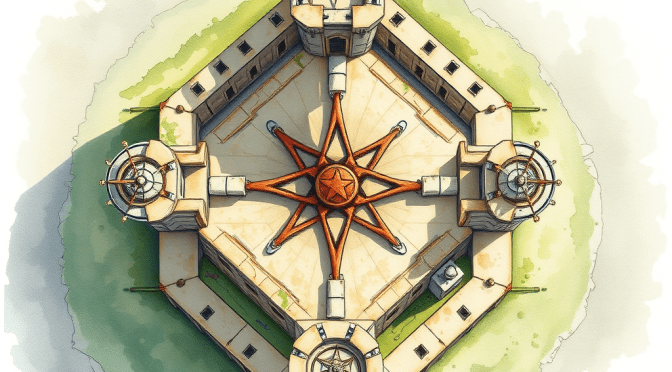
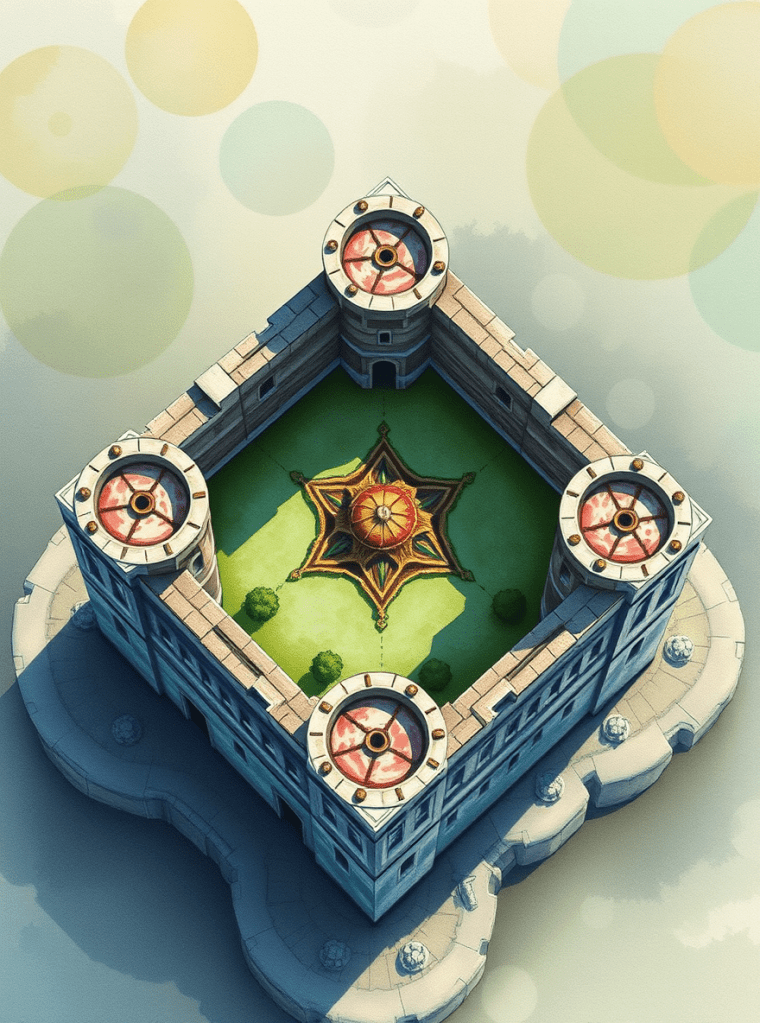
A Crowley-esque AI-generated illustration for the Four of Pentacles

Golden Dawn’s Book T

A HAND holding a branch of a rose tree, but without flowers or buds, save that in the centre is one fully blown white rose. Pentacles are disposed as on the points of a square; a rose in its centre. Symbols Sun and Capricorn above and below to represent the Decan.
Assured material gain: success, rank, dominion, earthy power, completed but leading to nothing beyond. Prejudicial, covetous, suspicious, careful and orderly, but discontented. Little enterprise or originality. According to dignity as usual.
Chesed of HB:H (Gain of money or influence: a present).
Herein do HB:KVQYH and HB:MNDAL bear rule

Etteilla

Benefit
Upright. This blade, as far as the medicine of the spirit is concerned, means, in its natural position: Present, Gift, Generosity, Beneficence, Liberality, Strenna, Grace, Offering, Giving, Gratification, Service. – White color, Lunar medicine, Stone to white.
Reversed. Enclosure, Circuit, Circumvolution, Circumscription, Circumference, Circle, Circulation. – Intercept, Obstruction, Engorgement, Hoarding, Cloister, Monastery, Convent. – Stop, Fixed, Determined, Definite, Extremity, Boundaries, Limits, Terms, End, Barrier, Dividing wall, Wall, Hedge, Wall. – Obstacles, Bars, Impediment, Suspension, Delay, Opposition.

MQS

Tarot Encyclopedia – The Four of Swords

(Note: this is a collection of the meanings attributed to the cards by some occultists in the past centuries. It does not reflect my own study or opinion of the cards. It is only meant as a quick comparative reference as I develop my own take.)

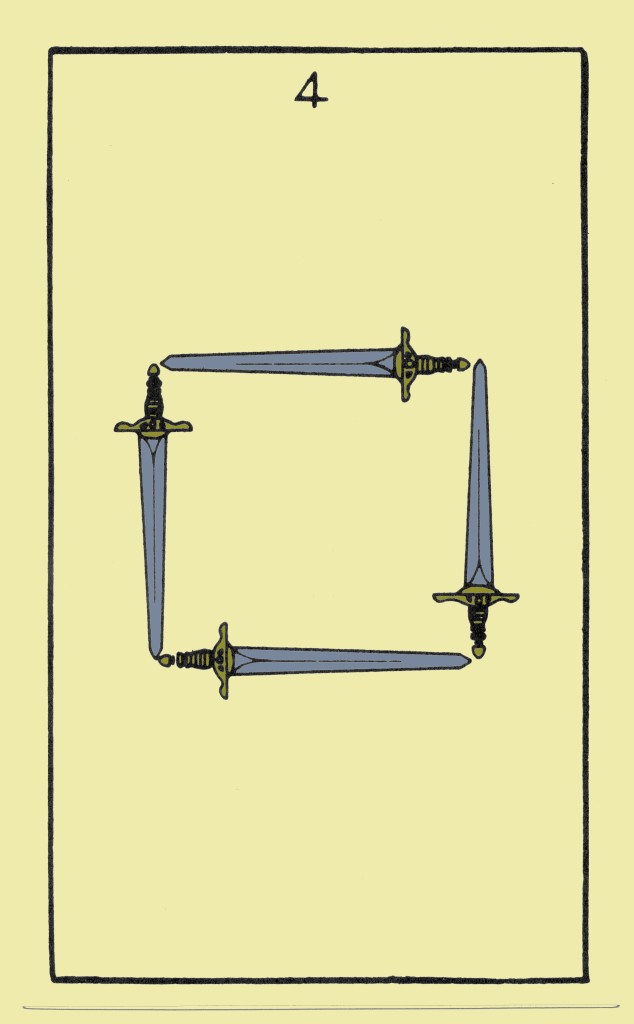
The Four of Swords from the Builders of the Adytum (BOTA) tarot deck

Paul Foster Case (and Ann Davies)

The time period is the last decanate of Libra, October 13 to October 23, under the rulership of Mercury.
Well-Dignified: rest from sorrow, yet after and through it; relief from anxiety; rest after illness; quietness; change for the better; success in legal affairs; association with others in Mercurial pursuits; strong mental attraction to a person of the opposite sex; activity in writing or short journeys.
Ill-Dignified: inharmony with partners; unsettled conditions in legal
affairs; disorder and loss through ill-considered writings or needless
short journeys; vexations through petty strife and sarcastic speech.
Keyword: Rest.
(From the Oracle of Tarot Course)

A. E. Waite

The effigy of a knight in the attitude of prayer, at full length upon his tomb. Divinatory Meanings: Vigilance, retreat, solitude, hermit’s repose, exile, tomb and coffin. It is these last that have suggested the design. Reversed: Wise administration, circumspection, economy, avarice, precaution, testament.
(From The Pictorial Key to the Tarot)

Aleister Crowley

The Four of Swords is called Truce. This seems rather on the lines of “the strong man armed, keeping his house in peace”. The masculine nature of air makes it dominant. The card is almost a picture of the formation of the military clan system of society.

[…]

The number Four, Chesed, is here manifested in the realm of the Intellect. Chesed refers to Jupiter who rules in Libra in this decanate. The sum of these symbols is therefore without opposition; hence the card proclaims the idea of authority in the intellectual world. It is the establishment of dogma, and law concerning it. It represents a refuge from mental chaos, chosen in an arbitrary manner. It argues for convention.

The hilts of the four Swords are at the corner of a St. Andrew’s cross. Their shape suggests fixation and rigidity. Their points are sheathed—in a rather large rose of forty-nine petals representing social harmony. Here, too, is compromise.

Minds too indolent or too cowardly to think out their own problems hail joyfully this policy of appeasement. As always, the Four is the term; as in this case there is no true justification for repose, its disturbance by the Five holds no promise of advance; its static shams go pell-mell into the melting-pot; the issue is mere mess, usually signalized by foetid stench. But it has to be done!
(From The Book of Thoth)

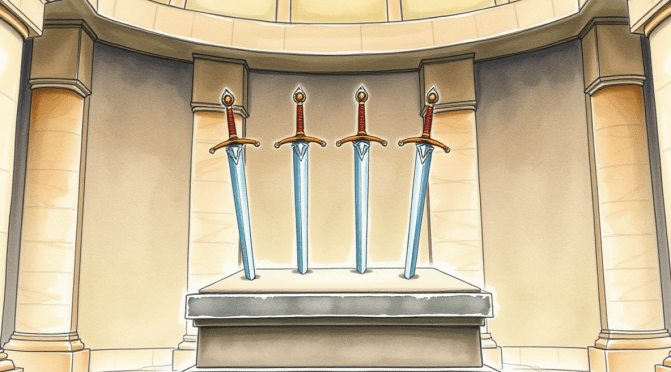
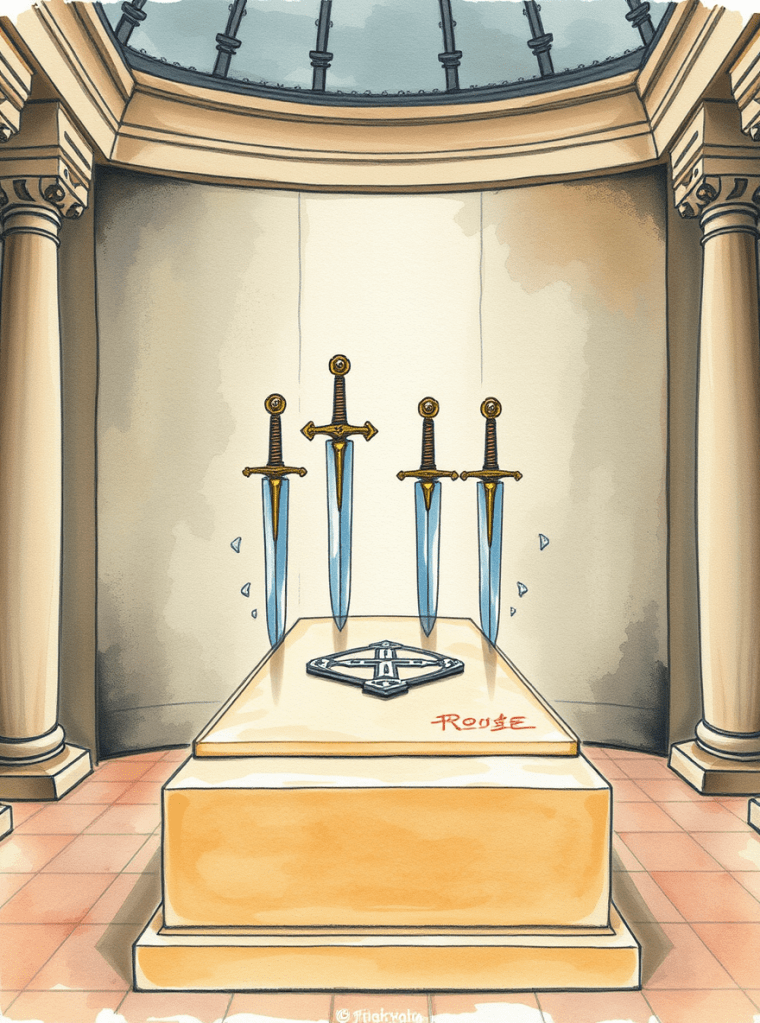
AI-generated illustration for the Four of Swords

Golden Dawn’s Book T

TWO White Radiating Angelic Hands, each holding two swords; which four cross in the centre. The rose of five petals with white radiations is reinstated on the point of their intersection. Above and below, on the points of two small daggers, are Jupiter and Libra, representing the Decanate.

Rest from sorrow; yet after and through it. Peace from and after war. Relaxation of anxiety. Quietness, rest, ease and plenty, yet after struggle. Goods of this life; abundance; modified by dignity as is usual.
Chesed of HB:V (Convalescence, recovery from sickness; change for the better).
Herein do HB:LAVYH and HB:KLYAL bear rule.

Etteilla

Solitude
Upright. This card means, as far as the medicine of the spirit is concerned and in its natural position: Solitude, Desert, Retired place, Hermitage. – Exile, Banishment, Proscription. – Uninhabited, Isolated, Abandoned, Neglected. – Tomb, Burial Ground, Coffin.
Reversed. Economy, Wise Conduct, Wise Administration. – Welfare, Management, Household management, Savings, Avarice. – Order, Arrangement, Relationship, Convenience, Concordance, Agreement, Harmony, Music, Disposition. – Will. – Reservation, Restriction, Exception. – Circumspection, Circumscription, Retention, Wisdom, Sympathy, Regard, Precaution.

MQS

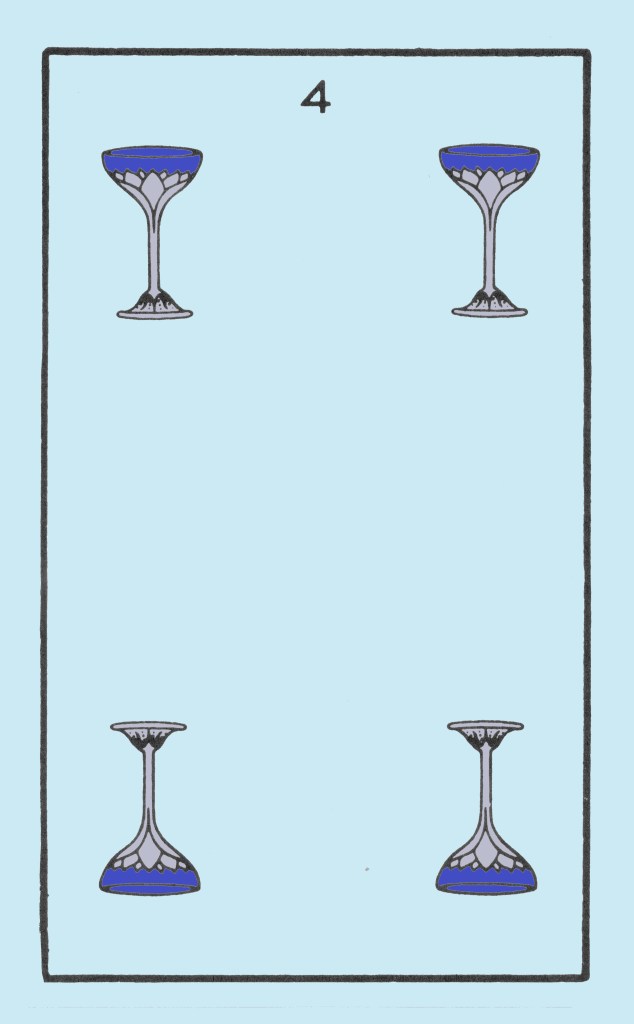
Tarot Encyclopedia – The Four of Cups

(Note: this is a collection of the meanings attributed to the cards by some occultists in the past centuries. It does not reflect my own study or opinion of the cards. It is only meant as a quick comparative reference as I develop my own take.)

The Four of Cups from the Builders of the Adytum (BOTA) tarot deck

Paul Foster Case (and Ann Davies)

The specific divinatory meanings are thus based on the attributions of Chesed, the planetary forces of Jupiter and Neptune, the zodiacal influences of Cancer ruled by the Moon, and the astrological fourth house. Jupiter’s sphere of influence is Chesed. It co-rules the third decanate of Cancer besides being exalted in this zodiacal sign. Therefore the Four of Cups has a very strong Jupiterian influence of wealth and expansiveness. The Four of Cups corresponding to the third decanate of Cancer is the time period July 13 to July 22, ruled by Jupiter and Neptune.
In specific Tarot Divination its key meanings are:
Well Dignified: success in material things, but desire for something higher; a period of comparative comfort, yet a little confining, thus suggesting a measure of satiety; it is a symbol of contemplation and of the turning away from pleasure in quest of higher things; it intimates strong psychic influences in the life or environment of the Querent.
lll-Dignified: material gain, but through injustice; sorrows resulting from satisfaction of desire; getting what one has wanted but finding no joy in it.
Keyword: Surfeit
(From the Oracle of Tarot Course)

A. E. Waite

A young man is seated under a tree and contemplates three cups set on the grass before him; an arm issuing from a cloud offers him another cup. His expression notwithstanding is one of discontent with his environment. Divinatory Meanings: Weariness, disgust, aversion, imaginary vexations, as if the wine of this world had caused satiety only; another wine, as if a fairy gift, is now offered the wastrel, but he sees no consolation therein. This is also a card of blended pleasure. Reversed: Novelty, presage, new instruction, new relations.
(From The Pictorial Key to the Tarot)

Aleister Crowley

The Four of Cups is called Luxury.

The masculine nature of fire permits the Four of Wands to appear as a very positive and clear-cut conception. The weakness in the element of water threatens its purity; it is not quite strong enough to control itself properly; so the Lord of Pleasure is a little unstable. Purity has somehow been lost in the process of satisfaction.

[…]

This card refers to Chesed in the sphere of Water. Here, below the Abyss, the energy of this element, although ordered, balanced and (for the moment) stabilized, has lost the original purity of the conception.

The card refers to the Moon in Cancer, which is her own house; but Cancer itself is so placed that this implies a certain weakness, an abandonment to desire. This tends to introduce the seeds of decay into the fruit of pleasure.

The sea is still shown, but its surface is ruffled, and the four Cups which stand upon it are no longer so stable. The Lotus from which the water Springs has a multiple stem, as if to show that the influence of the Dyad has gathered strength. For although the number Four is the manifestation and consolidation of the dyad, it is also secretly preparing catastrophe by emphasizing individuality.

There is a certain parallelism between this card and the Geomantic figures Via and Populus, which are attributed to the Moon in her decrease and increase respectively. The link is primarily the “Change=Stability” equation, already familiar to readers of this essay. Four is an “awkward” number; alone among the natural numbers, it is impossible to construct a “Magic Square” of four cells. Even in the Naples Arrangement, Four is a dead stop, a blind alley. An idea of a totally different Order is necessary to carry on the series. Note also the refolding-in-upon-itself suggested by the “Magic Number” of Four 1 + 2 + 3 + 4 which is Ten. Four is the number of the Curse of Limitation, of Restriction. It is the blind and barren Cross of equal arms, Tetragrammaton in his fatal aspect of finality, as the Qabalists knew him before the discovery of the Revolving Formula whereby the Daughter, seated upon the Throne of the Mother, “awakens the Eld of the All-Father”.

For the meanings of Via and Populus, refer to the “Handbook of Geomancy” (Equinox Vol. I, No.2).

(From The Book of Thoth)

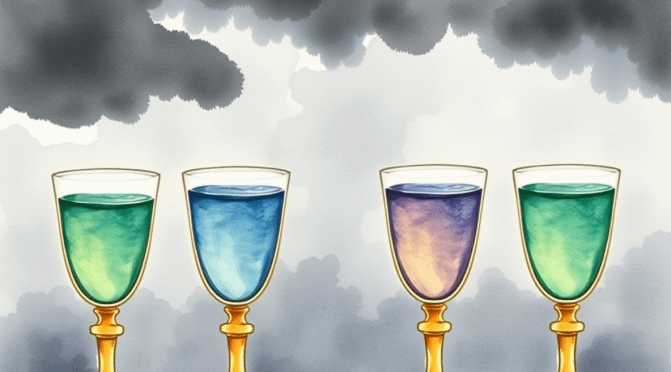
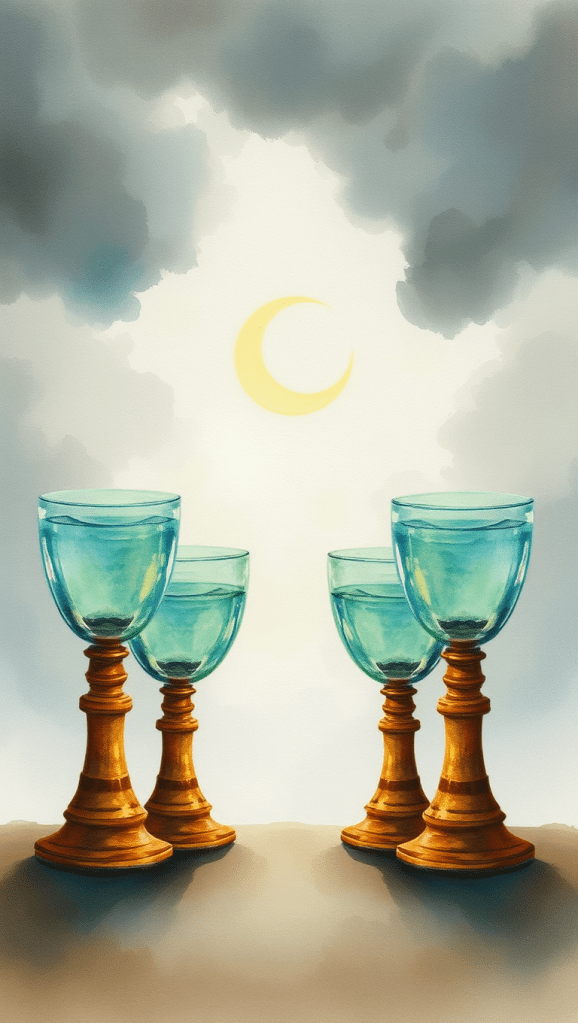
An AI-generated illustration for the Four of Cups

Golden Dawn’s Book T

FOUR cups: the two upper overflowing into the two lower, which do not
overflow. An Angelic Hand grasps a branch of lotus, from which ascends a stem bearing one flower at the top of the card, from which the white water flows into the two upper cups. From the centre two leaves pass right and left, making, as it were, a cross between the four cups. Above and below are the symbols Moon and Cancer for the Decan.

Success or pleasure approaching their end. A stationary period in happiness, which may, or may not, continue. It does not mean love and marriage so much as the previous symbol. It is too passive a symbol to represent perfectly complete happiness. Swiftness, hunting and pursuing. Acquisition by contention: injustice sometimes; some drawbacks to pleasure implied.
Chesed of HB:H (Receiving pleasure or kindness from others, but some
discomfort therewith).
Therein rule the great Angels HB:HYYAL and HB:MVMYH.

Etteilla

Boredom
Upright. This card, as far as the medicine of the spirit is concerned, means, in its natural position: Boredom, Displeasure, Discontent, Disgust, Aversion, Enmity, Hatred, Horror, Restlessness, Pain of spirit, Slight sadness, Affliction, Painful, Annoying, Unpleasant. – Saddening, Distressing.
Reversed. New Directive, New Light. – Index, Indication, Conjecture. – Augury, Foreboding. – Presentment, Foreboding, Predilection, Novelty.

MQS

Tarot Encyclopedia – The Four of Wands

(Note: this is a collection of the meanings attributed to the cards by some occultists in the past centuries. It does not reflect my own study or opinion of the cards. It is only meant as a quick comparative reference as I develop my own take.)

The Four of Wands from the Builders of the Adytum (BOTA) Tarot deck

Paul Foster Case (and Ann Davies)

The Four of Wands is associated with the third decanate of Aries, the time period April 10 to April 19, ruled by Jupiter.
Well-Dignified: this card signifies success through personal merit, good
social standing, influential friends, the perfection of something built
up after labor, benefit through travel, shipping and business with foreign countries.
lll-Dignified: loss in the same things, or in consequence of unpreparedness or by hasty action.
Keyword: Perfected work.
(From the Oracle of Tarot course)

A. E. Waite

From the four great staves planted in the foreground there is a great garland suspended; two female figures uplift nosegays; at their side is a bridge over a moat, leading to an old manorial house. Divinatory Meanings: They are for once almost on the surface–country life, haven of refuge, a species of domestic harvest-home, repose, concord, harmony, prosperity, peace, and the perfected work of these. Reversed: The meaning remains unaltered; it is prosperity, increase, felicity, beauty, embellishment.
(From The Pictorial Key to the Tarot)

Aleister Crowley

In the Wand suit, the card is called Completion. The manifestation promised by Binah has now taken place. This number must be very solid, because it is the actual dominating influence on all the following cards. Chesed, Jupiter-Ammon, the Father, the first below the Abyss, is the highest idea which can be understood in an intellectual way, and that is why the Sephira is attributed to Jupiter, who is the Demiurge.

[…]

This card refers to Chesed in the suit of Fire. Being below the Abyss, it is the Lord of all manifested active Power. The original Will of the Two has been transmitted through the Three, and is now built up into a solid system:-Order, Law, Government. It is also referred to Venus in Aries, which indicates that one cannot establish one’s work without tact and gentleness.

The wands are headed by the Ram, sacred to Chesed, the Father-god Amoun-Ra, as also to Aries; but at the other end of the wands are the Doves of Venus.

In the symbol, the ends of the wands touch a circle, showing the completion and limitation of the original work. It is within this circle that the flames (four double, as if to assert the balance) of the Energy are seen to play, and there is no intention to increase the scope of the original Will. But this limitation bears in itself the seeds of disorder.
(From The Book of Thoth)

AI-generated illustration for the Four of Wands

Golden Dawn’s Book T

TWO White Radiating Angelic Hands, as before, issuing from clouds right and left of the card and clasped in the centre with the grip of the First Order, holding four wands or torches crossed. Flames issue from the point of junction. Above and below are two small flaming wands, with the symbols of Venus and Aries representing the Decan.
Perfection or completion of a thing built up with trouble and labour. Rest after labour, subtlety, cleverness, beauty, mirth, success in completion. Reasoning faculty, conclusions drawn from previous knowledge. Unreadiness, unreliable and unsteady through over-anxiety and hurriedness of action. Graceful in manner, at times insincere, etc.
Chesed of HB:Y (Settlement, arrangement, completion).
Herein are HB:NNAAL and HB:NYThHL Angelic rulers

Etteilla

Company
Upright. This card, as far as the medicine of the spirit is concerned, in its natural position means: Society, Association, Assembly, Relation, Confederation, Alliance, Union, Gathering, Circle, Community, Assembling, Multitude, Mass, Crowd, Troop, Band, Company, Cohort, Army. – Convocation, Accompaniment, Mixing, Mixture, League, Amalgamation. – Contract, Convention, Covenant, Treaty.
Reversed. Prosperity, Increase, Accretion, Advancement, Success, Succeeding, Fortune, Blossoming, Happiness. – Beauty, Beautification.

MQS

The Mystery of the Seven of Swords

Waite the Juggler

The Rider Waite’s minor arcana (which I already talked about here) are based on the Golden Dawn’s correspondences and titles found in Mathers’ and Felkin’s Book T. Yet Waite, who was very fond of showing off his erudition, made it a point to look for as many similarities as possible between the Book T system and other lists of meanings such as Etteilla’s, Christian’s and others.

This is reflected in the accompanying book to his deck, The Pictorial Key to the Tarot, where he tries to find similarities between various sources for each minor card. He never mentions the Golden Dawn material, despite the fact that knowing the GD’s card names would clarify most of the designs.

The 1 to 1 correspondence between GD meanings and Waite’s minor arcana is self-evident, and once it is noted it cannot be unseen. Yet in his book he makes it a point to just rely on non-esoteric sources, or at least on non-GD sources.

Note that the Golden Dawn did something similar, despite the claim that the card titles were revealed to them. Take the Four of Cups, for instance, which technically should be ascribed to the rulership of the Moon in the third decan of Cancer and to the sephira Chesed (mercy). All these things sound very promising. Yet the card is called Blended Pleasure and it is less positive than the previous two, largely (I believe) in an attempt to accomodate Etteilla’s relatively negative interpretation of the Four of Cups as a card of boredom, annoyance, etc.

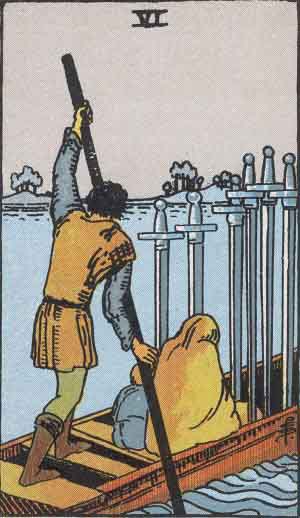
Similarly, the Golden Dawn retained certain meanings found in traditional fortune-telling, such as ‘travel by water’ for the Six of Swords. This can be seen as part of the GD’s attempt at summarizing the whole of the Western magical tradition in a new synthesis.

Going back to Waite, it is clear that in his book he is also trying to balance various sources, but if in doubt about which one to follow, he will stick (without saying so explicitly) to the GD tradition. An example I already discussed is the Five of Pentacles, which Etteilla calls the card of the lovers, but the Golden Dawn called it ‘Material Trouble’.

Another example is the Two of Wands, which Etteilla calls a card of sorrow, but for the GD it is a card of Dominion, so Waite goes with the GD but tries to stretch the interpretation in his text by saying that it could be the sorrow of a great leader, like Alexander the Great, at the height of his power.

But What About the Seven of Swords?

With that in mind, what the hell is going on with the Seven of Swords? Let me explain: most people who pick up a Rider Waite tarot deck, even today, have no idea about the esoteric stuff behind it, so they base their interpretation on the design (which, incidentally, Waite thought very little of). This is how, for instance, the Two of Pentacles, the Lord of Harmonious Change according to GD, became the card of juggling, or how the Seven of Cups, the Lord of Illusionary Success, became the card of options.

In this new folk approach to the Waite deck, the Seven of Swords became known as the thief card due to the design.

Yet Waite does not even mention thieves in his description. He says:

A man in the act of carrying away five swords rapidly; the two others of the card remain stuck in the ground. A camp is close at hand. Divinatory Meanings: Design, attempt, wish, hope, confidence; also quarrelling, a plan that may fail, annoyance. The design is uncertain in its import, because the significations are widely at variance with each other. Reversed: Good advice, counsel, instruction, slander, babbling.

The meanings he gives are from Etteilla, where the Seven of Swords is one of the few non negative Sword cards. The description of the card, however, is far more consonant with what we find in Book T, which is:

The Lord of Unstable Effort […]Partial success. Yielding when victory is within grasp, as if the last reserves of strength were used up. Inclination to lose when on the point of gaining, through not continuing the effort. Love of abundance, fascinated by display, given to compliments, affronts and insolences, and to spy upon others. Inclined to betray confidences, not always intentionally. Rather vacillatory and unreliable.
Netzach of HB:V (Journey by land: in character untrustworthy)

This thing with the yielding when victory is within grasp is clearly depicted in the card, where the thief takes away most of the enemy’s swords, but not all, as Waite clearly states.

But why did Waite (and, maybe, Smith) decide to depict a thief in the Seven of Swords despite it being so thematically different from Waite’s actual inspiration (Book T) and even his cover-up inspiration (Etteilla)?

The only hints we find in Book T that seem to point in this direction are “to spy upon others” and “in character untrustworthy”. In an attempt to accomodate Etteilla, Waite probably saw the man looking longingly at the swords he left on the ground as a symbol of hope, which is Etteilla’s meaning for the card.

One possible explanation is that Waite and/or Smith probably thought the type of action that is best suited to the Suit of Swords is the kind of sneaky, underhanded action depicted in the final design of the card. Be it as it may, this is one of the cards that always stood out to me when studying the history of this deck, because it takes a very non-obvious approach to its theme.

MQS