Tag Archives: tarocco bolognese

What’s the Bird Thinking? (Example Reading)

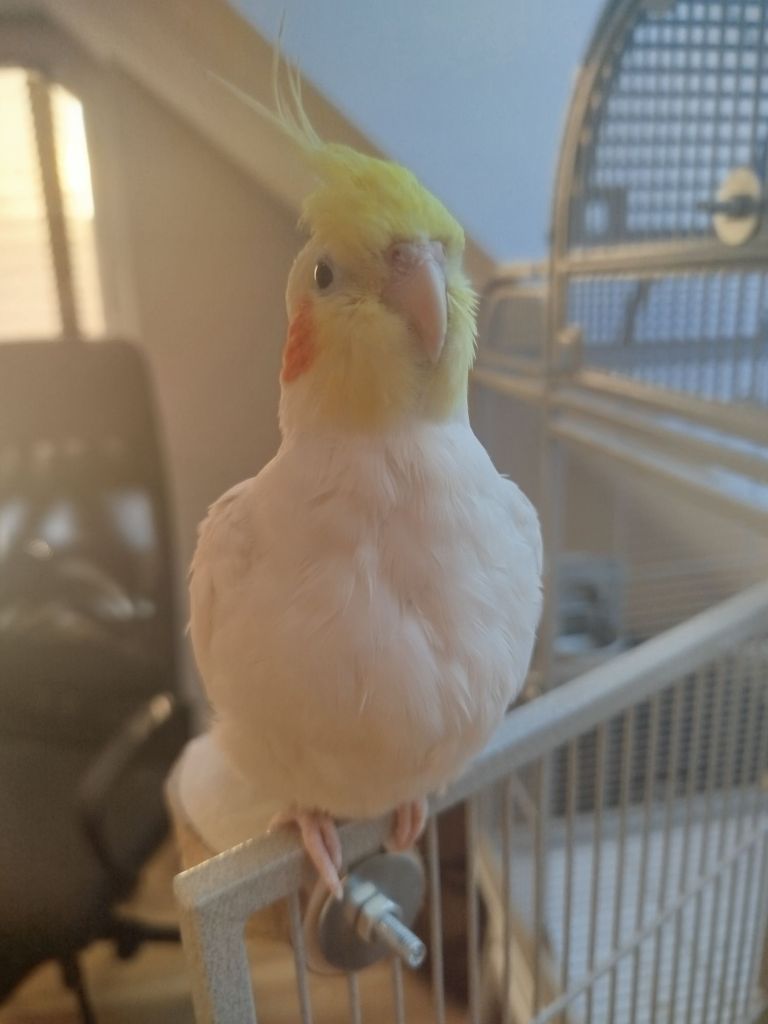
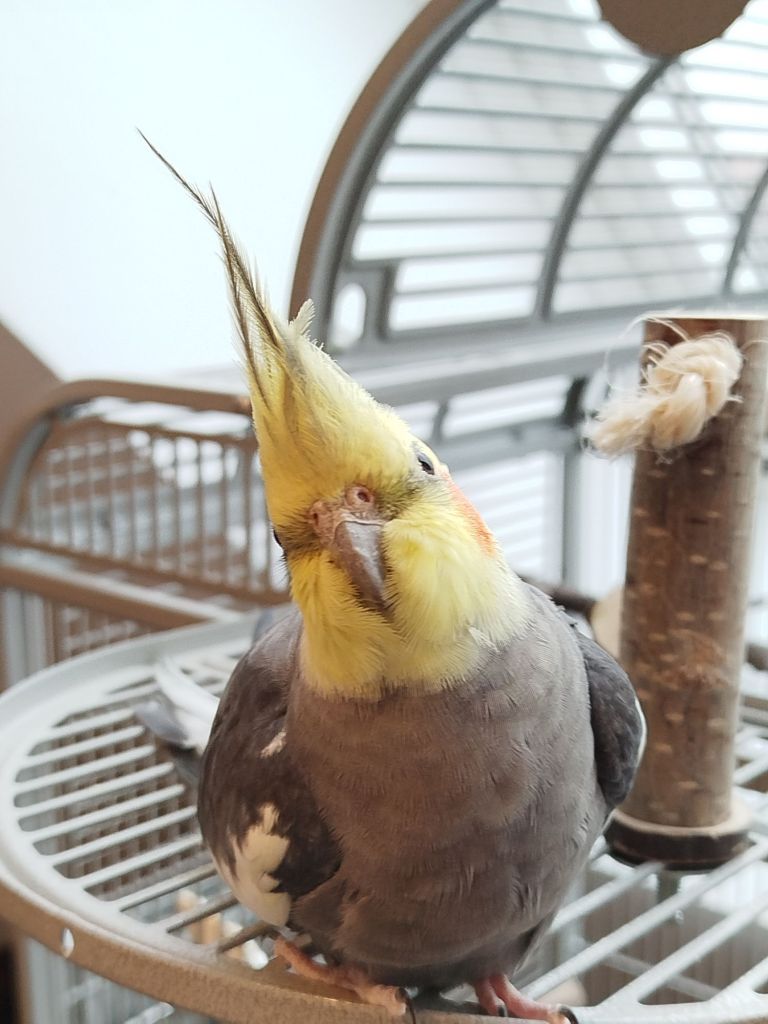
My two cockatiels couldn’t be more different from one another. Ciuffy, the white one, is a sweet cuddlebug who’ll do anything for a head scratch. He’s never nipped me, let alone bitten me. The only time he hurts me a little is when he tries to preen my ear.

“I’m the guy you want your daughter to bring home”

Zazu, the gray one, is a beaky, bossy, overbearing prick. He does have his sweet side, and considering I’ve had him for only a little over a month we’ve made huge progress, but when I have him on my shoulder I KNOW I’m going to get hurt at some point, and when he bites he really means it.

“I’m the guy your daughter brings home”

Now that I’ve set the scene and used the excuse to show you a couple of pics of my cutie pies, let’s get to the point. A couple of days ago, while Zazu was on my shoulder, he bit my earlobe incredibly hard out of nowhere (maybe he saw me move my head and didn’t like it).

I shooed him away with my hand, but he spooked and flew against a wall. Although he wasn’t hurt, he spent the day avoiding me and hissing (for those who don’t know, cockatiels can hiss, like cats).

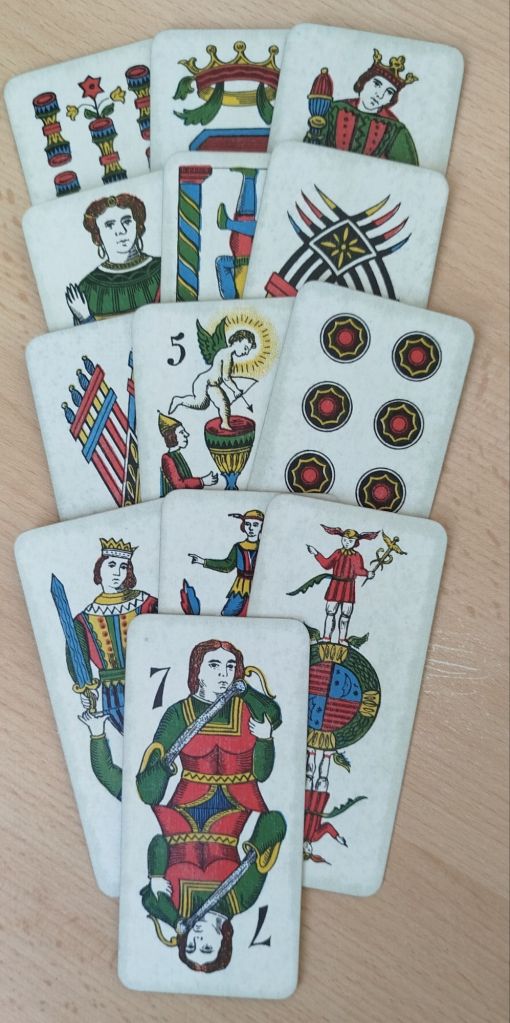
I knew that the accident set some of that hard-won progress back, but I wanted to know Zazu’s perspective and how it would likely evolve. Here’s what the Bolognese Tarot had to say:

What’s the featherball thinking? Tarot reading

One thing that surprised me is the first row, where we have happiness (Ten of Cups) in the house (Ace of Cups) with me (King of Wands). I know I try to care for the two little balls of feathers as best I can, but Zazu is always grumpy and old-farty in his behavior, so I assumed he didn’t like me very much. Apparently that’s just his character.

The second row is interesting, since we have unexpected (Stranger) betrayal (Hanged Man) leading to negative emotions (Eight of Swords). Clearly his good vibes were somewhat disrupted by the incident.

The third has a path (Eight of Wands) toward Love with harmony or small satisfactions (Ten of Coins). So even though there was a setback, there is room for moving toward love. Obviously we should be very careful when projecting human sentimentalism onto animals, but then again, divination is a language understandable to humans, so the tarot is probably translating Zazu’s reality in terms that are understandable to me.

I have some doubts about the last line. The King of Swords might be Zazu himself (it could represent my husband, but my husband isn’t particularly involved). Technically, pets are represented by the Juggler, but then again, the King of Swords does have some characteristics of the Juggler, so it’s a possibility. At any rate, the King is next to the sickbed. There are no combinations talking explicitly about sickness, so I believe this just shows his being cranky or a bit uncertain, but the World card at the end of the row indicates that this uncertainty doesn’t cause breaks: the situation remains open and moving.

The Temperance card at the end simply shows that patience and time are needed. I expected no less.

For now, the reading seems to be accurate. The day after the little bastard had gone back to his old behavior, being just a little more shy than usual, and the day following that he was back to normal.

MQS

Bolognese Tarot Spreads – The Thirteen Card Spread

Nothing prohibits anyone from using whatever spread they prefer, or even just from laying out a row of cards. However, traditionally, the smallest spread used with the Bolognese Tarot is the thirteen card spread, which is a small tableau of cards used to answer a specific question or explore a specific theme (although nothing prevents you from laying it out for a general reading. It will respond anyway). This is a spread I have already presented, and it is one that is used with many decks in Central and Northern Italy in particular. The layout is as follows:

123
456
789
101112
13
The Thirteen Card Spread

Some readers take out the significator for the querent or even the significator for the question and put them on top of the layout (above card 2) before starting to shuffle. I prefer to have all cards in the deck and have not found it necessary, but feel free to experiment.

The cards may be read in rows or in columns, and which direction is the primary one depends on which tradition you come from. Personally I tend to see rows as the primary reading direction, but I will look at columns if there is clear information contained in them. I have found that the columns tend to describe the situation rather than to predict it. But don’t force yourself to read in every direction possible: simply read the information where it is found, and leave the rest.

There is no strict differentiation between past, present and future. However, I have found, personally, that at least the first row, or sometimes two (and on occasion even three), contains the past or present of the situation. Occasionally the cards simply jump ahead into the future from the start.

Be open about it: it may sound confusing in theory but in practice it is often quite clear. For instance, if you see the cards changing from good to bad or vice versa (or simply changing “tone”) in the first row or two, that’s usually a sign that the cards before the change happens are the past/present, and the others the future. In doubt, simply ask the querent: we are not there to play Nostradamus, so it’s fine to ask for help in interpreting the spread.

The final card, number 13, doesn’t have any specific preassigned meaning. However, I have found that it can either simply be a regular part of the spread (simply coming after card 12 or under card 11), or it can highlight an important detail, or something that will be true, regardless of what the previous cards say. For instance, if the spread is a disaster but the thirteenth card is good, it can tell us the querent will have some kind of satisfaction, or will be protected.

Yes-or-No Questions

Now we come to an odd bit of tradition. I will relay it as it has been taught to me, and then I’ll give you my two cents. Although the thirteen card spread is not unique to the Bolognese Tarot, the Bolognese Tarot adds another layer to the spread.

This is relevant only when the question is a yes-or-no question. If it is, then, according to some traditions, the answer is yes if the Death card comes up in the spread or while cutting the deck (it says: “yes, as sure as the fact we all die”). If the Angel card comes up, according to some it’s a maybe, while according to others it’s a no but with positive developments; if the Death and Angel cards both come up, not necessarily together, it’s the best possible outcome (a super yes, as it were). If neither card comes up, it’s a no.

Some also add that if the Death card doesn’t come up but the Angel and Devil card come up in the spread, not necessarily together, it’s also a yes (the Devil card alone would be a no, but if you remember the combinations, Angel+Devil means good news or satisfaction). Others still also believe the answer is yes if three or four Kings come up in the spread.

Now I’m going to tell you what my experience is. My experience is that there is something to these rules, but it is not all so cut-and-dry. The spread always needs to be interpreted as describing a concrete situation, and the yes or no comes from our evalutation of whether the picture presented by the cards matches what the querent wants or not. It’s happened more than once that the Death card was present but the answer (confirmed by experience) was a no, or vice versa, the answer was yes with no yes-marker present.

Focus on interpreting the cards. If the Death card comes up, what does it say in the context? Does it show some sharp change? Does it show inner suffering? Does it confirm something? If so, look at the cards around it: what is it saying yes to? Sometimes it is obvious that the Death card comes up for no reason other than to say “yes” to the question, while at other times it is a regular card, like the others. Again, be flexible, record your experience and learn from it.

MQS

Bolognese Tarot – How to Tackle Combinations

Life is a recipe, and the art of living consists in large part in detecting the ingredients to know if and how to mix them differently. Divination is a mirror of life, and oracular systems usually have some kind of vocabulary to create descriptions of life.

In traditional divination by cards, each card carries small bits of meaning that must be mixed together to form coherent pictures. If divination mirrors life, then it stands to reason that the recipe for something in real life should be mirrored by a recipe for that same thing in the divinatory language. This is how all card reading systems I know work, and that’s how the Bolognese tarot works, with the exception of a couple of universal combinations with odd meanings (Angel + Devil = Good news or satisfaction; Sun + Moon = sorrow; Angel + Death = yes, confirmed).

Let us make an example. What are the ingredients of an inheritance in real life? I would say the ingredients are: death (no inheritance without someone croaking); family ties (usually we inherit from someone whom we are related to, though not always); the law (inheritances are generally regulated by the law and require a bureaucratic mechanism to be set in motion); material possessions (the things we inherit).

In the language of the Bolognese tarot, these ingredients correspond to the following cards: Death: Death; Family ties: Ace of Cups and/or Seven of Cups; The Law: Justice and/or King of Coins; Material Possessions: The Star and/or a money card.

Do we need all the cards to be present? It much depends on the context. If the question is directly about an inheritance, then we could do without many of these cards, while if it is a general reading then the more cards, the clearer the message. But we might also find other cards to flavor the basic recipe: the Moon is also connected with death (the realm of shadows); tears may sometimes be expected, so the Seven of Coins could come up; the court card of the deceased person could show up, etc.

Let us make another example. Let’s take surgery. What’s the recipe for surgery in real life? I would say: a hospital, a bed, a doctor, a cutting instrument. In the Bolognese tarot these same ingredients are: Hospital: The Tower; Bed: The Chariot; Doctor: King of Coins; Cutting instrument: Knight of Swords.

Again, there can be additions and variations. The doctor or the bed might be absent, while the Ten of Cups (blood) or the Moon (unpleasantness) or the Eight of Swords (suffering) might be present. A King or Queen of Swords may take the doctor’s place to show someone holding the knife. Just like my lasagne recipe might differ from yours, but it would still be recognized as lasagne, so the way the deck mixes the ingredients might vary slightly from time to time, but the broad picture remains the same.

One last example. Let’s take marriage. In many situations, a marriage requires the following ingredients: a commitment; love (let’s assume the best intentions in this case); a celebrant. The same ingredients are, in the language of the Bolognese tarot: Love: Love; Commitment: Ace of Wands or Ace of Swords; Celebrant: The Stranger. This is the basic recipe. But we might also expect the main significators to show up. A marriage is a celebration, so the Ten of Cups (fun) might be expected; the family life is certainly impacted, so some Cup cards could be there.

Once we start recognizing that life is made up of ingredients mixed together, it becomes easy (or at least easier) to see how the tarot might mix its own ingredients, the cards, to match the recipe. In many cases, while it is useful to reason out the combinations handed down by tradition, it is much easier to understand the basic principles and be flexible in our observations.

Ultimately, divination starts with logic, not with psychic powers, even though psychic abilities may occasionally be of help. The more we immerse ourselves in the logic of divination, the easier it becomes to decode its messages.

MQS

Bolognese Tarot – Some Examples of Combinations

This is a short selection from a much longer list. Although there are a couple of traditional combinations that are not easy to read unless studied beforehand (like Sun + Moon or Angel + Devil), most of the times the combinations of cards are logical. For this reason I have omitted many obvious combos: Page of Coins (words) and Love is sweet talk or words about love. Thank you very much. The following list is just an example: I will talk more about combining cards in the future. Plus, always remember that much depends on the context of the question and of the other cards. Be flexible. The comments in brackets are my own.

Ace of Cups + Ace of Wands = 1. married life 2. a business (the interpretation depends on the question or on the surrounding cards. For instance, + Love, married life; + Star, business)

Ace of Cups + Seven of Cups = things related to the family, or strong family or family-like relationship

Seven of Cups + Sun or Angel = protection, either from the family/friends or whoever is specified in the spread

Seven of Cups + Juggler = small city or your hometown (where you grew up)

Seven of Cups + World = large city or foreign city (not necessarily in another country though)

Ten of Cups + Love = falling in love, usually being at the stage where love is more fun than hard work (if also + Juggler or + Fool, fun but immature love)

Ten of Cups + Moon = there is no happiness (the Moon covers it)

Ten of Cups + Hermit = traditionally for women it shows their period being blocked, and if the Juggler appears it can show a pregnancy

Ten of Cups + Knight of Swords = 1. Hurting yourself and bleeding (with cards showing hospitalization, an operation) 2. More metaphorically, the fun or joy is cut short

Page of Cups + Ace of Wands = prostitute, according to tradition (it can still be like this nowadays, but look at the context of the question and the other cards. Also, prostitute can sometimes simply indicate a slutty individual, especially if no money card is involved)

Page of Cups + Juggler = son and daughter or a young girl

Knight of Cups + Angel = peace, agreement, reconciliation

Knight of Cups + Person card = the person is gentle, kind or agreeable

Ace of Wands + Love = a love relationship

Ace of Wands + Star = success at work or in business, can be the signing of a contract

Ace of Wands + Fool = “baronate” in Italian/Bolognese dialect, meaning fun sex without much thought

Eight of Wands + World = travel, removal

Eight of Wands + Hanged Man = 1. danger on the road 2. A road or path that ends abruptly

Eight of Wands + Juggler = A trip, but can have other interpretations in context

Ace of Coins + Tower + Hermit = serious money trouble and the need for making sacrifices (I guess instead of the Hermit any other troublesome card would suffice)

Ace of Coins + Ten of Coins = finances (in itself good finances, material well-being)

Ace of Coins + Ten of Cups = 1. prosperous finances 2. Can be a festive table

Ace of Coins + King of Coins = a banker or someone commanding lots of money

Seven of Coins + Fool + Moon = the blues

Seven of Coins + Ten of Coins = having little money

Ten of Coins + Ace of Cups = spending a little money on the family or home (I guess depending on the context it can also be a little money coming from the family or home)

Page of Coins + Queen of Coins = clarification or explanation (words that give you the truth)

Page of Coins + Juggler + Hermit = stuttering (probably mataphorical as well)

Knight of Coins + Page of Swords = 1. Post 2. Good news by message

Knight of Coins + Ace of Coins = good financial developments, money coming easily

Queen of Coins + Moon = hiding the truth, lack of clarity

Queen of Coins + King of Coins = expert

King of Coins + Justice = legal or bureaucratic matters (in itself can be a lawyer, notary, red tape, etc.)

King of Coins + Chariot = a doctor

King of Coins + Angel = 1. powerful protector (the one you’d ask to pull some strings, for instance) 2. A positive entity

Ace of Swords + Page of Swords = letter coming soon

Ace of Swords + Justice + Tower = prison (here the Ace of Swords is the handcuffs)

Eight of Swords + Ace of Swords + Devil = addiction (A bond to the devil for something that torments you. But it can mean being dependent from someone or something in a negative way)

Eight of Swords + Love + Devil = strong jealousy (probably pathological)

Page of Swords + World = message from afar (nowadays also probably messaging with people around the world)

Page of Swords + Moon = 1. secret correspondence 2. Letter whose content displeases us

Queen of Swords + Seven of Coins = affliction (obviously it can also mean a sad woman or a woman who causes sadness, depending on the context)

Queen of Swords + Devil = witch (or, more probably, a negative woman)

King of Swords + Juggler = an immature man or a young boy, or two sons

King of Swords + Justice = law enforcement

Fool + Juggler = bewilderment, disorientation

Fool + Ten of Cups = creativity or levity (in a medical context, since the Fool is the head and the Ten of Cups is blood, if there are negative cards it can indicate blood clots, brain strokes, etc.)

Fool + Hanged Man = estrangement from reality (+ Moon and/or + Seven of Coins, serious mental suffering)

Fool + Devil = excesses (either excessive character or using funky stuff. It can probably also indicate a negative situation that confuses us)

Juggler + Ace of Wands = conception or inception

Juggler + Moon + Devil = untrustworthy character, dangerous individual

Juggler + Page of Cups + King of Swords = children or young people

Juggler + Wheel = gambling (but it can mean other things in context)

Stranger + Fool = overturned expectations (I have experimented this combination as overturning the status quo as well)

Stranger + Moon = disappointment (unexpected bad things)

Stranger + Star = can mean a gift (unexpected object)

Love + Ace of Swords + Stranger = Marriage (the Stranger here is a priest or celebrant, the Ace are the rings. I think the Ace of Wands might be there instead of that of Swords. Without the Stranger it can still show a relationship or, if you’re single, love about to knock at the door)

Stranger + Devil + Moon + Ace of Swords = black magic (here the Stranger is the person celebrating the ritual, the Ace of Swords is the creation of magic bonds. I’m wondering if the Angel and Sun came up instead of the Devil and the Moon if it would indicate white magic)

Love + Hanged Man + Queen of Swords or King of Swords = cheating

Love + Temperance = lasting love

Chariot + Ace of Wands = sex

Chariot + Death = deathbed (but unless the question is specific or there are other cards it probably means something else)

Chariot + Moon = sickness

Justice + Ace of Wands = marriage, partnership or important contract

Justice + Moon = injustice (can probably be interpreted in various ways, such as something being wrong or unfair or mistaken)

Hermit + Person = person is indisposed (or blocked within the context)

Hermit + Temperance = lasting blockage

Hermit + Page of Wands or Knight of Wands = person is shy or solitary (has inner blockage)

Wheel + Stranger = chance meeting (probably with a person card next to it, otherwise maybe also unexpected chance)

Strength + Hermit + Moon = exhaustion, weakness, ill-health

Strength + Ace of Wands = person is very willful (I’ve noticed that the Ace of Wands next to a person card also makes them very willful)

Strength + Devil + Knight of Swords = fights

Hanged Man + Death = paralysis (literal or metaphorical)

Hanged Man + Tower = ending

Death + Wheel = what’s been set in motion cannot be stopped (probably also a change for the better, if the Wheel is upright and/or followed by positive cards)

Death + Tower = 1. Tragedy 2. Disruption

Death + Justice + Ace of Cups + Star = inheritance (the Star here refers to material possessions. I think a money card could be there instead as well.)

Temperance + Hanged Man = end of something (that lasted a while)

Temperance + Ace of Swords = short (short-ish) timeframe (here the Ace of Swords reduces the slowness of Temperance. It can probably also indicate a lasting bond.)

Ace of Coins + Temperance + Ten of Cups = finances slowly flourishing

Page of Coins + Devil = angry words, fights

Devil + Angel = great satisfaction or good news (regardless of the order of the cards)

Devil + Ace of Wands = great passion (primarily sexual but to be adapted to the context)

Tower + Chariot + King of Coins = hospital (other cards like the Moon, the Seven of Coins etc. may be present)

Tower + Chariot + Knight of Swords = surgery (I’ve already experimented this combination. The Queen of Swords was present indicating the female surgeon. Otherwise a King of Swords would be probably a man or the King of Coins would generically indicate the doctor)

Tower + Ace of Coins = financial sacrifice, financial limitations, bankruptcy with other bad cards

Tower + Fool + Moon = mental breakdown

Star + Ace of Coins = a well-paid job

Star + Temperance = stable job (if followed by cards of ending like the Hanged Man, temporary job)

Star + Queen of Coins = intellectual job (but I think it depends on the context)

Chariot + King of Coins + Star = therapy, prescription (here the Star indicates meds)

Moon + Person card = traditionally a dead person (someone who is no longer visible to us. But it needs to make sense in the context. It can probably also mean someone who is sad or is hiding something)

Moon + Eight of Wands + Hanged Man + King of Swords = danger on the road at night (probably due to a man)

Sun + Moon = Sorrow (if the cards are swapped around, with the Sun last, it is still sorrow but it is lessened or it goes away more quickly)

Sun + King of Coins = the doctor’s cure works (probably to be extended to any kind of professional help)

Sun + Devil or Ace of Wands = strong vitality or energy

Angel + Queen of Coins = faith

Angel + Page of Coins = prayer (probably also good/positive words)

Angel + Juggler + World = pregnancy (the World is the belly)

Angel + Death = yes, for sure (either to a question or to the cards preceding them)

World + Person card = person is not yet known or comes from far away (keep in mind that once upon a time even the next town was far away) or travels

World + Star + Ace or Ten of Coins = commerce (but it can probably mean other things too)

Three Aces together = “Tre assi son tralasci”, three aces equal abandonment. Radical change, leaving the old for the new.

Four Aces together = “Quattro assi fan fracassi”, four aces make a lot of noise. Destabilizing situations, chaos, pandemonium

Three Kings together = Success

Four Kings together = Triumph

Three Queens together = Problem*

Four Queens together = Failure*

Three Knights together = Good news, Speed

Four Knights together = Speedy good news, great speed

Three Pages together = gossip, talking

Four Pages together = slander, bad people

*Some (including one of my teachers) see the Queens less unfavourably, as delays (Queens, in this case, are probably seen as taking a long time to deliver the heir/result)
Bolognese Tarot – Introduction to Combinations

The Tarocco Bolognese is famous in Italy for relying heavily on combinations of cards. Rather than each card being a full picture, the cards are like small tiles in a mosaic, and need to be interpreted as a whole. No individual card can tell us much of anything. Let’s take the most favorable card in the deck, the Angel. In itself a wonderful card of protection and solution. Yet, alone, the Angel merely says “protection” or “solution” or “friendship” or any other keyword. We still don’t know if this protection exists, is longed for, is missing, is crumbling, or what effects it will have.

In this, the Bolognese tarot is much closer to the Sibilla or Playing Cards or other traditional oracles than to how tarot is often read nowadays (but regular tarot did use to be read in a combinatory manner in the past, before the Waite deck became popular and people started focusing on illustrations).

Since each individual card doesn’t say much by itself, the spreads tend to rely on a larger number of cards. The smallest traditional spread done with the Bolognese tarot is the thirteen card spread, which I have already shown, and which I will cover again. This is a small tableau of three columns of four cards (or four rows of three cards) plus one at the end. In this small tableau, the cards are interpreted in their interaction with one another.

Often, therefore, it is necessary to be able to see the big picture when interpreting the Bolognese Tarot. Occasionally, all cards are important and need to be considered. At other times, one or two cards come up in the spread that we don’t know how to interpret and don’t make sense to us, and there is no point in banging our head against them, trying to fit them into the interpretation at all costs: we should be able to see where the answer to our question lies, where the cards that are clearly forming a message are clustering, and go from there.

Look at the spread as if it were a bunch of people in central square. Some are there to meet other people and discuss something important or go somewhere interesting together. Others are simply sitting there because their wife kicked them out so she can finish waxing the floor in peace, so they just sit alone. They don’t have much to add. They are just there. Or, if you prefer the image of the mosaic I used earlier, some tiles go together to show the cool angel warding off the horde of demons, while other tiles are just vaguely blue and form the sky in the background.

This sounds complicated but it isn’t necessarily, once we have developed an eye for which cards tend to go together. Don’t fixate on rigid 1+ 1 + 1 + 1 +1 = 5 kind of combinations. In cartomancy, 1 + 1 +1 + 1 +1 often equals a bunch of crap if you are not careful. Who says that it’s 1 + 1 +1 +1 +1, and not 1 + 1 on one hand and then 1 +1 +1 on the other? Or 1 + 1 + 1 + 1 and then one left over? Who says the cards add up, instead of detracting from each other? The Angel is good, but followed by the Hermit and the Tower it is diminished. Strength makes you strong, but Strength followed by the Moon? Not so much.

Look at the flow and apply logic to it. See how the small meanings of the cards cluster together to form one coherent bit of mosaic. That coherent bit of mosaic may be next to another bit that is coherent in itself, without the two going together: in one corner you may have the scene with the angel warding off the demons, but right next to it you could have God creating Adam and Eve. Mix them the wrong way and you’ll have the angel warding off God, while the demons create Adam and Eve. Not good on the angel’s resume.

Also, don’t fixate rigidly on methods like “the first card is the noun and the second is the adjective” that were popular some time ago in the Lenormand community. I don’t use Lenormand, don’t know if that’s how they work, but it certainly doesn’t help with the Bolognese tarot. Again, the big picture is essential. Once we have that down, we can carefully add the details.

Finally, go for concrete life. The cards can talk about many things, from the most mundane to the most deep, including spirituality, psychology and so on. Do keep in mind, though, that the card readers of yore didn’t ponder too many questions we (often deludedly) consider deep. Not because they were dumb (they weren’t) but because they had other priorities: they were too occupied seeing if they could put away enough food for the winter or if the doctor would be able to come in time from two towns over on his rickety buggy to see what was wrong with little Guido.

Ordinary life is our starting point. It is in it that more spiritual or introspective topics are nestled. Without real life, spirituality falls into the void, failing to manifest, and it therefore remains an abstract collection of feel-good statements. But just because we start from real life doesn’t mean the tarot can’t talk about it in sometimes strikingly deep or metaphorical ways.

The tarot is highly metaphorical. Never forget that the old card readers had entire poems, folk songs, stories and even Bible books committed to memory. They were often capable of seing meaning in things we consider bland. Again, they were practical, not dumb. Life is highly metaphorical and symbolic if you know how to look at it, and the tarot is a good lens. Of course Truth (Queen of Coins) and Love can mean a true love, but what does it mean that your job is true? Think about it.

MQS

Bolognese Tarot – Master Post

Here I gather all my writings about my explorations with the Tarocco Bolognese or Tarocchino Bolognese (literally Small Bolognese Tarot), a traditional Northern-Italian fortune-telling deck. There are traditionally several ways of using this deck, almost all of which require the reader to create a reduced pack (hence the ‘small tarot’). The most common systems use a reduced pack of 50 or 45 cards, with the 45-card deck being probably older. Although I quickly introduce both systems, I currently focus mainly on the 45-card system.

Introductory Articles

A Quick Intro to the Bolognese Tarot
Introduction to the 50-card Deck
Introduction to the 45-card Deck
Making Sense of the Various Systems as a Beginner

Card Meanings and Combinations

Meanings of the Minor Arcana
Meanings of the Major Arcana
Introduction to Combinations
Some Examples of Combinations
How to Tackle Combinations

Spreads

Great Spread N°1: The Bed Sheet
Great Spread N° 2: The Staircase
Great Spread N° 3: The Significator Spread
The Thirteen Card Spread
The Cross Spread (with Example)
Three Variants of the Couple’s Spread

Book Reviews

Germana Tartari’s Tarocchino Bolognese. Storia Divinazione
Maria Luigia Ingallati’s I Tarocchi Parlano
Rossella Giliberti’s Manuale Pratico di Lettura di Tarocchino Bolognese
Lia Celi’s Manuale di Cartomanzia

My Articles on the Bolognese Tarot

Something went wrong. Please refresh the page and/or try again.