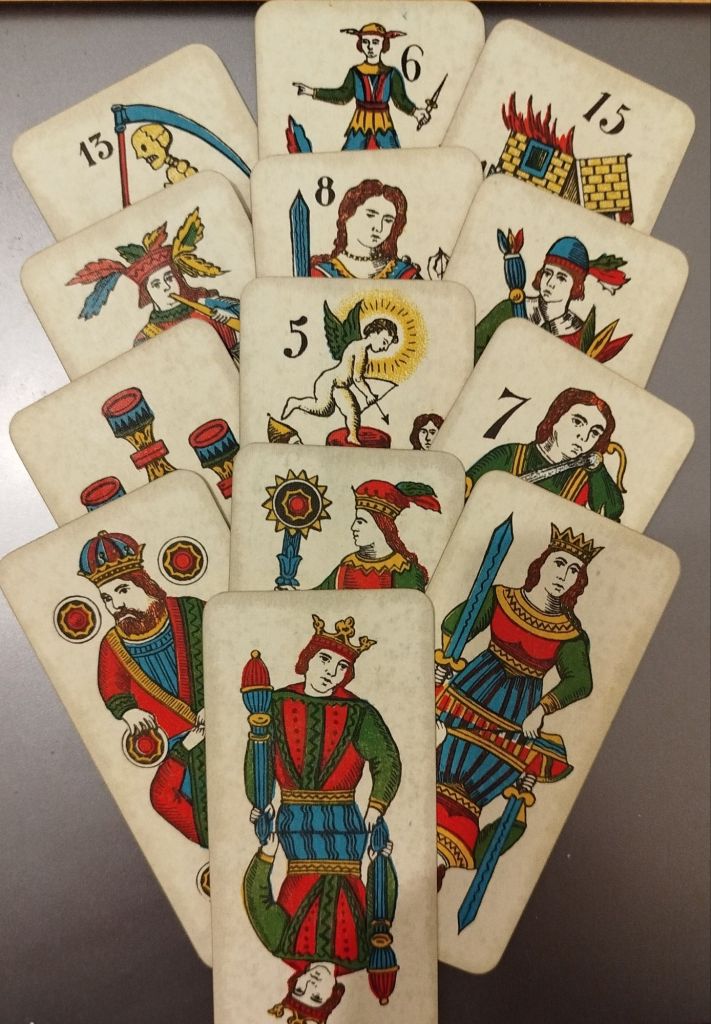
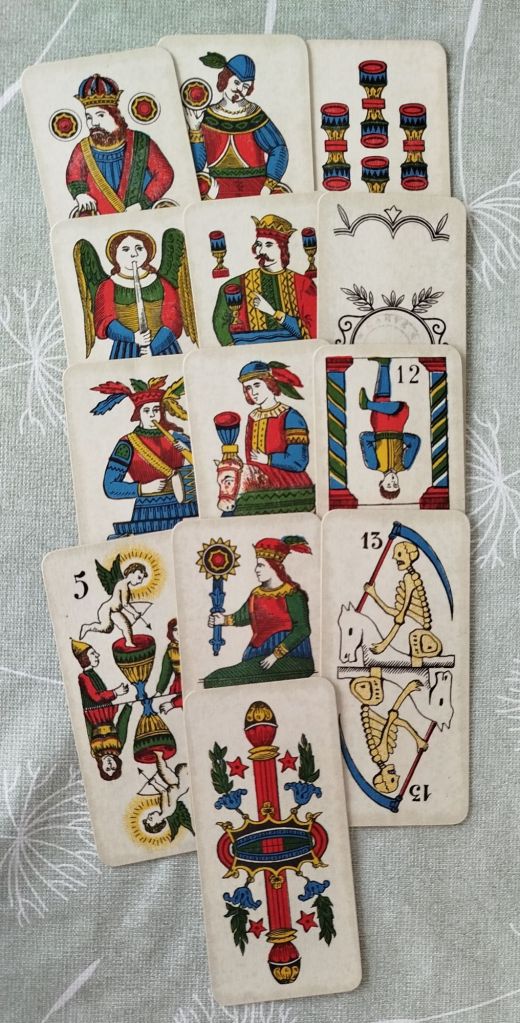
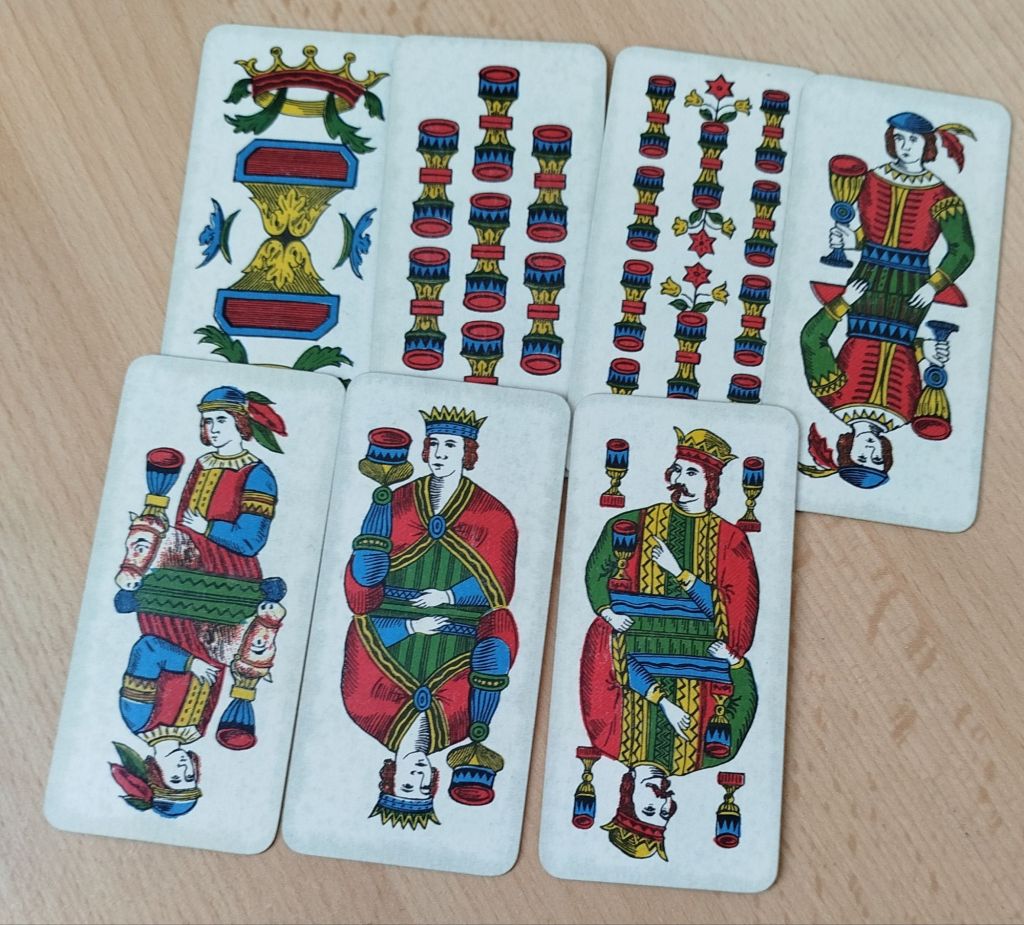
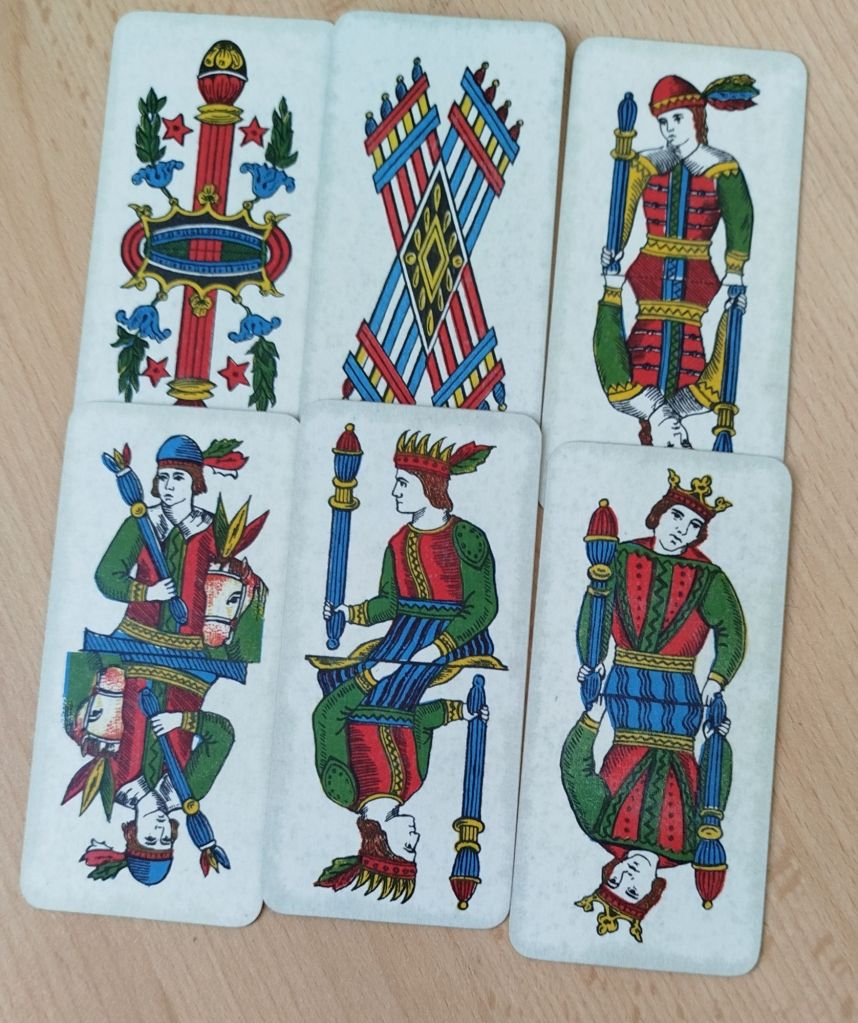
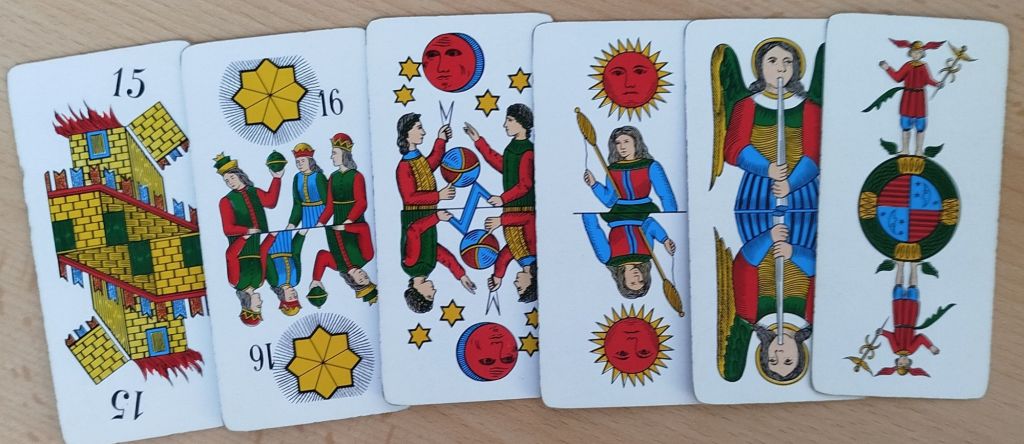
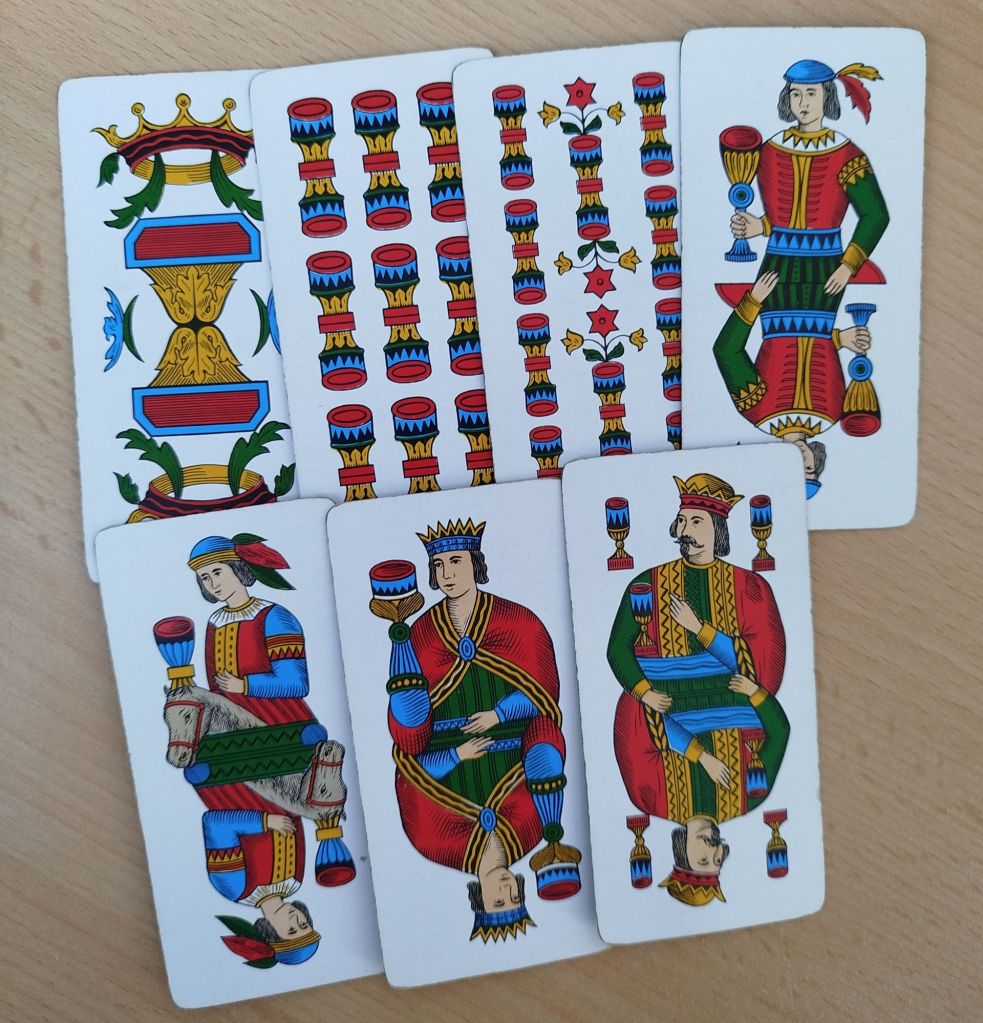
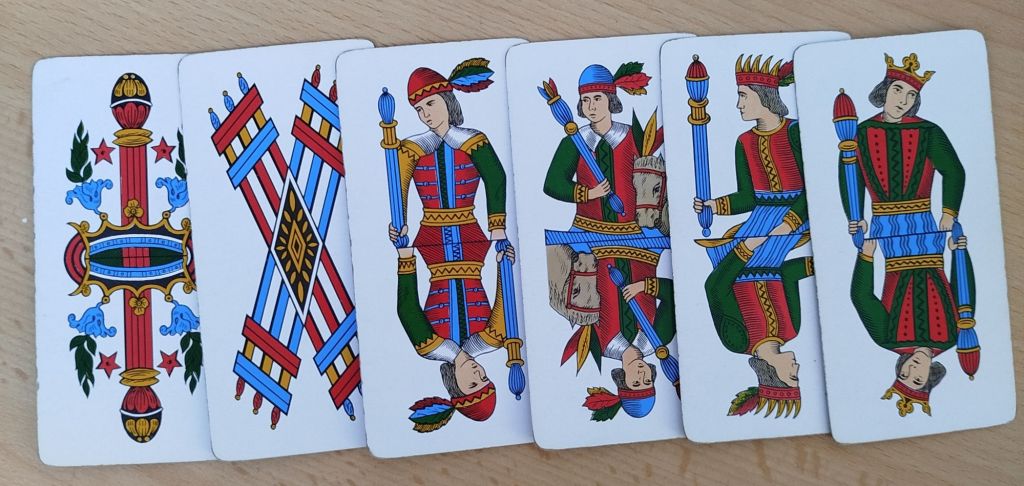
Plenty of readings this time of year, and an above average number on health issues. An acquaintance of ours, an elderly man whom we know from theater, had to go under the knife for major surgery, my husband and I decided to see how the situation would evolve. I used the 45-card Bologna tarot system and the 13 card spread.
Recovery from Surgery. Spread with the Bologna
I am immediately reassured by the lack of dramatic sequences. However, the first row is interesting: Death can indicate a major turning point, the Chariot is the bed card in this tradition, and the Tower is a place of suffering, such as a hospital. Death and Tower can be a tragedy or painful situation. Technically you’d need the Knight of Swords together with the Chariot and Tower to predict surgery, but considering I didn’t even need to predict it (I knew it already) the cards are being remarkably specific.
We also find that his thoughts (the Knight of Wands) are not at ease (the Fool and Justice, that is, irrgularities on his idea of what is right). It could simply indicate bewilderment at the question of how he is going to move on from this. Note that the Tower weighs his thoughts down.
In the following row we see that there is love and care around him (Seven of Cups and Love) and that this care is going to have to last quite a while (Temperance). The recovery is going to take its time. Finally, the cards reassure us that the people and doctors taking care of him mean well and know what they are doing (the Queen of Coins is the truth, wisdom and knowledge).
(Note: this is a collection of the meanings attributed to the cards by some occultists in the past centuries. It does not reflect my own study or opinion of the cards. It is only meant as a quick comparative reference as I develop my own take.)
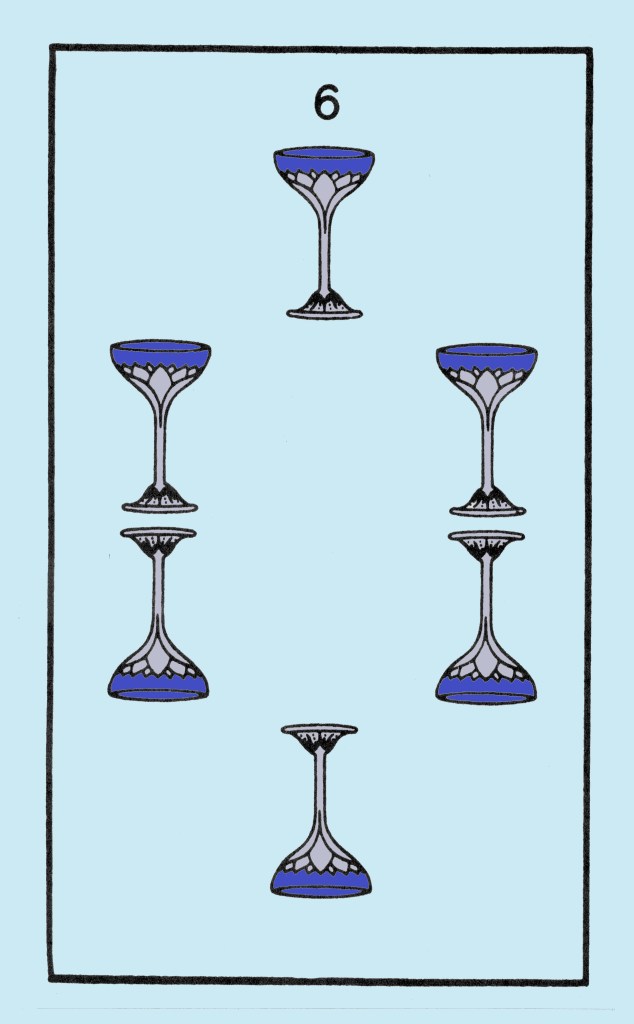
The Six of Cups from the Builders of the Adytum (BOTA) tarot deck
Paul Foster Case (and Ann Davies)
Time period is the second decanate of Scorpio, from November 1 to November 10 under the combined influences of Jupiter and Neptune. Well-Dignified: the meanings in specific divinations are based on the influence of Neptune and Jupiter in Scorpio combined with its natural 8th house; deep emotions, ardor, enthusiasm, generosity; money through marriage or business partner, or by inheritance; the beginning of steady gain in business or pleasure, but beginning only; peculiar circumstances. lll-Dignified: deceit in reference to partner’s money; loss of inheritance through some sort of swindle; danger of death on water, or through poisons or anesthetics; some reversal of fortune. Keyword: Betterment (From the Oracle of Tarot course)
A. E. Waite
Children in an old garden, their cups filled with flowers. Divinatory Meanings: A card of the past and of memories, looking back, as–for example–on childhood; happiness, enjoyment, but coming rather from the past; things that have vanished. Another reading reverses this, giving new relations, new knowledge, new environment, and then the children are disporting in an unfamiliar precinct. Reversed: The future, renewal, that which will come to pass presently. (From The Pictorial Key to the Tarot)
Aleister Crowley
The Six of Cups is called Pleasure. This pleasure is a kind of pleasure which is completely harmonized. The zodiacal sign governing the card being Scorpio, pleasure is here rooted in its most convenient soil. This is pre-eminently a fertile card; it is one of the best in the pack.
[…]
This card shows the influence of the number Six, Tiphareth, in the suit of Water. This influence is fortified by that of the Sun, who also represents the Six. The whole image is that of the influence of the Sun on Water. His fierce, but balanced power operates that type of putrefaction-he is in the Sign of Scorpio-which is the basis of all fertility, all life.
The lotus stems are grouped in an elaborate dancing movement. From their blossoms water gushes into the Cups, but they are not yet full to overflowing, as they are in the corresponding card below; the Nine.
Pleasure, in the title of this card, must be understood in its highest sense: it implies well-being, harmony of natural forces without effort or strain, ease, satisfaction. Foreign to the idea of the card is the gratification of natural or artificial desires. Yet it does represent emphatically the fulfilment of the sexual Will, as shown by the ruling Sephira, planet, element, and sign.
In the Yi King, Sol in Scorpio is represented by the 20th Hexagram, Kwan, which is also “Big Earth”, being the Earth Trigram with doubled lines. Kwan means “manifesting”, but also “contemplating”. The Kwan refers directly to an High Priest, ceremonially purified, about to present his offerings. The idea of Pleasure-Putrefaction as a Sacrament is therefore implicit in this Hexagram as in this card; while the comments on the separate lines by the Duke of Chau indicate the analytical value of this Eucharist. It is one of the master-keys to the Gate of Initiation. To realize and to enjoy this fully it is necessary to know, to understand, and to experience, the Secret of the Ninth Degree of the O.T.O. (From The Book of Thoth)
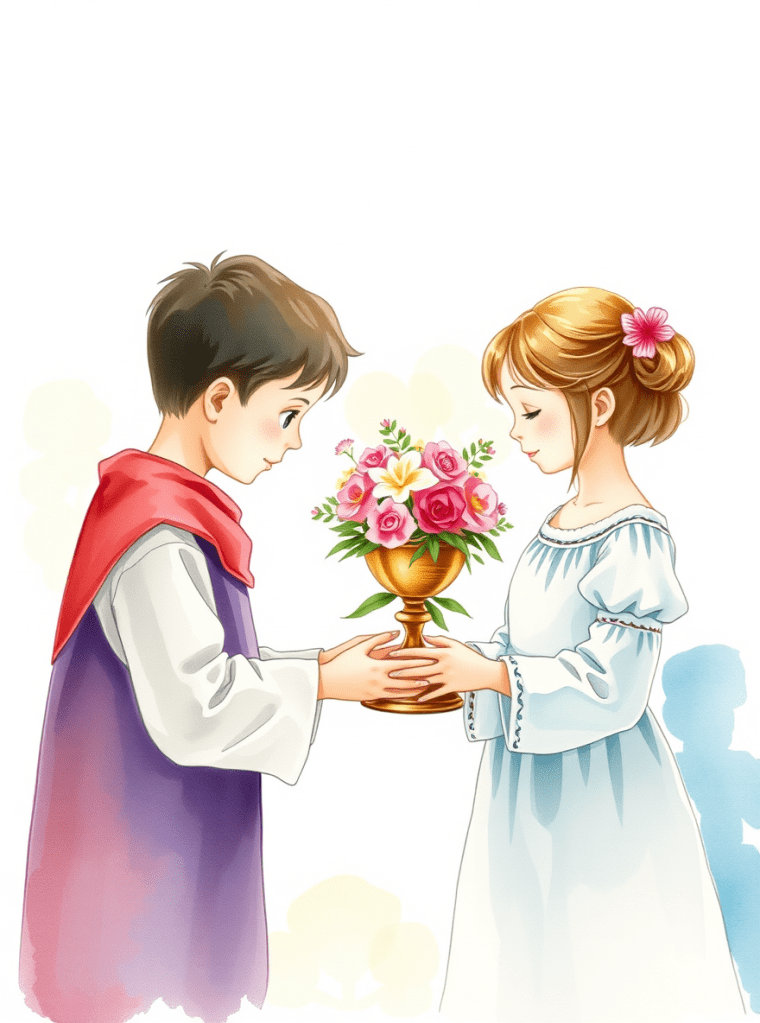
A fairytale-like AI-generated illustration for the Six of Cups
Golden Dawn’s Book T
AN Angelic Hand, as before, holds a group of stems of water-lilies or lotuses, from which six flowers bend, one over each cup. From these flowers a white glistening water flows into the cups as from a fountain, but they are not yet full. Above and below are Sun and Scorpio referring to the Decan.
Commencement of steady increase, gain and pleasure; but commencement only. Also affront, detection, knowledge, and in some instances contention and strife arising from unwarranted self-assertion and vanity. Sometimes thankless and presumptuous; sometimes amiable and patient. According to dignity as usual. Tiphareth of HB:H (Beginning of wish, happiness, success, or enjoyment). Therein rule HB:NLKAL and HB:YYYAL
Etteilla
Past. Upright. This card, as far as the medicine of the spirit is concerned, means, in its natural position: the Past, Formerly, Withered, Formerly. – Formerly, Anteriorly, Of Yore, Once. – Old age, Decrepitude, Antiquity. Reversed. Upcoming, Future. – What comes next, Afterwards, Posteriorly, Further. – Regeneration, Resurrection. – Reproduction, Renewal, Reiteration.
This is the last full-deck spread I am aware of that can be performed with the Bolognese Tarot. It doesn’t have an Italian name. The person who taught it to me, together with the 45-card method, just calls it “la stesa”, “the spread”. For her, this is THE spread, while all other systems, whether large or small, are in a separate category, as it were. My other teacher, who taught me the 50-card spread, is also aware of such a way of laying out the cards, but doesn’t have a name for it either.
To distinguish it from the other spreads I call it the Significator Spread, because it requires you to lay out a significator for the querent on the table, as opposed to the bed sheet spread and the staircase spread, where the significator remains in the deck.
In most regular readings, you are going to select either the King of Wands, for a man, or the Queen of Wands for a woman, though someone might ask to lay out the cards for someone else (e.g., a father would be the King of Cups, a daughter the Page of Cups, etc.) You may also choose to ‘christen’ the significator to connect it with the querent. Once this is done, you shuffle the deck, cut it, and then lay out the cards in the following manner:
14
15
16
Sign.
27
28
29
17
18
19
1
2
3
30
31
32
20
21
22
4
5
6
33
34
35
23
24
25
7
8
9
36
37
38
26
10
11
12
39
13
40
41
42
43
44
You may notice some similarities between this spread and the thirteen card spread, which also belongs to the same cartomancy tradition. Here is an example:
The Significator Spread using the Bologna tarot
In this case, the cards 1 to 13, that is, those underneath the significator, indicate either the past or the present of the querent, or sometimes the immediate future, if you’ve already discussed the querent’s past using other spreads. The cards 14 to 26 indicate what comes after (usually the nearer future), while the cards 27 to 39 show the further developments. Finally, the cards 40 to 44 can either give something upcoming and noteworthy or, according to others, simply be omitted from the spread. It is your choice. If you use the 50-card deck, you can add another row of five cards underneath.
As with the regular thirteen card spread, the central column of each thirteen-card cluster is more important, while the cards on the side either give details or may be ignored depending on the situation (after all, not all the cards in the deck are going to be read, otherwise everything would happen to everyone). Finally, remember that not every information you glean is going to be about the same topic, since this is a broad spread to tell a general future, before using shorter spreads to talk about individual topics.
Following up on my previous post about the “bed sheet” spread with the Bologna tarot, I wanted to cover another full-deck spread: la scala, i.e., the staircase spread. You could also call it a pyramid spread, but I’ve never heard it being referred to as ‘pyramid’, possibly because pyramids were quite outside of the daily experience of the old ladies of Bologna. Here is the layout:
The staircase spread (la scala) with the Bologna Tarot
Note that this spread is intended for a 45-card deck. If you use a 50-card deck you’ll have five cards left over that you can put to the side as describing something imminent or something that is outside of the querent’s life (your choice).
The principles for interpreting this spread are the same as with the previous one: we look at the angles, then we locate the significator (Queen of Wands for a woman, King of Wands for a man). Generally speaking, anything above or before the significator shows the past, and anything after or under it shows the future, but we need to be flexible: sometimes we can just read the full column or row of the significator as a single sentence.
Furthermore, while the angles are important, we must not forcefully insert them into the reading: if they seem meaningful we can look at them, if they don’t, we can ignore them. Sometimes their significance becomes clear as the reading progresses.
Finally, we can look at the cards forming the outer diagonal side of the triangle as giving us one or more predictions concerning the future. In this case, the cards are read from the bottom to the top, walking up the stairs as it were.
In this case, let us suppose we are reading for a man. The angles of the spread are formed by Temperance, the Moor and the World. The cards are not especially clear. Let us move on for now. The King of Wands is found in the fourth column and third row. The row is quite negative: Justice is in the dark (Moon) causing suffering (Eight of Swords) at home (Ace of Cups) and confusion (Fool) that requires an expert (King of Coins). This could relate to something legal or bureaucratic.
In his column we find that there are messages and talks (Page of Swords, Page of Coins) with a woman who is close to him (Queen of Cups) and these communications are sad (Seven of Coins) but will be required to clarify some things (Queen of Coins).
Note that not everything we read in this spread must necessarily be connected to everything else, since this spread is supposed to be general. However, in this case we find that the querent’s card is close to the house card and the conversations happen with a family woman, so we can guess that the two things are related. Looking back at the angles, they cound indicate that this situation is requiring unexpected journeys.
Now let us look at the diagonal: the World and the Juggler could indicate a small trip or, considering the Ace of Wands is next to the Juggler, it might refer to hearing about a pregnancy. The Love card would confirm the joyful occasion. If we connect these cards, together with the Queen of Coins and the Strength card, to the issues we’ve seen relating the family, it could show the solution coming after a bit of uncertainty.
Considering the final cards on the stair, namely the King of Coins and the Chariot with the Moor, it could indicate an unexpected need to see a doctor (Chariot = sick bed, King of Coins = important man).
The Bologna Tarot is typically read in large spreads. This is because each card has very simple meanings, so one cannot spend their time musing on them at length as often happens in contemporary tarot practice. The Bologna Tarot is closer to the Sibilla or to playing cards or Lenormand in this sense (or even to how regular tarot readings used to be).
Many general spreads done to tell a broad fortune use the whole deck. This is the case of the Lezuolata, or bed sheet spread. It is a 5×9 spread similar to the Lenormand or Kipper Grand Tableau (this is for the 45-card deck. If you use the 50-card deck just add a tenth row). Here is an example:
The Bed Sheet spread (Lenzuolata) with the Bologna tarot
This spread is typically used to “locate” the querent’s card (either the King or the Queen of Wands) and see how their general circumstances are. It is typical to start the reading by having a look at the four cards in the angles. In this case we have the Tower, the Hermit, the Ace of Coins and the Page of Cups. This could indicate money trouble relating to a young woman (maybe a daughter). If we interpret the Page figuratively, then it shows that the querent has no (bad cards) monetary (Ace of Coins) satisfaction (Page).
Let us suppose we are reading for a woman. The Queen of Wands is located in the second-to-last row and in the second-to-last column. She looks at the Moon, behind which there is the Ace of Cups (the house) and the Ace of Swords (relationships, or something close). Behind her is the King of Swords, a young man, and underneath her is the Juggler, which is a kid. So possibly she has kids (remember the Page of Cups), and she is worried about her financial situation at home.
Let’s look at the column where she appears. Broadly, this is a positive column, with a King and Queen of Cups possibly indicating figures in the family. Right above the Queen is the Chariot, which in this tradition indicates the sick bed, again reinforcing the idea of suffering (not necessarily physical). But the two figures of the Queen and King bring her the Ten of Cups, flourishing, and some minor good luck thanks to the Wheel.
Above the Wheel we find the Page of Wands, her thoughts, and the Seven of Cups, which also relates to the family, especially protection from the family. Possibly, therefore, the Queen is worried about having money for her kids, but her parents or another couple from her family are helping her.
As can be seen, this spread is not meant to let you talk at length, but it does give you a snapshot of the querent’s life at that moment.
I’ve recently talked about understanding the order of the cards when using the Vera Sibilla and playing cards. The Bolognese tarot, being a traditional fortune-telling system, follows similar rules, and as such it is important to understand whether the cards add their meanings together or contradict each other. Example:
Page of Coins + Queen of Coins
The Page indicates words, while the Queen represents the truth. Therefore, in this case, we get “true words”, “trustworthy words”, and similar combinations.
Queen of Coins + Moon
The Queen of Coins is the truth, but it is followed by the Moon, which indicates negativity, falseness, secrets. Therefore the combination talks about hidden truths, and thus of potential lies to cover the truth.
Moon + Sun
In the Bolognese tarot, the Moon is the card of negativity, while the Sun is the card of positivity. Traditionally, the Sun and Moon together are called “the two red cards” (due to the color of the two celestial bodies in the card) or the sorrow combination. Since here the Moon comes first and is followed by the Sun, the sorrow is passing, the problem will be solved.
Sun + Moon
In this case, the Moon more decisively blocks the Sun, so the sorrow doesn’t stop, or at least will last longer.
Tower + Justice
The tower can represent a large building one would rather avoid. Justice represents the law. Together, the two cards can represent a courthouse (but they can also indicate that justice or fairness is impeded, if the reading is not about a trial).
Justice + Sun
The Sun affirms the positivity of something. Together with Justice, it shows justice, fairness, equilibrium, etc
Justice + Moon
This is the opposite. The Moon negates justice.
Justice + King of Coins
The King of Coins is an important person, usually one with a degree. With Justice, he becomes an attorney, a notary, someone who is competent in some area of law or bureaucracy.
Love + Hanged Man
The Love card indicates, of course, love. In the Bolognese Tarot, the Hanged Man represents betrayal (being hanged upside down was the punishment for traitors). Together, they can indicate some kind of dishonesty connected to love (with the figure of a third party, it would become a triangle).
Love + Ten of Cups
The Ten of Cups brings feasting and jollity, so this combination would describe a happy-go-lucky love that is blooming, and if we add the Fool, that’s obviously a very fun love with not much commitment.
Love + King of Coins + Justice + Tower
We’ve seen that the King of Coins with Justice indicates a lawyer, and Justice and the Tower indicate a court of law. Connected with Love, this combination could show a divorce.
World + Eight of Wands
The World card means “around the world” or journey. The Eight of Wands indicates a road or path. Clearly, the two cards together strengthen the idea of a literal journey.
World + Page of Cups
The Page of Cups can indicate a younger woman, while the World shows “from afar” or “from around the world”. So this young woman probably isn’t part of the querent’ life: she’s a stranger.
All in all, combining the cards of the Bolognese tarot is a relatively intuitive process, although there are some traditional combinations that we’ll need to talk about in a future post.
As I mentioned here, I got a new parrot from a local breeder and I had an interesting reading concerning it. The reading was done using the Bologna Tarot in its 45-card variant. We had already gotten some pictures of some of the available birds, and we had settled on a gray cockatiel, because it looked like the one I had as a kid. As the day approached, I asked the cards if everything would go alright. This is the spread I got:
Is the bird handover going to go smoothly?
Although I’ve already talked about the 13 card spread, when used with the Bolognese tarot there are some peculiar aspects to it (it is, after all, one of the “official” traditional spreads to be used with this deck). Traditionally, when a yes-or-no question is asked, the following rules apply:
If the Death card shows up in the spread, it’s a yes (as sure as we all die)
If the Angel (Judgement) card shows up, it’s a good chance
If both show up, it’s a sure thing
If the Angel and the Devil show up, it represents great satisfaction within the context (the Devil is in itself a negative card, but it is redeemed by the presence of the Angel)
Well, in my (still limited) experience with this tarot deck, I have found that it’s best not to rely too much on mechanical rules: the cards must always be interpreted, and exceptions allowed for. Still, it is encouraging to see both the Angel and the Death card as answer. Let’s interpret the cards row by row, as they came up very clear and orderly (it is not always like this, unfortunately):
King of Coins – Page of Coins – Seven of Cups: there have been talks (Page) with a man concerning business (King). The Seven of Cups is generically positive here. Angel – King of Cups – Ace of Coins: There is help (Angel) from a man of the house (King) concerning money (Ace). My husband paid in part for the parrot and the cage and food. Fool – Knight of Cups – Hanged Man: This is the most interesting row in the spread. It shows something that brings chaos or confusion (Fool) and that betrays or upends (Hanged Man) the agreement (Knight of Cups) Love – Queen of Coins – Death: True (Queen of Coins) Love (Love) is confirmed (Death) Ace of Wands: Success, positive ending
So in general what we can say from the spread is that the breeder is trustworthy, my husband helps me and I will be very satisfied, but still the deal will somehow be changed in an unexpected/confused way.
What ended up happening: we got there and the breeder introduced us to the various chicks that were ready for adoption, including the one we had settled on. But as we were playing with them, a white cockatiel chick quickly flew onto my shirt looking for cuddles. Obviously, it was love at first sight (see the true love in the spread), and we got that one instead.
I believe this change of plans is shown in the spread by combination of Knight of Cups (agreement, conciliation) followed by the Hanged Man (betrayal, upending). Our initial agreement was upended (or “betrayed” in a metaphorical sense), but still everything ended on a positive note.
NOTE: look how “dry” this reading is. Traditionally, tarot was not interpreted by musing on how the pictures looked, but by applying clear and specific meanings.
In another post, I detailed the main meanings of the 50-card method, which is the one my teacher uses. Here I am going to talk about the other main method for using the Bolognese tarot using 45 cards. I have this from a contact of mine, who gave me permission to explore it and talk about it. The two methods are equally powerful: the absence of 5 cards does not reduce the ability to predict, because the meanings, though similar to the 50-card method, are distributed slightly differently across the cards. Supposedly, the 45-card method is slightly older.
Note that 1) there are some books (in Italian) that discuss the 45-card method, but each gives its own version, and the method I know is also partially different. This is normal: every village and city has its own folk tradition, especially in a country as culturally decentralized as Italy 2) again, the meanings are eminently practical 3) as with the 50-card method, I arranged the majors in the usual order, even though it is different from the Bolognese order of the trumps
Major Trumps
Bolognese Tarot, Major Trumps
The Fool. Strangeness, Instability, Creativity The Juggler. A Child, A pet, Immaturity, Something New Love. Love, Feelings, Affection, Passion, Harmony Chariot. The bed card, Sickness, Static Situations (because the horses seem to rest) Justice. Justice, The Law, Fairness, Equilibrium The Hermit. Obstacle, Blockage, Small ailments
Bolognese Tarot, Major Trumps
The Wheel. Fortune, Chance Strength. Energy, Power, Fortitude, Good Health, Active stance The Hanged Man. Betrayal,1 Upending Death. Loss, Mortification, Change, Yes to a yes-or-no question Temperance. Time, Patience, Waiting Devil. Being bedeviled, Anger, Jealousy
Bolognese Tarot, Major Trumps
The Tower. Prison, Hospital, Sacrifice, Being impeded or limited The Star. “Stuff”, Objects, Material things, Your work life, Business The Moon. By Night, Darkness, Sadness, Falsehood, Negativity The Sun. By Day, Light, Happiness, Positivity The Angel. Help, Friendship, Peace, Protection, Solution The World. Travel, Journey (literal or metaphorical), Around the world
The Suit of Cups
Bolognese Tarot, Suit of Cups
Ace. The Home, The House, The Family Seven. The City, The Surroundings, Also the family, Protection Ten. Blooming, Flourishing, Celebrating, Fun, Happiness Page. A young woman, sometimes a female rival, Comfort, Help Knight. Adjustment, Agreement, Positive development Queen. A mother, A woman in your family, A motherly figure King. A father, A man in your family, A fatherly figure
Suit of Wands
Bolognese Tarot, Suit of Wands
Ace. Victory, Union, Sex, Ability to succeed Eight. A road, A path, Taking Steps Page. The thoughts of the female querent Knight. The thoughts of the male querent Queen. The female querent, An important woman King. The male querent, An important man
Bolognese Tarot, Suit of Coins
Ace. Big Money, Abundance, Satisfaction, The table Seven. Tears, Sadness, Melancholy Ten. Small money card, Small satisfactions, Tranquillity Page. Discussions, Talks, Communications Knight. News (especially good news, but news in general), Sometimes a young man Queen. The Truth, Truthfulness, Wisdom, Knowledge, A blonde woman King. An important man, A doctor, A graduate, A professional, “Important” in general
Bolognese Tarot, Suit of Swords
Ace. Something knocking at the door, About to happen, Contract, Relationship, Being bound, Hands tied Eight. Suffering, A thorn in the heart The Moor.2 A priest, A person in uniform, A surprise, Unexpectedness Page. Letter, Message, Post, Contacts Knight. Fighting, Ill-disposition, Cutting, Problems Queen. A dark-haired woman, A problematic woman, Affliction in general King. A dark-haired man, A young man, A problematic man, Immaturity in general
Following my introductory article about the Bolognese Tarot, I want to introduce some quick meanings for the cards. No current method of reading the Bolognese Tarot employs all 62 cards. Instead, two main variants exist: the 45-card method and the 50-card method. I learned the 50-card method from my current teacher (whose book on the Bolognese tarot I reviewed some time ago). I have the 45-card method from another source, and I’ll talk about it separately.
My teacher’s hypothesis as to why traditional fortune-tellers seem to only use a reduced deck is that the cards were all employed in some older method, but the oral transmition of the tradition caused some meanings to go lost. I incline more toward the idea that the fortune-tellers of Bologna simply wanted a slimmer deck that could be used in large spreads (we will see in a future article that most spreads using this tarot deck employ many cards, some even the whole deck).
What follows is a quick summary of the main meanings. Note that: 1) the meanings are quick, concrete and to the point. Yet, in divination, it is possible to use the cards to write whole sentences 2) The major trumps are arranged according to our current system, but in reality the Bolognese tarot follows a different numbering tradition1
Major Trumps
Major Trumps of the Bolognese Tarot: The Fool, The Juggler, Love, The Charriot, Justice, The Hermit
The Fool. Foolishness, Originality, Confusion The Juggler. A child, naive, uncertain, unreliable. A beginning Love. Love, Good feelings, Joy The Chariot. Moving toward something, but also the bed card (because in the picture the chariot seems to be static, with the horses resting) Justice. Justice, Fairness, the law The Hermit. Blockage, Obstacle, Small health issues
Major Trumps of the Bolognese Tarot: The Wheel, Strength, The Hanged Man, Death, Temperance, The Devil
The Wheel. Upright (king with crown ascending): Good luck, positive development; Reversed (page without crown ascending): Instability, need for effort Strength. Strength, Power, Energy, Effort, Health The Hanged Man. Betrayal,2 Cheating, Feeling betrayed or cheated, Sudden reversal Death. A sharp ending, The confirmation of something3 Temperance. Time, the passage of time, the need to wait, stability over time The Devil. Wrath, Anger, Being bedeviled, Passion, Jealousy, Magic
Major Trumps of the Bolognese Tarot: The Tower, The Star, The Moon, The Sun, The Angel (Judgement), The World
The Tower. A large building (usually, but not always, with a negative connotation), A prison, A hosipital. Obstruction, being imprisoned or limited (imagine being trapped in a burning building) The Star. Objects, Gifts, Merchandise, Commerce, Work4, A positive card The Moon. By night, Darkness, Sadness, Negativity, Secret The Sun. By day, Light, Happiness, Positivity, Clarity The Angel. Goodness, Friendship, Peace, Solution, Spirituality The World. Around the world, From afar, Journey, Movement
The Moors
The three Moors used in divination with the Bolognese Tarot (the fourth one, similar to the third, is discarded)
Moor with three Arrows. Intrigue, Danger, Something that is difficult and requires to be disentangled or clarified Moor with a Turban. A doctor, someone wearing a uniform, sickness, melancholy. A priest Moor with one Spear. Surprise, something unexpected for good or ill, Bump on the road
The Suit of Cups
The Suit of Cups in the Bolognese Tarot
Ace. The Home, the Family Nine. Close to home, Something on its way to us or something/someone close Ten. Flourishing, Blooming, Feasting, Partying, Blood, Wine Page. A young(er) woman, a small opportunity or consolation Knight. Solution, Agreement, Reconciliation, Making peace or making your peace Queen. A woman close to us or who loves us, archatypally a mother King. A man close to us or who loves us, archetypally a father
The Suit of Wands
The Suit of Wands in the Bolognese Tarot
Ace. Sex, Pleasure, Triumph, Personal success Six. A road, a path (literal or figurative), an opening Page. The female querent’s thoughts Knight. The male querent’s thoughts Queen. The female querent King. The male querent
The Suit of Coins
The Suit of Coins in the Bolognese Tarot
Ace. A document or letter, test results, contracts, etc. The table (sitting at the table, etc.) Six. Tears, sadness Nine. Money, assets Ten. Well-being, lots of money Page. Words, talks, communications Knight. News (usually good) Queen. The truth, wisdom, knowledge, trustworthy. Sometimes a woman embodying these traits King. An important man, a gentleman, a lawyer or doctor, wise, with a degree
The Suit of Swords
The Suit of Swords in the Bolognese tarot
Ace. The door knockers, something about to happen.5 Also something binding, a union, a prison sentence, a contract (notice they look like rings or handcuffs) Six. Within a three (three hours, three days, three weeks, three months) Nine. Destiny. It highlights the other cards. Ten. A gate, end of the road, something closing down, Suffering Page. A letter, a message, interpersonal relationships Knights. Cuts, Stitches, Arguments, Attacks, Fractures (real or metaphorical) Queen. A strict woman. Affliction. King. A younger or strict man. Childishness
MQS
In reality, our current order of the major trump also differs from all other ways of numbering them in the first centuries of the tarot’s existence. ↩︎
In all ancient documents concerning the tarot, the Hanged Man was called “the traitor”, because being hanged by the feet was a the punishment for traitors (see Mussolini in Italy). In the old Medieval trumps, the Hanged Man represented the person who had betrayed God ↩︎
“Sicuro come la morte”, i.e., “As sure as the fact that we all die”. it is the ‘yes’ card in the Thirteen card spread. ↩︎
Usually the iconography of the card is interpreted as the three Magi bringing their gifts to Jesus, but some Bolognese fortune-tellers see three merchants striking a deal ↩︎
Interestingly, in many system of fortune-telling by cards practiced in Italy, there is always a card called “the door knockers”. In the system of cartomancy by playing cards I was taught, this card is the Two of Hearts↩︎
As I’ve mentioned on this blog, I’ve been studying the divination tradition of the Bolognese Tarot (Tarocchino Bolognese, literally the Small Tarot of Bologna) for some months now. I’ve been doing it under the direction of a traditional practitioner of this art, whom I’ve befriended and with whom a wonderful exchange of ideas has started.
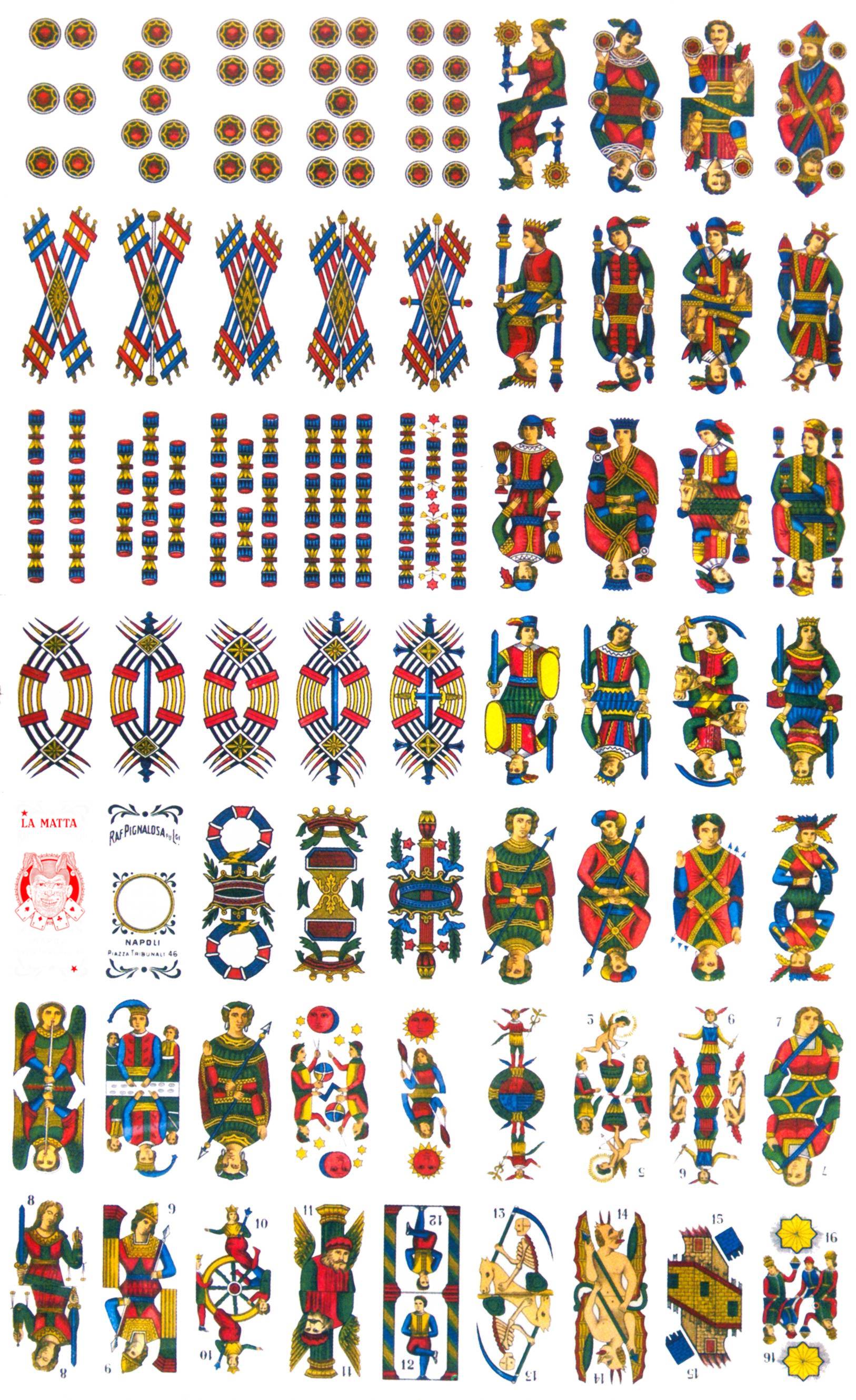
The full deck. Image from the website Labirinto Ermetico
I plan on introducing this form of divination in its main lines for a couple of reasons: 1) it is little known outside of Italy and it deserves some love 2) Its reading techniques are markedly different from the current approach and allow for a very concrete, down-to-earth approach 3) I want to discuss some spreads done with it in the future, and I can’t do it without introducing it first 4) it is the oldest tarot-related divination tradition that we know of, and it is therefore cool from a historical standpoint.1
The Ugly Duckling and Its Quirks
Like the almost totality of very old decks, with a couple of exceptions (the Visconti deck is one) the Bolognese tarot is distinctively unappealing from an esthetic standpoint, largely because, like other popular pre-RWS decks, it was meant to be used by poor people as a playing deck at the local inn.
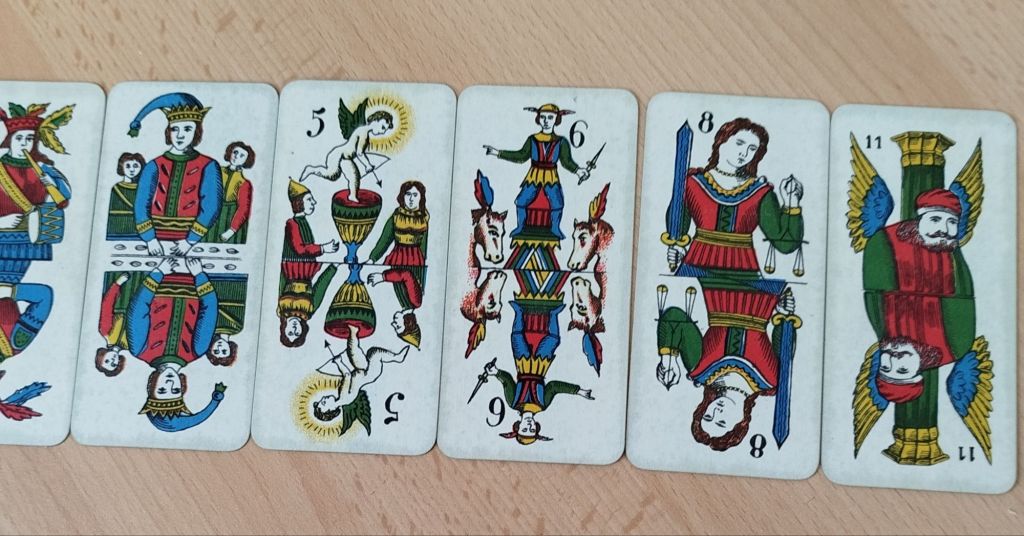
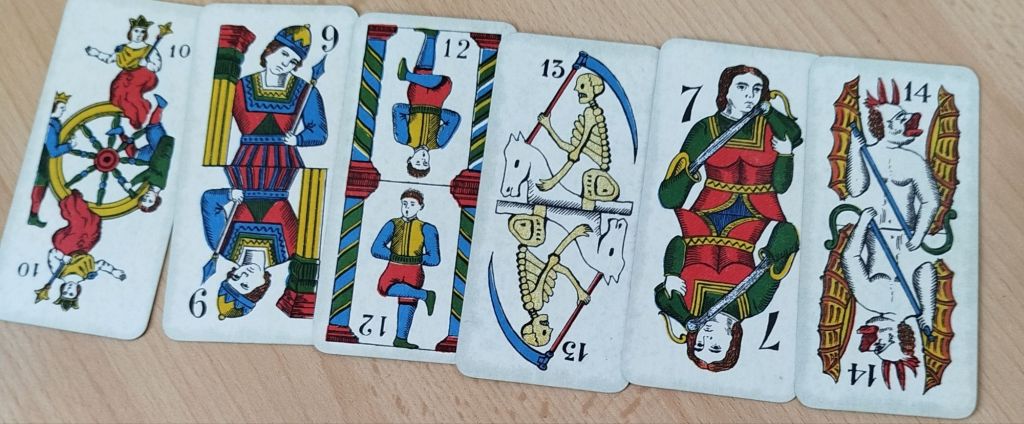
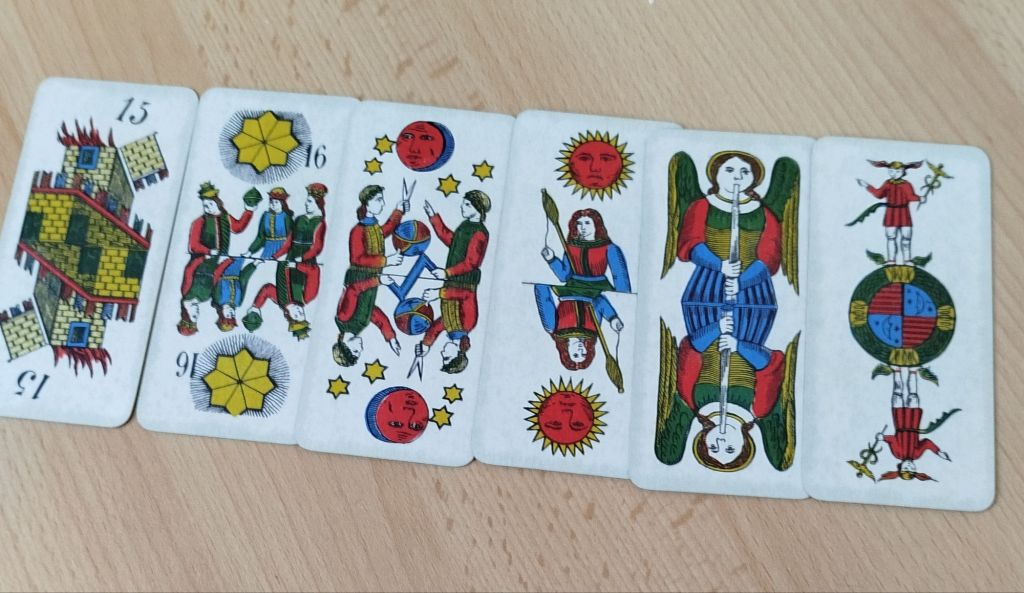
A selection of cards from the Bolognese Tarot. As may be noted, they are symmetrical, like playing cards, though the earliest packs had full images.
The reason it is called ‘tarocchino’ (small tarot) has to do with its reduced size, probably to enhance its handlability. However, it is not just the size of the cards that is reduced, but also the number of the cards that comprise the deck: all pip cards from Two to Five are removed, leaving only the Ace of each suit plus the cards from Six to Ten and the court cards.
Furthermore, the Pope (Hierophant), Popess (High Priestess) Empress and Emperor are absent from the deck for political reasons, as Bologna was directly under the control of the Church. Instead, the deck includes four ‘Moors‘ (the Moors were Muslim colonizers that had conquered parts of Italy.)
Three of the ‘Moors’. The Fourth one is a copy of the third on the right.
Finally, the Bolognese Tarot has another peculiarity, in that the Major Trumps are out of order compared to our regular system. This may sound surprising to some, but our current ordering of the trumps is a relatively recent development and has nothing mystical about it (the oldest preserved document with the order of the trumps gives a rather different sequence).
An Old Tradition
The Bolognese Tarot tradition was almost entirely confined to the city of Bologna and the surrounding areas, and was at risk of dying out, until both the card game and the divination tradition were transmitted to a larger public thanks to the power of the Internet.
Interestingly, to this tradition is connected the most ancient set of meanings handed down by old sources. The following list dates back to the pre-Napoleonic period and gives the meanings of a reduced pack of thirty five cards. I’m copying it here for its historical interest, but it does not correspond to the system I have been taught:
The Juggler (Magician): Married Man
The Lovers: Love
The Chariot: Journey
Temperance: Time
Strength: Violence
The Hermit: Old (Person)
The Hanged Man: Treason
Death (called ‘Thirteen’): Death
The Devil: Wrath
The Star: A Gift
The Moon: Night
The Sun: Day
The Angel (Judgement): Marriage or Agreement
The World: Long travel
The Fool: Madness
King of Wands: A Bachelor
Queen of Wands: A Prostitute
Knight of Wands: Something Knocking at the Door
Page of Wands: Thoughts of the Female Querent
Ace of Wands: Sexual Escapades
King of Cups: An Old Man
Queen of Cups: Married Woman
Knight of Cups: Reconciliation
Page of Cups: The Female Querent
Ten of Cups: The Roof of the House
Ace of Cups: The House
King of Swords: An Evil Tongue
Ten of Swords: Tears
Ace of Swords: A Letter
King of Coins: The Male Querent
Queen of Coins: The Truth
Knight of Coins: Thoughts of the Male Querent
Page of Coins: Unmarried Woman
Ten of Coins: Money
Ace of Coins: The Table
As I said, this is not the system that I’ve been taught, and it is very likely that even back then more than one system existed (usually, significant differences are found from quarter to quarter in Bologna and from small village to small village in the surrounding areas). Since this cartomantic tradition predates Etteilla’s by at least a quarter of a century, and probably more, and since Etteilla says he learned to read the tarot from an Italian card reader (though he pretends it was Alexis of Piedmont to add to the mystery), it is not to be excluded that the Bolognese tarot had some influence on him.
But this is speculation. What is clear is that tarot divination, whenever it was born, was brought into the world as a way of addressing concrete issues. This series of articles is dedicated to bringing the tarot back to these roots.