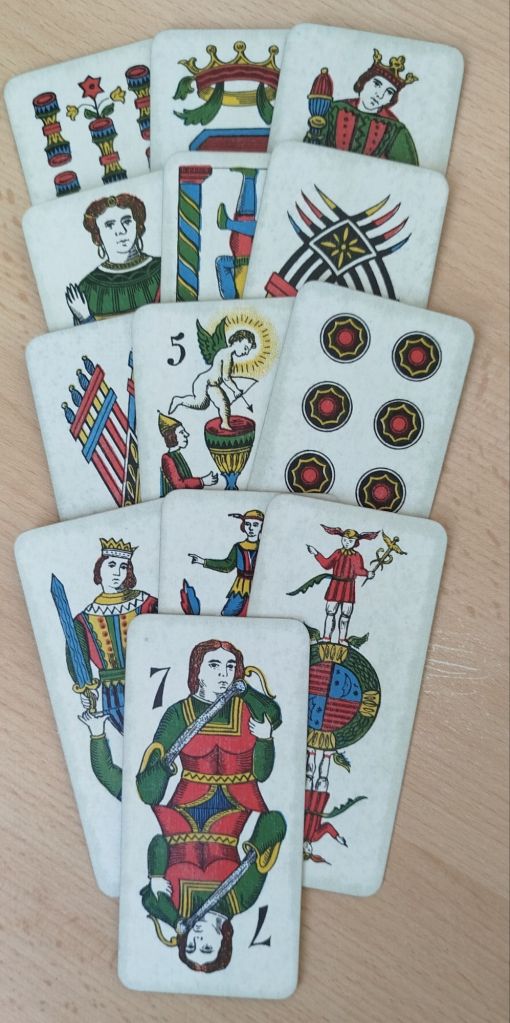
Tag Archives: Tarocchino Bolognese

How Long to Shuffle the Deck?

This may sound like a silly question, but it is one I get asked constantly in private. I think the reason is that, especially at the beginning, we are very unsure of how to go about the reading and we are afraid we may get it wrong on technical grounds even before the interpretation starts.

Unfortunately, there is no clear answer to this. I know of old-time diviners who shuffle the deck for a fixed (usually odd) number of times, like seven, nine or thirteen. I have never been able to get behind this way of doing things. It is, however, a traditional approach, so I thought it better to mention it.

I distinguish between when I’m reading for myself, or even for someone else, but who isn’t there; and when the person is with me, even just on the phone or on skype (I used to do skype readings for friends all the time when I was in college).

The second case is the easiest, so I’ll talk about it first: when I’m reading for someone and I am directly in contact with them, I simply ask them to think about the question and to give me a stop when they are ready. Meanwhile, I decide which spread to use, then I relax and I take on an attitude of calm focus, without strain.

The person may have me shuffle for two minutes, or they may tell me to stop after two shuffles. After the stop, if the person is physically there, I also let them cut the deck, otherwise I do it for them after knocking three times on its back (that’s my little ritual). As weird as it sounds, the cards always seem to fall into place very well regardless of how long it took to shuffle them.

I believe this is because, in a reading, there is more at play than just two eccentrics’ focus on a topic. We may like to concoct philosophies that give us ultimate power over external reality, but the fact remain that we live at the intersection of cosmic, personal and interpersonal currents, a number of which are beyond our control. Our focus may catalyze these forces, but they are more ingenious than our conscious awareness could be.

In the first case, i.e., when I’m reading for myself or for someone who isn’t there, I need to be especially at peace with myself. If I’m distracted, depressed, in a heightened mood or very sick, the reading won’t go well. Even when I am at peace, there is always a question mark at the end of my readings, like they are never as crisp as when I’m reading for someone else who is there with me.

So, how long do I shuffle in this case? The answer may be disheartening for some, but it’s: as long as I feel I need to. This is hard to explain, but one soon learns to recognize the feeling of a well-shuffled deck. Some may feel the deck becomes heavier, others seem to just get an undefined feeling.

For my part, I usually feel a sensation akin to being full after eating a hearty meal and being unable to take another bite, while at the same time the deck itself seems to oppose resistance to being shuffled as the cards lock into the right place. Your experience may vary.

MQS

Love Beyond the Grave? (Example Reading)

a reading with interesting implications. Like and subscribe to support my work

I thought this was a rather interesting reading, in part because of what it revealed and in part because it shows that divination requires rules and flexibility. I’ll probably talk about it again in an article.

MQS

The Road – A Deep Dive into Cartomancy

Following my deep dive into the Door Knockers, which seems to be an exclusive symbol (or almost) of Italian cartomancy, let’s talk about a much more universal presence in many traditions: the Road. Still, even though the symbol is widespread, the interpretations may vary.

I was introduced to the symbol of the road when being taught to read playing cards. In the system I was introduced to, the Two of Clubs is the card of the steps. Actually, the word for it was “cammino”, which means a way, road or path, but it also implies the idea of people taking steps on it. That is, a ‘cammino’ is a road that exists because people walk on it, rather than being a road that has been created so that people may or may not use it. An example would be a path through a forest or a road created by pilgrims as they progress on their pilgrimage.

The Two of Clubs therefore implies forward motion toward a goal of some kind, and the taking of steps, whether literal or figurative. In this, it is similar to the Two of Wands in some Piacentine cards systems, which interpret the card as a road, largely due to its design showing two parallel staves, no doubt (although in some other Piacentine systems the road is the Knight of Wands).

The Vera Sibilla doesn’t have a road card per se, although it does have various cards connected with movement, journeying or taking steps/fighting for something. For instance, the Journey card is connected to traveling, while the Soldier may imply fighting to attain a goal (although, being a Spade card, the struggle is more accentuated).

Etteilla famously attributed the meaning of road to the Six of Swords, and his pupils developed a whole vocabulary of synonyms that extend the meaning into other areas. An example of this is the meaning of conduct, which is, figuratively speaking, the path of the person’s actions through life. Etteilla’s attribution of the meaning of road to the Six of Swords remained attached to tarot through the Golden Dawn, who preserved it in part as a possible meaning in their Book T, and then through Waite, who had Smith design the Six of Swords as a card of journey. Even in the Crowley tradition this attribution has in part been rediscovered in Eshlemann’s Liber Theta.

In the Bolognese tarot, the meaning of road is attributed usually to the Six or Eight of Wands. Some strands of the tradition also distinguish between an open road (Six/Eight of Wands) and a closed road (Nine of Wands or Ten of Swords). The road is in itself a card of forward motion, like the Two of Clubs, it can indicate short trips and it is a card of openness.

The road or path is also present in the Lenormand and Kipper traditions. I am unclear on the Lenormand meaning, as the interpretation seems to have evolved considerably through time. Most contemporary English-speaking sources seem to see it as a card of choice (with two paths, although I am unsure if this duality was intended in the original design). Most German sources interpret it differently. Since I am not a Lenormand reader, I will leave it at that.

As for the Kipper cards, they have a card called Ein langer Weg, a long road. In most of the sources I have consulted, the card is more static than in the other traditions, highlighting the element of time (some call it the Two Years card). Interestingly, in many German Skat systems of divination, the suit of Spades / Leaves is connected with movement, and the low-numbered cards, mostly the Seven and Eight, can show a short trip or something happening quickly, while the Ten is also called the long road, and it can indicate an actual journey or the need to wait a long time.

BONUS: The Road is obviously present in Geomancy as well. The Geomantic figure Via, attributed to the Moon, is a symbol of journey and change. It is the symbol with the least amount of points, only one in every position, so some sources also attribute it to the concept of ‘little’ and to the waning of something.

MQS

Bolognese Tarot – I Tarocchi Parlano by Maria Luigia Ingallati (Review)

I Tarocchi Parlano (The Tarot Speaks) by Maria Luigia Ingallati is perhaps the most well-known book about the Tarocchino Bolognese in Italy, and the one that, thanks to its success, launched the rediscovery of this deck outside of its native region. Since the publication of Ingallati’s book, the Bolognese tarot has enjoyed a small but growing cult following. This, we shall see, is probably the book’s greatest merit, though not the only one.

Ingallati herself is not from Bologna. She relocated there many years prior to the publication of her first book (‘Il Tarocchino Bolognese’, which I will review separately). There, she started seeing the local card readers, getting her fortunes told and learning a great deal from them, until she began practicing the art herself and synthesizing a personal method from the Bolognese tradition and her own experience as a card reader.

The book does a good job of presenting Ingallati’s journey, and it is undeniable that her personality shines through the pages of the richly illustrated volume. Ingallati is a good story-teller, enjoys reading and talking about poetry, philosophy and psychology, all of which she uses to shed light on the Bolognese tarot.

Ingallati uses a personal variation of the 50-card method, comprised of the following cards: the 18 surviving Major Arcana; the 3 Strangers or Moors; 7 Cup cards (Ace, Nine, Ten and the Court); 6 Wand cards (Ace, Six and the Court); 8 Coin cards (Ace, Six, Nine, Ten and the Court); 7 Sword cards (Ace, Six, Seven and the Court); and the red Joker.

Of Ingallati’s selection, the choice to include the Joker is the one that has always stuck out like a sore thumb to me. The traditional deck includes no Jokers, since they are not needed for playing card games, and to this day only one producer has recently randomly decided to add them. That being said, Ingallati is very careful in acknowledging what she took from the tradition and what she introduced as her own innovation.

The book starts off with a chapter on the history of the Tarocchino. It is not the best and most accurate historical account, but it covers most of the basics and it is the one most people will skip anyway. Then, Ingallati presents the spreads she uses. This is a peculiar trait of her method, which she also teaches in her private classes: she uses a huge variety of spreads one after the other to move from an account of the querent’s past to the future.

No time is wasted on the technical details of how to lay out the cards, in what order, etc.: the reader is left to his or her own initiative of how to apply the traditional spreads. This may overwhelm us at the beginning, but it is clear that she thinks everyone should find their own way of laying out the traditional spreads, which is fair. This is possibly the most interesting part of the book: Ingallati’s method is a synthesis of many strands of traditional lore about the spreads which can be mined by reading the section carefully and comparing it to other sources.

Only after the section on the spreads does Ingallati start her discussion of the card meanings. Here, the writer spends, in my opinion, way too much time overanalyzing the various details of color and symbol. We learn, thus, that the shape of the lace on this or that character’s tunic has this or that meaning; that the number of triangular shapes on the Queen of Coin’s scepter suggests certain symbolic interpretations; that the colors of the Fool’s feathers is very important.

Of course, none of this has any historical relevance nor any bearing on the interpretation of the cards, nor with the traditional, succint meanings that Ingallati scatters around in the descriptions, sometimes almost as an afterthought. This leaves one wondering if the overzealous interpretation of the various bits of design was just the happy meeting point between the publisher needing a longer book and the writer being happy to provide it with a clear poetic gusto for the mysterious and the metaphorical. Almost every card is accompanied by snippets of poetry and aphorisms, anecdotes as well as by illustrations of some combinations.

The final part of the book is dedicated to Jungian character analysis based on the Bolognese tarot, something that the author clearly has a great deal of interest in, and for which she provides some curious combinations that might be worth trying.

Ingallati’s book is hard to review objectively. It has the incredible historical merit of having brought the Bolognese tarot to a wider public, and it is undeniable that her poetic and evocative style and her attempt at ennobling it as a ‘legitimate’ tool for divination is part of why she succeeded.

The esoteric landscape has a growing public of people I like to call educated suckers, those who think themselves too smart and learned for folk superstitions but can easily be sold on the idea of reinterpreting them as deeper mysteries of personal development and esoterically flavored self-help. This is the reason why so many ‘real and only’ Tarot of Marseilles’ get sold every year, together with ridiculously expensive courses on ‘this is not divination’ and books of metaphysical platitudes that sound deep if you don’t think too much about them.

Ingallati struck gold when she managed to appeal to this kind of public with her literary style while also preserving the teachings she received and developed from the card readers she met in Bologna. In doing so she succeeded where the small handful of other books published before and since failed: creating a niche for the Bolognese tarot. Despite my sarcasm in the previous paragraph, this is no small accomplishment. Pragmatically speaking, it is a serious merit.

The book also excels at being a treasure trove of meanings, spreads, combinations and suggestions that can be studied, reflected on and compared with other sources. It is certainly a book I recommend, in this regard.

Where to buy: Amazon

MQS

Cards That Change Topic

In the latest reading I presented, an interesting phenomenon occurred. At some point during the reading, two cards came up that seemed very negative, but which actually had nothing to do with the reading in itself. Instead, they simply acted as some form of punctuation. This happens especially with simple methods like the one I used, called ‘alla zdoura’ (literally, ‘method of the housewife’, or ‘like the housewives do it’ in dialect), where we start with a very limited number of cards, usually one, two or three, and then we keep adding them without following a specific layout.

In this type of reading, if the cards need to signal that we are changing topics and moving on to a new one, they may use cards or combinations that show an ending (sometimes even just the Death card). Of course, I had a huge deal of luck in this reading, because it came up clear. It isn’t always like that. Often, these combinations look really bad, but if we look around we see that they feel out of place.

In playing cards, the same can happen when the Four of Spades and Five of Spades, or the Ace of Spades, or the Five of Diamonds come up. Usually, in these situations, it pays to zoom out of the reading and catch the general flow of it: it will become apparent, generally, whether these cards are part of the reading or if they act as punctuation. 

I am also experiencing a similar phenomenon while experimenting with the Bolognese tarot. For instance, in the first few lines of a thirteen- card spread, it may happen that the Angel and Death cards come up together, and then the cards seem to discuss other topics. In this case, the cards seem to be answering the question positively and quickly, only to introduce new discussions. At other times, the Queen of Coins comes up to say “and that’s the truth about it, period.” or the Justice card, to say “and that ok the way it is.” Of course, I need to experiment a little more, especially to see if apparently negative combinations can act in the same way.

MQS

Bolognese Tarot – The Love / Couple’s Spread (Three Variants)

The Bolognese Tarot tradition has several spreads for the couple. One that has been taught to me, and which I have also found is practiced by other Bolognese tarot readers, is the following:

123456
HeShe
789101112
131415

He and She are, of course, the King and Queen of Wands. However, we can explore the relationship between any two individuals. The cards above the two significators show what’s on their mind (1-2-3 his mind, 4-5-6 her mind, in this case).

The cards covering them (7-8-9 for him, 10-11-12 for her) are ambiguous. The way the method has been passed down to me, these cards show what’s going on with him and what’s going on with her, but I have found other readers (such as Rossella Giliberti) who say that these cards show what’s in his heart and what’s in her heart. Choose the variant you prefer, and remember that these are local methods, so there’s bound to be variations between one town and the other. The final three cards (13-14-15) show what’s happening to them as a couple in the near future, or if there is potential, or what connects them.

Another spread, which is found in Maria Luigia Ingallati’s book on the Bolognese Tarot (which I will review in the near future together with the few others that have been published). The layout is as follows:

HeShe
1231516178910
456181920111213
72114

Here we have cards 1 through 7 talking about what’s going on with him, cards 8 through 14 telling us what’s going on with her, and finally the group in the center (15 through 21) talking about them as a couple. Another reader I know (Monica Barbieri) uses thirteen cards for each group instead of seven.

Another variant is found in Lia Celi’s out-of-print book on the 45-card method. This is the layout:

He and She
12345
67 – 89
1011 12
13 – 14
15

As can be seen, this is a pyramid spread. Here, cards 1, 2, 6, 7, 10 and 13 talk about him, cards 4, 5, 8, 9, 12 and 14 talk about her, and cards 3, 11 and 15 talk about them.

These methods are specific for analyzing two people’s interaction, but nothing prevents you from using a simpler spread, like the thirteen card spread. To be honest, that’s what I do. Still, this is an interesting bit of traditional lore about the Bolognese tarot.

MQS

Is He Gay? (Example Reading)

A reading with the Bolognese Tarot. Like and subscribe to my YT channel to support my work

MQS

The Door Knockers – A Deep Dive into Italian Cartomancy

In almost all cartomancy systems, Italian or otherwise, the Ace of Hearts/Cups is the house. Here the Sibilla is an exception, since it relegates the House to the Two of Hearts, although the Ace of Hearts still has connections to the idea of family and people living together. In the second most widespread Sibilla deck in Italy, which is the Sibilla Regionale, which uses the suits of the Neapolitan cards, the Ace of Cups is once again the house.

One thing I have so far never found in non-Italian systems, which on the contrary is very widespread in Italy, is the concept of the door knockers, also known as ‘close to home’. This is a meaning that is found in many regional Italian cartomancy systems, and keep in mind that almost everything in Italy is regional, since regions have a much older history as separate states than Italy itself, if we discount the Roman Empire.

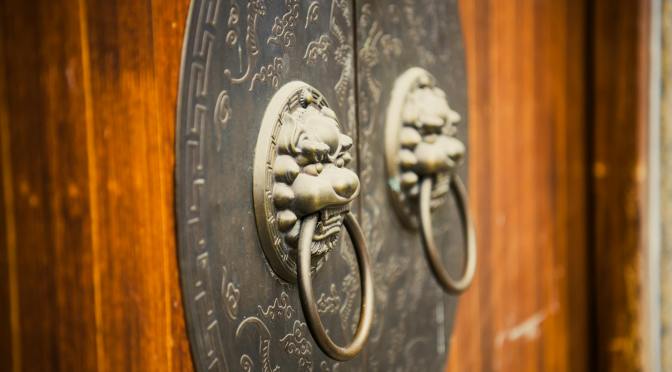
When I was taught to read playing cards, my teacher told me that the Two of Hearts is “al martel di porta”, knocking at the door. This refers to the way old house doors are made in many European countries, including Italy, where door knockers were used back when you couldn’t ring at the door. At least in Italy door knockers are still very much en vogue, though mostly as a decorative element.

The idea of the Two of Hearts as “the door knockers” is a reference to the fact that door knockers usually come in twos and to the fact that the Two of Hearts comes right after the Ace, which is the house, so that the Two is quite literally close to the home.

This meaning is also found in many systems for reading Piacentine cards, where the Two of Cups takes on that meaning (in some other systems this meaning is given to the Two of Wands) as well as in the Bolognese Tarot, where it’s the Ace of Swords that depicts it, due to the odd shape of the picture.

In some systems I am aware of, there are two distinct cards: the door knockers and the roof of the house. This is true for some systems employing Piacentine cards, where the Two of Cups is the door knockers and the Four of Wands is the roof.

This distinction is also found in the Bolognese tarot, where the Ace of Swords depicts the door knockers and the Seven of Cups the roof of the house. In the oldest surviving system for reading the Bolognese tarot, which dates back to before the French revolution (I talk about it here), the Knight of Wands indicated the door knockers and the Ten of Cups the roof of the house. Clearly, therefore, this symbolism is deeply ingrained in Italian cartomancy.

According to the person who taught me the 45-card system of Bolognese tarot, the Ace of Swords, the door knockers, tends to show something close to home in a temporal sense (about to happen) whereas the Seven of Cups, the roof, is more connected to everyday life, to our close environment and to the protection of people surrounding us, as well as to the family in a more extended sense. Germana Tartari, who initiated me to the 50-card system, which she was taught by her grandmother and by some of her grandmother’s friends, uses the Nine of Cups as ‘the staircase to the house‘, again mostly in a temporal sense as something about to happen.

On the other hand, in the system for reading playing cards that I was taught, the Two of Hearts covers both possibilities: it indicates something about to knock at the door or it can show family situations, people who are close to us etc.

I have never found this symbolism in other non-Italian systems. If you did, feel free to drop me a line, as it would be very interesting. Manuel Arcuri, an American reader who was taught to read playing cards by his Italian grandmother, says somewhere that his grandmother called the Two of Hearts “l’attesa”, which means waiting or expectation, as of something about to happen. He doesn’t mention door knockers though.

Furthermore, many card reading systems I have read about assign the meaning of “within two weeks” to the Two of Hearts, which once again gives us the idea of something about to knock at the door. Interestingly, Regina Russell‘s playing card system uses the Two of Hearts to indicate excitement for something that is about to happen, expectation and even pregnancy (expecting a child).

MQS

What’s the Bird Thinking? (Example Reading)

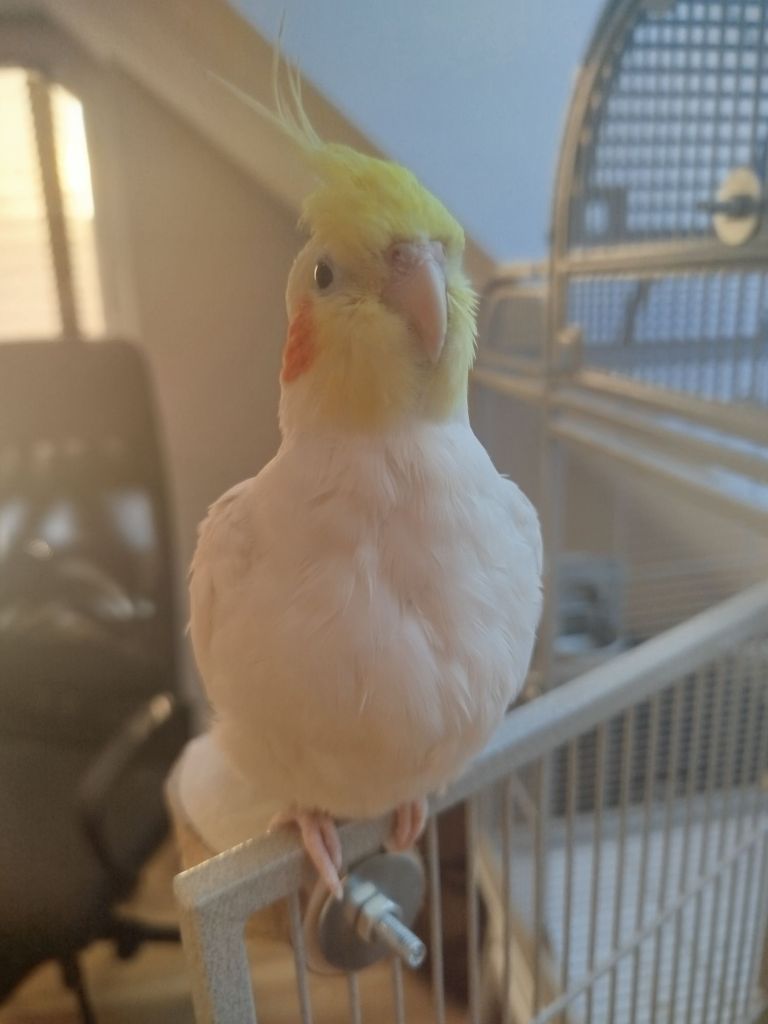
My two cockatiels couldn’t be more different from one another. Ciuffy, the white one, is a sweet cuddlebug who’ll do anything for a head scratch. He’s never nipped me, let alone bitten me. The only time he hurts me a little is when he tries to preen my ear.

“I’m the guy you want your daughter to bring home”

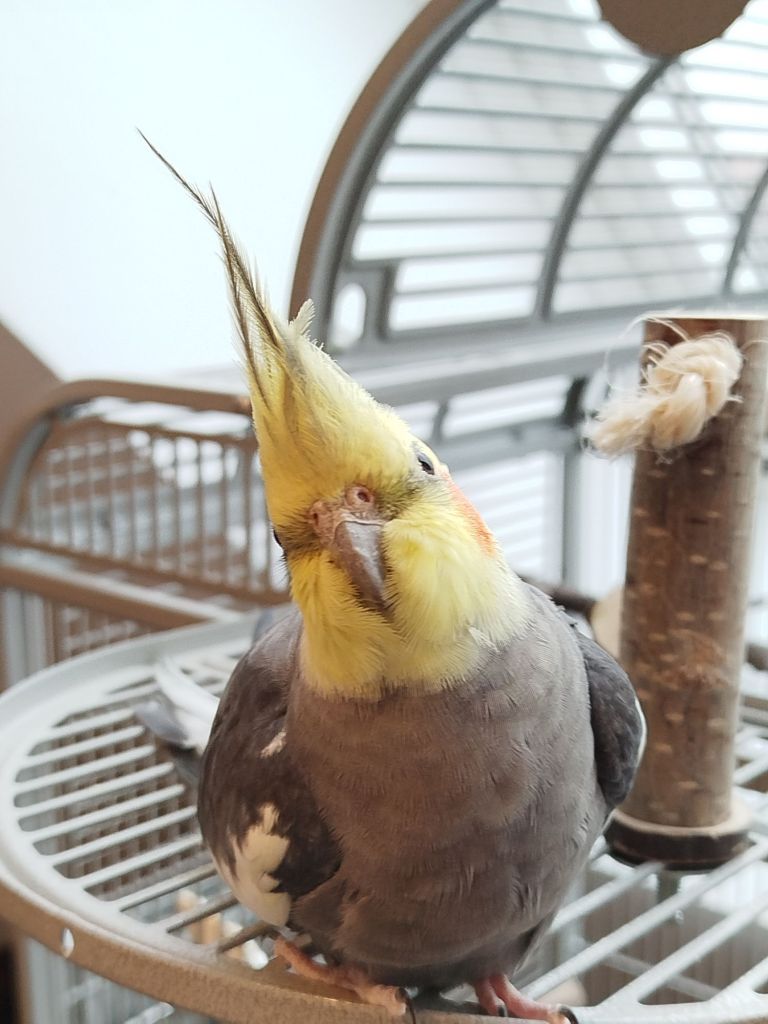
Zazu, the gray one, is a beaky, bossy, overbearing prick. He does have his sweet side, and considering I’ve had him for only a little over a month we’ve made huge progress, but when I have him on my shoulder I KNOW I’m going to get hurt at some point, and when he bites he really means it.

“I’m the guy your daughter brings home”

Now that I’ve set the scene and used the excuse to show you a couple of pics of my cutie pies, let’s get to the point. A couple of days ago, while Zazu was on my shoulder, he bit my earlobe incredibly hard out of nowhere (maybe he saw me move my head and didn’t like it).

I shooed him away with my hand, but he spooked and flew against a wall. Although he wasn’t hurt, he spent the day avoiding me and hissing (for those who don’t know, cockatiels can hiss, like cats).

I knew that the accident set some of that hard-won progress back, but I wanted to know Zazu’s perspective and how it would likely evolve. Here’s what the Bolognese Tarot had to say:

What’s the featherball thinking? Tarot reading

One thing that surprised me is the first row, where we have happiness (Ten of Cups) in the house (Ace of Cups) with me (King of Wands). I know I try to care for the two little balls of feathers as best I can, but Zazu is always grumpy and old-farty in his behavior, so I assumed he didn’t like me very much. Apparently that’s just his character.

The second row is interesting, since we have unexpected (Stranger) betrayal (Hanged Man) leading to negative emotions (Eight of Swords). Clearly his good vibes were somewhat disrupted by the incident.

The third has a path (Eight of Wands) toward Love with harmony or small satisfactions (Ten of Coins). So even though there was a setback, there is room for moving toward love. Obviously we should be very careful when projecting human sentimentalism onto animals, but then again, divination is a language understandable to humans, so the tarot is probably translating Zazu’s reality in terms that are understandable to me.

I have some doubts about the last line. The King of Swords might be Zazu himself (it could represent my husband, but my husband isn’t particularly involved). Technically, pets are represented by the Juggler, but then again, the King of Swords does have some characteristics of the Juggler, so it’s a possibility. At any rate, the King is next to the sickbed. There are no combinations talking explicitly about sickness, so I believe this just shows his being cranky or a bit uncertain, but the World card at the end of the row indicates that this uncertainty doesn’t cause breaks: the situation remains open and moving.

The Temperance card at the end simply shows that patience and time are needed. I expected no less.

For now, the reading seems to be accurate. The day after the little bastard had gone back to his old behavior, being just a little more shy than usual, and the day following that he was back to normal.

MQS