When it comes to divination, theory can only get you so far. The best way to improve your reading skills is to learn the basics of a *valid* system and then start reading.
For most of us, we are our own first querents, and that is a problem. I don’t have a 100% accuracy record when reading for others, but I barely reach 60% when reading for myself, especially if I’m invested in the topic. It is not just a matter of wrong interpretation, which can and does happen. I am more and more convinced that sometimes, when we read for ourselves and we are not perfectly at peace, we tend to get readings that reflect what we think rather than what is happening or will happen.
Furthermore, the tendency that many people have to start obsessively putting questions to the cards just to see if they say something vaguely understandable (which doesn’t mean true) is dangerous, and can get us in a warped frame of mind.
I know that for many, especially coming from certain societal backgrounds, reading for others can be a big step into the unknown, but I would advise anyone to start reading for some sympathetic friends or relatives (and when I say for them I mean in front of them, not asking questions about them) and then to graduate as soon as possible to readings for people we don’t know or know little about.
I don’t have too many friends, but they do a good job of talking about me to their friends and to their friends’ friends, which is how I get my supply of test anim-ehm, querents. If you start reading for your friends and ask them to spread the word the same will happen to you.
The cool thing about reading for people we don’t know is that it is so much easier than you might think. Divination DOES work! And divining for someone when there is no chance of you knowing the information in advance is very impressive for them and very satisfying for us as diviners. It will build your confidence much more quickly than torturing the cards about your own mental dramas. Plus, the oracles always seem to be much clearer and much more crisp when I divine for strangers.
One thing I would advise is to be as scientific as possible: record the question, the reading, your interpretation and the results. Don’t think you cannot build your vocabulary because the only right answer is the one offered to you by your intuition. 99% of intuitive readers are terrible, and what they call intuition is not actual intuition: it’s their stupidity echoing in the empty chambers of their mind. Be systematic and slowly you will gain experience.
I think this reading is interesting because it showcases the odd behavior of the Death card in the Bolognese tarot of answering yes to a question. I have already written that I prefer to take this traditional rule with a grain of salt, but it does seem to apply in several cases.
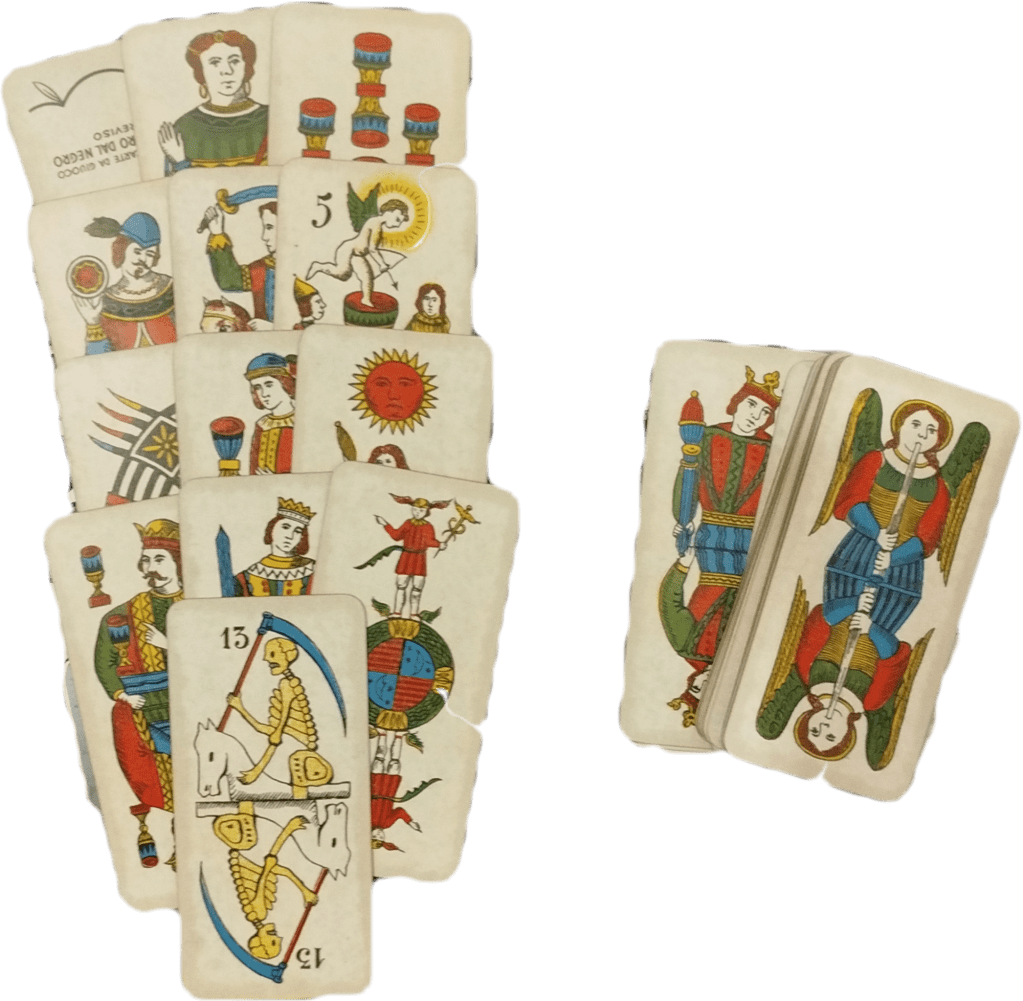
Here the question the (male) querent asked is if there would be reconciliation with a friend he had had a fight with. The reason I included the cards of the cut (the King of Wands and the Angel) will become clear shortly.
Two Friends
Right off the bat, the death card comes up in the last position, and this, added to the Angel in the cut, should give us a sort of super yes. But we always need to interpret the reading.
The second thing that caught my attention was the Page of Coins (words) next to the Knight of Swords (cuts, problems, arguments, hurt) and the Love (affection). So there is affection between the two, even now (how could there not be, since they were friends?) but the Sword card creates problems.
In the next line we find the Eight of Swords, which is a card of suffering. If we see the Eight of Swords as coming after the Love card in the line before, then there is great emotional suffering surrounding this argument. However, all is not lost, as the Knight of Cups (agreement, conciliation) and the Sun (positivity, clarity) follow. So this, together with the Death card, seems to confirm there will be a great improvement after a period of uncertainty.
In the last line we have two kings. One is the friend probably the Sword. The other king, the Cup, can possibly identify him as like family, or, paired with the third king in the cut, it constitutes a triplet of success in the matter (three Kings are a success). Then the World card comes. Talking to the querent, I discovered the friend lives quite far away, but I believe the deeper meaning here is that their relationship’s path is still an open road, so it is not over.
I don’t have much to say about the first line. It isn’t clear to me. The Ace of Coins can be money, but the argument wasn’t about money, but it can also be the table, their conviviality (especially with the Seven of Cups, which is a relationship of closeness), which suffers a hiccup (the Stranger). That’s my best guess.
As for advice, the querent (the King of Wands) comes up in the cut together with the Angel, so clearly he has feelings of deep friendship. I told him to show them better, since this is what leads to the Sun card in the spread overtaking the Eight of Swords.
You’ve got to appreciate how folk cartomancy takes the objects of our everyday life and turns them into means for predicting the future. This is, after all, probably how cartomancy started: people needing to know what tomorrow would bring adapting the symbolism of the decks to which they had access (tarot, playing cards and later oracle cards) to the objects and situations that constituted their daily lives and their symbolic interpretation.
From a philosophical perspective this shows great acumen and observational ability on their part. They may not have had a piece of paper that qualified them to count angels dancing on pinheads, but they were possessed of great perception–which is only natural, considering that on their perception depended their survival.
From an occult standpoint, it further indicates that they were perfectly acquainted with the power of symbols to connect the inner and outer realms, which is the foundation of all forms of magic.
One of the recurring symbols of folk cartomancy is the table. In the system of cartomancy with playing cards that I was taught, this corresponds to the Four of Clubs, certainly due to the squarish (Four) and social (Clubs) nature of the card. The Four of Clubs is chiefly the card of words and talks, but it extends to all contacts we develop with others: we can sit at the table with them and talk, negotiate, have fun, etc.
In the Vera Sibilla, we must distinguish between the table in general and the festive table. The former is assigned to the Ace of Hearts, the Conversation. This is also the card of words and talks, but being the Ace of Hearts it is also representative of your family or the people you live with. Furthermore, the table here can also be seen as the table you eat at, due to the connection of the card with the hearth and with everything to do with your mouth and throat. The festive table is more a prerogative of the Nine of Clubs, which is connected with celebrations, fun and banquets.
The first written record of the cartomantic concept of the table is found in the earliest recorded system of reading the Bolognese tarot with 35 cards: here the table is given to the Ace of Coins. This is a meaning that still exists in all traditions I am aware of, although the card has also doubled down as the card of big money in the 45-card system I know, the card of official documents and letters for Germana Tartari and of work for Ingallati.
I am unclear as to why the Ace of Coins was chosen, but I guess the round shape of the heavily stylized coin could be seen as a round table or as a centerpiece. Broadly, the table in the Bolognese tradition is seen as the place of direct contact with others, of conviviality and of business transactions. The card also symbolizes ‘l’ora di tavola’, the time of day you sit at the table, usually lunch time and therefore, more generally, the day as opposed to the night.
The second earliest recording of the symbol of the table comes from Etteilla, whose source attributed it to the Ace of Cups. Here Etteilla and his students tried to extend the meaning of the table beyond the common experience of it by playing on the other meanings of the word ‘table’, so that for instance, the Ace of Hearts for him can also be the table of laws (as in, the one Moses received).
I am unaware of whether the Lenormand or Kipper traditions contemplate the symbolism of the table, though the symbol is not obviously represented in the cards. What I do know is that the symbol is also present in most Italian playing card system, so that I am aware of at least one where the Four of Coins indicates the table.
The 45-card method, which is the one I’m trying to specialize in on this blog, despite being acquainted with and using the other methods as well, tends to be rather more obscure than the better-known 50-card one. One possible reason is that Maria Luigia Ingallati’s niche-defining book discusses the latter, and has consequently inspired others who follow her school.
Another separate source for the 50-card system is Germana Tartari’s book, whose approach I follow when using the 50-card deck, having been her student and now friend. Tartari’s book was also met with good success, further cementing the 50-card system in people’s imagination.
But before Ingallati made the Bolognese tarot available to a wider public there were a couple of books on the 45-card method, and Lia Celi’s Il Manuale di Cartomanzia (The Cartomancy Handbook) is one of them. The book was first published in 1999 and is very difficult to come by (don’t ask me how I got my copy. Or maybe do ask me, who knows.)
The subtitle of the book, “How to read tarot cards without boring yourself to death” serves as a good introduction to the style in which the book is written. Lia Celi is not a card reader, but a writer and journalist, and this is immediately evident in the refreshingly irreverent tone of the book. She did collaborate with some card readers to put together this book.
The second thing to notice is that, if you were to buy the book based on the front or back covers, you’d never know it’s about the Tarocchino Bolognese, as the title, subtitle and description simply talk about tarot cards and cartomancy, and even the cover art pictures regular tarot cards (I believe Sergio Ruffolo’s tarot).
The third thing to take notice of is that this is, broadly speaking, a good book. Honestly, it would be worth a read even if you had no interest in cartomancy, simply because it is guaranteed to tickle your funny bone on more than one occasion. And this is probably how the book was commissioned in the first place: as a fun and exotic read for the beach, aimed mostly at young women who may or may not choose to pursue cartomancy as a passion.
Given these presuppositions, Celi’s work has no right to be this informative. Pretty much everything you need in order to start using the 45-card system is offered to you in easily digestible bits: the various traditional methods on how to acquire, christen,1 study, shuffle and lay out the deck, the individual meanings of the cards (which are often easy to remember thanks to Celi’s sharp humor), a decent, if small, selection of traditional combinations, some of which I recognize from my own source, some practical advice on how to deal with various types of querents, and a final interview with the daughter of a card reader who is just setting out to practice the art herself, and who offers some advice. Clearly, Celi did her homework and did not skimp on looking for good information.
The card selection the author discusses is the same as the one I know, with one exception: she uses the Nine of Coins as the card of tears, while I use the Seven. Also, the meanings of some of the cards differ. For instance, she says that the Star is chiefly the card of health, while for me it is chiefly the card of business. Still, she does say that the Star is good for work and study, and even my own source taught me that the Star represents medications and healing in the right context. Besides, it is perfectly normal for a tradition like that of the Bolognese Tarot to differ a little from source to source.
The spreads Celi illustrates tend to be on the shorter side: a three-card spread, a four-card cross, a variation of the thirteen-card spread and a pyramid spread of fifteen cards that may be adapted to various questions.
So what is missing? Well, as in most books, what’s missing is the practical part. We have only brief mentions of how the cards interact with one another, so that if I didn’t come from a background in cartomancy and didn’t have access to first-hand information, I don’t know if I would be able to pick up a deck and start reading after finishing this book. Still, Celi’s Cartomancy Handbook is a good addition to your library if you are interested in the Bolognese tarot.
Where to find: This is the book’s amazon page. Unfortunately the book is unavailable, so your next best shot is ebay. However, the lord does work in mysterious ways…
MQS
The traditional practice of ‘christening’ the deck or having it blessed so that, according to popular superstition, it starts working properly. In reality the deck works anyway and only in particular situations (such as curses or difficult periods) does it need to be blessed. ↩︎
I had a nice exchange with a visitor, who asked how we can work with the readings we get wrong, so that we can improve our skill.
The first thing to take into account is that this is not always possible. We may say that we are accurate because 80-90% of our assertions end up being true, but that is calculated on those assertions for which we get feedback, and we don’t always get feedback.
Here, too, there is a lesson, I think: all we can do is be as good as we can be at the particular moment in which the reading takes place. If we think an interpretation is viable, there is no point in withholding it out of fear that we might get it wrong (unless the topic is sensitive and we choose to stretch the truth to avoid hurting the querent) because we might not get another chance to say it.
What happens after the reading is that some querents simply forget about it. Too many querents think that a reading needs to come true within a couple of weeks, when in fact it often takes months, so after the initial excitement (or dread) they simply move on, and they may only be reminded of it when it comes to pass, if at all.
Other readings are correct, but the querent thinks that’s just regular business, so they don’t bother to tell us, while other readings are wrong, and the querent either rubs that in our face as publicly as possible or they don’t talk about that anymore, thinking we are beneath them.
Then there’s the readings for which we do have feedback, which can be very positive (“everything was spot on, and you’re also kinda cute”), very negative (“it ended up being the exact opposite of what you said”), or mixed (“this and that came to pass, but this other thing not yet”).
Even the feedback we get needs to be taken with a grain of salt. Positive feedback can sometimes be a mix of wishful thinking and the desire to please, while negative feedback can sometimes be a mix of delusion (you said he wouldn’t call and he didn’t, but I know he loves me, so you’re wrong) and desire to hurt.
So, what do we do with the feedback we are given, if it is negative? The reasonable thing to do, in my opinion, is to check the spread (I usually take pictures and/or notes) and see where we might have screwed up.
Was there a point in the spread where the cards were a bit ambiguous and we forced the reading in the wrong direction? Was there a huge, smacking-your-forehead blunder? You simply cannot see what went wrong? Take notes on the reading. If you don’t think you can formulate a definitive theory on what went south, don’t. Leave things hanging. Add ‘maybe’ and ‘possibly’, and see if there are other readings you did on similar issues that can help you.
Even when going back to an older spread, we should never force it to say what the feedback said, if we just don’t see it: firstly, because, as I said, even feedback that exists must be treated with caution; secondly, because there is a tendency to want to read details into the reading that we would never have been able to guess beforehand, and that’s not divination.
Broadly speaking, the feedback we get, positive, negative or mixed, should be treated as raw data that needs to be studied carefully. That’s where a lot of growth can take place. Be especially thankful for mixed feedback, as usually it is the most honest kind: we rarely get 100% of the things right, either in our description of the past/present or in our predictions. As fallible humans, getting many things right many times should be enough to satisfy us, especially since we are doing something most people consider impossible.
Following my deep dive into the symbols of the door knockers and the road in divination by cards, I want to tackle the symbol of the home. This, too, like the road, is a widespread symbol that is almost never absent from any divination system of a practical nature (I am aware of systems for playing card divination based on Rider Waite symbolism, but they have very little practical use).
The popularity of the symbol of the home is simply a consequence of its importance in people’s lives. The home or house card is, in most systems, a ‘topic’ or significator card indicating the querent’s or someone else’s house, and the cards surrounding it show us the atmosphere or happenings of the household. Its practical value, therefore, is immense.
Whether this association originates with the Bolognese tarot I don’t know. It is possible that the symbolism is simply suggested by the shape of the Ace of Cups. In the Visconti tarot, the Ace of Cups is a water spring similar to a baptismal font, but in many old decks it can look similar to a walled structure. If we add to this the fact that the function of the cup is to contain, it may be that this could have suggested the idea of the house to old cartomancers, since a house is a large (the ace is large) containment structure.
Similarly, in almost all card reading systems using Italian regional cards, the Ace of Cups is the home, although I am aware of a couple where the meaning is attributed to the Four of Cups, possibly due to the squarish form suggested by the arrangement of the pips. The Ace of Cups is also the house card in the Sibilla regionale, which is the second-most widespread sibilla deck in Italy.
Why the same idea of home as the Ace was suggested by people using regular playing card suits is unclear, since the Ace of Hearts does not look like anything but a heart. Still, if the system I was taught is anything to go by, the main idea is that hearts deal with one’s emotional life and nourishment, and the home is the origin and source (ace) of our emotional life, the place where our first (ace) needs are met. As a matter of fact, the person who taught me cartomancy with playing cards often insisted that the Ace of Hearts is not just any house (though it can be, in practice) but especially one’s home, where we come from (the ‘spring’ we come from, in the Visconti sense), which is why an extended meaning of the house card is often one’s family.
The same attribution of the Ace of Hearts to the home is found in most systems I am aware of, including German cartomancy and most English and French methods. As far as tarot is concerned, we find that, in some earlier tarot documents, the Tower is simply called ‘casa’ (house), before being called House of God or House of the Devil in some other decks (the title ‘Tower’ is actually a rather late innovation).
Etteilla assigned the house to the Ten of Coins, which Waite retains in his illustration of the Ten of Pentacles, while Paul Case generally matched the house with the Two of Cups, among other things. However, this was more of an accidental consequence of the Golden Dawn attribution of the first cards of the suit of Cups to the zodiac sign of Cancer and, according to the sign/house equivalence theory, to the fourth house, which is the house of the father and therefore of one’s fathers and one’s family/house.
The Sibilla is a partial exception to the rule of the ace as the home, as the House card is given to the Two of Hearts. The meaning of origin (which metaphorically, depending on the reading, can also indicate the origin of a problem) is retained. Still, the Ace of Hearts is also given to the family and to people living together, among other meanings.
The Sibilla, like the Kipper cards, distinguishes between a House card and a Room card. This is probably because both decks seem to have been consolidated from earlier German or Austrian decks which also had similar cards, although the makers of the Sibilla also took playing cards into consideration.
I cannot speak to the Kipper cards (nor to Lenormand, where there is a House card, attributed to the King of Hearts), but in the Sibilla, the Room can represent a small(er) apartment, as well as a place in general, but it doesn’t usually have a connection with the emotional side of life, like the House, although it can represent intimacy, since it is connected with rooms in general, but with the bedroom specifically.
The Bolognese Tarot is traditionally read using a reduced pack of either 45 or 50 cards (the 35 card system, of historical interest, is no longer practiced today). However, since it is a tradition that varies locally, the make-up of the deck varies. In other words, the 45 cards I use are not necessarily the same used by another person who uses 45 cards. The same is true for the 50 card deck.
This uncertainty is what contributes to the relative obscurity of the method. At the end of the day, many people want a clear standard to follow. For my part, I practice the systems I have been taught: the 45-card system you often see in my readings, which I was taught three or four years ago but had left alone until recently, and the 50-card system I have been taught by Germana Tartari.
Many of the sources I have consulted seem to believe that the 45-card system is older, and later five extra cards were added by some. Germana herself told me she remembers her grandma telling her that she (her grandma) had seen the full pack of 62 used (this reconstructed system is the topic of Germana’s newer book, which I will review in the near future).
So we have several systems, which isn’t surprising: if we look at Piacentine playing cards, there are at least several full-deck methods, at least one method with 30 cards and several with 25 cards.
Going back to the tarocchino bolognese, and limiting ourselves to the two most used systems of 45 and 50, usually the cards that overlap tend to have the same or similar meanings, at least in part. For instance the Ace of Coins can be the table or desk in all systems I am aware of. Additionally, in the 45-card system I know, the Ace of Coins can also be the card of money (relatively big money). In Germana’s 50-card system, the Ace of Coins can be a table, but also a letter or document. In Ingallati’s system, the Ace of Coins is the table or the work card.
As for the work card, both Germana’s 50-card system and the 45-card system I know assign it to the Star, but the Star is also the card of material possessions and possibly of gifts, which is the main meaning assigned to the card by Ingallati. In another book on the 45-card method I have yet to review, the Star represents the health status (in my system it can represent meds), but also ‘good job opportunities’.
As you can see, there is overlap, but also space for divergence. To avoid confusion, both for myself and for the readers, I tend to stick to the meanings I know, but I think it’s fair that I bring this up.
As for the five extra cards that some add to the initial 45, there isn’t great uniformity either. Some don’t even add five cards: I know a reader who uses a pack of 49, while Giliberti, whose book I reviewed, seems to use 51 in one video I saw (how many cards she uses in the book I don’t know, due to the book’s chaotic nature).
All this chaos may be frustrating for someone who is approaching the bolognese tarot for the first time, especially from outside of Italy. One thing is growing up with a particular system, another thing is having to randomly choose one.
I don’t believe any system is inherently better or worse. All have the same potential for describing life, if properly used, and much also depends on the person’s inclination. For instance, having studied the 50-card system under Germana’s supervision, there should apparently be no reason for me to go back to the 45-card system. Yet I found myself always coming back to it, despite integrating insights from Germana’s system and from the books I read.
Ultimately I recognized that the 45-card system simply resonates with me beautifully, and while we are still in an open relationship, I tend to gravitate toward it. Certainly, if I had to write a full guide on the Bolognese tarot, I would illustrate this method. You may find otherwise.
I think anyone who is interested in this deck should take their time to explore their options. Mixing and matching randomly without having first studied the various strands of the tradition is not recommended, but as we study and practice we may find that a more individual approach emerges.
Some decks have variable significators, while others assign certain cards to always represent the querent and their partner. This can cause confusion when reading for people who would not have lived their life out in the open back when cartomancy emerged, such as gay or trans people. Following are some experimental notes on how to deal with such instances in the various decks I use.
I want to stress that these are based on my practical experience, not on that of someone else and not on some theory I am trying force onto the cards. My aim is to improve my accuracy as a diviner, not to pontificate on academic eventualities.
Vera Sibilla
The Sibilla doesn’t have fixed significators, meaning that the querent will, if at all, be represented by a court card that indicates their role in the situation and/or society at the moment of the reading, always compatibly with their sex.1
And this is already problematic nowadays. I haven’t read for too many trans people, but I have noticed that if the person has either transitioned, fully or in part, or has at least adapted considerably to the other sex, then they are represented by a court card of that sex (ftm as a male, mtf as a female).
To be blunt: Jane, cashier, who has been living as Jane despite being born as Jim, and lives out her concrete life as Jane, is described as a woman in the cards, although the cards may hint at the transition, if relevant in the context; Jim, cashier, who would like to become Jane and maybe one day will, is represented as a man, even if he’s started to play with makeup since watching Myra Breckinridge; Becky, professional TikTok cheese grater, special traits no personality, who thinks an androgynous look makes her stand out, still comes up as a woman even if she pretends to identify as a man on every day with an R in it.
This has nothing to do with politics or tolerance or “passing as the other sex” and everything to do with concrete life: divination mirrors life, but social media clout simply doesn’t transfer to the cards, and there’s nothing I can do about it, even if it may offend some. The good news is that indentification with a significator is just a divinatory device and lasts only for the fifteen minutes needed to conduct a reading, and then is over.
IMPORTANT: we are talking about trans people, not crossdressers. A crossdressing man is a man who cosplays as a woman for whatever reason, but remains a man and lives as a man, at least until that fake business trip to Atlanta that his wife knows nothing about.
Talking about gay people, the Sibilla is very straightforward. In the few readings I do for myself, I usually come up as the Boyfriend, my husband as the Gentleman, and some years ago I came up as the Helper and my husband as the Boyfriend.
As for “but what about…” particular cases about any of the identities that are created daily, the best I can offer is: I’ll cross that bridge when I get to it. I trust the cards to simply describe the situation as it is and I accept the risk of not being able to understand how complex it may be, either in reality or in someone’s perception.
Playing cards and Bolognese Tarot
In some systems of cartomancy with playing cards, significators are not fixed. The way I was taught, though, the male querent is the King of Clubs and the female querent the Queen of Clubs, and the other card is the person they love. Similarly, in the Bolognese tarot the male querent is the King of Wands and the female querent the Queen of Wands.
For trans people, I think what I said about the Sibilla still holds true. Again, all I can say is to keep your mind and your eyes open (on the cards, I mean. Looking if the querent has an adam’s apple doesn’t count.)
For gay people, I have generally found that a degree of flexibility is required on the diviner’s part. Some readers seem to believe that you can just dictate to the cards how to behave, including in the case of gay querents. If that works, then bully for you, but I have always found the cards to have a mind of their own, regardless of the conventions we try to establish for them, so all I can do is be flexible.
Some people think the querent is represented by the court card of their gender, the partner by the other main significator, regardless of their sex. This theory is predicated on the fact that the two main significators are meant to show those people, and the fact that they are of two different genders is accidental or a matter of historical bias.
This may sound convincing, but have I found it to be true in practice? Sometimes. Sometimes the partner will come up as the other Club/Wand figure and there is simply no way of interpreting it other than as the partner, even if the stuff under the dress doesn’t match. Sometimes the cards will represent the partner as a court card of another suit that matches them. Sometimes the cards will throw in both cards for good measure: hubby has come up as the Queen of Clubs + King of Hearts together on more than one occasion in the past. Talk about a big personality.
Tarot
This is like the Sibilla, and doesn’t require much discussion. The male querent is usually the Emperor or the Pope, the female querent is usually the Empress or the Popess. Two men in a relationship can be shown as Emperor and Pope.
MQS
I am aware of the difference between the word ‘sex’ and the word ‘gender’, but I am going to use them quasi-interchangeably to avoid too many repetitions that hurt the ear. ↩︎
In recent years, a small number of new books on the Bolognese tarot have been published to meet the demands of the small but growing niche of afficionados. This, as I explained, is largely the merit of Ingallati’s book, which, in spite of some limitations, managed to create that niche outside of Bologna.
Rossella Giliberti’s book is one of these new books. The title of the slim publication literally translates as ‘Practical Handbook for Reading the Bolognese Tarot’. It is a wonderful title, one that is likely to arouse hope in many people. Unfortunately, it has very little to do with the actual content of the book.
Giliberti uses a similar deck as Ingallati (49 cards plus the Joker). I have already explained in my review of Ingallati’s book why I don’t like this selection of cards, which however is unique to Ingallati’s style and must be accepted as such.
Seeing Giliberti’s choice of deck, one would think that she’s just a copycat of Ingallati. But this would be unfair to Giliberti. As short as it is, her book is filled to the brim with notes on combinations and meanings that Ingallati doesn’t talk about, plus she swaps certain cards for others. It is clear that Giliberti, despite obviously being inspired by Ingallati, also had other sources for learning the tarocco bolognese, and this alone makes her book worth buying if one is serious about this deck.
That said, there are some glaring issues with it. For starters, there is absolutely nothing practical or handbookish about it. It is a very (VERY) disorganized collection of notes which would have been fine as initial preparatory work for a book. After the skippable part (the initial chapter about history, which however is more interesting than that in Ingallati’s work) the book gives the usual rundown of the cards one by one, with their core meanings and a couple of classical combinations. For whatever reason, the picture of the Hanged Man is from the Marteau Marseille Tarot.
The merit of this section is that it is clearer, more concise and less fluffed up than Ingallati’s, and the symbolic interpretation more down-to-earth and more informed by Bolognese folklore, as it should be. The possible drawback is that there is space left for the reader to take notes, possibly in an attempt to make the book longer, with the result that the sections seem a bit disjointed and separated from one another. I guess that’s the ‘practical’ part of the book.
When Giliberti comes to the description of the minor arcana, the book starts to fall apart more clearly in terms of organization, with some cards often repeated, some out of order, lack of punctuation and proof-reading, tips on how to read the cards thrown in the mix in random places, some paragraphs all in caps lock, etc. At this point one would be excused for thinking the book is self-published, but it’s not. Some publisher took a look at this and said “yes, I want our brand to be linked to it”.
Giliberti also offers the meanings of the other minor arcana, the ones that are discarded from the 62-card deck. Unfortunately the meanings are taken from a famous discussion board post dating back several years, where one user had assigned the meanings of the Rider Waite deck to the discarded minor arcana.
Afterward there is a section on combinations, all rigorously in caps lock, all rigorously with huge amounts of blank space left between paragraphs. The wording of some of them even makes one think they were taken from other books that I shall review in the future. Some combinations make no sense (e.g., the Page of Coins and the Ace of Cups is a marriage). Some are repeated multiple times with different meanings. Typos and mistakes abound. Still, for all its limitations, an interesting section.
Then there is another section, organized differently in the form of a table, this time on… Combinations?And then there is another section, organized in yet another manner, which is about… Meanings and combinations, some of which have little to do with the ones presented in the first section, and which are more clearly taken “as is” from other sources.
At the end comes an extremely slim final section with some layouts, one of which is taken from Ingallati’s book (I do not mean the layout itself, which is traditional. I mean the actual spread, down to the cards shown in the example). The thirteen card spread is explained in two different ways. The cross spread is also explained in two different ways. You get the picture.
So, what to think of this book? It depends on how one sees it. As a ‘practical handbook’, as promised in the title, it is a bad joke bordering on false representation. As a disorganized mess of poorly edited notes taken from many different sources, some of which are credible, it is somewhat serviceable, especially if you know where and how to look, where and how to block out the information, and if there are no linguistic barriers between you and the text.
Whether it is worth your money depends on the level of autistic fixation you have for the Bolognese Tarot. As I am definitely on that spectrum, I’d rather have it than not, but I am not going to sit here and pretend it is a finished book worth 20€.
Another reason is that it showcases what I suspect to be an interesting quirk of the thirteen-card spread. This is a purely experimental anecdote, so take it with a pinch of salt, but I have found it to be true on more than one occasion.
The quirk is that, in the thirteen-card spread (which I discussed here), the rows seem to be connected not just one after the other, but also alternately, i.e., the first row with the third row and the second row with the fourth row.
I cannot stress this enough: this is NOT a rule, it is simply something I have found to be true on occasion. There are situations where the thirteen-card spread is perfectly smooth from start to finish, reading like a little story with a beginning, a middle and an end. In this sort of situation we don’t need to pair up the rows 1-3 and 2-4.
However, sometimes we can recognize snippets of story mixed together in an odd way. I have found that pairing odd rows together and then even rows together can help sort these snippets out, giving them a more logical order.
In the example of the spread I posted, the second and fourth rows seemed to talk more about material issues, whereas the first and third were more centered on the person’s emotional life. Pairing them odd-with-odd and even-with-even, the spread became more clear.
If the spread is talking about more than one issue at once (which can happen), then this kind of pairing often makes sense. However, sometimes it makes sense even if there is only one topic in play, and this particular case the rows that we pair up talk about subtopics within the same topic.
It may be that this technique simply stems from my limitations as a reader, so that I find ways to circumvent difficulties in the interpretation of the spread. Still, I found this to be accurate enough to bring up, in case anyone wants to experiment with it.
Finally, it may simply be that we need to be very flexible with the rows, and take for granted that they may pair up in unlikely ways. Who knows, maybe I’ll find that the first and fourth row really go well together in some readings. The point is always that the techniques we apply need to shed light on the querent’s life, not simply add flourishes and complications to the interpretation.