Tag Archives: tarocchi

Tarot Encyclopedia – The Nine of Wands

(Note: this is a collection of the meanings attributed to the cards by some occultists in the past centuries. It does not reflect my own study or opinion of the cards. It is only meant as a quick comparative reference as I develop my own take.)
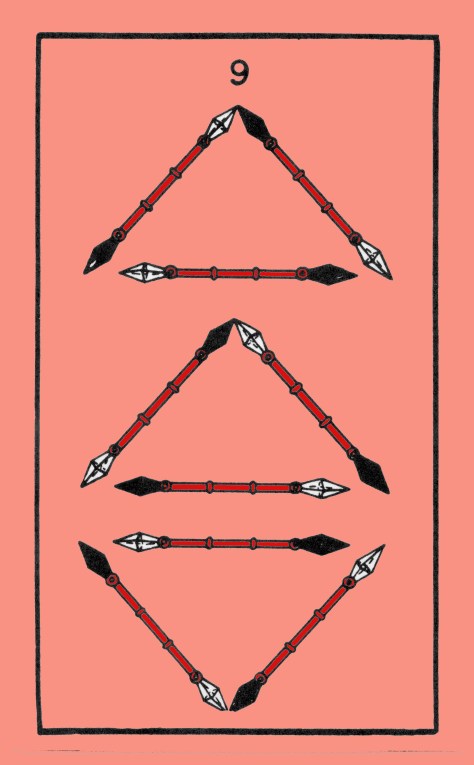
The Nine of Wands from the Builders of the Adytum (BOTA) tarot deck

Paul Foster Case (and Ann Davies)

In Tarot divination this Key combines the forces of the Moon, Mars and Jupiter and the zodiacal influences of Sagittarius and Aries, together with the Ninth house of the Higher Mind.
Well Dignified: well placed in a divination, this Key suggests originality, independence and daring. It has meanings that include strength in reserve; health after illness; success, but attended with some strife.
Ill-Dignified: danger; violence in foreign places or during long journeys; difficulties with relatives of the marriage partner; conflict with persons prominent in religion or law; obstinancy.
Keyword: Preparedness
(From the Oracle of Tarot course)

A. E. Waite

The figure leans upon his staff and has an expectant look, as if awaiting an enemy. Behind are eight other staves–erect, in orderly disposition, like a palisade. Divinatory Meanings: The card signifies strength in opposition. If attacked, the person will meet an onslaught boldly; and his build shews, that he may prove a formidable antagonist. With this main significance there are all its possible adjuncts–delay, suspension, adjournment. Reversed: Obstacles, adversity, calamity.
(From The Pictorial Key to the Tarot)
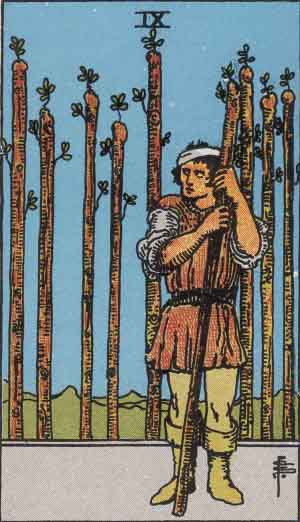
The Nine of Wands from the Rider Waite Smith Tarot

Aleister Crowley

The Nine of Wands is called Strength. It is ruled by the Moon and Yesod. In “The Vision and the Voice”, the eleventh Aethyr gives a classical account of the resolution of this antinomy of Change and Stability. The student should also consult the works of any of the better mathematical physicists.

Of all important doctrines concerning equilibrium, this is the easiest to understand, that change is stability; that stability is guaranteed by change; that if anything should stop changing for the fraction of a split second, it would go to pieces. It is the intense energy of the primal elements of Nature, call them electrons, atoms, anything you will, it makes no difference; change guarantees the order of Nature. This is why, in learning to ride a bicycle, one falls in an extremely awkward and ridiculous manner. Balance is made difficult by not going fast enough. So also, one cannot draw a straight line if one’s hand shakes. This card is a sort of elementary parable to illustrate the meaning of this aphorism: “Change is Stability.”

Here the Moon, the weakest of the planets, is in Sagittarius, the most elusive of the Signs; yet it dares call itself Strength. Defence, to be effective, must be mobile.

[…]

This card is referred to Yesod, the Foundation; this brings the Energy back into balance. The Nine represents always the fullest development of the Force in its relation with the Forces above it. The Nine may be considered as the best that can be obtained from the type involved, regarded from a practical and material standpoint.

This card is also governed by the Moon in Sagittarius; so here is a double influence of the Moon on the Tree of Life. Hence the aphorism “Change is Stability”.

The Wands have now become arrows. There are eight of them in the background, and in front of them one master arrow. This has the Moon for its point, and the Sun for the driving Force above it; for the path of Sagittarius on the Tree of Life joins the Sun and Moon. The flames in the card are tenfold, implying that the Energy is directed downwards.
(From The Book of Thoth)

The Nine of Wands from the Thoth tarot deck

Golden Dawn’s Book T

FOUR hands, as in the previous symbol, holding eight wands crossed four and four; but a fifth hand at the foot of the card holds another wand upright, which traverses the point of junction with the others: flames leap herefrom. Above and below are the symbols Moon and Sagittarius.

Tremendous and steady force that cannot be shaken. Herculean strength, yet sometimes scientifically applied. Great success, but with strife and energy.
Victory, preceded by apprehension and fear. Health good, and recovery not in doubt. Generous, questioning and curious; fond of external appearances: intractable, obstinate.

Yesod of HB:Y (Strength, power, health, recovery from sickness).
Herein rule the Angels HB:YRThAL and HB:ShAHYH.

Etteilla

Delay
Upright. This card, as far as the medicine of the spirit is concerned, means, in its natural position: Delayed, Dilated, Removed, Suspended, Stretched, Slowed, Slowly.
Reversed. Travail, Obstacle, Impediment, Contrariness, Disadvantage, Adversity, Penalty, Accident, Misfortune, Calamity.

MQS
Tarot Encyclopedia – The Seven of Cups

(Note: this is a collection of the meanings attributed to the cards by some occultists in the past centuries. It does not reflect my own study or opinion of the cards. It is only meant as a quick comparative reference as I develop my own take.)

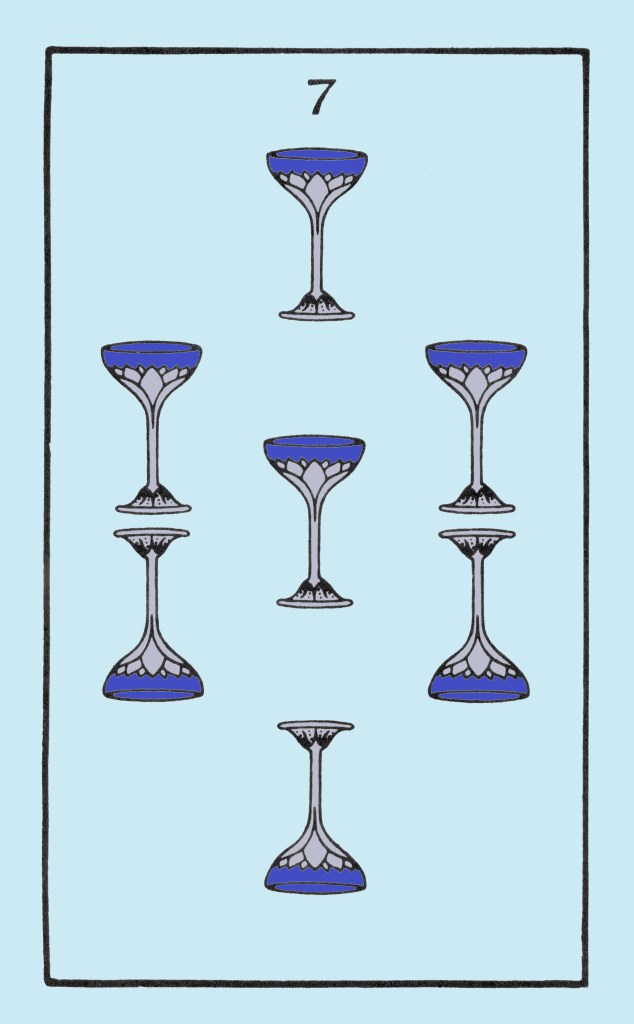
The Seven of Cups from the Builders of the Adytum (BOTA) tarot deck

Paul Foster Case (and Ann Davies)

The time period is the third decanate of Scorpio, November 11 to November 20, under the subrulership of the Moon.
Well-Dignified: possible victory, but the person to whom the card applies may be too indolent to take advantage of his opportunities for commanding circumstance. Success may be gained, but not followed up; necessity for choosing only the highest objectives.
lll-Dignified: illusionary success; lying and deceit; drunkenness; violence, even lust.
Keyword: Illusion
(From the Oracle of Tarot course)

A. E. Waite

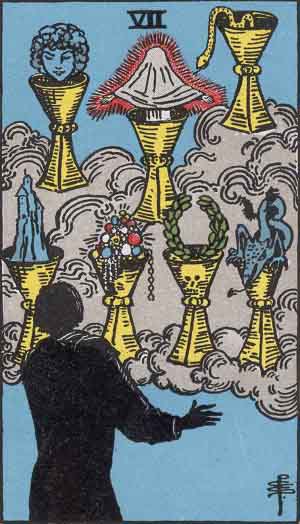
Strange chalices of vision, but the images are more especially those of the fantastic spirit. Divinatory Meanings: Fairy favours, images of reflection, sentiment, imagination, things seen in the glass of contemplation; some attainment in these degrees, but nothing permanent or substantial is suggested. Reversed: Desire, will, determination, project.
(From The Pictorial Key to the Tarot)

The Seven of Cups from the Rider Waite Smith Tarot Deck

Aleister Crowley

The Seven of Cups is called Debauch. This is one of the worst ideas that one can have; its mode is poison, its goal madness. It represents the delusion of Delirium Tremens and drug addiction; it represents the sinking into the mire of false pleasure. There is something almost suicidal in this card. It is particularly bad because there is nothing whatever to balance it-no strong planet to hold it up. Venus goes after Venus, and Earth is churned into the scorpion morass.

[…]

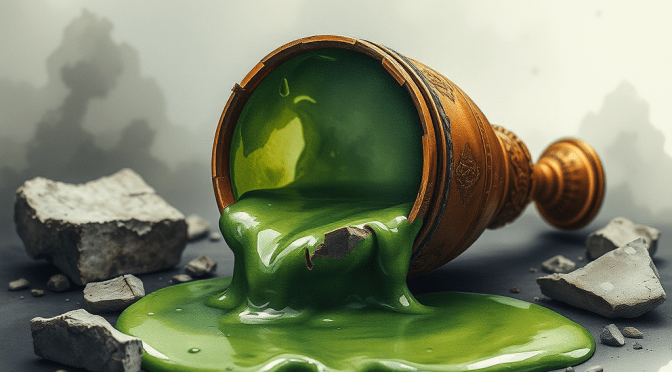
This card refers to the Seven, Netzach, in the suit of Water. Here recurs the invariable weakness arising from lack of balance; also, the card is governed by Venus in Scorpio. Her dignity is not good in this Sign; one is reminded that Venus is the planet of Copper, “external splendour and internal corruption”. The Lotuses have become poisonous, looking like tiger-lilies; and, instead of water, green slime issues from them and overflows, making the Sea a malarious morass. Venus redoubles the influence of the number Seven.

The cups are iridescent, carrying out the same idea. They are arranged as two descending triangles interlaced above the lowest cup, which is very much larger than the rest. This card is almost the “evil and averse” image of the Six; it is a wholesome reminder of the fatal ease with which a Sacrament may be profaned and prostituted.

Lose direct touch with Kether, the Highest; diverge never so little from the delicate balance of the Middle Pillar; at once the holiest mysteries of Nature become the obscene and shameful secrets of a guilty conscience.
(From The Book of Thoth)

The Seven of Cups from the Thoth Tarot

Golden Dawn’s Book T

THE seven cups are arranged as two descending triangles above a point: a hand, as usual, holds lotus stems which arise from the central lower cup. The hand is above this cup and below the middle one. With the exception of the central lower cup, each is overhung by a lotus flower, but no water falls from these into any of the cups, which are all quite empty. Above and below are the symbols of the Decanate Venus and Scorpio.

Possible victory, but neutralized by the supineness of the person: illusionary success, deception in the moment of apparent victory. Lying, error, promises unfulfilled. Drunkenness, wrath, vanity. Lust, fornication, violence against women, selfish dissipation, deception in love and friendship. Often success gained, but not followed up. Modified as usual by dignity.

Netzach of HB:H (Lying, promises unfulfilled; illusion, deception, error; slight success at outset, not retained).
Herein the Angels HB:MLHAL and HB:ChHVYH rule.

Etteilla

Thought
Upright. This card, as far as the medicine of the spirit is concerned, means, in its natural position: Thought, Soul, Spirit, Intelligence, Idea, Memory, Imagination, Understanding, Conception, Meditation, Contemplation, Reflection, Deliberation, Viewpoint, Opinion, Feeling.
Reversed. Plan, Design, Intention, Desire, Will, Resolution, Determination, Forethought.

MQS

Bolognese Tarot – Introduction to Combinations

The Tarocco Bolognese is famous in Italy for relying heavily on combinations of cards. Rather than each card being a full picture, the cards are like small tiles in a mosaic, and need to be interpreted as a whole. No individual card can tell us much of anything. Let’s take the most favorable card in the deck, the Angel. In itself a wonderful card of protection and solution. Yet, alone, the Angel merely says “protection” or “solution” or “friendship” or any other keyword. We still don’t know if this protection exists, is longed for, is missing, is crumbling, or what effects it will have.

In this, the Bolognese tarot is much closer to the Sibilla or Playing Cards or other traditional oracles than to how tarot is often read nowadays (but regular tarot did use to be read in a combinatory manner in the past, before the Waite deck became popular and people started focusing on illustrations).

Since each individual card doesn’t say much by itself, the spreads tend to rely on a larger number of cards. The smallest traditional spread done with the Bolognese tarot is the thirteen card spread, which I have already shown, and which I will cover again. This is a small tableau of three columns of four cards (or four rows of three cards) plus one at the end. In this small tableau, the cards are interpreted in their interaction with one another.

Often, therefore, it is necessary to be able to see the big picture when interpreting the Bolognese Tarot. Occasionally, all cards are important and need to be considered. At other times, one or two cards come up in the spread that we don’t know how to interpret and don’t make sense to us, and there is no point in banging our head against them, trying to fit them into the interpretation at all costs: we should be able to see where the answer to our question lies, where the cards that are clearly forming a message are clustering, and go from there.

Look at the spread as if it were a bunch of people in central square. Some are there to meet other people and discuss something important or go somewhere interesting together. Others are simply sitting there because their wife kicked them out so she can finish waxing the floor in peace, so they just sit alone. They don’t have much to add. They are just there. Or, if you prefer the image of the mosaic I used earlier, some tiles go together to show the cool angel warding off the horde of demons, while other tiles are just vaguely blue and form the sky in the background.

This sounds complicated but it isn’t necessarily, once we have developed an eye for which cards tend to go together. Don’t fixate on rigid 1+ 1 + 1 + 1 +1 = 5 kind of combinations. In cartomancy, 1 + 1 +1 + 1 +1 often equals a bunch of crap if you are not careful. Who says that it’s 1 + 1 +1 +1 +1, and not 1 + 1 on one hand and then 1 +1 +1 on the other? Or 1 + 1 + 1 + 1 and then one left over? Who says the cards add up, instead of detracting from each other? The Angel is good, but followed by the Hermit and the Tower it is diminished. Strength makes you strong, but Strength followed by the Moon? Not so much.

Look at the flow and apply logic to it. See how the small meanings of the cards cluster together to form one coherent bit of mosaic. That coherent bit of mosaic may be next to another bit that is coherent in itself, without the two going together: in one corner you may have the scene with the angel warding off the demons, but right next to it you could have God creating Adam and Eve. Mix them the wrong way and you’ll have the angel warding off God, while the demons create Adam and Eve. Not good on the angel’s resume.

Also, don’t fixate rigidly on methods like “the first card is the noun and the second is the adjective” that were popular some time ago in the Lenormand community. I don’t use Lenormand, don’t know if that’s how they work, but it certainly doesn’t help with the Bolognese tarot. Again, the big picture is essential. Once we have that down, we can carefully add the details.

Finally, go for concrete life. The cards can talk about many things, from the most mundane to the most deep, including spirituality, psychology and so on. Do keep in mind, though, that the card readers of yore didn’t ponder too many questions we (often deludedly) consider deep. Not because they were dumb (they weren’t) but because they had other priorities: they were too occupied seeing if they could put away enough food for the winter or if the doctor would be able to come in time from two towns over on his rickety buggy to see what was wrong with little Guido.

Ordinary life is our starting point. It is in it that more spiritual or introspective topics are nestled. Without real life, spirituality falls into the void, failing to manifest, and it therefore remains an abstract collection of feel-good statements. But just because we start from real life doesn’t mean the tarot can’t talk about it in sometimes strikingly deep or metaphorical ways.

The tarot is highly metaphorical. Never forget that the old card readers had entire poems, folk songs, stories and even Bible books committed to memory. They were often capable of seing meaning in things we consider bland. Again, they were practical, not dumb. Life is highly metaphorical and symbolic if you know how to look at it, and the tarot is a good lens. Of course Truth (Queen of Coins) and Love can mean a true love, but what does it mean that your job is true? Think about it.

MQS

Tarot Encyclopedia – The Six of Cups

(Note: this is a collection of the meanings attributed to the cards by some occultists in the past centuries. It does not reflect my own study or opinion of the cards. It is only meant as a quick comparative reference as I develop my own take.)

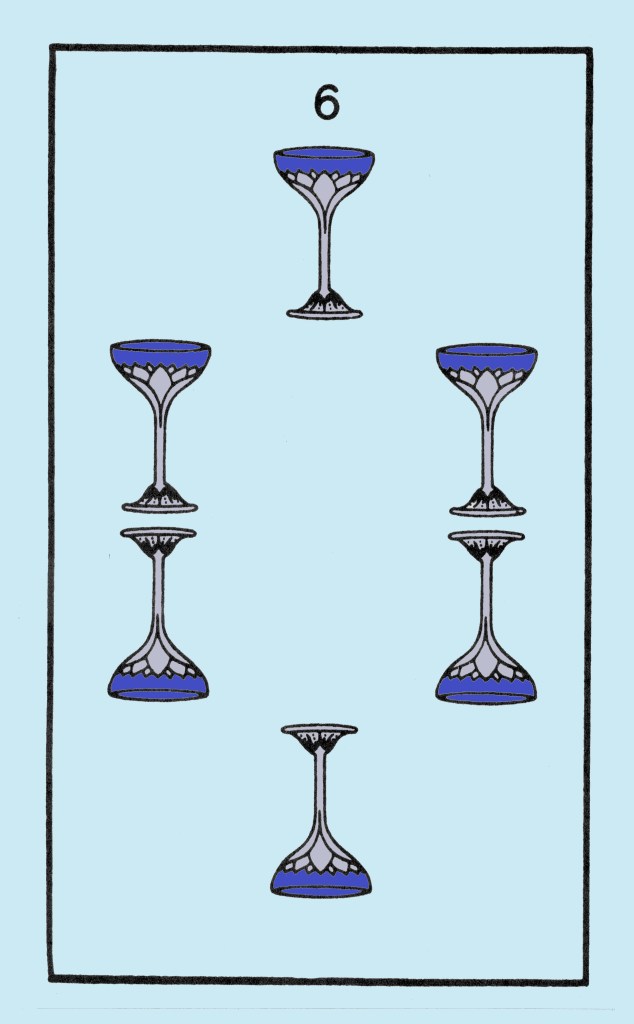
The Six of Cups from the Builders of the Adytum (BOTA) tarot deck

Paul Foster Case (and Ann Davies)

Time period is the second decanate of Scorpio, from November 1 to November 10 under the combined influences of Jupiter and Neptune.
Well-Dignified: the meanings in specific divinations are based on the influence of Neptune and Jupiter in Scorpio combined with its natural 8th house; deep emotions, ardor, enthusiasm, generosity; money through marriage or business partner, or by inheritance; the beginning of steady gain in business or pleasure, but beginning only; peculiar circumstances.
lll-Dignified: deceit in reference to partner’s money; loss of inheritance through some sort of swindle; danger of death on water, or through poisons or anesthetics; some reversal of fortune.
Keyword: Betterment
(From the Oracle of Tarot course)

A. E. Waite

Children in an old garden, their cups filled with flowers. Divinatory Meanings: A card of the past and of memories, looking back, as–for example–on childhood; happiness, enjoyment, but coming rather from the past; things that have vanished. Another reading reverses this, giving new relations, new knowledge, new environment, and then the children are disporting in an unfamiliar precinct. Reversed: The future, renewal, that which will come to pass presently.
(From The Pictorial Key to the Tarot)

Aleister Crowley

The Six of Cups is called Pleasure. This pleasure is a kind of pleasure which is completely harmonized. The zodiacal sign governing the card being Scorpio, pleasure is here rooted in its most convenient soil. This is pre-eminently a fertile card; it is one of the best in the pack.

[…]

This card shows the influence of the number Six, Tiphareth, in the suit of Water. This influence is fortified by that of the Sun, who also represents the Six. The whole image is that of the influence of the Sun on Water. His fierce, but balanced power operates that type of putrefaction-he is in the Sign of Scorpio-which is the basis of all fertility, all life.

The lotus stems are grouped in an elaborate dancing movement. From their blossoms water gushes into the Cups, but they are not yet full to overflowing, as they are in the corresponding card below; the Nine.

Pleasure, in the title of this card, must be understood in its highest sense: it implies well-being, harmony of natural forces without effort or strain, ease, satisfaction. Foreign to the idea of the card is the gratification of natural or artificial desires. Yet it does represent emphatically the fulfilment of the sexual Will, as shown by the ruling Sephira, planet, element, and sign.

In the Yi King, Sol in Scorpio is represented by the 20th Hexagram, Kwan, which is also “Big Earth”, being the Earth Trigram with doubled lines. Kwan means “manifesting”, but also “contemplating”. The Kwan refers directly to an High Priest, ceremonially purified, about to present his offerings. The idea of Pleasure-Putrefaction as a Sacrament is therefore implicit in this Hexagram as in this card; while the comments on the separate lines by the Duke of Chau indicate the analytical value of this Eucharist. It is one of the master-keys to the Gate of Initiation. To realize and to enjoy this fully it is necessary to know, to understand, and to experience, the Secret of the Ninth Degree of the O.T.O.
(From The Book of Thoth)

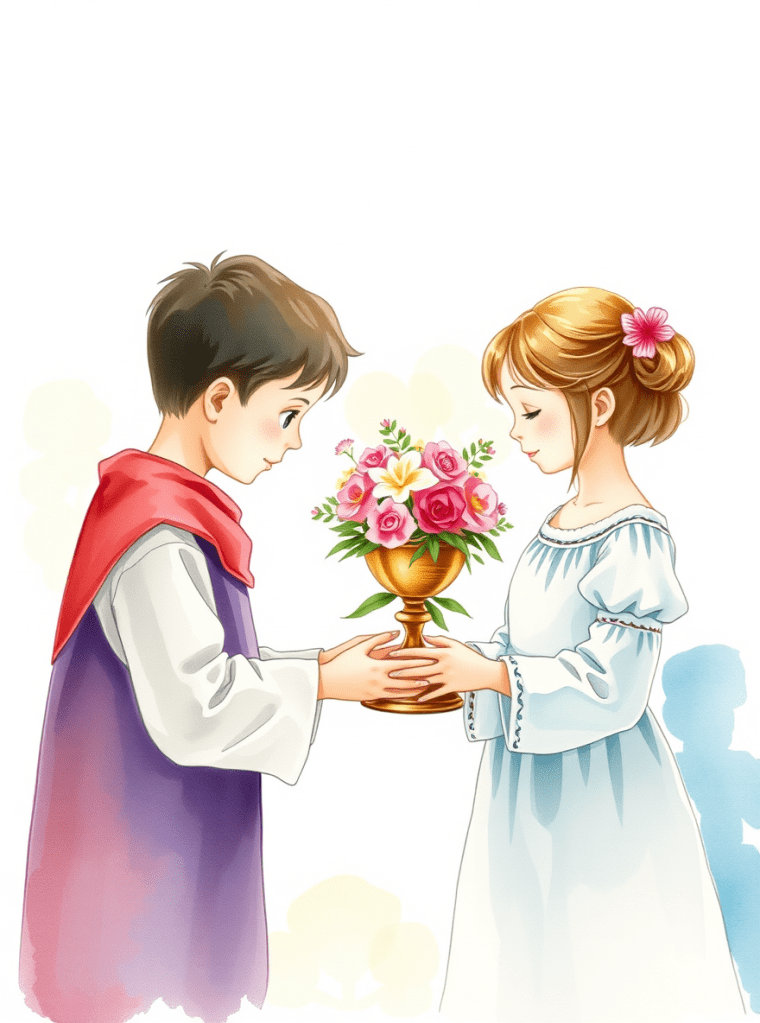
A fairytale-like AI-generated illustration for the Six of Cups

Golden Dawn’s Book T

AN Angelic Hand, as before, holds a group of stems of water-lilies or lotuses, from which six flowers bend, one over each cup. From these flowers a white glistening water flows into the cups as from a fountain, but they are not yet full.
Above and below are Sun and Scorpio referring to the Decan.

Commencement of steady increase, gain and pleasure; but commencement only.
Also affront, detection, knowledge, and in some instances contention and strife arising from unwarranted self-assertion and vanity. Sometimes thankless and presumptuous; sometimes amiable and patient. According to dignity as usual.
Tiphareth of HB:H (Beginning of wish, happiness, success, or enjoyment).
Therein rule HB:NLKAL and HB:YYYAL

Etteilla

Past.
Upright. This card, as far as the medicine of the spirit is concerned, means, in its natural position: the Past, Formerly, Withered, Formerly. – Formerly, Anteriorly, Of Yore, Once. – Old age, Decrepitude, Antiquity.
Reversed. Upcoming, Future. – What comes next, Afterwards, Posteriorly, Further. – Regeneration, Resurrection. – Reproduction, Renewal, Reiteration.

MQS

Tarot Encyclopedia – The Three of Swords

(Note: this is a collection of the meanings attributed to the cards by some occultists in the past centuries. It does not reflect my own study or opinion of the cards. It is only meant as a quick comparative reference as I develop my own take.)

The Three of Swords from the Builders of the Adytum (BOTA) tarot deck

Paul Foster Case (and Ann Davies)

The time period is the second decanate of Libra, under the combined rulership of Saturn and Uranus, October 3 to October 12. Because Libra is involved, remember that the qualities of the Seventh house are prominent.
Well-Dignified: this is nevertheless a Key depicting sorrow, disappointment and tears, but it can be the beginning of deep understanding as to the basis and cause of our problems; disruption of friendship; interruption of cherished projects; quarrels; occasionally the position in the layout may indicate platonic friendships; in money matters this card is almost always a symbol of loss, but indicates that whatever money matters are under consideration have been fair and honest, so that no blame attaches to anyone for the loss.
Ill-Dignified: slander; selfishness and dissipation; deceit with respect to promises; loss in legal affairs.
Keyword: Sorrow
(From the Oracle of Tarot course)

A. E. Waite

Three swords piercing a heart; cloud and rain behind. Divinatory Meanings: Removal, absence, delay, division, rupture, dispersion, and all that the design signifies naturally, being too simple and obvious to call for specific enumeration. Reversed: Mental alienation, error, loss, distraction, disorder, confusion.
(From The Pictorial Key to the Tarot)

Aleister Crowley

The idea of division, of mutability, the idea of the airy quality of things, manifests itself in the Three of Swords, the Lord of Sorrow. Here one is reminded of the darkness of Binah, of the mourning of Isis; but this is not any vulgar sorrow dependent upon any individual disappointment or discontent. It is Weltschmerz, the universal sorrow; it is the quality of melancholy.

[…]

Binah, the Great Mother, here rules the realm of Air. This fact involves an extremely difficult doctrine which must be studied at length in The Vision and the Voice: Aethyr 14.
Binah is here not the beneficent Mother completing the Trinity with Kether and Chokmah. She represents the darkness of the Great Sea.
This is accentuated by the Celestial Lordship of Saturn in Libra.
This card is dark and heavy; it is, so to speak, the womb of Chaos. There is an intense lurking passion to create, but its children are monsters. This may mean the supreme transcendence of the natural order. Secrecy is here, and Perversion.
The symbol represents the great Sword of the Magician, point uppermost; it cuts the junction of two short curved swords. The impact has destroyed the rose. In the background, storm broods under implacable night.
(From The Book of Thoth)

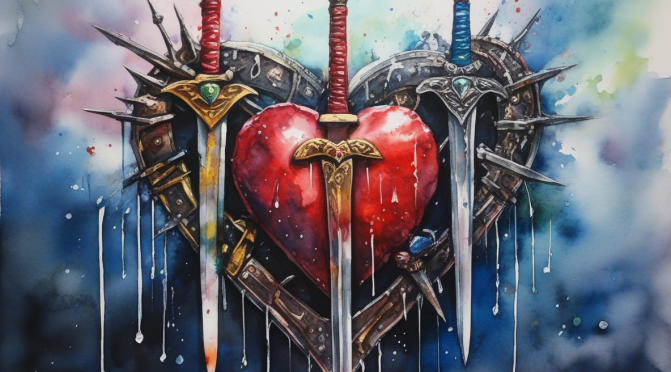
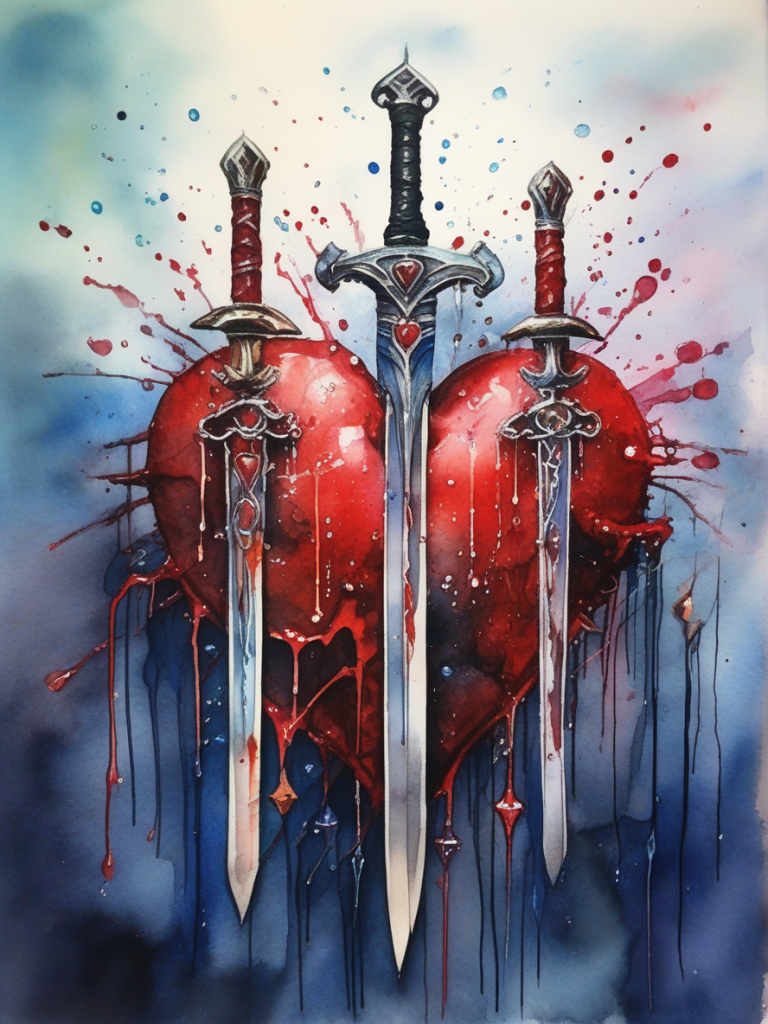
A gruesome AI-generated illustration for the Three of Swords

Golden Dawn’s Book T

THREE White Radiating Angelic Hands, issuing from clouds, and holding three swords upright (as though the central sword had struck apart the two others, which were crossed in the preceding symbol): the central sword cuts asunder the rose of five petals, which in the previous symbol grew at the junction of the swords; its petals are falling, and no white rays issue from it. Above and below the central sword are the symbols of Saturn and Libra.

Disruption, interruption, separation, quarrelling; sowing of discord and strife, mischief-making, sorrow and tears; yet mirth in Platonic pleasures; singing, faithfulness in promises, honesty in money transactions, selfish and dissipated, yet sometimes generous: deceitful in words and repetitions; the whole according to dignity.
Binah of HB:V (Unhappiness, sorrow, and tears).
Herein rule the Great Angels HB:HRYAL and HB:HQMYH as Lords of the Decan.

Etteilla

Removal
Upright. This card, as far as the medicine of the spirit is concerned, means, in its natural position: estrangement, Departure, Absence, Discarding, Dispersion, Remoteness, Delay. – Contempt, Repugnance, Aversion, Hatred, Disgust, Horror. – Incompatibility, Contrariness, Opposition, Unsociability, Misanthropy, Incivility. – Separation, Division, Breaking, Antipathy, Section, Cutting off.
Reversed. Misdirection, Dementia, Vanity, Alienation of spirit, Distraction, Insane conduct. – Error, Miscalculation, Loss, Deviation, Discard, Dispersion.

MQS

Tarot Encyclopedia – The Page of Cups

The Page of Cups in the Builders of the Adytum (BOTA) tarot deck

Paul Foster Case (and Ann Davies)

In divination this Key suggests the warmth, radiance and the generous productivity of summer. Thus the Page of Cups indicates a radiant, generous, youthful personality of either sex. The time period is from the first decanate of Cancer, June 21, through the last decanate of Virgo, September 22 – the entire summer season.
Well Dignified: the character is sweet, poetical, gentle and kind; fond of home and all that it stands for; imaginative, dreamy, yet with a good deal of latent courage; friendly to the Querent and will further Querent’s hopes and wishes.
lll Dignified: may still show or profess friendship, or even wish to be of help, but the character is unstable, too indolent to be of real service and probably prone to promise far more than he can perform.
(From the Oracle of Tarot course)

A. E. Waite

A fair, pleasing, somewhat effeminate page, of studious and intent aspect, contemplates a fish rising from a cup to look at him. It is the pictures of the mind taking form. Divinatory Meanings: Fair young man, one impelled to render service and with whom the Querent will be connected; a studious youth; news, message; application, reflection, meditation; also these things directed to business. Reversed: Taste, inclination, attachment, seduction, deception, artifice.
(From The Pictorial Key to the Tarot)

Aleister Crowley

The Princess of Cups represents the earthy part of Water; in particular, the faculty of crystallization. She represents the power of Water to give substance to idea, to support life, and to form the basis of chemical combination. She is represented as a dancing figure, robed in a flowing garment on whose edges crystals are seen to form.

For her crest she wears a swan with open wings. The symbolism of this swan reminds one of the swan in oriental philosophy which is the word AUM or AUMGN, which is the symbol of the entire process of creation. [See, for a full analysis and explanation of this Word, Magick, pp. 45.]

She bears a covered cup from which issues a tortoise. This is again the tortoise which in Hindu philosophy supports the elephant on whose back is the Universe. She is dancing upon a foaming sea in which disports himself a dolphin, the royal fish, which symbolizes the power of Creation.

The character of the Princess is infinitely gracious. All sweetness, all voluptuousness, gentleness, kindness and tenderness are in her character. She lives in the world of Romance, in the perpetual dream of rapture. On a superficial examination she might be thought selfish and indolent, but this is a quite false impression; silently and effortlessly she goes about her work.

In the Yi King, the earthy part of Water is represented by the 41st Hexagram, Sun. This means diminution, the dissolution of all solidity. People described by this card are very dependent on others, but at the same time helpful to them. Rarely, at the best, are they of individual importance. As helpmeets, they are unsurpassed.
(From the Book of Thoth)

A cutesy AI generated illustration for the Page of Cups

Golden Dawn’s Book T

A BEAUTIFUL Amazon-like figure, softer in nature than the Princess of Wands. Her attire is similar. She stands on a sea with foaming spray. Away to her right a Dolphin. She wears as a crest a swan with opening wings. She bears in one hand a lotus, and in the other an open cup from which a turtle issues. Her mantle is lined with swans-down, and is of thin floating material.
Sweetness, poetry, gentleness and kindness. Imaginative, dreamy, at times indolent, yet courageous if roused.
When ill dignified she is selfish and luxurious.
She rules a quadrant of the heavens around Kether.
Earth of Water

Etteilla

Blond boy
Upright. This card, as far as the medicine of the spirit is concerned, means, in its natural position: Blond Boy, Scholar. – Study, Application, Work, Reflection, Observation, Consideration, Meditation, Contemplation, Occupation. – Craft, Profession, Employment.
Reversed. Tendency, Inclination, Inclination, Attraction, Taste, Sympathy, Passion, Affection, Attachment, Friendship. – Heart, Want, Desire, Attraction, Promise, Seduction, Invitation, Attraction. – Flattery, Moine, Ruffianry, Flattery, Praise, Praise. – In decline, threatening ruin, tending to the end.

MQS

Tarot Encyclopedia – The Knight of Swords

(Note: this is a collection of the meanings attributed to the cards by some occultists in the past centuries. It does not reflect my own study or opinion of the cards. It is only meant as a quick comparative reference as I develop my own take.)

The Knight of Swords from the Builders of the Adytum (BOTA) tarot deck

Paul Foster Case (and Ann Davies)

The time period is from the beginning of the third decanate of Taurus to the end of the second decanate of Gemini, May 11 to June 10. Meanings: youngish man; some talent for governing; materialistic, with some artistic appreciation; active, clever, skillful in management.
Well-Dignified: favorable to querent and his enterprises
Ill-Dignified: Inimical, domineering, overvalues small things, crafty.
Dark hair and eyes.
(From the Oracle of Tarot course)

A. E. Waite

He is riding in full course, as if scattering his enemies. In the design he is really a prototypical hero of romantic chivalry. He might almost be Galahad, whose sword is swift and sure because he is clean of heart. Divinatory Meanings: Skill, bravery, capacity, defence, address, enmity, wrath, war, destruction, opposition, resistance, ruin. There is therefore a sense in which the card signifies death, but it carries this meaning only in its proximity to other cards of fatality. Reversed: Imprudence, incapacity, extravagance.
(From The Pictorial Key to the Tarot)

Aleister Crowley

(Note: Crowley and the Golden Dawn made a mess with the kings and knights)
This card represents the airy part of Air. With its particular interpretation, it is intellectual, it is a picture of the Mind as such. He rules from the 21st degree of Capricornus to the 20th degree of Aquarius.

The figure of this Prince is clothed with closely woven armour adorned with definite device, and the chariot which bears him suggests (even more closely) geometrical ideas. This chariot is drawn by winged children, looking and leaping irresponsibly in any direction that takes their fancy; they are not reined, but perfectly Capricious. The chariot consequently is easy enough to move, but quite unable to progress in any definite direction except by accident. This is a perfect picture of the Mind.

On the head of this Prince is, nevertheless, a child’s head radiant, for there is a secret crown in the nature of this card; if concentrated, it is exactly Tiphareth.

The operation of his logical mental processes have reduced the Air, which is his element, to many diverse geometrical patterns, but in these there is no real plan; they are demonstrations of the powers of the Mind without definite purpose. In his right hand is a lifted sword wherewith to create, but in his left hand a sickle, so that what he creates he instantly destroys.

A person thus symbolized is purely intellectual. He is full of ideas and designs which tumble over each other. He is a mass of fine ideals unrelated to practical effort. He has all the apparatus of Thought in the highest degree, intensely clever, admirably rational, but unstable of purpose, and in reality indifferent even to his own ideas, as knowing that any one of them is just as good as any other. He reduces everything to unreality by removing its substance and transmuting it to an ideal world of ratiocination which is purely formal and out of relation to any facts, even those upon which it is based.

In the Yi King, the airy part of Air is represented by the 57th hexagram, Sun. This is one of the most difficult figures in the book, on account of its ambivalence: it means both flexibility and penetration.

Immensely powerful because of its complete freedom from settled principles, capable of maintaining and putting forward any conceivable argument, insusceptible of regret or remorse, glib to “quote Scripture” aptly and cunningly to support any thesis soever, indifferent to the fate of a contrary argument advanced two minutes earlier, impossible to defeat because any position is as good as any other, ready to enter into combination with the nearest element available, these elusive and elastic people are of value only when firmly mastered by creative will fortified by an intelligence superior to their own. In practice, this is rarely possible: there is no purchase to be had upon them, not even by pandering to their appetites. These may nevertheless be stormy, even uncontrollable. Faddists, devotees of drink, drugs, humanitarianism, music or religion, are often in this class; but when this is the case, there is still no stability. They wander from one cult or one vice to another, always brilliantly supporting with the fanaticism of a fixed conviction what is actually no more than the whim of the moment.

It is easy to be deceived by such people; for the manifestation itself has enormous potency: it is as if an imbecile offered one the dialogues of Plato. They may in this way acquire a great reputation both for depth and breadth of mind.
(From The Book of Thoth)

A futuristic AI generated illustration for the Knight of Swords

Golden Dawn’s Book T

A WINGED King with Winged Crown, seated in a chariot drawn by Arch Fays, represented as winged youths very slightly dressed, with butterfly wings: heads encircled by a fillet with a pentagram thereon: and holding wands surmounted by pentagrams, the same butterfly wings on their feet and fillets. General equipment as the King of Wands: but he bears as a crest a winged angelic head with a pentagram on the brows. Beneath the chariot are grey nimbus clouds. His hair long and waving in serpentine whirls, and whorl figures compose the scales of his armour. A drawn sword in one hand; a sickle in the other. With the sword he rules, with the sickle he slays.
Full of ideas and thoughts and designs, distrustful, suspicious, firm in friendship and enmity; careful, observant, slow, over-cautious, symbolizes GR:Alpha and GR:Omega; he slays as fast as he creates.
If ill dignified: harsh, malicious, plotting; obstinate, yet hesitating; unreliable.
Rules from 20 Degree Capricorn to 20 Degree Aquarius.
Air of Air

Etteilla

Military Man
Upright: This card, as far as the medicine of the spirit is concerned, means, in its natural position: Military Man, Man of Sword, Man of Arms, Fencing Master, Swordsman. – Soldier of any corps and weapon, Enemy Fighter. – Dispute, War, Combat, Battle, Duel. – Attack, Defense, Opposition, Resistance, Destruction, Ruin, Overthrow. – Enmity, Hatred, Anger, Resentment. – Courage, Valor, Bravery. – Satellite [= Attendant], Mercenary.
Reversed: Inexperience, Inertia, Stupidity, Bestiality, Stupidity, Imprudence, Impertinence, Extravagance, Ridiculousness, Baggianity. – Scrounging, Fraud, Bricolage, Industry.

MQS